Does Rockwool Work for Soundproofing? What Its Own Walls Show
The wall is open, the Rockwool batts are stacked by the studs, and one question stops you before the first cut: does Rockwool work for soundproofing?
It helps, but only as one part of the wall, because Rockwool’s own listings put the same 3 inches of wool in a wall rated STC 38 and in one rated STC 51.
This guide uses Rockwool’s wall catalog and spec sheet, Owens Corning’s fiberglass product sheet, HUD’s Noise Guidebook and GSA’s office acoustics guide.
You’ll see what the wool does to sound, what it adds to a wall, how it compares with fiberglass and how to install it so it earns its place.
Start with the short answer, because the difference between absorbing sound and blocking it explains everything else.
Does Rockwool Work for Soundproofing?
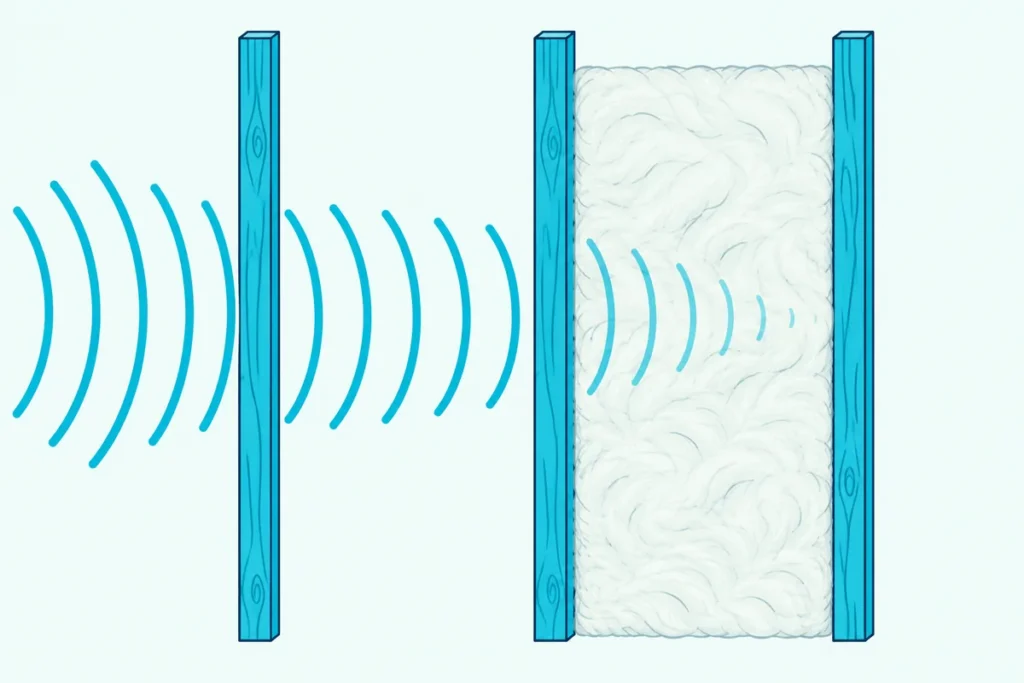
That depends on which job you mean, because Rockwool soaks up sound well and blocks it only as part of a wall.
HUD says a blanket of mineral wool, rock wool or fiberglass in a wall’s air space can cut noise by as much as 10 dB, mainly in light construction. Owens Corning’s fiberglass product sheet gives a similar range, 4 to 10 dB depending on how the wall is built.
Rockwool’s own listings show why the range is wide: the same 3 inches of Safe’n’Sound sits in a 2×4 wall rated STC 38 and in the same wall with resilient channels rated STC 51. GSA’s partition details put 3-inch batts in every stud cavity, so wool is a standard ingredient and never the whole recipe.
Rockwool also notes on its spec sheet that it doesn’t warrant the performance of any installation, because it has no control over the design and workmanship.
What Does Rockwool Do to Sound?
That difference starts with absorbing and blocking, which are separate jobs. GSA defines the noise reduction coefficient, NRC, as a single-number rating of how much sound a material absorbs, and Rockwool lists 1.10 for 3 inches of Safe’n’Sound and 1.25 for 6 inches:

| Frequency | 3 in Safe’n’Sound | 6 in Safe’n’Sound |
|---|---|---|
| 125 Hz | 0.44 | 1.38 |
| 250 Hz | 0.98 | 1.29 |
| 500 Hz | 1.22 | 1.30 |
| 1000 Hz | 1.14 | 1.22 |
| 2000 Hz | 1.09 | 1.15 |
| 4000 Hz | 1.07 | 1.08 |
| NRC | 1.10 | 1.25 |
At 125 Hz the 3-inch batt absorbs 0.44 and the 6-inch 1.38, so thicker wool reaches lower sound, which matters for bass inside a room. Our guide to Rockwool as acoustic treatment covers that room-side job.
Blocking is what STC measures, and HUD’s list of what raises a wall’s rating starts with mass and an air space, then wide stud spacing, staggered studs and resilient attachments. It lists wool blankets separately, as an add-on that works mainly in lightweight construction, and the weights show why.
Rockwool lists Safe’n’Sound at a nominal 2.5 pounds per cubic foot, so 3 inches works out at about 0.6 pounds per square foot. USG lists a 5/8 inch Firecode X panel at 2.2 pounds per square foot, so one layer of drywall weighs about three and a half times as much.
That’s arithmetic from a nominal density, and Rockwool notes that density varies with thickness.
Get Studio Tips Weekly
Join 5,000+ creators getting acoustic treatment advice every week.
No spam. Unsubscribe anytime.How Much Does Rockwool Add to a Wall?
Those numbers show up in the listed walls, and the table puts wood-stud assemblies from Rockwool and Owens Corning side by side:
| Wall as the maker lists it | STC | Source |
|---|---|---|
| 2×4 at 16 in, 1/2 or 5/8 in gypsum, 3 in Safe’n’Sound | 38 | Rockwool IWS-02 and IWS-03 |
| 2×4 at 16 in, 1/2 in Type X gypsum, QuietZone fiberglass batts | 39 | Owens Corning |
| 2×4 at 16 in, 1/2 in gypsum, 3.5 in Comfortbatt | 40 | Rockwool IWS-05 |
| 2×6 at 24 in, 5/8 in gypsum, 5.5 in AFB | 45 | Rockwool IWS-06 |
| 2×6 at 24 in, two 5/8 in Type X layers, 3 in Safe’n’Sound | 48 | Rockwool IWS-17 |
| 2×4 staggered studs, 5/8 in Type X, 3 in wool in each row | 50 | Rockwool IWS-19 |
| 2×4 at 16 in, 5/8 in gypsum, 3 in Safe’n’Sound, RC Deluxe channels at 24 in | 51 | Rockwool IWS-07 |
| Double 2×4 stud wall with a 1 in air gap, 1/2 in gypsum, 3.5 in Comfortbatt per row | 52 | Rockwool IWS-11 |
| Double 2×4 stud wall with a 1 in air gap, 5/8 in Type X, 3 in Safe’n’Sound per row | 56 | Rockwool IWS-12 |
| 2×6 QuietZone acoustic studs at 24 in, two 5/8 in Type X layers each side, 5.5 in batts | 63 | Owens Corning |
| 2×4 staggered studs on 2×6 plates, two Type X layers, channels, wool in each row | 66 | Rockwool IWS-26 |
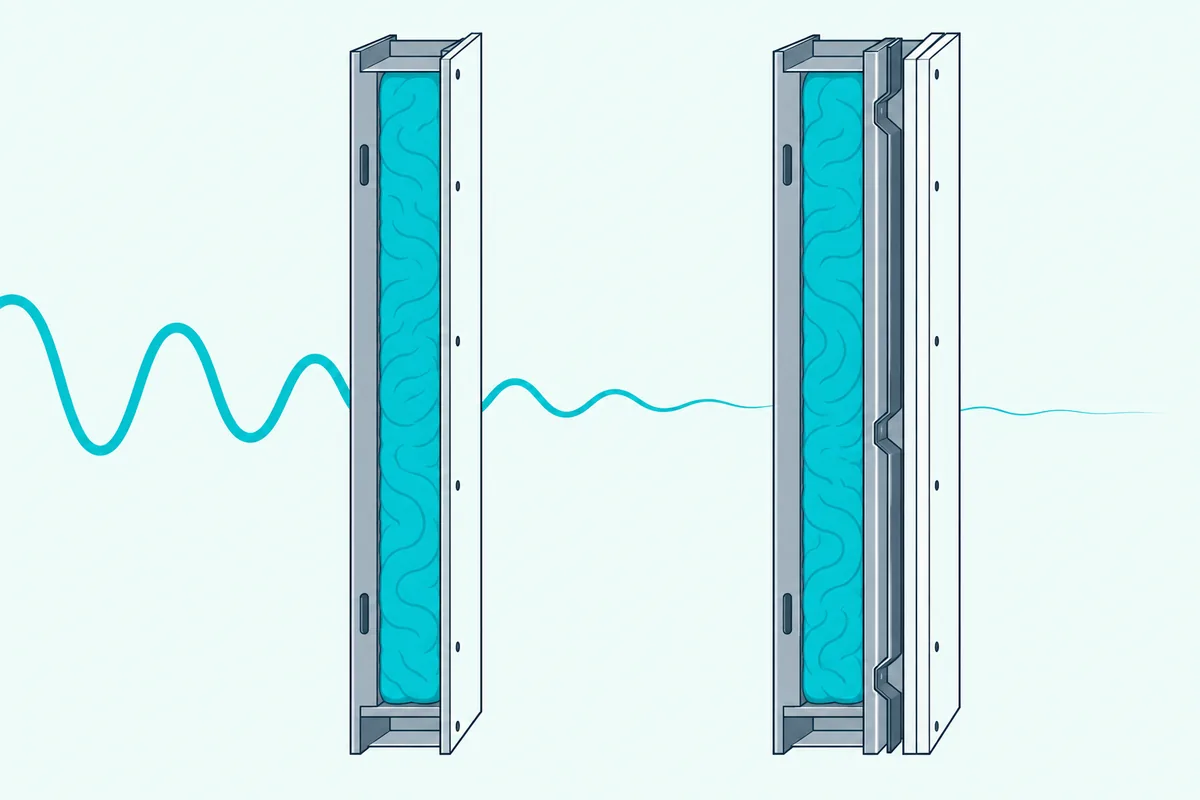
Read down the table and the wool stays similar, 3 to 5.5 inches, while the rating climbs from 38 to 66, so the layers, channels and framing are doing most of the work.
Wool in each row of a double stud wall shows the same thing: Rockwool lists those walls at STC 52 and 56, and HUD says an air space makes a cavity wall a more effective sound insulator than a single wall of equal weight.
HUD’s figures tell the same story: its staggered stud wall rates STC 39 against 35 for a common stud wall, and 43 with an absorbent blanket added, which puts the blanket’s share at 4 points there.
Is Rockwool Better Than Fiberglass for Soundproofing?
That comparison is closer than it looks, because the two makers’ own listings land within a point of each other. Rockwool lists a basic 2×4 wall with 3 inches of Safe’n’Sound at STC 38, and Owens Corning’s 2007 product sheet lists a similar 2×4 wall with its QuietZone fiberglass batts at STC 39.
HUD groups mineral wool, rock wool and fiberglass together as sound-absorbing blanket materials, so the wool type isn’t what decides the rating. The same holds for insulation in general: in NRC’s and Owens Corning’s paired tests, how effective soundproof insulation is depends on the framing far more than on the fill.
Where they differ is in fire and water. Rockwool lists Safe’n’Sound as noncombustible, with a flame spread index of 0 and a smoke developed index of 0, while Owens Corning says its unfaced batts are considered noncombustible by model codes and that kraft facing will burn.
Rockwool says its Comfortbatt stone wool doesn’t rot or promote mildew, fungi or mold, and Owens Corning says its glass fibers don’t absorb water but that mold can grow on contaminated wet insulation. Either way, keep batts dry, and choose on fit, handling and fire requirements and not on a promise of a quieter room.
Which Rockwool Product Should You Use?
That depends on the wall, and Rockwool’s catalog describes six products, of which these four come up for sound:
- Safe’n’Sound. A stone wool batt for interior partitions in wood and steel frame residential construction, sold in 3 and 6 inch thicknesses and made to friction fit in walls, ceilings and floors.
- AFB. A batt for commercial interior partitions in thicknesses from 1 to 6 inches, which Rockwool says is designed to reduce sound transmission when installed in a wall with gypsum boards and resilient channels.
- Comfortbatt. A semi-rigid thermal batt for exterior wood and steel studs with a flexible edge that helps prevent over-compression, and Rockwool lists noise reduction among its benefits too.
- ROXUL Safe 45. A semi-rigid board for fire-blocking in the concealed spaces of multi-unit residential buildings, which Rockwool says makes a high-density party wall system with its batts.
Comfortbatt and Safe’n’Sound are both stone wool, and the catalog’s split is by job: Comfortbatt is the thermal batt for exterior stud walls, with a high R-value per inch, and Safe’n’Sound is the fire and soundproofing batt for interior partitions.
For a home partition, Safe’n’Sound is the one made for interior residential walls, and one of the catalog’s STC 40 wood-stud walls uses Comfortbatt, so check which product the listed wall you’re copying used.
What About Mineral Wool and Roxul?
That is the same family of material: HUD lists mineral wool and rock wool together, Rockwool calls Safe’n’Sound a stone wool batt, and its catalog still lists a product under the ROXUL name. Fiberglass is a different material, which is why the comparison above matters.
How Does Rockwool Compare With Spray Foam?
That comparison favors the wool on absorption. BASF’s tech tip lists 3.5 inches of its open-cell spray foam at an NRC of 0.65 and 2 inches of closed-cell foam at 0.10, against Rockwool’s 1.10 for 3 inches of Safe’n’Sound.
On walls, BASF lists a 2×4 partition with 5/8 inch Type X gypsum on each side and 3.5 inches of open-cell foam at STC 34, and a 2×4 exterior wall with OSB and gypsum at STC 33. Rockwool lists a 2×4 wall with 5/8 inch gypsum and 3 inches of Safe’n’Sound at STC 38, though the walls differ in more than the insulation, so treat the gap as a hint and not a verdict.
BASF argues that foam stops airborne noise because it seals air leaks, which is the same sealing point GSA and HUD make about caulking and gaps. Our guide to what spray foam adds to a wall covers that side in more detail.
How Do You Install Rockwool for Soundproofing?
That comes down to fit and sealing, which Rockwool and Owens Corning both spell out. Rockwool sizes Safe’n’Sound batts for wood studs at 16 and 24 inches on center, 15.25 and 23 inches wide, so they friction fit, and Owens Corning says its batts must fit snugly and fill the cavity completely.
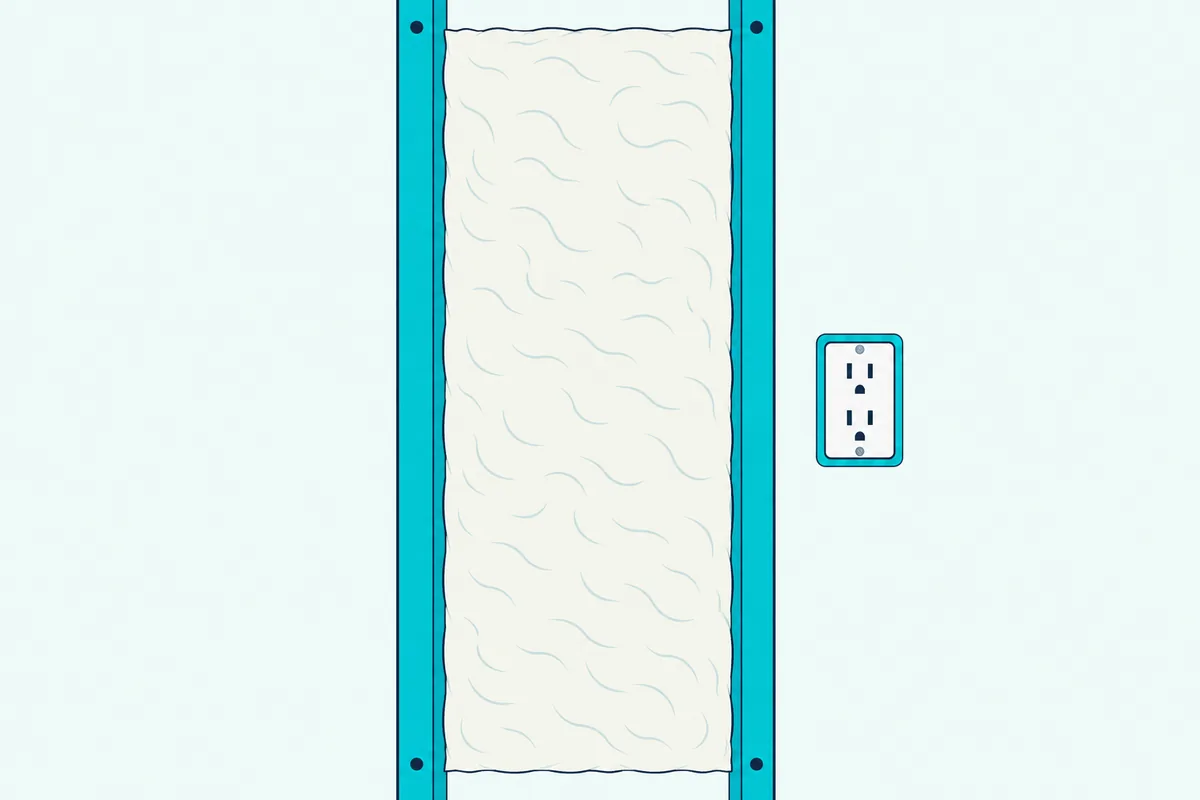
Owens Corning also says to keep batts dry, to keep light switches and outlets from sitting back to back and to seal around boxes airtight.
It adds that plumbing fixtures shouldn’t sit back to back either, that openings in walls should be caulked and that ducts can easily carry sound, so they need thought too. GSA says the same thing in its own terms, that caulking a wall at the top and bottom and staggering electrical connections and drywall seams can make a big difference.
Then add what the wool can’t. Rockwool says AFB works with gypsum boards and resilient channels, GSA’s partition details climb from STC 40 with one 5/8 inch layer on each side to 45 with two, and HUD says resilient layers can raise a wall’s rating by 2 to 5 dB.
Rockwool’s spec sheet carries no handling instructions, so follow the package for those.
Our guide to drywall layers over wool covers adding those layers to a finished wall.
Does Rockwool Work in Ceilings, Floors and Sheds?
Those cavities work the same way, and Rockwool’s spec sheet lists Safe’n’Sound for walls, ceilings and floors, with batts sized for I-joists at 16 and 19.2 inches as well as studs.
Floors need a caution, because Rockwool’s wall catalog lists STC and OITC and no impact ratings, so this guide has no IIC figure for Rockwool.
For IIC figures from tested joist floors with fiberglass batts, our pick of the best soundproofing insulation between floors sets them beside Safe’n’Sound’s sizes for joists.
BASF’s tech tip lists IIC 50 and 55 for two floor assemblies with open-cell foam, a resilient channel and an acoustical pad or mat, which suggests the rest of the floor decides impact noise.
In a shed, Tuff Shed says the common first step is a vapor barrier between the siding and the insulation, which our guide to wool in a shed wall works through with HUD’s numbers. In an office, GSA’s partitions use the same 3-inch batts, and our guide to home office wall targets shows what STC each build reaches.
What Should You Add on Top of the Wool?
That depends on the target, and the sources give a ladder to climb. Rockwool lists wood-stud walls from STC 36 to 66 and GSA’s metal-stud partitions run from STC 40 to 45 to 53, so the question is which rung your noise needs.
HUD’s list of what raises a wall’s rating gives the order: more mass, an air space, wider stud spacing, staggered studs and resilient attachments, plus sealing every crack and edge.
If you’re choosing between insulation types for a wall, our guide to choosing insulation for soundproofing explains why R-value is the wrong number to shop by.
How Should You Read These STC Numbers?
That matters because the table lists laboratory ratings, and GSA says it isn’t unusual for a finished wall to measure ten points or more below its lab STC when the room-to-room result, NIC, is taken. A wall listed at STC 38 could therefore land near NIC 28 in a real house, which is arithmetic and not a listed result.
FHWA’s noise primer says 3 dBA is barely perceptible, 5 dBA is readily perceptible and 10 dBA sounds half as loud, so the 13-point jump from channels in Rockwool’s pair of walls is the kind of change you’d hear, while a 1-point difference between wool types is not.
The Bottom Line
Rockwool works for soundproofing as part of a wall: it absorbs sound in the cavity and can cut a few decibels, and Rockwool’s own catalog shows the same 3 inches in walls rated STC 38 and 51. Fiberglass lands within a point of it in the makers’ listings, so choose on fit, fire behavior and handling.
Add layers, channels and sealing for the rating you want, and keep the wool dry.
Frequently Asked Questions
Is Rockwool soundproof?
No material is soundproof on its own, and Rockwool lists wood-stud walls from STC 36 to 66 depending on the construction around the wool. The wool absorbs sound well, with an NRC of 1.10 at 3 inches, but it adds little mass to a wall.
Does Roxul soundproofing work?
Roxul is a name Rockwool’s own catalog still uses for one product, ROXUL Safe 45, so it’s the same stone wool family. It works the same way as the rest of it: as one layer in a wall with gypsum and sealing.
How good is Rockwool soundproofing?
In Rockwool’s listings a basic 2×4 wall with 3 inches of Safe’n’Sound is STC 38, the same wall with resilient channels is STC 51, and the top wood-stud assembly reaches STC 66. HUD says a wool blanket in the air space can cut noise by as much as 10 dB.
How do you use Rockwool for soundproofing?
Friction fit the batts in the stud cavity so they fill it, seal around boxes and edges, and then add drywall layers and resilient channels. Rockwool says AFB works with gypsum boards and resilient channels.
Is mineral wool good for soundproofing?
HUD says mineral wool, rock wool or fiberglass blankets in the air space can cut noise by as much as 10 dB, and Owens Corning lists 4 to 10 dB for its fiberglass batts. They help, but the rest of the wall sets the rating.
Is Rockwool insulation good for soundproofing between rooms?
Safe’n’Sound is made for interior partitions in residential wood and steel frame construction, and GSA’s partition details use 3-inch batts in the cavity. Between rooms the layers and sealing matter as much as the wool.
Is Rockwool better than spray foam for soundproofing?
On absorption it is: BASF lists 0.65 for 3.5 inches of open-cell foam against Rockwool’s 1.10 for 3 inches. On walls the listings differ in more than the insulation, with BASF’s 2×4 partition at STC 34 and Rockwool’s at STC 38.
What is the difference between Safe’n’Sound and Comfortbatt?
Rockwool’s catalog calls Comfortbatt a thermal batt for exterior wood and steel stud walls and Safe’n’Sound a fire and soundproofing batt for interior partitions. Both are stone wool.
Does thicker Rockwool block more sound?
Thicker wool absorbs more at low frequency, with 1.38 at 125 Hz for 6 inches against 0.44 for 3 inches. In the listed walls the deeper 2×6 frames also use wider spacing and different gypsum, so thickness is only one of several changes.