Best Insulation for Soundproofing: Rockwool or Fiberglass?
If you’re shopping for the best insulation for soundproofing, the makers’ own wall tests point to something many guides skip: an ordinary fiberglass or mineral wool batt that fills the whole stud cavity.
That’s why paying extra for a denser product can get you a wall that rates no better than one filled with plain thermal insulation.
Choose insulation that fits your framing and fill every bay, and you’ll get all the quiet a cavity can give, with money left for the layers that do far more.
Below are the picks for open walls, closed walls, ceilings and outside walls, the lab figures behind each, and how fit, fire, moisture, handling and price separate fiberglass from mineral wool.
After that come the jobs insulation can’t do on its own and what to pair it with, so you buy the right thing once.
What Is the Best Insulation for Soundproofing?
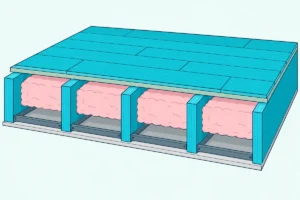
That fit-first rule is the short answer, and every pick below follows it. The best insulation for soundproofing is a fiberglass or mineral wool batt as deep as your studs, 3½ inches for a 2×4 wall and 5½ inches for a 2×6, pressed in edge to edge in every bay.
In Owens Corning’s own test, a 2×4 wall rated STC 35 empty and 39 with its 3½-inch QuietZone fiberglass, and ROCKWOOL’s catalog rates similar 2×4 walls at 38 and 40 with its stone wool. Filling the cavity added 4 points in Owens Corning’s pair, while the choice of product moved the result by a point or two.
| Your project | What to buy | What the makers’ and labs’ figures say |
|---|---|---|
| Open 2×4 wall between rooms | 3½-inch fiberglass or mineral wool batt | Owens Corning: STC 35 empty, 39 with 3½-inch QuietZone; ROCKWOOL: 40 with 3½-inch Comfortbatt |
| Open 2×6 wall | 5½-inch insulation that fills the cavity | ROCKWOOL: 36 with 3 inches of stone wool, 38 with 5½ inches in the same 2×6 wall |
| Wall that must keep a fire rating | The insulation the listed fire-rated design names | NRC Canada saw fire ratings change with the insulation type in otherwise identical walls |
| Wall that’s already closed | Blown-in cellulose, installed by a pro | NRC found blown and sprayed cellulose walls more variable, put down to installation |
| Ceiling or floor between levels | Joist-depth insulation plus resilient channels | NRC: no significant gain without channels, about 8 STC points with them |
| Outside wall | The thermal insulation the wall needs | A wood-siding wall went from STC 37 to 39 with fiberglass; windows in the same tables rated 26 to 34 |
Each row gets its own section below, with the source behind it. No batt listing on Amazon met this guide’s buying standard for ratings, reviews and stock on 17 October 2026, so none is linked here; ROCKWOOL says its products are sold at building supply retailers, and the last section lists what to check before you buy.
Is Rockwool or Fiberglass Better for Soundproofing?
Those 38-to-40 results already hint at the answer. Rockwool isn’t better than fiberglass at blocking sound in a wall: Owens Corning, which makes fiberglass, reports that glass fiber batts on average rate as well as or better than mineral wool batts of the same thickness that are about 265% denser (Owens Corning).
ROCKWOOL’s own catalog points the same way from the mineral wool side. It rates a 2×4 wall with ½-inch gypsum at STC 40 with its thermal Comfortbatt, which fills the 3½-inch cavity, and at 38 with its 3-inch Safe’n’Sound, the product it sells for soundproofing (catalog).
| 2×4 wall, studs 16 inches apart, ½-inch board each side | Insulation | STC |
|---|---|---|
| Owens Corning test W2169 (Type X board) | None | 35 |
| Owens Corning test W2069 (Type X board) | 3½-inch QuietZone fiberglass | 39 |
| ROCKWOOL IWS-03 (report RAL-TL96-266) | 3-inch Safe’n’Sound stone wool | 38 |
| ROCKWOOL IWS-05 (report NGC 2011013) | 3½-inch Comfortbatt stone wool | 40 |
Those four walls weren’t built in one lab, and Owens Corning’s used fire-rated Type X board while ROCKWOOL’s listing just says gypsum, so read the one- and two-point gaps as a tie. NRC Canada’s Warnock put about 3 dB as the smallest difference people can detect easily, with little point in worrying about one or two.
NRC’s study of more than 250 gypsum board walls, backed by a consortium that included the Canadian companies of both Owens Corning and ROCKWOOL, rated the type of sound-absorbing material “a relatively minor effect.” Density is only part of the story in the makers’ own listings, and what the makers’ wall numbers show for Rockwool puts a basic Rockwool wall and a basic fiberglass wall within a point of each other.
Get Studio Tips Weekly
Join 5,000+ creators getting acoustic treatment advice every week.
No spam. Unsubscribe anytime.Does Denser Insulation Block More Sound?
That tie surprises people because density is the usual sales pitch. Denser insulation helps mostly with higher-pitched sound: in NRC’s lab work on about 400 walls, Warnock and Quirt found the benefit of denser absorbers “evident at the higher frequencies but not at the low frequencies that determine STC.”
ROCKWOOL says much the same about its own product. It describes Safe’n’Sound trapping sound waves in thousands of tiny spaces between its fibers, and its data sheet lists a nominal density of 2.5 pounds per cubic foot with the note that “density is not a performance criteria” (data sheet).
Very dense, stiff fill can even work against you. NRC’s Construction Technology Update No. 1 warns that overfilling a cavity with fairly dense, rigid material risks sending sound through the material itself, and that the stiffer it is, the more the STC drops.
National Gypsum puts the trade-off plainly in its SoundBook: the thickness of the insulation has a greater effect on sound transmission loss than its density. Think of it as filling a box rather than packing it tighter, which is where the next section starts.
Which Size Fits Your Wall?
That thickness-over-density point makes fit the place your money goes furthest. Measure the studs before you buy: a 2×4 wall takes 3½-inch insulation and a 2×6 wall takes 5½-inch, about 15 inches wide for studs 16 inches apart and about 23 inches wide for studs 24 inches apart.
Try this in an open wall: hold a tape across the edge of a stud, and if it reads 3½ inches, you have 2×4 framing. Then check the spacing from the center of one stud to the center of the next.
Owens Corning’s QuietZone data sheet says the insulation “must fit snugly into place, filling the cavity completely,” and its assembly guide reports about 5 dB less sound transmission loss with the cavity half filled than full (QuietZone data sheet). ROCKWOOL’s catalog shows a smaller version of the same thing: a 2×6 wall rated STC 36 with 3 inches of stone wool and 38 with 5½ inches.
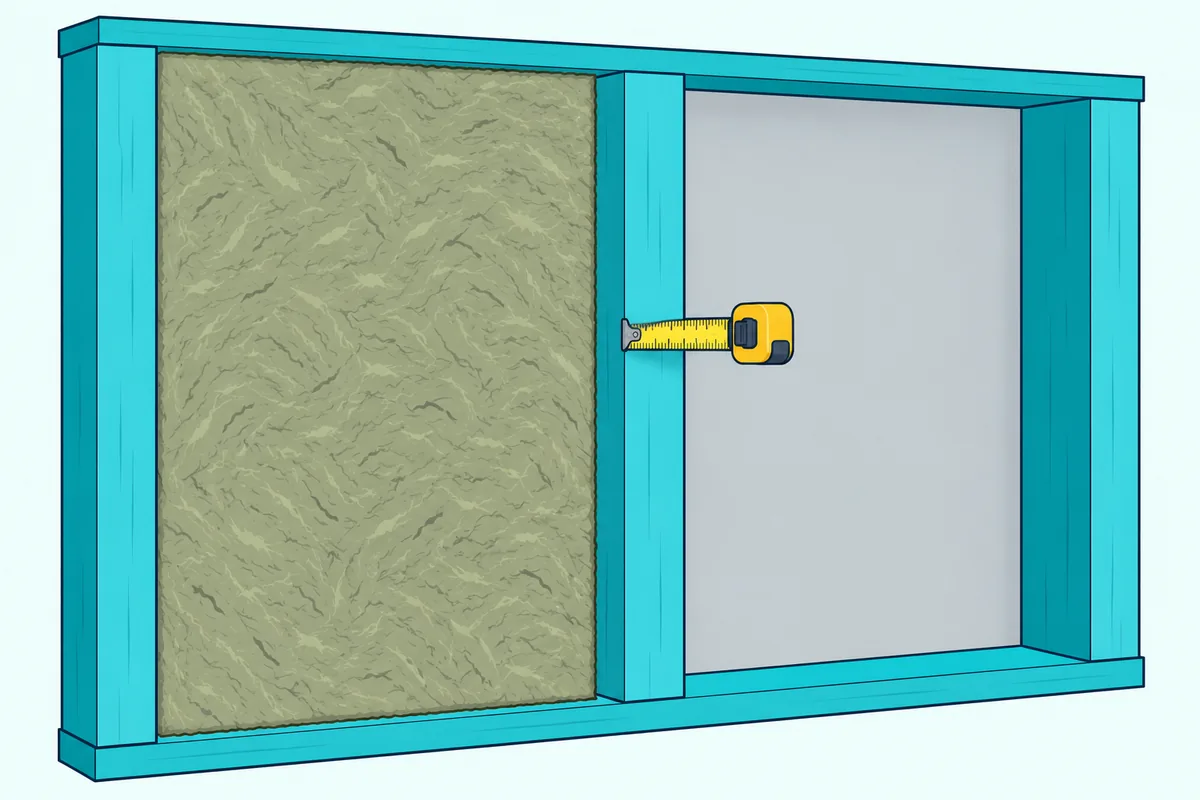
ROCKWOOL makes Safe’n’Sound 3 inches thick for walls, which leaves about half an inch of a 2×4’s 3½-inch cavity unfilled, while its 3½-inch Comfortbatt fills it. Doubling up doesn’t pay either: in Owens Corning’s staggered-stud wall, two layers of batts rated STC 51, the same as one.
Is R13 or R15 Better for Soundproofing?
That fit rule also settles the R-value question people ask next. Neither number tells you about sound, because R-value is about heat, the figure you shop by for energy efficiency: ROCKWOOL defines it as an insulation’s ability to prevent heat flow, and it lists both its R13 and R15 Comfortbatt at the same 3½-inch thickness for a 2×4 wall.
No source saved for this guide tests an R13 product against an R15 one in the same wall, so the honest answer is that either works if it fills the cavity. NRC’s Building Digest 239 says the glass fiber or mineral wool normally used for thermal insulation absorbs sound well and is “quite adequate” inside a wall.
Which Is Safer Around Fire and Moisture?
With the sound results this close, fire and moisture behavior are fairer reasons to choose. Both makers call their unfaced products noncombustible: ROCKWOOL rates Safe’n’Sound at zero flame spread and says its stone wool withstands up to 1,000°C (1,832°F), and Owens Corning says unfaced fiberglass is considered non-combustible by model building codes.
The paper facing is the difference. Owens Corning warns that kraft facing will burn, must not be left exposed and has to sit against an approved wall, floor or ceiling surface, which matters in basements and garages wherever the framing is left open.
For a wall that has to keep a fire rating, use the insulation the listed fire-rated design names. NRC found significant differences in fire-resistance ratings between full-size walls that were identical except for the type of sound-absorbing material.
ROCKWOOL says its stone wool repels water, keeps its R-value and resists rot, mildew and mold. Owens Corning says its glass fibers don’t absorb water and won’t rot or mildew, but that mold can grow on insulation that gets dirty and wet, so keep it dry while you store and fit it and replace any that’s soaked and contaminated.
Which Is Easier to Buy and Install?
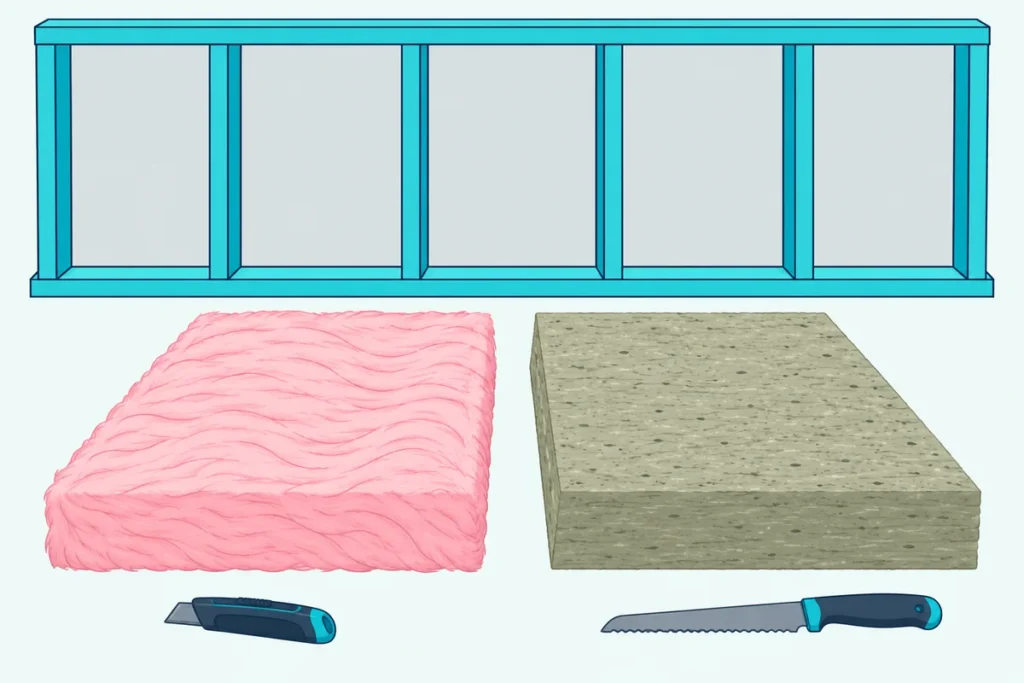
Those safety notes come with handling advice too. Neither is clearly easier: ROCKWOOL says its stone wool friction-fits between the studs and cuts cleanly with a serrated knife such as a bread knife, while Owens Corning’s data sheet has faced QuietZone stapled along its paper flanges and cut with a utility knife.
Don’t choose stone wool to avoid itching, though. ROCKWOOL’s own safe-use sheet says its product may cause temporary irritation to the eyes, skin and throat, and it calls for gloves, long sleeves, safety glasses and an N95 dust mask.
Price is the last tiebreaker, and the makers’ coverage figures make it easy to compare. ROCKWOOL lists 59.7 square feet per bag of 3-inch Safe’n’Sound for 16-inch studs and Owens Corning 155 square feet per package of 15-by-93-inch QuietZone batts, so divide the shelf price by the coverage and buy whichever fills your cavity for less.
What If the Wall Is Already Closed?
Everything so far assumes you can open the wall. If you can’t, batts are out, and Greenfiber, a cellulose maker, says blow-in cellulose can be added to existing walls.
Greenfiber also reports field measurements in five homes where 2×4 exterior walls rated 44 NIC with cellulose and 40 with fiberglass batts, but the article names no lab and links no report. NRC’s results are more cautious: walls with sprayed or blown-in cellulose varied more in performance than walls with other insulation, which NRC put down to installation that’s hard to control.
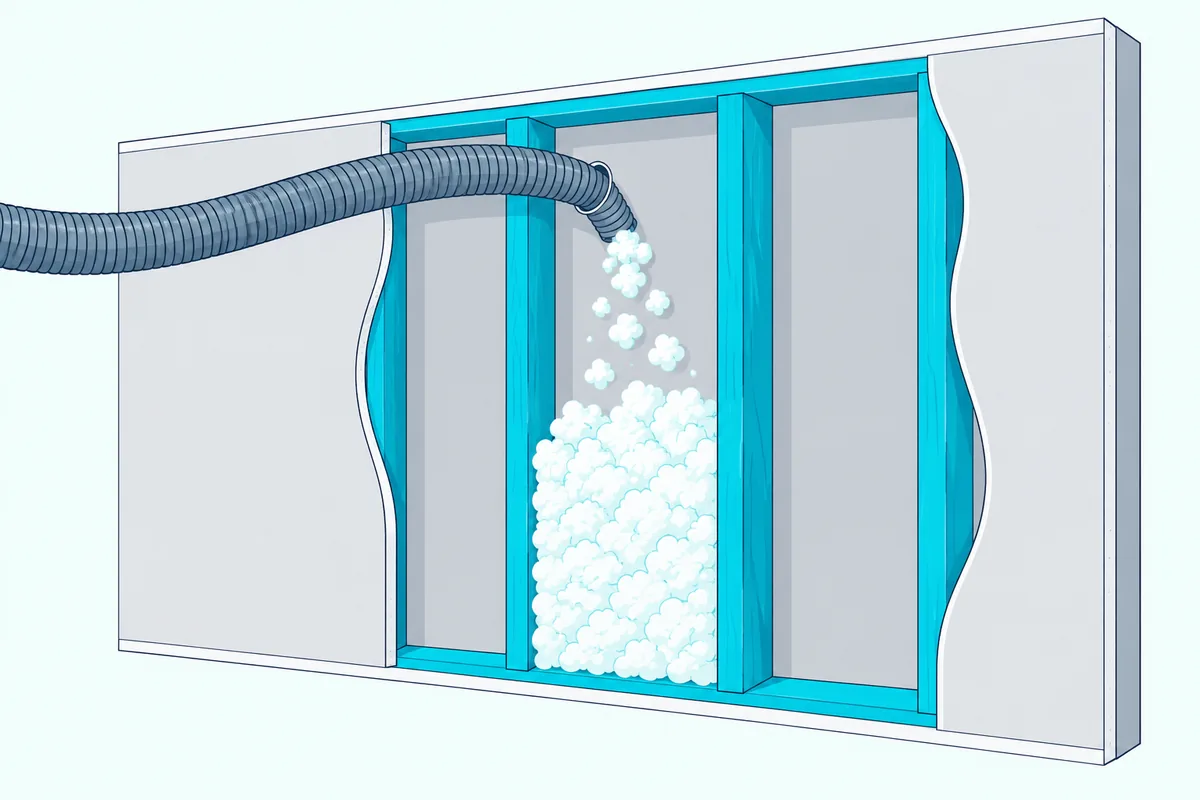
Greenfiber itself recommends a professional contractor for exterior walls, so treat this as a job for an installation service, and NRC’s warning about dense, rigid overfilling applies here too. Even done well, the gain in an ordinary closed wall is small, for the reason the section on what to pair it with explains.
What About Spray Foam, Foam Board and Denim?
Those are the fiber and blown options, but three other products show up in the same searches. None of them has a wall test among the makers’ and NRC documents saved for this guide, so none can be shown to beat a fiber batt here.
Spray foam has its own page on whether spray foam soundproofs a wall, with the test numbers behind it. NRC’s warning that stiffer fill lowers the STC points away from rigid foam board, and the longer page on why foam board isn’t acoustic explains what it does and doesn’t do for sound.
Cotton and denim insulation is sold for sound too, but no source saved for this guide tests it in a wall, so this page doesn’t rate it. HUD’s Noise Guidebook lists mineral or rock wool, fiberglass, hair felt and wood fibers side by side as materials for acoustic blankets in a wall’s airspace.
Which Insulation Works in Ceilings and Between Floors?
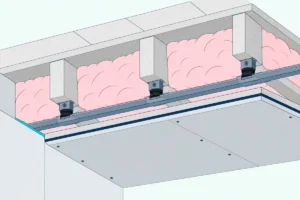
Floors and ceilings follow the same rule with one twist. In NRC Canada’s data on about 190 joist floors, insulation didn’t significantly improve the rating unless the ceiling hung on resilient metal channels, and with the channels it added about eight STC points.
That’s where denser wool earned an edge in NRC’s data: it saw “small but definite improvements” from denser rock fiber batts over glass fiber ones in those floors. National Gypsum’s floor-ceiling results put a size on the gain under a hung ceiling, from STC 52 and IIC 51 empty to 60 and 60 with 3½ inches of glass fiber.
Depth matters less than you’d think, and Burton Acoustix’s between-floors insulation guide shows how little Owens Corning’s NRC-tested floor gained going from 3-1/2 to 8-1/2 inches of batts.
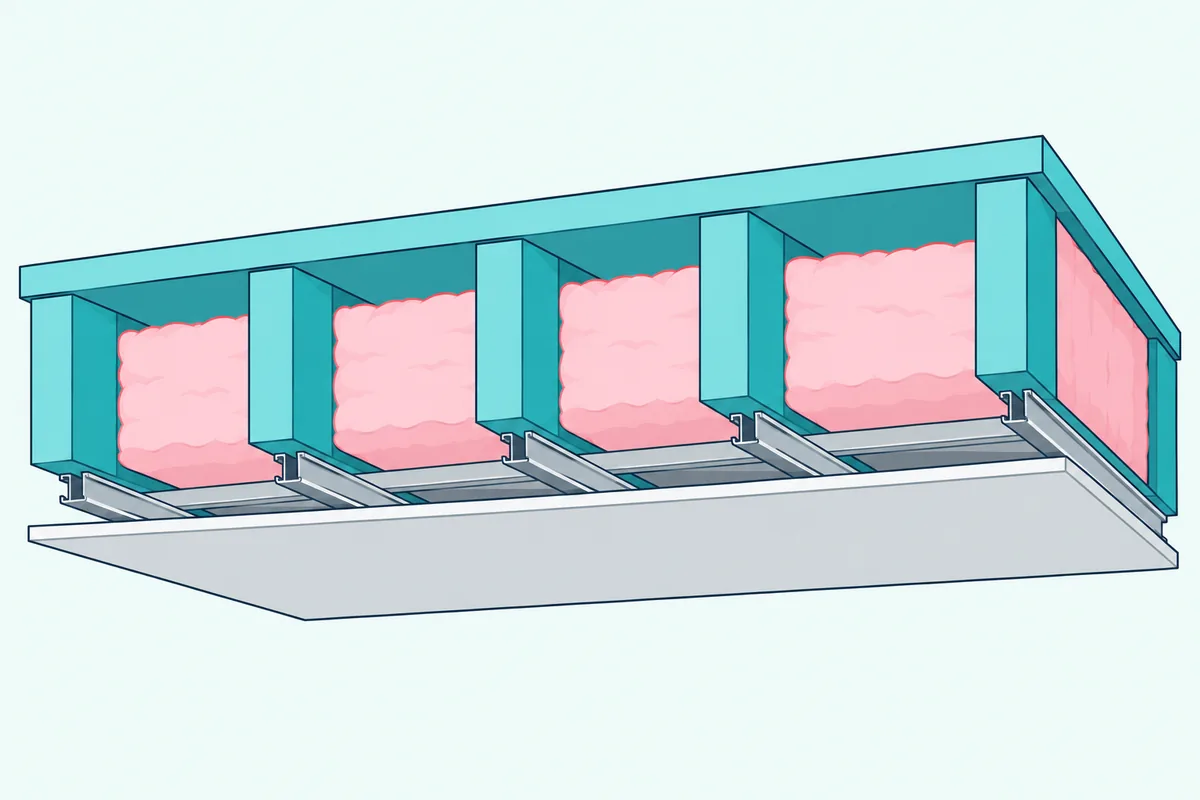
For the product itself, ROCKWOOL sells Safe’n’Sound 6 inches thick for floors and ceilings and lists a 2×10 joist ceiling with it, resilient channels and fire-rated 5/8-inch drywall at STC 50. For the rest of the ceiling, our guide to noise between floors covers footsteps and finished ceilings, and the best soundproofing material for ceiling noise guide sets insulation, clips, damped drywall and sealant side by side.
Does Insulating Exterior Walls Cut Outside Noise?
Outside walls follow the same rule, but they have weaker parts than the cavity. In tests of 2×4 walls with wood siding, which Owens Corning reprints from the National Bureau of Standards, 3½ inches of fiberglass raised the rating from STC 37 to 39, or from 43 to 47 with the drywall on resilient channels.
The windows in the same tables rated STC 26 to 34 closed and sealed, and the exterior doors 27 or 28, so the glass and the doors set the limit long before the insulation does. That’s why the windows deserve a look first, and Burton Acoustix’s guide to soundproofing windows covers them.
Owens Corning’s QuietZone data sheet says those batts are designed for interior cavities only and aren’t recommended for exterior walls. Use the thermal insulation your outside wall calls for, and treat its sound benefit as a bonus.
What Should You Pair With Insulation?
Even perfect insulation has limits, indoors or out, and those limits decide what to add. Pair it with sealing, more board and a decoupled face, because NRC’s Building Digest 239 puts the common house partition at about STC 33 and credits insulation with only about 3 points there, as the sound energy crosses from one drywall panel to the other through the studs, against about 8 points once the faces are decoupled.
Our answer to can insulation be used for soundproofing shows where those figures come from, wall by wall.
Owens Corning makes the same point from the maker’s side: the insulation performs a sound absorption function in the cavity but adds no significant mass to the wall. ROCKWOOL’s catalog shows what decoupling adds: a 2×4 wall with 3-inch Safe’n’Sound and 5/8-inch gypsum rated STC 38 on plain studs and 51 with resilient channels.
Sealing comes before any of it, since HUD’s Noise Guidebook says a 1/16-inch crack 16 inches long, or a one-inch-square hole, can take an STC 50 wall down to 40. Owens Corning’s own data sheet adds the details: seal the top and bottom plates and don’t put outlets back to back.
Low bass is the hardest part, since Warnock noted that low frequencies pass through walls much more easily than high ones, and stopping bass from traveling through walls takes mass and a separated layer.
For interior walls between rooms, our wall guide puts these upgrades in order, from sealing to channels and double studs. For most bedrooms and offices, the same order works: seal, fill the cavity, then add board or separate a face if the room still isn’t quiet enough.
If you’re weighing other products, the best soundproofing materials compares mass loaded vinyl, damping compound and sealant, and how to soundproof a room covers a whole room from the leaks to the walls.
What Should You Check Before You Buy?
That all comes down to a short checklist for soundproofing walls, ready for the store shelf:
- A thickness that matches your studs: 3½ inches for 2×4 framing, 5½ inches for 2×6.
- A width that matches your stud spacing: about 15 inches for 16-inch centers, about 23 for 24-inch centers.
- Unfaced insulation anywhere the framing stays open, and a paper facing only where drywall will cover it.
- For a fire-rated wall, the insulation the listed design names.
Skip paying extra for density alone, since ROCKWOOL itself says density isn’t a performance measure. Compare the price per square foot from the coverage the maker lists, and buy enough to fill every bay.
The Bottom Line
Every pick here comes back to that opening rule: the best insulation for soundproofing is the batt that fills your cavity, and fiberglass and mineral wool do that about equally well in a wall. Choose mineral wool for its heat resistance, water repellency and friction fit, fiberglass when it fills your cavity for less, and spend the rest on sealing, board and decoupling.
Frequently Asked Questions
How Do I Stop Noise Coming Through Walls?
Seal the gaps first, because HUD’s Noise Guidebook says a 1/16-inch crack 16 inches long can take an STC 50 wall to 40. Then fill an open cavity with a batt as deep as the studs, which took Owens Corning’s 2×4 test wall from STC 35 to 39. For a bigger step, separate one face on resilient channels or clips, which raised ROCKWOOL’s 2×4 wall from 38 to 51, or add another layer of drywall. Fill the cavity completely, since Owens Corning’s guide puts a half-filled cavity about 5 dB below a full one.
Is Insulation Alone Enough for Soundproofing?
No, not in an ordinary wall. NRC’s Building Digest 239 credits insulation with only about 3 STC points in a common house partition rated about STC 33, and Owens Corning’s own pair went from 35 to 39. On NBS Handbook 119’s scale, STC 35 still leaves loud speech audible and fairly understandable, and it takes about STC 45 before loud speech is barely audible. Insulation needs sealing, more board or a decoupled face to get there.
Is QuietZone or Safe’n’Sound Better?
On the makers’ own numbers, they tie in a basic wall. Owens Corning rates a 2×4 wall with ½-inch Type X board and 3½-inch QuietZone batts at STC 39 (test W2069), and ROCKWOOL rates a 2×4 wall with ½-inch gypsum and 3-inch Safe’n’Sound at 38 (report RAL-TL96-266), in different labs. Choose on the other differences: Safe’n’Sound is stone wool with zero flame spread and a water-repellent fiber, sold 3 inches thick for walls, while QuietZone is fiberglass, 3½ inches thick to fill a 2×4 cavity, and its faced version has a paper facing that burns if left exposed.