Best Soundproof Carpet Pad for Footsteps, by Published Rating
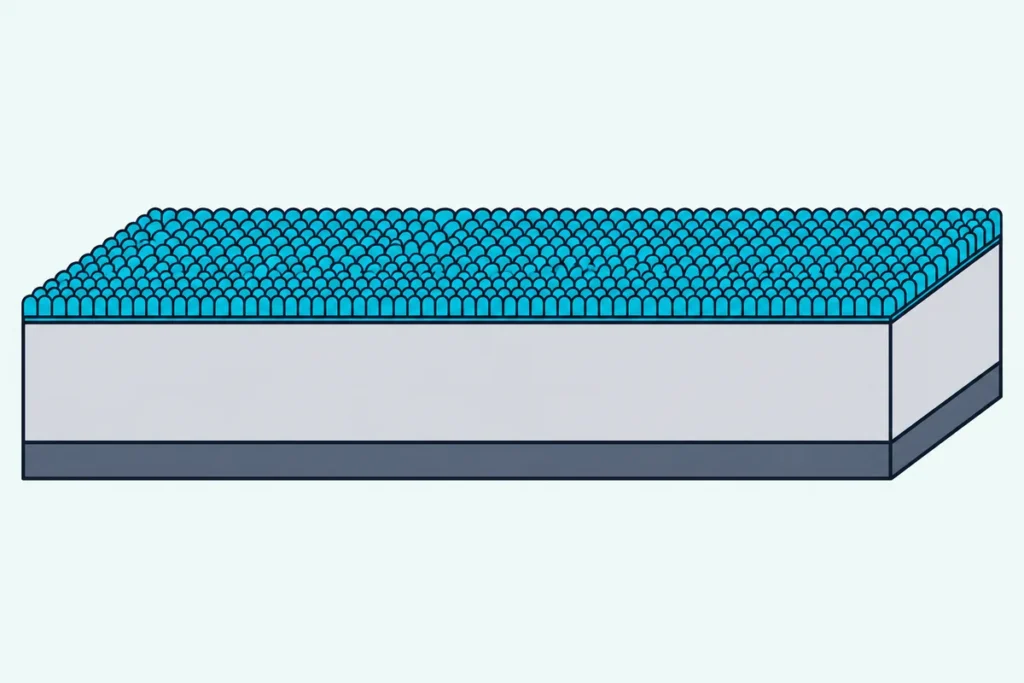
Choosing the best soundproof carpet pad means finding a rubber or foam cushion close to 7/16 inch thick, and even that pad quiets footsteps far more than voices.
Maybe the people below hear every step, or you’re looking at a roll marked soundproof with an IIC number and no hint of the floor that earned it.
Get the material and thickness right and a pad can take 44 decibels off impact sound on one maker’s sheet, while going too thick can put your carpet warranty at risk.
The first move is checking your carpet maker’s cushion limits, and the picks below start with rated wall-to-wall cushions from flooring dealers, then a cushion you can order online.
Pads for area rugs and carpet tile get their own section after that, followed by what material, your subfloor and the test behind the number do to those ratings.
What Is the Best Soundproof Carpet Pad?
That 7/16-inch figure comes from the Carpet and Rug Institute’s CRI 105 installation standard, which caps residential cushion there. Inside that limit, the best soundproof carpet pad in the table below is Dura’s Super Dura at IIC 91, then Leggett & Platt’s Arcadia at IIC 89 and Healthier Choice’s HC Green at IIC 87.
IIC, the impact insulation class, rates how well a floor keeps footsteps out of the room below, and higher is better. UK sellers call the same layer carpet underlay.
| Pad | Material | Thickness | Density | IIC | Test floor on the sheet |
|---|---|---|---|---|---|
| Dura Super Dura | Recycled rubber | 10 mm (25/64 in) | 22 lb/ft³ | 91 | 6-inch slab, ceiling grid, 12 mm carpet |
| Leggett & Platt Arcadia | Rubber XD | 0.425 in | 24 lb/ft³ | 89 | Not named |
| Healthier Choice HC Green | Memory foam | 7/16 in | 10 lb/ft³ | 87 | Not named |
| Dura Duracushion | Recycled rubber | 6 mm (15/64 in) | 22 lb/ft³ | 84 | 6-inch slab, ceiling grid, 12 mm carpet |
| Healthier Choice HC Gold | Memory foam | 3/8 in | 10 lb/ft³ | 80 | Not named |
| Tredaire Dreamwalk | Foam rebond | 11 mm | 110 kg/m³ | 73 | Not named |
Compare down a brand, not across brands, since only Dura’s brochure names its test floor, and that slab and ceiling grid rated IIC 40 on their own. Healthier Choice and Leggett & Platt work through flooring dealers, so ask a store for those pads by name.
The descriptions come from the makers’ sheets, brochures and listings.
Still choosing the carpet itself? Our carpet and cushion pairing guide covers the layer above the pad.
Dura Super Dura 10 mm
For a low-traffic room, Super Dura carries the top number here. Dura aims it at hotel suites, penthouses and home theaters, and the IIC 91 comes from an Intertek test with a 12 mm carpet over a 6-inch slab and a wire-hung ceiling grid.
It’s recycled rubber at 22 pounds per cubic foot and 0.39 inch thick, with an R-value of 0.88 that Dura lists as suitable over radiant heat. Dura warrants it to keep its firmness and resilience through the useful life of the floor covering.
Leggett & Platt Arcadia
For the fullest set of numbers, the Arcadia sheet prints IIC 89, HIIC 90 and STC 61, though it doesn’t name the test floor. HIIC tracks high-frequency impacts, and STC is the airborne rating.
Arcadia is a stretch-in Rubber XD cushion at 24 pounds per cubic foot and 0.425 inch, just inside the 7/16-inch limit. Leggett & Platt lists it for plush, textured, patterned or looped and wool carpets, and calls it an excellent choice over in-floor heating.
Healthier Choice HC Green 7/16″
For memory foam, the HC Green page calls 7/16 inch the optimal gauge for residential installations, and its sheet prints IIC 87. It’s frothed polyurethane at 10 pounds per cubic foot, and the sheet cites ASTM E492 without naming the floor.
Healthier Choice guarantees this cushion will keep 90% of its original thickness for the life of the installation. It’s for stretch-in installation only, so a double-glue job needs a different pad.
Dura Duracushion 6 mm
For heavy foot traffic, Duracushion is the Dura grade to ask for, at IIC 84 on the same test floor as Super Dura. Dura calls it ideal for high-traffic areas in hotels, condos and private homes, and at 64 ounces per square yard it’s much the lighter of the two.
Its 6 mm thickness also clears the 3/8-inch limit the institute’s FAQ sets for Berber and most commercial carpet, and its R-value is 0.52.
Healthier Choice HC Gold 3/8″
For Berber, HC Gold is the memory foam grade that fits that same 3/8-inch limit, at IIC 80. The institute also wants a very firm cushion there, and Healthier Choice’s thinner grades do push back harder: 5.80 pounds per square foot at 25% compression on HC Gold against 4.20 on the 1/2-inch HC White.
Tredaire Dreamwalk 11 mm
For UK rooms, Dreamwalk is Interfloor’s foam rebond underlay for stretch-fit carpet, rated L/U, Luxury Use. Its sheet gives 44 dB of impact sound reduction and IIC 73 at 11 mm, the same 11 mm as the CRI limit.
| Product | Size | Link |
|---|---|---|
Ordering Carpet Cushion Online 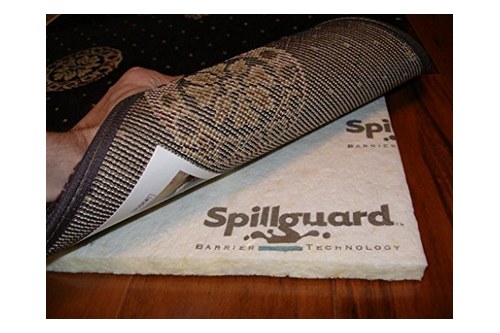 | 1/2 in | See ratings |
Carpet Tile 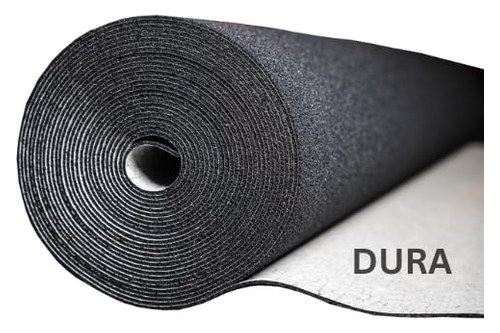 | 2 mm (5/64 in) | See ratings |
A Rug on a Hard Floor 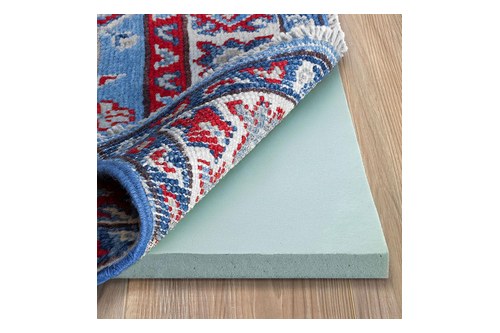 | 7/16 in | See ratings |
A Large Rug Under Furniture 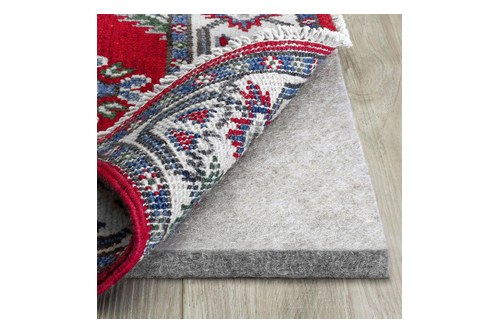 | 1/2 in | See ratings |
A Rug That Slides 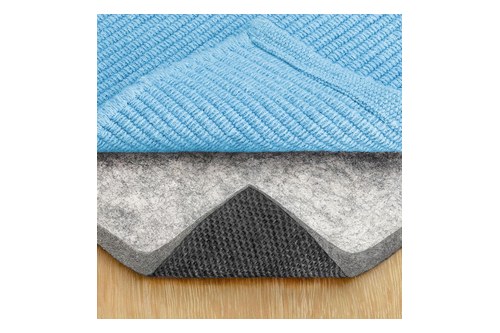 | About 1/2 in | See ratings |
Which Soundproof Pads Can You Order Online?
Those dealer cushions leave a narrower choice online. The carpet cushion to order is Carpenter’s Spillguard, and pads for rugs and carpet tile follow in a section of their own.
Every pick met Burton Acoustix’s rating, review and stock checks on 6 November 2026.
Carpenter Spillguard Carpet Cushion 1/2″
For ordering carpet cushion online, Carpenter’s Spillguard cushion is the pick, with two warnings.
Carpenter’s Spillguard cushion
The listing files it under rug pads, but it’s a Carpenter carpet cushion, 1/2 inch of foam rebond with a spill barrier. Carpenter’s carpet cushion page names Spillguard’s breathable barrier, and the listing says it’s made in 6-foot-wide goods and joined with carpet tape to reach other sizes, such as this 10 x 14 feet.
The first warning is thickness: 1/2 inch is past the CRI 105 limit, so get your carpet maker’s yes before you order. The second is the rating: the listing says it reduces impact noise, and neither it nor Carpenter’s page gives an IIC.
Which Pads Work Under an Area Rug or Carpet Tile?
That rug-pad label points to a different job, a pad under a loose rug or under carpet tile. Thick felt or memory foam rug pads suit a rug on a hard floor and DuraPad suits carpet tile, though none of these is sold for stretched wall-to-wall carpet or shows an IIC in its title or listing photos.
So buy these for cushion, not for a number, and remember a rug pad only helps where the rug lies. The institute’s slab tests hint at how little a thin layer adds: one 44-ounce carpet rated IIC 68 alone and 69 with a 3/16-inch sponge rubber cushion attached.
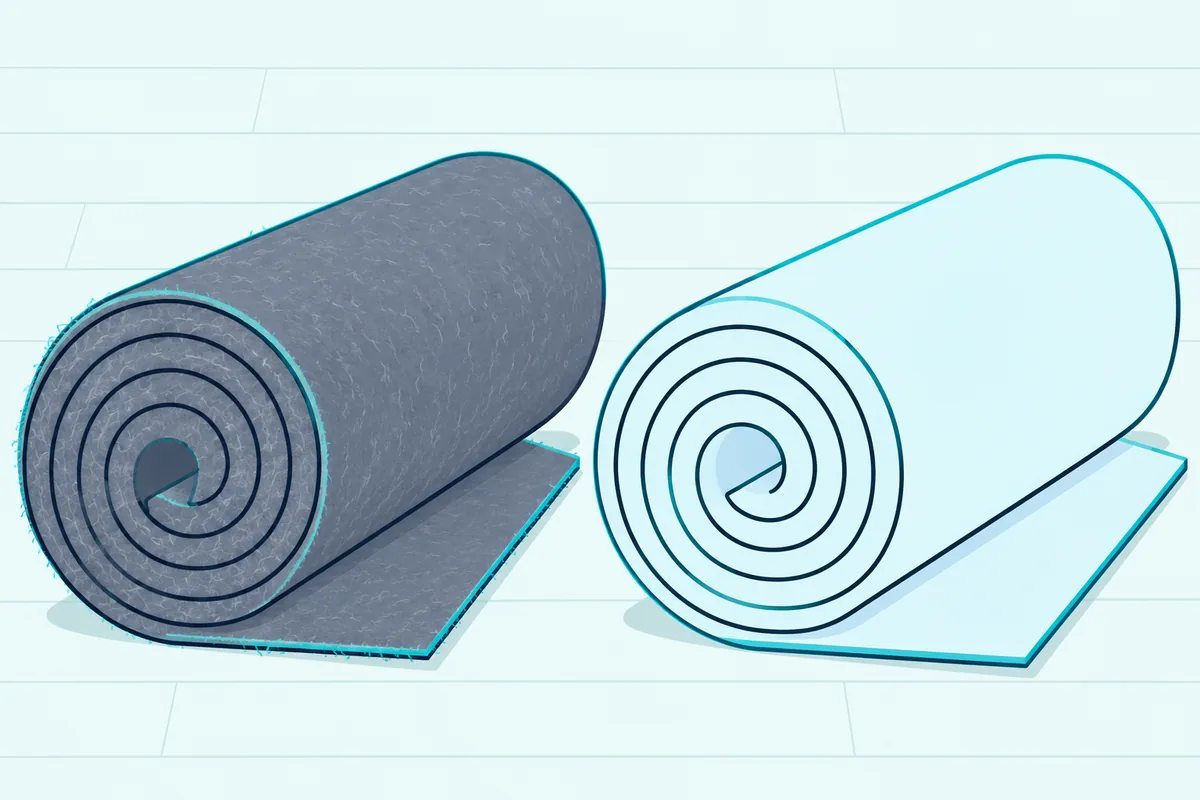
DuraPad Underlayment for Carpet Tile
For carpet tile, Dura’s DuraPad Underlayment is the pick.
Dura’s DuraPad Underlayment
Its listing drawing sets the 2 mm rubber between the tile and the subfloor. That’s a carpet-tile layer, not a stretch-in cushion.
Some carpet tile carries this layer in its backing instead. Tarkett says its DESSO SoundMaster backing adds 8 dB of impact sound insulation above its standard value.
RUGPADUSA Cloud Comfort 7/16″
For a rug on a hard floor, RUGPADUSA’s Cloud Comfort matches HC Green’s thickness in memory foam.
RUGPADUSA’s Cloud Comfort
RugPadUSA says it suits larger rugs that don’t need grip. Its listing photos show six hard floors, and carpet isn’t one of them.
RUGPADUSA Eco-Plush 1/2″
For a large rug held down by furniture, RUGPADUSA’s Eco-Plush is the felt option.
RUGPADUSA’s Eco-Plush
RugPadUSA’s page says the cushioning helps cut down on thumps, thuds and ambient noise, and it stops short of giving a figure.
RUGPADUSA Dual Surface 1/2″
For a rug that slides, RUGPADUSA’s Dual Surface adds a rubber backing.
RUGPADUSA’s Dual Surface
Its title says hard surface floors, but its photos also show carpet, the only one of these rug pads that does.
How Much Do Thickness and Density Change a Pad’s Rating?
Thickness is the main thing those rug pads offer, and the rated cushions show why it counts. In the makers’ figures, thickness moves a pad’s rating far more than density does.
Canada’s National Research Council puts the rule plainly: the softer and thicker the floor covering, the better the IIC. Dura’s carpet cushions make the cleanest comparison, because each one carries the same 22-pound density and sits on the same slab, ceiling grid and 12 mm carpet.
| Dura cushion | Thickness | Weight | IIC |
|---|---|---|---|
| Protector | 5 mm | 54 oz/yd² | 81 |
| Duracushion | 6 mm | 64 oz/yd² | 84 |
| Duralux | 7 mm | 74 oz/yd² | 85 |
| Super Dura | 10 mm | 106 oz/yd² | 91 |
So doubling the thickness added 10 points in Dura’s range. Healthier Choice’s 10-pound memory foam climbs the same way, from IIC 78 at 5/16 inch to 80 at 3/8, 87 at 7/16 and 90 at 1/2.
Density barely moved Interfloor’s numbers. Its two 11 mm foam rebond pads, at about 7 and 9 pounds per cubic foot, rate 44 and 43 dB of impact sound reduction, the closest these sheets come to the 6-pound versus 8-pound rebond question.
Density also means different things by material. Leggett & Platt’s rubber cushions run 18 to 24 pounds and its Ultra Magic bonded foam 8, while Healthier Choice sets its 10-pound foam against ordinary memory foam at 2 to 3 pounds, so the number only compares within one pad type.
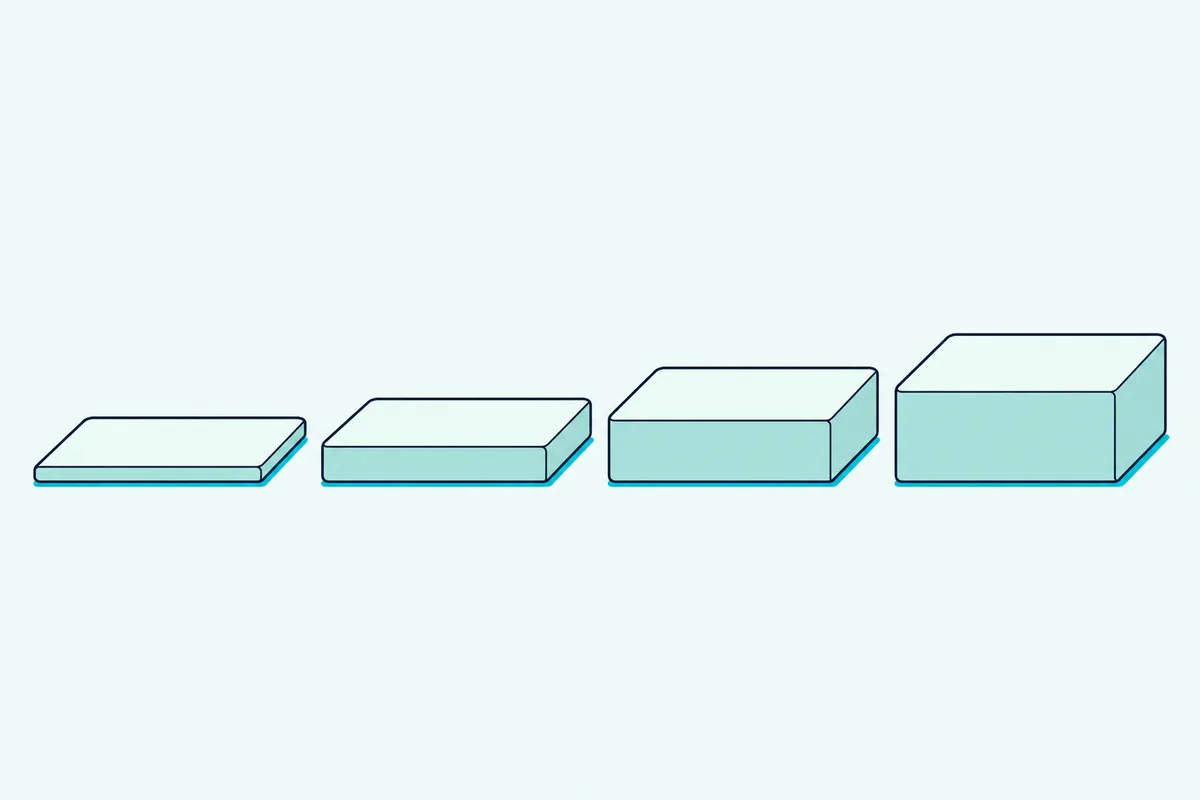
Thicker isn’t always allowed, though. The institute’s carpet FAQ asks for a firm cushion no thicker than 7/16 inch under cut pile and 3/8 inch under Berber, and CRI 105 warns that ignoring the carpet maker’s cushion rules may void the warranty.
So HC White’s IIC 90 comes at 1/2 inch, past that limit, and Leggett & Platt’s Napa and Scotchgard Diamond sit at 0.500 inch too. The same maker’s MemoryStep runs just over at 0.450 inch, while Arcadia stays inside at 0.425.
Which Pad Material Cuts the Most Impact Noise?
Thickness only compares pads of one material, so material comes next. Sponge rubber and foam rebond cut the most impact noise in Interfloor’s technical sheets, and crumb rubber cuts the least at the same thickness.
| Interfloor pad | Material | Thickness | Impact sound reduction |
|---|---|---|---|
| Dreamwalk | Foam rebond | 11 mm | 44 dB |
| Sensation | Foam rebond | 11 mm | 43 dB |
| Hallmark | Sponge rubber | 9.5 mm | 42 dB |
| Defender | Sponge rubber | 6.1 mm | 31 dB |
| Kensington Deluxe | Crumb rubber | 11 mm | 30 dB |
| Durafit 500 | Crumb rubber | 5.25 mm | 26 dB |
More decibels is better, and some sheets print both scales: 44 dB sits beside IIC 73 on Dreamwalk and 31 dB beside IIC 59 on Defender. Dura’s recycled rubber rates far higher on its own test floor, so keep this order inside Interfloor’s range.
Rubber Cushion
Rubber leads the institute’s older slab tests too. Under one 44-ounce carpet, 80-ounce sponge rubber rated IIC 80, ahead of polyurethane foam at 76 and hair-jute at 73.
Leggett & Platt’s rubber line shows how the grades step up, from Coronado at 0.360 inch and 18 pounds to Arcadia at 0.425 inch and 24 pounds. Arcadia is the one in that family whose page prints an IIC, so ask for test data on the others.
Interfloor splits the type in two, sponge rubber for spring underfoot and crumb rubber from recycled tires for high-traffic areas. It says crumb rubber gives up some comfort, and it’s the bottom of the table above.
Memory Foam Cushion
Memory foam isn’t in that table, and HC Green’s IIC 87 can’t sit beside Dreamwalk’s 73 because neither sheet names its floor. Healthier Choice’s line is a continuous frothed foam rather than glued chunks, sold from 5/16 inch to 1/2 inch.
Leggett & Platt’s MemoryStep uses recycled foam at 0.450 inch, and its page and sheet give no IIC.
Bonded Foam or Rebond
Rebond is recycled foam bonded into a cushion, and Carpenter puts its EnviroStep products at about 90% recycled material. Published ratings sit lower here: Future Foam’s 7/16-inch, 8-pound cushion prints IIC 73, and so does Dreamwalk at 11 mm, each on an unnamed floor.
Ultra Magic from Leggett & Platt comes in 1/4, 3/8, 7/16 and 1/2 inch at 8 pounds, with no IIC on its sheet. The 7/16-inch grade is the thickest one inside the limit for cut pile.
Fiber and Felt Cushion
Fiber trails in the older data. Under that same carpet, hair-jute rated IIC 73 on a slab and 61 on joists, the lowest separate cushion on both floors.
FiberTek, Leggett & Platt’s fiber cushion, runs from 18 to 40 ounces at 0.210 to 0.380 inch and prints no IIC. Leggett & Platt aims it at commercial, multifamily, medical and institutional jobs.
Acoustic Underlays With a Barrier Layer
These add weight the pads above don’t have. Sound Isolation Company sells grades at 1, 1.65 and 2.25 pounds per square foot, and Soundown pairs foam padding with a TuffMass barrier.
Their pages give no IIC or STC for these underlays. Soundown’s 1/2-inch foam with a 2-pound barrier also finishes at 3/4 inch, well past the 7/16-inch limit, so raise it with your carpet maker first.
One trap for shoppers is QuietWalk, a floating-floor underlayment that turns up beside carpet pads in store listings. MP Global’s spec sheet lists carpet among the floors it isn’t suitable under.
Does a Carpet Pad Stop Voices and TV?
Every rating above measures impact, and voices travel a different way. A carpet pad doesn’t stop voices or TV, because that’s airborne sound and a pad adds very little weight.
Veneklasen Associates tested one truss floor for MiTek both ways, swapping engineered wood for carpet over a 9.5 mm pad (lab report).
| Rating | Engineered wood | Carpet over 9.5 mm pad |
|---|---|---|
| IIC, footsteps | 51 | 72 |
| HIIC, high-frequency impacts | 56 | 87 |
| LIIC, low-frequency impacts | 35 | 47 |
| STC, airborne sound | 54 | 53 |
So the carpet and pad lifted IIC by 21 points and left STC a point lower. The low-frequency row rose 12 points against 31 for the high-frequency row, and low-frequency impact is the thudding ASTM E3207 was written to describe.
That makes an STC on a pad sheet, such as Arcadia’s 61 or Future Foam’s 52, a rating of the floor under it. Neither sheet names that floor.
The institute’s bulletin shows what such a number looks like with its floor attached: STC 49 for a 25-ounce carpet over a 1/2-inch, 6-pound bonded cushion on an insulated open-joist floor with a resilient gypsum ceiling. Canada’s National Research Council makes the same point about light joist floors, where carpet and pad can bring a high IIC while the floor keeps a low STC.
Heavier underlays aim at this gap. Sound Isolation Company’s Ultimate Carpet Underlay weighs 1.65 pounds per square foot, about three times the carpet and pad in that MiTek test, though at 12 mm it runs just past the 11 mm limit.
What Does a Carpet Pad Do for Echo in the Room?
That airborne sound still bounces around your own room, and here a pad does help. A carpet pad raises how much sound the floor absorbs, which calms echo inside the room without blocking anything.
In the institute’s tests, one 40-ounce loop carpet rated NRC 0.35 on a bare floor, 0.60 over 3/8-inch foam rubber and 0.65 over 86-ounce hair-jute. A Carpet Cushion Council study run at Intertek took a 36-ounce commercial carpet from NRC 0.25 to 0.55 with bonded foam cushion.
The order flips from the impact tests, though. Sponge rubber scored lowest here, 0.45 at 44 ounces, and the institute calls permeability the critical factor, with hair, hair-jute and foam rubber letting more sound in.
So in those tests the pad that did most for the room below wasn’t the one that did most for echo, and that second job is acoustic treatment, not soundproofing. For echo rather than noise leaving the room, Burton Acoustix’s rug guide covers placement.
Does the Subfloor Change What a Pad Can Do?
Those tests all ran on one kind of floor, and changing it changes the result. The subfloor changes a pad’s result a lot, and joist floors score well below concrete with the same carpet and cushion.
| Cushion under one 44-ounce carpet | Concrete slab IIC | Wood joist IIC |
|---|---|---|
| Hair-jute, 40 oz | 73 | 61 |
| Polyurethane foam | 76 | 63 |
| Sponge rubber, 44 oz | 79 | 65 |
| Foam rubber, 31 oz, 3/8 in | 79 | 67 |
| Sponge rubber, 80 oz | 80 | 68 |
Those are the institute’s figures, with the joist floor on a 5/8-inch plywood subfloor. Bare, the two floors rated IIC 34 and 32, so the gap only opens once carpet and cushion go down.
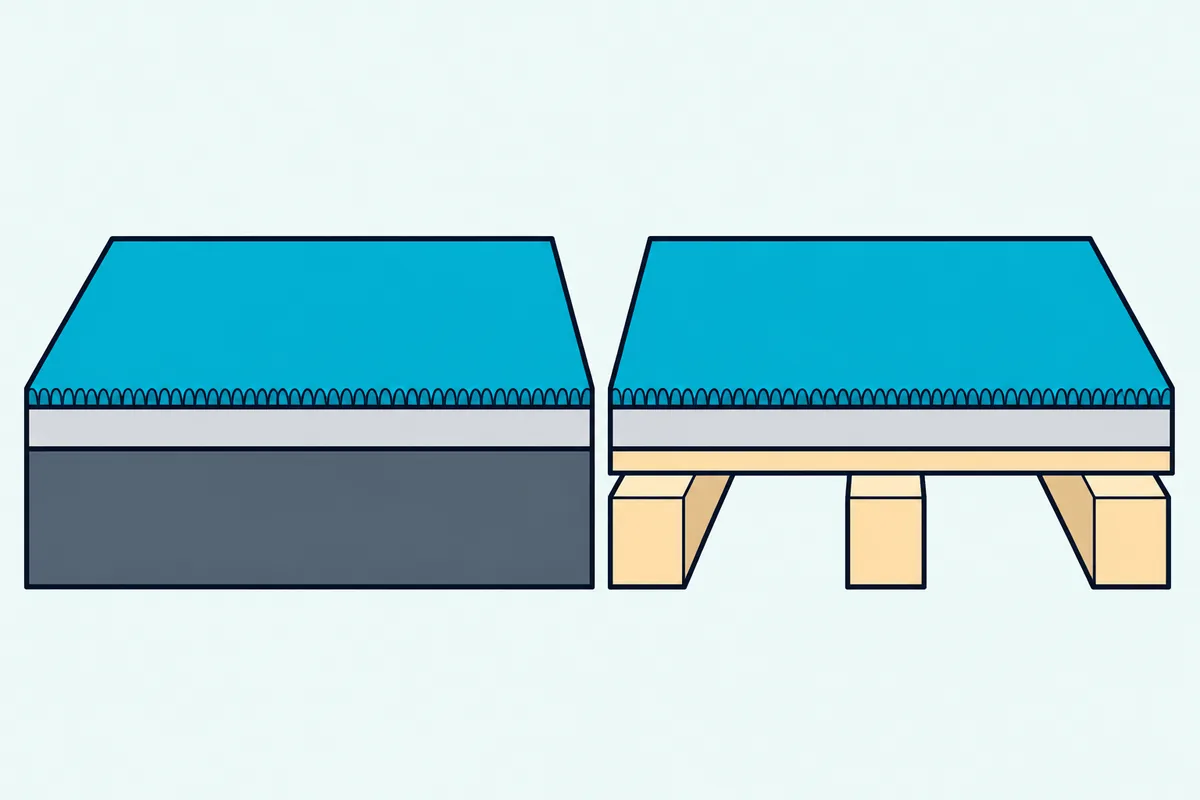
Wood Joist Floors
Joists bring the thud problem. ASTM E492 says its tapping machine doesn’t simulate a walker’s weight, and Canada’s National Research Council reports booming and thumping complaints on joist floors even above IIC 50, its usual minimum.
The council’s own table gives a basic joist floor about IIC 45 bare and 75 to 85 with carpet and underlay, and warns that a light floor can still draw low-frequency complaints if the layers’ total mass is too low. CRI 105 wants wood subfloors structurally sound, flat, dry and securely anchored, and Healthier Choice’s stretch-in instructions also ask for a structurally sound subfloor.
Concrete Slabs
A slab is where carpet and cushion post the biggest gains. The council gives a bare 150 mm slab about IIC 28 and carpet with underlay 75 to 85, and says most occupants won’t be disturbed by footstep noise on that topping.
Moisture is the slab’s own question. CRI 105 says any concrete floor can pass moisture vapor even when cured and dry, and also says most residential stretch-in jobs need no moisture testing.
Leggett & Platt’s Napa sheet asks you to inspect and test for moisture before installing any dual-moisture-barrier product. Raise that with your installer if you choose a barrier pad.
Radiant-Heated Floors
Radiant-heated floors have their own rule: the institute’s FAQ asks for a flat rubber or synthetic cushion no thicker than 3/8 inch, and CRI 105 caps the floor’s surface at 85°F. Rubber runs low on R-value, 0.46 to 0.88 across Dura’s sheets and 0.80 on Arcadia’s.
Makers’ wording runs looser than that FAQ. Healthier Choice’s sheets call all four foam grades excellent for radiant heated floors at R-values of 1.10 to 1.60, so check the heating maker’s limit too, while Interfloor strongly recommends an underlay of 0.8 tog at most.
Upstairs Rooms and Stairs
For an upstairs room, the pad belongs on the noisy floor, because it cushions the step before it reaches the structure. Leggett & Platt describes the job as cutting impact noise traveling through a floor from footsteps, falling objects and furniture movement.
On stairs, CRI 105 extends the cushion over the stair nose. Dura asks buyers to contact it before putting Super Dura under a stair runner, and it describes Duralux as ideal for stair runners.
How Does a Cushion’s Rating Compare With the Carpet’s?
Those slab numbers also show how much of a rating is carpet and how much is cushion. In the published tests, the carpet makes the first and biggest jump, and the cushion adds the rest.
In the institute’s series, the bare slab rated IIC 34, one 44-ounce carpet alone took it to 68, and the best cushion added 12 more. The Carpet Cushion Council’s commercial test ran the same way: IIC 19 bare, 58 with a 36-ounce carpet and 69 with bonded cushion glued under it.
Pile weight moved the number too. With no cushion at all, the institute’s carpets ran from IIC 53 at 20 ounces to 70 at 60 ounces, a bigger step than any cushion gave that 44-ounce carpet.
So a published pad rating can carry a lot of carpet in it. Dura’s 91 was earned under a 12 mm carpet, which makes it a rating of the carpet and cushion together.
How Should You Read a Maker’s IIC Claim?
Those gaps between floors and carpets are why a bare IIC tells you so little. Read a maker’s IIC claim as a rating of one whole assembly, then ask these four things:
- Floor: the slab’s thickness, or the joist type and subfloor
- Ceiling: none, a hung grid or resilient channels
- Carpet: its weight or thickness
- Lab: the lab’s name and the standard, such as ASTM E492 for IIC
Healthier Choice’s own Sound Solution table shows why: the same underlayment under laminate on a 6-inch slab rated IIC 52 with no ceiling and 60 to 73 with one. Delta IIC, from ASTM E2179, is the fairer number, since it measures what a covering adds on a concrete floor.
Laguna Woods Village’s flooring standard says it plainly: a maker’s IIC rating is valid only if the factory assembly matches the conditions in your building. It also warns that field results can run 3 to 5 dB below lab results.
Check the small print too. Interfloor flags some figures as derived from similar products, Healthier Choice’s sheets carry a 7% manufacturing tolerance, and Leggett & Platt’s Arcadia page says HIIC 93 where its sheet says 90.
How Do You Install a Soundproof Carpet Pad?
Those sheets also spell out the install, and the steps run close across makers. Lay the pad in the longest lengths you can, with seams at right angles to the carpet seams or at least 6 inches to one side, then fasten it at the seams and around each room.
Healthier Choice asks for the foam side up, seams made up loosely under 2-inch moisture-resistant tape, and no tight compression seams. Its room conditions are 65°F to 95°F and 10% to 65% humidity for at least 48 hours before the job, during it and for 72 hours after.
Leggett & Platt’s rubber guide adds a fix for old glue: sprinkle talcum, baby powder or baking soda so the cushion doesn’t partly stick to the floor. Its sheets also rule out masking or other paper-based tape on cushion seams.
Dura lays its cushions black side down, and its stretch-in steps hold the edges with double-sided carpet tape. Glue-down is a different job, since CRI 105 limits double-glue cushion to 3/8 inch and Healthier Choice’s residential cushion isn’t designed for it.
When Is a Pad Alone Not Enough?
Even a well-documented pad has limits. A pad alone isn’t enough when the noise is voices, when you live below the noise, or when the floor has to stay hard.
If you’re the one below, our guide to footstep noise from the neighbors upstairs covers what you can change from your side. If you’re keeping a hard floor, this floor soundproofing comparison sets underlayments against carpet.
Buildings can also set their own bar. Laguna Woods Village requires an overall AIIC of 57 for new flooring, though its standard says carpet and pad over new subfloor will generally meet it.
For a fix below the floor covering, Interfloor sells its Decibel mats to sit inside the subfloor under a screed. It says the choice of floor covering doesn’t affect them.
The Bottom Line
All of that comes down to one rule: the best soundproof carpet pad is the thickest sponge rubber or foam cushion your carpet maker allows, up to 7/16 inch, ideally with a test floor you can check.
Expect quieter footsteps for the people below, not quieter voices.
Frequently Asked Questions
Is carpet padding good for soundproofing?
For footsteps, yes; for voices, no. In the Carpet and Rug Institute’s slab tests, a 44-ounce carpet rated IIC 68 alone and up to 80 over sponge rubber. In the MiTek lab pair, carpet and pad left the airborne rating at STC 53, where engineered wood had scored 54.
Can you put soundproofing under carpet?
Yes, in place of the standard pad. Rubber cushions such as Dura’s and heavier underlays such as Sound Isolation Company’s sit under the carpet, and CRI 105 still expects you to follow the carpet maker’s cushion rules. Keep to 7/16 inch for residential carpet.
What thickness of carpet pad is best for soundproofing?
Aim for 7/16 inch under cut pile and 3/8 inch under Berber, the limits in the Carpet and Rug Institute’s FAQ. Dura’s range gained 10 IIC points from 5 mm to 10 mm on one test floor, and Healthier Choice’s gained 9 from 5/16 to 7/16 inch, so stay near the top of what your carpet maker allows.
What IIC rating should carpet underlay have?
Aim above IIC 50, which Canada’s National Research Council calls the usual minimum for satisfied residents and Laguna Woods Village’s standard gives as California’s code minimum. SoundAway calls IIC 60 medium noise reduction. In the Carpet and Rug Institute’s tests, carpet over a separate cushion cleared 60 on both slab and joists, so ask your building which rating it wants, and how it’s measured.
Is memory foam or rubber better for noise under carpet?
The makers’ sheets don’t settle it, since Arcadia’s IIC 89 and HC Green’s IIC 87 come with no named floor. The Carpet and Rug Institute’s older tests put sponge rubber and foam rubber at 79 to 80 on a slab, but memory foam wasn’t in them. On a radiant-heated floor, rubber has the lower R-value: 0.80 on Arcadia’s sheet against 1.50 on HC Green’s.
Is an 8-pound carpet pad quieter than a 6-pound pad?
The sheets here don’t show it. The nearest pair is Interfloor’s two 11 mm foam rebond pads at about 7 and 9 pounds per cubic foot, which rate 44 and 43 dB, so the denser pad scored a little lower. Thickness moved the numbers far more, so compare thickness first.
Can you use a rug pad under wall-to-wall carpet?
Check the maker first. RugPadUSA sells its felt and foam pads for area rugs, and Mohawk Home’s listing says its felt pad is for rugs anchored by heavy items. CRI 105 requires a cushion that meets the carpet maker’s recommendations, whatever the seller calls it. Carpenter’s Spillguard is filed as a rug pad, but it’s made as carpet cushion.
Does a carpet pad help in an apartment?
It helps the neighbors below you more than it helps you. Canada’s National Research Council puts a basic joist floor at about IIC 45 bare and 75 to 85 with carpet and underlay, while a pad does little for noise coming down from above.