Best Portable Office Partition for Soundproofing, and Its Limits
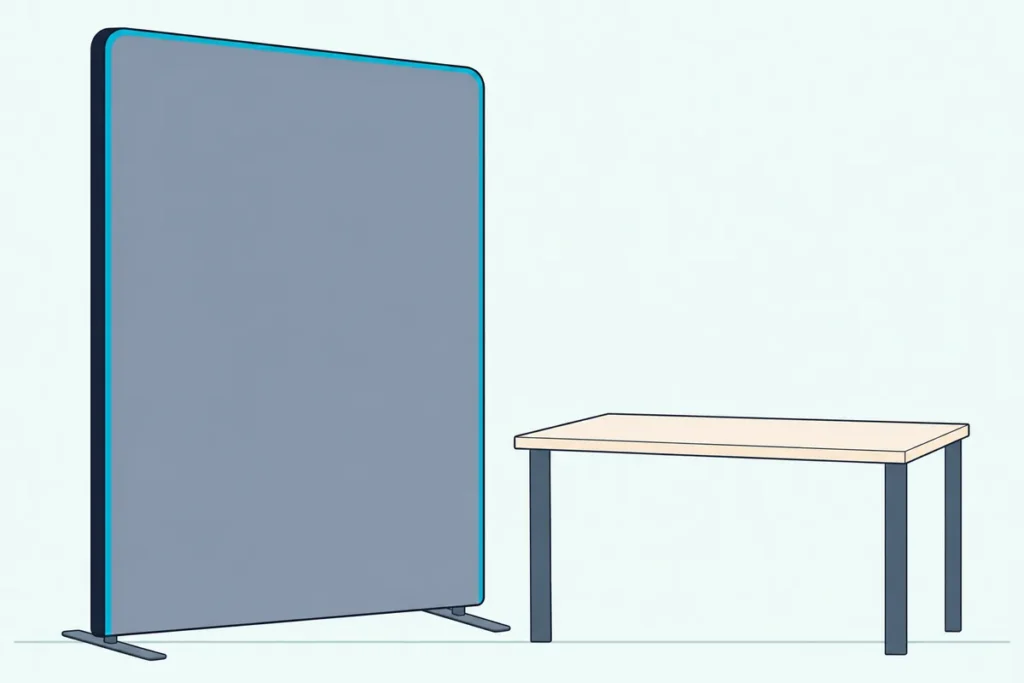
To pick the best portable office partition for soundproofing, look for a panel about 66 inches tall with an absorbent face, then accept that no freestanding partition is truly soundproof.
Speech keeps coming because it travels over and around the panel, so the coworker you can no longer see is still the coworker you can hear.
Get the height and layout right and the panel at least breaks the straight line between two desks, the one part of the problem a partition can fix.
The first move is a zip-together set such as VIVO’s 72 x 66 panels placed between the desks, and the picks below run from floor-standing panels to clamp-on desk dividers.
A comparison table and the picks come first, then what the ratings mean, how tall to go, where to stand a panel and what only a real room can do.
What Is the Best Portable Office Partition for Soundproofing?
That 66-inch target comes from the office research further down this page, and the tallest ready-made panels on feet sit right at it. The best portable office partition for soundproofing a desk is VIVO’s Freestanding 72″ x 66″ Privacy Panel, whose listing photos put it at 65.8 inches high, with zippers that let its three panels bend around a desk.
Don’t expect a wall, though. Versare’s Hush Panel page says its partitions don’t create a sealed, soundproof enclosure because their open design lets sound travel over and around the panels, and that geometry applies to every row in this table.
| Pick | Type | Size | How it stands | Sound figure | Best for |
|---|---|---|---|---|---|
| VIVO Freestanding 72″ x 66″ | Three zip-together panels | 72.4 x 65.8 in | Feet | None in its listing photos | Two desks side by side |
| VIVO Freestanding 145″ x 66″ | Six zip-together panels | 145.3 x 65.8 in | Feet | None in its listing photos | Boxing in a whole desk |
| ReFocus Raw Freestanding 3 Pack | Three separate PET panels | 24 x 62 in each | Feet | 0.85 NRC on Luxor’s page | Moving one panel at a time |
| Versare Room Divider 360 | Folding panels | Not in its title | Locking wheels | Up to 0.50 NRC for Versare’s acoustic option | Rolling across a room |
| VIVO Clamp-on 60″ x 24″ | Desk panel | 59.1 x 23.8 in | Desk clamp or screws | None in its listing photos | A long desk |
| ReFocus Raw Clamp-On | Desk panel | 47.25 x 16 in | Desk clamp | 0.85 NRC on Luxor’s page | A slim panel on a 48-inch desk |
| Kisston 6 Pcs Desk Divider | Six felt panels | 24 x 24 in each | Slot-in feet on the table | None in its listing photos | Shared tables with no clamps |
The descriptions come from the makers’ spec pages, data sheets and listings. Every pick met Burton Acoustix’s rating, review and stock checks on 6 November 2026.
If you want a whole workstation instead of a panel, this guide to where to buy soundproof cubicles and pods sorts the sellers and picks up where this page stops.
Not sure which row fits? Spend an hour noting where the voices that bother you come from: the next seat calls for a panel between you, and the far side of the room calls for the ceiling fixes near the end of this page.
| Product | Size | Link |
|---|---|---|
Two Desks Side by Side 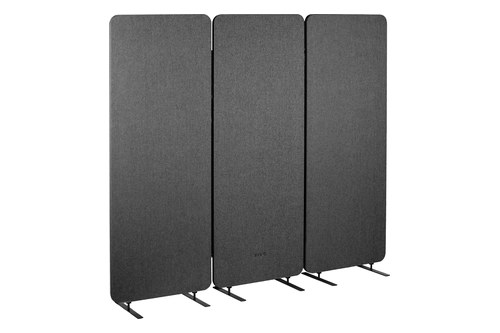 | 72.4 x 65.8 in | See ratings |
Boxing In a Whole Desk 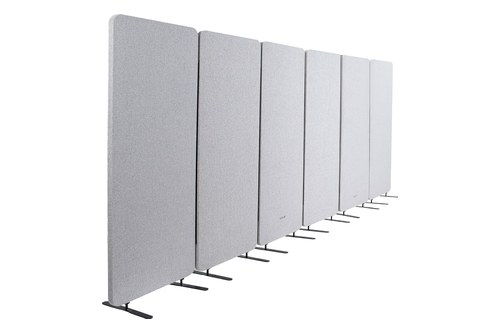 | 145.3 x 65.8 in | See ratings |
Moving One Panel at a Time 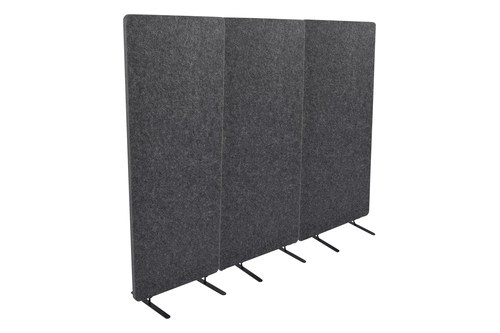 | 24 x 62 in each | See ratings |
Rolling Across a Room 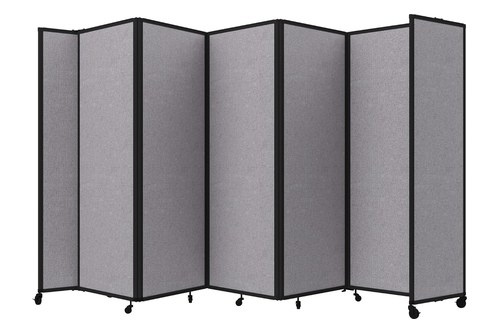 | Not listed | See ratings |
A Long Desk 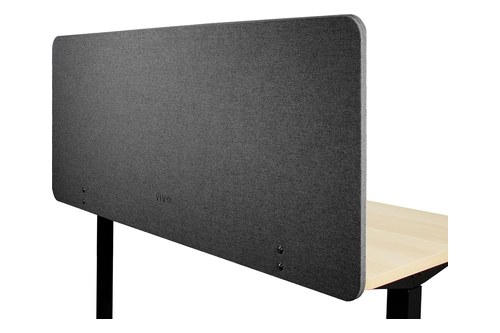 | 59.1 x 23.8 in | See ratings |
A Slim Panel on a 48-Inch Desk 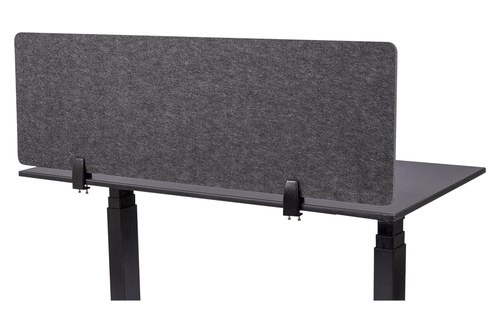 | 47.25 x 16 in | See ratings |
Shared Tables With No Clamps 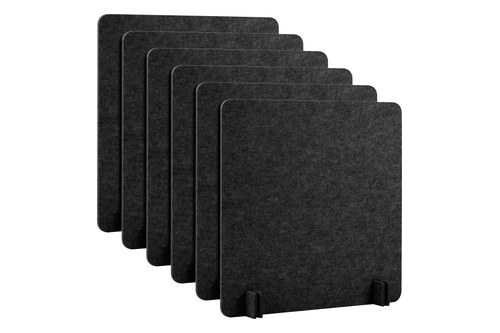 | 24 x 24 in each | See ratings |
Which Freestanding Partition Suits Two Desks?
The first three rows of that table stand on the floor, and height and joints are what separate them. The freestanding partition that suits two desks best is the tallest one that fits between them, which here means VIVO’s 65.8-inch panels over the 62-inch ReFocus Raw.
None of the three needs anything fixed to a wall or desk, so they suit an office you can’t drill. They do stand on long feet, so measure the aisle first: the listing photos show 13.8 inches of depth on VIVO’s and 14.625 inches on ReFocus Raw.
VIVO Freestanding 72″ x 66″ Privacy Panel
For two desks side by side, VIVO’s Freestanding 72″ x 66″ Privacy Panel is the pick.
VIVO’s Freestanding 72″ x 66″ Privacy Panel
Its listing photos show three panels, each 23.8 inches wide and 1.3 inches thick, joined by zippers that keep them stable but flexible. The fabric face takes pins, so the panel can double as a notice board.
VIVO’s listing photos print no sound rating, so buy this one for its height and joints rather than a number. If your office needs a figure on paper, ask VIVO for a test report first.
VIVO Freestanding 145″ x 66″ Privacy Panel
To box in a whole desk, VIVO’s Freestanding 145″ x 66″ Privacy Panel doubles the run.
VIVO’s Freestanding 145″ x 66″ Privacy Panel
Its listing photos show four middle panels with zippers on both sides and two end panels with zippers on one side, 145.3 inches in all. Height, thickness and feet match the 72-inch set.
Two panels on each of three sides make a U about 48 inches wide and 48 inches deep, so measure your desk against that first. A wider desk can take four panels across the back and one down each side, which gives you about 95 inches of back.
ReFocus Raw Freestanding Acoustic Room Divider 3 Pack
For panels you can move one at a time, the ReFocus Raw Freestanding Acoustic Room Divider 3 Pack is the pick.
ReFocus Raw Freestanding Acoustic Room Divider 3 Pack
The listing is Stand Up Desk Store’s, and that company’s web address now leads to Luxor Workspaces, which sells the ReFocus line. Luxor’s page lists each panel at 23.6 inches wide, 60 inches high and 1 inch thick, in PET that’s 60% post-consumer material, and 62 inches high on its feet.
Luxor prints 0.85 NRC for it, the highest figure among these picks, though the ratings section below explains why that number needs care. The panels have no connection between them, so this set suits a layout that shifts often more than a tight wrap around a desk.
What If You Need to Roll a Partition Across a Room?
Feet are fine for a panel that stays put, but a room that changes shape through the day needs wheels. A partition you need to roll across a room should fold on locking casters, and Versare’s Room Divider 360 does that in runs Versare lists from 8 feet 6 inches to 25 feet wide.
Think of it as a rolling wall of panels rather than a screen you carry. It moves in one piece, which separate panels on feet can’t do.

Versare Room Divider 360
For moving a run of panels in one piece, Versare’s Room Divider 360 is the pick.
Versare’s Room Divider 360
Versare’s page lists heights from 4 feet to 7 feet 6 inches and panels 33 inches wide on hinges that rotate a full circle, with end panels fixed at 90 degrees for stability. The frame is black aluminum, and locking casters hold it in place.
The panel you choose decides the sound result. Versare offers fabric, polycarbonate, woodgrain vinyl and acoustical panels and gives NRC up to 0.50 for its sound-dampening options, so check which panel the listing is selling.
Skip polycarbonate if noise is why you’re buying, because the research below found hard, non-absorbing panels clearly worse for privacy. Wheels also lift a panel off the floor, and Versare’s VersiPanel page makes that point from the other side by selling full floor contact as a way to keep sound confined.
Which Desk Divider Works Without Floor Space?
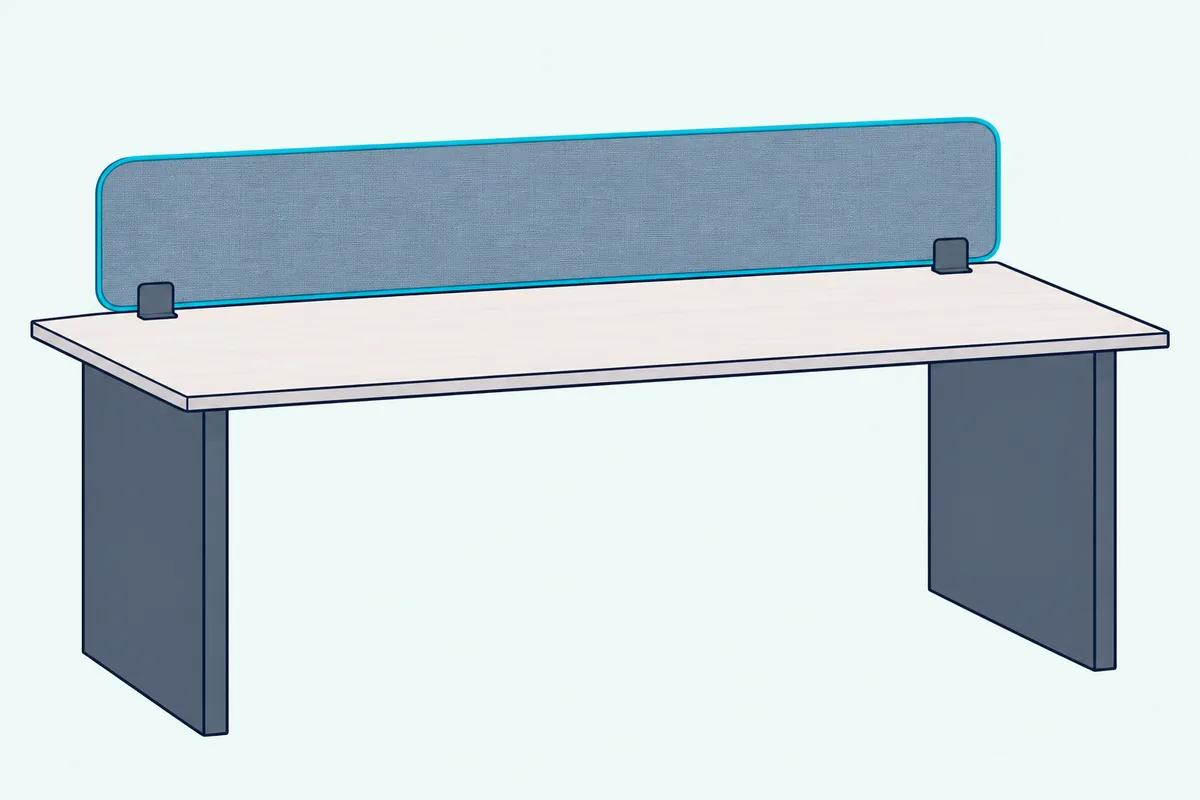
Those floor panels and rolling walls all need room, and a crowded office may not have any to give. A clamp-on desk divider works without floor space, and VIVO’s Clamp-on 60″ x 24″ Privacy Panel is the tallest clamp-on here at 23.8 inches.
Keep your expectations modest, because a desk panel’s top edge sits well below a floor panel’s. On a 30-inch desk, VIVO’s panel reaches about 54 inches and the 16-inch ReFocus Raw reaches about 46 inches.
VIVO Clamp-on 60″ x 24″ Privacy Panel
For a long desk, VIVO’s Clamp-on 60″ x 24″ Privacy Panel is the pick.
VIVO’s Clamp-on 60″ x 24″ Privacy Panel
Its listing photos show a panel 59.1 by 23.8 inches and 1 inch thick that fits desktops 0.4 to 1.4 inches thick. It can clamp on without tools or screw to the desk with the included hardware, above the desktop or below it.
For noise, mount it above the desktop, since a panel below the edge does nothing for the straight line between two seated people. The photos print no sound rating here either.
ReFocus Raw Clamp-On Acoustic Desk Divider
For a slim panel on a 48-inch desk, Stand Up Desk Store’s ReFocus Raw Clamp-On Acoustic Desk Divider is the pick.
Stand Up Desk Store’s ReFocus Raw Clamp-On Acoustic Desk Divider
The listing gives 47.25 by 16 inches in anthracite gray, and Luxor’s page adds metal clamps with rubberized inserts for desktops up to 1 inch thick. Luxor prints 0.85 NRC and sells 24, 48 and 60-inch widths, so you can mix sizes across the back and sides of a desk.
Two thicknesses appear for it: Luxor’s page says 0.475 inch in one line and .55 inch in another, and the listing photos say .55 inch. Either way it’s about half an inch of PET, which matters when you reach the ratings table.
Kisston 6 Pcs Acoustic Desk Divider
For a shared table with no clamps, Kisston’s 6 Pcs Acoustic Desk Divider is the pick.
Kisston’s 6 Pcs Acoustic Desk Divider
The listing gives six felt panels, each 24 by 24 inches, and its photos show 0.35-inch sheets standing on slot-in feet. Nothing clamps on, so you can lift them away between sessions on a training table or a shared bench.
One listing photo calls the felt effective soundproofing, and that’s the phrase to ignore. Auralex says soft materials have much lower STC ratings than dense ones, so treat this as a sight screen with some absorption.
Do Office Partitions Block Sound or Absorb It?
That word soundproofing turns up across these listings, so it’s worth pinning down. Office partitions mostly absorb sound rather than block it: their soft faces soak up some of what hits them, while sound going over and around the panel keeps going.
Those are two separate jobs with two separate numbers. Auralex’s Acoustics 101 guide defines NRC as a rating of how much sound a material absorbs and STC as a rating of how well a material or partition isolates sound, and it says dense materials stop sound far better than porous ones.
Think of a panel as a garden fence rather than the wall of a house. A fence blocks the view and takes something off a neighbor’s voice, but with no roof over it, the voice still arrives.
GSA’s Sound Matters guide lists “high cubicle partitions mean less noise” as a myth, saying higher panels block a standing person’s line of sight but add only small amounts of acoustical shielding. It adds that the look of privacy may encourage people to talk louder.
What Does a Partition’s NRC Rating Tell You?
Most makers here print an NRC and no STC, so that’s the number you’ll end up shopping by. A partition’s NRC rating tells you how much sound its surface absorbs on average at 250, 500, 1,000 and 2,000 Hz, and it tells you nothing about sound going through or over the panel.
It isn’t a percentage, either. Auralex says plainly that NRCs are not percentages, so Luxor’s “0.85 NRC (85%)” and its line about absorbing 85% of the sound passing through a panel claim more than the rating can show.
| Product | Build, as the maker gives it | Figure printed | Test named on its page |
|---|---|---|---|
| Versare Hush Panel | Fabric over a 2-inch honeycomb core | NRC up to 0.25, or up to 0.50 with SoundSorb | None |
| Versare SoundSorb Acoustic Partition | High-density rigid polyester | NRC up to 0.77 | None; a linked report covers 3/4-inch panels |
| Versare VersiPanel | Ribbed fabric over a foam core | NRC up to 0.77 | None |
| Screenflex Folding Acoustical Divider | Fabric over a dense foam core | NRC up to 0.50 | None |
| Luxor RECLAIM 3 Pack | Fabric over PET, 1.25 inches thick | 0.85 NRC | None |
| ReFocus Raw 24 x 62 | 1-inch PET | 0.85 NRC | None |
| ReFocus Raw Clamp-On | About 1/2-inch PET | 0.85 NRC | None |
| Acoustical Surfaces SoundBlox | 12.5 lb per cubic foot polyester | NRC 0.40 | ASTM C423 |
The one lab report in that group is worth reading. Versare’s SoundSorb test report, from Element Materials Technology in 2019, measured 3/4-inch panels at NRC 0.60 under ASTM C423, and Versare’s sell sheet also says up to 0.60.
That makes the partition page’s 0.77 worth a question. Auralex says NRCs can only be multiples of 0.05 and that a reported 0.72 probably wasn’t tested to the standard, and Element’s report rounds the same way.
Related products can differ too. Screenflex, which shares Versare’s Minneapolis address, lists NRC up to 0.50 for a folding fabric-and-foam divider 6 feet 6 inches by 8 feet, the same size Versare gives for its VersiFold at up to 0.77.
Thickness usually moves the number, yet Luxor prints 0.85 for panels from about half an inch to 1.25 inches. Owens Corning’s data sheet shows its 703 fiberglass board going from 0.70 at 1 inch to 1.00 at 2 inches, so ask which thickness Luxor’s figure describes.
Mounting matters as well. Element’s lab laid the panels flat on the test surface, and Auralex warns that results from different mounts can’t be compared, so a panel standing in open air isn’t the setup that report describes.
Here’s the test to run on any seller: ask for the lab’s name, the standard, the thickness tested and the mounting. Then stop chasing the top number, because the research in the next section found the step from a medium to a high absorber makes only a small difference to privacy.
How Tall Should a Portable Office Partition Be?
Absorption only works on sound that reaches the panel, so height comes next. A portable office partition should stand about 66 inches tall if seated privacy is the goal, because Bradley’s 2003 paper for the National Research Council of Canada built its acceptable open-office design around a panel 1.7 meters (5.6 feet) high.
Bradley puts a seated talker’s mouth and a neighbor’s ear about 1.2 meters above the floor, and says the panel has to be substantially higher than that. Above 1.7 meters, more height made only small differences in his model.
That result comes with conditions. His design also needed a ceiling with a sound absorption average of 0.95, workstations 3 meters square and background sound at 45 dBA, and he says acceptable privacy isn’t possible unless the design parameters are near their best values.
GSA pulls the other way, recommending a workstation panel no taller than 66 inches and seated privacy at 51 inches. Its worry is behavior: higher panels give the illusion of being alone, so voices tend to rise.
A 2024 study in Heliyon by Lee and Haan modeled partitions 1.2, 1.5 and 1.8 meters high. It listed raising partitions among the most effective steps, along with separating workers and avoiding face-to-face desks, and it concluded that partitions alone struggle to deliver speech privacy.
So 66 inches is a sensible top end, not a promise, and the table shows how each pick’s top edge compares. The clamp-on and table rows assume a 30-inch desk.
| Pick | Top edge | Against a seated mouth (47 in) | Against Bradley’s panel (67 in) |
|---|---|---|---|
| VIVO Freestanding sets | 65.8 in | About 19 in above | About 1 in below |
| ReFocus Raw Freestanding | 62 in | About 15 in above | About 5 in below |
| Versare Room Divider 360 | 48 to 90 in, by size | 1 to 43 in above | From 19 in below to 23 in above |
| VIVO Clamp-on | About 54 in | About 7 in above | About 13 in below |
| Kisston Desk Divider | About 54 in | About 7 in above | About 13 in below |
| ReFocus Raw Clamp-On | About 46 in | About 1 in below | About 21 in below |
Read that last row carefully. A 16-inch panel on a 30-inch desk stops at about mouth height, which makes it a sight screen rather than a speech screen.
Where Should You Put a Portable Partition?
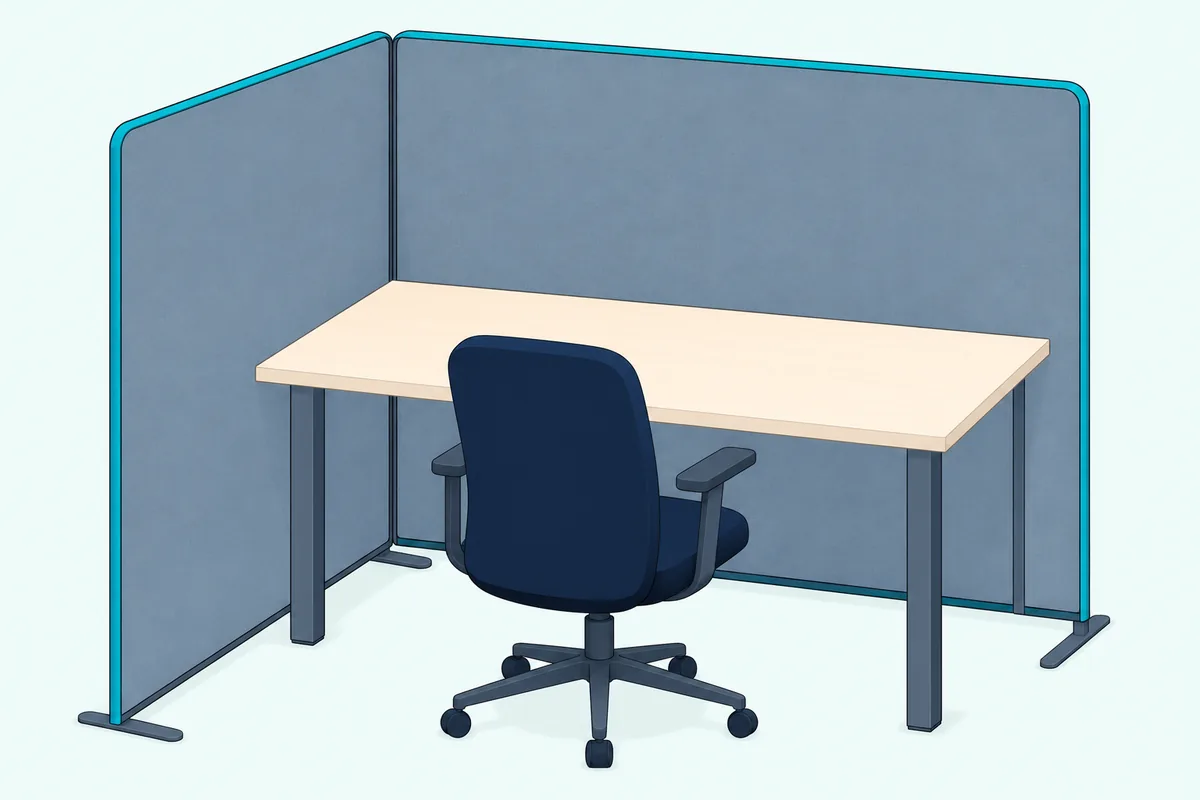
Height sets the limit, and placement decides whether you reach it. Put a portable partition across the straight line between the two people, then close its open ends with a wall, a second panel or a bend around the desk.
Layout counts here. Lee and Haan’s face-to-face layout scored worst at 1.2 meters, and Bradley’s 3-meter workstation just met his target while a 2.5-meter one would not quite meet it, so spacing people out helps whatever panel you buy.
- Turn the desks so nobody faces a neighbor directly across the panel.
- Stand the panel on the line between the two seats, as close to the desks as its feet allow.
- Bend the ends around the desk corners; Luxor says RECLAIM’s zippers flex from 180 to 90 degrees for that, and Versare suggests S, C or L shapes for VersiPanel.
- Use it on carpet if you can, since Bradley says carpet helps limit sound through gaps at the bottom of screens.
Try a simple check once the panels are in. Have a coworker read a paragraph at normal volume from their seat, then repeat it with the panel moved a foot either way, and keep the spot where the words get hardest to follow.
Does a Sound-Blocking Core Help a Portable Partition?
That open top is why a heavier panel helps less than you’d expect. A sound-blocking core helps a portable partition only up to a point, because Bradley found a panel of about STC 20 was enough, and going from STC 21 to STC 25 made a negligible difference.
Once sound through the panel stops being the main route, a heavier core has nothing left to fix, because it can’t touch what goes over the top. None of the pages behind these picks prints an STC anyway.
Heavy screens do exist. Steel Guard Safety lists a portable screen with 1 pound per square foot of mass loaded vinyl behind quilted fiberglass, rated NRC .70 and STC 27, with optional caster wheels.
Steel Guard sells that screen for machinery and industrial processes, which is where a block-and-absorb screen earns its weight. Between two desks, the speech still takes the open route.
What About Modular Office Partitions?
Bolting more panels together doesn’t change that route, so modular is a question of layout. Modular office partitions reconfigure more easily than single panels, but they share the same open top and the same absorption limits.
Versare’s Hush Panel is the clearest example: fabric panels join at four-sided aluminum posts with no tools, up to four panels on a post, in nominal widths of 2 to 6 feet and heights of 45-3/4 or 72 inches. Its 2-inch honeycomb-core panels list NRC up to 0.25, or up to 0.50 with SoundSorb.
Zip-together sets do a lighter version of the same job, and Luxor sells a single RECLAIM expansion panel to lengthen a run. Choose modular when the layout keeps changing, then judge it on height, joints and absorbent faces like any other panel.
Can a Portable Partition Make a Conference Room Private?
Those limits rule out a meeting room in particular, where the words themselves need protecting. A portable partition can’t make a conference room private, because GSA’s guide asks for STC 40-45 in offices and conference rooms, and that takes a closed assembly from floor to ceiling.
The closest movable option is a track-hung folding wall. NetWell’s Curtition page rates its accordion-style system at STC 40, and compares that with a drywall wall with insulation at about STC 38-39.
It’s portable only in the sense that it folds aside. NetWell hangs it from a ceiling track, sizes it to the opening and tells you to measure the tallest floor-to-ceiling height so no leak points remain, and its system averages 3.5 pounds per square foot.
Versare’s Operable Wall dividers sit between the two, mounting to a wall and reaching 12 feet 3 inches. Their sell sheets say sound dampening and print no STC, so ask for a figure before you treat one as a wall.
What Can’t a Portable Partition Do?
Even that STC 40 wall relies on a closed opening, and a panel on feet has no seal at all. A portable partition can’t give you a private room, stop a loud call two desks away or replace the ceiling and background sound an open office depends on.
Bradley calls the ceiling the most important reflecting surface in an open office, and says acceptable privacy isn’t possible below an absorption average of 0.90 even in an otherwise good design. He also calls electronic masking sound an essential part of a successful open office, and Burton Acoustix’s guide to acoustic treatment for office spaces covers the ceiling and masking side.
For calls that must stay private, the answer is an enclosure. A soundproof booth or privacy pod gives you a door and a roof, and GSA keeps speakerphones to enclosed rooms of at least STC 45 for the same reason.
At home, the fix is the room itself, and this walk-through for soundproofing a home office wall by wall covers the gaps, the door and the walls in turn.
The Bottom Line
The best portable office partition for soundproofing is the best one for cutting the direct line between two desks, because no panel on feet makes a room. VIVO’s 65.8-inch zip-together sets sit right at the height the research points to, and Versare’s Room Divider 360 is the one to roll.
Treat every NRC as a claim until you’ve seen the lab, the standard, the thickness and the mounting. If your problem is confidential speech rather than distraction, skip the panel and go straight to the ceiling, masking sound or an enclosed room.
Frequently Asked Questions
Are room dividers soundproof?
No. Versare says its panels don’t create a sealed enclosure and that sound travels over and around them, and a panel on feet can’t seal to a floor, walls and ceiling. Versare and Luxor both describe absorption, not isolation. A track-hung folding wall such as NetWell’s Curtition, rated STC 40, is the closest thing to a soundproof divider, and it’s fixed to the ceiling rather than portable.
Do room dividers reduce noise?
Yes, in a limited way. A soft panel absorbs some of the sound that hits it and breaks the direct line between two people, and Bradley’s model shows absorbing panels doing clearly better than hard ones. GSA still warns that high panels add only small amounts of shielding, so expect a calmer desk rather than a quiet one.
What NRC should an office partition have?
GSA asks for 0.7 in the partition in front of a seated worker, and 0.8 for a partition enclosing a workstation in focused areas. In Bradley’s model, dropping panel absorption from 0.9 to 0.6 moved his privacy score only from 0.19 to 0.22, right at the 0.03 change he says is about the smallest anyone could detect. A non-absorbing panel moved it to 0.29, so a soft face matters more than the top figure.
Do soundproof curtains work as a room divider?
Only a little. Burton Acoustix’s page on what the lab numbers say about curtains gathers the measurements, and they’re modest for ordinary fabric. NetWell’s Curtition sounds like a curtain, and its page calls it a room divider curtain, but it’s a steel-framed folding wall wrapped in layers of sound-attenuating material, not a drape.
Which brand offers the best modular dividers for quiet offices?
No brand’s number settles that, since most of these figures name no test. Versare publishes the most, including a lab report for SoundSorb and plain limits for its Hush Panel system. Luxor prints the highest figure, and you should ask which thickness it describes. Choose the modular system whose panels are tall enough and whose joints leave the fewest gaps.
How do you make a soundproof office partition?
You’d be building a wall, not a panel. GSA’s high-isolation partition runs slab to slab, caulked at the sill and head, and reaches STC 53. A panel with heavier layers still leaves the open top, which is why Bradley found extra blocking past about STC 20 did almost nothing in an open plan.
How much floor does a freestanding partition need?
Allow for the feet as well as the panel. VIVO’s listing photos show feet 13.8 inches deep, Luxor lists 14.63 inches for RECLAIM and ReFocus Raw’s photos show 14.625 inches. On a 72-inch run with a chair behind it, that depth can be what blocks the aisle, so tape the footprint to the floor first.