Acoustic Treatment Vs Soundproofing (They Solve Completely Different Problems)
Acoustic treatment vs soundproofing is one of the most misunderstood distinctions in the entire noise-control space, but the difference matters because buying the wrong one wastes money and leaves the original problem untouched.
That is why so many buyers feel disappointed. They buy acoustic foam panels expecting to block neighbor noise, or they add mass loaded vinyl to a wall expecting clearer audio in a recording setup.
Both products work, but they solve completely different problems, and using one where the other belongs is the single most common mistake in this category.
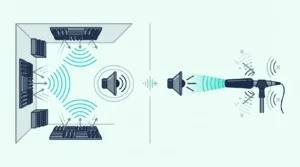
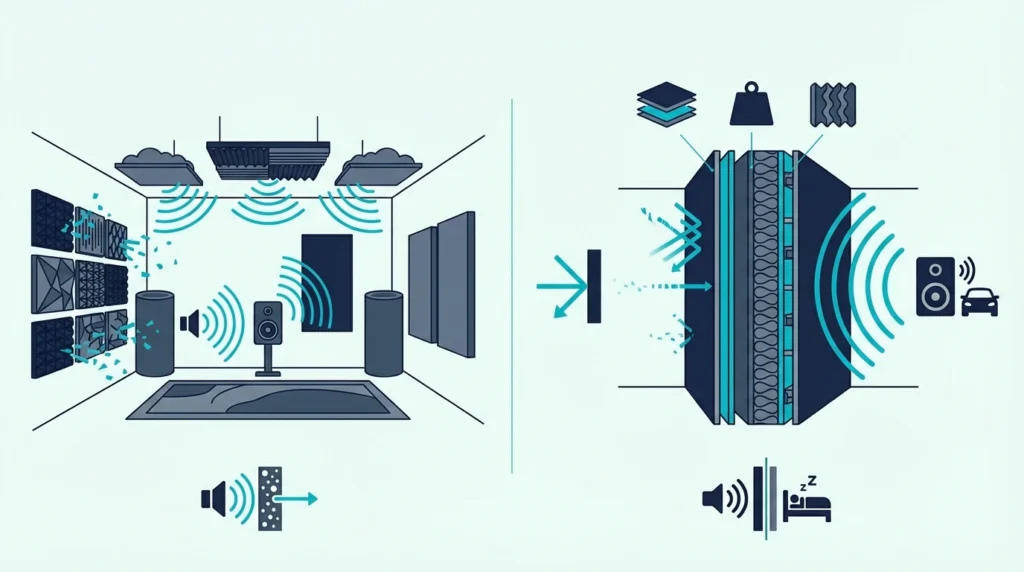
The clearer way to think about it is simple: acoustic treatment changes how a room sounds inside. Soundproofing changes how much sound travels in or out.
Once you understand which problem you actually have, the right product becomes obvious.
Below, you will learn what each approach actually does, which one is better for your specific situation, the most common misconceptions, and how to decide whether you need one or both.
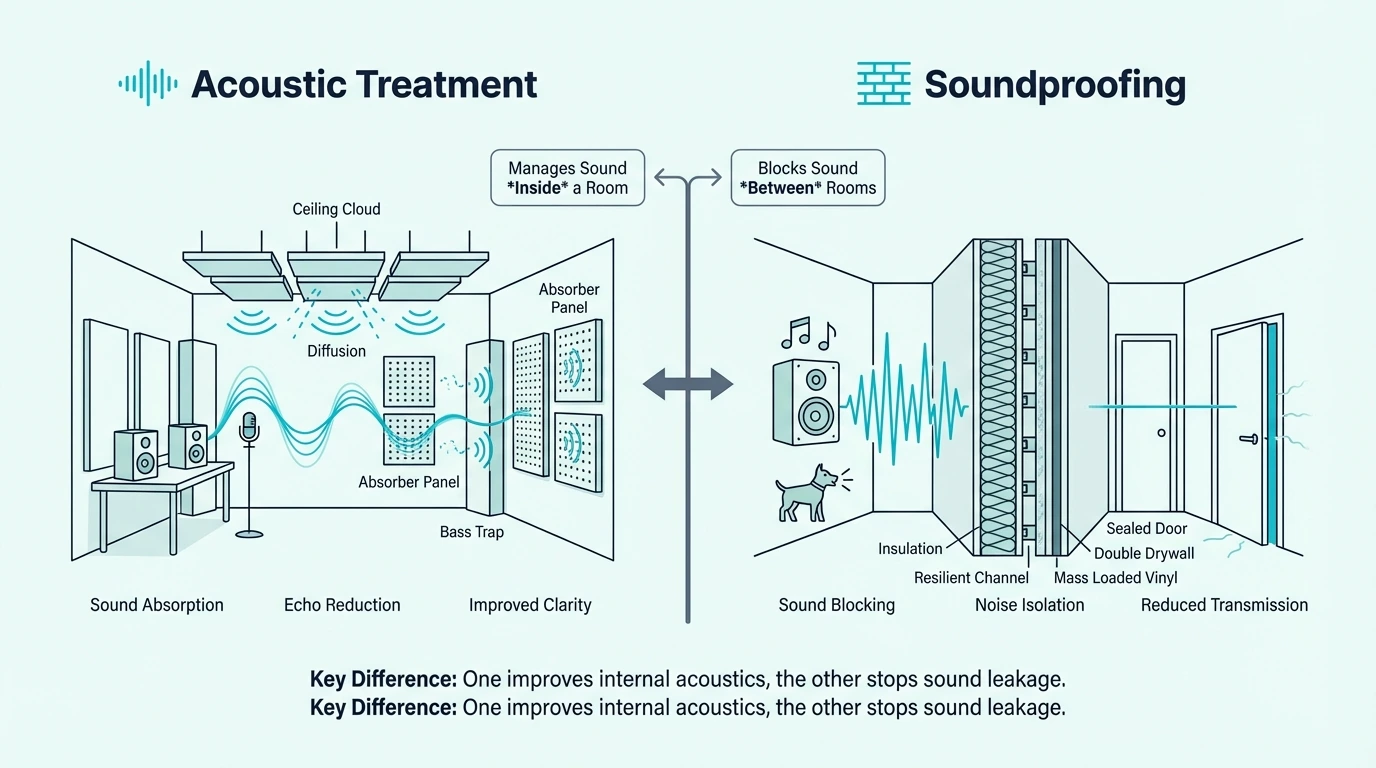
Acoustic treatment vs soundproofing comes down to direction. Treatment improves the sound inside a room by controlling reflections, echo, and clarity. Soundproofing reduces how much sound passes through walls, ceilings, floors, and openings. They solve different problems, and most rooms that need help need one or the other — not both — depending on whether the issue is internal sound quality or external noise transfer.
What Is The Difference Between Acoustic Treatment And Soundproofing?
Now that the core distinction is clear, the next step is understanding what each approach actually does in practice.
What Does Acoustic Treatment Actually Do?
Acoustic treatment controls how sound behaves inside a room. It reduces echo, flutter, harsh reflections, and the muddy or boomy quality that untreated rooms create when sound bounces off hard surfaces.
The main tools are absorbers (panels and foam that soak up mid and high frequencies), bass traps (thicker absorbers that target low frequencies), and diffusers (surfaces that scatter sound evenly instead of absorbing it). Together, they make the room sound clearer, tighter, and more controlled.
That family is broader than wall panels alone. Acoustic foam is the entry-level treatment option, fiberglass or mineral-wool panels built from cores like Owens Corning 703, Knauf, or Rockwool are the stronger broadband option, bass traps handle corners and low-end buildup, and diffusers keep a room from becoming too dead.
Acoustic panels like UMIACOUSTICS Acoustic Panels are a typical treatment product. They make the room sound better inside, but they do not stop noise from traveling through the wall to the neighbor.
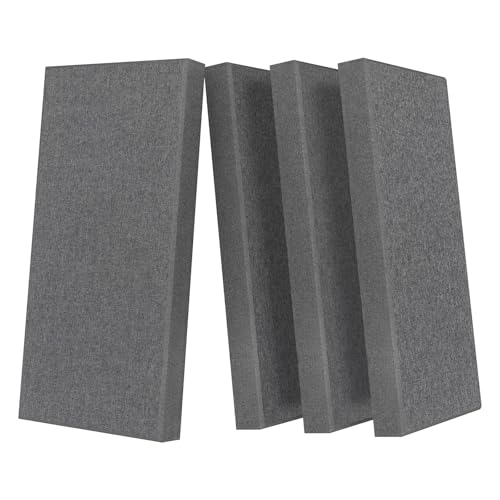
UMIACOUSTICS Acoustic Panels
Foam tiles like JBER Acoustic Foam Panels are the cheaper and weaker branch of treatment. They can help with flutter echo and upper-frequency splash, but they should not be mistaken for broadband panels, bass traps, or any kind of soundproofing.
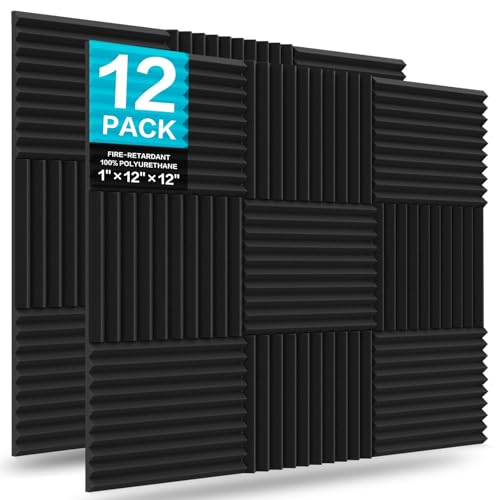
JBER Acoustic Foam Panels
When the room also has obvious low-frequency buildup, corner treatment matters just as much as flat wall absorption. A starter option like TroyStudio Bass Traps makes that clearer because treatment is not only about wall panels.
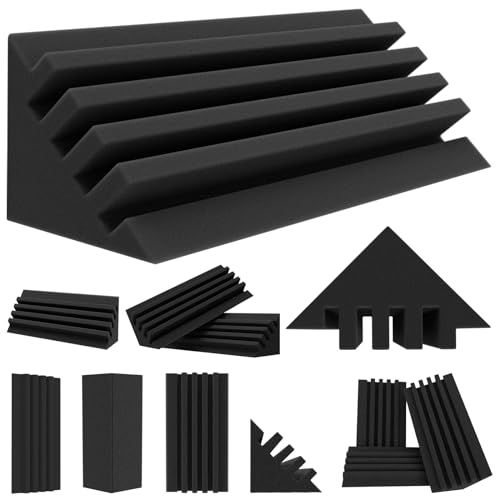
TroyStudio Bass Traps
It is about controlling the reflections and buildup that happen inside the room. If the room already has enough absorption and starts feeling too dead, compare that next step with sound diffuser vs acoustic panel so the diffusion side of treatment is clear too.
What Does Soundproofing Actually Do?
Soundproofing reduces how much sound passes between spaces. It targets the walls, ceilings, floors, doors, and windows that separate the room from the outside world or from adjacent rooms.
The main tools are mass (heavier barriers like mass loaded vinyl and double drywall), decoupling (resilient channels and isolation clips that break the vibration path), damping (compounds that convert vibration to heat), and sealing (closing every air gap that sound can leak through).
That family is broader than one so-called soundproofing panel. MLV and extra drywall add mass, Green Glue adds damping between rigid layers, clips and channel add decoupling, solid-core doors and acoustical sealant close leak paths, and batt materials like AFB or Owens Corning-type fiberglass or mineral wool belong inside the wall assembly rather than on the room surface.
A barrier material like Trademark Soundproofing Mass Loaded Vinyl is a typical soundproofing product. It stops noise from traveling through the wall, but it does nothing to improve the clarity or quality of sound inside the room.
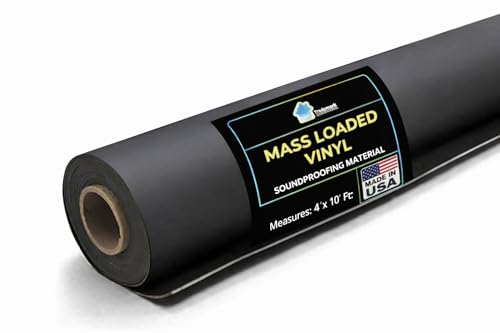
Trademark Soundproofing Mass Loaded Vinyl
A damping product like Green Glue Noiseproofing Compound belongs between rigid layers, usually drywall, when the goal is to reduce panel vibration in a real build. It is not a decorative room-treatment product, and it only works when the wall or ceiling assembly is actually being built or rebuilt.
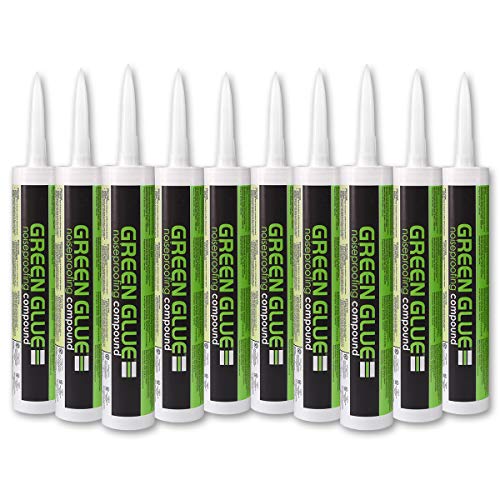
Green Glue Noiseproofing Compound
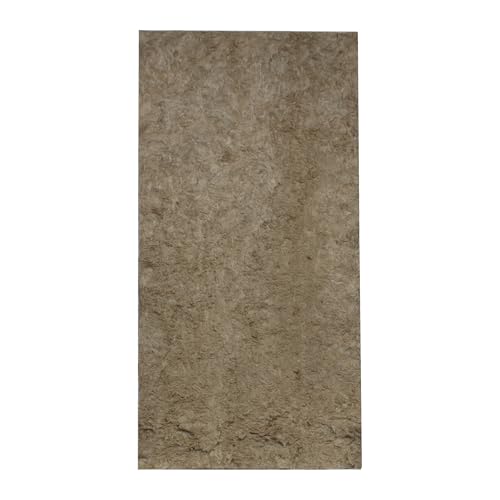
An insulation product like AFB Acoustical Fire Batts belong inside an open stud or joist cavity as the absorptive layer in the assembly. They help the system perform better, but by themselves they are not the same thing as hanging an acoustic panel on the finished wall.
AFB Acoustical Fire Batts
Why Do People Confuse These Two So Often?
Because the marketing language overlaps. Products labeled “soundproof foam” are actually acoustic treatment.
Products sold as “acoustic panels” are sometimes foam absorbers and sometimes mass-based barriers. The word “acoustic” gets applied to both categories, and buyers who do not know the difference end up buying the wrong product for their problem.
There is not really a simple soundproofing equivalent to acoustic foam or acoustic panels. Real soundproofing is usually a layered wall, ceiling, floor, door, or window assembly rather than a decorative surface product you hang like treatment.
The simplest test is this: if the product is lightweight, porous, and designed to hang on the wall surface, it is probably treatment. If it is heavy, dense, and designed to go behind the wall or between layers, it is probably soundproofing.
Which Is Better: Acoustic Treatment Or Soundproofing?
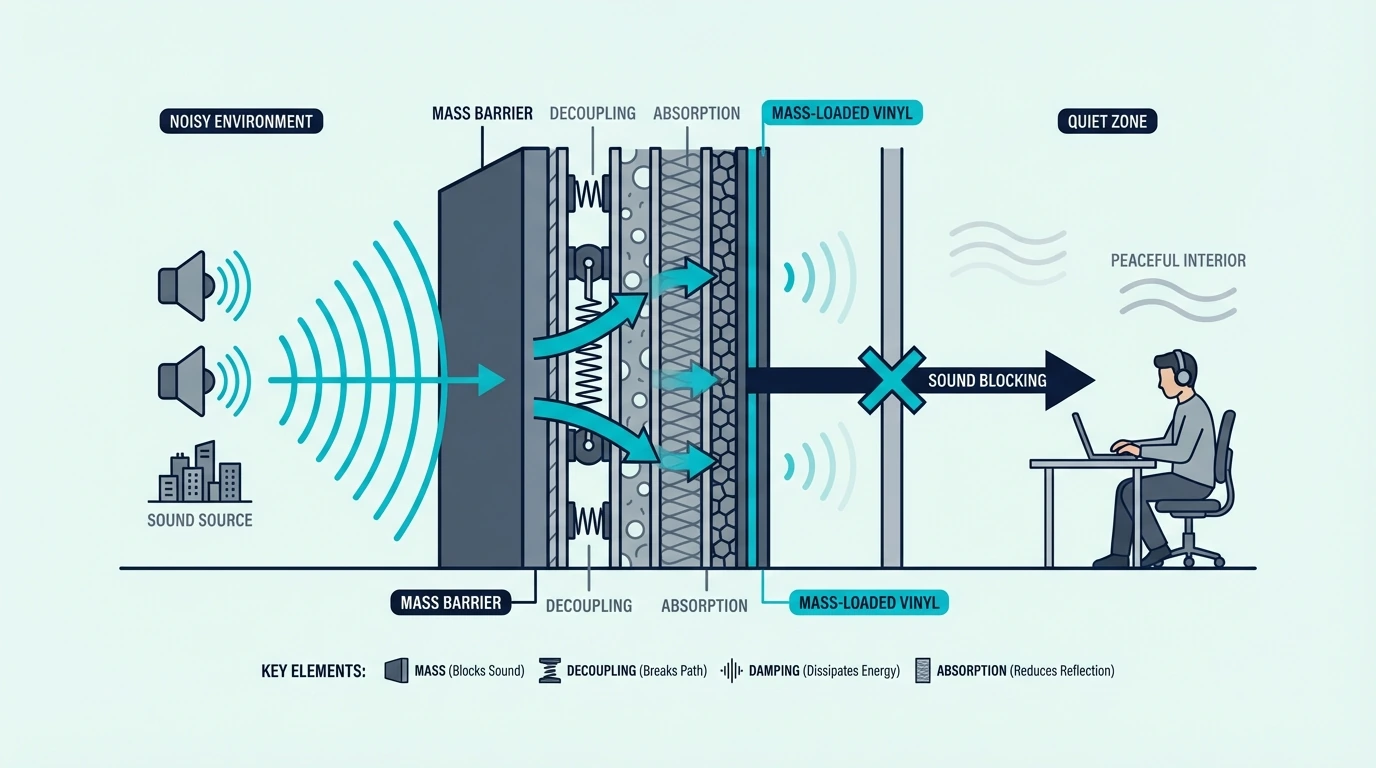
Neither is better in general. The right choice depends entirely on the problem you are trying to solve.
Which One Helps More With Echo And Harsh Reflections?
Acoustic treatment. If the room sounds echoey, boomy, harsh, or muddy — especially during recording, video calls, or music listening — treatment is the fix.
Panels, bass traps, and diffusers change the internal acoustic character of the room without affecting how much noise travels through the walls.
This is the most common need in home studio acoustic treatment, podcast setups, conference rooms, and home theater acoustic treatment where the quality of sound inside the room matters more than blocking sound from outside.
Which One Helps More With Neighbors And Outside Noise?
Soundproofing. If the problem is hearing your neighbor’s TV, traffic through the window, or footsteps from upstairs, no amount of acoustic treatment will fix it because the noise is entering the room through the structure, not bouncing around inside.
For neighbor and outside noise problems, the fix is always mass, sealing, decoupling, or some combination of those — not foam panels or fabric absorbers. Soundproofing a wall, soundproofing a door, and soundproofing windows are the relevant starting points depending on where the noise enters.
When Do You Need Both?
You need both when you want to keep sound from leaving the room (soundproofing) and you also want the room to sound good inside (treatment). A home recording studio is the most common combined-use case because it needs isolation from outside noise and controlled internal acoustics for accurate monitoring.
In that scenario, the soundproofing goes first — mass, sealing, and decoupling in the walls, ceiling, and door. Then the treatment goes on the inside surfaces to control reflections and clarity.
Doing it in the opposite order (treatment first, soundproofing never) is the mistake that leads to a room that sounds great inside but still leaks noise in both directions.
Get Studio Tips Weekly
Join 5,000+ creators getting acoustic treatment advice every week.
No spam. Unsubscribe anytime.What Are The Most Common Misconceptions?
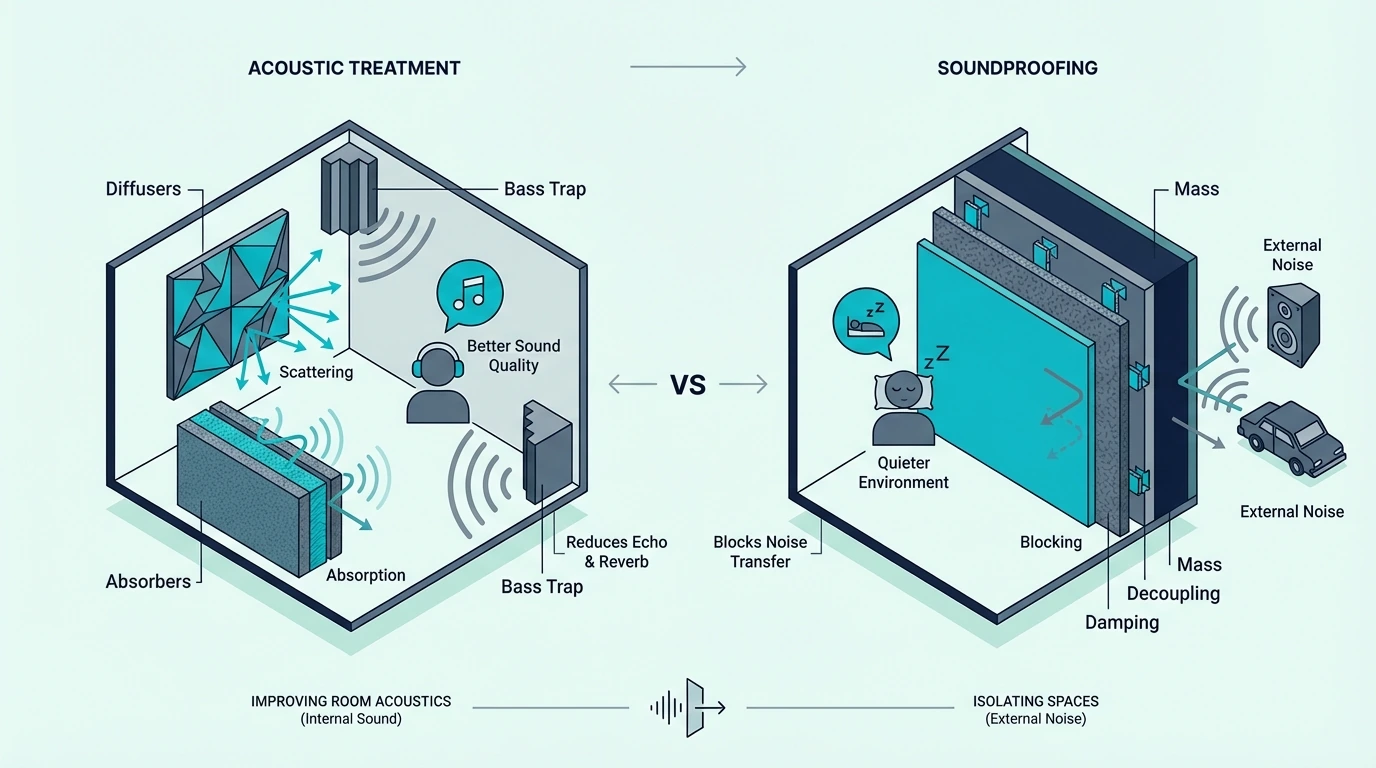
Most acoustic product complaints come from misconceptions rather than product failures.
Why Don’t Acoustic Panels Soundproof A Room?
Because acoustic panels are porous and lightweight. They absorb sound energy inside the room, but they do not add enough mass to block sound from passing through the wall behind them.
Hanging foam on a shared wall will make the room sound less echoey inside, but the neighbor’s TV will be just as audible.
This is the most expensive mistake in the category because buyers often buy enough panels to cover an entire wall expecting isolation, then discover that the noise has not changed at all.
Why Doesn’t Soundproofing Automatically Improve Room Acoustics?
Because soundproofing adds mass and isolation to the structure, not absorption to the room surfaces. A room with double drywall, MLV, and resilient channels will be much quieter from outside noise, but it can still sound echoey and harsh inside if the interior surfaces are all hard and reflective.
That is why recording studios treat both problems separately. The soundproofing keeps noise out and sound in, and the treatment makes the internal sound accurate and comfortable.
Why Can A Room Feel Better Without Actually Blocking More Noise?
Because reducing echo and reflections inside the room lowers the perceived noise level even though the actual transmission has not changed. When a room has less reverberant buildup, sounds feel quieter and cleaner, which can make outside noise seem less intrusive even though the same amount of energy is still entering.
This is useful to understand because it means acoustic treatment can sometimes improve comfort enough that full soundproofing becomes unnecessary. If the room feels better after treatment and the remaining noise is tolerable, you may not need to spend on isolation at all.
How Should You Choose Between Acoustic Treatment And Soundproofing?
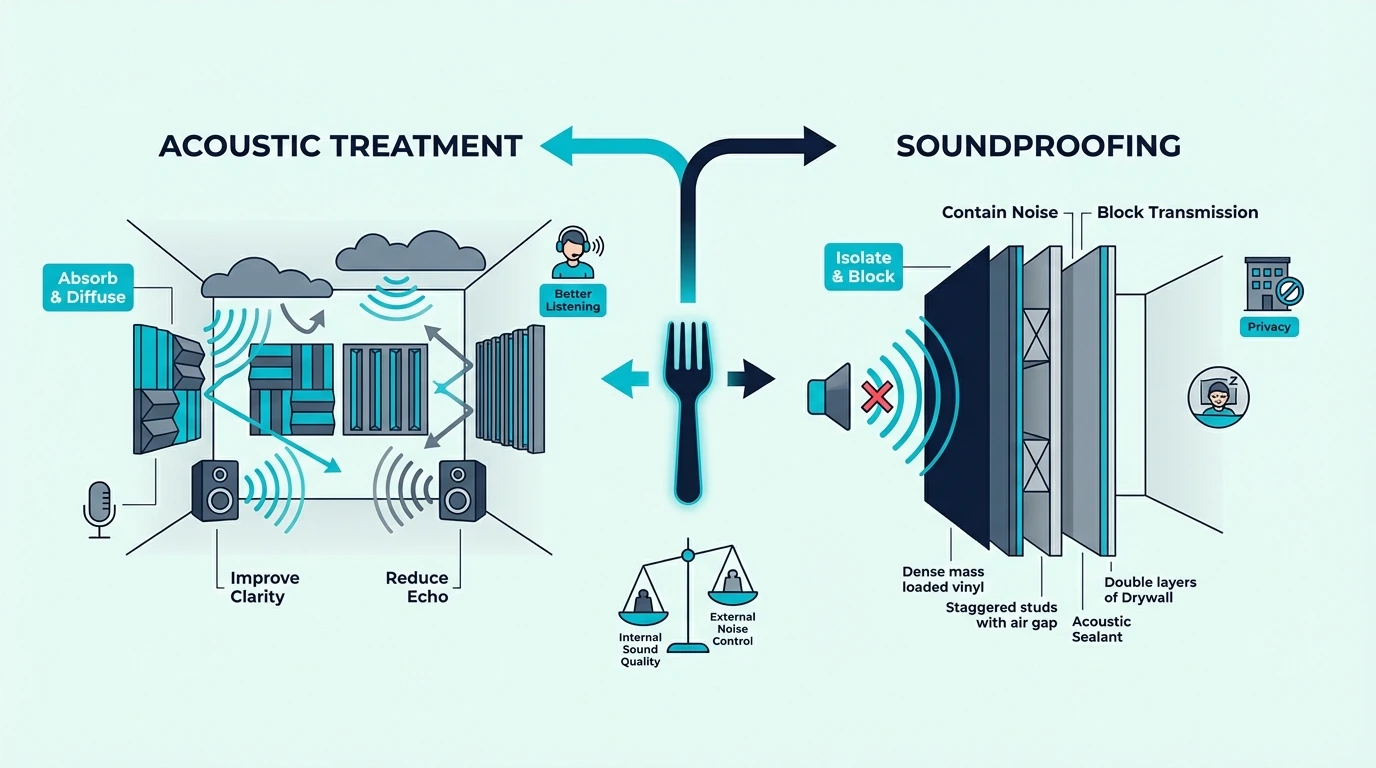
The decision starts with the problem, not the product.
Are You Mixing, Recording, Sleeping, Or Blocking Neighbors?
If you are mixing or recording, you almost certainly need treatment and may also need soundproofing. If you are sleeping, working from home, or trying to block neighbor noise, you need soundproofing and probably do not need treatment.
For budget-conscious testing, a small MLV barrier like TroyStudio High Density Mass Loaded Vinyl over the weakest surface can confirm whether soundproofing is what you actually need before investing in a bigger project.
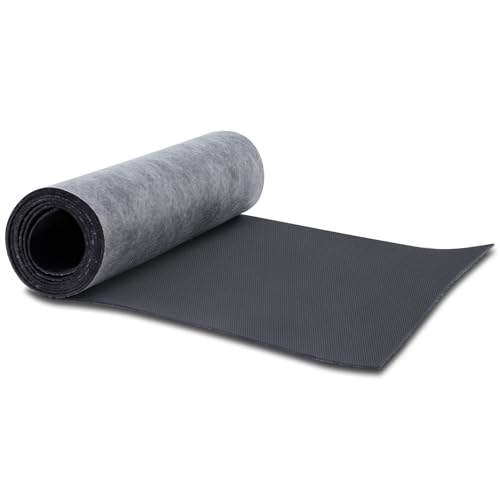
TroyStudio High Density Mass Loaded Vinyl
What Is The Budget Difference?
Treatment is usually cheaper. A set of panels or foam tiles for a small room can cost under two hundred dollars and be installed in an afternoon.
Soundproofing can cost from a few hundred for basic sealing and a solid door up to several thousand for wall and ceiling mass-and-decouple assemblies.
That budget difference often drives the decision in practice. Many buyers start with treatment because it is accessible and affordable, then add soundproofing later if the noise problem turns out to be the bigger issue.
What Is The Best Order To Tackle These Problems?
If you need both, do soundproofing first. Mass, sealing, and decoupling go into the structure before the finish surfaces are applied.
Treatment goes on the room surfaces after the structure is complete.
If you only need one, start with the one that matches your primary complaint. Echo and clarity issues point to treatment.
Noise transfer issues point to soundproofing. If you are not sure, compare the problem against does soundproof foam work, best soundproofing material, and acoustic treatment placement before you spend more money.
Treatment is cheaper and reversible, while soundproofing is slower and structural. That difference usually tells you whether the remaining problem is internal acoustics or external transmission.
Compare your situation with the broader soundproofing hub and how much acoustic treatment you need so you can match the right approach to your specific room and budget.
The Bottom Line
Acoustic treatment vs soundproofing is not a competition between two products. It is a distinction between two entirely different problems.
Treatment fixes how a room sounds inside. Soundproofing fixes how much noise travels in or out.
On the treatment side, think acoustic foam, fiberglass or mineral-wool panels, bass traps, ceiling clouds, and diffusers. On the soundproofing side, think drywall mass, MLV, Green Glue, AFB or Owens Corning-type cavity fill, clips, channels, doors, and seals working together as one assembly.
Buying the wrong one wastes money and leaves the original problem exactly where it was.
For most buyers, the decision is straightforward: if the complaint is echo, harshness, or poor audio quality, treatment is the answer. If the complaint is neighbor noise, traffic, or sound leaking between rooms, soundproofing is the answer.
And if you need both, do the soundproofing first so the treatment has a quiet, stable room to work with.
Frequently Asked Questions
What’s the difference between soundproofing and acoustic treatment?
Soundproofing reduces how much noise passes between spaces by adding mass, decoupling, and sealing to the barriers. Acoustic treatment improves how the room sounds inside by controlling reflections and echo with absorbers, bass traps, and diffusers.
Can acoustic treatment reduce neighbor noise?
Not in the way most buyers mean it. Acoustic treatment can make a room feel calmer by reducing reflections and reverberant buildup, but it does not meaningfully block sound transmission through walls, ceilings, doors, or windows.
If the real complaint is neighbor noise, you usually need soundproofing instead.
Do you need both acoustic treatment and soundproofing in a home studio?
Often, yes. Soundproofing helps keep outside noise out and prevents your own sound from leaking, while acoustic treatment helps the room sound more accurate and less echoey inside.
If you only choose one, pick the one that matches the main problem you are hearing right now.