What Are Sound Diffusers Made Of (Commercial vs DIY Material Breakdown)
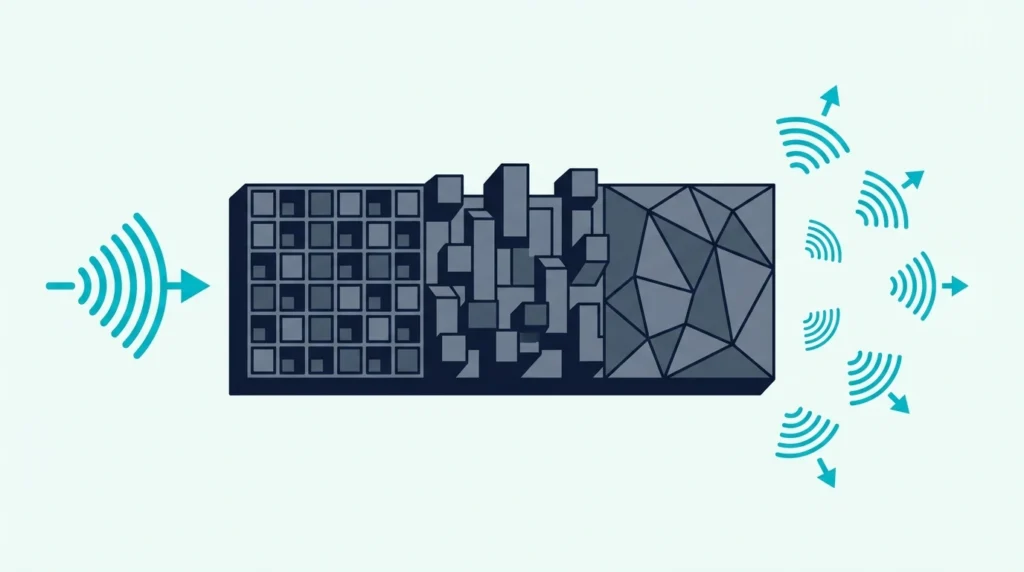
What are sound diffusers made of comes down to how rigid and reflective the material is, but most people assume diffusers use the same soft, porous materials as acoustic foam panels — which is the exact opposite of what a diffuser needs.
The wrong material causes reflections to absorb instead of scatter — turning your diffuser into an expensive foam panel that deadens the room rather than controlling it. Acoustic foam absorbs sound energy through porous fibers, which is the opposite of what a diffuser needs.
A diffuser must bounce sound waves off a hard surface shaped with precise well depths or block heights. Soft materials defeat the purpose entirely.
Knowing what commercial diffusers actually use helps you evaluate products accurately and choose materials that scatter sound waves cleanly instead of absorbing them or resonating at unwanted frequencies.
Below, you’ll see what major brands build their diffusers from, which materials work for DIY builds, and why 3D-printed options are gaining traction.
Commercial sound diffusers are made from hardwood (oak, maple), MDF with veneer, thermoformed plastic, or expanded polystyrene (EPS). Hardwood delivers the cleanest reflections due to its density and rigidity. Budget diffusers use plastic or foam composites that work for high frequencies but flex at lower frequencies. DIY builders typically use Baltic birch plywood or 3D-printed PLA/PETG.
What Are Sound Diffusers Made Of — And Why Does Material Matter?
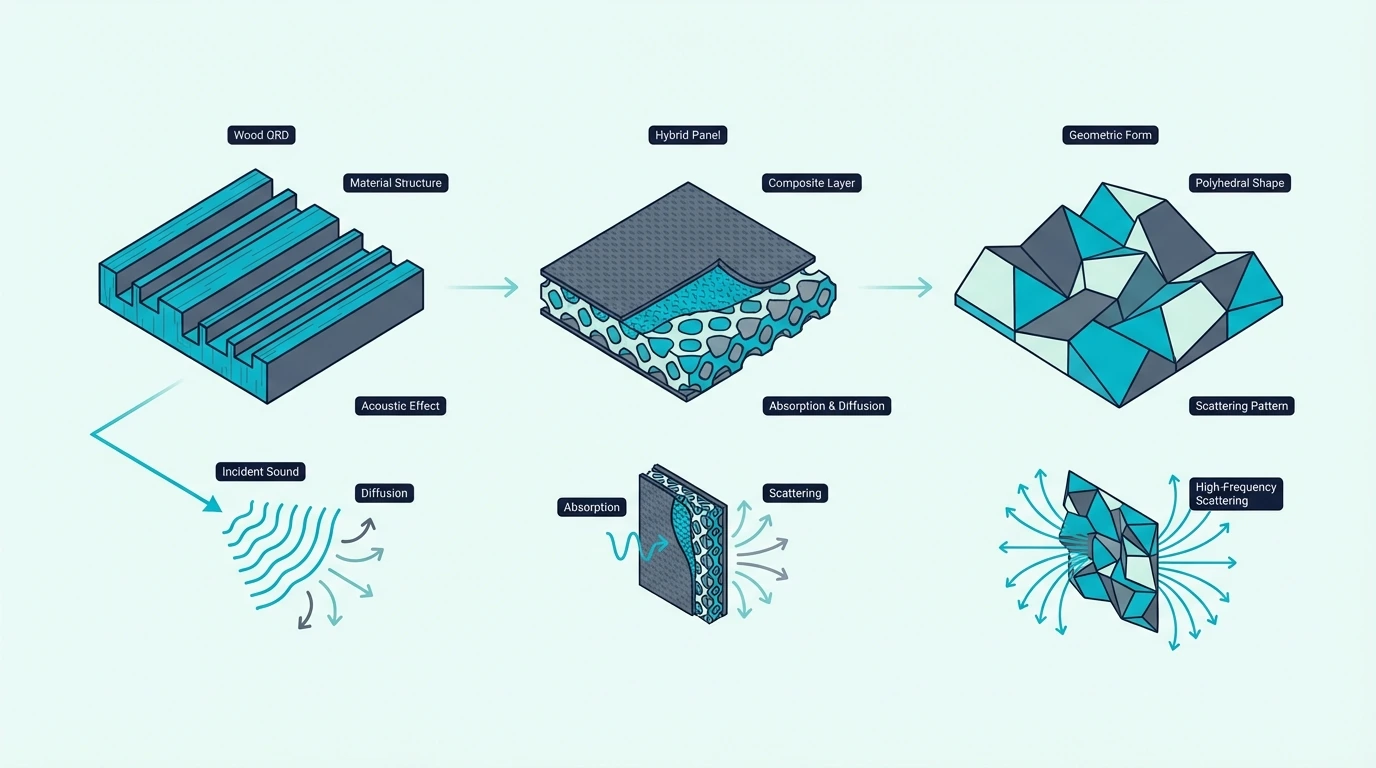
A diffuser scatters sound waves by bouncing them off a rigid surface with varying depths. The material must reflect sound energy cleanly — any flex, porosity, or resonance degrades the scatter pattern.
This is the fundamental difference between diffusion and absorption materials. For how absorption and diffusion differ at the physics level, that guide explains why porous and rigid materials serve opposite acoustic purposes.
The Importance Of Material Rigidity
A diffuser panel that flexes under sound pressure acts as a membrane absorber — converting acoustic energy into mechanical vibration instead of reflecting it. The result is a panel that absorbs low-mid frequencies rather than scattering them.
Rigidity is measured by the material’s modulus of elasticity. Hardwoods like oak and maple have high modulus values, which is why they reflect sound waves with minimal energy loss.
Softwoods like pine and cedar have lower modulus values and flex more easily under sound pressure. Thin plastics and foam flex even more, which is why they only scatter high frequencies where the wavelengths are short enough that the panel doesn’t vibrate.
The Impact Of Material Density On Sound Diffusion
Denser materials reflect more sound energy across a wider frequency range. A 3/4-inch oak panel reflects frequencies from 500 Hz to 8 kHz with virtually no absorption loss.
A thin plastic panel of the same thickness might only reflect cleanly above 2 kHz — below that, the panel vibrates and absorbs rather than scatters. This is why budget plastic diffusers are marketed for “high frequency treatment” rather than full-range diffusion.
What Are Commercial Diffusers Typically Made From?

Solid Hardwood And MDF Diffusers
Professional-grade diffusers from brands like RPG and Vicoustic use solid hardwood — oak, maple, or walnut machined into precise QRD well patterns or skyline block arrays. The wood’s natural density and rigidity produce the cleanest possible scatter pattern.
The machining process matters as much as the material itself. CNC-routed wells hold tolerances within 1/32 of an inch, which keeps the scatter pattern mathematically accurate across the panel’s design bandwidth.
Mid-range brands use MDF (medium-density fiberboard) or HDF (high-density fiberboard) with wood veneer. MDF is cheaper to machine than solid hardwood and produces consistent results, though it’s heavier and extremely moisture-sensitive.
The veneer finish on MDF diffusers serves two purposes — it protects the fiberboard from humidity damage and provides a harder reflective surface than raw MDF. Without veneer, exposed MDF absorbs a small percentage of high-frequency energy through its porous surface.
The BXI Wood Sound Diffuser (1D QRD) uses solid wood construction with calculated well depths — a good example of what mid-price commercial diffusers are made from. For a deeper comparison of which wood species perform best in diffusers, that guide ranks options by density and cost.
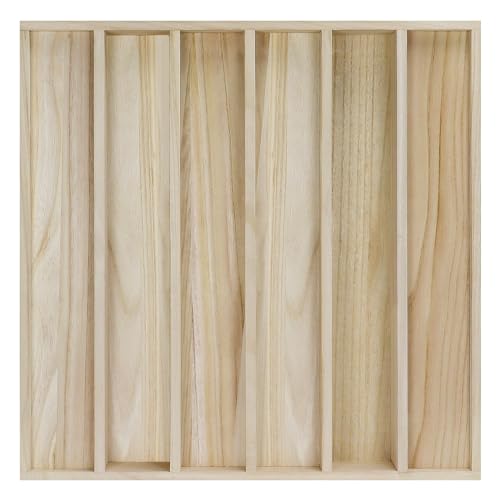
BXI Wood Sound Diffuser (1D QRD)
Thermoformed Plastic And EPS Diffusers
Budget commercial diffusers use thermoformed ABS, HIPS, or expanded polystyrene (EPS). These materials are lightweight, cheap to mold, and can be shaped into complex patterns that would be expensive to machine from wood.
EPS is the same material used in disposable coffee cups and packaging foam — rigid enough at small thicknesses for high-frequency scatter, but too lightweight to reflect anything below 2-3 kHz without flexing.
The tradeoff is frequency range. Plastic and EPS panels typically scatter effectively above 2-3 kHz but flex at lower frequencies.
For rooms where high-frequency flutter echo is the primary problem, plastic diffusers are adequate. For full-range treatment, wood remains the only reliable option at consumer price points.
The EVA Acoustic Diffusers (4-Pack) use rigid EVA foam in a waffle pattern — at $70 for four panels, they demonstrate the cost advantage of non-wood materials. For a full comparison of diffusers across all material types, that roundup ranks options by performance and value.
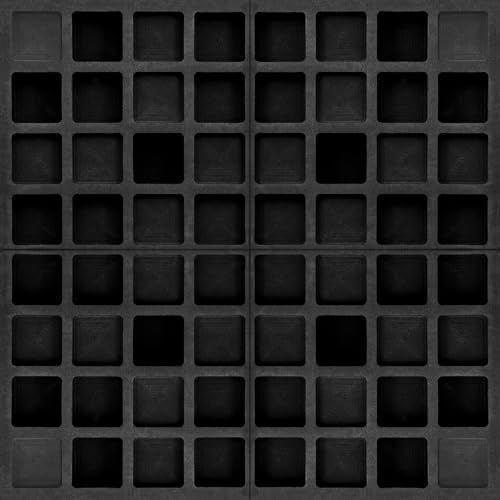
EVA Acoustic Diffusers (4-Pack)
Get Studio Tips Weekly
Join 5,000+ creators getting acoustic treatment advice every week.
No spam. Unsubscribe anytime.Can You 3D Print A Sound Diffuser?
Best Filaments For 3D-Printed Diffusers
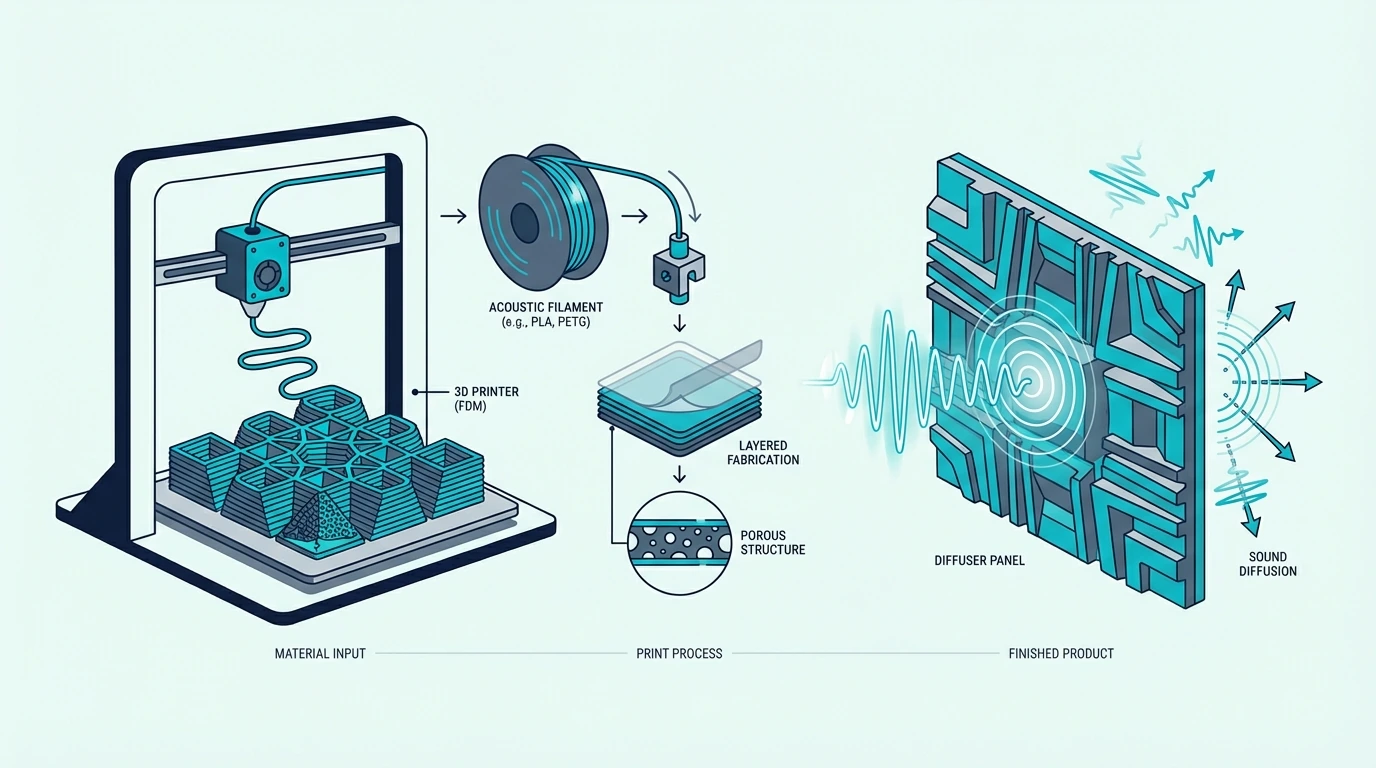
PLA (polylactic acid) is the most common filament for printed diffusers — easy to print, rigid at room temperature, and available in every color. PETG offers better impact resistance and slight flexibility that prevents cracking during mounting.
Both filaments cost $15-25 per kilogram, which yields roughly 2-3 small diffuser sections depending on infill density and wall count. That makes material cost negligible compared to the print time investment.
The critical variable is infill percentage. A 20% infill QRD panel is essentially hollow — it flexes under sound pressure and acts more like a membrane absorber than a diffuser.
Aim for 50-80% infill to achieve the rigidity needed for clean mid-frequency scatter. Higher infill adds print time and material cost, but the acoustic difference between 20% and 60% infill is dramatic.
Wall thickness matters equally. Four or more perimeter walls create a rigid outer shell that maintains the precise well depths or block heights the scatter pattern depends on.
Limitations And Workarounds
Consumer 3D printers max out at 8-10 inches per axis. A standard diffuser panel needs 24 inches of continuous surface — which means printing in sections and tiling them onto a shared backboard.
Larger format printers (like the Creality K1 Max or Bambu X1) expand the per-section size to 12 inches, cutting the number of tiles needed by roughly half. But even with larger printers, multi-section assembly is unavoidable for standard 24-inch panels.
Seams between printed sections create flat spots in the scatter pattern. The workaround is to design interlocking edges or mount sections on a plywood backing with minimal visible gaps.
Some builders print individual blocks and glue them to a plywood base, creating a hybrid skyline diffuser that combines printed precision with wood’s structural mass. This approach also solves the rigidity problem — the plywood base provides the mass while the printed blocks provide the calculated geometry.
For building diffusers from scratch using traditional methods, our DIY wooden sound diffuser guide covers the full process. And for understanding the physics behind why these materials scatter sound, that guide explains how surface shape and material rigidity interact.
The Bottom Line
Commercial diffusers are made from hardwood (premium), MDF with veneer (mid-range), or thermoformed plastic and EPS (budget). The material determines the frequency range the panel can scatter effectively and how long the panel maintains its acoustic properties over time.
For DIY builds, Baltic birch plywood offers the best balance of cost, rigidity, and workability. A single 3/4-inch sheet costs $40-60 and yields enough material for two 24×24-inch QRD panels.
3D-printed PLA/PETG works for custom designs at small scale, provided you use high infill and adequate wall thickness.
Match the material to your acoustic goals. Wood handles full-range diffusion from 500 Hz to 8 kHz.
Plastic and foam cover high frequencies only (2 kHz+). For where to place your diffusers once built or purchased, that guide covers optimal positioning for every room type.
If you’re comparing diffusers against other acoustic treatment options, our diffuser vs acoustic panel guide explains when each approach makes sense for your room.
Frequently Asked Questions
What is the best material for a sound diffuser?
Hardwood (oak or maple) for maximum acoustic performance — dense, rigid, and produces the cleanest reflections. Baltic birch plywood is the best budget alternative with similar rigidity at a fraction of the cost.
Can you 3D print a sound diffuser?
Yes — PLA and PETG both work for small-to-medium diffuser panels. Use 50%+ infill for rigidity, and tile multiple printed sections onto a plywood backboard to achieve standard panel sizes.
How effective are sound diffusers?
Very effective when made from rigid materials and properly sized for the target frequency range. A well-built wood QRD diffuser on the rear wall eliminates flutter echo and comb filtering while preserving the room’s natural energy and spaciousness.