What Materials Diffuse Sound? (Why Rigidity Matters More Than You Think)

What materials diffuse sound depends on one property above all others — rigidity, but most people confuse diffusion materials with absorption materials and end up buying soft, porous panels that do the opposite of what they need.
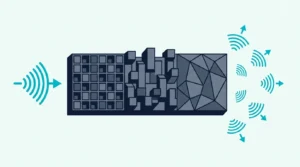
The problem is that absorption and diffusion require completely different material physics. Porous materials like fiberglass and foam absorb sound energy, while diffusion needs a hard, reflective surface shaped with varying depths to scatter sound waves across the room.
Choosing the right material means your diffuser actually redirects reflections evenly instead of deadening the room — so you get controlled liveliness rather than harsh echoes or lifeless silence.
Below, you’ll see which materials work for each diffuser type, from professional hardwoods to budget-friendly alternatives.
Sound diffusion requires hard, rigid materials that reflect sound waves rather than absorb them. Hardwoods (oak, maple) are the professional standard for QRD and skyline diffusers. Baltic birch plywood is the best budget option for DIY builds. Plastic and EVA foam work for lightweight, high-frequency diffusers but lack the mass for full-range scatter.
What Materials Diffuse Sound — And Why Does Material Choice Matter?
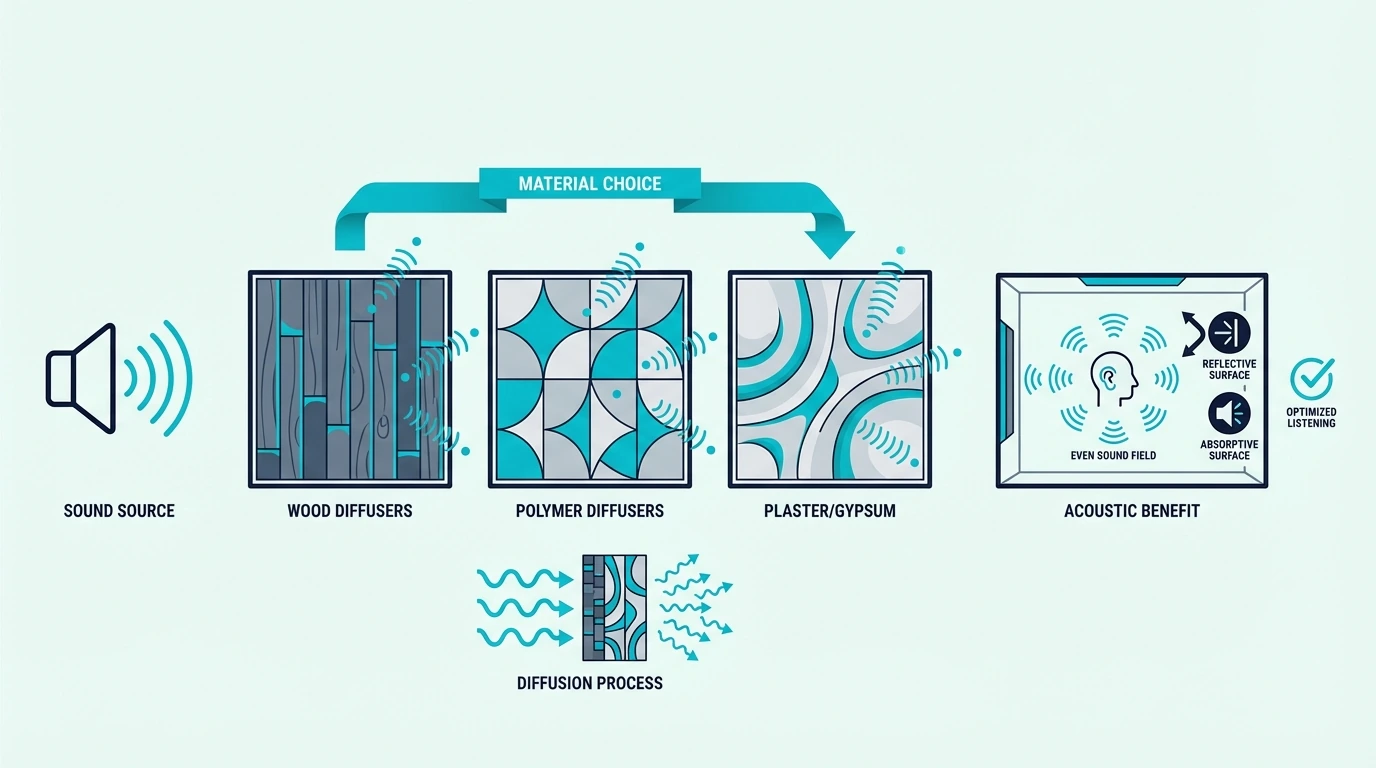
A diffuser works by bouncing sound waves off a rigid surface with varying depths — wells, blocks, or slats arranged in a mathematical sequence. The material’s job is to reflect energy cleanly without absorbing it or flexing under pressure.
If the material is too soft, it absorbs sound energy instead of redirecting it. If it flexes at certain frequencies, the panel resonates and creates coloration — adding its own unwanted tonal character to the scattered reflections.
This is the opposite of what absorption materials do. For how absorption and diffusion differ at the physics level, that guide covers why you need rigid materials for one and porous materials for the other.
The ideal diffusion material is dense, rigid, non-resonant, and machinable into precise shapes. Wood dominates because it checks every box — but it’s not the only option.
Which Woods Are Used For Sound Diffusers?
Hardwoods For Professional Diffusers
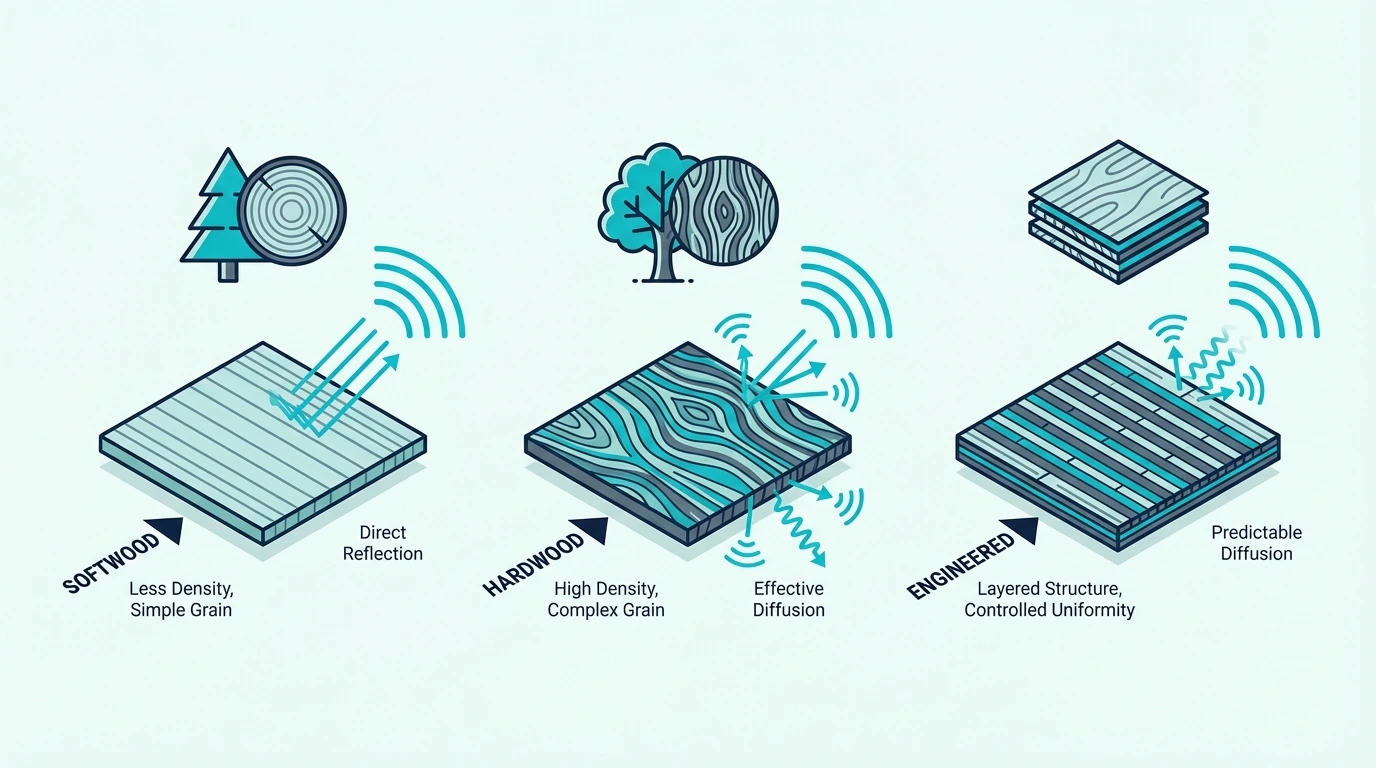
Oak, maple, and walnut are the materials most professional diffuser manufacturers use. Their density (typically 40-50 lbs per cubic foot) ensures clean, predictable reflections without resonance or flex.
Density matters because a low-mass surface vibrates when hit by sound waves — converting acoustic energy into mechanical vibration instead of reflecting it cleanly. Dense hardwoods resist that vibration, which is why they produce tighter, more controlled scatter patterns than softwoods like pine or cedar.
Hard maple is the gold standard — its tight grain structure and high density produce the most neutral reflections. White oak is a close second with the added benefit of moisture resistance.
Walnut offers a warmer aesthetic with similar acoustic performance. For a detailed comparison of which wood species perform best in diffuser construction, that guide ranks options by density, workability, and cost.
Plywood And MDF For Budget Builds
Baltic birch plywood is the DIY diffuser builder’s best friend. Its cross-laminated layers resist warping, and the consistent density produces clean reflections across the panel surface.
A 3/4-inch Baltic birch sheet costs $40-60 at most lumber yards — enough material for two 24×24-inch QRD panels. That’s a fraction of what pre-built wood diffusers cost for equivalent coverage.
MDF (medium-density fiberboard) is cheaper per sheet but heavier and extremely moisture-sensitive. A single exposure to humidity can swell MDF enough to change the well depths — which shifts the scatter pattern off its calculated frequencies.
For either material, seal the surface with polyurethane to maximize reflectivity. Raw wood absorbs a small percentage of high-frequency energy — a sealed surface keeps those reflections clean.
Our DIY wooden sound diffuser guide covers the full build process using both plywood and hardwood.
Get Studio Tips Weekly
Join 5,000+ creators getting acoustic treatment advice every week.
No spam. Unsubscribe anytime.What Types Of Acoustic Diffusers Use Different Materials?
QRD And Skyline — Wood Construction
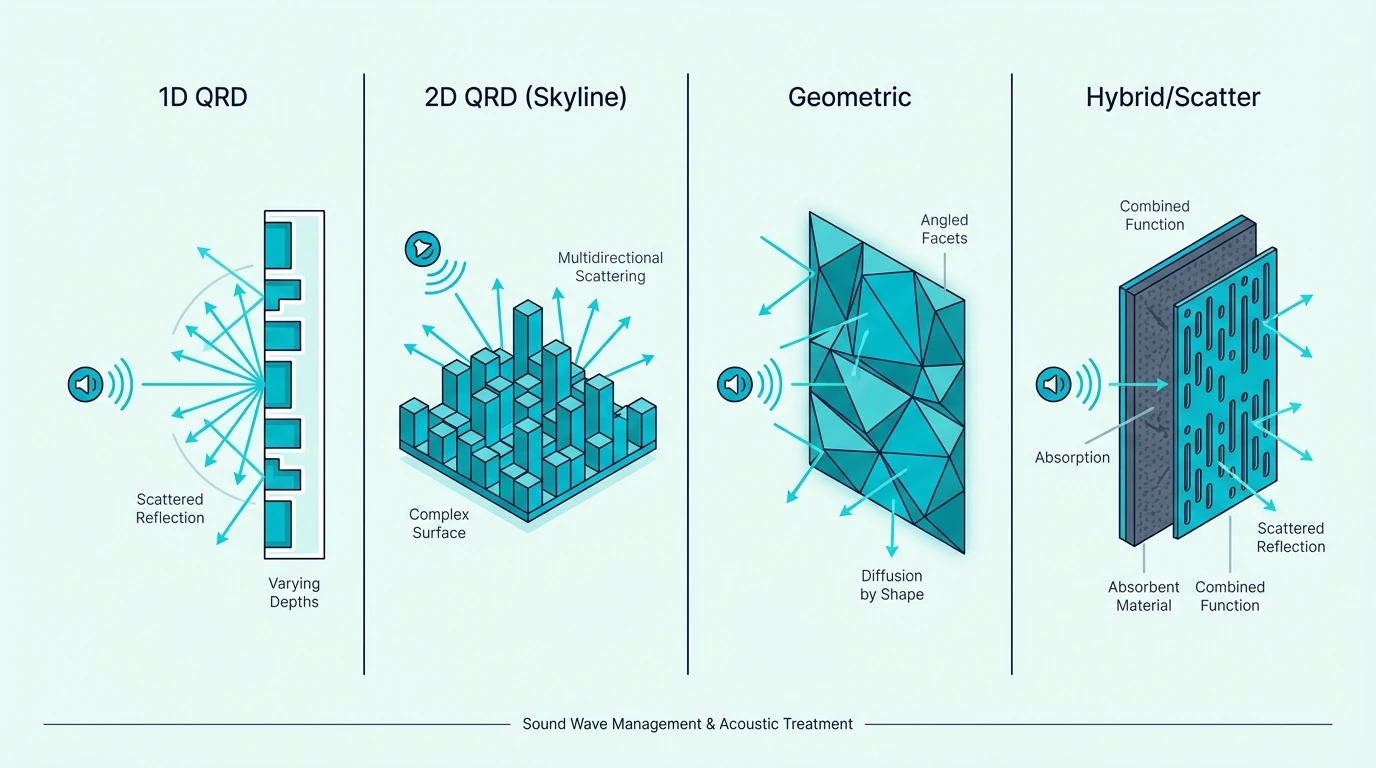
QRD (Quadratic Residue Diffuser) panels use a series of wells at mathematically calculated depths, carved or assembled from wood. The well depths follow a prime-number sequence that ensures even scattering across the design bandwidth.
The wood must hold tight tolerances during machining — router passes that chip or splinter change the effective well depth. This is another reason hardwoods and quality plywood outperform softwoods for QRD construction.
Skyline diffusers use blocks of varying heights glued to a backboard. Both designs require wood rigid enough to maintain precise dimensions — even a 1/8-inch deviation in well depth shifts the target frequency by 50-100 Hz.
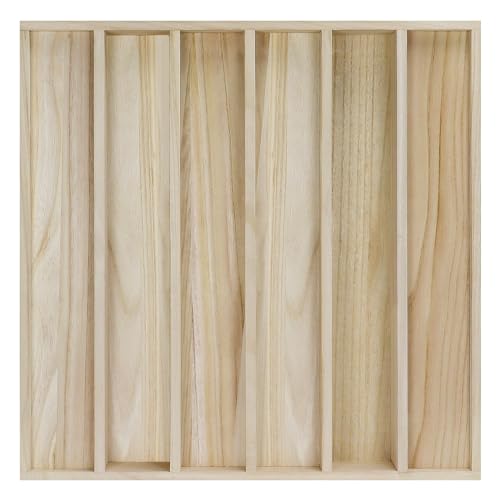
The BXI Wood Sound Diffuser (1D QRD) is a solid-wood example — calculated well depths in a 24×24-inch panel that scatters mid-frequency energy across a wide horizontal arc.
BXI Wood Sound Diffuser (1D QRD)
Polycylindrical And Curved — Wood Or Plastic
Polycylindrical diffusers use a curved surface to scatter sound across a broader arc than flat-faced designs. The curve can be formed from bent plywood (steam-bent or kerfed) or thermoformed plastic.
These designs trade precision for coverage — they scatter more evenly across a room but can’t target specific frequency ranges as precisely as QRD panels. Concert halls and auditoriums use curved architectural elements for exactly this reason.
Slat-style diffusers bridge the gap between curved and well-based designs. Wood slats at varying depths scatter mid-high frequencies while delivering a modern aesthetic that works in living spaces and studios alike.
For how diffusers compare to absorption panels, that guide covers when each treatment type is the right choice.
EPS And Thermoformed Plastic
Expanded polystyrene (EPS) and thermoformed ABS/HIPS are the materials behind most budget commercial diffusers. They’re lightweight, cheap to manufacture, and can be molded into complex shapes that would be difficult or expensive to machine from wood.
The main advantage of plastic is cost per unit. A thermoformed diffuser panel costs roughly half the price of an equivalent wood panel, making it practical to cover larger wall areas on a tight budget.
The tradeoff is mass. Lightweight plastic panels may flex at lower frequencies, which means they absorb low-mid energy instead of scattering it.
This limits their effective range to roughly 2 kHz and above. For rooms where only high-frequency flutter echo is the problem, that’s sufficient — but studios needing full-range scatter should stick with wood.
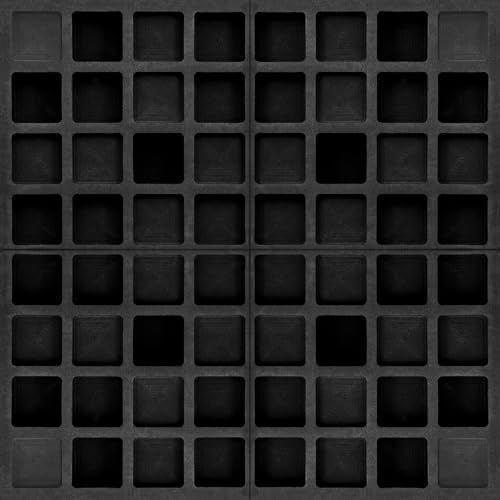
The EVA Acoustic Diffusers (4-Pack) use rigid EVA foam in a waffle pattern — effective for high-frequency scatter at a fraction of wood panel prices, though they won’t match solid wood for full-range diffusion.
EVA Acoustic Diffusers (4-Pack)
3D-Printed Diffusers
PLA and PETG filaments with high infill percentages (80%+) produce rigid enough surfaces for mid-to-high frequency diffusion. Open-source QRD and skyline STL files are available online, making custom designs accessible to anyone with a printer.
The material cost per panel is low — a few dollars of filament versus $30-70 for an equivalent wood build. The tradeoff is print time, which can run 20-40 hours per panel section depending on size and infill.
The limitation is build volume. Most consumer 3D printers max out at 8-10 inches per axis — far smaller than the 24-inch panels needed for effective mid-frequency scatter.
Tiling multiple printed sections introduces seams that can disrupt the scatter pattern. Some builders work around this by printing modular blocks that mount to a shared plywood backboard — combining printed precision with wood’s structural rigidity.
For the physics behind why these materials work, that guide covers how surface shape and material rigidity interact to create controlled scattering.
The Bottom Line
Wood is the default diffuser material for good reason — dense, rigid, machinable, and aesthetically versatile. Hardwood for professional builds, Baltic birch plywood for budget DIY.
Plastic and foam alternatives work for high-frequency scatter but lack the mass for full-range diffusion below 2 kHz. 3D-printed panels are a growing option for custom designs, limited mainly by printer build volume.
Match the material to the frequency range you need to treat. Wood handles everything from 500 Hz to 8 kHz depending on well depth.
Plastic and foam cover 2 kHz and above. Natural diffusion from bookshelves and irregular surfaces scatters unpredictably but costs nothing.
For where to place your finished diffusers, that guide covers rear wall, ceiling, and first reflection point positioning. And our best sound diffusers roundup compares the top pre-built options across all material types.
Frequently Asked Questions
What materials are used to diffuse sound?
Hard, rigid materials — primarily wood (oak, maple, plywood), rigid plastics (ABS, HIPS), and dense foam composites (EVA). The key requirement is that the surface reflects sound waves rather than absorbing them, so porous materials like fiberglass and open-cell foam are excluded.
What is an example of sound diffusion?
A QRD panel on the rear wall of a recording studio scatters reflections into a diffuse wash instead of a focused echo. Concert halls achieve the same effect naturally through ornate moldings, coffered ceilings, and irregular wall surfaces.
What is the best material for a sound diffuser?
Hard maple or white oak for maximum acoustic performance and durability. Baltic birch plywood for budget builds — it’s rigid, stable, and costs a fraction of hardwood. Seal either surface with polyurethane to maximize reflectivity.