Soundproofing

Soundproofing starts with where the noise is getting through.

Acoustic treatment improves sound inside a room. Soundproofing keeps sound from moving between rooms. Different physics, different products, different build scopes — but most advice blurs them together.

This hub keeps the line clear. Learn how sound travels, find the weak point, then choose the right path: renter fixes, owner upgrades, or a serious isolation build. We'll also flag purchases that won't solve the job.

Stage 1 — Direction

Keep sound in? Or keep sound out?

First, choose the direction. Are you keeping noise in — drums, studio, theatre — or keeping noise out — neighbours, traffic, roommates? The weak points can look similar, but the priorities change.

Keep sound IN

Drums, studio, home theatre.

You're generating the noise.

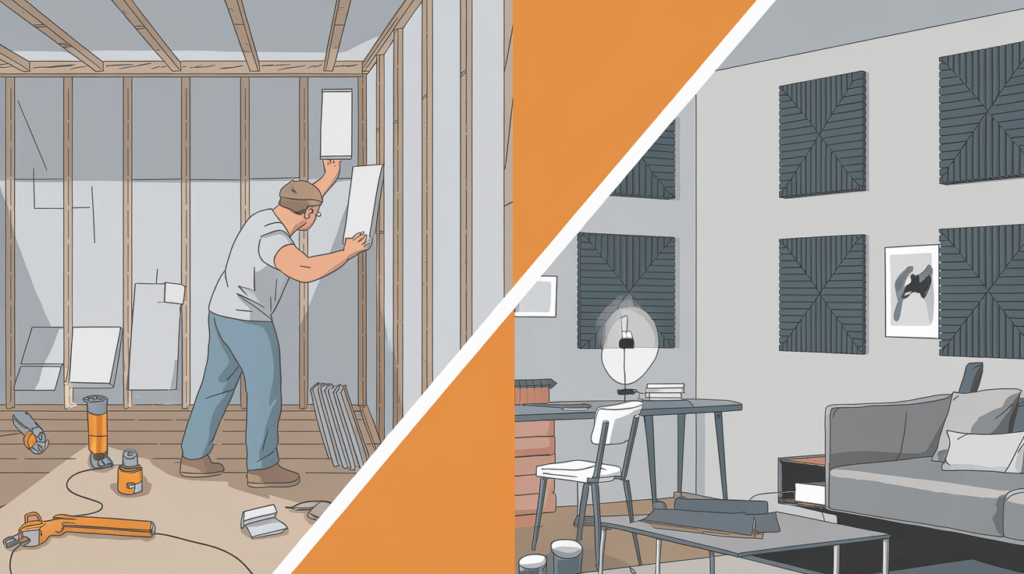
The pressure is trying to leave through walls, floors, ceilings, ducts, and the door jamb. Mass and decoupling lead the plan — a limp wall vibrates, so you make it heavier, and a rigid wall transmits everything, so you break the path. Low frequencies are the main villain, and they demand the most serious build scope.

What it usually takes Double drywall + Green Glue, resilient channels, dense insulation, an acoustic door, a floating floor if drums are involved.
Build reality A room-level plan with construction layers, sealed openings, and a door that earns the wall around it.
How to keep sound inside a room
Keep sound OUT

Neighbours, traffic, roommates.

Someone else is generating the noise.

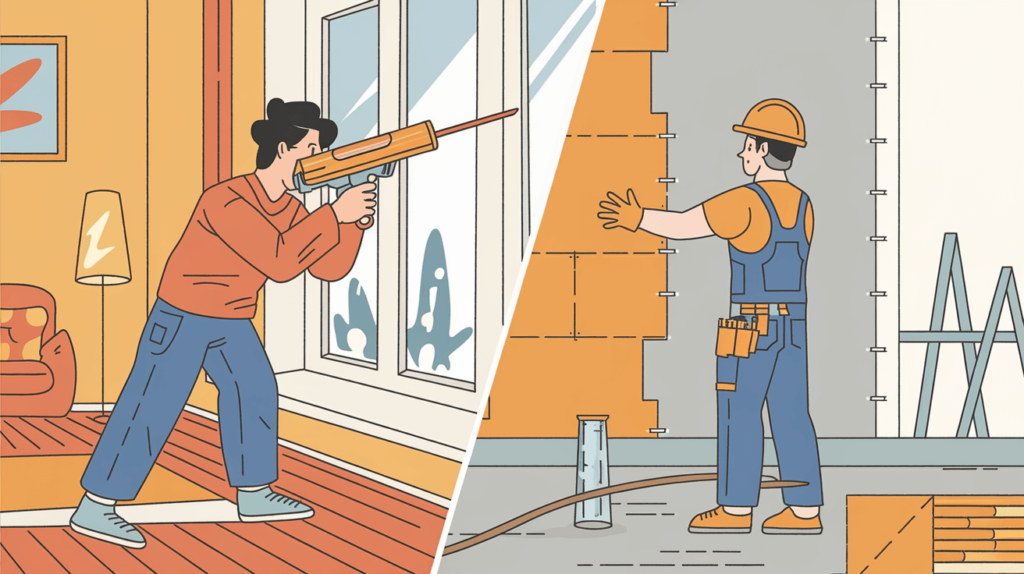
Your job is to find the leak. Most intrusion noise enters through the weakest element in an assembly — an unsealed door, a single-pane window, a thin wall, an open vent. Sealing wins before rebuilding does, and in many rental situations sealing is all you get.

What it usually takes Door sweeps and weatherstripping, thick curtains or window inserts, bookshelf walls, sealed outlet boxes, vent baffles.
Best first move Map the leak path before buying anything: door gaps, window panes, outlets, vents, then the wall itself.
How to block outside noise
Stage 2 — The five laws

Soundproofing is essentially just five things.

Soundproofing can look complicated, and there is a lot of false information online. But the real fixes keep coming back to the same five principles: add mass, seal leaks, damp vibration, decouple structures, and absorb energy where it actually helps.

Mass

Heavier walls lose less sound.

Sound is pressure. The heavier a surface is, the less it moves under that pressure, and the less energy passes through to the other side. Doubling the mass of a wall reduces transmission by roughly 5 dB across the board. This is why every serious soundproof wall is double drywall, and why 5/8-inch rock outperforms 1/2-inch.

Double drywall QuietRock MLV Cement board
The mass law, in plain English

Damping

Turn vibration into a tiny amount of heat.

Sandwich a viscoelastic layer between two sheets of drywall and the layer shears as the wall vibrates, converting the energy to heat. That's Green Glue. It's only one product in the plan, but it adds real STC points — especially in the mid and low-mid range where mass alone struggles.

Green Glue QuietRock 530 CLD sheets
Does Green Glue actually work?

Decoupling

Break the path and the sound stops travelling.

If the drywall on your side is rigidly screwed to the same studs as the drywall on the neighbour's side, every vibration in one surface rides the stud straight into the other. Decoupling introduces a soft break — a resilient clip, a separate stud wall, a floating floor — so vibration can't cross. It's the single biggest lever for low-frequency isolation.

Resilient channels RSIC clips Staggered studs Floating floors
Why decoupling beats mass alone

Absorption

Fill the cavity so the wall isn't a drum.

The hollow cavity inside a wall is its own resonator. Stuff it with dense mineral wool or fibreglass batts and you absorb the air-cavity resonance, which is usually responsible for the mid-frequency dip in any stud wall's isolation curve. This is a support layer, not the whole plan — and the one most people confuse with acoustic foam, which goes inside a room, not inside a wall.

Rockwool Safe'n'Sound Owens Corning 703 Dense-pack cellulose
Best insulation for soundproofing

Sealing

Air is sound. Gaps ruin everything else.

An unsealed 1 % air gap lets through 50 % of the sound — which is why a premium wall with an untreated door is still leaky. Sealing isn't a product, it's a discipline: every perimeter, every outlet, every vent, every gap at the top plate gets acoustic caulk, weatherstrip, or a sweep. It is also the best first move for renters because it works without changing the room.

Acoustic caulk Door sweeps Weatherstripping Outlet putty pads
The sealing checklist
Stage 3 — Your room

Different rooms face different noise problems.

The five laws stay the same, but the plan changes when you are renting, trying to sleep, protecting call privacy, working around hard kitchen surfaces and plumbing, or dealing with concrete and outdoor noise. Choose the space closest to yours, then use the next stage to find the exact weak point inside it.

Use the building to choose the room first. If the weak point is already obvious, jump by leak path below.
Stage 4 — Surfaces

Every surface leaks sound differently.

After you know the direction, the five principles, and the room, zoom into the surface: door, window, wall, ceiling, floor, vent, outlet, or pipe. A gap needs sealing. A shared wall may need mass and damping. A ceiling or floor may need decoupling. Understand the surface first, then the fix starts making sense.

Stage 5 — Source, noise, fix

Find the source. Name the noise. Fix the weak point.

Use this as the buying order after the room diagnosis. Find the entry point, identify whether the noise is airborne or impact, try the least invasive fix that could actually help, then move to doors, windows, walls, floors, or ceilings only when the cheaper step fails.

Airborne / impact / flanking Diagnose before buying

Locate the entry point before you buy anything.

Stand in the room and ask where the noise is actually getting in. A door gap, window crack, outlet, vent, or shared cavity can make a room feel weaker than the wall itself. If you skip this step, you can add mass in the wrong place while the real leak stays open.

Airborne: voices, TV, music, traffic, barking.

Impact / vibration: footsteps, bass, scraping, upstairs thuds — not a curtain problem.

Airborne leaks Cheapest real fix

Seal the leaks you can see, feel, or shine light through.

For door gaps, window edges, thresholds, trim cracks, vents, and outlets, the first real fix is sealing. This is not glamorous, but it is often the highest-return move because even a heavy wall fails when air leaks stay open.

Use this when: sound feels like it is coming around an opening, not shaking through the whole structure. Start with door sweeps, weatherstripping, better seals, removable caulk where appropriate, and obvious leak control.

Airborne Temporary fixes

Try temporary soundproofing before permanent work.

If sealing helps but the room is still uncomfortable, try fixes you can remove later. Window inserts, heavy curtains, soundproofing blankets, and rugs can reduce some everyday noise without opening the room. They are useful when permanent work is off-limits, but they will not fix a ceiling impact problem or a wall that needs rebuilding.

Use this when: the noise is coming through a window, light door, practice corner, or shared surface you cannot change yet. Stop here if the room becomes livable.

Landlord approval Airborne Door / window soundproofing

Soundproof the door or window the noise is coming through.

If most of the noise is still coming through one door or window, treating every wall is usually the wrong next move. A hollow-core door, loose frame, thin glass, or tired window seal can keep letting sound in even after the room feels improved elsewhere.

Use this when: sealing helped, but the noise still points to one door or window. Renters can bring that specific fix to the landlord; owners can price it before committing to walls or ceilings.

Not renter-friendly Airborne through walls Heavier layers

Soundproof the wall, ceiling, or floor when the noise is still coming through.

If gaps are sealed and the door or window is not the main problem, the wall, ceiling, or floor may need a heavier fix. That can mean extra drywall, damping compound between layers, insulation inside open cavities, or better edge details.

Permission + budget gate: this usually means fastening new layers, opening cavities, changing materials, or paying a contractor. Do it only when noise is still coming through the wall, ceiling, or floor after the easier leaks are dealt with.

Not renter-friendly Impact / vibration Separation

Use separation when the noise is footsteps, thuds, or vibration.

Impact noise is different. If footsteps from above, dropped objects, bass vibration, or floor/ceiling thuds are the problem, the noise is traveling through the structure. Soft layers may reduce the feel, but curtains or blankets will not isolate it. Real isolation needs underlayment, isolated ceilings, better floor buildup, or a full room plan.

Permission + budget gate: renters usually start with rugs and communication, then ask what the landlord can change. Owners should price separation only when the problem is severe enough to justify floor, ceiling, or framing work.

Stage 6 — Reality check

Soundproofing is not sound treatment.

Sound treatment makes a room less echoey inside. Soundproofing stops noise from getting in or out. Foam, panels, rugs, and curtains can help a room feel calmer, but they will not block voices, traffic, footsteps, or bass unless the real leak, lightweight surface, or vibration path is fixed.

Claim

Acoustic foam soundproofs a room.

Reality

The single most-sold lie in the category. Acoustic foam absorbs reflections inside a room so it sounds less echoey. It has almost no mass and no damping, so it barely changes how much sound travels between rooms. If a product says “soundproof foam”, assume it means “mildly treatment-y foam”.

Claim

MLV (mass-loaded vinyl) is a miracle layer.

Reality

Not on its own. MLV is genuinely useful as a mass layer inside a wall assembly — behind drywall, under flooring, over a ceiling before you close it up. Stapling a sheet of MLV to the surface of a finished wall barely does anything, because you've added mass but not damping and not decoupling.

Claim

Soundproof panels are just thicker acoustic panels.

Reality

Different products entirely. A soundproofing panel is a heavy laminated assembly — drywall + MLV + damping — intended to be installed as part of a wall build-up. An acoustic panel is a lightweight porous absorber for reflections inside a room. Same word, unrelated physics.

Claim

Sound deadening is the same as soundproofing.

Reality

Close, but not quite. Sound deadening (the term from cars and appliances) is damping — stopping a thin metal panel from ringing. Soundproofing is the whole stack: mass, decoupling, damping, absorption, sealing. Damping is one ingredient; treating it as the whole recipe is how people end up surprised a car product didn't soundproof their apartment.

Claim

Soundproofing doesn't really work.

Reality

It works — when you do more than one of the five laws at once. A single intervention often disappoints because the sound rerouted through the next-weakest path. A door sweep alone rarely transforms a room, but a door sweep plus a curtain plus a bookshelf on the shared wall absolutely does. The skill is staging the interventions.

Claim

Egg cartons and old blankets count as soundproofing.

Reality

They don't. Egg cartons have no mass, no damping, no decoupling, no seal. Old blankets absorb a little midrange but don't block transmission. Pillow walls look good on TikTok and fail the same test. The only DIY materials that participate in real soundproofing are rockwool, drywall, Green Glue, MLV, acoustic caulk, and heavy carpet underlay — the ones that execute one of the five laws.

You know the problem

Find the soundproofing solution that matches it.

If you already know the weak spot, room, material, or myth you are dealing with, use the library below to go deeper into the fix: doors, windows, walls, ceilings, floors, rooms, products, and realistic next steps.