Does Bubble Wrap Work as Acoustic Foam? The Truth About This DIY Myth
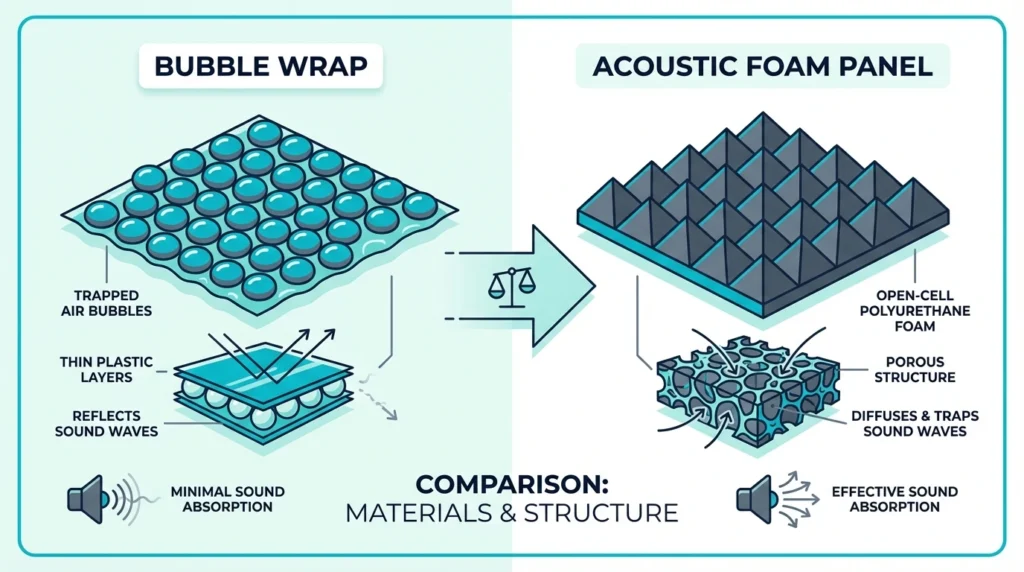
Yes, bubble wrap can change the sound in a room — but it doesn’t work as acoustic foam for stopping echo.
If you tape it up and the room still sounds sharp when you clap or record, it’s because the plastic skin reflects sound instead of absorbing it.
By the end, you’ll know what bubble wrap actually does, why the physics make it a dead end for absorption, and what to use instead.
Below, I’ll show you why bubble wrap reflects sound, then walk you through a few budget-friendly materials that actually absorb echo when you place them at first reflection points.
Bubble wrap is closed-cell plastic, so it reflects sound instead of absorbing echo in any meaningful way. If you need a budget fix, use porous absorption (foam, blankets, or mineral wool panels) placed at first reflection points.
Why Bubble Wrap Doesn’t Work
Understanding the physics explains the failure. Once you see what bubble wrap is made of, it’s obvious why it can’t do a foam panel’s job.
Closed-Cell Structure
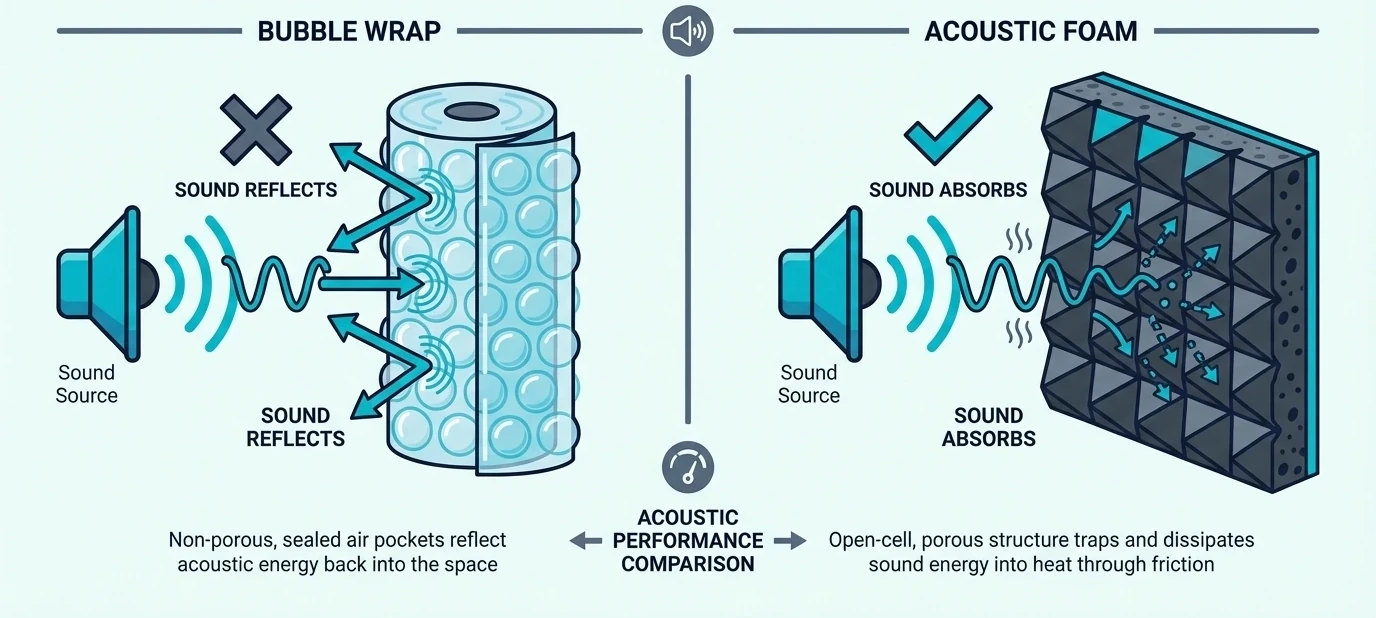
Acoustic absorption needs a porous surface that air (and sound) can move through. That airflow is what creates friction, which turns a little of the sound energy into heat.
Bubble wrap blocks that path because the bubbles are sealed. Sound waves hit the plastic skin and bounce back into the room.
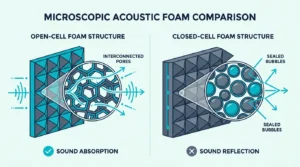
If you want the short version of why “open-cell” matters, see open-cell vs closed-cell foam.
In other words, bubble wrap behaves like thin plastic sheeting. It adds reflections, not absorption.
Insufficient Thickness
Even if bubble wrap were porous, it’s still extremely thin. Thickness matters because lower frequencies need more depth to lose energy.
Thin materials only touch the very top end. The voice and room-reflection range that makes a room sound boxy needs real absorption depth.
Reflective Surface
Plastic is also a naturally reflective surface. In some setups, a wall covered in bubble wrap can actually sound more “zingy” because you’ve added another hard skin.
The Air Pocket Myth
People assume “air pockets” automatically mean absorption. With bubble wrap, the sealed pockets act more like little springs that bounce energy back.
Open-cell foam absorbs because air can move through the material. Closed-cell materials insulate heat better than they absorb sound.
Testing Bubble Wrap: What Happens
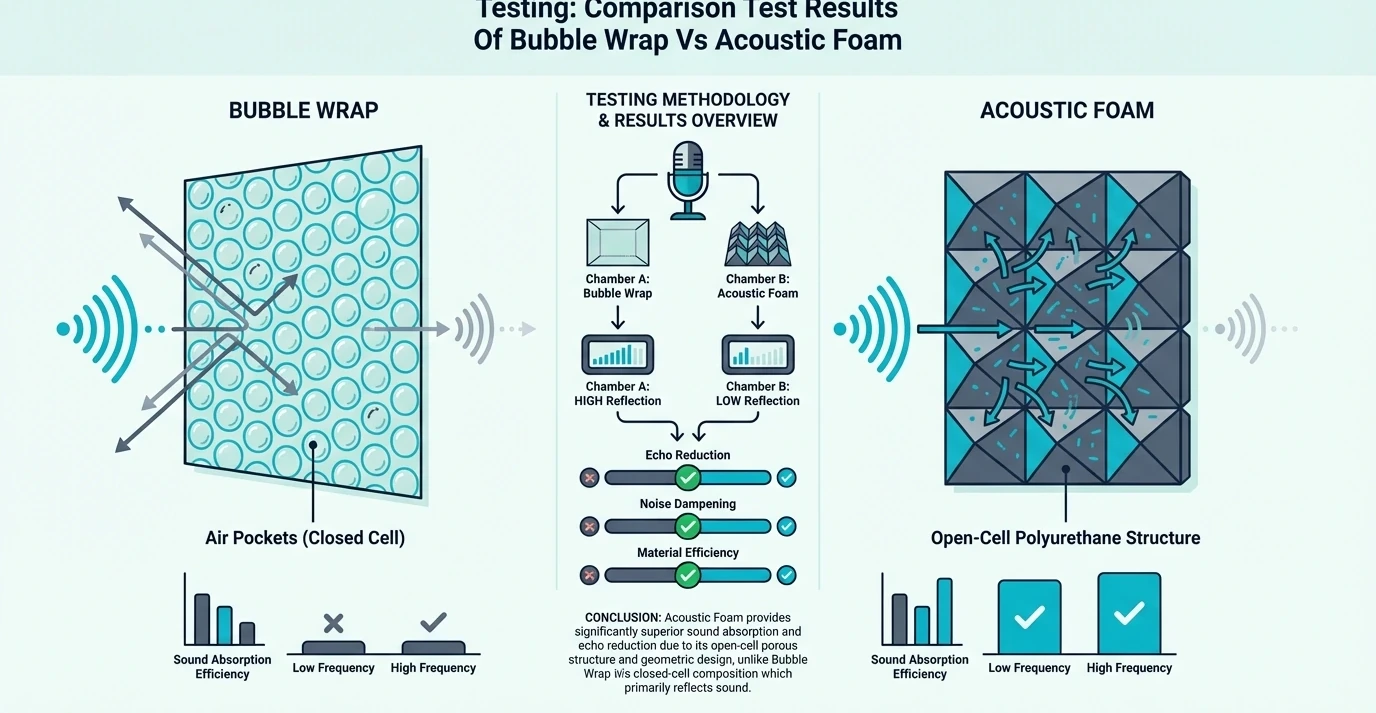
If you want to judge this honestly, you need a test that isolates echo (reflections), not “the room feels different.” Here’s what tends to happen when you do a quick clap/recording A/B and listen for the reverb tail.
Keep your test boring on purpose. Put your mic (or phone) in the same spot, speak the same line, and only change one thing: what’s on the wall at the first reflection point (usually behind your mic/desk, or the side wall next to it).
When you listen back, don’t focus on “brightness.” Listen for the half-second after you stop talking, because that’s where the room tail lives.
Absorption Coefficient
If you do a simple clap test, bubble wrap rarely changes what you care about. The room still has the same “ping” and “slap,” especially in the midrange.
If you want an easy way to catch yourself before you convince yourself it “worked,” record a short clap test. Clap three times with a pause between claps and listen for the tail between hits, not the hit itself.
Acoustic foam isn’t magic either, but it’s built for absorption. Bubble wrap is built for impact protection and packaging.
Real-World Effect
Covering walls with bubble wrap usually doesn’t reduce echo in a way you can hear on recordings. It’s wasted time and materials, and the room ends up sounding essentially the same.
Why People Think It Works
Some report “improvement” because they expected one, because adding any material changes the room a little, and because they’re comparing it to a totally bare wall. Most of the time they’re also mixing up sound blocking with absorption, so the echo problem stays.
Another trap is that bubble wrap can slightly change the tone of reflections by scattering the very top end. That can feel like “less harshness,” but the echo tail is still there, and that’s what microphones pick up in recordings.
Placement mistakes also make the myth stick. If you tape bubble wrap to a random wall, you might not be touching the reflection path that’s actually hitting your ears or your mic in the first place.
The key giveaway is this: your recordings still sound roomy, and your clap still rings. That’s the reflection problem bubble wrap can’t solve.
Want a fast A/B test? Record 10 seconds of voice in the same spot, then tape bubble wrap up behind the mic and record again.
If the second take still has the same “room tail” after your words, you didn’t absorb anything — you just changed the wall texture. Swap bubble wrap for one porous layer (a moving blanket, thick curtain, or a couple foam tiles) in the same spot and repeat.
Get Studio Tips Weekly
Join 5,000+ creators getting acoustic treatment advice every week.
No spam. Unsubscribe anytime.What Bubble Wrap Actually Does
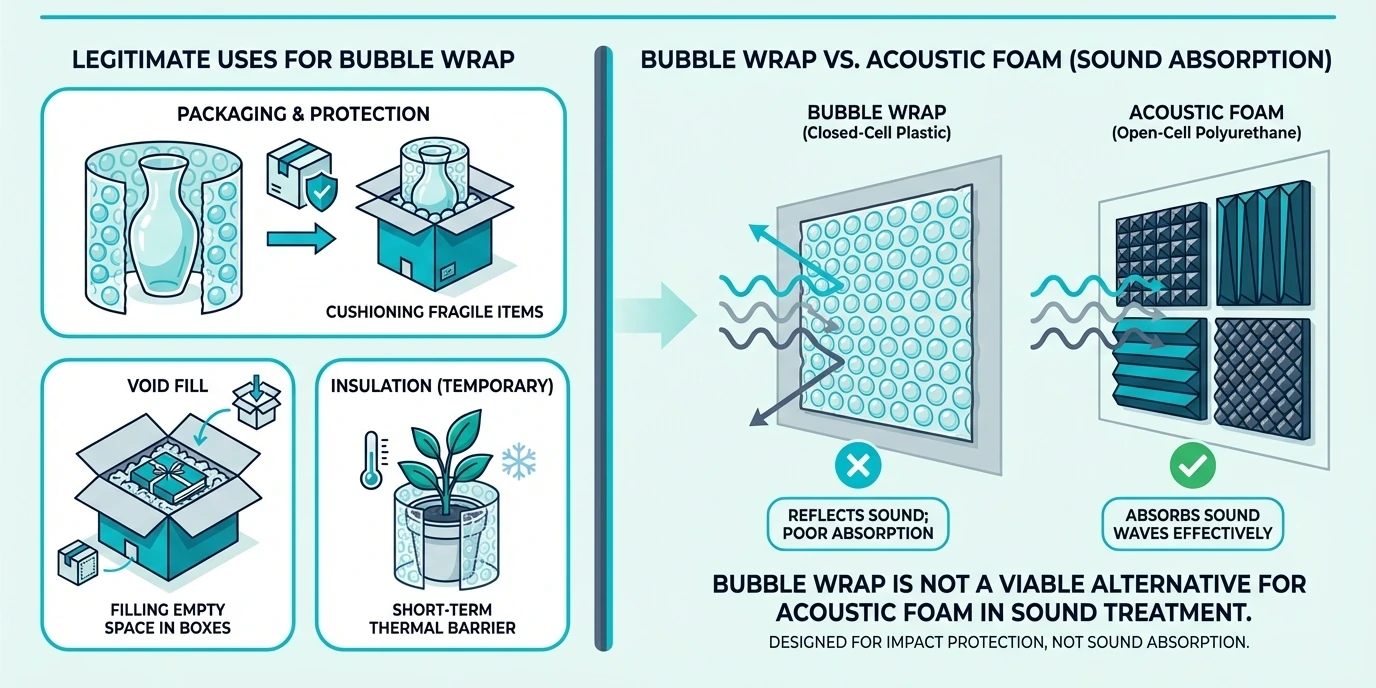
Bubble wrap has real uses—just not acoustic treatment.
Thermal Insulation
Bubble wrap can help a bit with thermal insulation because it traps air. That’s why you’ll see it used on windows in greenhouses and cold snaps.
That “trapped air” effect is heat-related, not sound-related. If you want the clean distinction, compare acoustic foam vs insulation.
Packaging Protection
This is where bubble wrap shines. It cushions impacts and protects fragile gear in transit.
That’s the real “strength” of bubble wrap: it protects objects, not sound. So when we talk about noise between rooms, it helps to reset expectations before you waste an afternoon taping plastic to a wall.
Sound Blocking (Minimal)
Bubble wrap has so little mass that it doesn’t meaningfully block sound between rooms. If your goal is blocking noise, you’re in the soundproofing world, not the treatment world.
That confusion is common, and this breakdown of sound deadening vs acoustic foam helps you pick the right approach.
One quick self-check is speech clarity. If you can hear words clearly through a wall, you’re dealing with sound transmission, not “room echo.”
That’s solved with sealing gaps and adding mass, not with thin plastic. Bubble wrap can reduce drafts and window rattles, but that’s comfort and vibration control, not real soundproofing.
Better DIY Alternatives
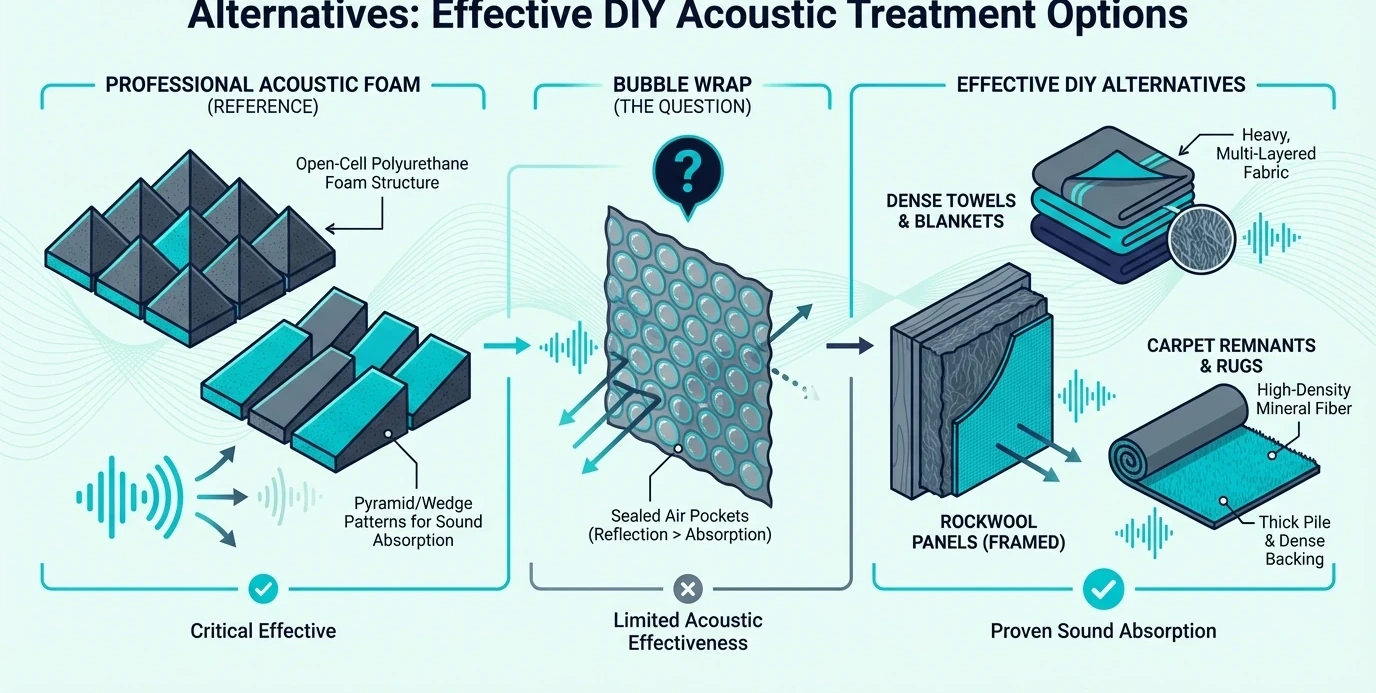
If budget is the concern, these actually work.
The common thread is porosity: you want materials that let air move through them, not sealed plastic. Start by treating the first reflection points, because “smart placement” beats “more stuff on the wall” every time.
First reflection points are the spots where sound bounces once before it hits your ears or mic. Treat those first and the room stops sounding “roomy” without you covering every surface.
To find side-wall reflections, sit where you listen/record and have a friend slide a mirror along the wall. Where you can see the speaker (or the loudest surface) in the mirror is the spot to treat.
Moving Blankets
Moving blankets are a genuinely decent “temporary studio” move. They won’t fix bass, but they can tame harsh reflections and flutter echo fast.
If you want a simple, removable option for rentals, a quilted moving blanket is a practical first buy. Hang it behind your mic/desk (or behind your speakers) and you’ll hear more change than bubble wrap on an entire wall.
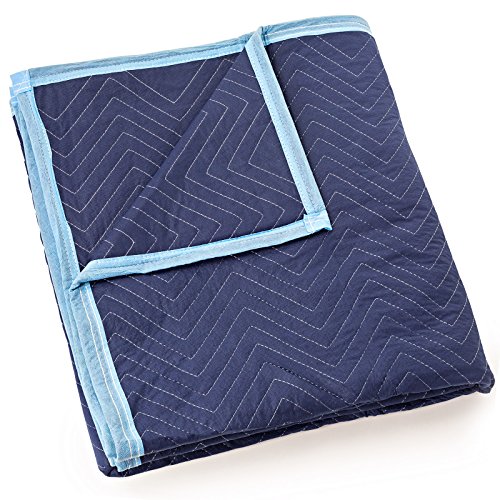
Sure-Max Quilted Moving Blanket (80 x 72 in)
Don’t stretch it tight like a drum head. Leaving a little air gap helps it behave more like absorption and less like a reflective sheet.
If you want something that looks more like “home decor” than “moving day,” curtains are the next step. They won’t absorb as deeply as a thick panel, but they’re easy to live with.
Heavy Curtains
Thick curtains are similar: they’re not a full treatment plan, but they help. They’re also easy to remove if you’re renting.
DIY Rockwool Panels
If you want a big jump in sound quality per dollar, build DIY mineral wool panels. That’s the “this actually sounds different” tier because the material is thick and porous.
If you build panels, wrap the absorber in breathable fabric so sound can reach it instead of bouncing off the face. A fire-rated acoustic fabric is a clean way to do that.
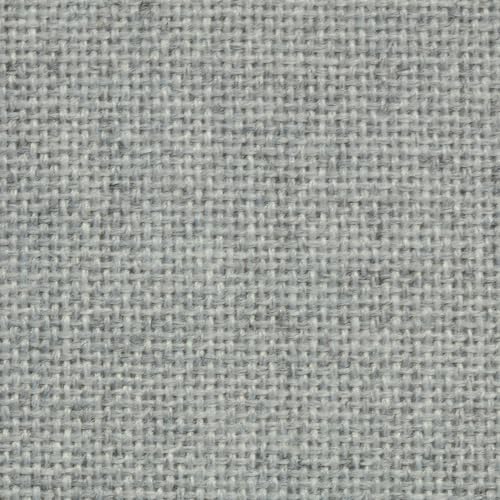
Fire-Rated Acoustic Fabric (Breathable Panel Wrap)
If you want the “what material actually works” breakdown before you build, start with acoustic foam vs rockwool. It’ll save you from building a panel that looks great but underperforms because it’s too thin.
Budget Acoustic Foam
Even budget foam beats bubble wrap because it’s at least designed for absorption. If you’re new to foam and want safe “first buy” guidance, use best beginner acoustic foam.
If you want a basic starter pack that actually changes a small room, 2-inch acoustic foam wedge tiles are a safer “first buy” than trying to DIY with plastic. Treat behind your mic/desk first, then use the mirror trick to find the side-wall reflection points.
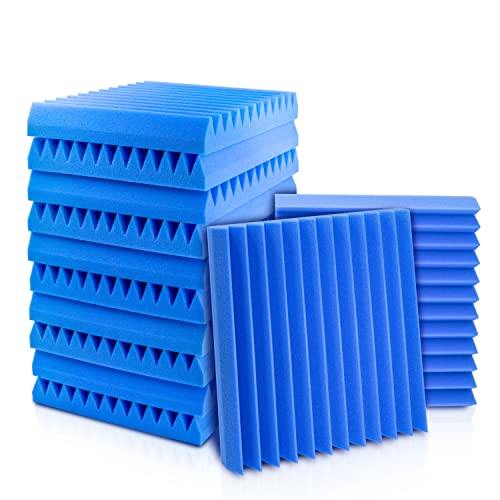
2-Inch Acoustic Foam Wedge Tiles (Starter Pack)
And if you want the “best overall” shortlist, best acoustic foam panels is the cleaner place to start.
Once you’ve got any porous absorption in the right spot, the room changes quickly. Soft furnishings can be enough to get you over the “my room sounds like a bathroom” hump while you decide what to buy.
Soft Furnishings
Start with what you already have: rugs, couches, bookshelves, and any fabric wall hangings. They won’t replace real treatment, but they can take the edge off reflections while you save for the right materials.
If you want a longer list of practical swaps, acoustic foam alternatives goes deeper than quick hacks.
Other Materials That Don’t Work
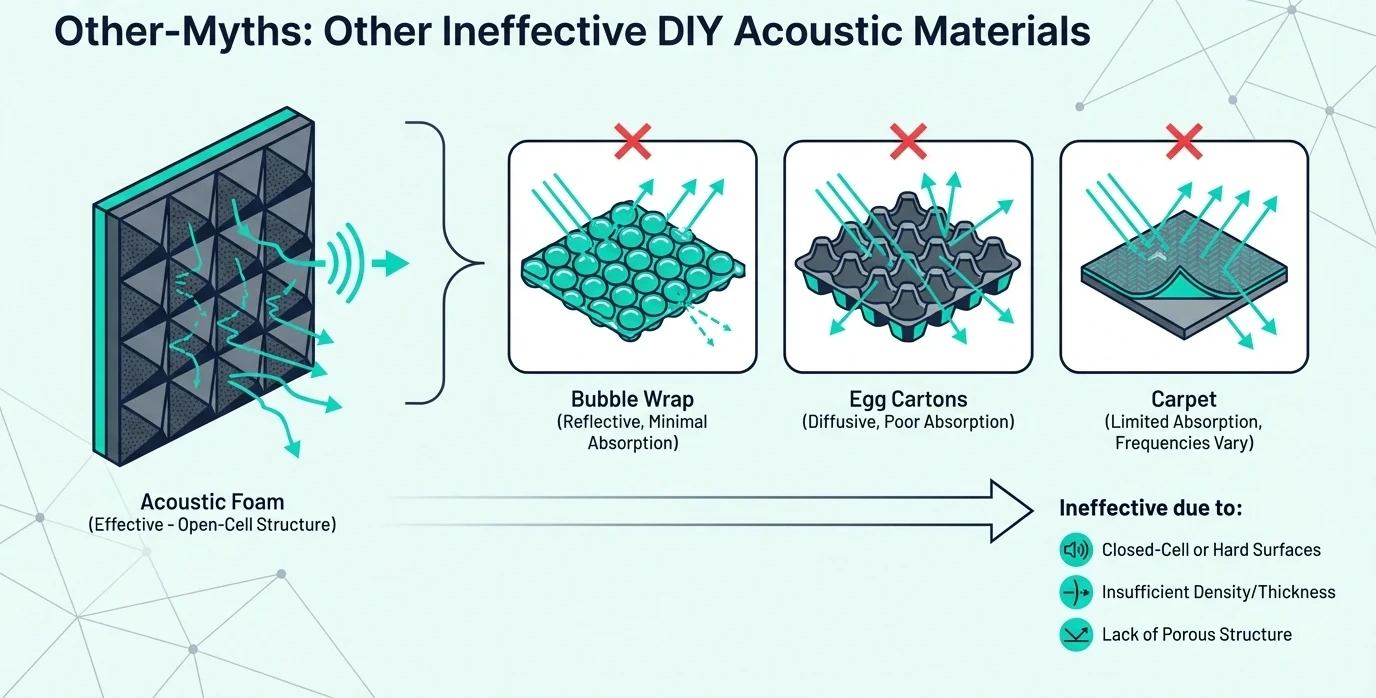
Bubble wrap isn’t the only acoustic myth.
Most myths share the same problem: they change the wall’s texture, but they don’t add porous depth. If air can’t move through the material, you don’t get meaningful absorption.
Egg Cartons
Another popular myth. Cardboard doesn’t absorb sound effectively, and the “shape” doesn’t compensate for the wrong material.
Covering walls in egg cartons is also a fire hazard. And it looks terrible while still not fixing the room.
For the truth about egg cartons, see our guide on egg cartons vs acoustic foam.
For understanding why foam board insulation also doesn’t work, see our guide on whether foam board is acoustic.
Styrofoam/Polystyrene
Styrofoam is closed-cell, so it reflects sound instead of absorbing it. It has the same core problem as bubble wrap: sealed cells that don’t let air move through.
In some rooms, it can even add more reflections. It’s not acoustic treatment.
Cardboard
Cardboard is too thin and has the wrong material properties for absorption. It’s also a fire hazard if you start covering walls with it.
Even if it changes the look of the wall, it doesn’t deliver meaningful acoustic benefit. So you spend time installing it and still end up with the same echo.
Carpet on Walls
Carpet can absorb some high frequencies, so it may take the edge off flutter echo. But it won’t do much for mid-range reverb, and it won’t touch bass.
It’s better than nothing if it’s what you already have. It also tends to look odd on a wall, which is usually why people abandon it later.
The Cost Perspective
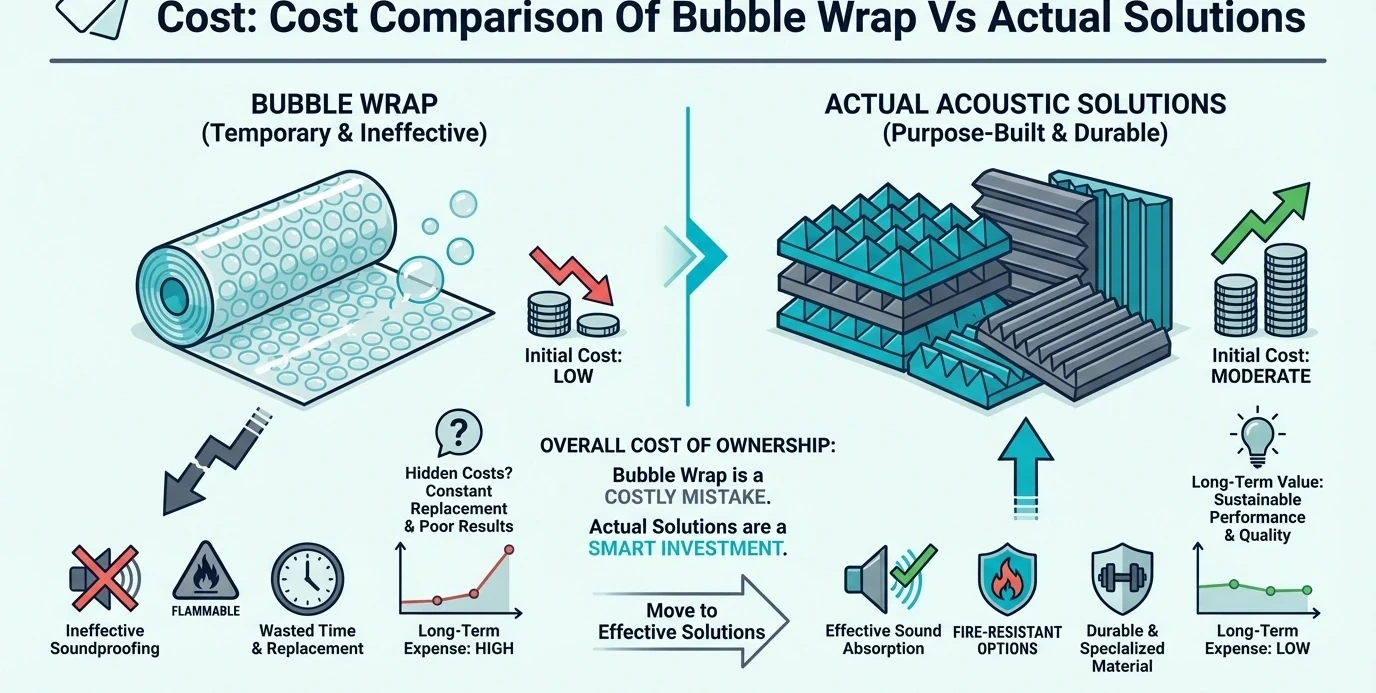
“Cheaper” only counts if it actually moves the needle. So let’s compare what you spend and what you get back in real acoustic benefit.
Bubble Wrap Cost
To cover significant wall area, you still need large rolls, mounting materials, and time to install. And after all that, you get basically zero acoustic benefit.
So it’s not a cheap fix. It’s just a waste of money that you’ll replace later.
Budget Foam Cost
Entry-level acoustic foam is a better use of money because a small pack can cover the high-impact spots first. It’s not a full solution, but it can actually change the room when you place it correctly.
The hidden cost of bubble wrap is that you’ll still end up buying real treatment later. So you pay twice: once in time and once in replacement materials.
True Budget Option
If money is extremely tight, start with what you already own. Heavy blankets, smarter furniture placement, and extra soft items can help while you save for proper treatment later.
The goal isn’t to cover the entire room. It’s to kill the strongest reflections first, then stop when your recordings sound controlled.
Spending money on bubble wrap for acoustics is one of those “cheap” ideas that gets expensive fast. Put that budget toward materials that are actually porous and thick.
Conclusion
Bubble wrap doesn’t work as acoustic foam because sound can’t get into it. It’s closed-cell plastic, so it reflects energy back into the room instead of absorbing it.
If you need a budget fix, use porous absorption in the right spots: blankets, curtains, DIY mineral wool panels, or real foam. Even the cheapest purpose-built option outperforms bubble wrap because it’s built for the job.
Save bubble wrap for shipping and gear protection. For acoustics, spend your effort on placement and materials that actually absorb reflections.
Frequently Asked Questions
Will multiple layers of bubble wrap help?
No. More layers just means more plastic surfaces reflecting sound back into the room.
Can bubble wrap help with soundproofing?
Not in a meaningful way. For soundproofing you need mass and air sealing, and bubble wrap doesn’t provide either.
Why do some people say bubble wrap works?
Mostly expectation bias and comparison to a totally bare room. In practice, the echo and “room sound” remain because bubble wrap doesn’t absorb reflections.
What’s the cheapest thing that actually works?
Start with what you already own: rugs, couches, bookshelves, and heavy blankets placed at reflection points. If you can buy one thing, DIY mineral wool panels are usually the best performance per dollar.
Is bubble wrap better than nothing?
Barely, and usually not in a way you’ll notice. Your time is better spent placing real absorption where the reflections actually hit.
Can I use packing materials for acoustic treatment?
Most packing materials are closed-cell or too thin, so they reflect sound instead of absorbing it. If it isn’t porous and thick, it won’t behave like acoustic treatment.