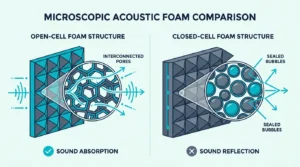
Sound Deadening Material vs Acoustic Foam: Understanding the Difference
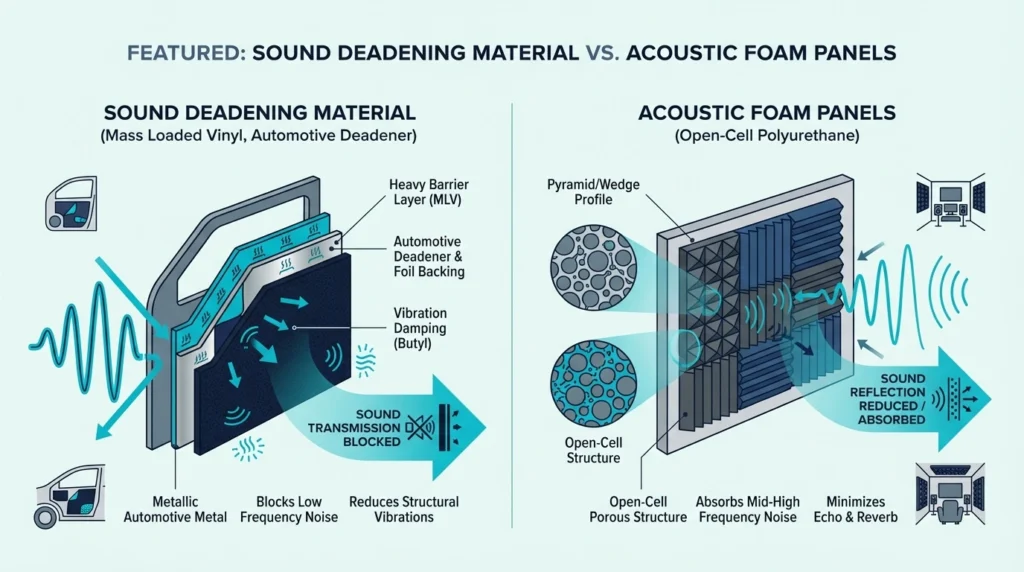
Sound deadening material and acoustic foam look like two versions of the same fix, but they solve opposite problems. Pick the wrong one and you’ll waste money while the noise stays exactly the same.
Sound deadening blocks transmission through walls and barriers. Acoustic foam absorbs reflections bouncing around inside a room.
Mixing them up is the most common mistake people make when treating a space.
Below you’ll find what each material does, when to use each, and how to tell which problem you’re actually dealing with.
Sound deadening material blocks sound transmission between spaces using mass (MLV, extra drywall, automotive deadener). Acoustic foam absorbs reflections within a room using porous structure (wedge foam, pyramid foam, studio panels). If sound is coming through walls, you need deadening. If sound is bouncing inside your room, you need foam.
What’s the Real Difference Between Sound Deadening and Acoustic Foam?
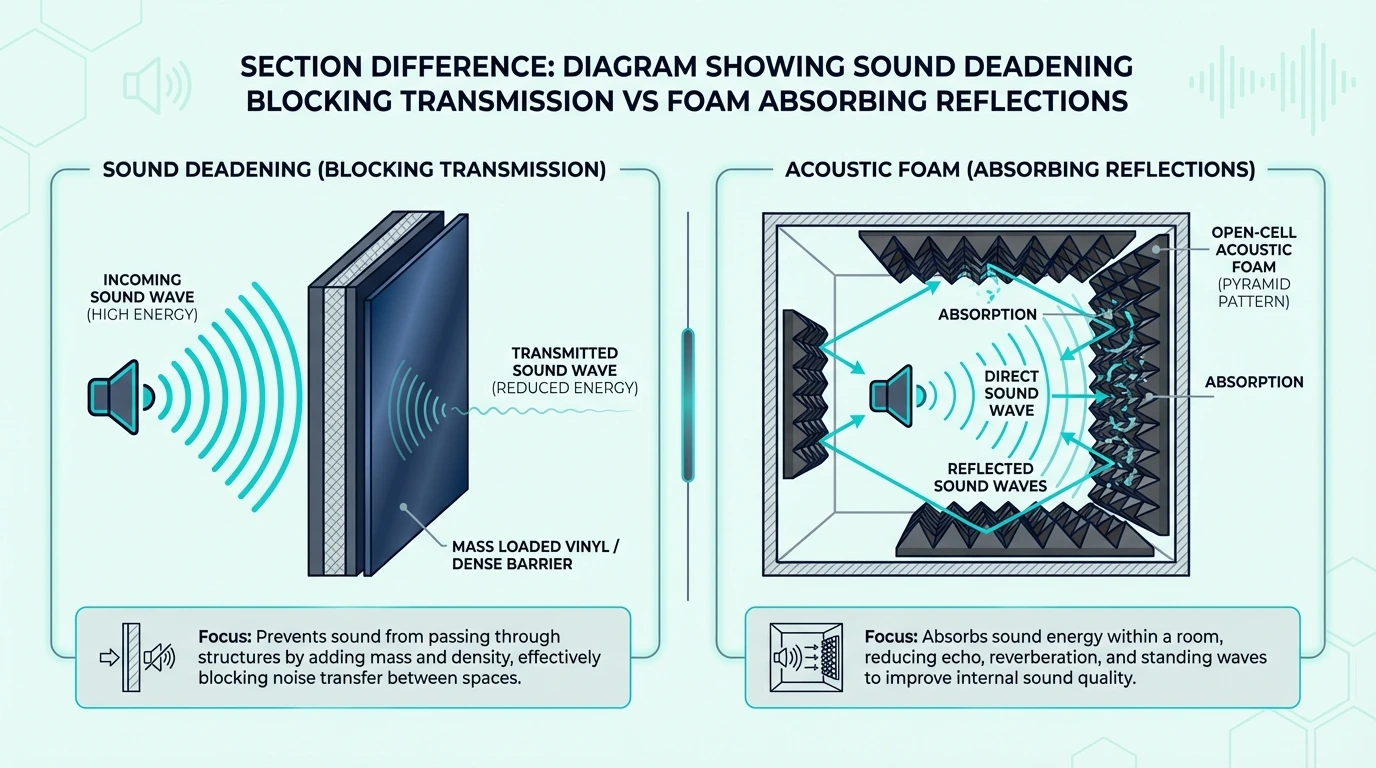
Understanding this core distinction prevents costly mistakes.
Sound Deadening: Blocking Transmission
Sound deadening materials stop sound from traveling through barriers—walls, floors, ceilings, vehicle panels. They work through mass: heavy, dense materials that sound waves can’t easily pass through.
The physics: Sound waves carry energy. When they hit a massive barrier, most energy reflects back rather than passing through. The heavier and denser the barrier, the more sound it blocks.
Common applications: – Reducing noise between rooms – Soundproofing home theaters – Quieting vehicle interiors – Blocking external noise (traffic, neighbors)
Acoustic Foam: Absorbing Reflections
Acoustic foam absorbs sound waves within a room. It doesn’t stop sound from passing through walls—it reduces the sound bouncing around inside.
The physics: Sound waves enter the foam’s porous structure. Friction between air molecules and cell walls converts acoustic energy to heat. The sound dissipates rather than reflecting.
Common applications: – Recording studios – Podcast rooms – Home theaters (for clarity, not soundproofing) – Reducing echo in any space
For more on how foam works, see what frequencies acoustic foam absorbs.
Sound Deadening Materials Explained
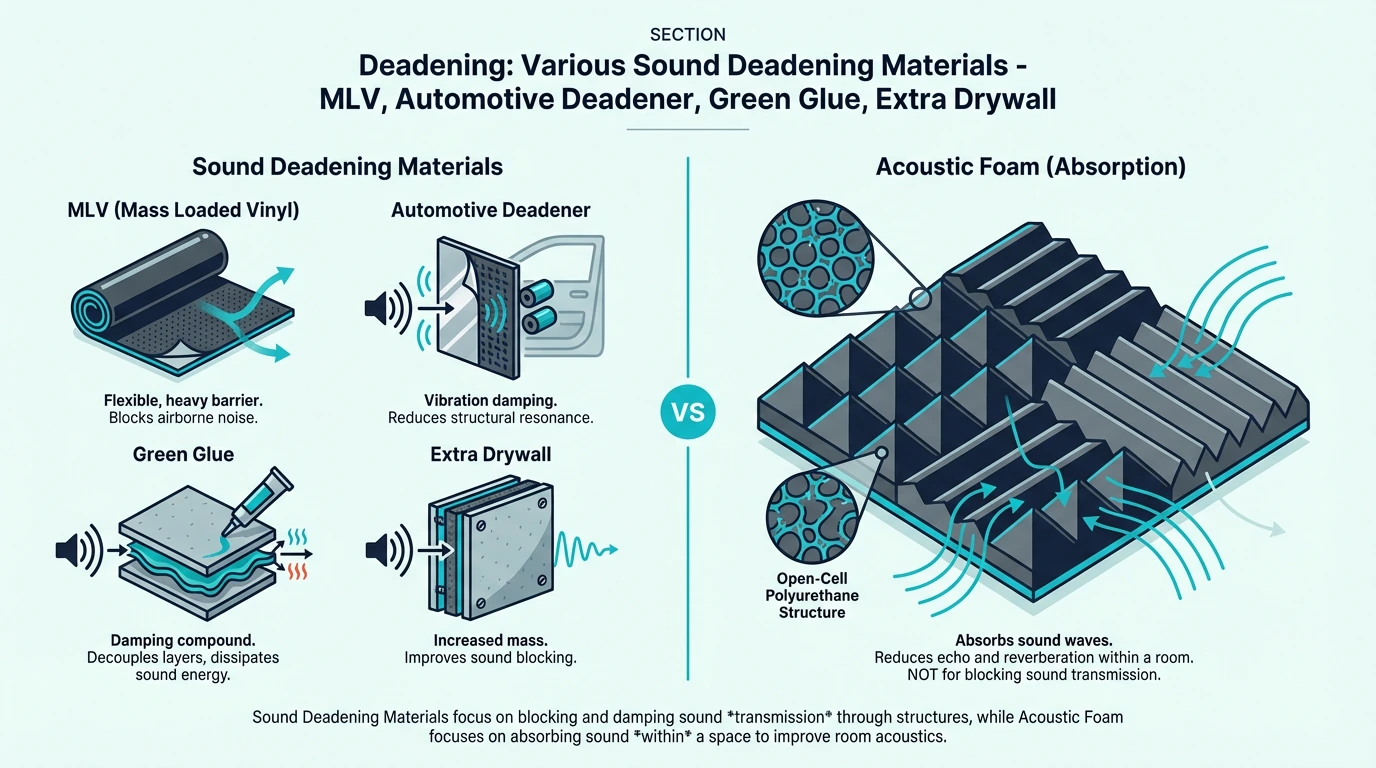
Several materials serve sound deadening purposes. Each has specific properties measured by Sound Transmission Class (STC) ratings—higher numbers mean better sound blocking.
Mass Loaded Vinyl (MLV)
MLV is a thin, heavy, flexible material specifically designed for soundproofing. It adds mass to walls, floors, and ceilings without adding much thickness.
Properties: – Very dense (1-2 lb per square foot) – Flexible, can conform to surfaces – Adds 25-32 STC points when properly installed – Only 1/8” thick but weighs 1 lb/sq ft – Installs behind drywall or under flooring
Best for: Adding mass to existing walls, wrapping pipes and ducts, soundproofing without major construction. A single layer of MLV can reduce sound transmission by 50-70% at mid frequencies.
Automotive Sound Deadener
Products like Dynamat, Noico, and Kilmat are designed for vehicle applications. They’re self-adhesive mats that add mass and damping to metal panels.
Properties: – Adhesive backing for easy application – Combines mass with vibration damping – Typically 80 mil (2mm) thick – Reduces road noise by 3-8 dB when covering 25-50% of panel area – Heat resistant up to 300°F and moisture resistant
Best for: Car audio installations, reducing road noise, quieting vehicle interiors.
Additional Drywall
Simply adding more drywall layers increases wall mass, improving sound blocking. This is often the most cost-effective soundproofing approach.
Properties: – Readily available at $10-15 per 4×8 sheet – Each 5/8” layer adds 2.5 lbs per square foot – Single layer adds 3-5 STC points; double layer adds 8-10 STC – Can combine with damping compounds for 12-15 STC improvement – Requires finishing work (tape, mud, paint)
Best for: New construction, renovations where walls are accessible.
Green Glue and Damping Compounds
These viscoelastic compounds apply between drywall layers, converting sound energy to heat through damping.
Properties: – Costs $15-20 per tube (covers 16-32 sq ft) – Enhances performance of drywall layers by 5-9 STC points – Easy to apply with standard caulk gun – Most effective at 125-400 Hz (bass frequencies) – Requires sandwich construction (drywall-glue-drywall)
Best for: Maximizing performance of multi-layer drywall assemblies. Two layers of 5/8” drywall with Green Glue achieves STC 50-55, compared to STC 33-38 for standard single-layer walls.
Get Studio Tips Weekly
Join 5,000+ creators getting acoustic treatment advice every week.
No spam. Unsubscribe anytime.Acoustic Foam Explained
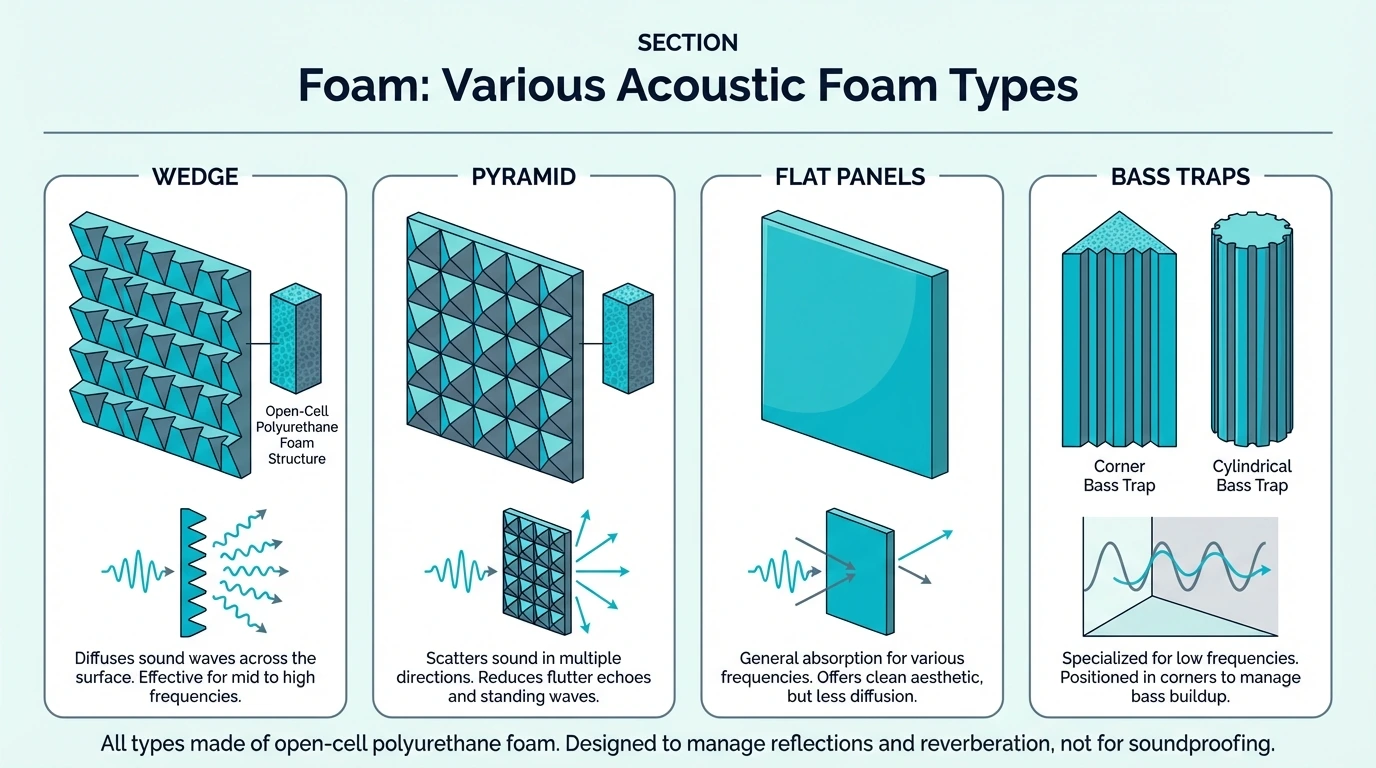
Acoustic foam comes in various forms for different applications.
Standard Panels (Wedge, Pyramid)
The most common acoustic foam. Wedge and pyramid patterns increase surface area for better absorption.
Properties: – Typically 2-4 inches thick – Absorbs mid and high frequencies – Easy to mount on walls – Various colors available
Best for: General room treatment, recording spaces, reducing echo. A starter pack like Foamily 12-Pack Acoustic Wedge Panels is a common way to test placement before committing to full coverage.
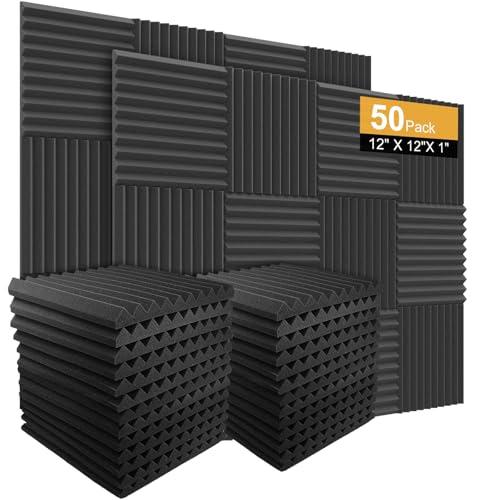
Foamily 12-Pack Acoustic Wedge Panels
For help with panel selection, see how to choose acoustic foam. For product recommendations, see best acoustic foam for recording.
Bass Traps
Thicker foam or specialized shapes designed for corner placement and low-frequency absorption.
Properties: – Thicker than standard panels (4+ inches) – Designed for corner mounting – Better low-frequency performance than flat panels – Still limited compared to fiberglass traps
Best for: Corner treatment, addressing mid-bass issues. The 8 Pack Corner Bass Trap Foam Blocks are a budget option for corner placement.
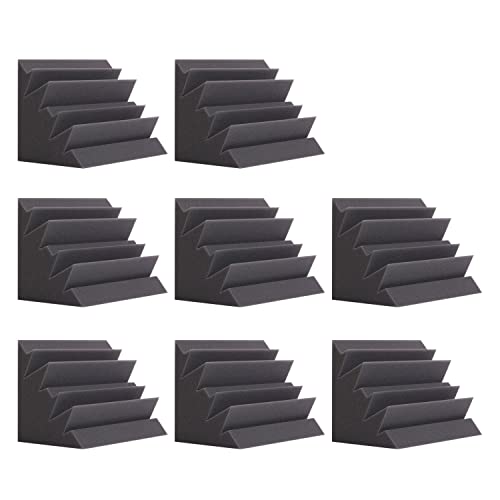
8 Pack Corner Bass Trap Foam Blocks
For more on bass treatment, see bass traps vs acoustic foam.
Flat Panels
Smooth-surface foam without wedge or pyramid patterns.
Properties: – Clean, professional appearance – Similar absorption to patterned foam – Better for video backgrounds – Easier to clean
Best for: Visible installations, video recording spaces.
When You Need Sound Deadening
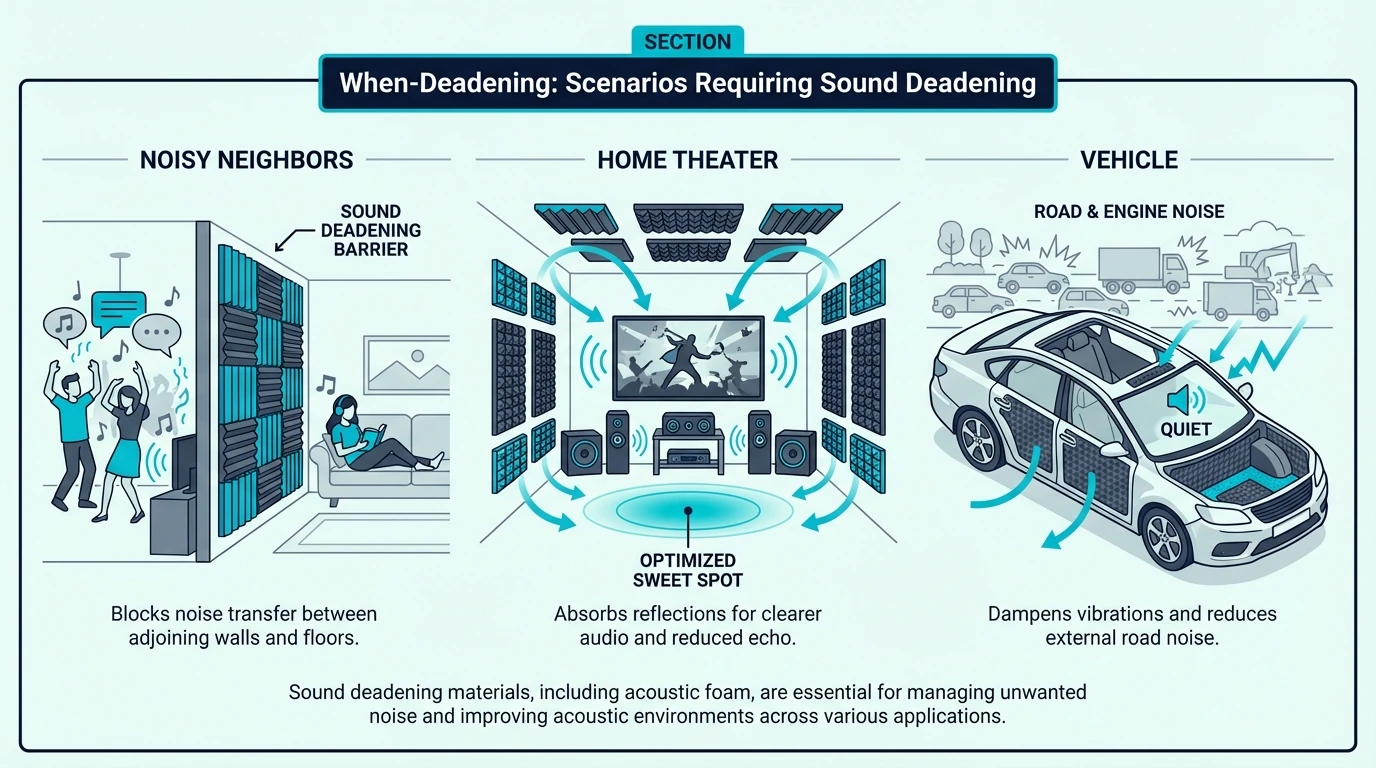
Identify these situations to know if sound deadening is your solution.
Noise From Outside
If external sounds disturb you—traffic, neighbors, aircraft—you need to block sound transmission. Acoustic foam won’t help because the sound is coming through your walls, not bouncing inside your room.
Solutions: – Add mass to walls (MLV, extra drywall) – Seal air gaps (acoustic caulk) – Upgrade windows – Address the weakest points first
Noise Escaping Your Space
If your sound disturbs others—home theater bass, music practice, recording—you need to contain it. Again, this is a transmission problem, not a reflection problem.
Solutions: – Same as above: mass, sealing, isolation – Focus on shared walls/floors/ceilings – Address bass frequencies specifically (they transmit most easily)
Vehicle Applications
Reducing road noise, improving car audio, or quieting engine sound requires sound deadening. Vehicles have thin metal panels that transmit sound easily.
Solutions: – Automotive deadening mats on doors, floor, trunk – MLV for additional mass – Combine with absorption for best results
When You Need Acoustic Foam
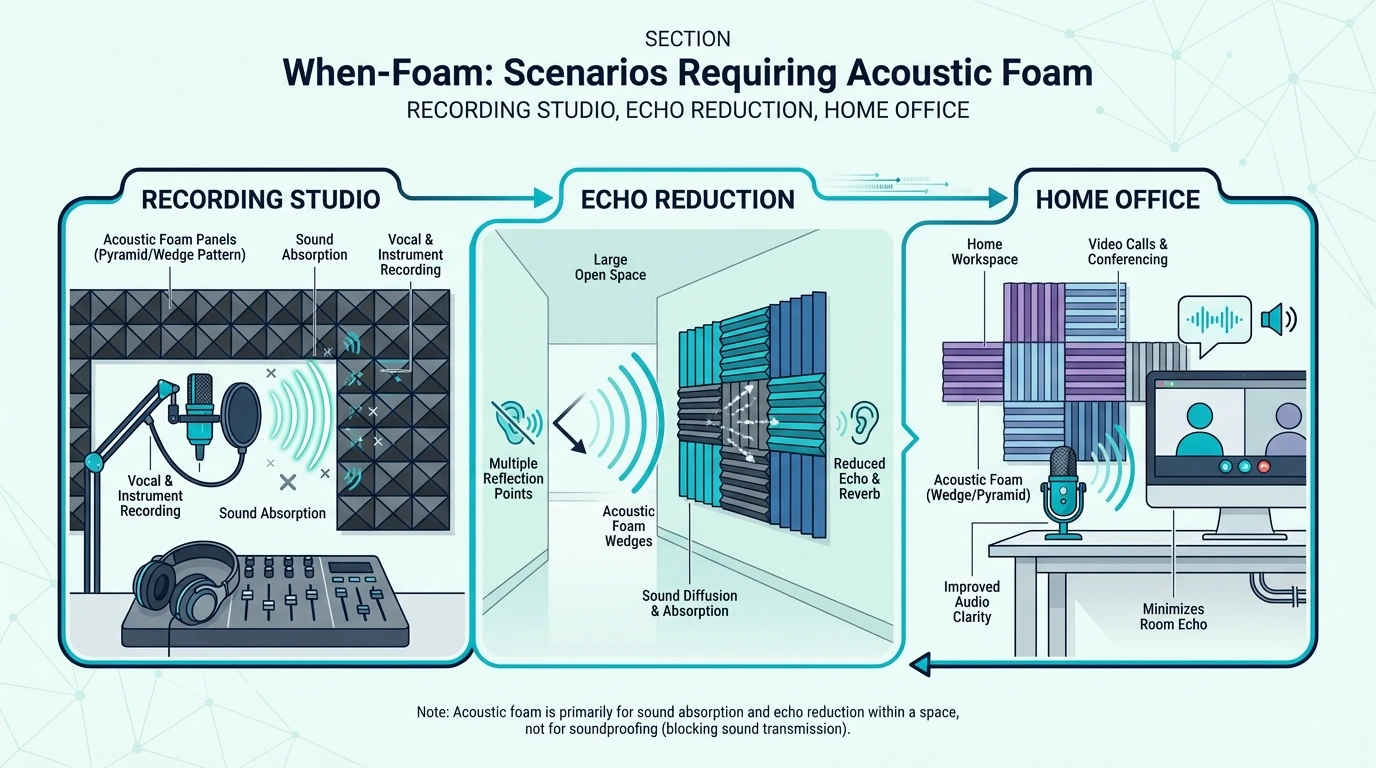
These situations call for absorption, not blocking.
Recording and Podcasting
If your recordings sound echoey, roomy, or harsh, you need to absorb reflections. The sound quality problem is inside your room, not coming through walls.
Solutions: – Foam panels at reflection points – Treatment behind microphone – Ceiling treatment – Corner treatment for bass
If you want thicker panels for voice work, JBER 12 Pack Acoustic Foam covers first reflection points without a big commitment. For effective panel placement, see how to arrange acoustic foam.
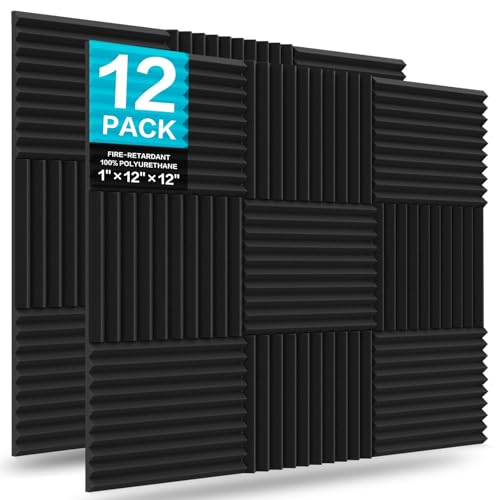
JBER 12 Pack Acoustic Foam
For recording improvement, see whether acoustic foam improves recording.
Echo and Reverb Reduction
If your room sounds echoey during calls, conversations, or playback, reflections are the problem. Hard surfaces bounce sound around, creating that hollow, reverberant quality.
Solutions: – Foam panels on walls – Soft furnishings (rugs, curtains) – Strategic placement at first reflection points
Home Theater Clarity
If dialogue is hard to understand or sound seems muddy, room reflections may be interfering. Note: this is different from soundproofing the theater to contain bass.
Solutions: – Absorption at first reflection points – Rear wall treatment – Combination with diffusion for natural sound
What Mistakes Do People Make with These Materials?
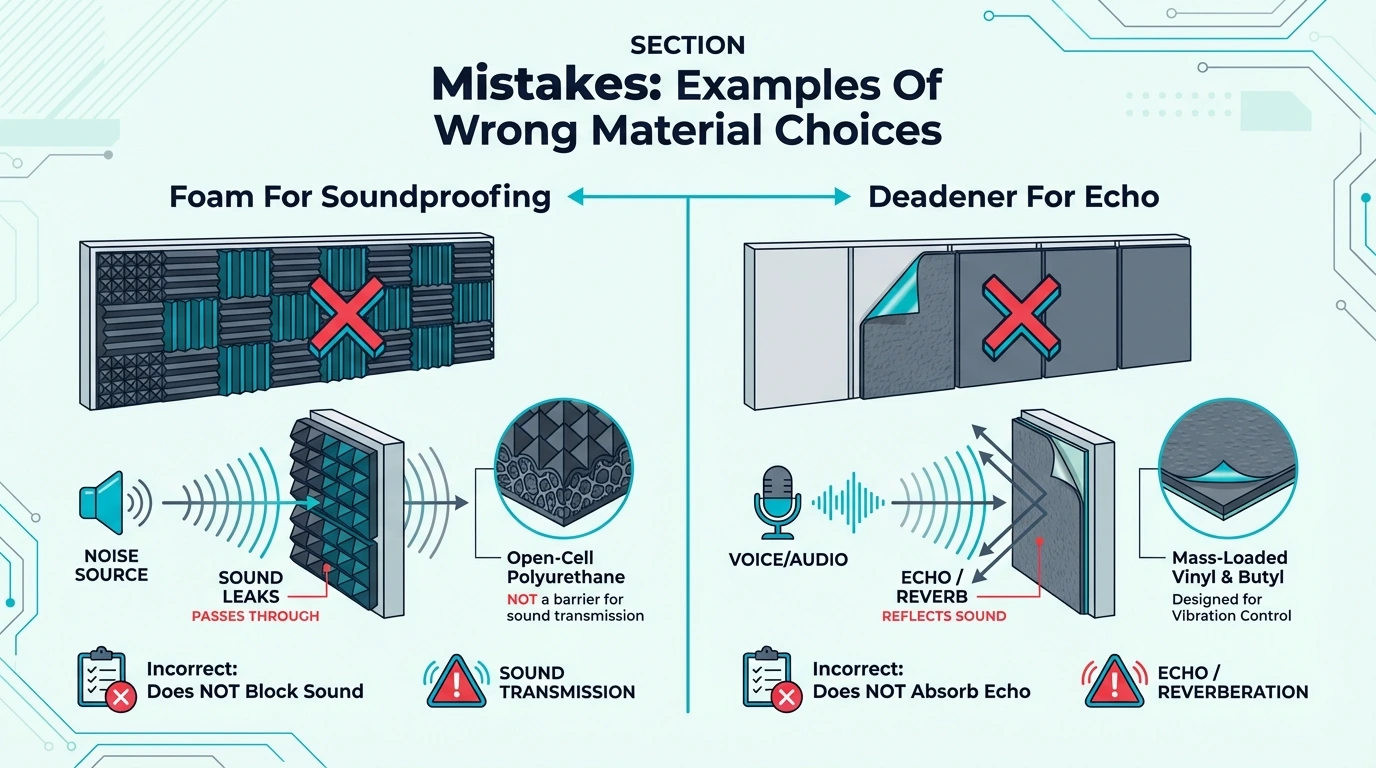
These errors waste money and leave problems unsolved.
Using Foam for Soundproofing
The most common mistake. People cover walls with acoustic foam expecting it to block sound from neighbors or contain their music.
It doesn’t work.
Foam is lightweight and porous—the opposite of what blocks sound. Sound passes right through it.
You might slightly reduce high-frequency transmission, but bass and mid-range pass through essentially unchanged.
The fix: If you need soundproofing, use mass (MLV, drywall) and sealing. Foam is for absorption only.
Using Sound Deadening for Echo
Less common but still happens. Adding MLV or automotive deadener to walls won’t reduce echo—these materials reflect sound rather than absorbing it.
The fix: If you need absorption, use acoustic foam or fabric-wrapped panels. Sound deadening materials don’t absorb.
For alternatives to foam that do absorb see what to use instead of acoustic foam.
Expecting Either to Solve Everything
Neither material solves all acoustic problems. A room might need both: sound deadening to block external noise AND acoustic foam to control internal reflections.
The fix: Identify your specific problems and address each appropriately.
Using Both Together
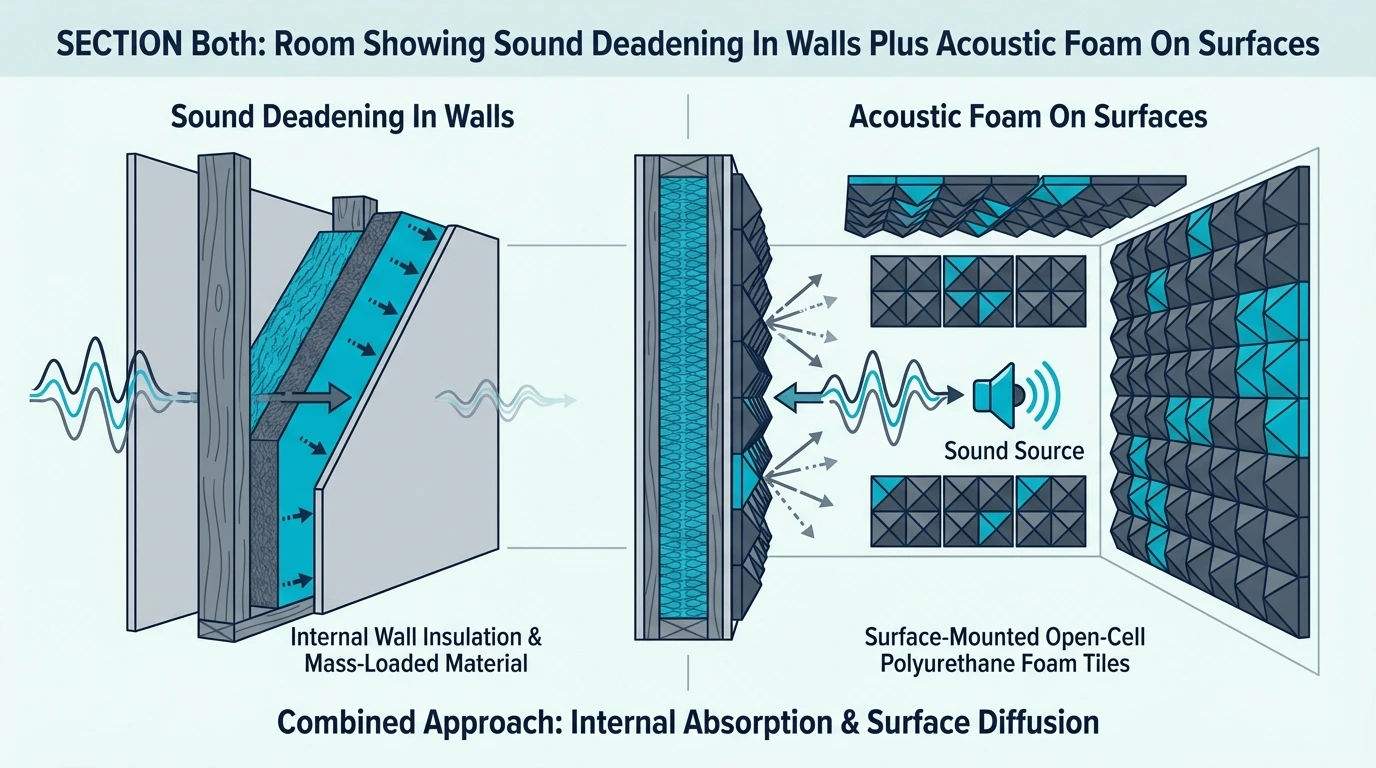
Many situations benefit from combining approaches.
Home Studio Example
Sound deadening needs: – Block noise from outside (traffic, HVAC) – Contain sound to avoid disturbing others
Acoustic foam needs: – Reduce reflections for clean recordings – Control room sound for accurate monitoring
Combined approach: – MLV or extra drywall in walls for isolation – Seal all gaps with acoustic caulk – Acoustic foam on interior surfaces for absorption – Bass traps in corners
Home Theater Example
Sound deadening needs: – Contain bass to avoid disturbing neighbors – Block external noise for immersive experience
Acoustic foam needs: – Control reflections for clear dialogue – Reduce flutter echo
Combined approach: – Soundproofing on shared walls (mass + damping) – Absorption at first reflection points – Bass traps for low-frequency control – Diffusion on rear wall (optional)
How Do Costs Compare Between Sound Deadening and Acoustic Foam?
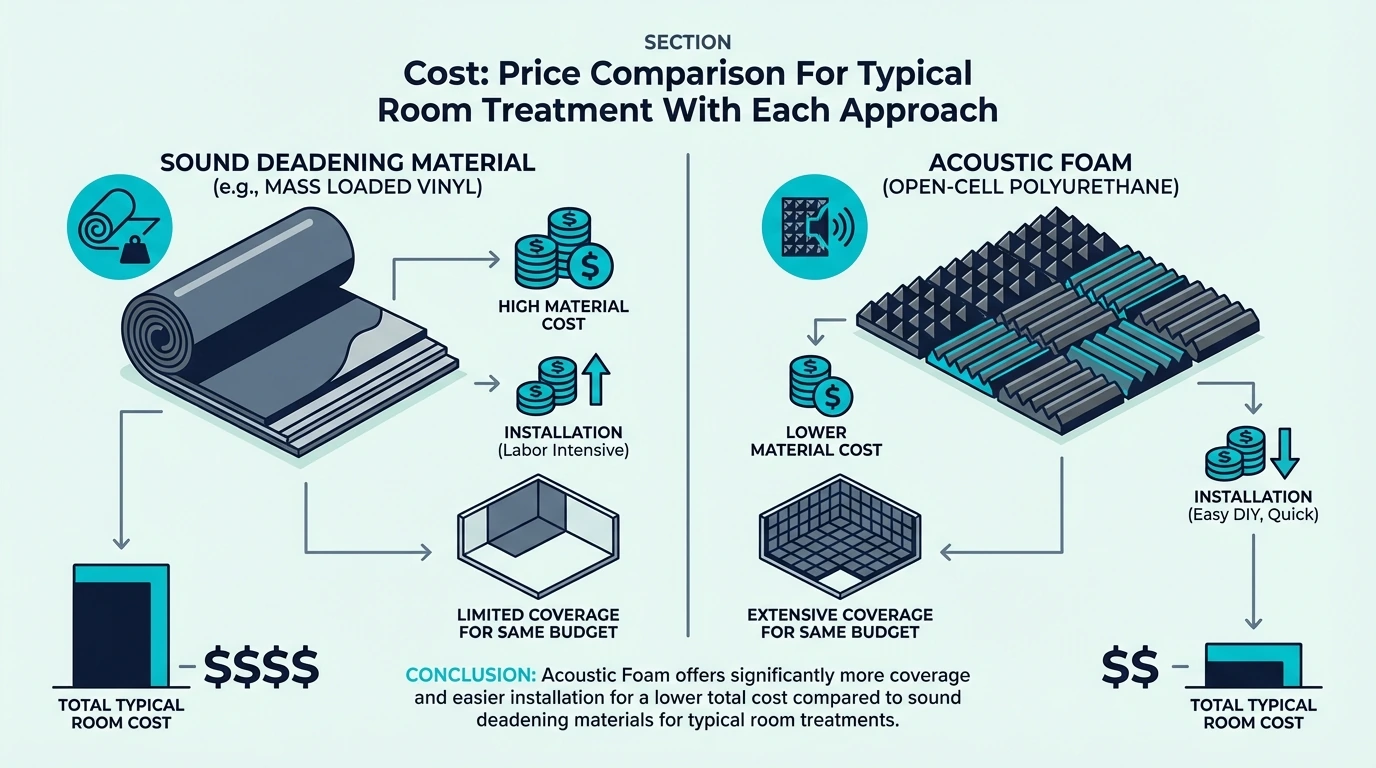
Budget implications are worth understanding before you commit.
Sound Deadening Costs
Sound deadening typically costs more because it often involves construction:
MLV: Moderate cost per square foot Extra drywall + Green Glue: Lower material cost, plus labor Professional soundproofing: Much higher for full-room treatment
Effective soundproofing often requires treating entire walls, floors, or ceilings—large surface areas add up quickly.
Acoustic Foam Costs
Acoustic foam is generally more affordable:
Budget foam: Lower cost per square foot Quality foam (Auralex): Moderate cost per square foot Typical room treatment: Moderate total for 30-50% coverage
Foam only needs to cover a portion of surfaces, reducing total material needs. Be careful not to over-treat—see whether you can put too much acoustic foam.
Value Consideration
Don’t choose based on cost alone. The cheaper option that doesn’t solve your problem wastes money entirely.
Identify your actual need first, then budget accordingly.
How Do You Decide Which Material You Need?
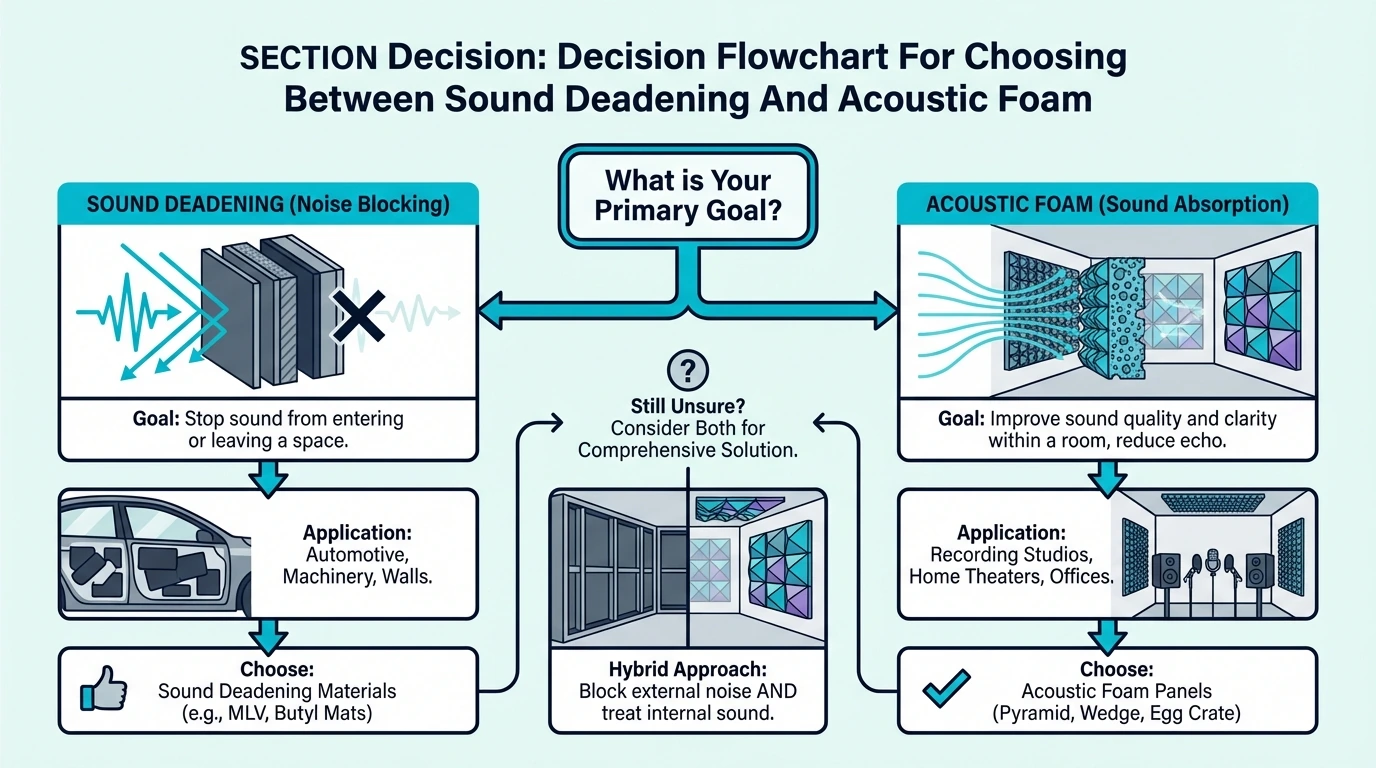
Answer these questions to identify your solution.
What’s Your Problem?
“I hear my neighbors / traffic / outside noise” → Sound deadening (blocking transmission)
“My neighbors hear me / I disturb others” → Sound deadening (containing transmission)
“My room sounds echoey / reverberant” → Acoustic foam (absorbing reflections)
“My recordings sound roomy / harsh” → Acoustic foam (absorbing reflections)
“Both external noise AND room echo” → Both solutions needed
Where Is the Sound?
Coming through walls/ceiling/floor: → Sound deadening
Bouncing around inside the room: → Acoustic foam
What’s Your Budget Reality?
Limited budget, need absorption: → Acoustic foam provides affordable improvement
Limited budget, need soundproofing: → Focus on sealing gaps first (cheapest), then add mass strategically
Adequate budget: → Address your actual problem properly
The Bottom Line
Sound deadening material and acoustic foam solve different problems. Sound deadening blocks transmission—stopping sound from passing through walls, floors, and ceilings.
Acoustic foam absorbs reflections—improving how sound behaves inside a room.
Using foam for soundproofing doesn’t work; it’s too light and porous to block sound. Using sound deadening for echo reduction doesn’t work; dense materials reflect rather than absorb.
Identify your actual problem first. If sound is coming through barriers, you need mass and sealing.
If sound is bouncing inside your room, you need absorption. Many situations require both approaches working together.
The right solution depends entirely on what you’re trying to achieve. Match the material to the problem, and you’ll get results.
Mismatch them, and you’ll waste money while the problem persists.
For more guides on foam types, placement, and mounting, start at the acoustic foam hub.
Frequently Asked Questions
Will acoustic foam soundproof my room?
No. Acoustic foam absorbs sound reflections inside your room but doesn’t block sound transmission through walls. Foam is lightweight and porous—sound passes through it easily.
For soundproofing, you need mass (heavy materials like MLV or extra drywall) and sealing (no air gaps).
Can I use automotive sound deadener for room acoustics?
For blocking sound transmission, yes—automotive deadener adds mass and damping. For absorbing reflections (reducing echo), no—deadener reflects sound rather than absorbing it.
If you want to soundproof a room, automotive deadener can help. If you want to reduce echo, you need acoustic foam or similar absorptive material.
What’s more important—sound deadening or acoustic foam?
Depends entirely on your problem. If external noise bothers you or your sound bothers others, sound deadening is the priority.
If your room sounds echoey or your recordings sound roomy, acoustic foam is what you need. Neither is universally “more important”—they solve different problems.
Do I need both sound deadening and acoustic foam?
Many situations benefit from both. A recording studio might need sound deadening to block external noise AND acoustic foam to control internal reflections.
A home theater might need soundproofing to contain bass AND absorption for dialogue clarity. Assess your specific needs—you may need one, the other, or both.
Why doesn’t acoustic foam block sound?
Sound blocking requires mass—heavy, dense materials that sound waves can’t easily penetrate. Acoustic foam is lightweight and porous by design, allowing sound waves to enter and be absorbed.
The same properties that make foam good at absorption (porosity, low density) make it ineffective at blocking.
What’s the cheapest way to reduce noise from neighbors?
Sealing air gaps is the cheapest first step—sound travels easily through gaps around doors, windows, outlets, and pipes. Use acoustic caulk and weatherstripping.
After sealing, adding mass (extra drywall layer) provides the most cost-effective improvement. Acoustic foam won’t help with neighbor noise—that’s a transmission problem requiring mass and sealing.