What Are Acoustic Foam Panels? Complete Beginner’s Guide
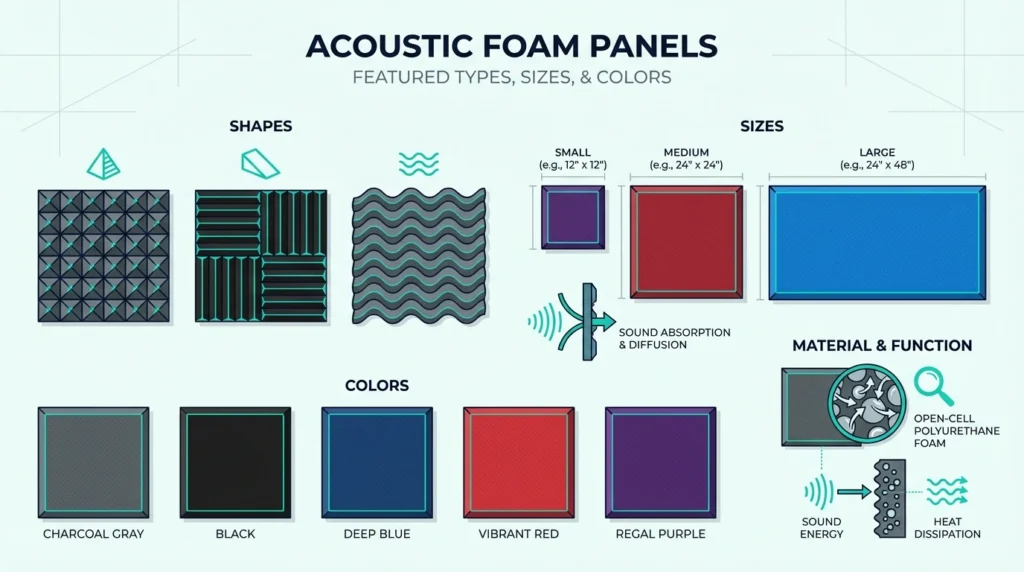
What are acoustic foam panels? They’re the wedge or pyramid-patterned tiles you see on studio walls, but most people buy them expecting soundproofing and end up disappointed when noise still comes through.
The result is wasted money on panels that can’t solve the problem they were bought for. If your room still sounds echoey after treatment, or noise keeps leaking through the wall despite a full foam install, the issue is almost always a mismatch between what foam does and what you expected it to do.
Once you understand the difference between absorption and soundproofing, choosing the right panels and placing them where they matter takes about an afternoon. Below you’ll find how foam panels work, which types exist, who actually needs them, and how to place them for real results.
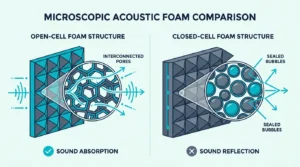
Acoustic foam panels are porous materials (polyurethane or melamine) that absorb mid and high-frequency sound reflections. They reduce echo, improve speech clarity, and create better recording environments. They do not soundproof rooms, block sound transmission, or absorb bass frequencies.
How Acoustic Foam Panels Work
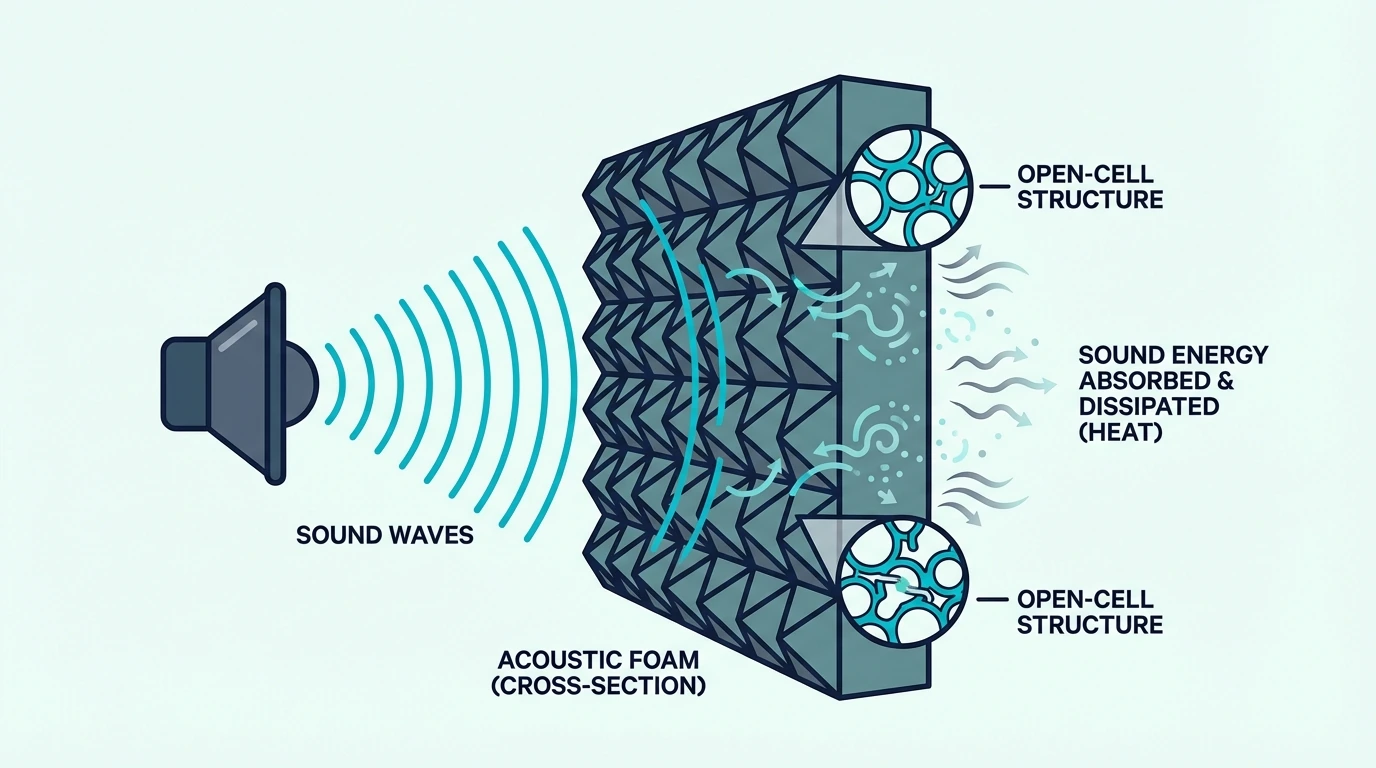
Understanding the mechanism helps set realistic expectations.
The Absorption Process
When sound waves hit acoustic foam: 1. Waves enter the foam’s open-cell structure 2. Sound travels through interconnected air pockets 3. Air molecules vibrate against cell walls 4. Friction converts sound energy to heat 5. Sound dissipates rather than reflecting back
This process reduces the sound bouncing around your room. The result is a more controlled acoustic environment where reflections don’t compete with the direct signal from your speakers or microphone.
What Gets Absorbed
Acoustic foam primarily absorbs mid and high frequencies: – High frequencies (2kHz+): Very effectively absorbed – Mid frequencies (500Hz-2kHz): Well absorbed – Low frequencies (below 500Hz): Poorly absorbed
This is why foam helps with voice clarity and echo but doesn’t control bass rumble. Bass frequencies require thicker, denser materials.
For detailed frequency information, see what frequencies acoustic foam absorbs.
Absorption vs Reflection
Hard surfaces (walls, glass, concrete) reflect sound—that’s what creates echo and reverb. Soft, porous surfaces absorb sound.
Acoustic foam is engineered to maximize absorption, reducing the reflections that cause acoustic problems.
Types of Acoustic Foam Panels
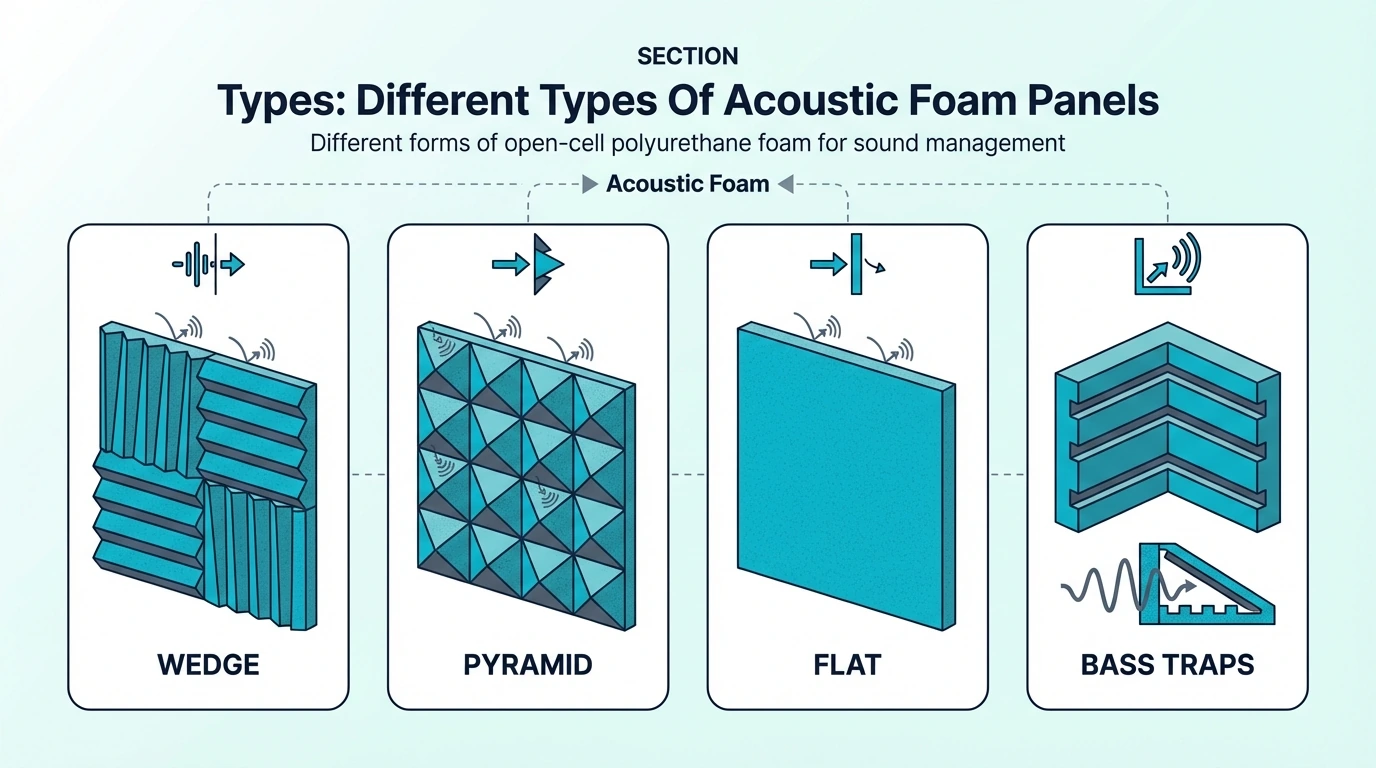
Panels come in various configurations for different needs.
Wedge Panels
Description: Parallel ridges with triangular profile Best for: General room treatment, studios, home theaters Characteristics: Good absorption, classic studio look, affordable
Pyramid Panels
Description: Four-sided pyramids in grid pattern Best for: Professional studios, maximum absorption needs Characteristics: Excellent absorption, scatters sound well, higher cost
Flat Panels
Description: Smooth surface, no texture Best for: Video backgrounds, aesthetic-priority spaces Characteristics: Clean look, equivalent absorption to shaped panels
Bass Traps
Description: Thick panels or corner-mounted triangular pieces Best for: Corner placement, low-frequency control Characteristics: Addresses bass that regular panels can’t
Egg Crate Panels
Description: Rounded bumps in alternating pattern Best for: Budget applications Characteristics: Lower cost, often lower quality
A pack like Foamily 12-Pack Acoustic Wedge Panels is a common starting point for testing foam in your room. For shape comparisons, see best acoustic foam shape.
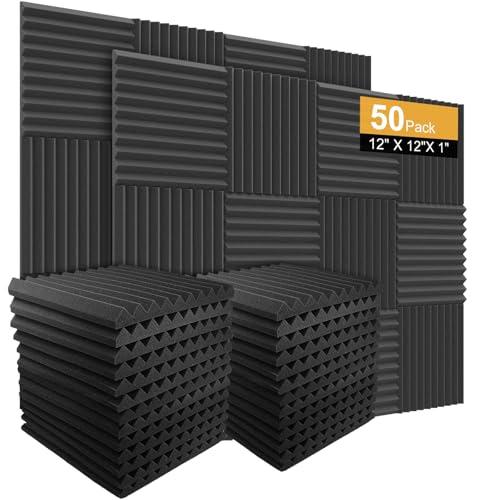
Foamily 12-Pack Acoustic Wedge Panels
Get Studio Tips Weekly
Join 5,000+ creators getting acoustic treatment advice every week.
No spam. Unsubscribe anytime.What Do Acoustic Foam Panels Actually Do?
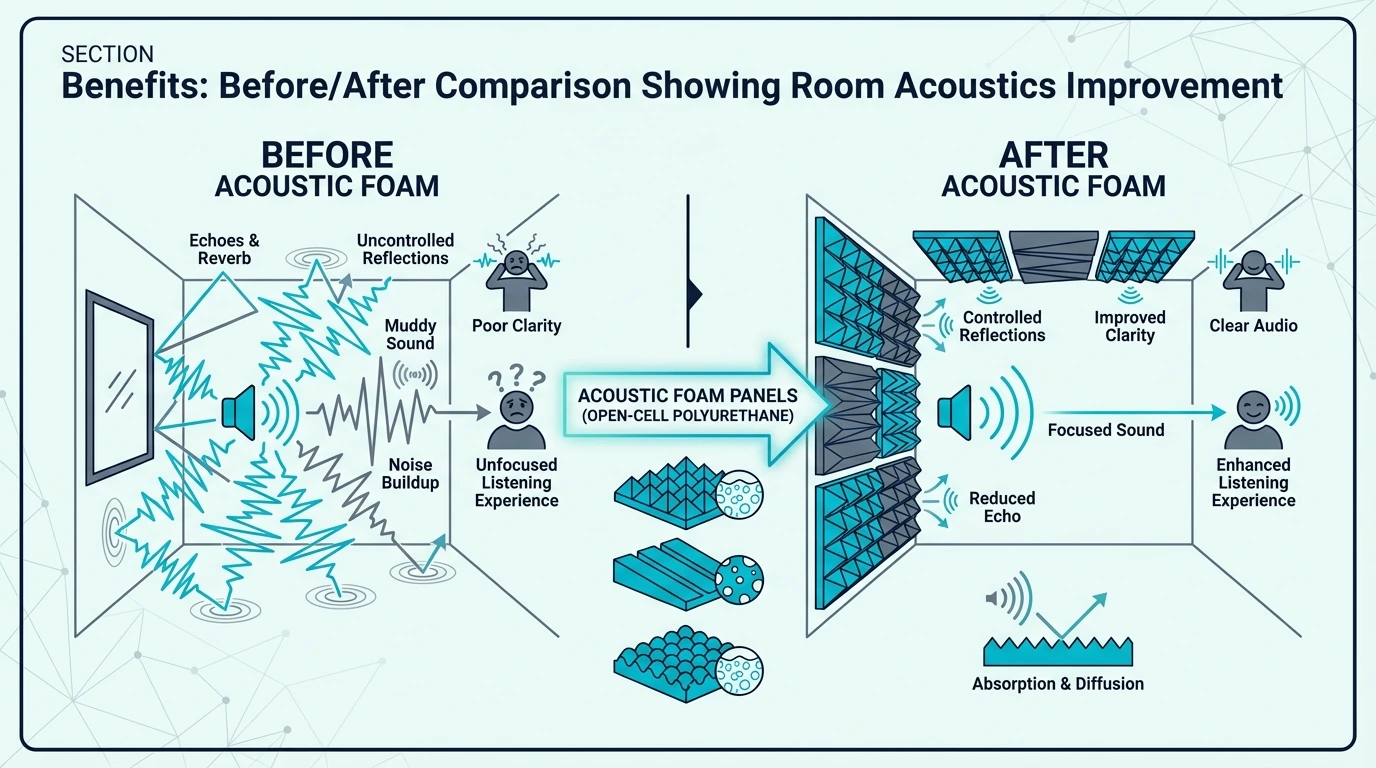
Understanding the benefits helps determine if you need them.
Reduce Echo and Reverb
The primary function. Foam absorbs sound that would otherwise bounce off walls, reducing: – Echo (distinct repetition of sound) – Reverb (prolonged sound decay) – Flutter echo (rapid repeated reflections)
Improve Recording Quality
For podcasters, musicians, and content creators, foam panels: – Reduce room sound in recordings – Improve vocal clarity – Create more professional audio – Provide consistent recording environment
If you’re starting a podcast or voice recording setup, JBER 48 Pack Acoustic Foam Panels give you enough tiles to cover a recording nook without a big investment. For recording applications, see whether acoustic foam improves recording.
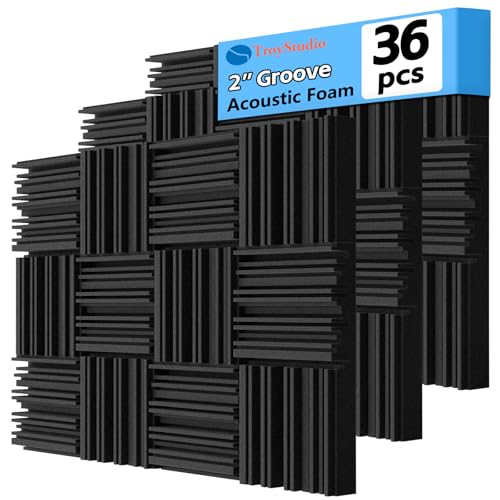
JBER 48 Pack Acoustic Foam Panels
Enhance Listening Accuracy
For mixing music or critical listening: – Reduce reflections that color what you hear – Improve stereo imaging – Create more accurate monitoring environment – Help identify issues in recordings
Reduce Noise Distraction
In offices and workspaces: – Absorb ambient noise – Improve speech privacy – Reduce distraction from conversations – Create more comfortable acoustic environment
What Can’t Acoustic Foam Panels Do?
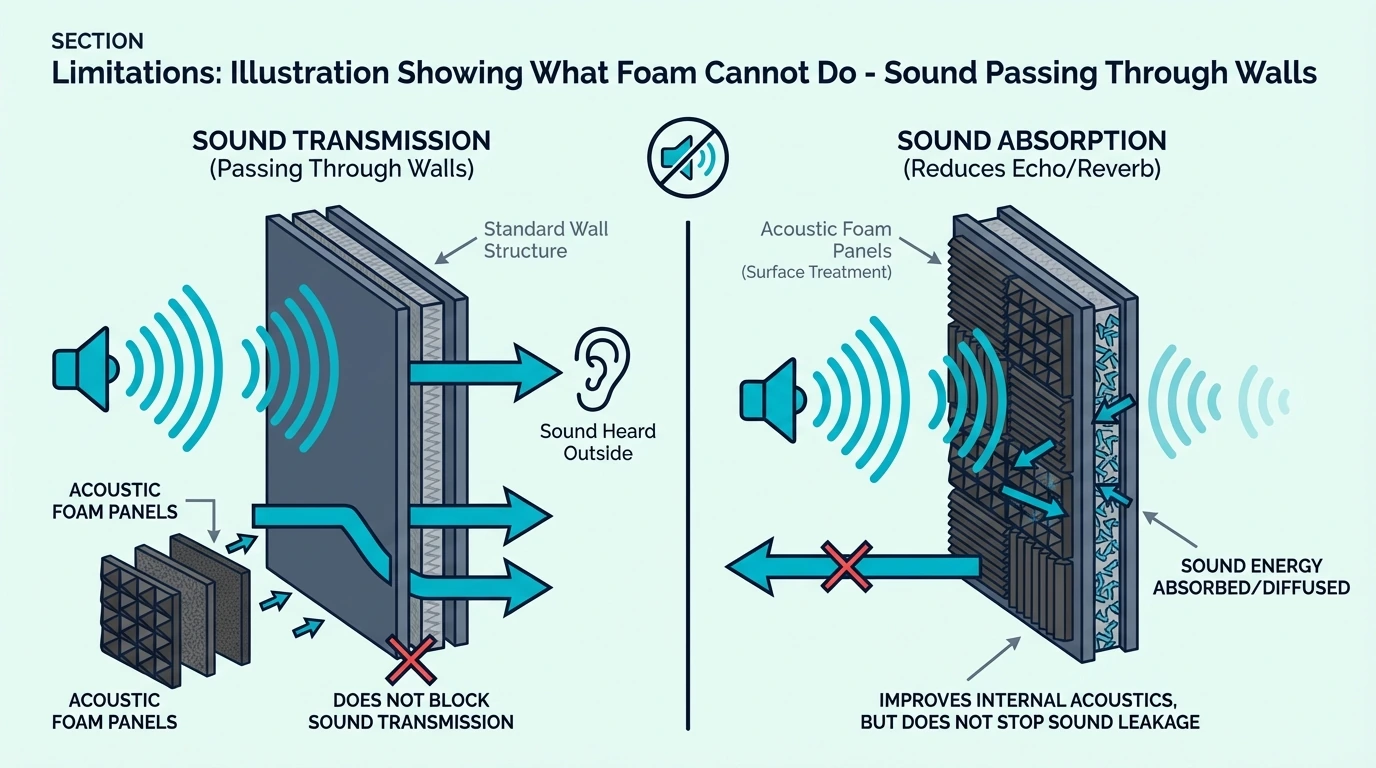
Common misconceptions lead to disappointment.
They Don’t Soundproof
This is the biggest misconception. Acoustic foam: – Does NOT block sound from entering your room – Does NOT prevent sound from leaving your room – Does NOT reduce noise from neighbors – Does NOT stop traffic noise
Soundproofing requires mass (heavy materials), decoupling (isolated structures), and sealing (no air gaps). Foam is lightweight and porous—the opposite of what blocks sound.
For soundproofing information, see sound deadening material vs acoustic foam.
They Don’t Absorb Bass
Standard foam panels (2-4 inches) don’t effectively absorb low frequencies. Bass control requires: – Thicker materials (4+ inches) – Denser materials (fiberglass, rockwool) – Corner placement (bass traps)
They Don’t Replace Proper Room Design
Foam panels help but can’t fix fundamental room problems: – Parallel walls causing flutter echo – Room dimensions creating standing waves – Structural noise transmission
Do You Actually Need Acoustic Foam Panels?
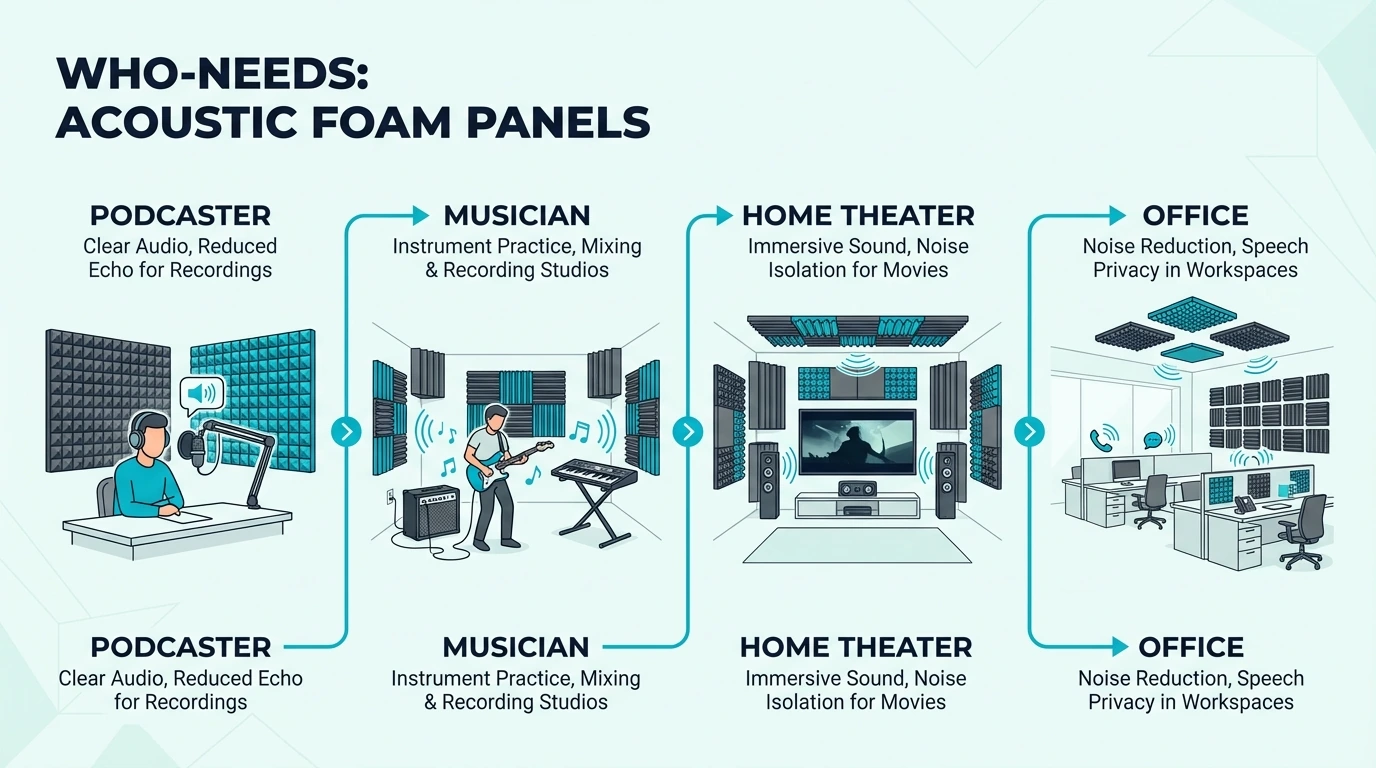
Determine if foam panels suit your situation.
You Likely Need Them If:
- You record audio (podcasts, music, voiceover)
- Your room sounds echoey or reverberant
- You mix or master audio
- You have a home theater
- Video calls sound hollow or roomy
- You work in a noisy open office
You Probably Don’t Need Them If:
- Your main problem is outside noise (need soundproofing)
- Your room already has soft furnishings (rugs, curtains, furniture)
- You’re trying to block sound between rooms
- You have no audio-related activities
Consider Alternatives If:
- Budget is extremely limited (DIY options exist)
- Aesthetics are primary concern (fabric panels look better)
- You need bass control (bass traps more effective)
For alternatives, see what to use instead of acoustic foam.
How Should You Place Acoustic Foam Panels?
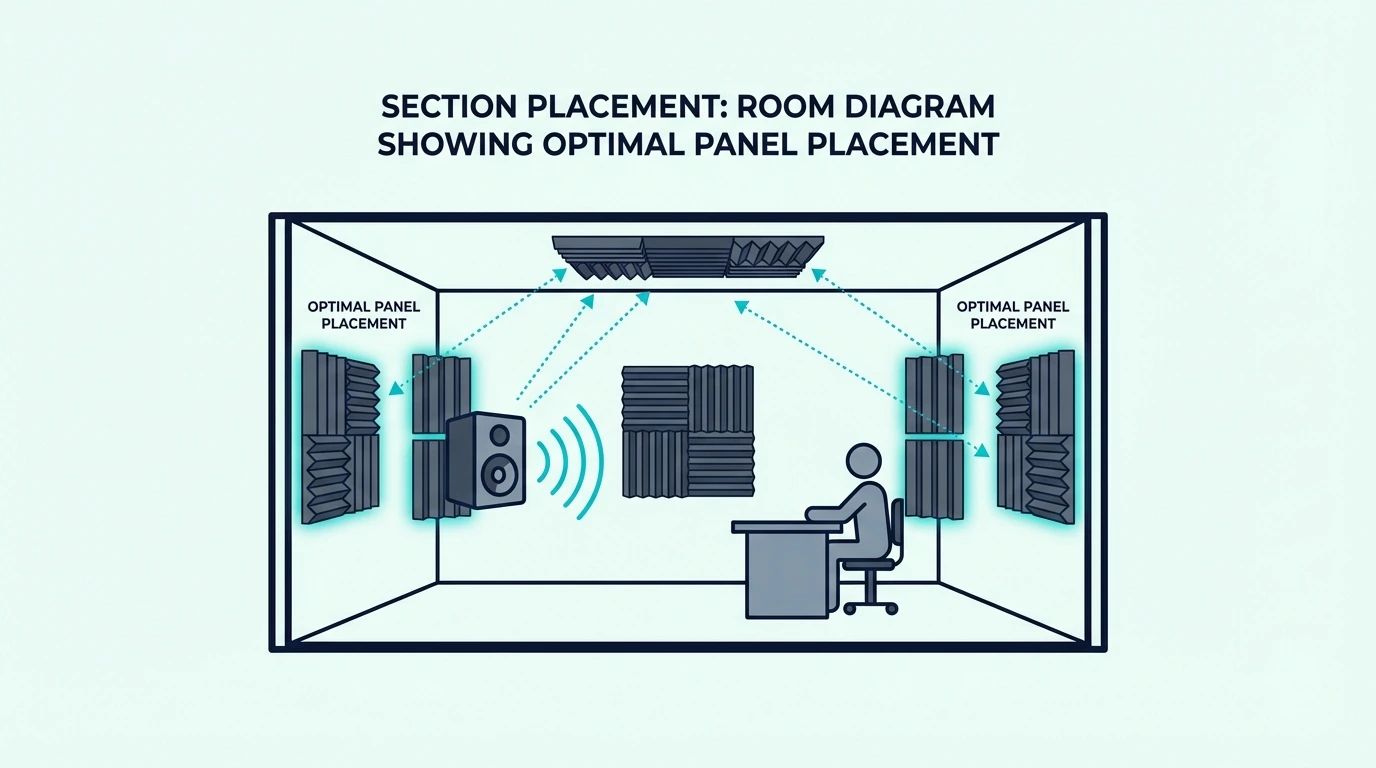
Proper placement maximizes effectiveness.
Key Placement Areas
First reflection points: Where sound bounces from speakers/voice to your ears Behind microphones: Absorbs sound that would reflect back into mic Corners: Where bass accumulates (use bass traps) Ceiling: Often overlooked but important for reflections
Coverage Guidelines
- Recording: 30-40% wall coverage in recording area
- Mixing: 40-50% coverage at listening position
- General improvement: 25-35% distributed coverage
Installation Methods
- Adhesive: Permanent, strong bond
- Command strips: Removable, renter-friendly
- Impaling clips: Semi-permanent, foam removable
For thicker coverage at first reflection points, TroyStudio 2-inch Self-Adhesive Panels provide better mid-range absorption than 1-inch alternatives. For detailed placement guidance, see how to arrange acoustic foam.
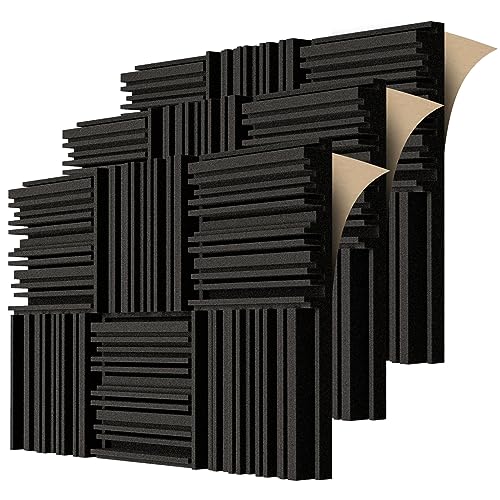
TroyStudio 2-inch Self-Adhesive Panels
How Do You Choose the Right Acoustic Foam Panels?
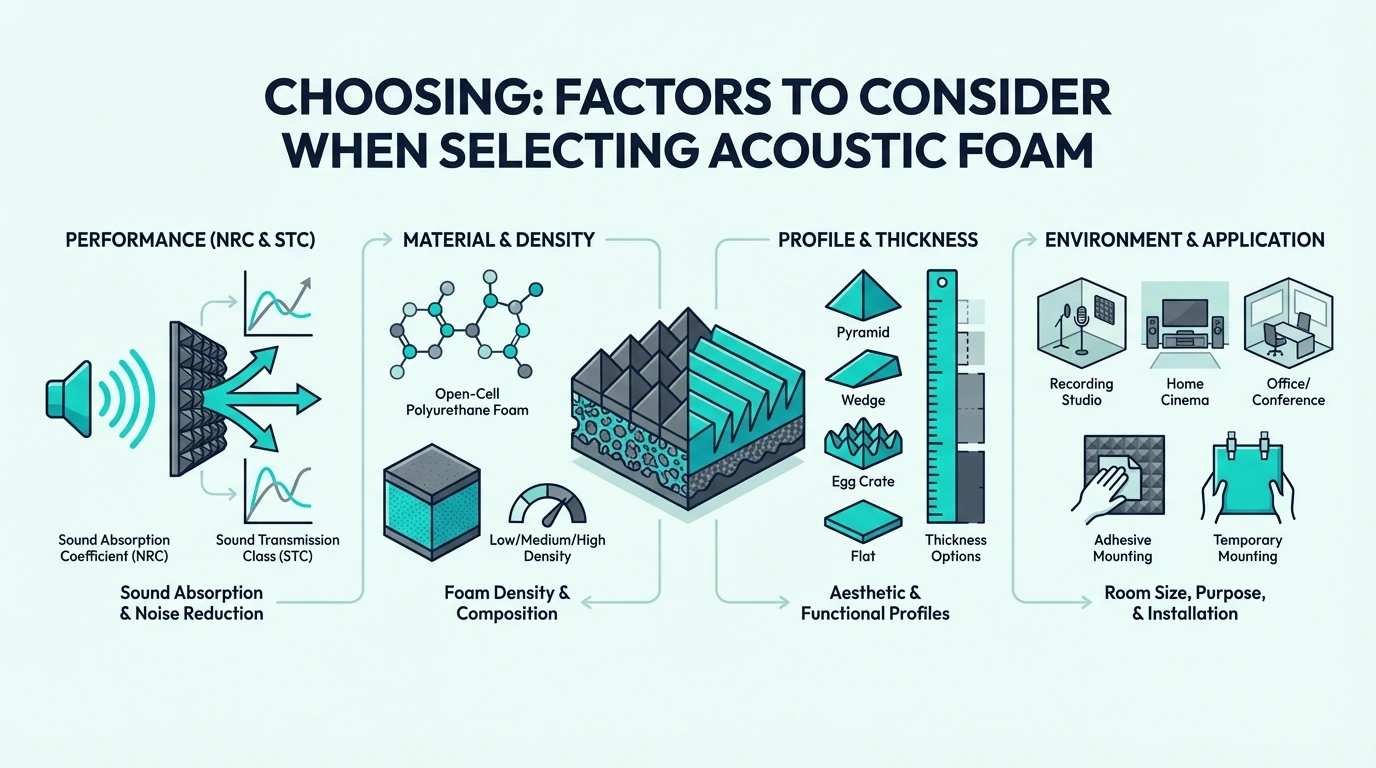
Key factors for selection.
Thickness
- 2 inches: Minimum for effective absorption
- 3-4 inches: Better low-mid frequency absorption
- 1 inch: Inadequate for most applications
Density
- 1.5-2.5 lb/ft³: Ideal range
- Below 1.5: May underperform
- Above 2.5: Diminishing returns
NRC Rating
- 0.5+: Acceptable
- 0.7+: Good
- 0.85+: Excellent
Fire Rating
- Class A or B: Required for safety
- Unrated: Avoid for permanent installation
For selection help, see how to choose acoustic foam.
The Bottom Line
Acoustic foam panels are sound-absorbing materials that reduce echo, reverb, and reflections within a room. They improve recording quality, listening accuracy, and general acoustic comfort by absorbing mid and high-frequency sound waves.
They don’t soundproof—foam won’t block noise from neighbors or prevent your sound from disturbing others. They also don’t effectively absorb bass frequencies, which require thicker, denser materials.
If you record audio, mix music, or simply want to reduce echo in a reverberant room, acoustic foam panels provide noticeable improvement. Choose panels with adequate thickness (2”+), appropriate density (1.5+ lb/ft³), and proper fire rating.
Place them strategically at first reflection points and behind recording positions for the best results.
For soundproofing needs, look elsewhere. For acoustic treatment within your room, foam panels are an accessible, effective starting point.
For more guides on foam types, placement, and mounting, start at the acoustic foam hub.
Frequently Asked Questions
Do acoustic foam panels really work?
Yes, for their intended purpose. Foam panels effectively absorb mid and high-frequency sound reflections, reducing echo and reverb.
They don’t work for soundproofing (blocking sound transmission) or bass control—those require different solutions.
How many acoustic foam panels do I need?
For a typical bedroom-sized room, 12-24 panels (12”x12”) for basic treatment, or 24-48 for more thorough coverage. Focus on first reflection points and the area around your recording/listening position rather than covering every wall.
Where should I put acoustic foam panels?
Priority order: wall behind your microphone/speakers first, then side walls at first reflection points, ceiling above your position, and the wall behind your listening position. Use the mirror trick to find first reflection points—where you see your speakers reflected while sitting in your position.
Will acoustic foam panels soundproof my room?
No. Acoustic foam absorbs sound within your room but doesn’t block sound transmission through walls.
Soundproofing requires mass (heavy materials like drywall), decoupling (isolated wall structures), and sealing (no air gaps).
How much do acoustic foam panels cost?
Budget panels run around $1-2 per square foot, quality panels (Auralex, Foamily) $2-4 per square foot, and premium panels $4+ per square foot. A basic room treatment (20-40 square feet) typically costs $40-150 depending on quality.
Can I make my own acoustic panels?
Yes. DIY panels using rockwool or fiberglass insulation wrapped in fabric often outperform foam at similar or lower cost.
They require more effort to build but provide better absorption, especially at lower frequencies.