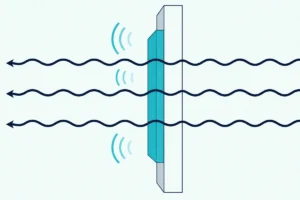
How to Soundproof a Hollow Door: Seal the Gaps First
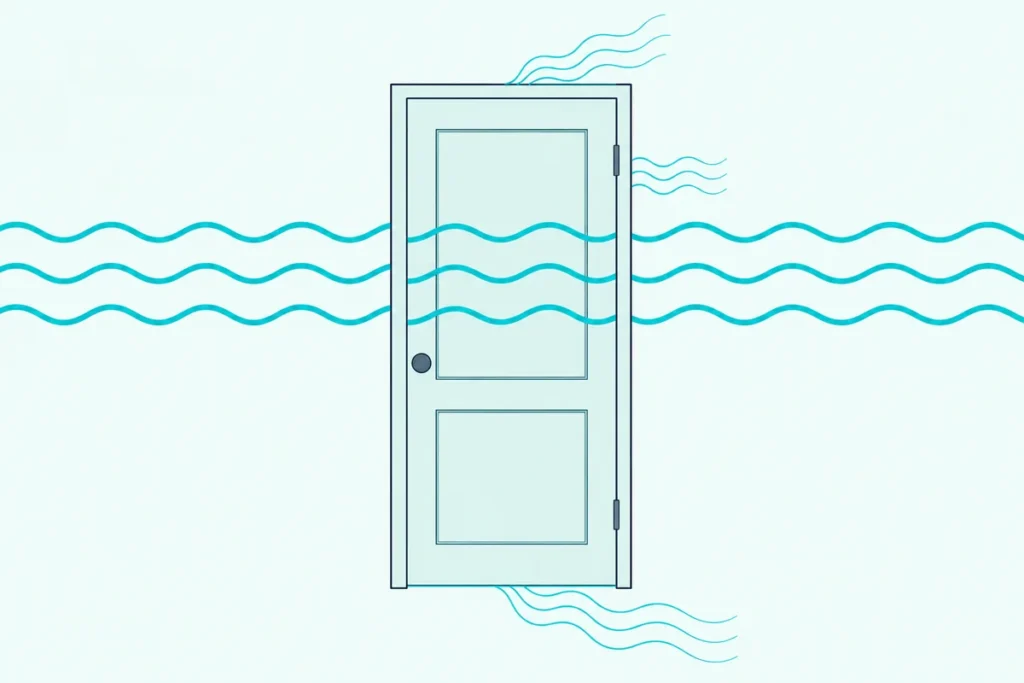
You shut the bedroom door and can still follow a conversation in the hallway, which is when you start searching for how to soundproof a hollow door.
The slab is only two thin skins around a light core, so it has little mass to stop sound, and the gaps around its edges let through whatever the slab doesn’t.
This guide uses the ratings published by JELD-WEN, TruStile and National Guard Products, HUD’s noise guidebook and GSA’s office acoustics guide to rank the fixes.
You’ll see why a hollow door is weak, how to seal it, whether adding mass or filling the core pays off, when a solid-core swap is worth it and what to do about a metal one.
Start with the five steps, because the cheap ones come first.
How to Soundproof a Hollow Door in Five Steps
That order puts the cheap fixes first because open gaps cancel what a better slab would add, so sealing has to come before anything else. You soundproof a hollow door by finding its leaks, sealing the sides, top and bottom, adding mass only if you must, and swapping the slab when sealing isn’t enough.
| Step | What you do | Why it comes here |
|---|---|---|
| 1. Find the leaks | Light the room, close the door and look from the dark side for light around the edges and under the door | Light shows where sound can follow |
| 2. Seal the sides and top | One continuous closed-cell foam strip on the three edges | GSA calls for a continuous three-sided seal |
| 3. Seal the bottom | A sweep or drop seal that shuts the gap under the door | GSA says the undercut should be shielded |
| 4. Add mass or a cover | Optional extras such as a heavy sheet on the door | The slab is thin, but no maker rates a hollow door this way |
| 5. Swap the slab | A solid-core door with a published STC | JELD-WEN lists 29 to 32 for solid core against 24 to 27 for hollow |
Steps one to three cost little, and TruStile’s rating tables show why they come first: its 1-3/4 in wood door style TS5xxx to TS9xxx rated 30 with a full seal package and 18 with a basic one (TruStile).
Skip ahead to step five only if the door is already tight, and use our guide to soundproofing every other kind of door for sliding, pocket and exterior doors.
How Can You Tell Whether Your Door Is Hollow?
Before you buy anything, confirm the slab really is hollow, because the steps above assume it. You can tell by knocking, by looking at the hardware cut-outs and by checking the maker’s model number.
Knock near the middle of the door, because a hollow slab sounds light and drum-like while a solid core sounds dull and heavy.
Look at the edge where the latch is cut in: a hollow door shows thin skins around a cavity, while JELD-WEN says its ProCore doors have a solid core of medium density fiberboard instead (JELD-WEN).
Style won’t tell you, because JELD-WEN’s rating guide lists a hollow-core and a solid-core version of the same panel style, such as Birkdale at 25 and 32 (JELD-WEN).
If you still have the model number or the paperwork, the maker’s guide gives the rating for that exact door.
Get Studio Tips Weekly
Join 5,000+ creators getting acoustic treatment advice every week.
No spam. Unsubscribe anytime.Why Are Hollow Core Doors So Bad at Blocking Sound?
Those steps start with the edges because the slab itself starts from a low base. A hollow-core door is bad at blocking sound because two thin skins around a light core carry little mass, which is why published ratings run only 17 to 27 STC against 29 to 32 for solid-core doors.
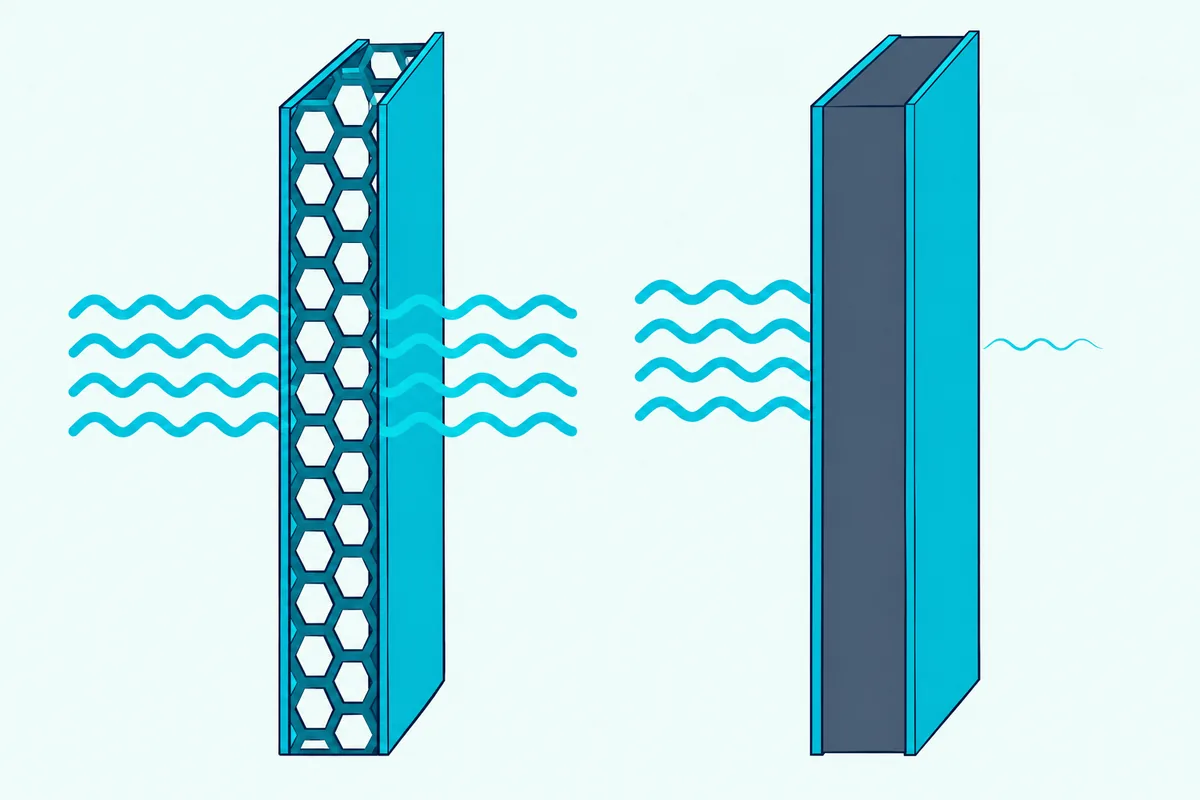
TruStile says mass, damping and stiffness decide how well a barrier resists sound, and that more mass means less sound gets through, especially at low frequencies (TruStile).
JELD-WEN describes its door cores as chipboard, flaxboard or a honeycomb of recycled paper, and says the honeycomb cores make its doors lightweight (JELD-WEN).
The published ratings agree that a hollow-core slab sits at the bottom of the scale.
| Source | Hollow-core door | Solid or heavier door |
|---|---|---|
| HUD Noise Guidebook | STC 17, which takes a 48 STC wall down to 24 | Solid core with a vinyl seal and carpet: the same wall falls only to 33 |
| JELD-WEN rating guide (2023) | 24 to 27 | 29 to 32 for its solid-core versions |
| JELD-WEN ProCore | 25 for hollow-core molded doors | Up to 36 for its top solid MDF core door |
| TruStile | 20 to 25, rated “very poor” with low speech audible | 35 to 40, rated “good”, with correct gasketing |
| GSA | “Only good to poor” | “Very good” with a solid or insulated core |
HUD’s example is a door that takes up about 20% of a 48 STC wall, and the hollow door alone drags the whole wall down to 24.
JELD-WEN notes that its ratings are for new products, so the number on your own door can differ with its components and options.
How Much Do the Gaps Around a Hollow Door Matter?
But the slab isn’t the only leak, and on a door this weak the gaps can be the bigger one. Gaps matter a great deal: TruStile says 1/8 in clearances around the edges reduce the effective rating of a 52 STC door to 21 (TruStile).

The reason, TruStile says, is that sound travels through any opening with very little loss, so a tiny hole transmits almost as much as a much larger gap.
For scale, a 1/8 in gap all the way around a 32 by 80 in door is about 28 square inches, roughly 1% of the door’s face.
National Guard Products, which makes acoustical gasketing, says standard doors without gasketing have no sound control and rate between STC 15 and 20, while solid-core wood doors with gasketing reach about 28 to 30 (NGP).
TruStile’s rating tables show how far sealing alone moves the same solid door, using three seal packages from Zero International (TruStile).
| TruStile 1-3/4 in door style | Full package: two seals, threshold and sweep | One seal and a threshold, no sweep | Basic package |
|---|---|---|---|
| Wood, TS1xxx to TS4xxx | 32 | 30 | Not listed |
| Wood, TS5xxx to TS9xxx | 30 | Not listed | 18 |
| MDF, TS1xxx to TS4xxx | 33 | 30 | 21 |
| MDF, TS5xxx to TS9xxx | 34 | 32 | Not listed |
The spread is 12 points for the one wood style listed with both the full and the basic package, and TruStile says it’s the gasketing and perimeter sealing package that determines the rating a door achieves.
Find your own leaks before you buy anything, by lighting the room, closing the door and looking from the dark side.
| Where light shows | What it means | What closes it |
|---|---|---|
| Along the top or hinge side | A gap between the slab and the frame | Foam on the frame stop |
| Along the latch side | A gap the strike plate and latch hold open | Foam thick enough to compress when the door latches |
| Under the door | The undercut | A sweep, drop seal or threshold |
| At spots where button stops hold the door off its frame | GSA says button stops, or none, give poor results | One continuous stop and seal |
| Around the casing | A gap between the frame and the wall | Sealant, covered below |
How Do You Seal the Top and Sides of a Hollow Door?
Once you’ve found the leaks, start with the three edges the door closes against. You seal them with one continuous strip of closed-cell foam, which GSA says a good perimeter seal should be, on all three sides of the opening (GSA).
TruStile adds that the seals around the head, jamb and sill must be complete, uninterrupted and airtight, and installed all on the same side of the door and frame (TruStile).
GSA also says results are poor when button-style impact stops are used, or none at all, so a continuous strip beats a few dabs of foam.
For the edges, Kikerike’s self-adhesive foam weatherstrip is a 1/2 in by 1/4 in high-density strip, and its listing sells it for door and window sound isolation.
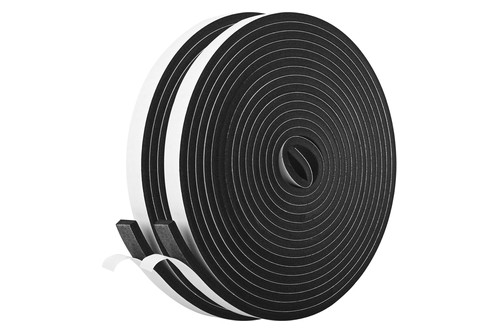
Kikerike’s self-adhesive foam weatherstrip
Clean the frame stop with rubbing alcohol, press the strip on in one run without gaps at the corners, then close the door and check that it still latches with a firm push.
If the latch stops catching, switch to a thinner strip instead of forcing the door, because a door that won’t latch isn’t sealed.
If the door carries a fire-rating label, read the fire-door section below before you add anything.
How Do You Seal the Bottom of a Hollow Door?
That leaves the bottom edge, where GSA says the undercut should be shielded by a sweep or a drop seal gasket. You seal it by fitting a sweep that reaches the floor, or a threshold with a drop seal, sized to the gap you measure at the lowest point (GSA).
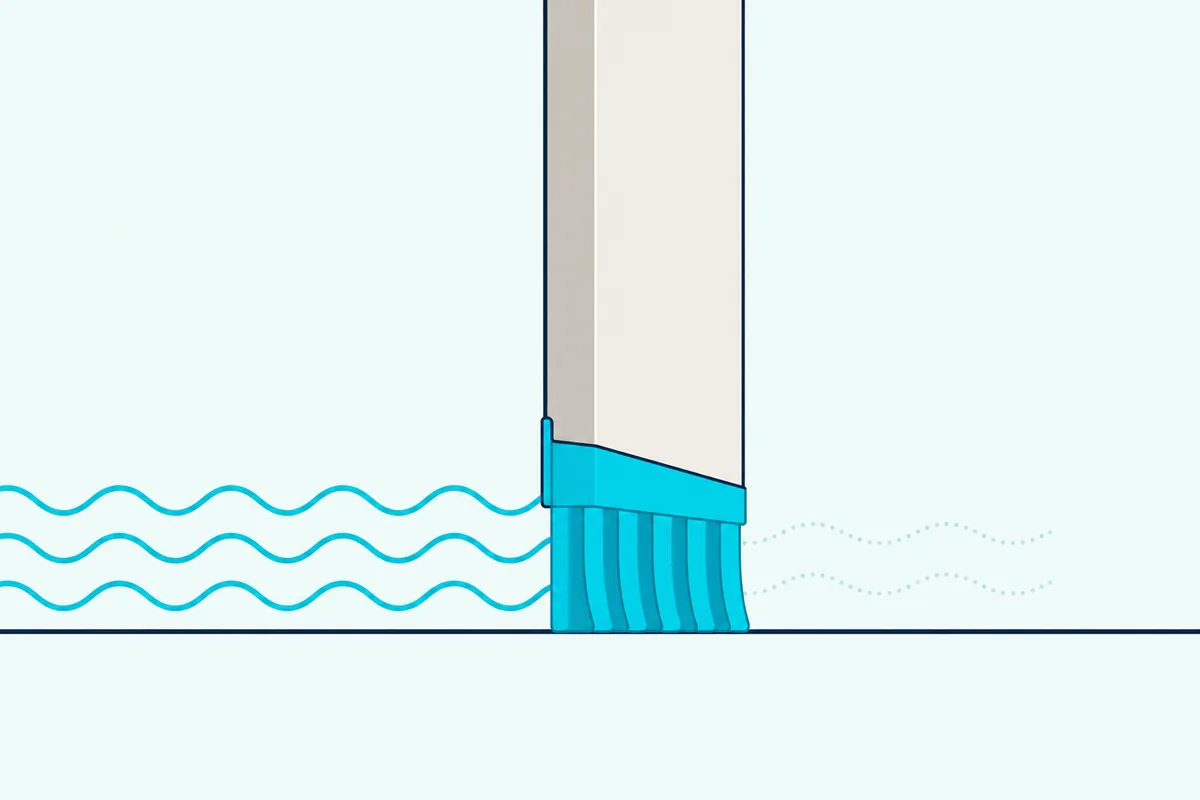
HUD lists gasketed stops and drop-bar threshold closers at the bottom edge as ways to add insulation value to a door (HUD).
National Guard Products’ seal sets that use an automatic door bottom say a 1/4 in drop is best and 3/8 in the most, and GreenBuildingAdvisor editor Malcolm Taylor says a wood threshold and sweep make a big difference (NGP, GBA).
Measure the gap at the lowest point of the floor, because a seal chosen for the average gap leaves a slit where the floor dips.
| Gap under the door | What fits | What the maker says |
|---|---|---|
| Up to about 1 in | A self-adhesive silicone sweep | VITAM AMO’s listing says it seals gaps up to 1-3/32 in |
| 1/2 to 1-1/2 in | A slide-on interior seal made for 1-3/8 in doors | M-D’s interior Cinch seal lists 1/2 to 1-1/2 in |
| An uneven floor or a larger gap | A threshold with a drop seal | GSA, HUD and NGP all point to this |
Check the door’s thickness before you buy a slide-on seal, because M-D lists its interior seal for standard 1-3/8 in doors and its better-known exterior seal for 1-3/4 in doors.
For a peel-and-stick fix that doesn’t depend on thickness, the VITAM AMO silicone door sweep trims to length and sticks to the bottom of the slab.
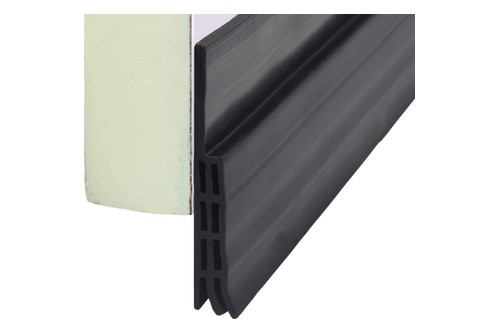
the VITAM AMO silicone door sweep
Our comparison of which door sweeps seal the bottom best covers the other styles.
What Does a One-Hour Seal Job Look Like?
Once the leaks are mapped and the seals chosen, the job itself is short. A one-hour seal job means measuring, cleaning, sticking the strips on in one continuous run and testing, with a tape measure, rubbing alcohol, scissors and a light.
- Measure the gap under the door at its widest point, and the width of the stop the door closes against.
- Run the light test again and write down every leak, so you can check them off afterward.
- Wipe the stop and the bottom of the door with rubbing alcohol and let them dry.
- Press the foam strip onto the stop in one run, up the hinge side, across the top and down the latch side, with no gaps at the corners.
- Close the door and check that it latches with a firm push, and trim or swap the strip if it doesn’t.
- Trim the sweep to the width of the door with scissors, peel the backing and press it along the bottom face so its fins just touch the floor.
- Swing the door a few times to check the sweep doesn’t drag so hard that the door won’t close, then repeat the light test.
Both adhesives need a clean surface, and VITAM AMO’s listing says its sweep works on carpet or hardwood floors and shows the adhesive taking 24 hours to stick completely.
Do the voice-recording check from the results section below once the adhesive has set, so you know what the job bought you.
Does the Frame or Wall Around the Door Matter?
And a well-sealed door can still lose to the opening it sits in. The frame and wall matter because sound leaks through any crack, and HUD’s example is a 1/16 in crack 16 in long that takes a 50 STC wall down to 40 (HUD).
HUD says a wall has to be well sealed at its perimeter for its rating to count, which for a door means checking the gap between the casing and the wall as well.
The 2021 International Building Code goes further for walls between dwellings: openings for pipes and ducts must be sealed, and entrance doors must be tight fitting to the frame and sill (ICC).
Our guide to soundproofing the wall around the door covers the wall itself.
Can You Add Mass to a Hollow Door?
Seals fix the gaps, but they can’t change the slab, which is why people try adding weight. You can add mass, but only to a point: Acoustical Surfaces rates its 1 lb per square foot vinyl sheet at STC 27 and its 2 lb sheet at STC 31 on their own, and no maker rates a hollow door with one added (Acoustical Surfaces).
Acoustical Surfaces says the sheet can be glued, screwed or hung like a curtain with grommets.
A 1 lb per square foot sheet over one 32 by 80 in face adds about 18 lb, and the hinges and frame have to carry it.
None of the maker documents above covers a hollow door loaded this way, so check the hinges and screws before you add anything heavy.
| Add-on | What the source says | The catch |
|---|---|---|
| Mass-loaded vinyl, 1 lb per square foot | The sheet alone rates STC 27 | About 18 lb per face, and no rating for it on a hollow door |
| Mass-loaded vinyl, 2 lb per square foot | The sheet alone rates STC 31 | About 36 lb per face on the hinges |
| A heavy curtain or blanket | No source rates one | Removable, but a bonus and not a fix |
| A solid-core slab | JELD-WEN lists 29 to 32 | The slab swap, covered below |
Do Door Blankets or Curtains Help?
But a heavy curtain or blanket isn’t a barrier, and it’s the first thing many people try. A curtain or blanket on a door helps only a little: lab-tested curtain materials rate STC 13 to 21, below the 24 to 27 of the hollow slab itself (arXiv).
That National University of Singapore study measured a commercial dual-layer drapery at 13 and its best PVC-coated polyester and pure PVC sheets at 21, and a curtain on a rod also leaves its edges open.
GSA’s guide treats absorbing sound inside a room and blocking it between rooms as different jobs, and a soft layer on the door mainly does the first.
If you want a removable layer anyway, hang it over a door that’s already sealed, and count it as a bonus.
Should You Fill a Hollow Core Door With Insulation or Foam?
But adding weight from outside isn’t the same as filling the slab from inside, which many guides suggest. You shouldn’t bother: GreenBuildingAdvisor editor Martin Holladay says it’s far easier to buy a solid-core door than to fill a hollow-core door with cellulose and patch it (GBA).
The same thread’s other GBA editor, Malcolm Taylor, says to check a replacement door’s STC rating before you choose, and that effective weatherstripping decides a lot.
No source in this guide tests a filled hollow-core door, so there’s no rating to quote for filling one.
Is a Solid-Core Door Worth Swapping In?
If the seals are on and speech still comes through, the slab is the limit, and a solid-core swap is the next step. A solid-core door is worth it when you own the door: JELD-WEN lists its solid-core molded doors at STC 29 to 32 against 24 to 27 for the hollow-core versions, a gain of roughly 5 to 7 points for most models (JELD-WEN).
JELD-WEN’s ProCore line goes further, with a solid MDF core and a top rating of STC 36, and the maker says that’s about as far as an interior door needs to go because a typical 2×4 interior wall carries a 36 (JELD-WEN).
HUD calls a well-sealed solid-core door relatively inexpensive, and GBA’s editors point to the same swap while saying to check the STC rating first.
A real wood panel door isn’t automatically better, because JELD-WEN rates its Hemlock 6-panel at 27, its Meranti 6-panel at 29 and its Fir 6-panel at 30 (JELD-WEN).
The table shows what each door does to a 36 STC wall when the door takes up about 20% of it.
| Door | Its STC | The wall and door together |
|---|---|---|
| Hollow core (HUD) | 17 | About 24 |
| Hollow core (JELD-WEN) | 25 | About 31 |
| Solid core (JELD-WEN) | 30 | About 34 |
| Solid core (JELD-WEN) | 32 | About 35 |
| ProCore top door (JELD-WEN) | 36 | 36 |
Those figures are our arithmetic, using the area-weighted average that reproduces HUD’s own example, where a 17 STC door in 20% of a 48 STC wall leaves 24.
They assume a sealed door in a plain 2×4 wall rated 36, and they show why a slab rated above the wall adds nothing.
| Check before you buy | Why it matters |
|---|---|
| A published STC from the maker | JELD-WEN and TruStile list ratings by model, and the number varies |
| Thickness | M-D lists standard interior doors at 1-3/8 in and exterior doors at 1-3/4 in, so match what your hinges and stops expect |
| A fire rating | A fire-rated door has to keep its label, as the fire-door section below explains |
| Seals | A solid door still needs the seals above, since NGP’s 15 to 20 is for doors without gasketing |
Our guide to which solid-core interior doors to buy compares the options.
What If Your Hollow Door Is Metal or Fire-Rated?
Everything above assumes a wood or composite slab, so a hollow metal door needs its own check. National Guard Products says honeycomb-core hollow metal doors with gasketing rate about STC 32 to 36, and without gasketing 15 to 20 (NGP).
If the door carries a fire-rating label, leave its construction alone: NFPA says the label must stay legible while the door is in service, and NFPA 80 governs how signs and similar items are attached and checks the clearance around the door (NFPA).
NFPA also says fire doors must always be able to open, close and latch, so check that any seal you add doesn’t stop the latch from catching.
If the door is the entry door to an apartment, look for a label and ask the landlord or building manager before you add layers, hardware or seals.
| Door | Start with | Then |
|---|---|---|
| Interior wood or composite, no label | Seals on the edges and bottom | Mass or a solid-core swap |
| Metal, no label | Seals, since NGP rates these doors 32 to 36 with gasketing and 15 to 20 without | A solid or acoustic door if you own it |
| Any door with a fire label | Ask the building manager | Only changes they approve |
How Much Quieter Will a Hollow Door Get?
Those fixes add up unevenly, so it helps to know what each rating step sounds like. A sealed hollow door should land near the 24 to 27 STC that JELD-WEN lists for the slab, where TruStile’s scale puts the line between “very poor, low speech audible” and “poor, normal speech understood easily and distinctly” (TruStile).
| STC range | TruStile’s description | Where a door lands |
|---|---|---|
| 20 to 25 | Very poor: low speech audible | A typical hollow-core door |
| 25 to 30 | Poor: normal speech understood easily and distinctly | A sealed hollow door, or a solid-core door with gasketing at 28 to 30 |
| 30 to 35 | Fair: loud speech understood fairly well | A well-sealed solid-core door |
| 35 to 40 | Good: loud speech heard but hardly intelligible | TruStile’s doors with correct gasketing, and JELD-WEN’s top ProCore door at 36 |
| 40 to 50 | Very good: loud speech heard faintly | Specially made acoustic doors with full gasketing |
FHWA’s noise primer rates a 3 dBA change as barely perceptible, 5 dBA as readily perceptible and 10 dBA as half as loud, which is a fair guide to how big a step you’ll notice (FHWA).
To check your result, play the same voice recording at the same volume on the far side before and after, and read the level on your side with the free NIOSH Sound Level Meter app, which CDC lists as accurate within 2 dBA and available only on iOS (CDC).
Expect speech to get harder to follow rather than to disappear, because even a good solid-core door rates only about 29 to 32 in JELD-WEN’s guide.
Our explainer on how to read an STC rating shows what to look for on a spec sheet.
Which Fix Fits a Bedroom, Office or Apartment Door?
Those numbers apply anywhere, but what you can change depends on the room and who owns the door. Pick your route by situation: a rental bedroom door gets removable seals, an owned office door can take a solid-core swap, and an apartment entry door starts with a call to the landlord.
| Situation | Start with | Then |
|---|---|---|
| Rental bedroom | Adhesive foam on the stops and an adhesive sweep, with no screws | Ask about a swap if you stay long term |
| Owned bedroom | The same seals | A solid-core door if speech still comes through |
| Home office | Seals first, then check the target: GSA wants STC 40 or more in walls for normal speech privacy and 45 for confidential speech | A solid-core door, since a hollow one rates 24 to 27 |
| Apartment entry door | Check for a fire label and ask management | The seals they approve, remembering the code’s tight-fitting rule |
GSA’s office guide sets walls at STC 40 for normal speech privacy and 45 where speech must stay confidential, and it rates hollow-core doors as only good to poor.
A hollow door at 24 to 27 can’t match a 40 or 45 wall, so a home office that needs real privacy ends up at a solid-core door with full seals.
The Bottom Line
Seal the three edges and the bottom first, because open gaps cancel what a better door would add, then swap in a solid-core slab if speech still comes through.
Expect speech to get harder to follow, not to vanish, since even a good solid-core door rates only 29 to 32.
Frequently Asked Questions
Can you soundproof a hollow core door?
Yes, but only partly. Sealing the edges and bottom gets a hollow door close to the 24 to 27 STC JELD-WEN lists for the slab, and past that you need mass or a solid-core swap.
How do you soundproof a hollow door cheaply?
Light the room, find the gaps and close them with a continuous closed-cell foam strip on the sides and top and a sweep on the bottom. GreenBuildingAdvisor editor Martin Holladay calls weatherstripping the first step.
Are hollow core doors soundproof?
No. HUD rates a common one at STC 17 and JELD-WEN lists its own at 24 to 27, which TruStile’s scale calls very poor to poor, with speech easy to understand.
Does weatherstripping help a hollow door?
Yes, it helps most. TruStile says 1/8 in gaps cut a 52 STC door to 21, and National Guard Products says doors without gasketing rate only 15 to 20.
What is the best seal for the bottom of a hollow door?
One that closes the gap you measure. A self-adhesive sweep suits gaps up to about 1 in, and a slide-on seal made for 1-3/8 in interior doors suits 1/2 to 1-1/2 in.
Can you fill a hollow core door with insulation or spray foam?
It isn’t worth it. GreenBuildingAdvisor’s editor says it’s far easier to buy a solid-core door, and no source tests a filled hollow door.
Is it better to replace a hollow door or soundproof it?
Seal it first, then replace it if speech still comes through. JELD-WEN lists solid-core doors at 29 to 32 against 24 to 27 for hollow ones.
How do you soundproof a hollow bedroom door?
Seal the stops and the bottom with removable adhesive foam and a sweep, then check the result with the same voice recording before and after. A rental can stop there, while an owner can swap in a solid-core slab.
How do you soundproof a hollow office door?
Seal it, then plan a solid-core swap, because GSA wants walls at STC 40 for normal speech privacy and 45 for confidential speech. A hollow door at 24 to 27 can’t match that.
Can you soundproof a hollow metal door?
Yes, mostly with seals. National Guard Products says honeycomb-core hollow metal doors rate about 32 to 36 with gasketing and 15 to 20 without, and a fire-labeled door should stay unchanged.
How do you soundproof a room that has a hollow door?
Treat the door first, because it’s the weakest part of the wall: HUD’s example is a hollow door at STC 17 pulling a 48 STC wall down to 24. Once the door is sealed, the wall, the frame and any vents are the next leaks to check.
Can you soundproof a hollow door without replacing it?
Yes, up to the slab’s own rating. Seal the sides, top and bottom, add a bonus layer if you like, and replace the slab only if speech still comes through, since JELD-WEN lists solid-core doors only about 5 to 7 points higher.
Will mass-loaded vinyl help a hollow door?
It adds weight, but no maker rates a hollow door with it on. Acoustical Surfaces rates the sheet alone at STC 27 for 1 lb per square foot, and the sheet adds about 18 lb to a 32 by 80 in face.