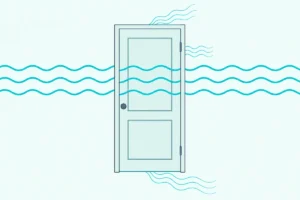
Felt Soundproofing: What It Absorbs and What It Can’t Block
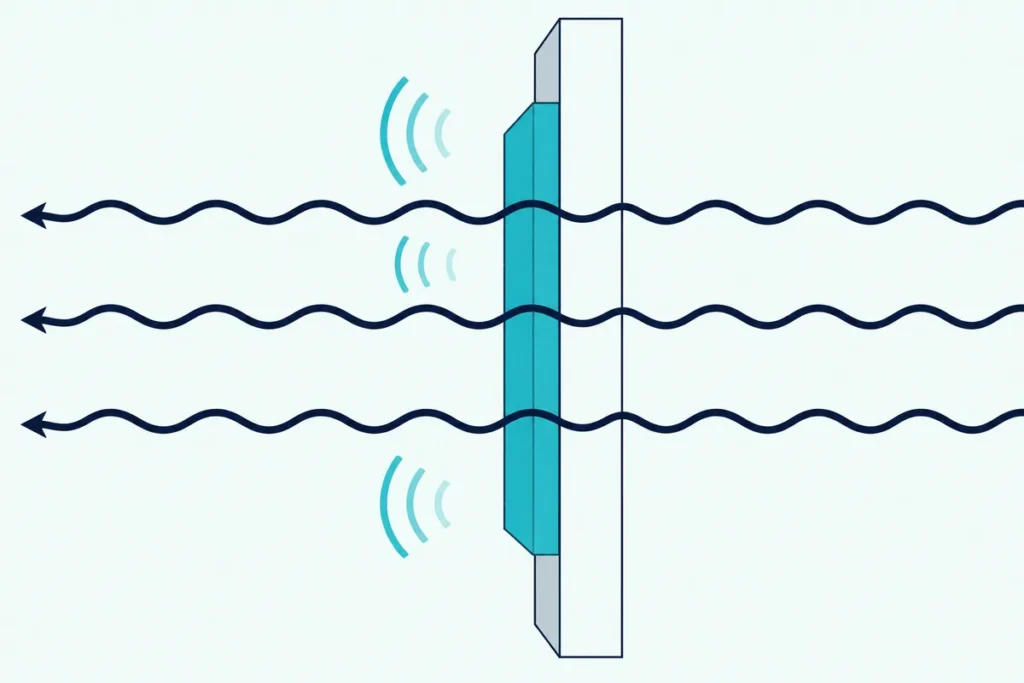
You press a felt tile to the wall behind your desk, clap once, and the echo goes flat, so you wonder whether felt soundproofing could mute the neighbor’s television the same way.
The listings call it soundproofing, yet in one lab test a 9 mm felt panel on a bare wall absorbed only 5% of the sound at 250 Hz and 14% at 500 Hz.
This guide uses Riverbank Acoustical Laboratories’ reports for Kirei’s felt panels, plus USG’s, GSA’s and HUD’s own guidance, to separate what felt does from what walls do.
You’ll see how thickness, air gaps and insulation change the numbers, why felt can’t stop a neighbor, and which panels are worth buying.
Start with the short answer, because it decides what you should buy.
Does Felt Soundproofing Work?
That clap test hints at why the answer splits in two. Felt soundproofing works for echo inside a room but not for stopping sound between rooms, since a 24 mm felt panel fixed to a wall rates NRC 0.75 yet weighed just 0.67 lb/ft² in the lab, against 2.2 lb/ft² for one layer of 5/8 in drywall (Kirei, USG).
| What you want | Does felt help? | Why |
|---|---|---|
| Less echo and reverb in a room | Yes | Porous material absorbs sound that would bounce off hard walls |
| Clearer calls and recordings | Yes | Less reverberation improves speech clarity |
| Less bass boom | Only a little on its own | A 9 mm panel on a wall absorbed 0% at 125 Hz and 5% at 250 Hz |
| A quieter room next to a loud neighbor | No | Blocking sound takes mass and airtight seals |
| Less traffic noise from outside | No | Same reason: felt adds almost no mass |
Kirei’s spec sheet lists absorption, fire rating and emissions for its felt but no sound transmission rating, which fits a material built to absorb rather than block.
If the noise is coming through a wall, our guide to how soundproofing really works covers mass, damping and decoupling.
What Is the Difference Between Absorbing and Blocking Sound?
That table rests on two separate jobs. Absorbing sound means a material turns part of a sound wave into heat, which NRC rates under ASTM C423, while blocking sound means cutting what passes between two spaces, which STC rates under ASTM E90 (USG).
GSA defines NRC as the average of the absorption coefficients at 250, 500, 1000 and 2000 Hz, rounded to the nearest 0.05, so an NRC of 0.40 can hide a panel that does almost nothing at 250 Hz (GSA).
USG adds that porous materials such as glass fiber absorb sound efficiently while non-porous ones such as gypsum board tend to reflect it, so the two jobs need different materials.
Felt makers draw the same line: Feltright’s explainer says its felt wall tiles are designed for sound dampening, not soundproofing, and don’t block sound entering or leaving a room (Feltright).
Blocking comes from weight and stiffness: HUD says the denser the wall, the more it reduces noise, and doubling a partition’s thickness can cut sound by as much as 6 dB (HUD).
Riverbank weighed Kirei’s 9 mm panel at 0.42 lb/ft², about a fifth of the 2.2 lb/ft² in one layer of 5/8 in drywall (0.42 ÷ 2.2), so it can’t add much blocking.
Our comparison of why panels absorb and walls block goes deeper on that split.
Get Studio Tips Weekly
Join 5,000+ creators getting acoustic treatment advice every week.
No spam. Unsubscribe anytime.How Much Sound Does Felt Absorb?
Those two jobs explain why lab numbers matter more than a listing’s claim. Fixed straight to a wall, Kirei’s felt rates NRC 0.35 at 9 mm, 0.40 at 12 mm and 0.75 at 24 mm in Riverbank Acoustical Laboratories’ ASTM C423 tests (Kirei).
Riverbank Acoustical Laboratories, an NVLAP-accredited lab founded in 1918, ran those tests in May 2026 for Kirei’s maker, Carnegie Fabrics, and the coefficients for felt fixed straight to the wall look like this, where 1.00 would mean every bit of sound that reaches the panel is absorbed:
| Felt thickness | 250 Hz | 500 Hz | 1,000 Hz | 2,000 Hz | NRC |
|---|---|---|---|---|---|
| 9 mm | 0.05 | 0.14 | 0.40 | 0.73 | 0.35 |
| 12 mm | 0.05 | 0.21 | 0.58 | 0.85 | 0.40 |
| 24 mm | 0.20 | 0.67 | 0.98 | 1.06 | 0.75 |
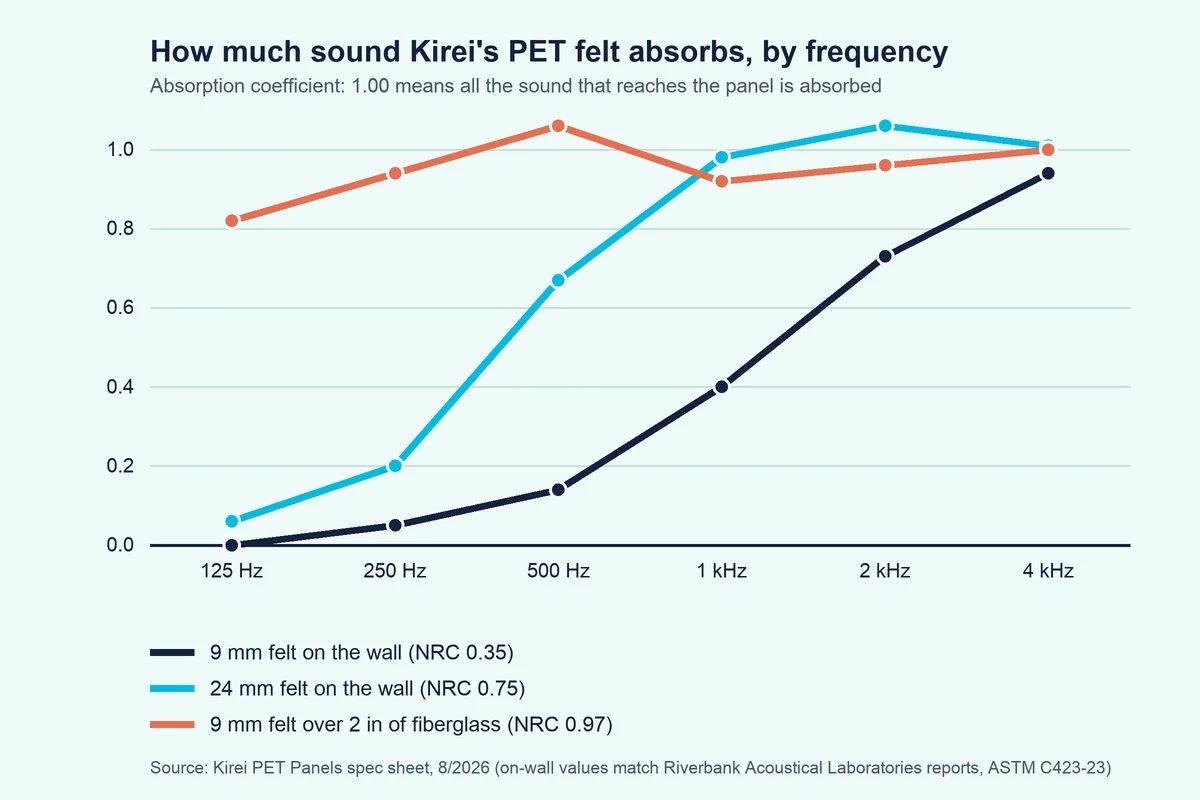
Read across the 9 mm row and the pattern is clear: the panel absorbs 5% of the sound at 250 Hz and 94% at 4,000 Hz.
That makes thin felt a treble absorber, so it calms clap echo and harsh high frequencies but does almost nothing for a room’s bass.
Thickness changes that: the 24 mm panel absorbs 67% at 500 Hz where the 12 mm panel absorbs 21%, and our guide to acoustic panel density explains how thickness and density work together.
Does an Air Gap or Insulation Behind Felt Help?
That treble-only problem is where mounting comes in. Yes: in Kirei’s own tests, moving a 9 mm panel 50 mm off the wall lifts it from NRC 0.35 to 0.70, and backing it with 2 in of fiberglass lifts it to 0.97 (Kirei).
| Mounting | 9 mm felt | 12 mm felt | 24 mm felt |
|---|---|---|---|
| Straight on the wall | 0.35 | 0.40 | 0.75 |
| 20 mm (about 3/4 in) air gap | 0.55 | 0.60 | 0.85 |
| 50 mm (about 2 in) air gap | 0.70 | 0.80 | 0.90 |
| Over 1 in of fiberglass | 0.86 | 0.90 | Not listed |
| Over 2 in of fiberglass | 0.97 | 1.00 | 1.05 |
The 24 mm panel starts higher, so its gain is smaller: 0.75 straight on the wall and 1.05 over 2 in of fiberglass.
Bass shows the biggest change, because the 9 mm panel absorbs 0% at 125 Hz on the wall and 82% over 2 in of fiberglass, while at 250 Hz it goes from 5% to 94%.
So the felt is the finish and the insulation behind it does the heavy lifting.
Which NRC Number on a Felt Listing Can You Trust?
Those mounting differences explain why one thickness can carry very different NRC claims. Trust a number only when it names the lab, the standard and the mounting, because Kirei’s 9 mm felt rates 0.35 straight on a wall in an ASTM C423 test while Plastock’s 9 mm felt rates 0.80 in an ISO 354 test with a 200 mm cavity behind it (Plastock).
Two Amazon felt tile listings, TroyStudio’s 16 by 12 in pack and BXI’s 12 by 12 in pack, both quote NRC 0.97 and an average absorption of 0.85 in their bullet points without naming a lab or a mounting.
Both also list a density of 9.4 lb/ft³ for 0.5 in felt, while Kirei’s lab report measures 12.3 lb/ft³ for its 12 mm panel (2.33 kg/m² over 11.79 mm), so the tiles are lighter felt than the one tested.
That makes Kirei’s numbers a guide rather than a promise, so plan on its on-wall 0.35 to 0.40 for 9 to 12 mm felt, not a listing’s 0.97.
Can Felt Reduce Noise From a Neighbor or the Street?
Those NRC claims also blur the bigger question of neighbors. Felt alone can’t reduce noise from a neighbor or the street, because HUD says a one-inch square hole or a 1/16 in crack 16 in long takes a 50 STC wall down to 40, so gaps and mass decide the result (HUD).
Absorbent material inside the wall is a different story: HUD’s wall figures show a staggered-stud wall rising from STC 39 to 43 with an absorbent blanket, and it lists hair felt among the materials for blankets placed in a wall’s airspace, which can attenuate noise as much as 10 dB in lightweight construction (HUD).
GSA’s office guide also treats the two jobs separately, asking a teleconference room for NIC 53 noise isolation and, as its own item, NRC 0.8 absorption on half the ceiling and a quarter of two adjacent walls (GSA).
If the problem is a neighbor, our guide to sealing and adding mass to an existing wall ranks the fixes that actually cut it.
Where Does Felt Actually Help in a Room?
If echo is the real problem, that split is good news for felt. It helps most on the walls and ceiling of a room with hard, reflective surfaces, because USG says glass, painted drywall and tile tend to make a room more reverberant and that absorbing the reverberation improves speech clarity (USG).
GSA’s meeting-room benchmark is NRC 0.8 or better on half the ceiling and a quarter of two adjacent walls, with a target reverberation time of 0.5 to 0.6 seconds (GSA).
In a 12 ft by 10 ft room with 8 ft walls, a quarter of two adjacent walls is 44 ft².
Matching that absorption takes about 88 ft² of 12 mm felt on the wall (NRC 0.40) or about 36 ft² of felt over 2 in of fiberglass (NRC 0.97), by area times coefficient.
That arithmetic is ours and it ignores that thin felt does little below 500 Hz, so treat it as a sizing guide, not a design.
What Is Acoustic Felt Made Of, and Is It Safe?
Once you know where felt helps, what’s in it matters next. Acoustic felt is usually PET polyester made from recycled bottles: Kirei’s panels are 100% PET with at least 60% post-consumer content, rated ASTM E84 Class A, and compliant with California’s CDPH (CA 01350) emissions test at under 0.5 mg/m³ TVOC (Kirei).
Plastock’s felt lists EN 13501-1 class B-s1,d0 and ASTM E84 Class A with a flame spread index of 0 and a smoke developed index of 35 (Plastock).
TroyStudio’s and BXI’s listings say “Class B1” flame retardant without naming a test, while Kirei and Plastock name ASTM E84, so look for a stated test before hanging felt in a rental or an office.
Wool felt panels exist too, but the lab numbers in this guide are for PET, so don’t assume wool matches them.
How Do You Hang Felt Panels for the Best Absorption?
With the material sorted, mounting decides how much of that absorption you keep. Fix felt with an air gap or insulation behind it: Kirei’s installation guide says 3 in furring strips can provide an air gap for best acoustic results, standoffs of 1.25 in diameter or more reach up to 2 in deep, and 1 to 2 in of fiberglass board adds absorption (Kirei).
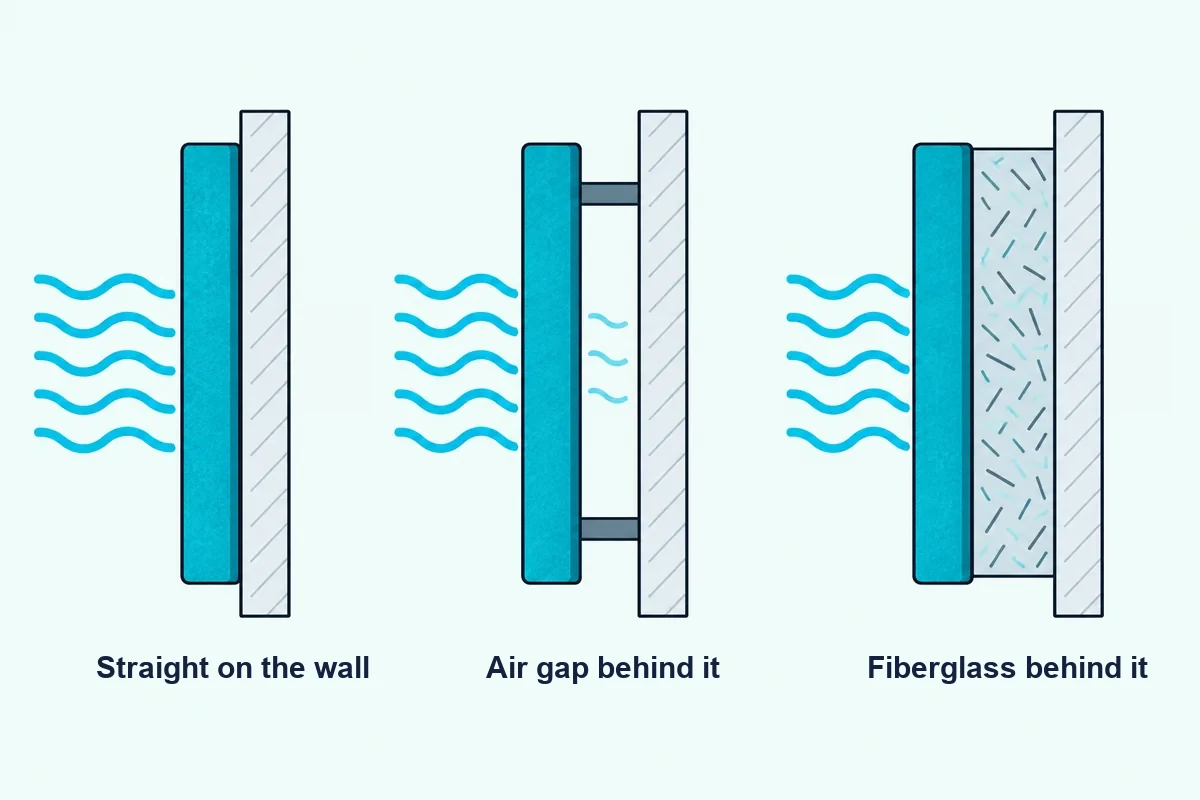
A 20 mm gap is about 3/4 in and 50 mm is about 2 in, so strips between 3/4 in and 2 in thick land inside the range Kirei tested.
For a direct mount, the guide says to spread construction adhesive on the panel back and leave a 2 in margin at the edges.
For a temporary mount it allows commercial-grade hook-and-loop or acrylic double-sided tape, but it warns that panels may be damaged when removed and recommends at least 30% adhesive coverage on the panel.
Listings differ: TroyStudio’s pack names construction adhesive, double-sided tape or small screws, while DMSKY’s tiles have a built-in adhesive backing.
Which Felt Panels Are Worth Buying?
Those mounting rules apply to any felt, so choose by thickness first. The thickest felt that fits your wall space wins, since Kirei’s on-wall NRC rises from 0.35 at 9 mm to 0.75 at 24 mm, and any listing’s NRC is a best case.
For 0.5 in tiles, TroyStudio’s thickened felt tiles are 0.5 in thick, and its listing gives 100% polyester fiber at 9.4 lb/ft³.
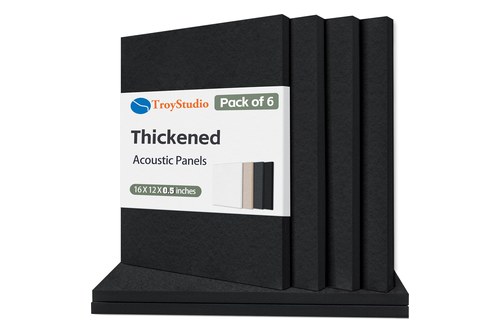
TroyStudio’s thickened felt tiles
For a peel-and-stick start, DMSKY’s 18-pack of polyester fiber tiles is 0.4 in thick, and its listing says plainly that it removes echo by absorbing sound, not by blocking it.
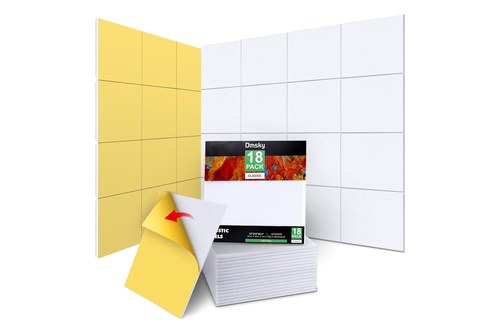
DMSKY’s 18-pack of polyester fiber tiles
Neither is a substitute for insulation or a gap behind the felt, so use Kirei’s on-wall numbers as your guide, and see our comparison of PET against fiberglass, rockwool and foam before you buy.
The Bottom Line
Felt is an absorber, so use it to cut echo, put insulation or an air gap behind it if you want bass absorption, and don’t count on it to block a neighbor.
Pick the thickest felt you can, read any NRC number for its mounting, and spend the rest on sealing gaps and adding mass if the noise comes from next door.
Frequently Asked Questions
Is felt soundproof or a good sound insulator?
No. Felt absorbs sound inside a room but doesn’t block it between rooms: a 24 mm panel weighed 0.67 lb/ft² in the lab against 2.2 lb/ft² for 5/8 in drywall, and Kirei’s spec sheet lists no sound transmission rating.
Does felt absorb sound?
Yes, mostly treble. Fixed straight to a wall, Kirei’s 9 mm felt absorbs 5% of sound at 250 Hz and 94% at 4,000 Hz, which averages to NRC 0.35.
Does felt absorb bass?
Only with help. A 9 mm panel on the wall absorbs 0% at 125 Hz and 5% at 250 Hz, but over 2 in of fiberglass it absorbs 82% and 94%.
What thickness of felt is best for sound absorption?
The thickest you can fit. Straight on a wall, 24 mm felt rates NRC 0.75 against 0.35 for 9 mm, and a gap or insulation behind the thinner felt closes much of the difference.
Is felt good for acoustic panels?
Yes, as the face of a panel. Over 2 in of fiberglass, Kirei’s 9 mm felt rates NRC 0.97 and its 12 mm felt rates 1.00.
How do you clean felt acoustic panels?
Kirei’s cleaning guide says to vacuum regularly with low suction and a smooth attachment, spot clean with upholstery shampoo rather than dishwashing or laundry detergent, and let the panel dry away from direct heat (Kirei).
Is acoustic felt flammable?
Check for a stated test. Kirei and Plastock both list ASTM E84 Class A, while a bare “flame retardant” claim doesn’t say which test was used.