Does Soundproofing Work Both Ways? Yes, With Four Catches
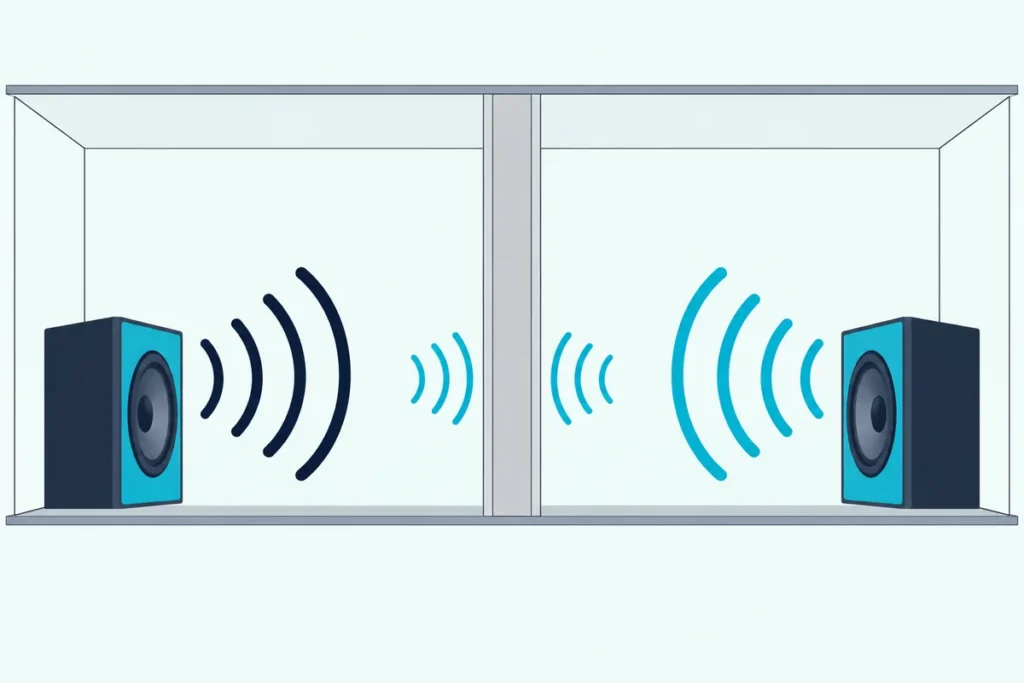
Does soundproofing work both ways? For airborne sound through a real wall or floor, yes: NBS Handbook 119 says sound travels through a wall about as easily in one direction as the other, though foam and panels aren’t soundproofing at all.
So if you can hear your neighbor’s TV through the wall, your own voice and music are getting through to them on the same path.
What isn’t symmetric is everything around the wall: how loud each side is, how quiet the listening room is, footsteps from above and sound that slips around the edges.
Blocking versus absorbing comes first, because that’s where most both-ways answers about foam and panels go wrong.
After that come the four catches that make one side hear more, and what each one means for where your soundproofing should go.
Does Soundproofing Work Both Ways Through a Wall?
That symmetry is the starting point. Soundproofing works both ways through a wall because a wall’s sound transmission loss belongs to the wall itself, the number of decibels it takes off sound passing through it, whichever room the sound starts in (NBS Handbook 119).
NBS Handbook 119 puts it plainly: sound generally travels through a wall as easily from one direction as from the opposite one, so the path is reversible. HUD’s Noise Guidebook describes the STC rating the same way, as essentially the difference between the sound level on the side where the noise starts and the side where it’s heard.
ASTM E336, the standard for measuring sound isolation between rooms in real buildings, says its apparent transmission loss results are in theory the same in each direction (ASTM E336). The same sentence adds that differences with direction have been observed in practice, and the rest of this page is about why.
Here’s a test the handbook itself suggests for hunting leaks. Because the path is reversible, you can swap places: make the noise yourself and listen from the other side, putting the listener wherever the background is quieter.
Do Foam and Acoustic Panels Work Both Ways Too?
That reversible path only exists where something blocks sound in the first place, and foam doesn’t. NRC Canada’s Building Digest 236 explains that sound absorbing materials control sound within a space and work by letting sound pass through them relatively easily, while materials with good transmission loss are usually non-porous (NRC Canada).
So acoustic foam and fabric-wrapped acoustic panels are acoustic treatment, not soundproofing. They cut the reflections and echo in the room they hang in, which adds clarity to voices and music, and they do that the same way whichever side of the wall you’re on.
Think of a wall as a closed window and foam as a sponge stuck to the glass. The sponge soaks up drips inside the room, but it doesn’t make the window any thicker for the sound outside.
NBS Handbook 119 makes the same point about absorbers: soft, porous, lightweight materials are relatively poor sound insulators. It warns against putting them on one room’s walls with the sole aim of stopping sound reaching the next room, because their porosity actually helps sound through.
That answers the padding, foam-wall and soundproof-panel versions of the question too: a layer that absorbs doesn’t block in either direction.
If your question is about panels in particular, our answer to do acoustic panels work both ways covers which face goes out and why flipping them changes little.
The same goes for foam, and Burton Acoustix’s answer on soundproof foam shows where foam earns its keep and what to use instead when the goal is blocking.
Get Studio Tips Weekly
Join 5,000+ creators getting acoustic treatment advice every week.
No spam. Unsubscribe anytime.Why Can You Hear Your Neighbors Better Than They Hear You?
Once foam is out of the picture, the wall is symmetric, but the two rooms aren’t. NBS Handbook 119 says whether a wall works in a given situation hinges on three things: the sound level on the noisy side, the wall’s transmission loss, and the background noise on the quiet side.
The handbook’s example is a wall that takes 30 dB off a 70 dB noise, leaving 40 dB on the other side, above that room’s background, so it’s audible. A 50 dB wall under the same conditions drops it below the background, which then masks it.
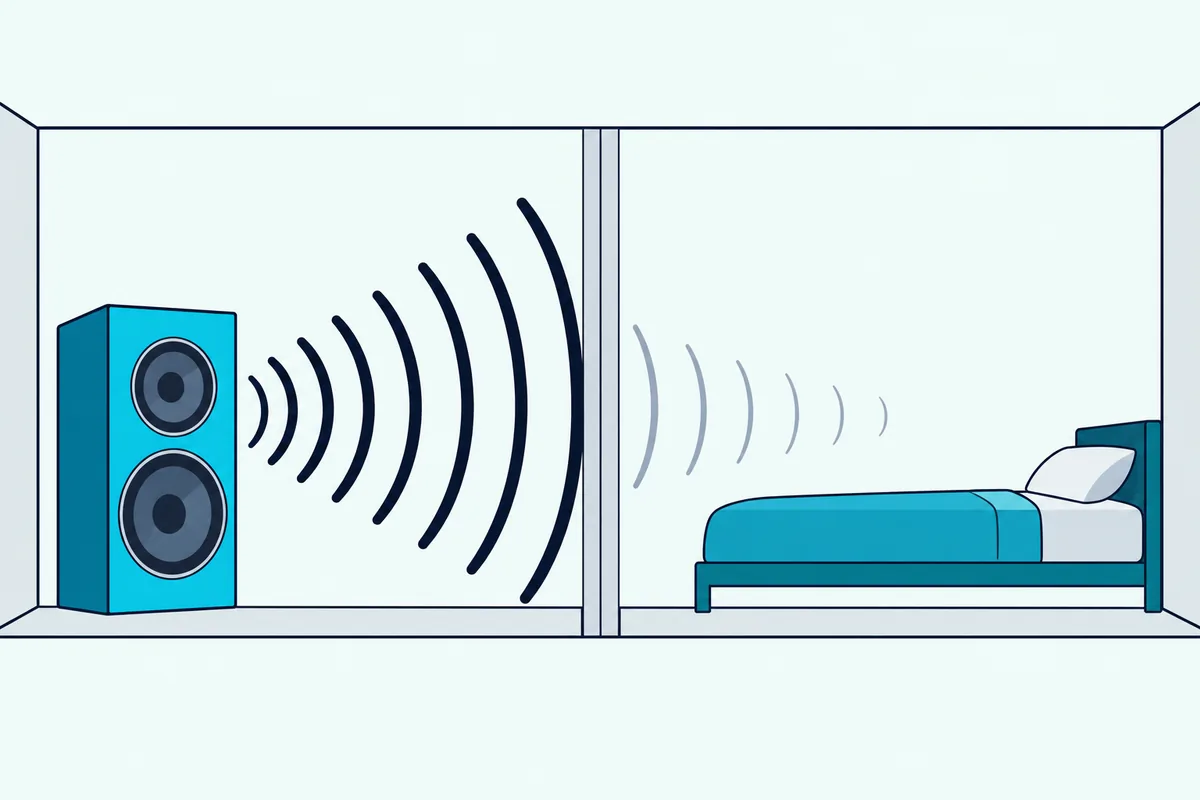
That’s the first catch: the same wall can hide your neighbor’s quiet conversation while their subwoofer comes through clearly. Their loud source and your quiet bedroom make one direction a much harder test than the other.
NRC Canada’s Digest 186 lists the factors that decide speech privacy between two offices: background noise, the partition’s transmission loss, the loudest speech used in either room, the shared wall area and the furnishings in each. When two rooms need different ratings, it says to use the higher one so occupants are protected in both directions, free of intrusive speech and free of being overheard.
Try this at night: play music at a fixed volume, then listen from the other room and note what you hear. Then do it in reverse with the same source, and the difference you notice is mostly loudness and background, not the wall.
How Much Does the Room on Each Side Matter?
Background noise is one side of the room question, and the furnishings are the other. ASTM E336 says the noise reduction measured between two rooms depends on the test direction and the sound absorption in the spaces, and that the noise reduction in unfurnished rooms is typically less than in furnished ones.
That’s the second catch. A bare, echoey room lets sound build up, so more of it reaches the wall, while a room full of sofas, rugs and curtains soaks some of it up.
Digest 236 shows the same effect with a noisy machine in a box: without absorbing material inside, the sound builds up and the box takes off much less than expected. That’s the one part absorbing material plays in soundproofing: it lowers the level reaching the wall on the noisy side, and the digest says it works only alongside a solid barrier and resilient supports, never on its own.
Don’t expect much from it, though, because it changes the level reaching the wall, not the wall’s rating. Furnished rooms already hold plenty of absorption: Digest 186 estimates a furnished office’s at about 80 percent of its floor area.
Is Footstep Noise a One-Way Problem?
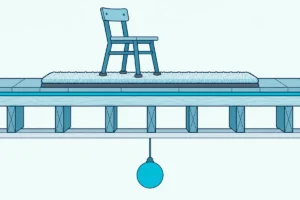
Furnishings change airborne sound a little, but footsteps work by a different route. Footstep noise mostly travels one way, down: Digest 236 explains that an impact such as a footstep shakes the structure directly, and that the vibration travels through the building before it’s radiated elsewhere as sound.
That’s the third catch. The lab test for impact sound, ASTM E492, sets a tapping machine on the floor and measures in the receiving room directly below, so an IIC rating describes noise going down (ASTM E492).
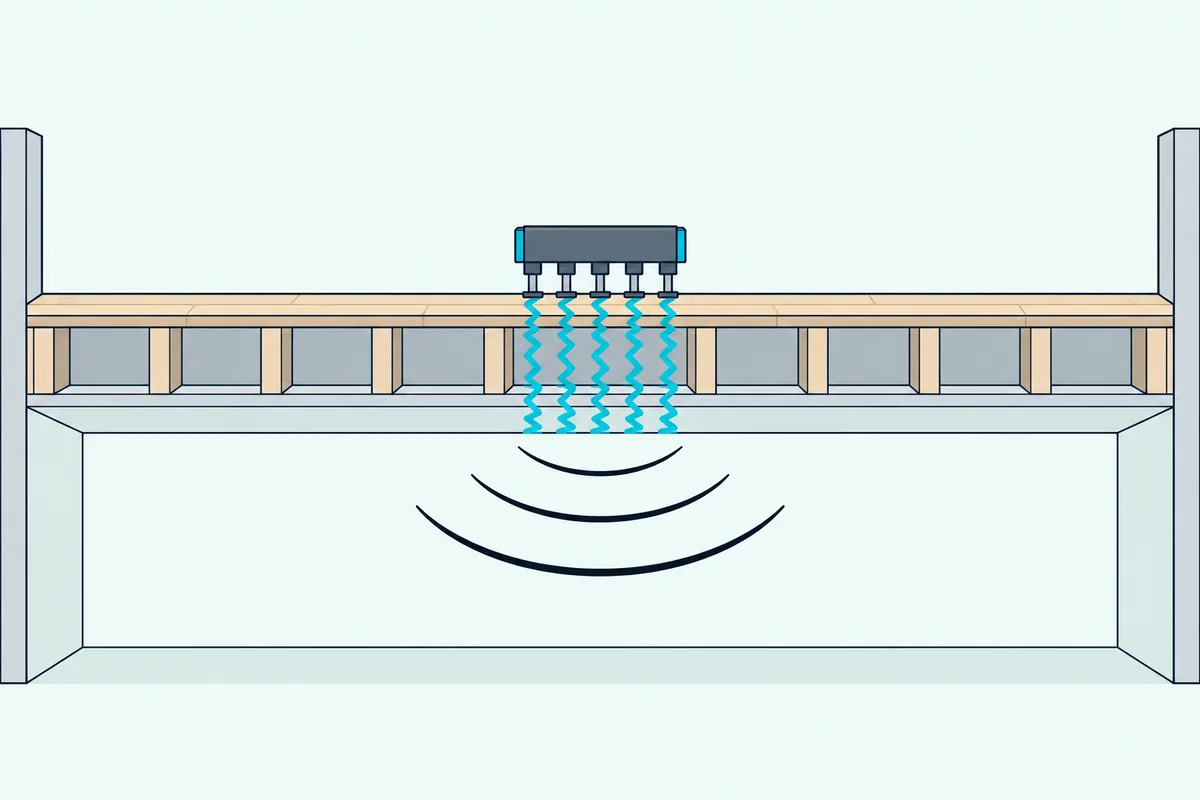
So the downstairs neighbor hears your steps, and you mostly hear their voices and TV. NRC Canada’s research on impact sound says the floor covering has a major effect: thick carpet with good underlay usually gives very high IIC ratings, and most people living below carpeted concrete floors aren’t disturbed by footsteps.
The same study adds the catch inside the catch. A thick carpet and pad can give a floor a very high IIC while it still thumps when someone walks on it and has low airborne sound attenuation, because the tapping machine can’t simulate the low thumping of a person walking.
NRC puts the minimum IIC for occupant satisfaction at 50. If the numbers are new to you, our guide to what STC and IIC ratings measure explains both scales.
Why Does Sound Slip Around a Soundproofed Wall?
Footsteps travel through the structure, and so does a lot of airborne sound that never crosses the wall you treated. Sound slips around a soundproofed wall because walls are rated alone: ASTM E90, the lab test behind STC, builds its rooms so that the test wall is the only significant path, and calls its ratings an upper limit to what a field test in a building would measure.
In real buildings sound also takes flanking paths: through the structure around the partition, common air ducts and doors to the corridor, as ASTM E336 lists them. ASTM E413 adds that a wall built in a building may rate lower than the same wall in the lab because of flanking or construction errors.
That’s the fourth catch. NRC Canada’s flanking study of wood-framed buildings tested a much better party wall over a subfloor that ran continuously from one unit to the next, and the rating between the rooms rose only from FSTC 50 to 52.
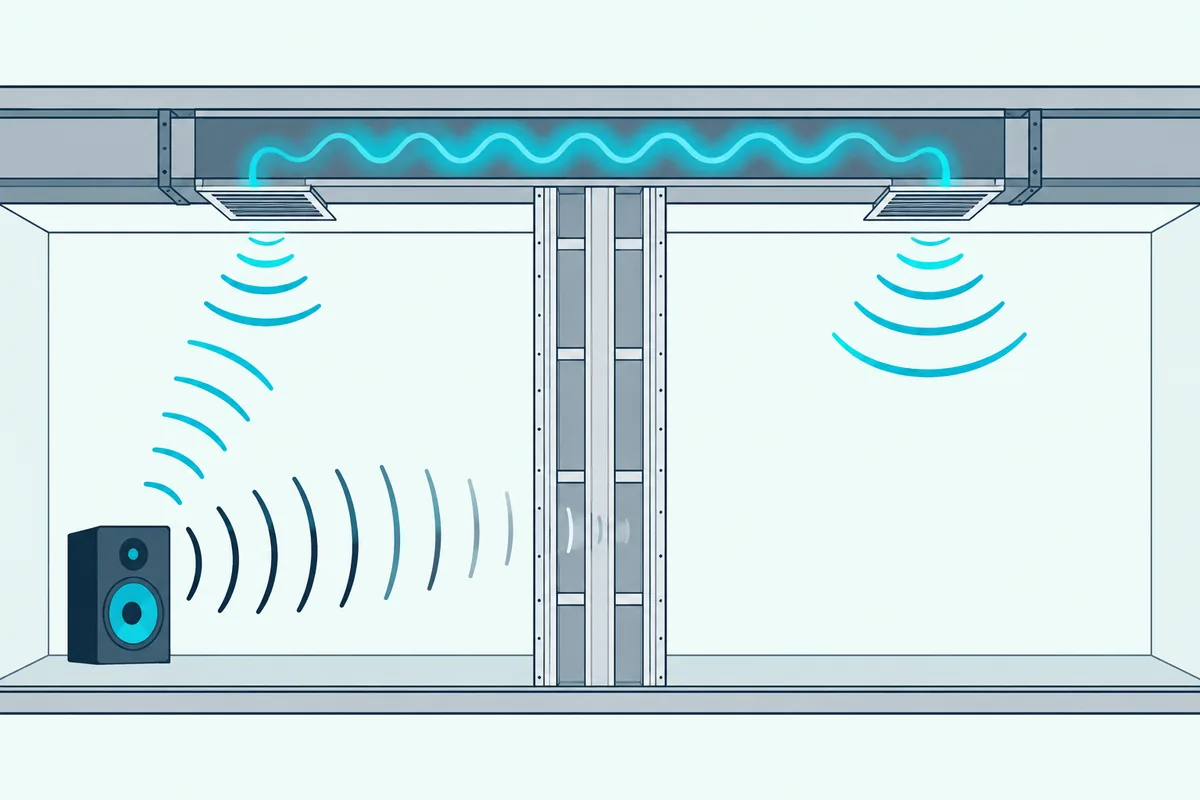
At low frequency the better wall did its job, adding about 10 dB, but above 250 Hz the sound went floor to floor around it. With a gap cut in the subfloor at the wall, the rating reached FSTC 66.
Small leaks behave the same way. HUD’s Noise Guidebook says a one-inch square hole, or a 1/16-inch crack 16 inches long, will take an STC 50 wall down to 40 (HUD).
Which Side Should the Soundproofing Go On?
Those four catches decide where the work goes. For airborne sound the wall’s rating belongs to the whole assembly, so the side matters less than whether the gaps are sealed and the weak paths are dealt with, and NBS Handbook 119 suggests laminating a new layer of wallboard, the drywall itself, preferably to both sides of the wall.
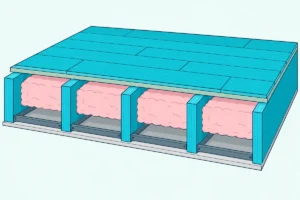
Impact noise is different, because the fix belongs where the impact happens. NRC’s impact research puts the floor covering on top, a resilient layer or a floating floor, while a ceiling hung resiliently below also raises the IIC.
So if the people upstairs are the problem, the most direct fix is a soft covering on their floor, the carpet NRC found keeps most people below from being disturbed. The resilient ceiling on your side helps too, but it’s a construction job to install.
Flanking fixes go wherever the sound actually travels. In NRC’s flanking study, extra layers on the floor inside each room did more than the better wall: a second layer of subfloor raised the rating from FSTC 52 to 60, and a floating floor took it to 67.
If you’re new to how mass, damping and decoupling divide up the work, our explainer on how soundproofing blocks sound with mass, damping and decoupling covers each one.
What Should You Expect in an Apartment, a Studio or a Bedroom?
All four catches show up differently depending on the room. In an apartment, the shared wall works both ways for voices and TV, but the unit above sends footsteps down that you can’t send back up, and flanking through the floor can cap what any wall upgrade achieves.
In a home studio or practice room, you’re usually the loud side, which is the harder direction. ASTM E413 says the STC rating isn’t appropriate for many music systems, musical instruments or machinery, so a wall that keeps out speech can still leak your bass to the house.
In a bedroom, you’re the quiet side. NBS Handbook 119’s three factors work in your favor when there’s a steady background sound, and against you in a silent room at 2 a.m., when the same wall seems to let more through.
The practical test is the reversal from the first section. Put the noise where it really happens, listen where it bothers you, and fix the path you can hear first.
The Bottom Line
That reversal sums it up. Soundproofing works both ways for airborne sound through a real wall or floor, because the transmission loss belongs to the assembly: NBS says so, and ASTM E336 says the same holds in theory.
The differences you notice come from the rooms, not the wall: a louder source on one side, a quieter background on the other, bare rooms versus furnished ones, footsteps that only go down and sound that slips around through floors, ducts and gaps. Foam and acoustic panels treat the room they’re in and don’t block sound in either direction.
Frequently Asked Questions
Can my neighbors hear me if I can hear them?
Probably, if you’re as loud as they are. NBS Handbook 119 says sound travels through a wall about as easily in either direction, so whatever path carries their TV to you carries your voice to them.
How much they hear depends on how loud you are and how quiet their room is. A neighbor with a steady background, such as a fan or traffic, will notice less than one in a silent bedroom.
Is there such a thing as one-way soundproofing?
Not for airborne sound through a wall. ASTM E336 says the results are in theory the same in each direction, and the differences seen in practice come from the rooms, background noise and flanking.
Impact noise is the one real exception. Footsteps go down into the floor below, which is why the IIC test measures only in the room underneath.
Does soundproofing a room keep sound in as well as out?
Yes, for airborne sound, if the room’s walls, floor, ceiling and doors are sealed and upgraded. In theory the same assembly takes the same decibels off in either direction, as ASTM E336 puts it.
Keeping sound in is often harder in practice, because you’re usually the louder side. Music and bass from inside the room are a tougher test than voices coming from outside.
Does soundproofing an apartment work both ways?
For voices, TV and music through a shared wall, yes. The upgraded wall protects you and your neighbors alike.
Footsteps are the exception: the floor above sends them down, so the fix belongs on the upstairs floor. Flanking through floors and ducts can also limit what any wall upgrade achieves in an apartment building.