Do It Yourself Soundproofing Projects, Matched to the Noise
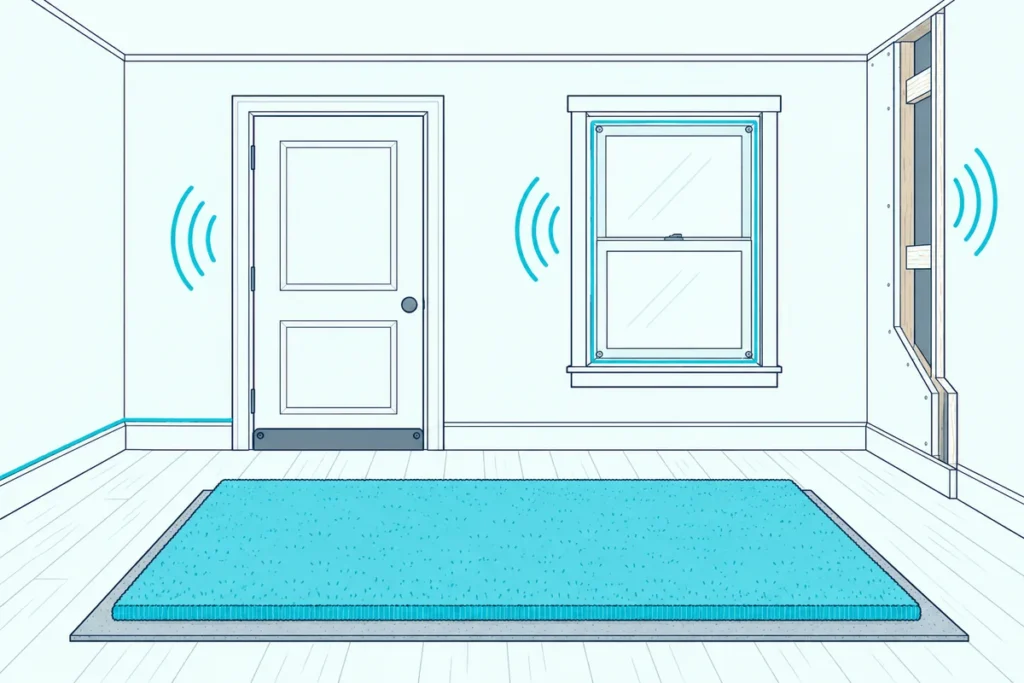
The do it yourself soundproofing projects that work are the ones that seal gaps, add mass or cushion impacts, and most need only a caulk gun, a drill and a weekend.
The ones that fail are the internet favorites, like egg cartons, foam and blankets, which soak up echo but let a neighbor’s TV straight through.
Match each project to the noise you actually hear, and your effort goes into the fix that noise responds to instead of the one that looks busiest.
This guide starts with finding leaks by ear, then works through doors, windows, a second drywall layer, clips, mass-loaded vinyl and rugs, with ratings from standards bodies and makers’ lab reports.
It ends with what DIY can’t fix, like sound that flanks around a wall or rides the building’s frame, so you know when to stop buying.
Which Do It Yourself Soundproofing Projects Actually Work?
Sealing, mass and cushioning are the whole map, and the table puts them in order. The DIY projects that work are sealing gaps, fixing doors, adding window inserts, laminating a second drywall layer, decoupling with clips, adding mass-loaded vinyl inside a wall and cushioning floors.
| Project | The noise it fixes | The source’s rating |
|---|---|---|
| 1. Seal gaps with acoustic caulk | Voices and TV leaking at edges, outlets, pipes | A 1/16-inch crack 16 inches long takes an STC 50 wall to 40 (HUD) |
| 2. Gasket the door and add a drop seal | Sound around and under a door | A sealed solid-core door holds an STC 48 wall at 33 (HUD) |
| 3. Swap a hollow-core door for solid core | Sound through the door itself | A hollow-core door rates STC 17 and drops that wall to 24 (HUD) |
| 4. Add window inserts | Traffic and street noise | 18.9 dBA less noise over single panes (Indow, Portland State lab) |
| 5. Laminate a second drywall layer with damping | Voices and TV through a wall | An STC 36 wall reaches 42 with damped board on one side (National Gypsum) |
| 6. Hang new drywall on resilient clips | Stubborn and low-pitched noise | The same wall reaches 51 with one side on resilient channel (National Gypsum) |
| 7. Add mass-loaded vinyl inside a wall | Extra mass in a wall, ceiling or floor build | A 1 lb per square foot sheet rates STC 26 on its own (Johns Manville) |
| 8. Put rugs on thick underlay | Footsteps and dropped objects | A concrete slab goes from IIC 28 to 75-85 (NRC Canada) |
The first four rows are hand-tool jobs, while rows five to seven mean new drywall, mud and paint. If cost decides the order for you, the guide to soundproofing a room on a tight budget ranks the cheap versions of these fixes.
What Kind of Noise Are You Trying to Stop?
Each row in that table answers one kind of noise, so name yours before you pick a project. The noise you’re trying to stop is either airborne, like voices, TV and traffic, or structure-borne, like footsteps, slammed doors and machines that shake the building itself.
National Bureau of Standards (NBS) Handbook 119 says airborne sound travels through continuous air passages such as corridors, doorways, staircases and duct systems. Structure-borne vibration, it adds, moves through a building’s frame with very little loss, then large light panels radiate it like the sounding board of a piano.
That difference sets the tool. Airborne noise needs sealed gaps and mass, while impact noise needs a cushion or a break between the source and the structure.
Soft material on your side of the wall does neither job. NBS calls acoustical tile, carpet and drapery highly effective absorbers but relatively poor sound insulators, because they’re soft, porous and lightweight, and the guide to what each soundproofing material is for sorts out the rest.
Get Studio Tips Weekly
Join 5,000+ creators getting acoustic treatment advice every week.
No spam. Unsubscribe anytime.How Do You Find the Leaks Before You Buy Anything?
Airborne noise finds the weakest spot first, so find that spot before you spend anything. Find the leaks by listening at the baseboards, outlets, door edges, window frames and vents on a quiet evening, and marking every place where the sound gets louder.
Small gaps matter far more than their size suggests. HUD’s Noise Guidebook says a 1-inch square hole, or a 1/16-inch crack 16 inches long, will reduce an STC 50 wall to 40.
If talk or TV comes through a bedroom wall, NBS says to look for leaks at the base of the walls and at the electrical outlets. In shared walls, it names back-to-back outlets, medicine cabinets and TV outlets as common causes of leakage.
Think of a wall like a bucket: a thicker bucket won’t hold more water until the hole in it is plugged. For the same audit done surface by surface, the full guide to soundproofing a room walks every wall, door and window.
How Do You Seal Gaps With Acoustic Caulk and Weatherstripping?
Those marked spots become your caulking list. Seal gaps with a non-hardening acoustic caulk wherever the parts don’t move, like wall edges, pipes and outlets, and use weatherstripping or gaskets wherever they do, like doors and window sashes.
NBS’s method for a pipe hole is to enlarge the opening slightly, pack it with glass fiber and seal it completely with a resilient caulk. Openings around ducts, grilles and outlets get the same treatment.
Cracks where a wall meets the ceiling or the floor get resilient caulk too, preferably from a caulking gun. NBS warns the floor edge may mean pulling the baseboards to do a thorough job.
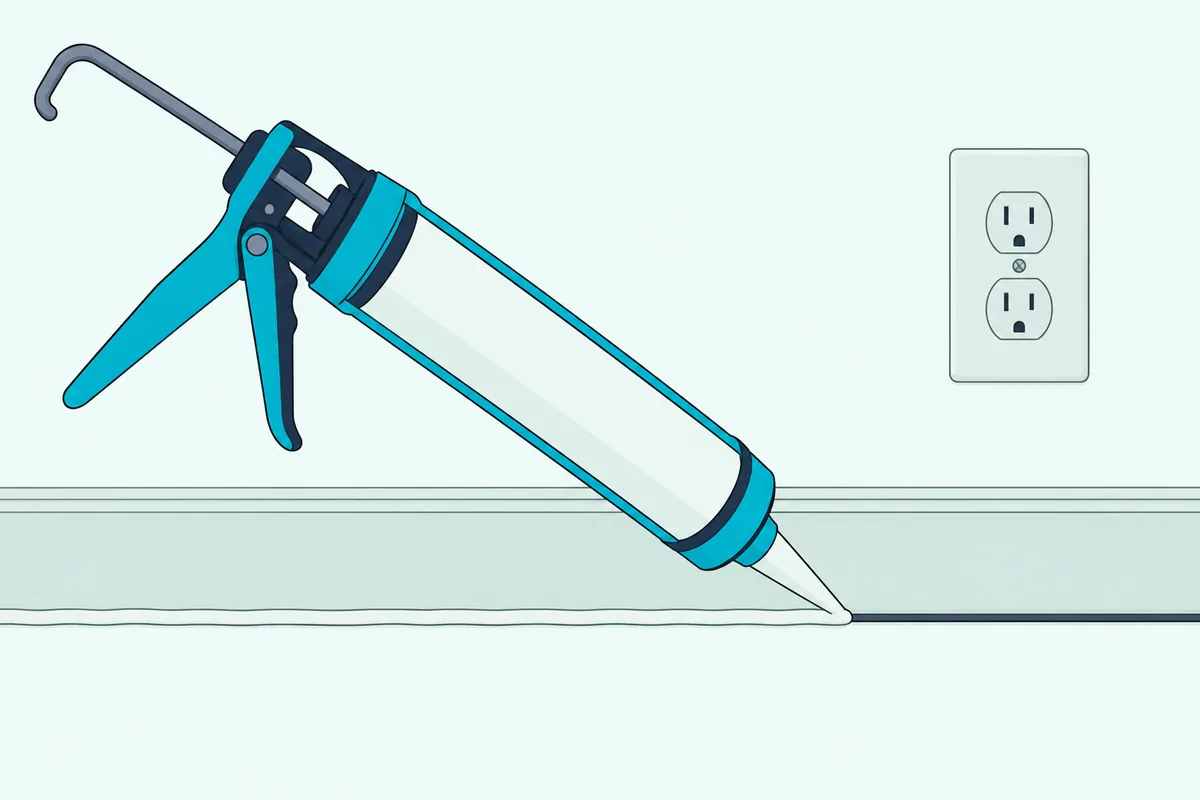
National Gypsum’s SoundBook gives the same rule for new drywall. Leave a 1/4-inch gap at every edge, seal it with acoustical sealant, and seal each penetration with sealant or putty pads.
For those joints, TMS’s acoustical caulk is sold for exactly this kind of gap. Each product in this guide had at least 4.0 stars and 50 reviews on Amazon and was in stock when checked on 22 October 2026, and prices aren’t shown because they change.
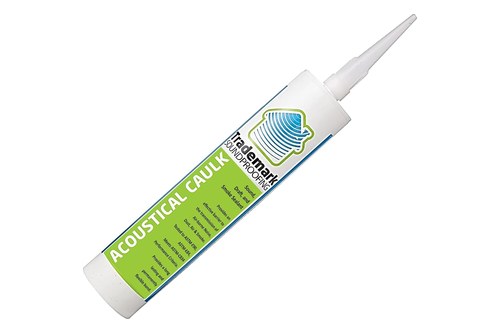
TMS’s acoustical caulk
The parts that move need a seal that compresses instead of one that sets. NBS’s list for basements is to caulk or weatherstrip existing windows and weatherstrip hinged or sliding doors, and its outdoor-noise list asks for windows caulked or gasketed to an airtight seal.
What Fixes a Door That Lets Sound Through?
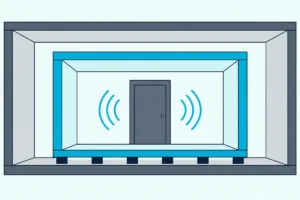
A door is the largest gap in most walls, which is why it gets its own project. Fix a door that lets sound through by sealing its edges with gaskets, closing the gap underneath with a drop seal, and replacing it with a solid-core door if it’s hollow.
HUD’s numbers show why the slab matters. The common hollow-core wood door rates STC 17, and taking up about a fifth of a wall rated 48, it drags the whole wall down to 24.
A solid-core door with vinyl seals around the edges and carpet on the floor leaves that same wall at 33, HUD says. It adds that gasketed stops or drop-bar threshold closers at the bottom edge raise the rating further.
NBS gives the same recipe for a noisy furnace closet: a solid-core door with a perimeter rubber gasket and a threshold drop closure. Its caution applies to any closet door with louvers, which may be there to feed the furnace air that has to come from somewhere else.
Try this first: switch off the hall light, leave the room light on, close the door and look for light at its edges. Anywhere light shows, air and sound can pass, and that’s where the gasket goes.
For the gap at the bottom, Pemko’s 411APKL36 automatic door bottom is that drop closure. A plunger touches the jamb as the door shuts and pushes the seal down onto the floor or threshold.
Do Window Inserts Work for Outside Noise?
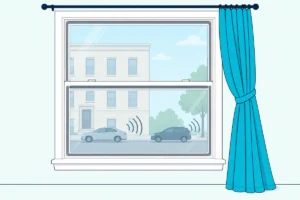
After the doors, windows are the next weak spot in an outside wall. Window inserts do work for outside noise, and the lab results Indow publishes for its press-in inserts show by how much.
At Portland State University’s Green Building Research Laboratory, Indow’s Acoustic Grade insert cut noise by 18.9 dBA over a single-pane window, and its Standard Grade by 10 to 12 dBA. In tests at the British Columbia Institute of Technology, inserts over double-pane windows raised the rating to STC 42 to 45.
Indow adds its own caveat: overall reduction depends on the noise coming through your walls, ceilings, floors, doors and existing windows. That’s the bucket again, since an insert can’t quiet a room whose door still leaks.
NBS’s older version of the same fix is a storm window installed with caulk or gasket seals on the side of the house facing the noise. It adds that sealed storm windows on every window also help against low-pitched noise.
Does Adding a Drywall Layer With Damping Compound Help?
With the openings sealed, the wall itself is the next thing sound passes through. Adding a drywall layer with damping compound helps, and it’s the largest wall upgrade you can make without opening the wall.
NBS’s version is to laminate a 1/2-inch gypsum layer, preferably to both sides, with a resilient non-setting adhesive, and to fill a 1/4-inch gap around its edges with non-setting caulk. It recommends this where only a moderate degree of extra sound insulation is needed.
National Gypsum explains the principle as constrained-layer damping. A viscoelastic material sandwiched between two stiffer sheets dissipates the vibration that would otherwise carry sound through.
Its own wall ratings put a size on the gain. A 2×4 wall with 5/8-inch gypsum on both sides and glass fiber in the cavity rates STC 36, and swapping one side for its damped board raises that to 42, or 45 with damped board on both sides.
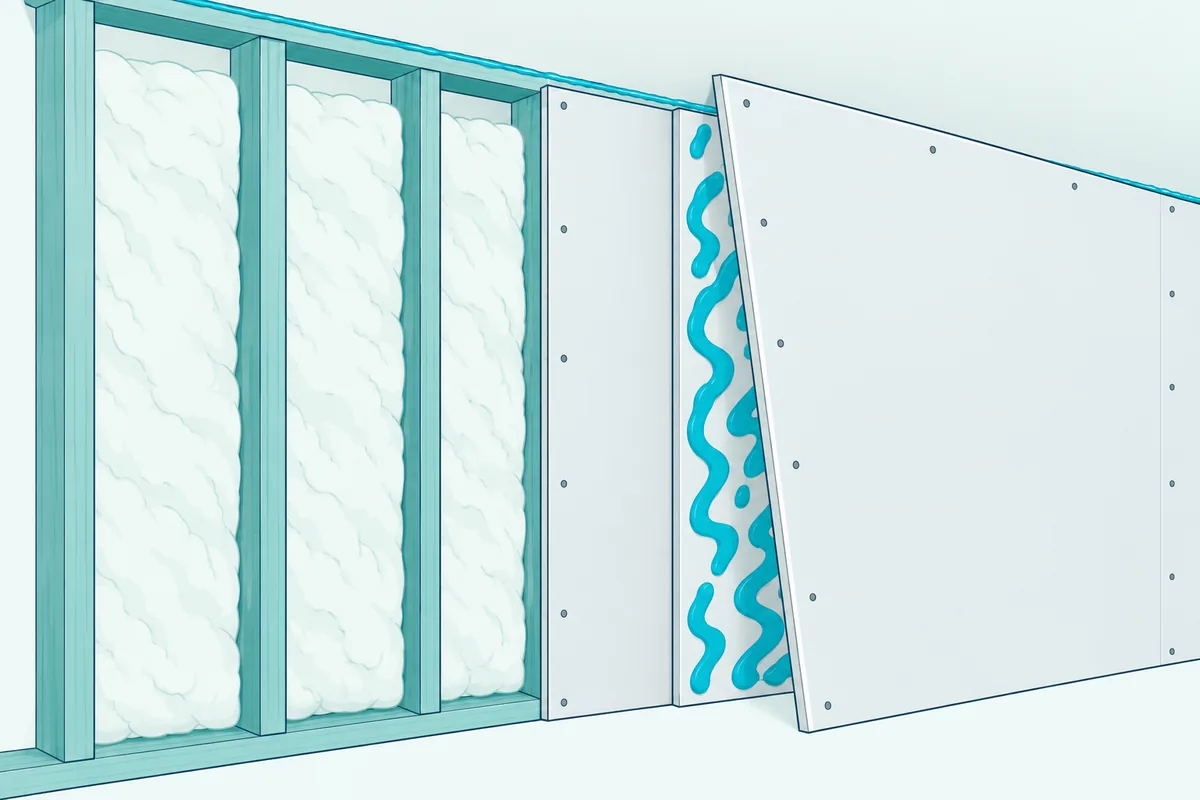
Its retrofit damped board, screwed over the existing 1/2-inch drywall on one side, rates STC 36 on an empty 2×4 wall and 40 with an insulated cavity. Those are tests of National Gypsum’s factory-damped boards, not of a compound you spread between two ordinary sheets, which works on the same idea but has no test in this guide’s sources.
If you’re laminating ordinary drywall yourself, Green Glue Noiseproofing Compound is the damping layer. Seal the new sheet’s edges exactly as in the caulking step, because the same gap rule still applies.
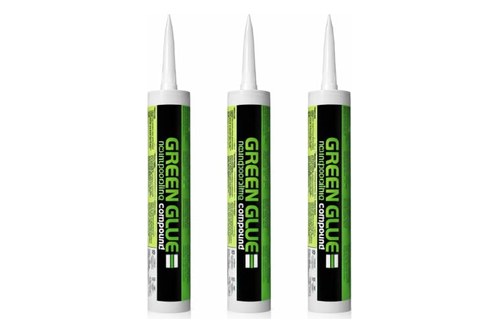
Green Glue Noiseproofing Compound
When Are Resilient Clips Worth Opening a Wall?
A damped layer adds weight and damping, but the new drywall is still screwed to the same studs. Resilient clips are worth opening a wall for when the damped layer isn’t enough, because they hold the drywall away from the studs so less vibration crosses the frame.
National Gypsum’s tests put a number on it. Mounting one side of that STC 36 wall on RC-1 resilient channel raised it to 51.
PAC International’s lab report for its RSIC-1 clips on a 2×4 wall, with drywall furring channel held by the clips and 6 inches of fiberglass in the cavity, rates STC 58 and OITC 39. That’s a different lab and thicker insulation than National Gypsum’s wall, so read the two numbers side by side rather than as one gain.
HUD is more modest about typical resilient attachments, which it says can raise a wall’s STC rating by 2 to 5 dB. It also credits acoustical blankets of mineral wool, rock wool or fiberglass in the cavity with up to 10 dB in lightweight construction.
NBS’s high-privacy version for an existing wall works without demolition. Fasten furring strips to the wall, run resilient channels across them 24 inches apart, fill the space with glass fiber and screw new gypsum on top.
That’s the one project here that adds a whole new wall surface, so save it for the noise the damped layer and the sealing didn’t stop.
Where Does Mass-Loaded Vinyl Fit?
Clips and damping change how a wall is built, while mass-loaded vinyl simply adds weight. Mass-loaded vinyl fits as one layer inside a wall, ceiling or floor build, behind new drywall, because a sheet on its own rates modestly.
Johns Manville’s data sheet rates its 1 lb per square foot vinyl barrier at STC 26 under ASTM E90. Its loss climbs from 16 dB at 125 Hz to 36 dB at 4,000 Hz, so the sheet does least against low, booming sound.
STC 26 sits below the STC 30 to 35 NBS gives for most interior walls in a typical home. The vinyl earns its keep added to that wall, not hung in front of it like a curtain.
Do Rugs and Underlay Stop Footstep Noise?
Everything so far blocks airborne sound, and footsteps are the other half of the split from the start. Rugs and underlay do stop much of the footstep noise from a floor, because they cushion each impact before it reaches the structure.
NRC Canada’s guide to impact sound rates a bare 150 mm concrete slab at about IIC 28 and the same slab under carpet and underlay at 75 to 85. It treats IIC 50 as the usual minimum for residential buildings.
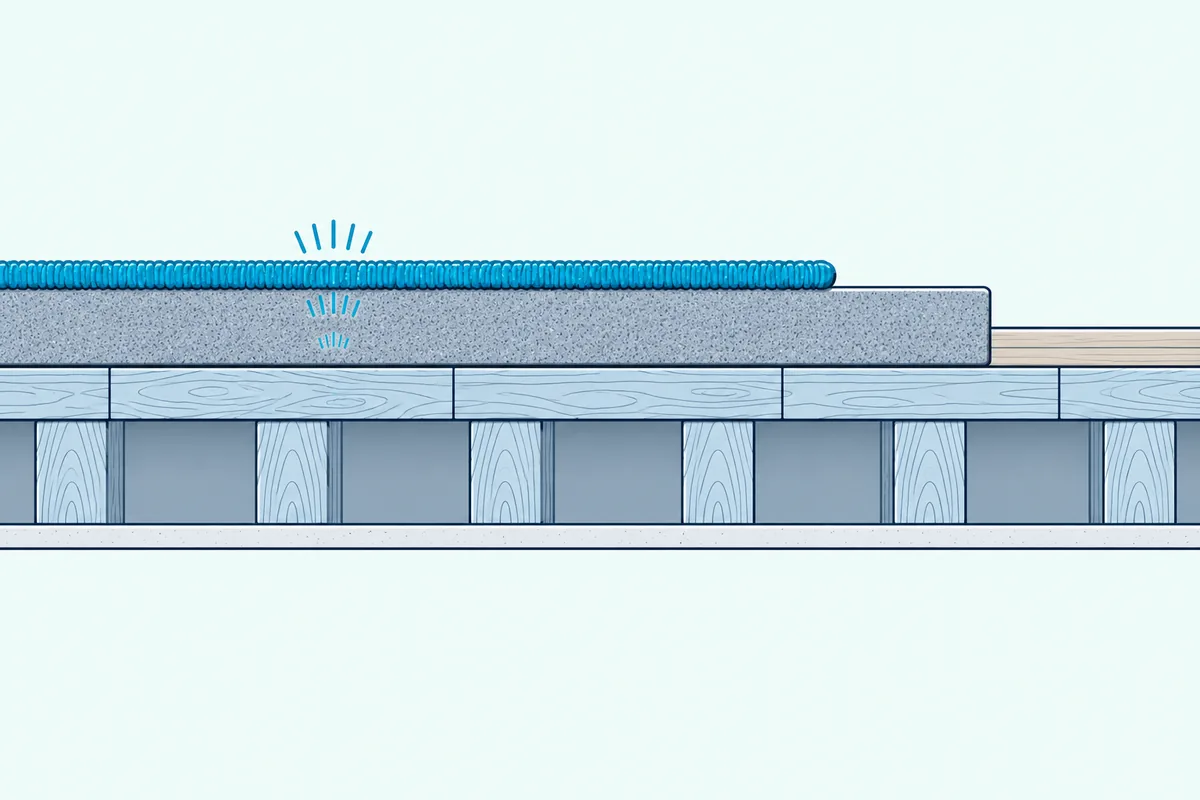
Wood-frame floors are harder. The same guide warns that the tapping machine behind IIC doesn’t mimic walking, so a joist floor with a good IIC can still thump below 100 Hz.
NBS says a soft, thick carpet with felt padding muffles impact and footstep noise very effectively. For a light-frame floor, though, it says carpet may need help from a gypsum ceiling hung on resilient channels below, and the guide to stopping footsteps through a wood floor covers that job.
What Can’t Do It Yourself Soundproofing Fix?
That thump through a joist floor shows the limit of surface fixes, and walls have the same limit. Do it yourself soundproofing can’t fix flanking, where sound goes around the part you upgraded through floors, ceilings and shared spaces, or noise the building’s frame carries from machines.
An NRC Canada study of wood-frame construction measured flanking directly. Upgrading a double-stud party wall to two layers of gypsum per side raised its low-frequency performance by about 10 dB, yet its overall field rating rose only from FSTC 50 to 52.
Above about 250 Hz, sound crossing through the continuous subfloor beneath the wall dominated, so the better wall barely showed. Changing the floor where it meets the wall, such as cutting a gap in the subfloor, lifted the rating as high as FSTC 66.
NBS names the chief flanking paths in homes as open ceiling plenums, attic spaces, basements and crawl spaces that run across rooms or units. Closing them takes full-height barriers above and below the shared wall, which is framing work rather than a weekend project.
Machine noise is the other limit. NBS’s sounding-board point from earlier applies here: once a washer, furnace or pump shakes the frame, the fix is isolation at the source, and our order for soundproofing a whole house covers those systems.
The Bottom Line
Do it yourself soundproofing pays off in order. Seal the gaps, fix the doors, add window inserts, then laminate a damped drywall layer, and only then move to clips, mass-loaded vinyl or a new wall surface.
Put rugs on thick underlay for footsteps, and when a finished wall still leaks, look at what runs past it. Expect real reduction, not silence, and listen again at the same spots after each project.
Frequently Asked Questions
What is the best DIY soundproofing?
The best DIY soundproofing is sealing the gaps, because it’s cheap and every other fix depends on it. HUD’s numbers show why: a 1/16-inch crack 16 inches long takes an STC 50 wall down to 40.
After sealing, the next best projects are a solid, gasketed door with a drop seal and a laminated drywall layer with damping. In National Gypsum’s ratings, damped board on one side of an insulated 2×4 wall raises it from STC 36 to 42.
Does homemade soundproofing material work?
Homemade soundproofing material works only when it’s dense, airtight and part of the wall, not soft material hung in front of it. NBS calls carpet, drapery and acoustical tile poor sound insulators because they’re soft, porous and lightweight.
Egg cartons, foam and blankets are soft, porous and light too, so they can cut echo inside a room without stopping sound between rooms. The materials that block sound are sealant, gypsum, damping layers and mass inside the structure.
How do you soundproof a wall yourself?
Soundproof a wall yourself by sealing it first, then adding a layer. Caulk the edges at the floor and ceiling, seal around outlets and pipes, then laminate a second sheet of drywall with damping compound between the layers.
NBS describes the same approach: a glued 1/2-inch gypsum layer with a 1/4-inch caulked gap at the edges for a moderate gain. For more, it adds furring, resilient channels, glass fiber and new gypsum over the existing wall.
Can you soundproof a ceiling yourself?
Yes, you can soundproof a ceiling yourself, especially where the joists are exposed, as in a basement. NBS’s ceiling for that case is 3 inches of glass fiber between the joists, metal resilient channels across them 2 feet apart, and 5/8-inch gypsum board on the channels.
Footsteps are harder to stop from below. NRC Canada’s impact guide warns that wood joist floors can still thump below 100 Hz, and NBS says carpet with felt padding on the floor above muffles footsteps very effectively.