Best Soundbar for Large Room: 7 Systems That Fill Big Spaces

Choosing the best soundbar for large room setups is less about buying the biggest bar and more about how many speakers end up around you.
Bose’s own buying guide warns that in rooms of 500 square feet or more, sound gets lost when the soundbar has only a few speakers, and bare walls and big windows make it worse.
Pick a system that adds channels, a subwoofer and rear speakers, then let room calibration tune it, and the sound reaches the back of the couch instead of fading halfway there.
Below are seven systems, checked on Amazon on 24 October 2026 and described from each maker’s own guide, manual or spec page.
The quick answer comes first, then what counts as a large room, a card per pick, and the calibration, placement and receiver questions that decide between them.
What Is the Best Soundbar for a Large Room?
The best soundbar for a large room is a system with a separate subwoofer, rear speakers and automatic room calibration, rather than a single bar on its own. On that rule, the Samsung HW-Q990F is the most complete package here: Samsung’s user guide shows it playing Dolby Atmos as 11.1.4 channels with the subwoofer and surround speakers that come in its box, and its SpaceFit Sound Pro uses the bar’s microphone to analyze the room.
The LG S95TR also arrives as a full 9.1.5 system, and the Klipsch Flexus Core 300 is the only pick whose maker publishes a loudness figure. The Sonos Arc Ultra and Sony BRAVIA Theater Bar 9 start as one bar and grow, the Polk MagniFi Max AX SR packs rear speakers and a subwoofer for less fuss, and the Bose Smart Ultra is the all-in-one to start with.
| Pick | Channels (maker or listing) | In the box | Room calibration | Best for |
|---|---|---|---|---|
| Samsung HW-Q990F | 11.1.4 | Bar, subwoofer, two surrounds | SpaceFit Sound Pro | The complete big-room system |
| LG S95TR | 9.1.5 | Bar, subwoofer, two rears | AI Room Calibration | The most height channels |
| Klipsch Flexus Core 300 | 5.1.2 | Bar only | Dirac Live | A published loudness figure |
| Sonos Arc Ultra | 9.1.4 | Bar only | Trueplay | Growing one bar into a system |
| Sony BRAVIA Theater Bar 9 | 13 speakers (listing) | Bar only | Sound Field Optimization | Two subwoofers later |
| Polk MagniFi Max AX SR | 7.1.2 | Bar, subwoofer, two SR2 | None in the pages read | Surrounds and HDMI inputs |
| Bose Smart Ultra | 5.0.2 | Bar only | ADAPTiQ | A one-box start |
The calibration column matters more than it looks. A big room has more surfaces, more distance and often more seats, and every maker above except Polk ships a tool that measures the room and adjusts the sound to it.
| Product | Size | Link |
|---|---|---|
The Complete Big-Room System 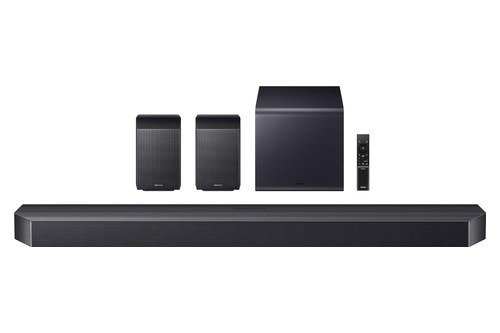 | — | See ratings |
The Most Height Channels 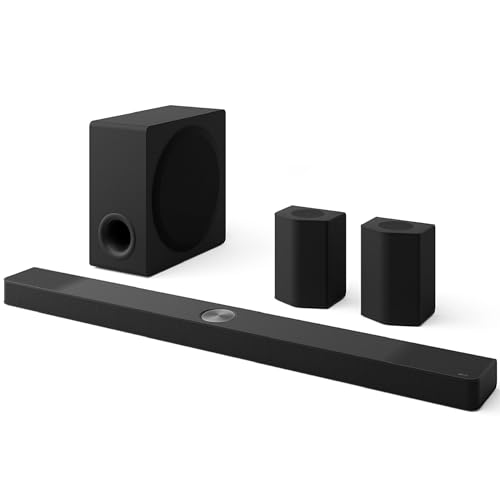 | 49.2 inch | See ratings |
A Published Loudness Figure 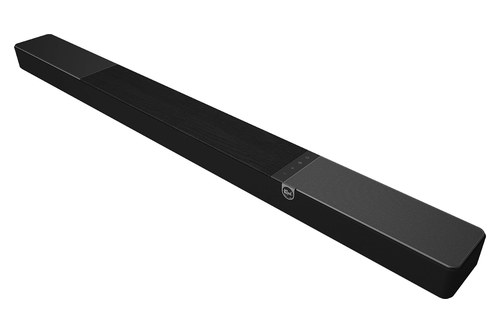 | 54 inch | See ratings |
Growing One Bar Into a System 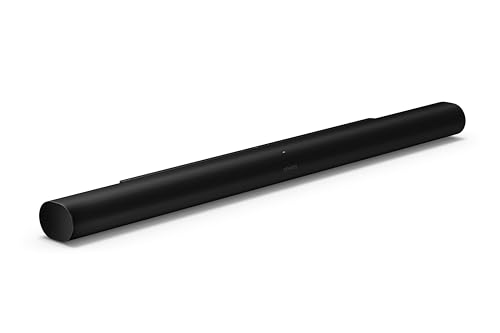 | 46.38 inch | See ratings |
Room to Add Two Subwoofers 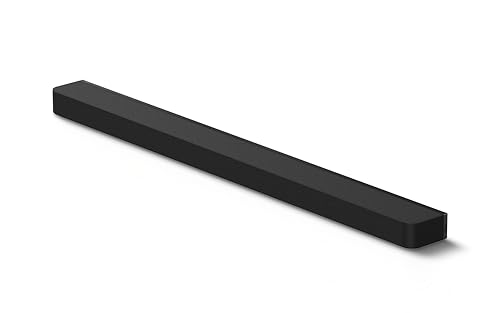 | — | See ratings |
Surrounds and HDMI Inputs 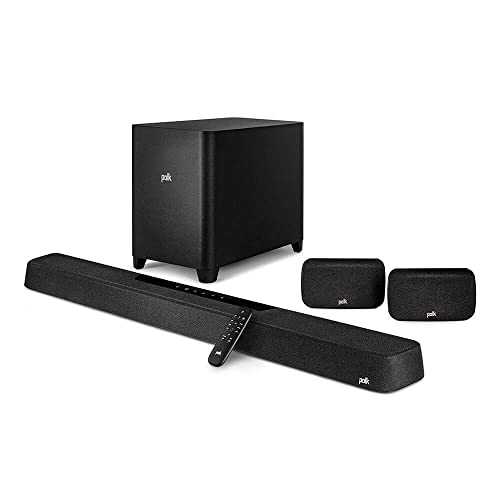 | 10 inch | See ratings |
A One-Box Start 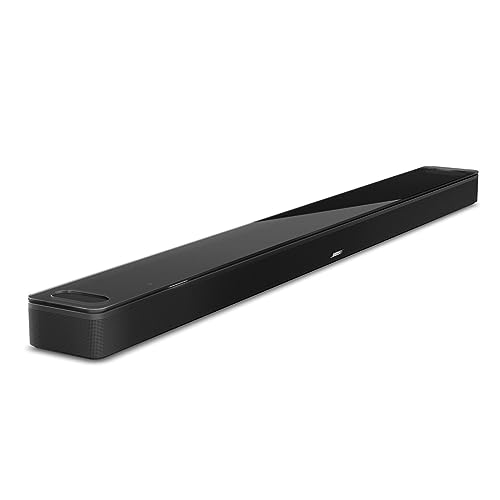 | 41 inch | See ratings |
What Counts as a Large Room for a Soundbar?
A large room for a soundbar is one of about 500 square feet or more, the line Bose draws in its buying guide, especially when it’s open plan or has high ceilings (Bose, How to choose a soundbar). For scale, Bose puts the average US living room at around 340 square feet with 9-foot ceilings and treats 200 square feet or less as a small room, which Burton Acoustix’s small-room soundbar guide covers.
Floor area is only half of it, because sound fills volume. Bose’s 340-square-foot room with 9-foot ceilings holds about 3,060 cubic feet of air, while a 500-square-foot room with the same ceiling holds about 4,500, roughly half as much again for the same soundbar to fill.

Listening distance is the other half. HyperPhysics, the Georgia State University physics reference, notes that sound from a point source drops by about 6 dB each time the distance doubles when there are no reflections (HyperPhysics, distance ratios).
Real rooms do reflect sound, so treat that as a rough guide rather than a rule. Still, a couch 16 feet from the TV is twice as far as one at 8 feet, and the bar has to work that much harder to sound the same.
Here’s a practical test. Multiply your room’s length by its width; if the answer is near 500 or the seating sits well back from the screen, read the picks below as systems and not as single bars.
Do high ceilings change the answer?
Yes, high ceilings change the answer for soundbars with upward-firing Dolby Atmos speakers. Dolby’s soundbar setup guide gives the ideal ceiling height as 7.5 to 12 feet, says a flat ceiling is best and a shallow vaulted one is acceptable, and warns that acoustic-tile ceilings absorb the overhead effect (Dolby Atmos sound bar setup guide).
So a great room with a 16-foot cathedral ceiling sits outside Dolby’s range, and the height effect from any bar may weaken there. In that room, the rear speakers and subwoofer in the next section do more of the work than the up-firing drivers.
Get Studio Tips Weekly
Join 5,000+ creators getting acoustic treatment advice every week.
No spam. Unsubscribe anytime.Why Do Channels, a Subwoofer and Rear Speakers Matter More as Rooms Grow?
That distance and volume math is why channels, a subwoofer and rear speakers matter more in a big room: a single bar sends everything from one spot at the front, and the farther away you sit, the more of it reaches you as reflections. Bose says as much, recommending a big soundbar “ideally paired with other speakers to create a full home theater system” for spaces of 500 square feet or more.
Think of it like lighting a large room. One bright lamp by the TV leaves the back of the room dim, while a few lamps spread around it light the whole space evenly, which is what rear speakers do for sound.
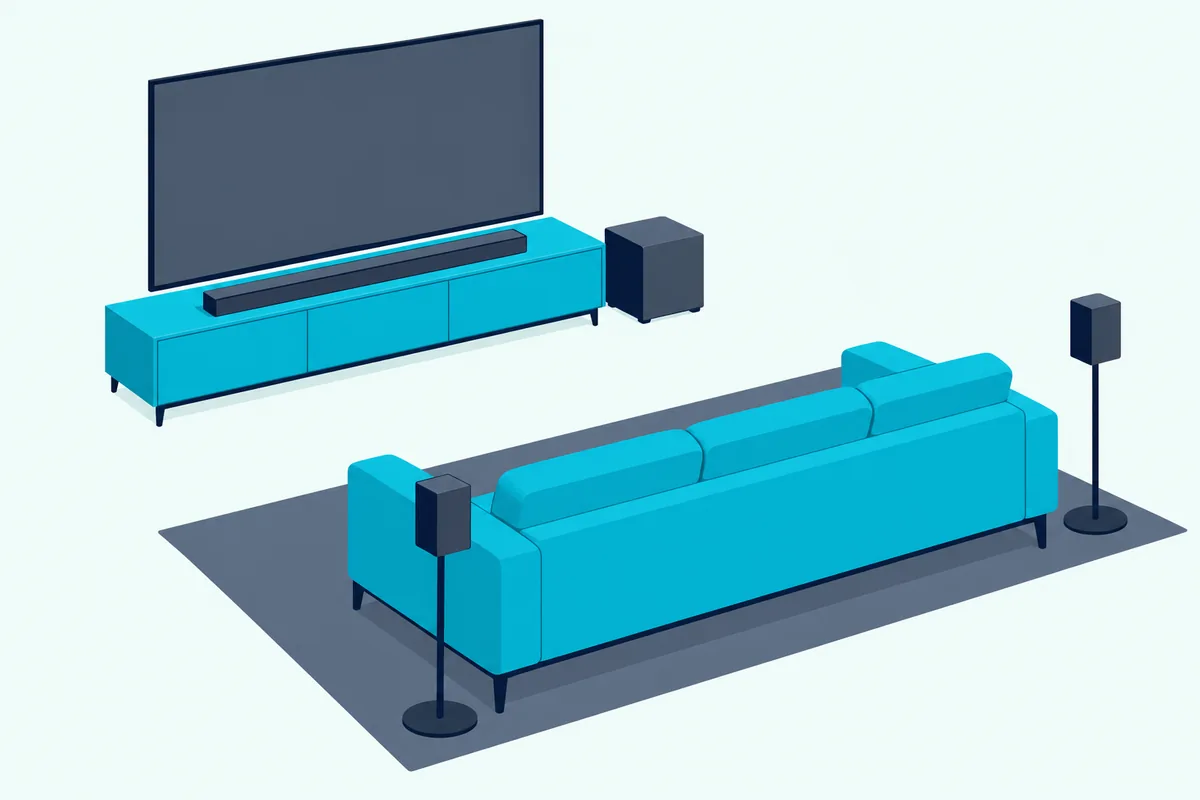
Dolby’s guide adds a detail that matters in wide rooms. Bars with side-firing speakers rely on a clear line to the side walls, so in an open-plan room where one side opens onto a kitchen, those reflections have less to bounce off.
Bass is the easier part to place. Sony’s help guide says a subwoofer’s output is omnidirectional, so it can go where it fits, and Sonos says the Sub 4’s WiFi link lets it sit wherever it looks best.
How many speakers does a big room need?
A big room needs at least a subwoofer and two rear speakers to go with the bar: left, center and right in front, two rears behind you and one subwoofer, the layout a 5.1 label describes. Dolby’s setup guide shows the step beyond it, a 5.1.4 soundbar with wireless speakers adding four overhead channels.
The Samsung, LG and Polk picks reach that layout out of the box, and the Sonos, Sony, Klipsch and Bose bars each have a maker-approved route to it. If bass is the main worry rather than surround, soundbars that ship with a separate subwoofer compares more systems across budgets.
Which Soundbars Are the Best Picks for a Large Room?
Those needs set the order below: the two complete systems first, then the bar with a published loudness figure, the two bars that grow into systems, the packaged Polk and the Bose all-in-one. Every card was checked on Amazon on 24 October 2026 for a 4.0-star or better average, 50 or more reviews and stock; the ratings themselves aren’t shown here.
Samsung HW-Q990F
The Q990F is the pick for a large room if you want the whole system in one box. Samsung’s user guide lists a subwoofer and two surround speakers in the box for the Q990F, and shows Dolby Atmos and DTS:X input played as 11.1.4 channels when both are connected.
For the complete big-room system, the Samsung HW-Q990F is the pick.
the Samsung HW-Q990F
Two features in the guide speak straight to big rooms. SpaceFit Sound Pro analyzes your listening space with the soundbar’s microphone and runs automatically, and Sound Grouping plays the full sound through the bar and rear speakers together, which Samsung calls ideal for a group of people in a large space.
Samsung also lets you move the surround speakers to the front in Surround Speaker mode, a handy option when the back of an open-plan room has no wall for them. Samsung’s own product site refused Burton’s scripts this month, so these details come from the user guide saved on 8 October.
LG S95TR
The S95TR is the pick for the most height channels, at 9.1.5 with five up-firing speakers, per its Amazon listing. LG’s manual shows the wireless subwoofer and wireless rear speakers in the setup and puts total amplifier output at 810 W RMS.
For the most height channels, the LG S95TR is the pick.
the LG S95TR
LG’s AI Room Calibration analyzes the sound coming from the system and fine-tunes the audio settings through the LG ThinQ app, using a microphone built into the bar (LG S95TR manual). LG notes that the system may play louder than expected while it measures, so warn the rest of the house first.
The manual asks you to install the wireless subwoofer close to the soundbar. The listing describes the system as filling even the largest rooms, which is LG’s claim, not a measured figure.
Klipsch Flexus Core 300
The Flexus Core 300 is the pick if you want a published loudness figure, because it’s the only bar here whose maker prints one: 106 dB maximum acoustic output, with a frequency response of 43 Hz to 20 kHz. Klipsch’s spec sheet also lists it at 54 inches wide, the widest bar on this page.
For a published loudness figure, the Klipsch Flexus Core 300 is the pick.
the Klipsch Flexus Core 300
Klipsch calls it the first soundbar with Dirac Live room correction built in, scanning the room through the Klipsch Connect Plus app and correcting for room size and shape, furniture and speaker setup (Klipsch Flexus Core 300). Inside the bar, Klipsch lists two pairs of 4-inch woofers and says no subwoofer is required.
For a large room, though, Klipsch’s own upgrade path is the point. Its product page invites you to add Flexus surrounds and a Flexus subwoofer, or two, and the spec sheet lists a wired subwoofer output as well.
Sonos Arc Ultra
The Arc Ultra is the pick for starting with one bar and growing it into a system, and Sonos itself labels it a soundbar for large rooms and TVs. Sonos lists 14 drivers and a 9.1.4 Dolby Atmos layout from the bar alone.
For growing one bar into a system, the Sonos Arc Ultra is the pick.
the Sonos Arc Ultra
Sonos’s Trueplay measures the room’s acoustics, then fine-tunes the EQ, using the bar’s far-field microphones (Sonos Arc Ultra). Sonos suggests pairing the bar with a Sonos Sub and Era 300 rear speakers for full Dolby Atmos surround.
The Sub 4 connects over WiFi, so it can sit where it fits, and Sonos says Trueplay keeps its bass from sounding muddy even next to a wall or lying flat under a sofa. That makes the Arc Ultra a sensible buy for a 340-square-foot living room today and a bigger open-plan space later.
Sony BRAVIA Theater Bar 9
The Theater Bar 9 is the pick if you may want two subwoofers, because Sony’s help guide supports connecting a pair. Its Amazon listing describes 13 speaker units in the bar.
For room to add two subwoofers, the Sony BRAVIA Theater Bar 9 is the pick.
the Sony BRAVIA Theater Bar 9
Sony’s help guide says two subwoofers of the same model can be connected for more powerful bass, placed side by side or far apart, with a phase setting in the app if the pair cancels some bass in your room (Sony BRAVIA Theatre Bar 9/8 help guide). It also names the optional SA-RS5 rear speakers.
Sound Field Optimization tunes the system to the room, and Sony asks you to run it again after moving the speakers, rearranging furniture or changing where you usually sit. Sony’s own product site refused Burton’s scripts this month, so these details come from its help guide and listing.
Polk MagniFi Max AX SR
The MagniFi Max AX SR is the pick for surround speakers and HDMI inputs in one box: a 7.1.2 system with a 10-inch wireless subwoofer and two SR2 surround speakers, per its listing. Polk’s page names the SR as the version that includes the SR2 pair.
For surrounds and HDMI inputs, the Polk MagniFi Max AX SR is the pick.
the Polk MagniFi Max AX SR
Polk says its SDA technology widens the soundstage beyond the bar to fill the room, and its VoiceAdjust raises voices over the rest of the mix. The listing says the surrounds can go at the front, sides or rear, which helps in a room without a back wall near the couch.
No room calibration feature appears in the Polk pages read for this guide, so this is the one pick you tune by ear with its bass and voice controls.
Bose Smart Ultra Soundbar
The Smart Ultra is the pick if you want to start with a single bar, and Bose names it as its choice for large spaces. Bose describes it as a 5.0.2-channel bar just over 41 inches wide, with nine speakers and two upward-firing dipole transducers.
For a one-box start, the Bose Smart Ultra Soundbar is the pick.
the Bose Smart Ultra Soundbar
ADAPTiQ takes measurements at multiple places in the room through a headset that comes with the bar, and Bose says it needs about 10 minutes of quiet. The owner’s guide lists the Bass Module 500 and 700 and two Bose surround speaker models as add-ons, and asks you to run ADAPTiQ again after adding any of them.
Bose’s buying guide is honest about its limits. For rooms of 500 square feet or more it recommends a big bar paired with other speakers, so in a truly large room, budget for at least a Bass Module.
Does Room Calibration Matter More in a Big Room?
Room calibration matters more in a big room because the room shapes more of what you hear: more distance means more of the sound reaches you after bouncing off walls, floor and windows. Six of the seven makers above build a calibration tool into the system, and they all work the same basic way, playing test sounds, measuring them and adjusting the output.
Where they differ is where the microphone sits. Samsung, LG and Sonos use microphones in the bar, Bose uses a headset you wear at several seats, Sony measures the viewing position during setup, and Klipsch scans the room through its app.
The rule in the Bose and Sony guides is the same: calibrate again after any change. Both ask you to rerun it after moving the bar, adding a subwoofer or rear speakers, or rearranging furniture, and in a big room those changes happen often.
Here’s a real scenario. You set up the Bose in a 500-square-foot great room, run ADAPTiQ, then add a Bass Module 700 next month and move the sofa forward; that’s two reasons to run it again, and skipping them leaves the system tuned for a room you no longer have.
Where Should the Soundbar and Extra Speakers Go in a Large Room?
Calibration works best from a good starting position, so placement comes next: the bar at ear level in the open, the rear speakers behind or beside the seats facing you, and the subwoofer wherever it fits near the front. Dolby’s guide says an Atmos bar should sit at or slightly above seated ear level, with a clear line to the ceiling, and never in a cabinet or under a soffit.

Dolby also says to sit at least 4 to 5 feet from an Atmos bar, which is rarely a problem in a big room. Bose adds a gap between the bar and the TV so the cabinet doesn’t block the TV’s remote sensor.
The rear speakers need the most thought. Sony recommends placing them as a pair behind the viewing position, facing it, at ear height, and Samsung’s layout diagram marks the surround speakers at 135 and 150 degrees from the bar.
For the subwoofer, the makers’ advice differs a little. LG asks for its subwoofer close to the soundbar, Sonos says Trueplay copes with a Sub 4 beside a wall or under a sofa, and our guide to subwoofer spots around a soundbar goes through the trade-offs in more detail.
One more Bose detail is easy to miss in a big, gadget-filled room. Its owner’s guide says some WiFi access points may need to sit 8 to 10 feet away from the bar, Bass Module and surround speakers to avoid wireless interference.
Do Makers Publish Loudness Figures for Large Rooms?
Those calibration and placement tools have no loudness figure behind them, because mostly the makers don’t publish one: Klipsch’s 106 dB maximum output for the Flexus Core 300 is the only loudness figure in the maker pages read for these seven systems. None of the other six publishes a maximum output, and only Bose and Sonos put room-size words on their bars at all.
That leaves the comparison on firmer ground than watts. Channel count, the subwoofer and rear speakers, and room calibration are all things the makers do publish, which is why the table at the top uses them.
Test labs fill some of that gap, but only partly here. RTINGS publishes measured results in its soundbar reviews, but its review pages build those results by script, and the copy saved for this guide held no figures, so none appear on this page.
The LG listing’s “fills even the largest rooms” and Sonos’s “for large rooms” are useful signals of what each bar was designed for. Read them as descriptions, not measurements.
When Is a Receiver System the Better Answer?
Even a full soundbar system has limits, and a receiver system is the better answer when the room is so big, or so oddly shaped, that you want full-size speakers at each position and the freedom to swap any one of them later. Every soundbar system above ties you to one maker’s subwoofers and rear speakers, while separate speakers and an AV receiver let you pick each piece.
The trade is space, wiring and setup time, and a full speaker-and-receiver setup weighed against a soundbar covers that decision side by side. For most large living rooms, a soundbar system with rear speakers sits between the two.
Two of the picks narrow the gap. Klipsch’s spec sheet lists a wired subwoofer output on the Core 300, and Sony’s help guide supports a pair of subwoofers on the Theater Bar 9, which is the kind of bass upgrade a big room rewards.
How Were These Soundbars Checked?
Those seven cards rest on makers’ own pages: each system’s channels, speakers, calibration feature and add-ons come from its maker’s guide, manual or spec page, except where a card says a figure comes from the Amazon listing. Samsung’s and Sony’s own product sites refused Burton’s scripts earlier this month, so Samsung’s details come from a user guide saved on 8 October and Sony’s from its help guide and listing.
No system was tested or listened to for this page, and none of the descriptions above is a listening verdict. Every pick was checked on Amazon on 24 October 2026 for a 4.0-star or better average, at least 50 reviews and stock.
The Bottom Line
So for a large room, buy a system rather than a bar: a subwoofer and rear speakers do more for a big space than a longer soundbar alone. The Samsung HW-Q990F and LG S95TR arrive complete, the Polk MagniFi Max AX SR adds surrounds for less fuss, and the Klipsch Flexus Core 300, Sonos Arc Ultra and Sony Theater Bar 9 grow into systems.
The Bose Smart Ultra makes sense as a start in a mid-sized room, or in a big one with a Bass Module and surrounds planned. Whichever you choose, run its room calibration from your usual seat, and run it again whenever the room changes.
Frequently Asked Questions
Do soundbars work in large rooms?
Yes, soundbars work in large rooms when they’re part of a system with a subwoofer and rear speakers. Bose’s guide says sound gets lost in rooms of 500 square feet or more when a soundbar has only a few speakers, and it recommends pairing a big bar with other speakers there.
A single bar still works for watching in a big room, but voices and effects come only from the front. Adding rear speakers and running the system’s room calibration closes most of that gap.
How do I choose a soundbar by room size?
Start with floor area: Bose treats 200 square feet or less as small, about 340 as an average living room and 500 or more as large. Then check ceiling height, since Dolby gives 7.5 to 12 feet as ideal for Atmos bars with up-firing speakers.
For a small room, a compact bar is enough. For an average room, a mid-sized bar works, and for a large room, choose a system with a subwoofer, rear speakers and room calibration.
Is a 2.1 or 5.1 soundbar better for a large room?
A 5.1 soundbar is better for a large room, because it adds a center channel for dialogue and two rear channels that bring sound to the back of the seating area. A 2.1 bar has left, right and a subwoofer, so every effect comes from the front.
The Samsung, LG and Polk picks are 5.1 or more out of the box, and the others reach it with their makers’ add-ons.
What is the best soundbar for a large room with high ceilings?
The best soundbar for a large room with high ceilings is one with rear speakers, since Dolby gives 7.5 to 12 feet as the ideal ceiling height for up-firing Atmos speakers. Above that, the overhead effect may weaken, so the surround speakers carry more of the immersion.
The Samsung HW-Q990F and LG S95TR include rear speakers, and the Polk MagniFi Max AX SR includes its SR2 surrounds. Run the system’s calibration after setup either way.
Do I need a subwoofer for a large living room?
A subwoofer is the first add-on most large living rooms need, because Bose recommends pairing its biggest bar with other speakers in rooms of 500 square feet or more. Of the seven picks, the Samsung, LG and Polk include one.
Sonos, Sony, Klipsch and Bose sell matching subwoofers, and Sony’s Theater Bar 9 can run two.