Are Concrete Walls Soundproof? Close for Voices, Not for Bass
If you’re asking are concrete walls soundproof, the lab answer is close but no: a bare 8-inch poured wall rated STC 58 in Portland Cement Association tests, enough to stop shouting but not a bass line.
You’ve probably met the other half of that answer: a thick, solid-looking wall that still lets a neighbor’s TV or subwoofer through.
Work out whether yours is poured concrete, hollow block or a good wall with a leak around it, and you’ll know which fix comes first.
The first job needs no tools: find out what the wall is made of, because 8-inch lightweight block tested 14 points below 8-inch poured concrete in the same lab series.
Below are the scores by wall type, what decides them, why bass still gets through, and what each added layer gained in those tests.
Are Concrete Walls Soundproof Enough to Stop Voices?
That STC 58 needs a yardstick. Concrete walls aren’t fully soundproof, but 6 or 8 inches of solid concrete stops voices well enough to clear the building code’s line, far ahead of a typical stud wall.
STC, or Sound Transmission Class, is a single number for how much airborne sound a wall blocks, measured in a lab under ASTM E90 from 125 to 4,000 Hz, as National Gypsum’s SoundBook explains. The 2021 International Building Code asks for STC 50 between dwelling units, or 45 when tested in the field.
The National Bureau of Standards’ Handbook 119 puts words to that scale: STC 45 is loud speech barely audible, 50 is shouting barely audible, and 55 is shouting not audible.
Geiler & Associates, an acoustics consultancy, reads the top end more strictly, with loud music still audible at 52 to 55, faint at 57 to 60, and low frequencies faintly heard at 62 to 65. So “soundproof” depends on the noise: a conversation is one job, and a subwoofer is another.
National Gypsum’s chart puts normal speech at 65 dB and a suburban home at 45 dB, so a wall that takes roughly 50 dB off a voice leaves it far under the room’s own background sound.
Are Cement Walls Soundproof, or Is That Concrete?
Those scores belong to concrete, which is what most cement walls turn out to be. Cement walls are as soundproof as the concrete or block they’re built from, since cement is only an ingredient, typically 10 to 15 percent of a concrete mix by volume, according to the American Cement Association.
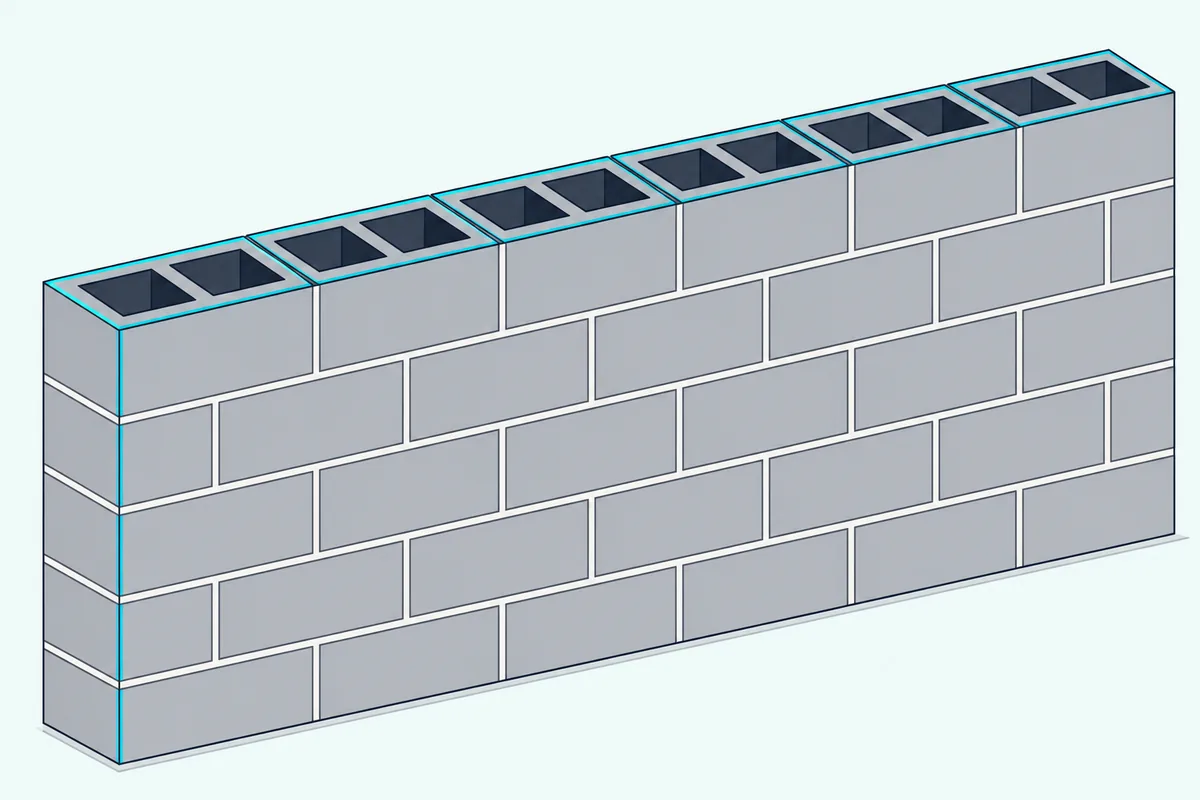
Poured or precast concrete is solid, while concrete block walls are usually hollow, and cinder block is the everyday name for that block.
You can often tell them apart where the wall is bare, such as a basement or garage: block shows a grid of mortar joints, while poured concrete reads as one continuous surface.
How Soundproof Is Concrete Compared With Block?
That solid-or-hollow split shows up straight away in the numbers. Solid concrete rates in the mid-to-high 50s at 6 to 8 inches, while hollow 8-inch block sits in the mid-40s until its cores are filled.
| Wall | Weight (lb/sq ft) | STC | Source |
|---|---|---|---|
| 8-in. poured concrete, bare | 97 | 58 | PCA test 76-77 |
| 6-in. poured concrete, bare | 71 | 57 | PCA test 76-66 |
| 6-in. precast panel | 75 | 55 | PCI Table 1 |
| 4-in. precast panel | 54 | 49 | PCI Table 1 |
| 8-in. lightweight block, bare | 32 | 44 | PCA test 76-75 |
| Same block, latex paint on one side | 32 | 48 | PCA test 76-76 |
| 8-in. block, cores grouted, one side painted | 89 | 56 | PCA test 76-104 |
| 8-in. hollow block at 105 lb/cu ft | Not listed | 46 (calculated) | CMHA Table 1 |
| Common stud wall | Not listed | 35 | HUD |
The PCA rows are Riverbank Acoustical Laboratories tests to ASTM E90 in the Portland Cement Association’s Bulletin RD066. PCI is the Precast/Prestressed Concrete Institute’s acoustics notebook, HUD is the federal housing department’s Noise Guidebook, and CMHA is the Concrete Masonry & Hardscapes Association’s TEK 13-01D, which says its calculated values tend to be conservative.
The figures come from these associations’ bulletins, research papers and the standards bodies’ guides, and they don’t always agree. The National Ready Mixed Concrete Association (NRMCA) 2022 compilation gives 6-inch slabs STC 50 to 55 and 8-inch slabs 57 to 58, so treat any single number as a guide.
How Soundproof Is Cinder Block?
That 14-point gap between poured concrete and light block comes down mostly to weight. Bare 8-inch cinder block rates about STC 44 to 49, under the code line, and its score rises as the wall gets heavier.
CMHA’s table runs by density, from 44 at 85 pounds per cubic foot to 49 at 135 for hollow 8-inch units, and from 55 to 57 once the cores are full of grout. PCA’s lab wall agrees: grout took it from 32 to 89 pounds per square foot and from STC 44 to 56.
Warnock, of the National Research Council of Canada, says in his 1995 masonry paper that grout works through its weight, while insulation isn’t effective because sound travels mainly through the block’s structure. Geiler’s table gives it 2 points where grout gets 6.
Rough block has a second problem, because sound passes through its pores. Warnock says gains of 5 to 10 STC points after sealing aren’t uncommon, and his 190 mm (7.5-inch) lightweight wall went from 42 to 49 with plaster on one face.
That’s the 4-point jump in the table too: two coats of latex took PCA’s lightweight block from 44 to 48. Dense block shows no such gain, and NRC’s RR-331 guide says paint has no effect on normal-weight block in the lab.
If you can’t tell which you have, Warnock says it’s safer to seal the wall, and all mortar joints must be finished and free from leakage. Clay masonry has its own numbers, covered in soundproofing a brick wall with a separate lining.
Where Does Sound Get Around a Concrete Wall?
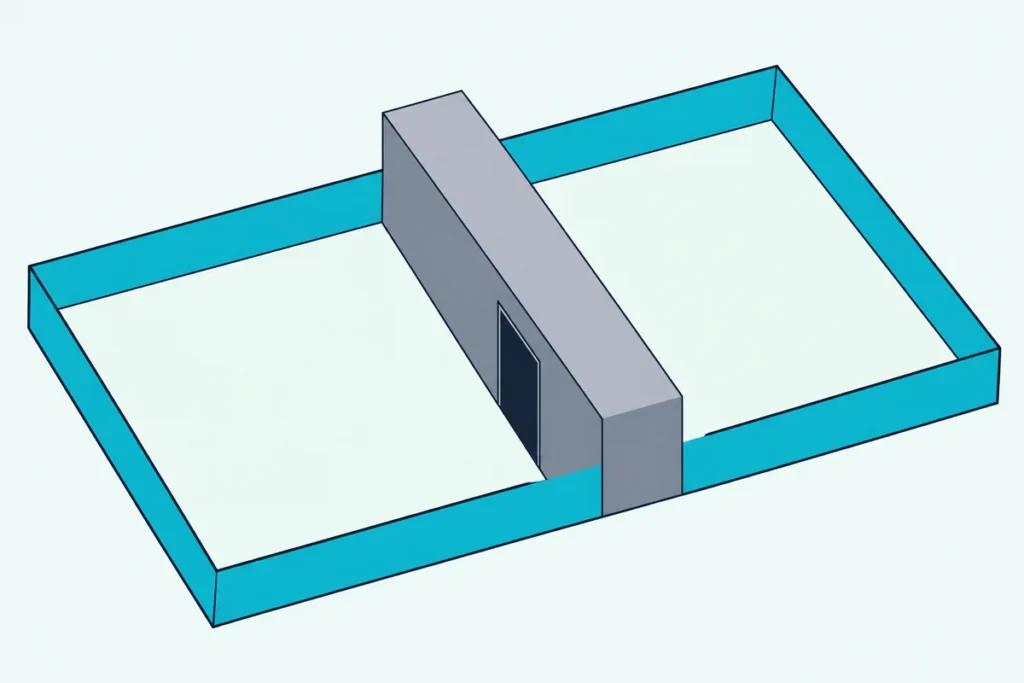
Every score so far describes the wall alone in a lab, and a real room has other routes. Sound gets around a concrete wall through cracks, outlets, doors, windows and the floor and ceiling it connects to, so the room usually scores below the wall.
NRMCA says field ratings typically land 5 points or more under lab STC. In RR-331’s worked examples, a 6-inch concrete wall at STC 57 for the direct path came to ASTC 54, the room-to-room rating, and an unsealed 140 mm (5.5-inch) lightweight block wall came to just 34.
HUD says a 1-inch square hole takes an STC 50 wall down to 40, and CMHA’s TEK 13-02A says a crack 0.007 inch wide along the top of a 12½-foot wall passes just as much sound.

Doors and windows cap the whole wall. In HUD’s examples, a hollow-core door rated STC 17 drags a 48-STC wall to 24, and an STC 26 window over 30 percent of an STC 45 wall leaves it at 35.
Try this: with the room quiet, have someone talk on the far side while you listen along the floor, corners, outlets and door edge. If the voice is loudest at a joint, that’s your first fix, and the same hunt explains why concrete apartments still carry noise.
Why Does Bass Still Get Through Concrete?
Seal every one of those gaps and low notes are still the last thing a heavy wall gives up. Bass gets through concrete because a wall’s sound loss shrinks as pitch drops, and the STC score says nothing below 125 Hz.
PCA’s plotted curve for 8-inch poured concrete climbs from about 44 dB at 125 Hz to about 58 dB at 1,000 Hz. PCI’s notebook says STC was originally designed for speech privacy.
A better STC can even mean more bass gets through. PCA’s three lined 8-inch walls rate STC 59 to 63, yet they plot at about 35 to 40 dB at 125 Hz, below the bare wall’s 44.
Warnock names the cause: a mass-air-mass resonance between the drywall, the trapped air and the wall, which passes sound more easily around its own frequency. A deeper air space lowers that frequency, and his target of 63 Hz means the wall improves from 125 Hz up.
Light block runs the other way: PCA’s curves at 125 Hz read about 32 dB bare, 35 furred, 40 with isolated studs behind a 1-inch air gap, and 43 with grouted cores.
Does Concrete Absorb Sound?
Blocking bass and taming a boomy room are different jobs, and concrete only does the first. Concrete mostly reflects sound: PCI says a dense, non-porous surface absorbs 1 to 2 percent of what hits it, a noise reduction coefficient of 0.015.
Bare block does better, at 0.26 to 0.50 in CMHA’s table, until paint seals it.
That’s why a concrete room can echo and still block the neighbors. Echo is a separate problem, covered in the best acoustic treatment for a concrete room, and panels won’t stop sound leaving through the wall.
What Can You Add to a Concrete Wall?
Absorption won’t close a leak, so the fixes run in a set order. You can add sealant first, then a lining that stands off the wall with mineral wool behind it, and each step only pays off once the one before is done.
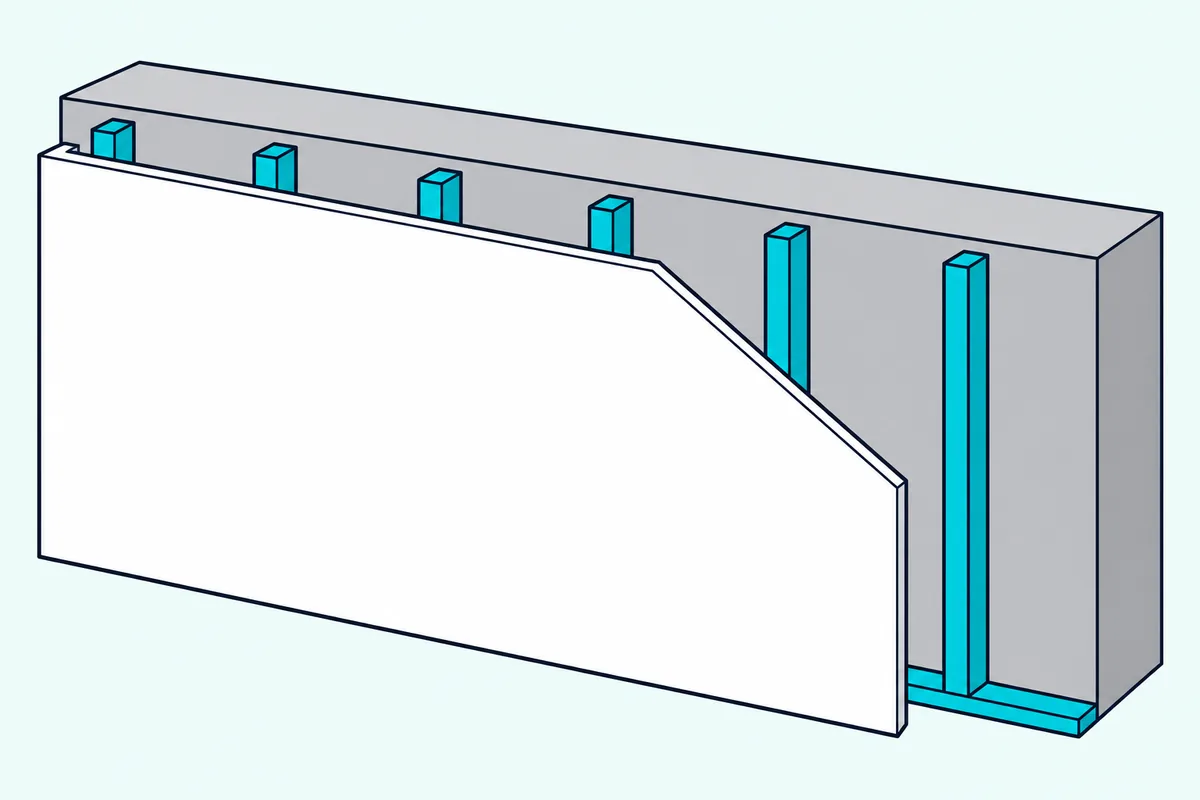
- Seal the gaps. Run acoustic sealant along the joints and around boxes, and pack through-wall openings with mineral wool, foam or fiber first, as CMHA says.
- Seal rough block on one face. Warnock says one face only, with any drywall on the other, which gave his lightweight wall STC 57 against 53.
- Stand a lining off the wall. NRMCA ranks a free-standing stud wall with at least 1 inch of air as the best upgrade, then resilient clips, then channels.
- Fill the cavity. Fibrous insulation works here, and closed-cell foam doesn’t, CMHA says.
Green Glue Noiseproofing Sealant is one acoustic sealant sold for step 1. Every pick met Burton Acoustix’s rating, review and stock checks on 6 November 2026.
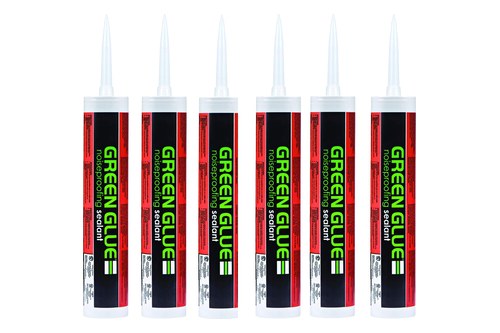
Green Glue Noiseproofing Sealant
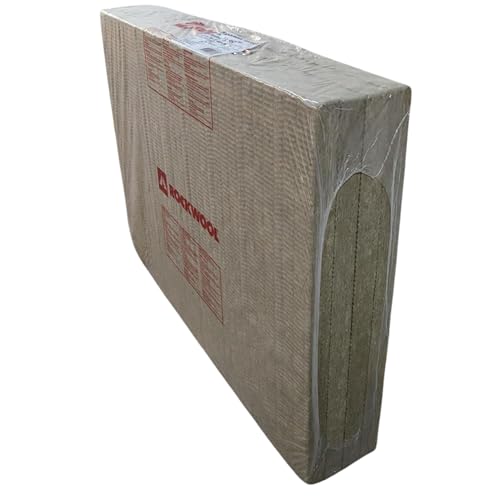
For step 3, Genuine RSIC-1 clips hold 7/8-inch hat channel and drywall off the wall, and Acoustical Surfaces lists them for block and concrete walls. For step 4, ROCKWOOL ProRox mineral wool boards are 2 inches thick.
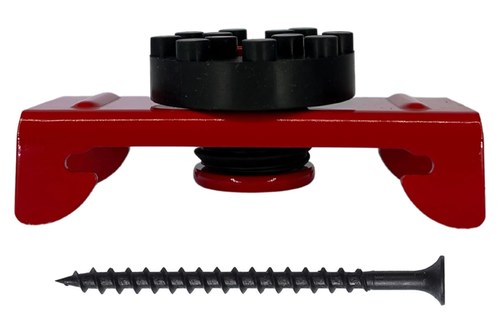
Genuine RSIC-1 clips
PCA measured these linings on one side of its walls, where furring means strips or channels that hold the drywall off the masonry.
| Lining on one side | Wall | STC before and after | Gain | PCA test |
|---|---|---|---|---|
| Wood furring, ½-in. drywall, empty cavity | 8-in. concrete | 58 to 59 | 1 | 76-79 |
| Metal Z channels, ½-in. drywall, empty cavity | 6-in. concrete | 57 to 59 | 2 | 76-68 |
| Metal Z channels, 1-in. rockwool, ½-in. drywall | 6-in. concrete | 57 to 62 | 5 | 76-69 |
| Wood furring, 1½-in. rockwool, ½-in. drywall | 6-in. concrete | 57 to 63 | 6 | 76-71 |
| Wood furring, 1½-in. rockwool, ½-in. drywall | 8-in. concrete | 58 to 63 | 5 | 76-99 |
| Furring, resilient channels, 1½-in. rockwool, ½-in. drywall | 8-in. lightweight block | 44 to 58 | 14 | 76-74 |
| 1-in. air gap, metal studs, 1½-in. rockwool, ½-in. drywall | 8-in. lightweight block | 44 to 59 | 15 | 76-72 |
Drywall over an empty cavity barely moved poured concrete, and the insulation did most of the work. Block gained far more, partly because RR-331 says a lining also stops the leak through lightweight block.
Depth decides the rest. On Warnock’s 190 mm block wall at STC 50, 5/8-inch drywall on ½-inch resilient channels reached 51, or 54 with glass fiber, while 3-inch Z-bars reached 57 with the cavity empty.
Go deeper and fill the gap, and the numbers jump: he reports close to STC 64 with drywall about 2 inches off the block, and above 70 at about 3 inches, both with the cavity filled.
Three shortcuts backfire. CMHA says drywall stuck straight to masonry does very little beyond sealing it, and screws long enough to touch the block carry vibration across.
Shallow linings on both sides are the third, because Warnock’s wall fell to 49 with channels on both faces, below the bare wall’s 50.
The rest of the job is in the six steps for soundproofing a wall, and a shared wall has its own limits in Burton Acoustix’s guide to joining walls.
When Should You Upgrade a Concrete Wall?
Those gains only matter if the wall is your weak point. Upgrade a concrete wall when you’ve sealed it and music or bass still gets through, or when it’s bare, light block.
If you can hear words through 6 inches of solid concrete, the wall probably isn’t the cause, since STC 57 sits past Handbook 119’s line for shouting. Check the door, outlets and joints first.
For a subwoofer or a band, a thin lining on poured concrete won’t help at 125 Hz, so plan on more weight or a deep, isolated stud wall.
The Bottom Line
Concrete walls aren’t soundproof, but solid ones come close for voices, at STC 57 and 58 in PCA’s tests against a code line of 50. Hollow block starts in the mid-40s, and bass passes through both more easily than the score suggests.
Find out what your wall is, seal it, deal with the door and windows, and only then add an insulated lining with a deep air gap.
Frequently Asked Questions
Are concrete houses more soundproof?
Against a common stud wall at STC 35, yes, for sound passing through the wall itself. NRMCA lists insulated concrete form walls with a 6-inch core at STC 46 to 50 bare and 54 to 56 with one layer of drywall on each side.
How thick does a concrete wall need to be to block sound?
Six inches passes the code line in these tables, with PCI’s panel at 55 and PCA’s test wall at 57. Extra thickness adds little after that: PCA’s 8-inch wall gained one point on its 6-inch wall, and PCI says STC rises about 6 units for each doubling of weight.
Can you hear neighbors through concrete walls?
Yes, usually through the leaks or through a thin or hollow wall. Loud music stays audible at STC 52 to 55 on Geiler’s scale, and bass carries further.
Are concrete floors soundproof?
Not against footsteps. NRMCA gives a 6-inch slab an impact rating (IIC) of 26 to 30, against the 2021 International Building Code’s minimum of 50.
What blocks out the most noise?
For a wall, real separation. Warnock’s two separate rows of 90 mm block with glass fiber between them rated STC 77, though he warns that mortar droppings can bridge the gap.