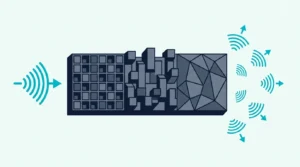
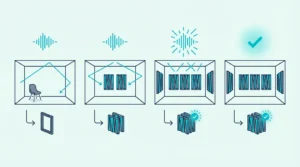
How To Diffuse Sound In A Room? (The Fix Most People Skip)
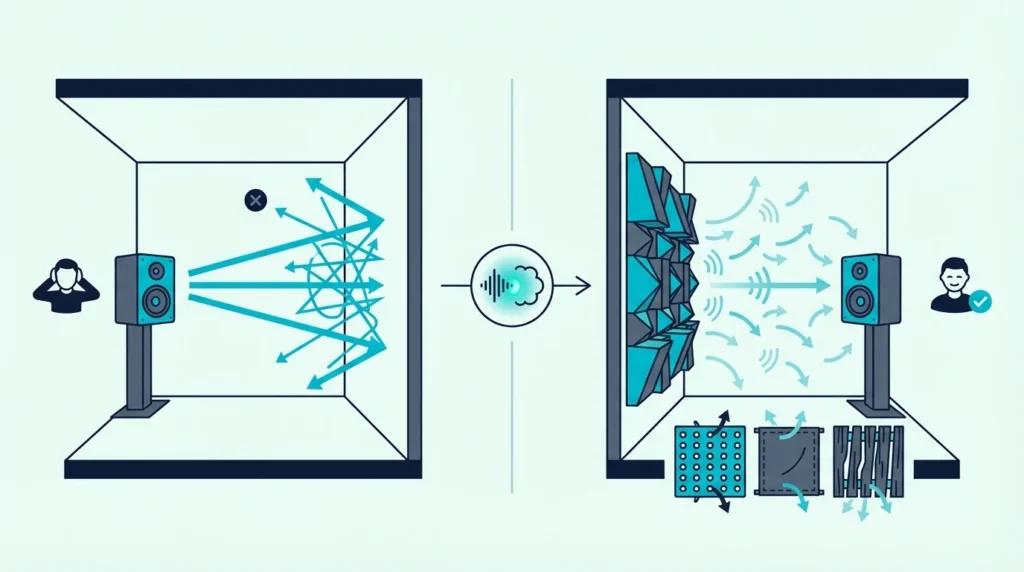
How to diffuse sound in a room comes down to one thing most people overlook — scattering reflections instead of just absorbing them.
If your room sounds echoey with bare walls but claustrophobic after you hang absorption panels everywhere, you’ve hit the exact problem diffusion solves.
The right diffuser placement turns harsh, focused reflections into smooth ambient energy that keeps your room sounding open and natural — without the deadness that comes from over-absorbing.
Below, you’ll see where diffusers go, which types match your room, and how to balance diffusion with absorption so you’re not guessing at what your walls need.
To diffuse sound in a room, mount QRD or skyline diffusers on the rear wall (at least 2 meters from your listening position), use absorption at first reflection points and the front wall, and add ceiling diffusion if flutter echo persists. This live-end/dead-end layout is the industry standard for studios, home theaters, and critical listening rooms.
How To Diffuse Sound In A Room — And Why Does It Matter?
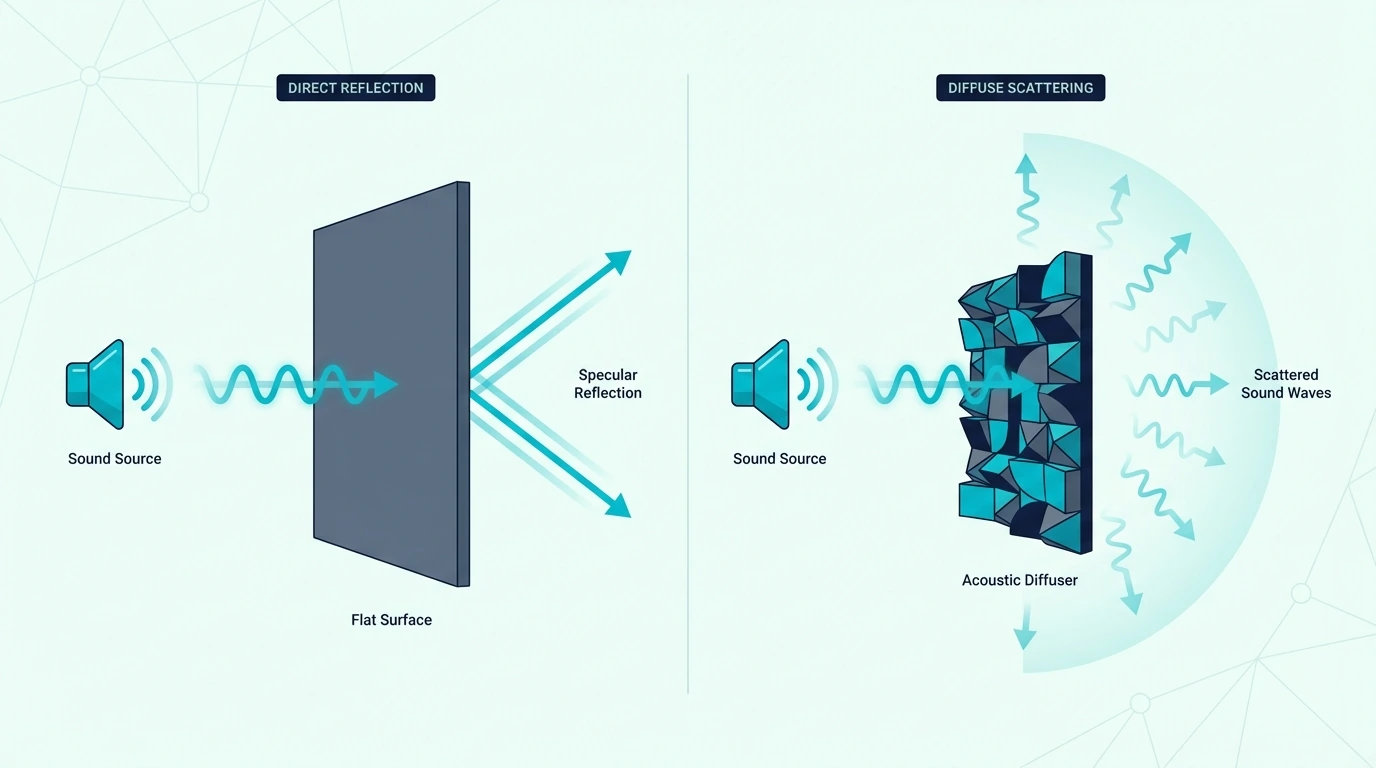
That echoey slap you hear when you clap in an empty room is sound bouncing off flat walls in a focused beam — and it’s the problem diffusion was designed to solve. If you’ve already tried absorption and the room sounds too dead, diffusion is the missing piece.
What Is Sound Diffusion?
Sound diffusion scatters a focused reflection into dozens of smaller ones that arrive from different angles over a spread of 10-20 milliseconds. Instead of one sharp echo bouncing straight back at you, you get a smooth wash of ambient energy that your brain interprets as natural room sound.
The mechanism is purely geometric. A diffuser’s uneven surface — wells of varying depths in a QRD panel, blocks of varying heights in a skyline design — forces different parts of the same sound wave to reflect at different angles and times.
That scattered energy still exists in the room. Your ears still sense the space’s size and character, but without the harsh comb filtering or flutter echo that flat walls create.
This is fundamentally different from absorption, which converts sound energy into heat and removes it from the room entirely. Diffuser vs absorber — one redirects energy, the other deletes it.
Why Diffusion Matters For Room Sound Quality
A room with zero treatment sounds terrible — flutter echoes, ringing sustains, and frequency cancellations make everything from music to speech sound colored and uneven. Most people fix this by covering walls with absorption panels or foam.
The problem shows up after they’ve absorbed too much. The room goes from echoey to lifeless — tight, claustrophobic, and fatiguing to listen in for more than thirty minutes.
Diffusion fixes this by controlling reflections without removing them. Professional studios figured this out in the 1980s: you need some reflected energy for a room to sound natural, you just need it spread evenly instead of concentrated in focused beams.
The result is a space that sounds controlled and open at the same time. Clarity without deadness — that’s the balance diffusion delivers.
What Problems Does Sound Diffusion Solve In A Room?
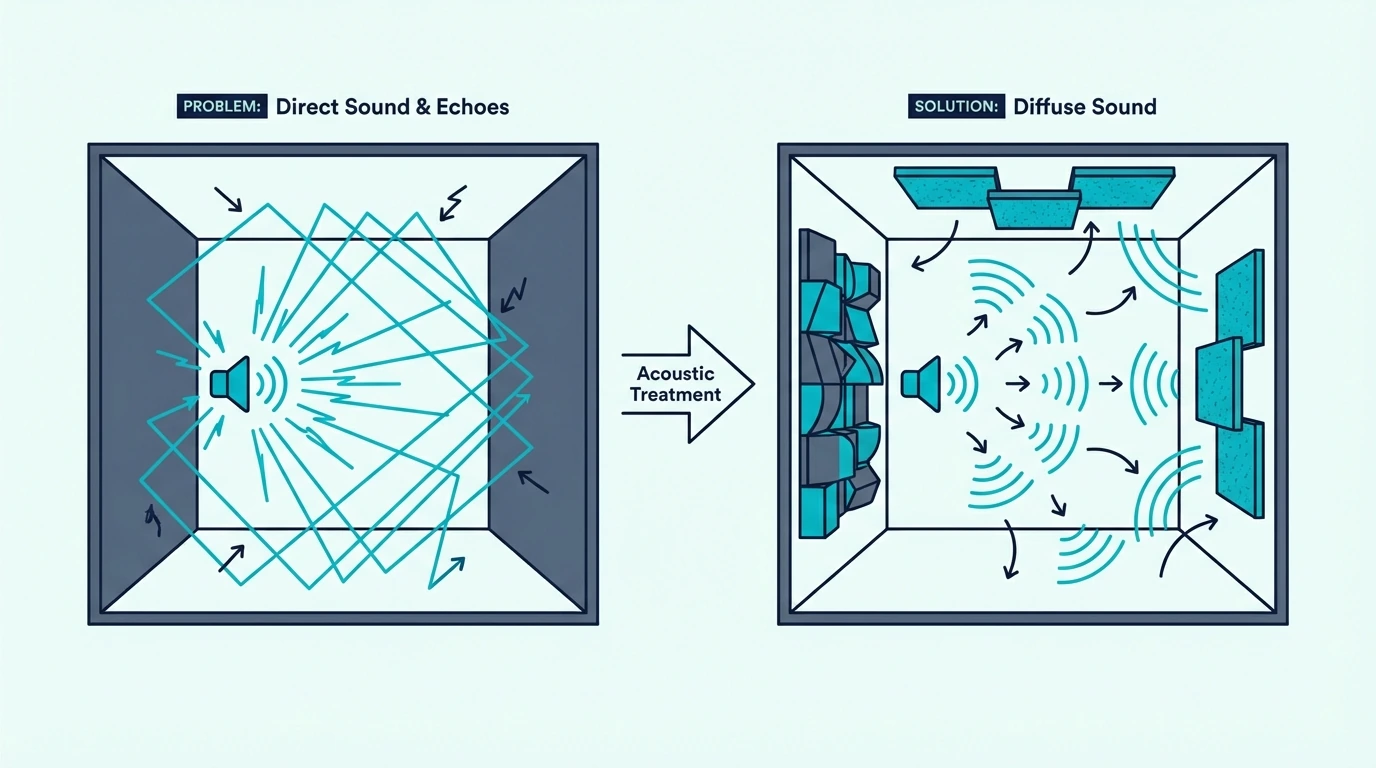
The problems diffusion targets are specific and measurable — not vague “bad sound” complaints. Each one has a physical cause that diffusion’s scattering mechanism directly addresses.
Flutter Echo And Comb Filtering
Flutter echo is that metallic “zing” you hear when you clap between two parallel walls. Sound bounces back and forth in a rapid ping-pong pattern, creating a sustained ringing that colors everything in the room.
Try this: stand between two bare parallel walls and clap once. If you hear a bright, ringing sustain instead of a clean decay, that’s flutter echo.
Comb filtering happens when a direct sound and its reflection arrive at your ears with a slight time delay. Certain frequencies cancel while others reinforce — the result is an uneven frequency response that shifts depending on where your head is.
A diffuser on one of those parallel walls breaks the ping-pong pattern immediately. The scattered reflections arrive from multiple angles at multiple times, so they can’t reinforce into a focused flutter.
One BXI Wood Sound Diffuser (1D QRD) on the rear wall is often enough to eliminate the worst flutter echo in a home studio.
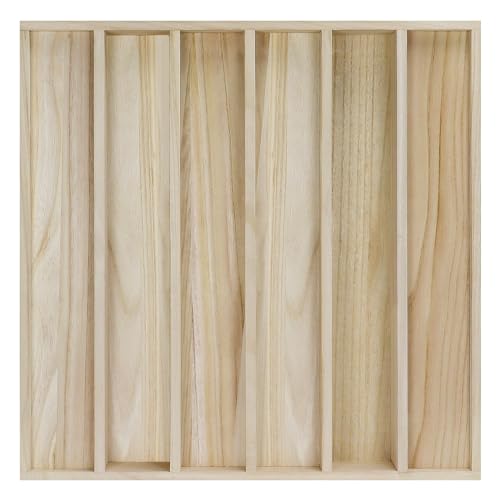
BXI Wood Sound Diffuser (1D QRD)
The Over-Absorbed “Dead Room” Problem
Absorption panels are the first treatment most people buy — and the easiest to overdo. A room with absorption on every wall sounds artificially tight, like wearing headphones in a closet.
The issue is biological, not just aesthetic. Your brain uses reflected sound to gauge room size, distance, and spatial orientation.
Remove all reflections and your brain gets confused — listening becomes fatiguing because there are no spatial cues to process.
Studios call this “dead room syndrome.” Engineers who mix in over-absorbed rooms make compensating EQ decisions that don’t translate to other playback systems.
They boost highs because the room absorbs them, then the mix sounds harsh everywhere else.
Diffusion is the antidote. Swapping absorption panels for diffusers on the rear wall restores the room’s ambient energy while keeping reflections scattered and controlled.
The room feels open and alive again without the harsh echoes you started with. For a deeper look at this tradeoff, sound absorption vs diffusion covers when each approach wins.
Get Studio Tips Weekly
Join 5,000+ creators getting acoustic treatment advice every week.
No spam. Unsubscribe anytime.Where Should You Place Diffusers In A Room?
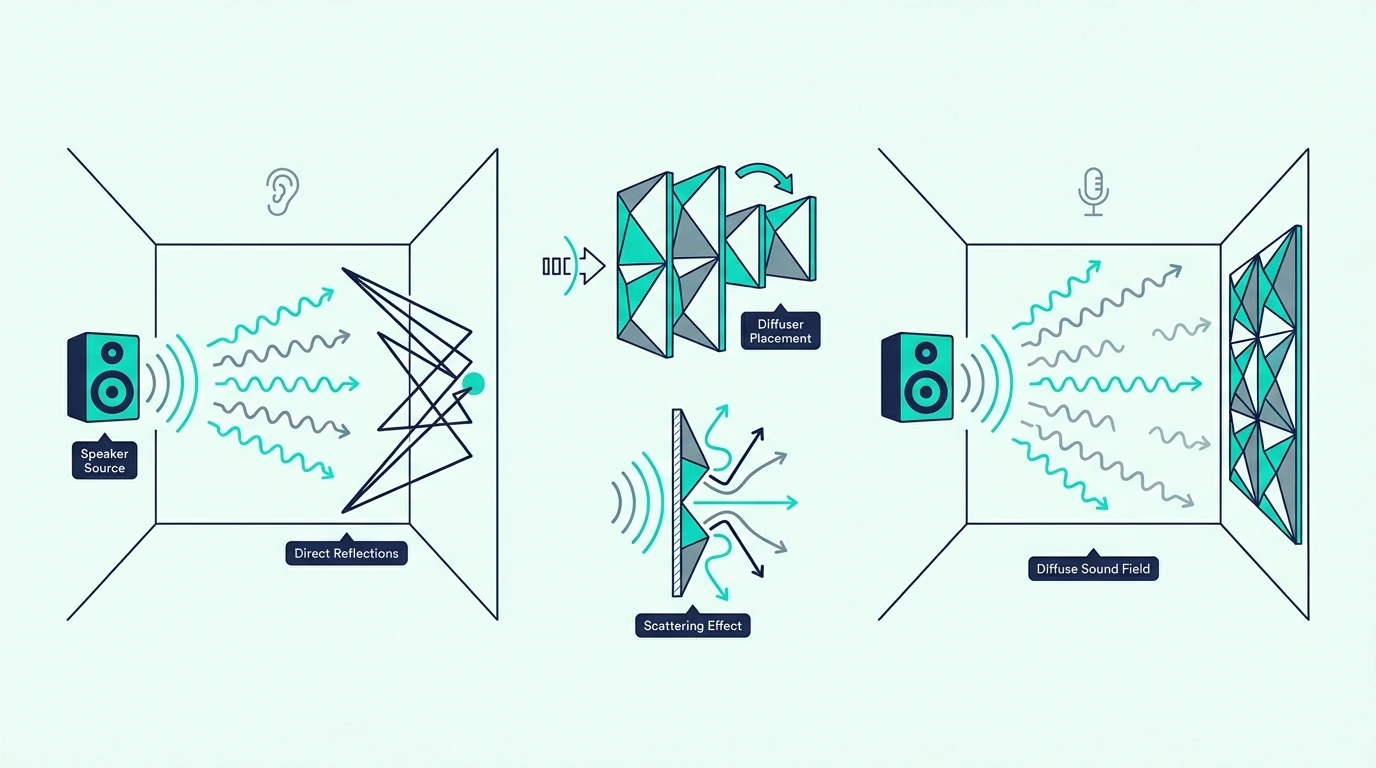
Knowing that diffusion scatters sound is step one — knowing where to scatter it determines whether the treatment actually works. The same panel in the wrong spot either does nothing or creates new problems.
Rear Wall (The Default Starting Point)
The rear wall catches the strongest delayed reflection in any room. Sound travels from your speakers (or the sound source) to the back wall and bounces straight back — arriving late enough to hear as a distinct echo.
This is where diffusion makes the biggest difference with the least effort. A QRD or skyline panel on the rear wall scatters that focused return into ambient energy that reaches your ears from multiple angles over a spread of milliseconds.
The critical requirement is distance. You need at least 2 meters between the diffuser and your listening position for the scattered reflections to separate properly.
Below that distance, the reflections arrive too close together and create comb filtering instead of smooth diffusion. Our diffuser placement guide covers the math behind this distance rule.
If your room is too short for rear-wall diffusion, diffusion in small rooms covers the workarounds — ceiling mounting, shallow high-frequency panels, and alternative layouts that still work.
Ceiling And First Reflection Points
Ceiling flutter echo is the second most common problem after rear-wall reflections. The vertical bounce between a hard floor and hard ceiling creates a rapid “zing” that’s especially audible in rooms under 9 feet.
The BXI Wood Sound Diffuser (2D Skyline) is purpose-built for ceiling mounting — the 2D design scatters sound in both horizontal and vertical planes, which is exactly what you need when the reflection comes straight down.
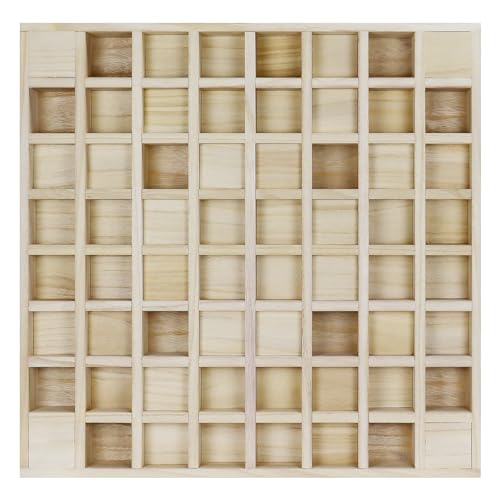
BXI Wood Sound Diffuser (2D Skyline)
First reflection points on the side walls are more debated. Most mixing engineers absorb here for tighter stereo imaging, but home theaters and listening rooms sometimes benefit from diffusion — scattered side reflections preserve the surround field without the comb filtering of a bare wall.
The rule of thumb: absorb at first reflection points if you’re mixing music, diffuse if you’re building a listening or theater space where immersion matters more than clinical precision. For how many diffusers your room actually needs, that guide walks through the calculation.
What Types Of Diffusers Work Best For Room Treatment?
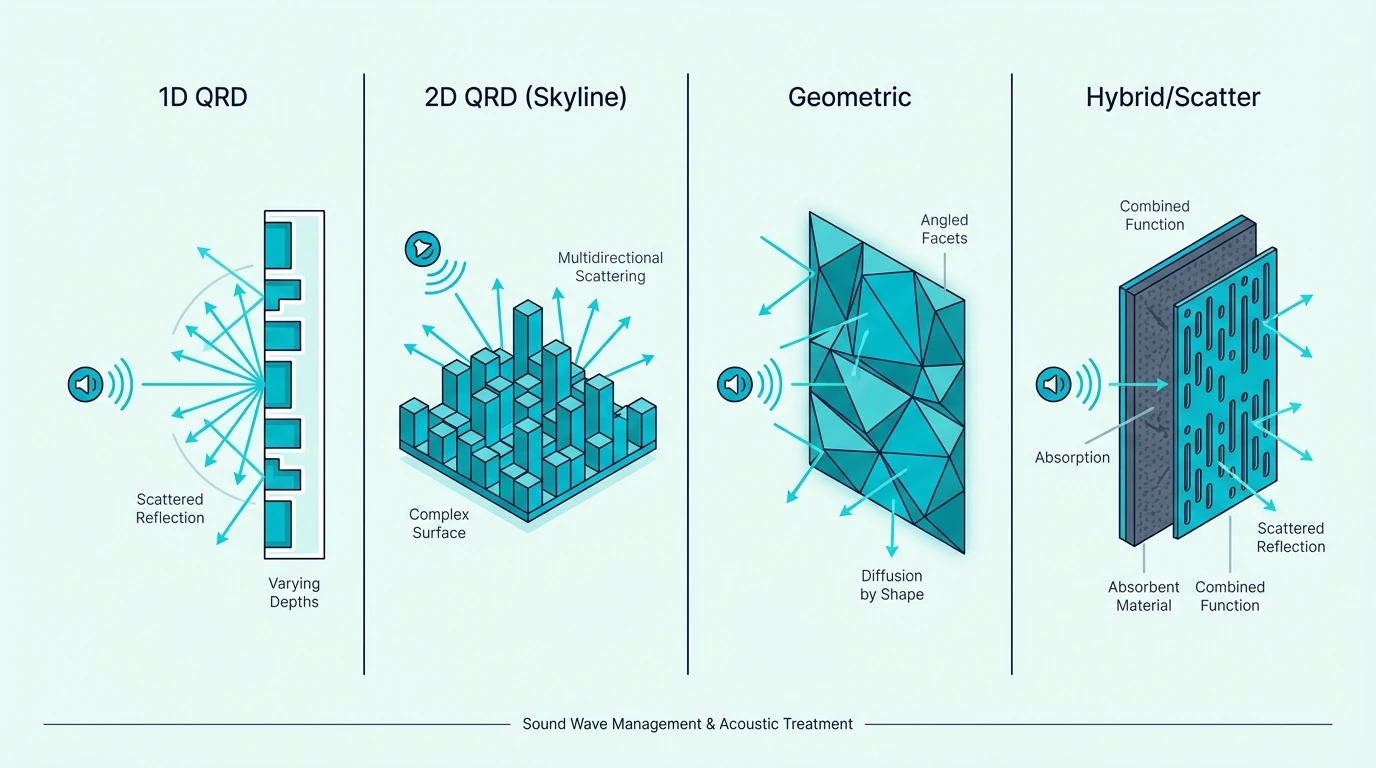
The physics principles from earlier — surface geometry and well depth — show up differently depending on the diffuser design. Matching the right type to your room and use case prevents wasting money on a panel that can’t do its job at the distance you have.
QRD And Skyline Diffusers
A QRD (Quadratic Residue Diffuser) uses wells of mathematically calculated depths arranged in a row. Sound enters the wells and reflects out at different times, scattering horizontally across a wide arc.
This one-dimensional scatter makes QRD panels ideal for rear walls where the primary reflection path is horizontal.
Skyline diffusers work on the same principle but scatter in two dimensions. Blocks of varying heights spread sound both horizontally and vertically — making them the better choice for ceilings or rooms where reflections come from multiple directions.
The frequency range depends on depth. A panel with 2.8-inch deep wells scatters frequencies from roughly 1 kHz upward.
Deeper wells push the effective range lower, but the panel gets heavier and sticks further off the wall.
For most home studios and listening rooms, the 1-4 kHz scatter range covers the frequencies where clarity and speech intelligibility live — and where flutter echo is most audible. If you’re considering building your own, our DIY wooden diffuser guide covers the well-depth calculations.
Polycylindrical And Curved Diffusers
Curved surfaces scatter sound differently from wells and blocks. A polycylindrical (barrel-shaped) diffuser spreads reflections across a broad arc with a smoother frequency response than a QRD — no sharp cutoff at the low end, just a gradual rolloff.
Concert halls have used curved surfaces for centuries. The barrel-vaulted ceilings in classical music venues are essentially giant polycylindrical diffusers that scatter orchestral sound across the entire audience.
The tradeoff is precision. A QRD scatters specific frequencies with mathematical exactness.
A curved diffuser scatters more broadly but less evenly — some angles get more energy than others.
For home theaters and living rooms where aesthetics matter as much as acoustics, the Art3d Wood Slat Acoustic Panels offer a middle ground — wood slats that scatter mid-high frequencies while looking like modern wall art instead of studio equipment. For a deeper breakdown of which materials work best for different room types, that guide covers wood, plastic, and foam options.
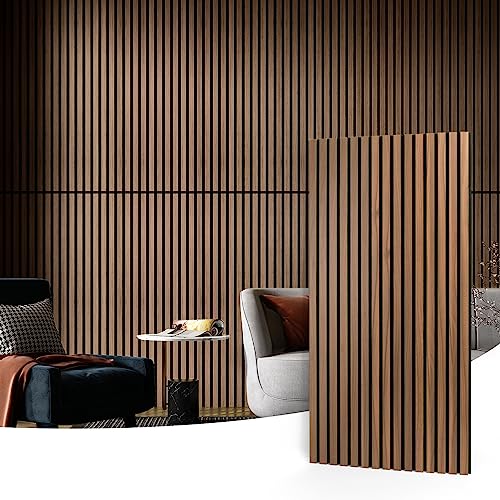
Art3d Wood Slat Acoustic Panels
Can You Combine Diffusion With Absorption?
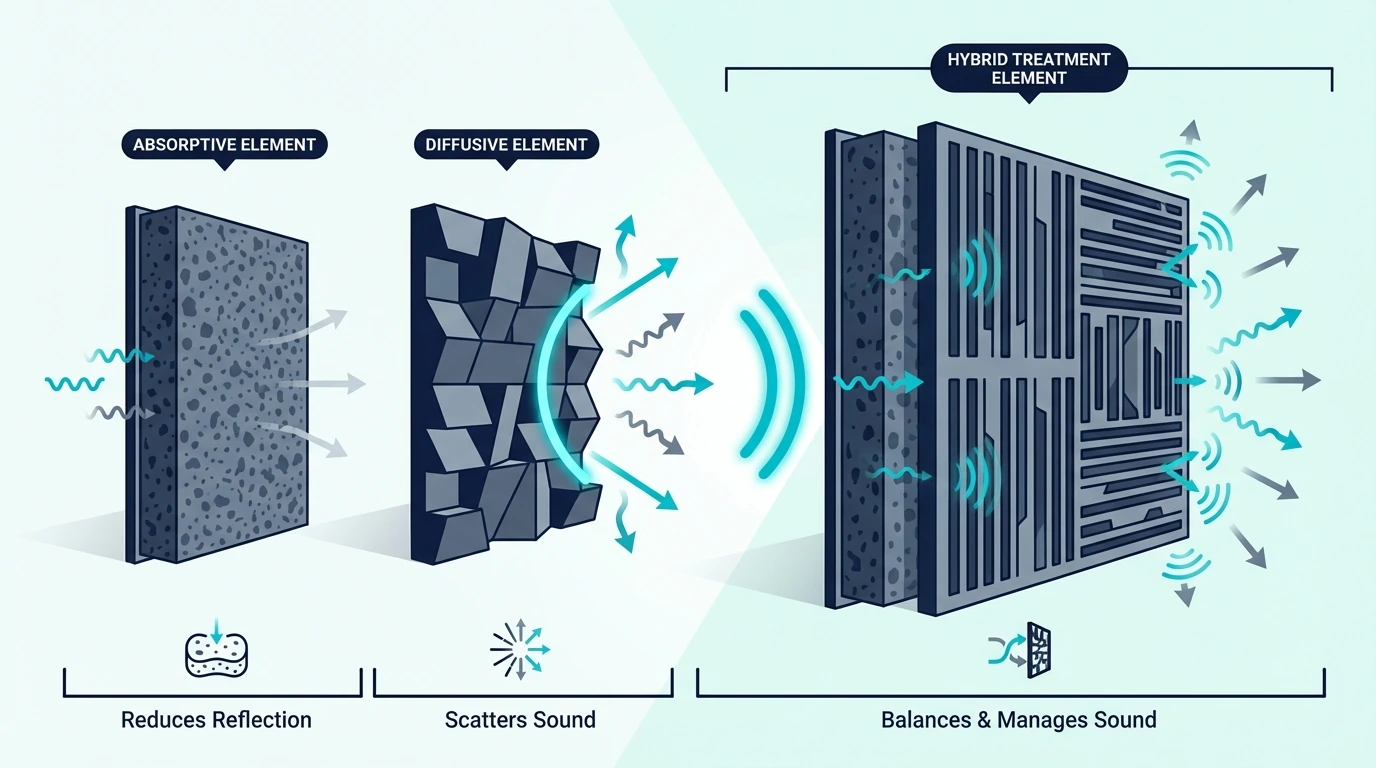
Nearly every professional room uses both — the question isn’t whether to combine them, but where each one goes. Getting this balance right is the difference between a room that sounds naturally controlled and one that sounds either dead or chaotic.
The Live-End/Dead-End Concept
Professional studios have used the live-end/dead-end (LEDE) layout since the 1980s, and it remains the standard for control rooms, mastering suites, and serious listening rooms.
The front wall — behind the speakers — gets heavy absorption. This is the “dead end” where you want zero early reflections interfering with the direct sound from your monitors.
The rear wall gets diffusion. This is the “live end” where scattered reflections add natural ambience without creating focused echoes.
The contrast between dead front and live rear gives your brain two distinct signals: clean direct sound from the speakers and diffuse ambient energy from behind.
First reflection points on the side walls get absorption (for mixing) or diffusion (for listening rooms). Bass traps go in the corners to handle low-frequency buildup that neither absorption panels nor diffusers can address.
Creating Better-Sounding Rooms
The transformation is dramatic. An untreated room with bare drywall might have a reverb time of 1.0-1.2 seconds — enough to make speech muddy and music blurred.
Add absorption at the front wall and first reflection points, and that drops to 0.4-0.6 seconds. The room sounds cleaner and tighter immediately.
Now add diffusion to the rear wall. The reverb time doesn’t change much, but the character shifts — the room sounds open and dimensional instead of flat and compressed.
Music has depth, dialogue has presence, and you can listen for hours without fatigue.
That’s the combination working: absorption removes the problematic reflections, diffusion preserves the ones that make the space feel alive. Understanding what a sound diffuser actually does at a physics level helps you decide which ratio your room needs.
If you’re weighing diffusers vs acoustic panels for your next purchase, that comparison breaks down when each type earns its spot.
The Bottom Line
The single most impactful diffusion move for any room is a QRD or skyline panel on the rear wall, at least 2 meters from where you sit. That one placement eliminates the strongest delayed reflection and adds natural ambience that makes the space sound three-dimensional.
From there, absorb at first reflection points, trap bass in the corners, and add ceiling diffusion if the room height allows it. The LEDE layout covers 90% of rooms — dead front, live rear, treated ceiling.
If the room still sounds harsh after the rear wall is diffused, the problem is usually flutter echo between parallel surfaces. Find the offending wall pair with a clap test and treat one side.
For specifics on how to choose and mount your diffuser panels, that guide walks through the hardware and placement.
Frequently Asked Questions
How many diffusers do you need for a room?
Most rooms need 2-4 panels on the rear wall to cover the area directly behind the listening position. Exact count depends on panel size and wall width — a 12-foot rear wall takes three 24-inch QRD panels side by side.
Our coverage calculator gives room-specific numbers.
Do diffusers work in small rooms?
Only certain types. Standard QRD panels need 2+ meters of clearance to scatter properly, which most rooms under 10×10 feet can’t provide.
Shallow high-frequency diffusers and 2D skyline panels work at shorter distances because they spread energy across more angles — reducing the minimum clearance needed.
Is diffusion better than absorption?
They solve different problems — most rooms need both. Absorption controls reverb time and eliminates specific problem reflections. Diffusion preserves room energy while preventing focused echoes. The live-end/dead-end layout uses absorption up front and diffusion behind you, which gives you both clarity and natural spaciousness.