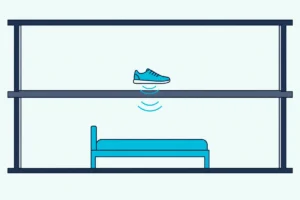
Does MLV Soundproofing Work (And When Is It Worth Using)

Does MLV soundproofing work is a fair question because mass loaded vinyl is one of the most recommended soundproofing materials online, but it only delivers real results when it is installed correctly as part of a proper assembly rather than stapled loosely to a wall and expected to fix everything by itself.
That is why buyer opinions split so sharply. People who use MLV inside a well-built wall assembly with insulation, sealing, and proper attachment report noticeable improvement.
People who hang it over drywall with gaps at the edges report almost no change. The material works, but the application determines whether you get a meaningful result or a frustrating waste of money.
The better way to evaluate MLV is to understand what it actually does, where it fits in the assembly, and when other approaches deliver the same or better result for less effort. Once you know those boundaries, the decision becomes much clearer.
Below, you will learn what MLV is, what noise it helps with, when it works best, where it falls short, what alternatives exist, and how to decide whether it is worth using for your specific project.
Does MLV soundproofing work? Yes, mass loaded vinyl adds meaningful mass to walls, ceilings, floors, and other barriers, which reduces airborne noise transmission. It works best when installed inside an assembly with insulation and sealed edges, and it disappoints most when used as a standalone surface treatment with gaps that let sound bypass the barrier.
What MLV Is and What It Actually Does to Sound
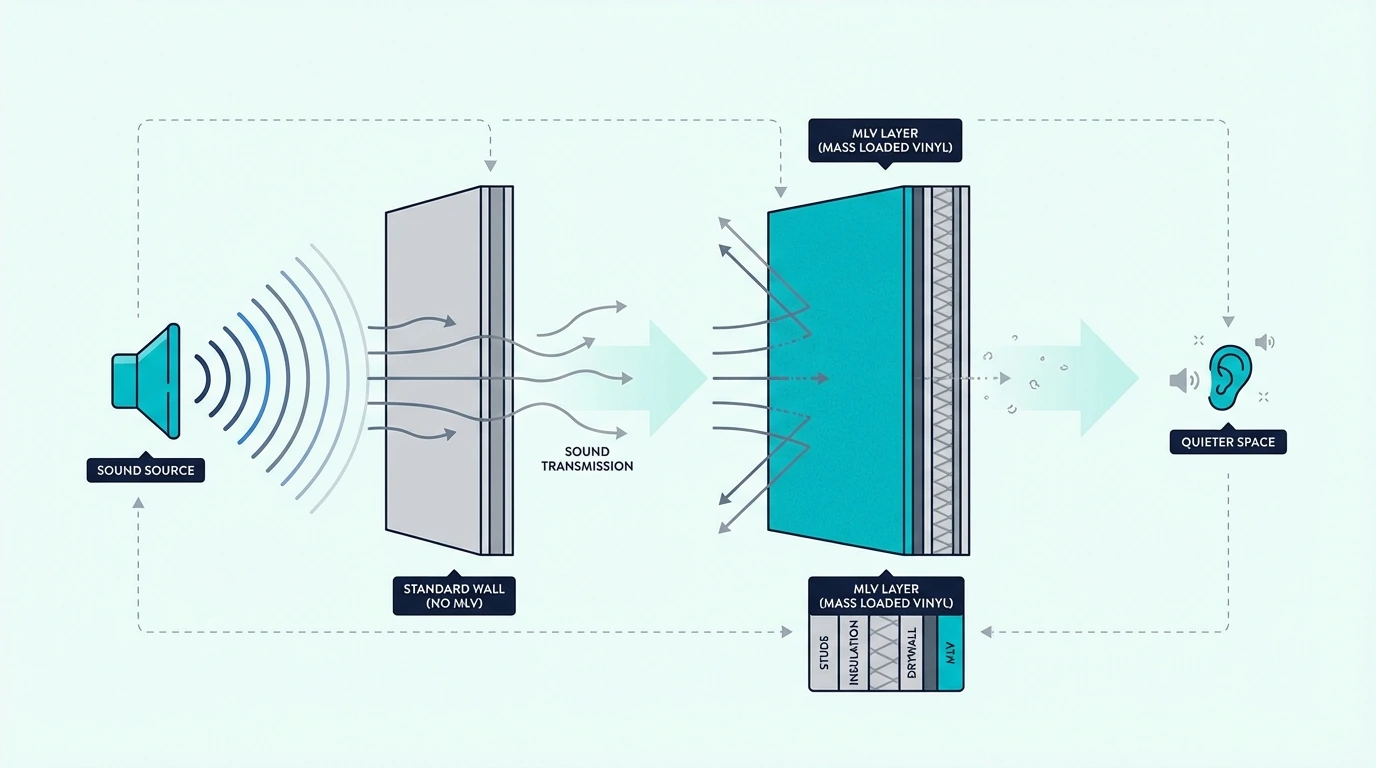
Now that the core answer is clear, the next step is understanding what MLV actually is and what it can realistically do.
The material and how it works
Mass loaded vinyl is a dense, flexible sheet material made from vinyl loaded with heavy fillers like barium sulfate or calcium carbonate. It is designed to add mass to a barrier without adding significant thickness, which makes it useful in situations where you need to increase the weight of a wall, ceiling, or floor assembly without rebuilding it.
Standard MLV weighs about 1 pound per square foot and is typically 1/8 inch thick. That combination of high density and thin profile is what makes it attractive for retrofit soundproofing — it fits between drywall layers, staples to studs, and wraps around pipes and ducts in spaces where thicker materials would not work.
The material is rated by its Sound Transmission Class (STC), which measures how much sound it blocks when tested as part of an assembly. A single layer of 1 lb MLV typically adds 3–8 STC points to whatever assembly it is installed in, depending on the other layers present.
That is a meaningful contribution, but it also shows why MLV works best as a component rather than a standalone fix — the other layers in the assembly determine how much of that contribution actually reaches the listener as reduced noise.
A standard 1 lb MLV roll like Trademark Soundproofing Mass Loaded Vinyl is the most common format and covers 100 square feet per roll, which is enough for a typical bedroom wall.
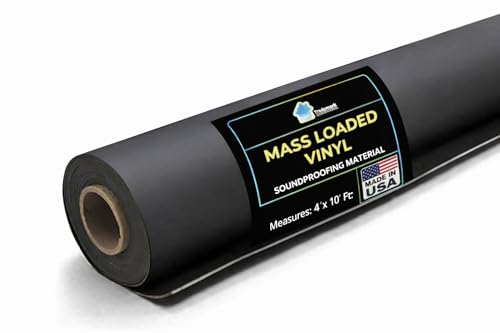
Trademark Soundproofing Mass Loaded Vinyl
Which noise types MLV handles best
That mass-in-a-thin-profile design determines which noise MLV can actually reduce. MLV is most effective against airborne noise: voices, TV audio, music without heavy bass, and general household sound that travels through walls, ceilings, and floors. These mid-to-high-frequency sounds are the easiest to reduce with added mass because the sound waves are shorter and lose energy more readily when they hit a dense barrier.
Low-frequency bass is harder. MLV helps with bass to some degree because it adds mass, but it is not heavy enough on its own to stop deep bass from a subwoofer, drum kit, or loud amplifier.
Those frequencies require significantly more mass, air gaps, and decoupling than a single layer of MLV can provide.
Why some buyers think MLV failed them
Despite those real capabilities, negative reviews are common — and almost always trace back to installation. Most negative experiences come from three installation mistakes: gaps at the seams and edges, mounting over drywall instead of inside the assembly, and expecting MLV to fix a problem that requires decoupling or sealing rather than mass.
Gaps are the most common issue. MLV works by adding continuous mass to the barrier path.
Any gap — even a small one at a seam, around an outlet, or at the floor line — creates a flanking path that lets sound bypass the barrier. Buyers who install MLV with care and seal every edge report much better results than those who leave visible gaps.
Where MLV Delivers the Strongest Results
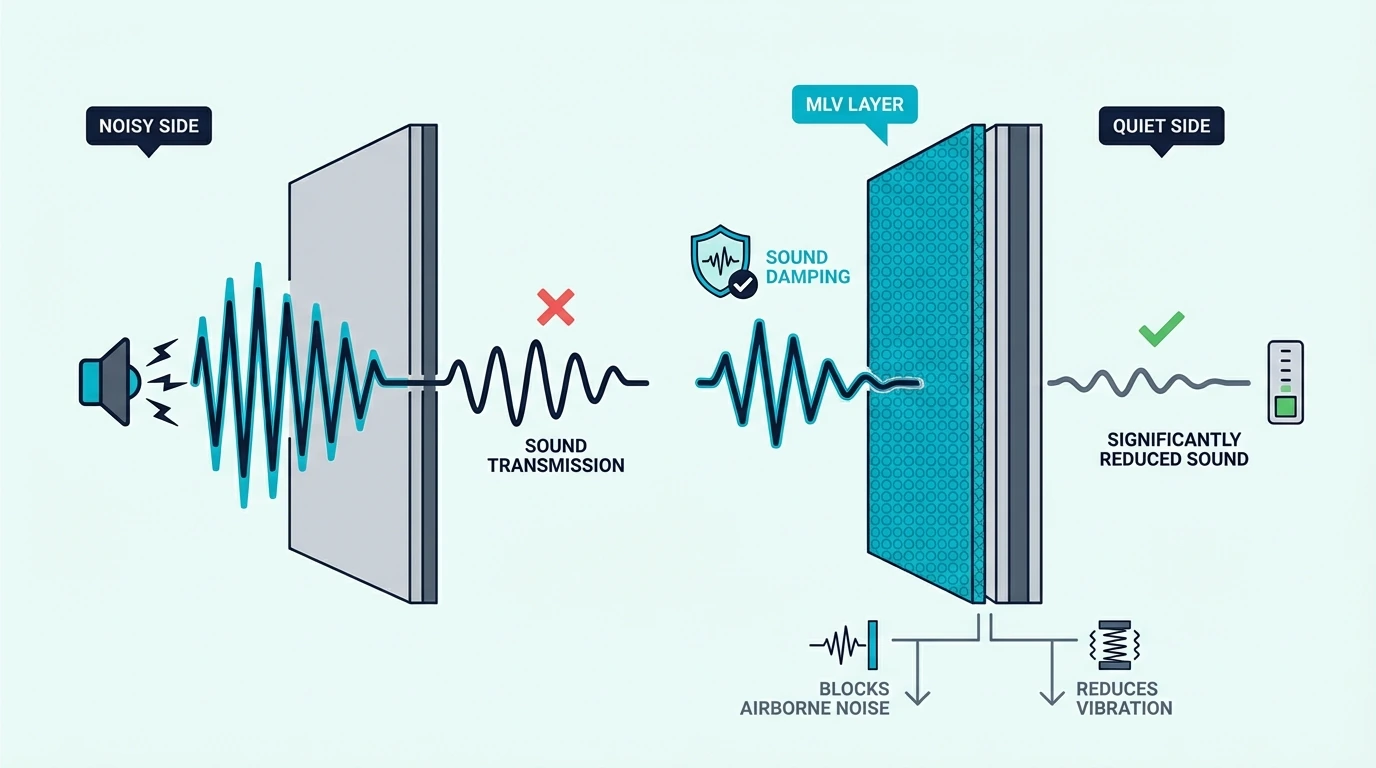
MLV delivers the strongest results when it is part of a layered assembly rather than the only upgrade.
Wall assemblies: the strongest application
Wall assemblies are the most common and most effective application for MLV. The standard approach is to install MLV between the studs and the drywall, or between two layers of drywall, with sealed seams and edges.
This adds mass directly to the transmission path where it has the most impact.
A wall with insulation in the cavity, MLV on the studs, and sealed drywall over the top will outperform the same wall without MLV by a measurable margin — typically 3–8 STC points depending on the rest of the assembly. That improvement is enough to make neighbor voices significantly quieter and to reduce general household noise transfer noticeably.
Filling the cavity with AFB Acoustical Fire Batts before layering MLV over the studs is one of the strongest residential wall upgrades available. Soundproofing a wall and soundproofing an existing wall cover the full range of wall assembly options.
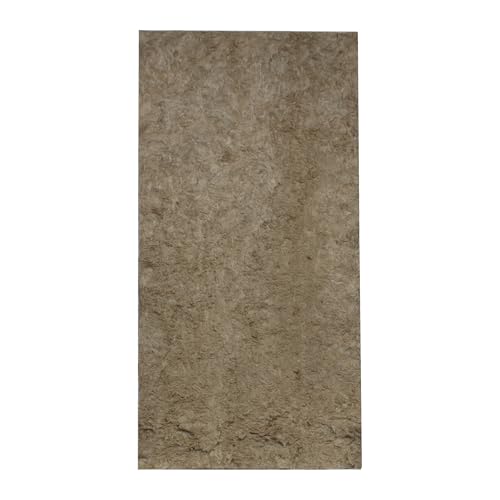
AFB Acoustical Fire Batts
Floors, ceilings, and doors
The same mass-addition logic extends beyond walls. MLV helps on ceilings when installed between the joists and the drywall, following the same logic as wall assemblies. It helps on floors when used as an underlayment layer beneath the finish floor, adding mass to the floor assembly to reduce impact and airborne noise transfer to the room below.
On doors, MLV can be applied to the back of a hollow-core door to add mass, but a solid-core door replacement is usually a better investment because it provides mass, density, and better edge sealing in one upgrade. Before either option, sealing the gap at the bottom with a MAXTID Under Door Draft Stopper often reveals whether the door gap was the main leak path all along.
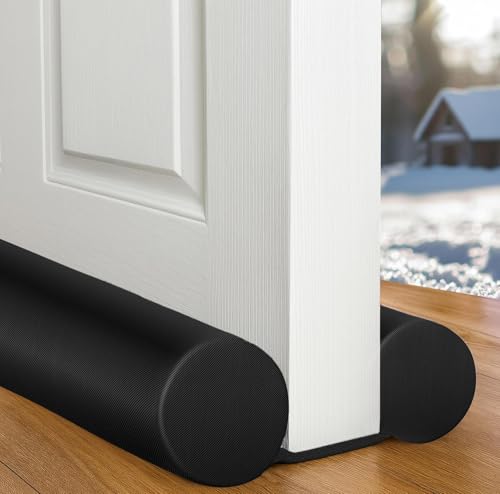
MAXTID Under Door Draft Stopper
Soundproofing a door covers when MLV on the door makes sense versus when a replacement is the better path.
MLV also works well for wrapping pipes, ducts, and mechanical equipment where the goal is to reduce noise radiation from a specific source. Soundproofing drain pipes and soundproofing a vent both use MLV as a primary treatment material.
Why MLV works better as part of a system
Those applications all share one pattern: MLV performs best alongside other layers. Because soundproofing is a system, not a single product. MLV adds mass, but mass alone does not address every part of the noise path.
Insulation absorbs sound energy inside the cavity. Decoupling prevents vibration from traveling through the structure.
Sealing closes the air paths where sound leaks around the barrier.
When all four — mass, absorption, decoupling, and sealing — work together, the result is much stronger than any one of them alone. MLV is the mass layer, and it performs best when the other three are also present.
Dense mineral wool batts inside the cavity complement MLV by handling the sound energy that mass alone does not absorb. best insulation for soundproofing covers the companion materials that make MLV assemblies stronger.
Get Studio Tips Weekly
Join 5,000+ creators getting acoustic treatment advice every week.
No spam. Unsubscribe anytime.MLV Limitations: Mass Alone Is Not Enough
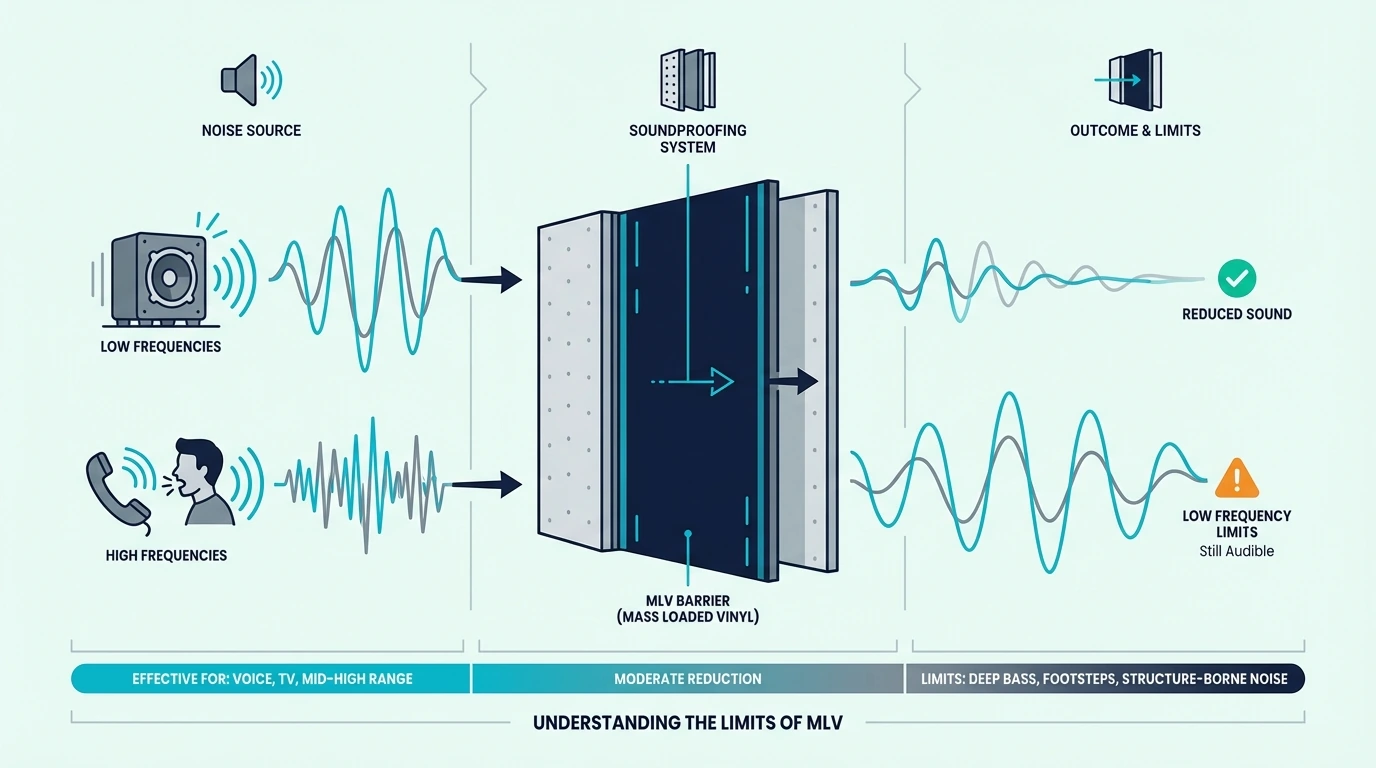
MLV has real limitations that are worth understanding before you buy.
Why MLV alone disappoints
The system-thinking from the previous section also explains the failures. MLV is one layer in a multi-layer system. If the wall has no insulation, the drywall is directly attached to the studs, and the outlets and joints are unsealed, adding MLV addresses only the mass deficit while leaving the absorption, decoupling, and sealing deficits untouched.
That is why MLV-only upgrades sometimes disappoint. The mass improvement is real, but it is limited by whichever other weakness remains.
A wall with MLV but no insulation will perform better than the same wall without MLV, but it will still underperform compared to a wall that addresses all four factors together.
Bass: where mass alone falls short
That multi-layer gap hits hardest with low-frequency bass. Low-frequency bass is harder.
MLV helps with bass to some degree because it adds mass, but it is not heavy enough on its own to stop deep bass from a subwoofer, drum kit, or loud amplifier.
Those frequencies require significantly more mass, air gaps, and decoupling than a single layer of MLV can provide.
Stopping bass requires significantly more mass — multiple layers of drywall, concrete, or thicker barrier materials — plus air gaps and decoupling to prevent structure-borne vibration from bypassing the mass entirely.
If bass is the primary complaint, MLV is a useful component but not a standalone solution.
Installation mistakes that ruin performance
Even in a proper assembly, sloppy installation can undo the investment. Unsealed seams are the biggest mistake. MLV seams must be overlapped and sealed with acoustical caulk or taped with a compatible barrier tape.
Acoustical Caulk (29 oz)
A butt joint with no overlap or seal creates a direct flanking path that sound will exploit.
Mounting MLV loosely on the wall surface instead of attaching it tightly to the studs or between drywall layers is the second biggest mistake. Loose MLV can vibrate independently and actually re-radiate sound instead of blocking it.
The material needs to be in firm, continuous contact with the structure to perform correctly.
Using too-thin MLV is another overlooked issue. Products marketed as “sound barrier” that weigh significantly less than 1 lb per square foot do not deliver the same mass benefit as standard MLV, even though they look similar.
Always check the weight-per-square-foot spec before buying.
Leaving gaps around outlets, switches, pipe penetrations, and the perimeter of the sheet is the third most common mistake. Every penetration needs to be sealed, and every edge needs to meet the adjacent surface or be caulked closed.
When Something Else Works Better Than MLV
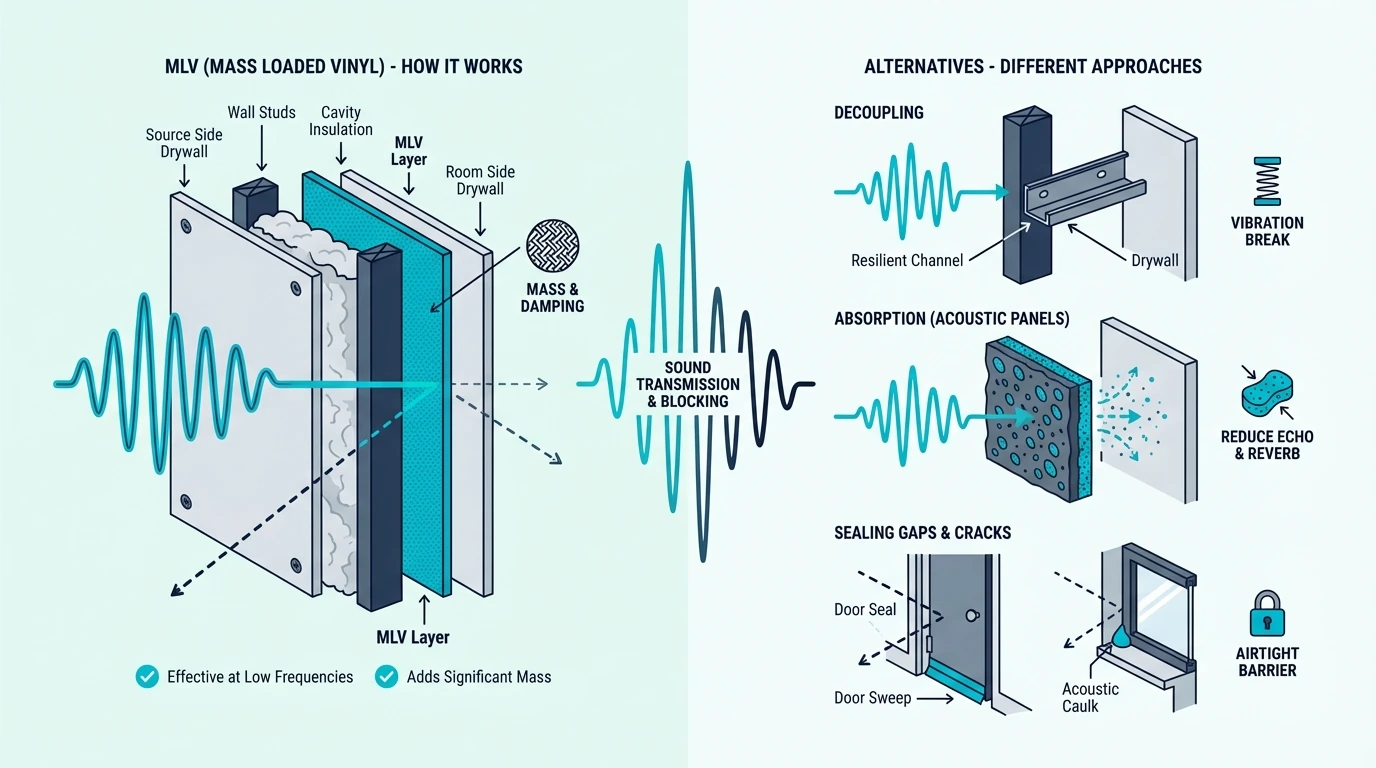
MLV is not always the best choice. Sometimes simpler or more targeted approaches deliver a better return.
Extra drywall with damping compound
A second layer of drywall with a viscoelastic damping compound like Green Glue Noiseproofing Compound between the layers can match or exceed MLV’s mass contribution while also adding damping — something MLV alone does not provide. This “double drywall with Green Glue” approach is often cheaper per square foot than MLV and delivers stronger combined performance because it addresses both mass and damping in one step.
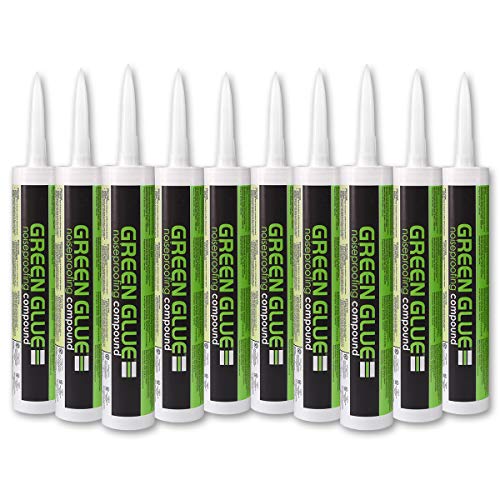
Green Glue Noiseproofing Compound (12 Tubes)
The tradeoff is thickness. Two layers of 5/8-inch drywall add about 1-1/4 inches to the wall, while MLV adds only 1/8 inch.
If space is tight, MLV wins on profile. If space allows the extra thickness, double drywall usually wins on performance and cost.
Soundproof drywall vs regular drywall covers this comparison in detail.
Decoupling for structure-borne noise
Drywall-plus-damping handles mass and vibration control, but neither it nor MLV breaks the direct structural path. Decoupling matters more when the noise is structure-borne rather than airborne. If footsteps, vibration, or impact noise is the main complaint, adding mass with MLV will help less than breaking the rigid connection between the noise source and the listening space.
Resilient channels, sound isolation clips, and floating floor systems all address structure-borne transfer by decoupling the finish surface from the framing. In those cases, the decoupling upgrade delivers more improvement per dollar than MLV because it targets the dominant transmission path.
Soundproofing a ceiling and soundproofing between floors cover the decoupling options for common residential applications.
The decision framework
With mass, damping, and decoupling options all on the table, the decision comes down to your specific noise path. Start by identifying the noise type. If the noise is airborne (voices, TV, music without heavy bass), MLV is a strong candidate.
If the noise is structure-borne (footsteps, vibration), decoupling should come first.
Then check the rest of the assembly. If the wall already has insulation and sealed joints, MLV is the logical next mass upgrade.
If the wall is empty, uninsulated, and unsealed, address those gaps first because they are cheaper to fix and will deliver more improvement per dollar.
For windows, MLV is rarely practical because it blocks light and is difficult to mount over glass. A heavy curtain like RYB HOME Soundproof Divider Curtain adds mass over the glass without blocking all light and comes down when you move — a more practical solution for window noise than trying to make MLV work on a surface it was not designed for.
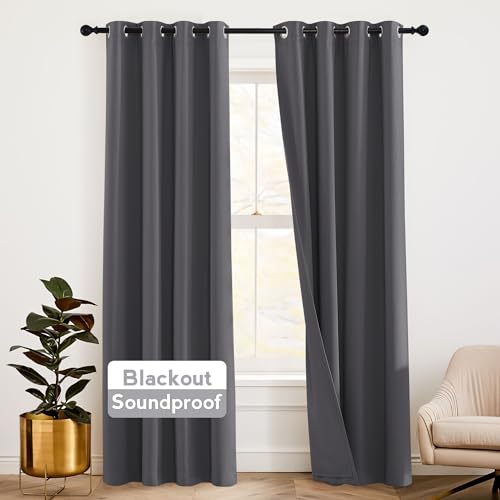
RYB HOME Soundproof Divider Curtain
For a budget test, a small roll of MLV like TroyStudio 1 lb/sq ft MLV on the weakest section of the wall can confirm whether mass is the missing factor before you invest in covering the entire surface.
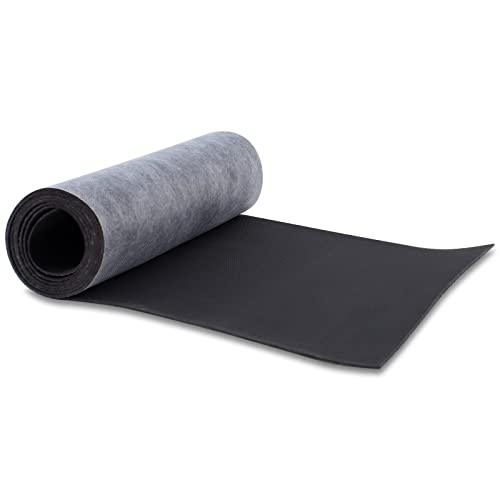
TroyStudio 1 lb/sq ft MLV
For projects where the noise is severe or the standard MLV feels insufficient, a next-generation formulation like Soundsulate Next Generation Mass Loaded Vinyl offers denser construction that performs better at low frequencies while maintaining the thin profile that makes MLV practical.
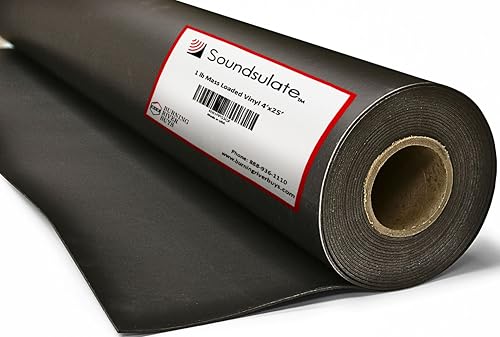
Soundsulate Next Generation Mass Loaded Vinyl
Compare this page with the broader soundproofing hub, soundproofing an apartment, and does soundproofing work so the MLV decision stays in proportion to the rest of the project.
The Bottom Line
Does MLV soundproofing work? Yes, mass loaded vinyl adds meaningful mass to barrier assemblies and reduces airborne noise transmission when installed correctly with sealed seams and edges.
It works best inside a wall, ceiling, or floor assembly alongside insulation, sealing, and ideally decoupling, and it disappoints most when used as a standalone surface treatment with gaps that let sound bypass the barrier.
For most residential projects, MLV earns its place as the mass layer in a multi-layer assembly. It is not a magic fix by itself, but when combined with insulation, sealing, and proper installation, it is one of the most effective and space-efficient soundproofing materials available for the money.
Frequently Asked Questions
How to block out 100% of noise?
Blocking 100% of noise requires a fully sealed room-within-a-room construction with mass, decoupling, and absorption on every surface, which is impractical for most residential situations. The realistic goal is reducing noise enough that it no longer disrupts sleep, work, or daily comfort.
What is better than mass loaded vinyl?
In many situations, a double layer of drywall with a damping compound between them delivers equal or better performance than MLV at a lower total cost. Decoupling with resilient channels or isolation clips also delivers more improvement than MLV when the noise is structure-borne rather than airborne.
Can I put MLV over drywall?
You can put MLV over existing drywall and then add a second layer of drywall over the MLV, which creates a sandwich that adds both mass and some damping. Mounting MLV on the surface of drywall without covering it is less effective because the exposed edges are harder to seal and the finish is not practical for a living space.