How to Connect a Turntable to a Receiver Without Phono Input: 3 Ways
Hey there, vinyl enthusiasts, let’s work out how to connect a turntable to a receiver without a phono input! Ready to dive into the world of connecting turntables to receivers without phono inputs?
How To Connect Turntable To Receiver Without Phono Input
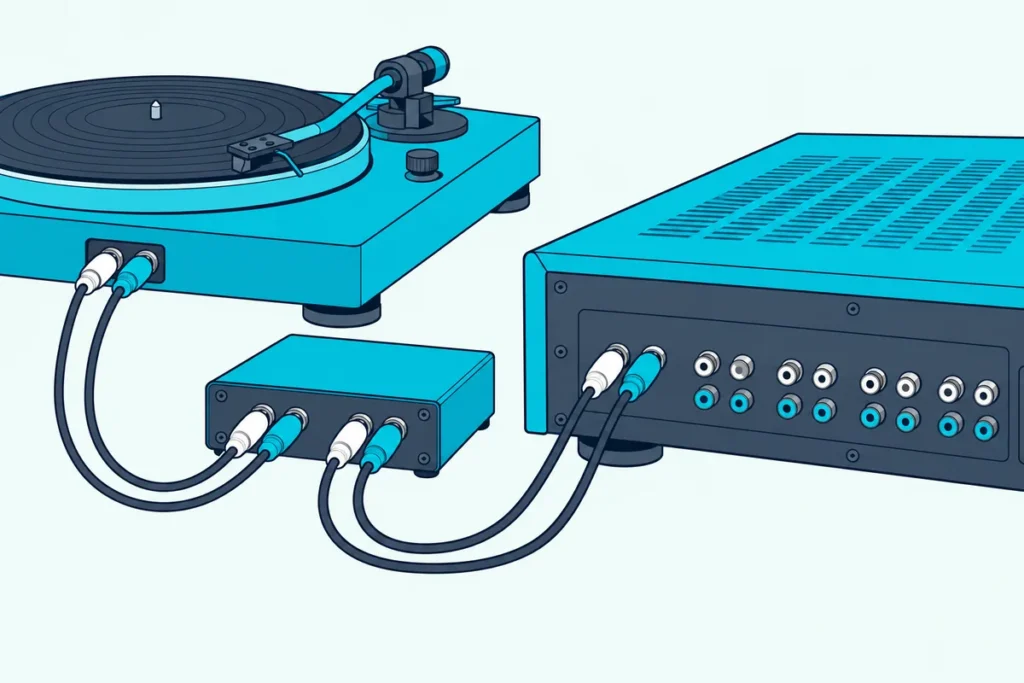
Here’s the deal: you’ll need a phono preamp. It’s this nifty little device that boosts the turntable’s weak signal and applies the necessary equalization.
Just plug your turntable into the preamp, then connect the preamp to any standard input on your receiver (like AUX or CD). Voila! You’re ready to spin those records.
What is a Phono Input and Why It Matters
A phono input isn’t just some fancy-pants audiophile term: it’s actually pretty crucial for playing vinyl.
See, back in the day, every receiver worth its salt had a phono input. But times change, and so does technology.
So, what’s the big deal? Well, the signal that comes straight off a turntable is super weak.
Like, whisper-in-a-hurricane weak. A phono input is specially designed to boost that signal and apply something called RIAA equalization.
Without getting too nerdy, this equalization basically makes sure your records sound the way they’re supposed to.
But here’s the rub – a lot of modern receivers don’t have phono inputs anymore. It’s like trying to find a payphone in 2024.
Sure, they exist, but good luck finding one when you need it!
This is where things get interesting. Just because your receiver doesn’t have a phono input doesn’t mean you’re out of luck.
There are workarounds.
The Problem: Connecting a Turntable to a Receiver Without Phono Input
Okay, so you’ve got your shiny new turntable (or maybe a vintage gem), and you’re all set to dive into the warm, rich sound of vinyl. But wait! You look at the back of your receiver, and… no phono input.
Cue the sad trombone.
It’s like showing up to a potluck with a dish that requires an oven, only to find out there isn’t one.
Frustrating, right?
The issue here is pretty straightforward. Your turntable is putting out a signal that’s too weak and differently equalized for a standard input to handle properly.
It’s like trying to fill a swimming pool with a garden hose – technically possible, but not very effective.
This scenario is becoming more and more common these days. Vinyl is making a comeback, but receiver manufacturers haven’t quite caught up.
They’re still living in the digital age, focusing on things like HDMI ports and Bluetooth connectivity.
This isn’t a deal-breaker. In fact, it’s an opportunity to get a little creative with your setup.
There’s nothing quite like the satisfaction of getting your system up and running, especially when you’ve had to overcome a hurdle or two.
So, let’s roll up our sleeves and get that turntable connected!
Solution 1: Using a Phono Preamp
Alright, folks, let’s talk about the magic box that’s gonna solve our little phono input dilemma – the phono preamp. This little gizmo is about to become your new best friend in the world of vinyl playback.
So, what the heck is a phono preamp? Well, it’s basically a middleman between your turntable and your receiver.
It does the job that a phono input would do – amplifying that weak turntable signal and applying the RIAA equalization we talked about earlier. It’s like a translator that helps your turntable and receiver speak the same language.
Now, how do you use one of these bad boys? It’s pretty straightforward. Here’s how it goes:
- Connect your turntable’s output cables to the input on the phono preamp.
- If your turntable has a ground wire (looks like a thin wire with a forked end), connect that to the ground terminal on the preamp.
- Connect the output of the phono preamp to any standard input on your receiver (AUX, CD, etc.).
- Plug in the preamp’s power supply.
- Turn everything on and start spinning those records!
Now, let’s talk about some phono preamps that get the job done:
- Art DJ Pre II: This little guy is a workhorse.
- Pro-Ject Phono Box DC: It delivers clean, detailed sound.
- Schiit Mani: An American-made phono preamp.
- Cambridge Audio Duo: This one even has a headphone amp built in!
Remember, the key is to choose a preamp that fits your needs. Even a basic preamp will be leagues better than no preamp at all.
With a phono preamp in place, your vinyl can sound good even without a dedicated phono input on your receiver.
Solution 2: Turntables with Built-in Preamps
Alright, vinyl heads, let’s chat about another nifty solution to our phono input predicament – turntables with built-in preamps. These bad boys are like the Swiss Army knives of the turntable world.
They’ve got everything you need in one package!
So, what’s the deal with these all-in-one wonders? Well, they’re exactly what they sound like – turntables that have a phono preamp built right into them.
It’s like having a turntable and a preamp that decided to move in together and save on rent.
Now, let’s break down the pros and cons, because like fruitcake, they’re not for everyone.
Advantages:
- Convenience: Just plug and play, baby! No need for extra boxes or cables.
- Space-saving: Great for tight setups.
Disadvantages:
- Less flexibility: You’re stuck with the preamp you’ve got. No mixing and matching for that perfect sound.
- Potential quality compromise: Sometimes (not always) the built-in preamps aren’t as high-quality as separate units. It’s like those all-in-one TV dinners – convenient, but not always gourmet.
- Upgraditis: If you catch the audiophile bug, you might find yourself wanting to upgrade your preamp down the line.
Now, how do you use these built-in preamp turntables? Here’s the lowdown:
- Look for a switch on your turntable labeled something like “PHONO/LINE” or “WITH PHONO/WITHOUT PHONO”.
- Flip that switch to the LINE position (or WITHOUT PHONO, depending on your model).
- Connect the turntable’s output cables directly to any standard input on your receiver (AUX, CD, etc.).
- Fire it up and let the good times roll!
When in doubt, read the manual!
Now, let’s talk about some popular turntables with built-in preamps that won’t let you down:
- Audio-Technica AT-LP120XUSB: This is like the Swiss Army knife of turntables. Built-in preamp, USB output, the works.
- Sony PS-LX310BT: If you want to go wireless, this one’s got Bluetooth.
- Fluance RT81: It’s got a warm, rich sound that’ll make you wonder why you ever bothered with digital.
Remember, the key is to find a turntable that fits your needs. Don’t get suckered into buying features you’ll never use – it’s like buying a speedboat for your backyard kiddie pool.
Solution 3: Using a Stereo Preamp
Alright, vinyl enthusiasts, this solution is slightly more advanced territory.
Let’s talk about using a stereo preamp to connect your turntable to a receiver without a phono input.
First off, what’s the difference between a phono preamp and a stereo preamp? Well, it’s kind of like the difference between a specialist doctor and a general practitioner.
A phono preamp is designed specifically for turntables, while a stereo preamp is a more general-purpose device that can work with various audio sources.
Here’s the kicker – some stereo preamps have a phono stage built in. It’s like finding out your Swiss Army knife also has a tiny espresso maker.
These are the ones we’re interested in.
So, how do you use a stereo preamp with a phono stage? Here’s how:
- Connect your turntable to the phono input on the stereo preamp.
- If your turntable has a ground wire, connect it to the preamp’s ground terminal.
- Connect the stereo preamp’s output to any standard input on your receiver.
- Power up the preamp and adjust the volume.
- Start spinning those records and bask in the audio goodness!
Now, when should you choose this option? Well, a stereo preamp with a phono stage can be a great choice if:
- You want flexibility to connect other audio sources.
- You’re looking to upgrade your overall audio setup, not just your turntable connection.
- You want higher-quality components.
Here are a few stereo preamps with phono stages to look at:
- Cambridge Audio AXA35: This little beauty has a great phono stage and plenty of inputs for other devices.
- Yamaha A-S301: A powerhouse that’ll handle your turntable and then some.
- NAD C 316BEE V2: Don’t let the alphabet soup name fool you – this is a solid performer.
Remember, using a stereo preamp is a bit more involved than the other solutions we’ve discussed. But if you’re looking to take your audio game to the next level, it can be a great option.
Just be prepared for a bit of trial and error.
Troubleshooting Common Issues
Alright, folks, let’s talk troubleshooting. Because let’s face it, sometimes things don’t go as smoothly as we’d like.
First up, let’s tackle the dreaded ground loop hum. You know, that annoying buzz that sounds like a swarm of electronic bees decided to crash your listening party? Yeah, that one.
The most common cause of this is a grounding issue. Here’s how to fix it:
- Make sure your turntable’s ground wire is connected to the preamp or receiver’s ground terminal.
- If that doesn’t work, try connecting the ground wire to a different ground point.
Next up, let’s talk about low volume problems. If your music sounds like it’s coming from the bottom of a well, try these steps:
- Double-check that you’ve selected the correct input on your receiver.
- Make sure your preamp is turned on and the volume is up.
- If you’re using a turntable with a built-in preamp, check that the PHONO/LINE switch is set to LINE.
Now, let’s address distortion issues. If your music sounds like it’s being played through a kazoo, try these fixes:
- Check your stylus (needle) for dust or damage. A quick clean can work wonders.
- Make sure your turntable is properly balanced and the tracking force is correct.
- If you’re using an external preamp, try adjusting its gain settings.
Remember, troubleshooting is all about patience and methodical testing. Reach out to manufacturer support or local audio shops if you’re stuck.
And whatever you do, resist the urge to throw your equipment out the window. It doesn’t help (and it makes a terrible mess).
Optimizing Your Turntable Setup for Best Sound Quality
Alright, audio aficionados, we’ve got our turntable connected and troubleshot. Now let’s talk about squeezing every last drop of audio goodness out of your setup.
Because let’s face it, if we’re going through all this trouble, we might as well make it sound amazing, right?
First things first – placement is key. Your turntable is like a diva; it needs the right stage to perform its best.
Here are some tips:
- Keep it level: Use a spirit level to make sure your turntable is perfectly flat. A tilted turntable is about as useful as a chocolate teapot.
- Isolation is your friend: Keep your turntable away from your speakers to avoid vibrations.
- Avoid direct sunlight: Unless you want your vinyl to do its best Salvador Dali impression, keep it out of the sun.
Next up, let’s talk about cartridge alignment and tracking force. These might sound like terms from a sci-fi novel, but they’re crucial for good sound.
Cartridge alignment: This is all about making sure your needle sits in the groove at the right angle. Use a protractor (you can print one online) to check the alignment.
Tracking force: This is how heavily your stylus sits in the groove. Too light, and you’ll get distortion.
Too heavy, and you’ll wear out your records faster than a cat wears out a new scratching post. Follow your cartridge manufacturer’s recommendations, and use a tracking force gauge if you’re serious about your sound.
Now, let’s talk maintenance. A little TLC goes a long way in the world of vinyl:
- Clean your records: Use a good record cleaning solution and brush.
- Keep your stylus clean: A dirty stylus is like trying to listen to music through a sock. Use a stylus brush or cleaning gel regularly.
- Check your belt: If you have a belt-drive turntable, check the belt periodically for wear and tear. A stretched belt can make your music sound like it’s being played by a drunk DJ.
Remember, optimizing your setup is an ongoing process. Experiment with different settings, and trust your ears.
After all, the goal is for the music to sound good to you, not to impress the audio snobs at the hi-fi store (though that can be fun too).
And hey, if all else fails, just crank up the volume and dance.
Conclusion
Let’s recap our journey:
- We learned about phono inputs and why they matter.
- We explored three solutions to the no-phono-input problem:
- Using a separate phono preamp
- Opting for turntables with built-in preamps
- Employing a stereo preamp with a phono stage
- We tackled common issues like ground loop hum, low volume, and distortion.
- And finally, we dove into optimizing our setup for the best possible sound quality.
Remember, there’s no one-size-fits-all solution in the world of audio. What works for one person might not work for another.
It’s all about finding what sounds best to your ears and fits your lifestyle.
Experiment, try different setups, and most importantly, enjoy the process. There’s something magical about dropping the needle on a record and hearing that first crackle before the music starts.
It’s a ritual that connects us to the music in a way that clicking ‘play’ on a digital file just can’t match.
So go forth and spin those records! Whether you’re rediscovering old favorites or exploring new sounds, there’s a whole world of music waiting for you.
Remember, it’s all about the music. So crank up the volume, settle into your favorite listening spot, and let the vinyl vibes wash over you.
Happy listening, everyone!