Best Turntable for Beginners: Easy First Record Players
Picking the best turntable for beginners is easiest when the deck does the fiddly parts for you, and the Audio-Technica AT-LP70X does: its START button plays a whole side and its built-in preamp plugs straight into powered speakers.
| Pick | Best for | Why |
|---|---|---|
| Audio-Technica AT-LP70X | Most first setups | Automatic, with a switchable preamp |
| Audio-Technica AT-LP60X | The simplest, lightest start | Automatic at 5.73 lb |
| Audio-Technica AT-LP70XBT | Bluetooth speakers or headphones | aptX Adaptive over Bluetooth 5.2 |
| Fluance RT81+ | Learning a manual tonearm | Built-in preamp and an adjustable arm |
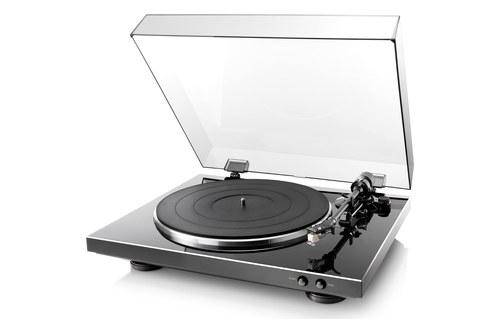
| Denon DP-300F | Automatic play with arm settings | Counterweight and anti-skating dials |
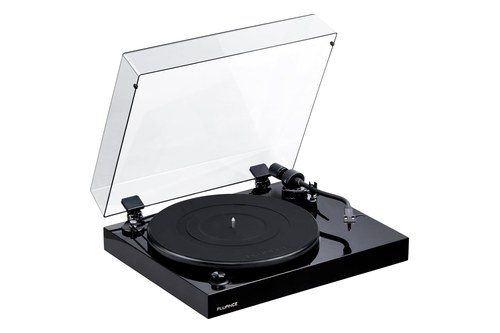
| Fluance RT82 | A receiver with a PHONO input | Servo speed control, no preamp |
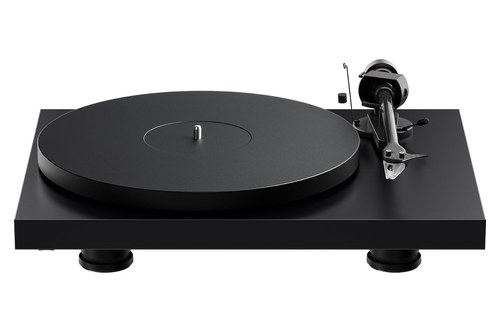
| Pro-Ject Debut EVO 2 | A first step into hi-fi | Carbon fiber tonearm |
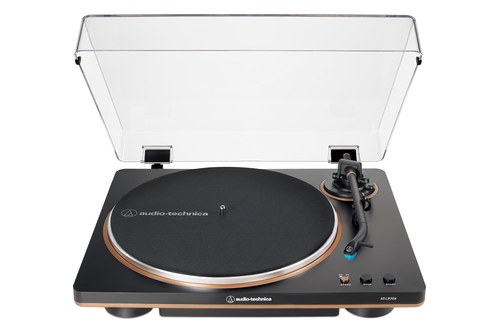
- ✓ Fully automatic: START plays the side and the arm returns at the end
- ✓ Built-in phono preamp with a PHONO/LINE switch
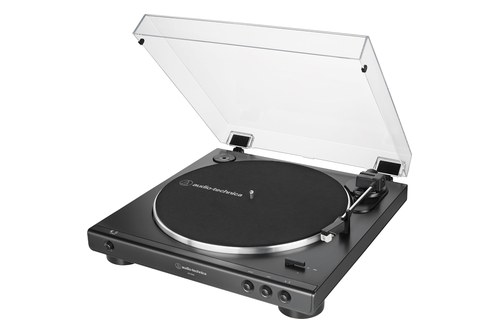
- ✓ Fully automatic with START and STOP buttons
- ✓ Built-in phono preamp, PHONO/LINE switchable
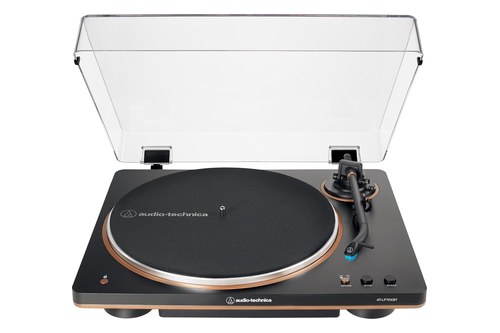
- ✓ Bluetooth 5.2 with aptX Adaptive, aptX and SBC
- ✓ Remembers up to eight paired devices
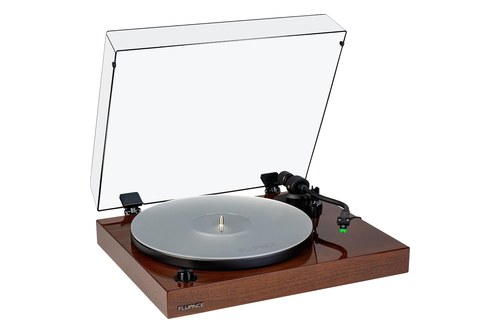
- ✓ Built-in phono preamp with a bypass for an outside preamp
- ✓ AT-VM95E elliptical stylus on a removable headshell
- ✓ Fully automatic play with auto return
- ✓ Switchable phono equalizer
- ✓ Servo speed control with 0.07% wow and flutter
- ✓ Ortofon OM 10 elliptical cartridge
- ✓ Carbon fiber tonearm
- ✓ Electronic 33/45 speed switch
Picking the best turntable for beginners is easiest when the deck does the fiddly parts for you, and the Audio-Technica AT-LP70X does: its START button plays a whole side and its built-in preamp plugs straight into powered speakers.
Pick the wrong first deck and a record can sound faint through speakers without a phono input, or you’ll be balancing a counterweight and setting anti-skate before the first song.
Match the turntable to the speakers you already own and to how hands-on you want to be, and you won’t need a second box to hear your first record.
The seven picks come first, then automatic or manual play, built-in preamps, speakers, Bluetooth, suitcase players, what’s in the box and setup.
Start with the quick picks table, then read whichever section answers the question you’re least sure of.
Which Is the Best Turntable for Beginners?
That one-button start is where the answer begins. The best turntable for beginners is the Audio-Technica AT-LP70X, because Audio-Technica’s AT-LP70X user manual pairs fully automatic play with a built-in phono equalizer that lets you connect active speakers directly.
If you’d rather learn a manual tonearm, the Fluance RT81+ keeps a preamp built in. For wireless speakers or headphones, the AT-LP70XBT adds Bluetooth to the AT-LP70X’s deck.
With a receiver that already has a PHONO input, the Fluance RT82 and Pro-Ject Debut EVO 2 are the step up, one with servo speed control and the other with a carbon fiber tonearm.
The first three play a record with one button and the Denon does too, while the last two need a receiver’s PHONO input or a separate phono preamp, which our guide to what a turntable preamp does explains.
The descriptions come from the makers’ manuals and spec pages.
Every pick met Burton Acoustix’s rating, review and stock checks on 7 November 2026.
Audio-Technica AT-LP70X
Spec: Fully automatic belt drive; 33-1/3 and 45 RPM; built-in phono preamp with a PHONO/LINE switch; AT-VM95C cartridge; 6.4 lb.
For most first setups, the Audio-Technica AT-LP70X in black and bronze is the pick. Press START and the platter spins while the tonearm moves onto the record, and at the end of the side the arm lifts and returns to its rest.
Audio-Technica AT-LP70X
Set its rear switch to LINE for powered speakers or to PHONO for an amplifier’s phono input. If the amplifier has a ground terminal, connect the cable’s ground wire to it, which Audio-Technica says helps prevent a low hum.
The AT-VM95C cartridge is fixed to the arm, but its AT-VMN95C stylus pulls off for replacement. The deck has no power switch, so Audio-Technica says to unplug it if it’ll sit unused for a long time.
Audio-Technica AT-LP60X
Spec: Fully automatic belt drive; 33-1/3 and 45 RPM; built-in phono preamp with a PHONO/LINE switch; AT3600L cartridge with an ATN3600L replacement stylus; 5.73 lb.
For the simplest, lightest start, the Audio-Technica AT-LP60X in black runs the same one-button routine in a 5.73-lb body. Audio-Technica’s AT-LP60X user manual lists START and STOP buttons, a size selector for 12-inch and 7-inch records and the same PHONO/LINE preamp switch.
Audio-Technica AT-LP60X
Its tonearm lift is a button rather than the AT-LP70X’s lever, and its AT3600L cartridge sits on a headshell. Press STOP partway through a side and the arm returns to its rest by itself, so ending early never means lifting it by hand.
Audio-Technica AT-LP70XBT
Spec: Fully automatic belt drive; Bluetooth 5.2 with aptX Adaptive, aptX and SBC; built-in phono preamp with RCA outputs; AT-VM95C cartridge; 6.4 lb.
For Bluetooth speakers or headphones, the Audio-Technica AT-LP70XBT in black and bronze is the AT-LP70X with Bluetooth added. Audio-Technica’s AT-LP70XBT user manual gives its Bluetooth range as about 33 feet in line of sight.
Audio-Technica AT-LP70XBT
You pair it by holding the Bluetooth connect button for about 2 seconds, and it remembers up to eight devices. Its RCA outputs and PHONO/LINE switch stay, and the manual notes that any wired speakers that are connected also play while Bluetooth is on.
Fluance RT81+
Spec: Manual belt drive with auto-stop; built-in phono preamp with a bypass; AT-VM95E elliptical stylus on a removable headshell; 14.1 lb.
For learning a manual tonearm without buying a preamp, the Fluance RT81+ in natural walnut is the pick. Fluance’s RT81+ page lists a built-in Texas Instruments phono preamp, and switching it to PHONO bypasses all its electronics for an outside preamp.
Fluance RT81+
You lift and lower the arm with a cueing lever, and the Audio-Technica VM95E cartridge with its elliptical diamond stylus sits on a removable headshell. Fluance names the AT-VMN95 styli as its upgrade path.
Denon DP-300F
Spec: Fully automatic belt drive; switchable phono equalizer; counterweight and anti-skating adjustments; DSN-85 replacement stylus; 12.13 lb.
For automatic play with an arm you can still adjust, the Denon DP-300F is the pick. Denon’s DP-300F page says the tonearm swings over at the touch of a button and returns when the record ends, with a manual lifter for placing the stylus anywhere on the record.
Denon DP-300F
Its counterweight and anti-skating knob both go to 2 for the included cartridge’s 2.0-gram tracking force. The phono equalizer ships switched on for an AUX input, and Denon’s manual has you switch it off for a PHONO input.
Fluance RT82
Spec: Manual belt drive with servo speed control and auto-stop; no built-in preamp; Ortofon OM 10 elliptical cartridge; 14.99 lb.
If your receiver already has a PHONO input, the Fluance RT82 in piano black leaves the preamp out and adds speed control. Fluance’s RT82 page lists a servo-controlled motor that checks its speed 500 times a second, for 0.07% wow and flutter, and an Ortofon OM 10 cartridge with an elliptical stylus.
Fluance RT82
Fluance’s manual says the RT82 has no internal preamp, so its cable goes to a PHONO input or a separate phono preamp. Its tracking force and anti-skating both go to 1.5, and Fluance makes its auto-stop defeatable.
Pro-Ject Debut EVO 2
Spec: Manual belt drive with an electronic 33/45 switch; carbon fiber tonearm; pre-mounted MM EVO cartridge; needs a PHONO input or a phono preamp; 13.2 lb.
For a first step into hi-fi, the Pro-Ject Debut EVO 2 in black satin is the pick. Henley Audio’s Debut EVO 2 page lists a carbon fiber tonearm and a die-cast aluminum platter.
Pro-Ject Debut EVO 2
Pro-Ject’s Debut EVO 2 instructions say the deck arrives partly disassembled, with a two-point alignment protractor in the box, and that its MM EVO cartridge tracks at 1.8 grams. It needs a PHONO input or a separate MM phono preamp, since Pro-Ject says line inputs such as CD or tuner aren’t suitable.
Should a First Turntable Be Automatic or Manual?
Those seven split first on who moves the arm. Automatic is the easier start, because on the AT-LP70X, AT-LP60X, AT-LP70XBT and Denon DP-300F one button lowers the stylus and the arm returns to its rest at the end of the side.
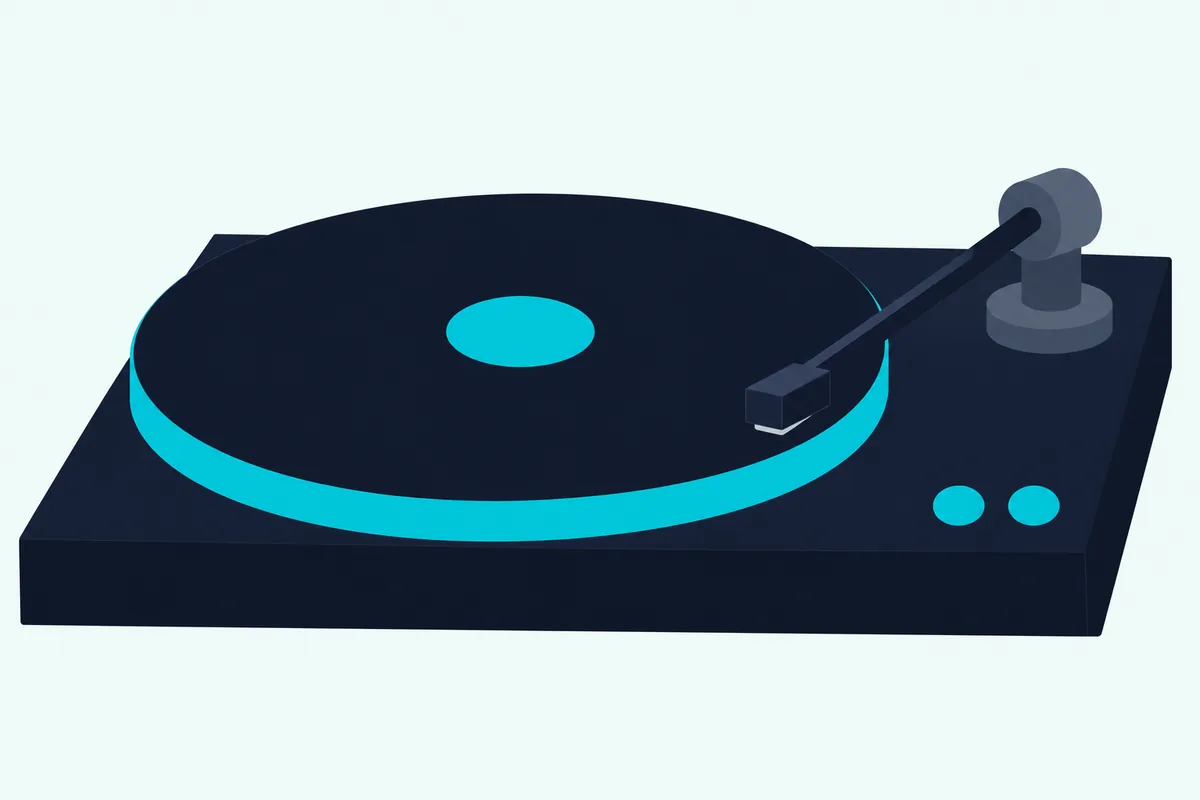
Manual play means lifting and lowering the arm with a cueing lever, and Audio-Technica’s manual warns that letting the arm drop can damage the stylus tip. Fluance’s auto-stop on the RT81+ and RT82 stops the platter about 30 seconds after the record ends, which Fluance says saves stylus life, though neither deck is fully automatic.
Here’s how all seven compare on play, preamp and arm setup:
| Turntable | Play | Phono preamp | Arm dials |
|---|---|---|---|
| AT-LP70X | Automatic | Built in | None |
| AT-LP60X | Automatic | Built in | None |
| AT-LP70XBT | Automatic | Built in | None |
| Denon DP-300F | Automatic | Built in | Counterweight, anti-skate |
| Fluance RT81+ | Manual, auto-stop | Built in | Counterweight, anti-skate |
| Fluance RT82 | Manual, auto-stop | None | Counterweight, anti-skate |
| Pro-Ject Debut EVO 2 | Manual | None | Counterweight, anti-skate |
The Denon shows the two styles aren’t exclusive: it plays automatically yet has the counterweight and anti-skating dials of a manual deck. For the longer tradeoffs, from sound to convenience, see Burton Acoustix’s manual vs. automatic breakdown.
Does a Beginner Turntable Need a Built-In Preamp?
That table’s middle column decides what the turntable can plug into. A beginner turntable needs a built-in preamp only when your speakers or amplifier have no PHONO input, because Audio-Technica puts the AT-LP70X’s PHONO output at 4.0 mV against 252 mV on LINE.
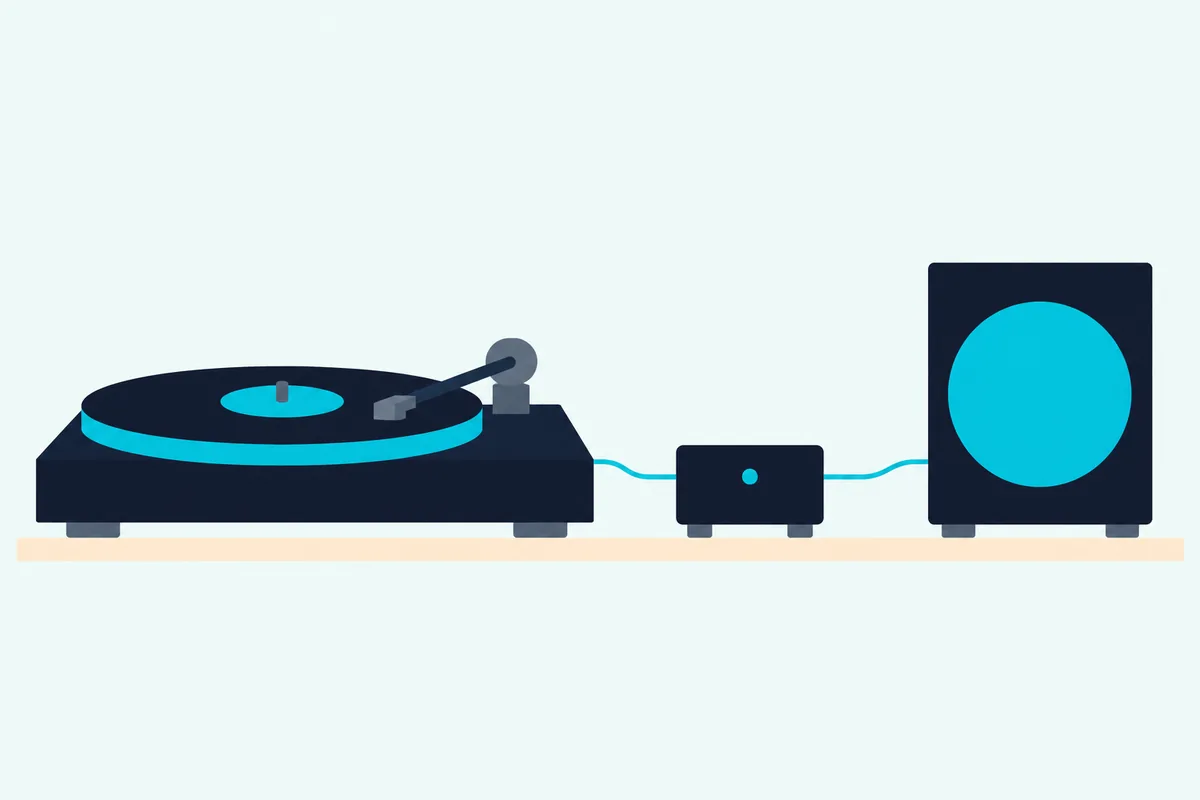
Powered speakers with RCA or AUX inputs take the LINE setting. Audio-Technica’s troubleshooting lists PHONO into an AUX input as a cause of no sound or low volume, and LINE into a PHONO input as too loud or distorted.
The Fluance RT82 and Pro-Ject Debut EVO 2 have no preamp, so they need a receiver with a PHONO input or a separate phono preamp. Pro-Ject recommends 47k ohms, 150 pF and 40 dB of gain for its MM EVO cartridge, though it says an MM phono input’s default settings work reasonably well.
If your amplifier lacks a PHONO input and you want one of those two anyway, our walkthrough on hooking a turntable to a receiver without a phono input covers the options.
Do You Need Separate Speakers for a First Record Player?
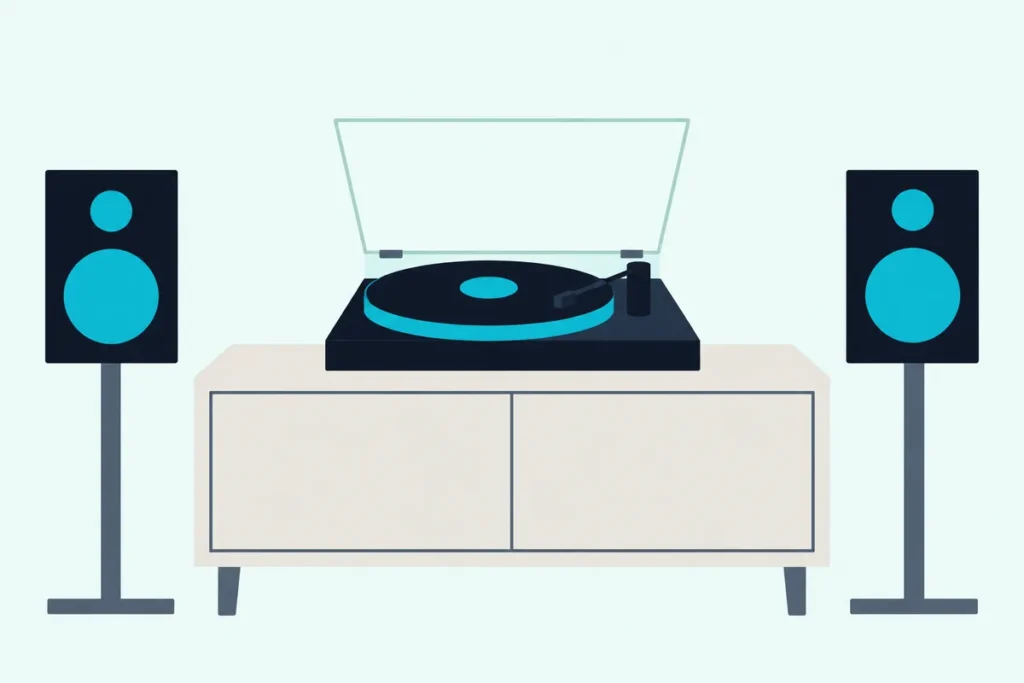
Once the preamp is settled, speakers are the rest of the system. You do need them, because none of the seven picks has a speaker of its own, and Audio-Technica’s manuals say to use active speakers when connecting the deck straight to speakers.
Powered speakers suit the five decks with a built-in preamp. Fluance says an amplifier is needed only for passive speakers, and a receiver can also supply the PHONO input the RT82 and Debut EVO 2 need.
Keep the speakers apart from the turntable, though. Audio-Technica tells you not to place the deck next to speakers because of vibration and acoustic pressure, and its troubleshooting lists nearby speakers as a cause of howling.
If you’re weighing a record player with speakers built in, our comparison of built-in and external speakers sets the two side by side.
Is a Bluetooth Turntable a Good First Choice?
Wireless speakers change that wiring question. A Bluetooth turntable is a good first choice when your speakers or headphones are already wireless, and the AT-LP70XBT gives up nothing on the record side, since Audio-Technica lists the same AT-VM95C cartridge and 36 dB phono preamp as on the AT-LP70X.
The AT-LP70XBT has no volume control of its own, so you set the listening level on the speaker or headphones. Audio-Technica also asks you to pair within about 3.3 feet of the deck.
Fluance lists no wireless playback on the RT81+ or RT82 and points to a Bluetooth or Wi-Fi transmitter on the RCA outputs instead. For how the music gets from the stylus to a wireless speaker, see how a Bluetooth record player works.
Are Suitcase Record Players Okay for Beginners?
Wired or wireless, every pick so far keeps its speakers in separate boxes, and that’s the one thing a suitcase record player can’t do, since it packs a turntable, amplifier and speakers into one portable case. Suitcase players aren’t a good first turntable, because Burton Acoustix’s suitcase turntable guide explains how heavy tracking force, a cartridge you can’t align and speakers shaking the same case can wear vinyl faster.
Four of the seven picks also have a counterweight you set yourself. If a suitcase player is already on your shelf, the same guide covers how to reduce the risk until you upgrade.
What Should Come in the Box With a First Turntable?
That leaves the boxes themselves, which tell you how much setup is ahead. A first turntable should come with its platter and belt, a mat, a dust cover, a 45 RPM adapter, a cable and power, and the three Audio-Technica decks ship with exactly that, ready to plug in.
The decks with adjustable arms add the parts you set: a counterweight on the two Fluance models, the Denon and the Pro-Ject, a bubble level with both Fluance models, and a two-point alignment protractor with the Pro-Ject. The Fluance RT81+’s RCA cable has its ground wire attached, while the RT82 comes with a separate 3-foot ground wire.
What no box includes is a speaker, and the RT82 and Debut EVO 2 also leave the phono preamp to you. Keep the packaging too, since Audio-Technica suggests saving it for moving and Pro-Ject suggests storing the tonearm’s transport lock with it.
How Do You Set Up a Beginner Turntable?
Those parts go together in much the same order on every pick. Set the deck on a level surface away from the speakers, fit the platter and belt, balance the arm and set its tracking force on a deck with a counterweight, then connect the RCA cable with the preamp switch matched to your input.
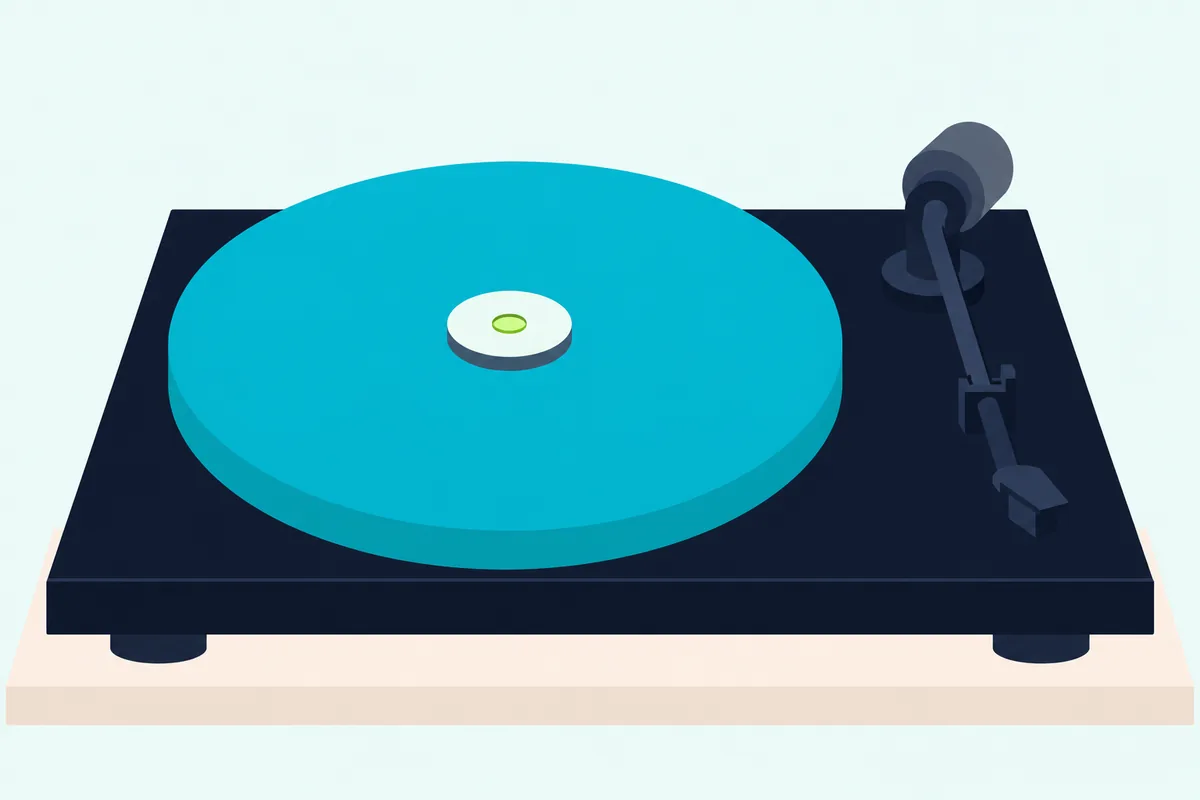
On the Audio-Technica picks you loop the belt onto the brass motor pulley with its red ribbon, then turn the platter ten times by hand to seat the belt and reset the auto mechanism. Plug in last, and wait about 30 seconds before playing, because Audio-Technica says the sound can be garbled straight after power-up.
On the Fluance RT81+, you balance the arm with anti-skating at 0, turn the counterweight’s ring to 0, then rotate the whole weight to 2 for 2.0 grams and set anti-skating to 2. Each manual gives its own cartridge’s figure, and the anti-skating setting is matched to it.
Our step-by-step turntable setup goes through each stage, and this tonearm balancing walkthrough covers the counterweight in more detail.
The Bottom Line
All of that points to the Audio-Technica AT-LP70X as the best turntable for beginners: one START button plays a whole side, and its built-in phono preamp connects straight to powered speakers.
Choose the AT-LP60X for the simplest, lightest start, the AT-LP70XBT for Bluetooth, the Fluance RT81+ to learn a manual tonearm with a preamp built in, the Denon DP-300F for automatic play with arm settings, and the Fluance RT82 or Pro-Ject Debut EVO 2 if your receiver has a PHONO input.
Whichever you buy, budget for speakers, keep them apart from the deck and set any PHONO/LINE switch to match the input you plug into.
Frequently Asked Questions
How long does a turntable stylus last?
Audio-Technica’s rule of thumb is about 300 hours for the AT-LP70X’s stylus and 400 hours for the AT-LP60X’s, and Denon gives the DP-300F’s DSN-85 stylus a service life of about 400 hours. Both makers say a worn stylus can damage records as well as hurt sound quality, so replace it on schedule.
Our guide to how long a turntable stylus lasts covers the signs of wear.
Can a beginner turntable play 78 RPM records?
Not these seven: each lists 33-1/3 and 45 RPM only, and Fluance’s spec tables mark 78 RPM as “No” on the RT81+ and RT82. If you own 78s, look for a deck whose maker lists that speed, such as Pro-Ject’s Debut Carbon EVO, whose instructions add 78 RPM with a separate round belt.
How often should you replace a turntable belt?
Audio-Technica suggests a new drive belt about once a year, or sooner if playback slows down or the speed wavers. Pro-Ject suggests taking the belt off a deck that’ll sit unused for a long time, so it doesn’t stretch unevenly.
Our guide to when a turntable belt wears out covers the signs that a belt needs replacing.
Can you upgrade the cartridge on a beginner turntable later?
Yes on the Fluance, Denon and Pro-Ject picks. The Fluance RT81+ and RT82 use a removable H-4 bayonet headshell, Denon says the DP-300F takes commercially available cartridges of 5.0 to 10.0 grams, and Pro-Ject says any cartridge with half-inch mounting holes fits the Debut EVO 2.
The AT-LP70X and AT-LP70XBT keep their AT-VM95C cartridge fixed to the arm, so the upgrade there is a replacement stylus.