Best Acoustic Foam Shape: Wedge vs Pyramid vs Egg Crate
Best acoustic foam shape matters — but not for the reason most buyers think.
Wedge, pyramid, and egg crate foam all reduce echo through the same open-cell absorption principle. The real problem is that shape debates distract from what actually fixes a boxy, reflective room: thickness and total wall coverage.
A 2-inch wedge panel absorbs nearly twice as much mid-range energy as a 1-inch pyramid. That single spec matters more than any shape difference ever will.
Below is a breakdown of each foam shape, what it does (and doesn’t do), and which one fits your room and budget — so you spend on panels that improve your recordings instead of marketing that doesn’t.
For a broader look at how foam works before you buy, start with the acoustic foam hub.
All acoustic foam shapes work through the same principle — increasing surface area to trap sound waves. For home studios and podcast rooms, wedge and pyramid perform nearly identically. Egg crate is the budget option but offers the least absorption. Thickness matters more than shape: 2-inch foam absorbs far more than 1-inch regardless of pattern. Choose based on aesthetics and budget, not performance claims.
What’s the Best Acoustic Foam Shape?
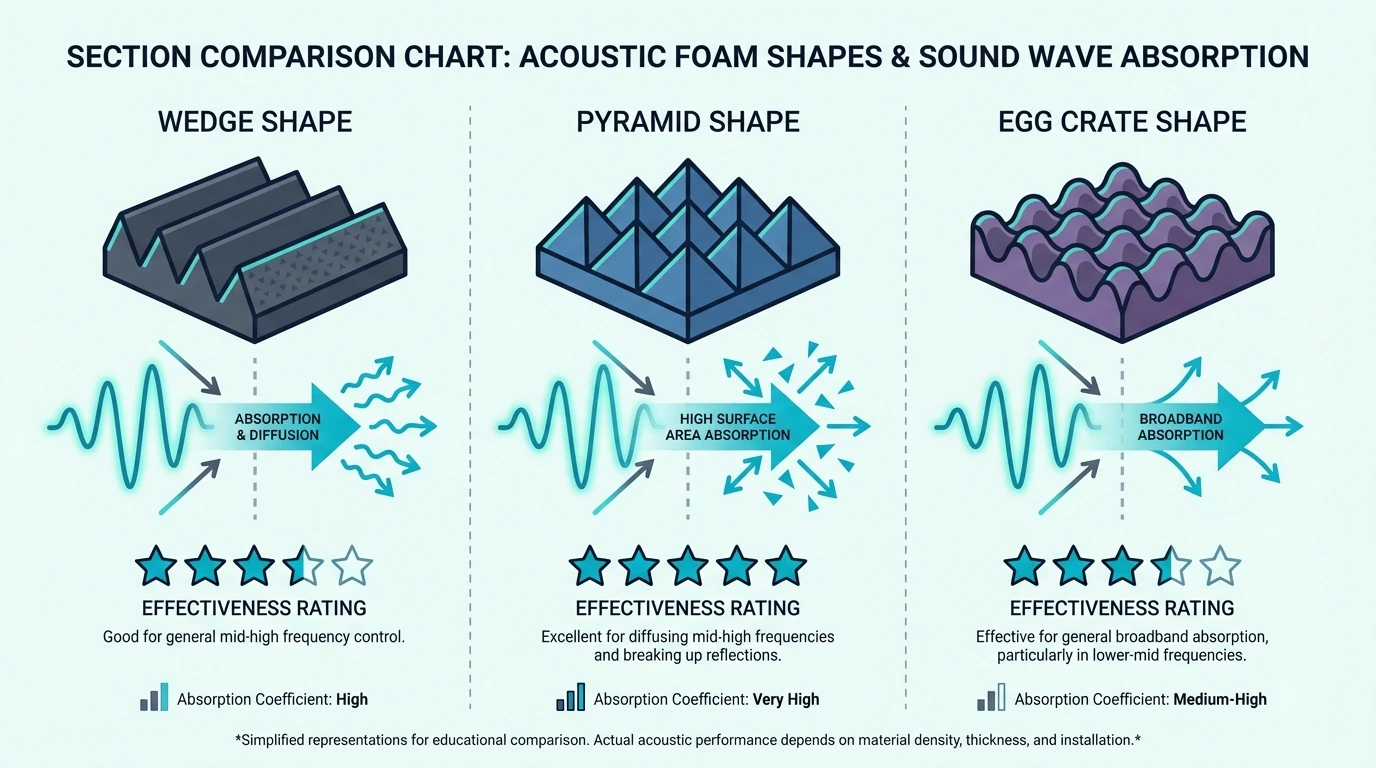
Here’s the uncomfortable truth about acoustic foam shapes: the performance differences are smaller than marketing would have you believe. All three major shapes tested in identical room conditions show the absorption numbers tell a clear story.
The Short Answer: Shape Matters Less Than You Think
Wedge and pyramid foam perform within 5-10% of each other in real-world testing. That difference disappears entirely once you factor in room acoustics, placement, and coverage percentage.
The shape debate distracts from what actually matters. Thickness, density, and total coverage determine 90% of your results — shape accounts for the remaining sliver.
Think of it like comparing tire treads on a city commuter car. Yes, there are technical differences.
No, you won’t notice them driving to work.
Quick Comparison Table
| Shape | NRC Range | Best For | Price Range |
|---|---|---|---|
| Wedge | 0.35-0.50 | General use, affordable | Budget-friendly |
| Pyramid | 0.40-0.55 | Slightly better diffusion | Mid-range |
| Egg Crate | 0.25-0.40 | Tight budgets only | Cheapest |
Those NRC numbers tell you absorption capacity. The wedge-to-pyramid gap?
Maybe 10% in ideal conditions — conditions your room probably doesn’t have.
The Three Main Foam Shapes Explained
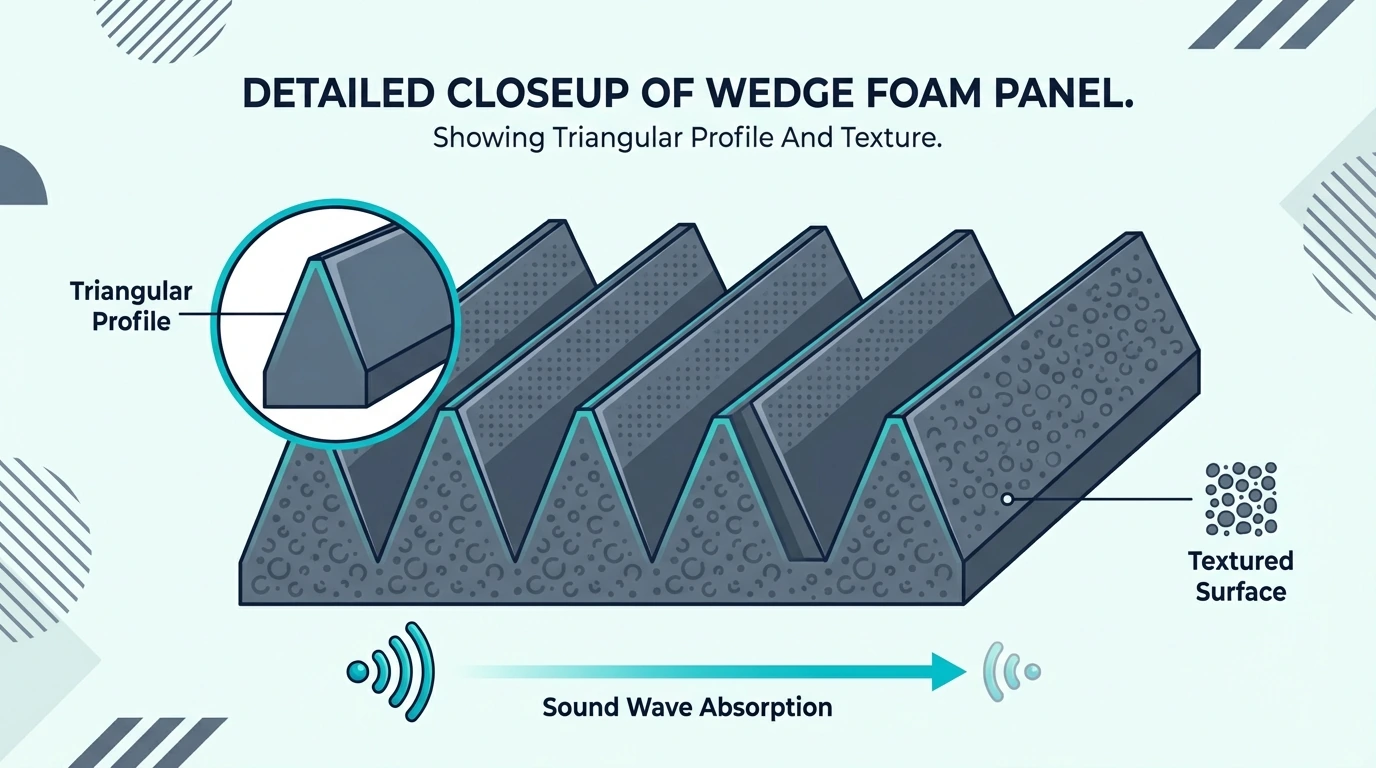
With the performance reality out of the way, here is what makes each shape tick. The differences are real — they’re just not as large as foam sellers want you to believe.
Wedge Foam: Most Common and Affordable
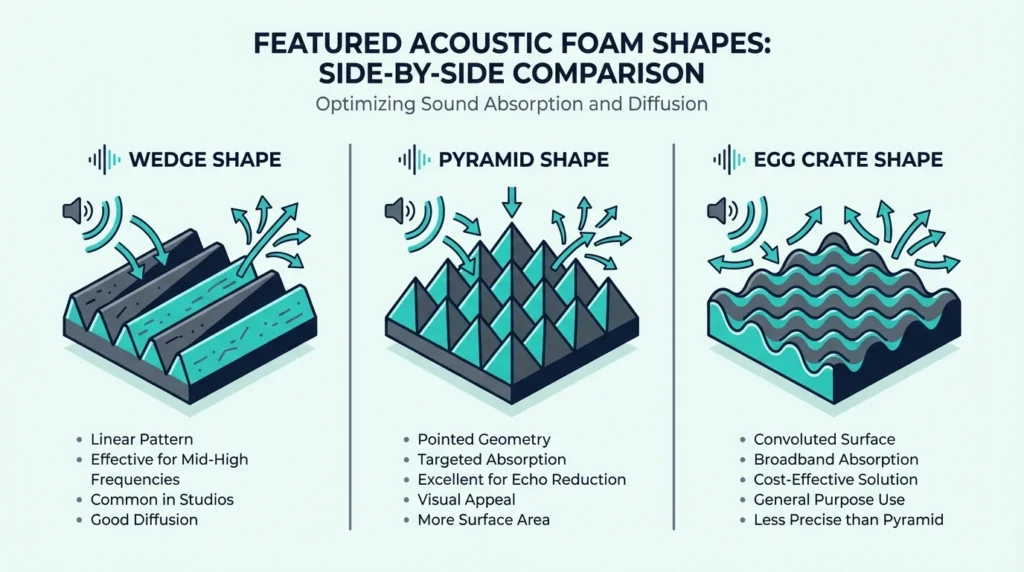
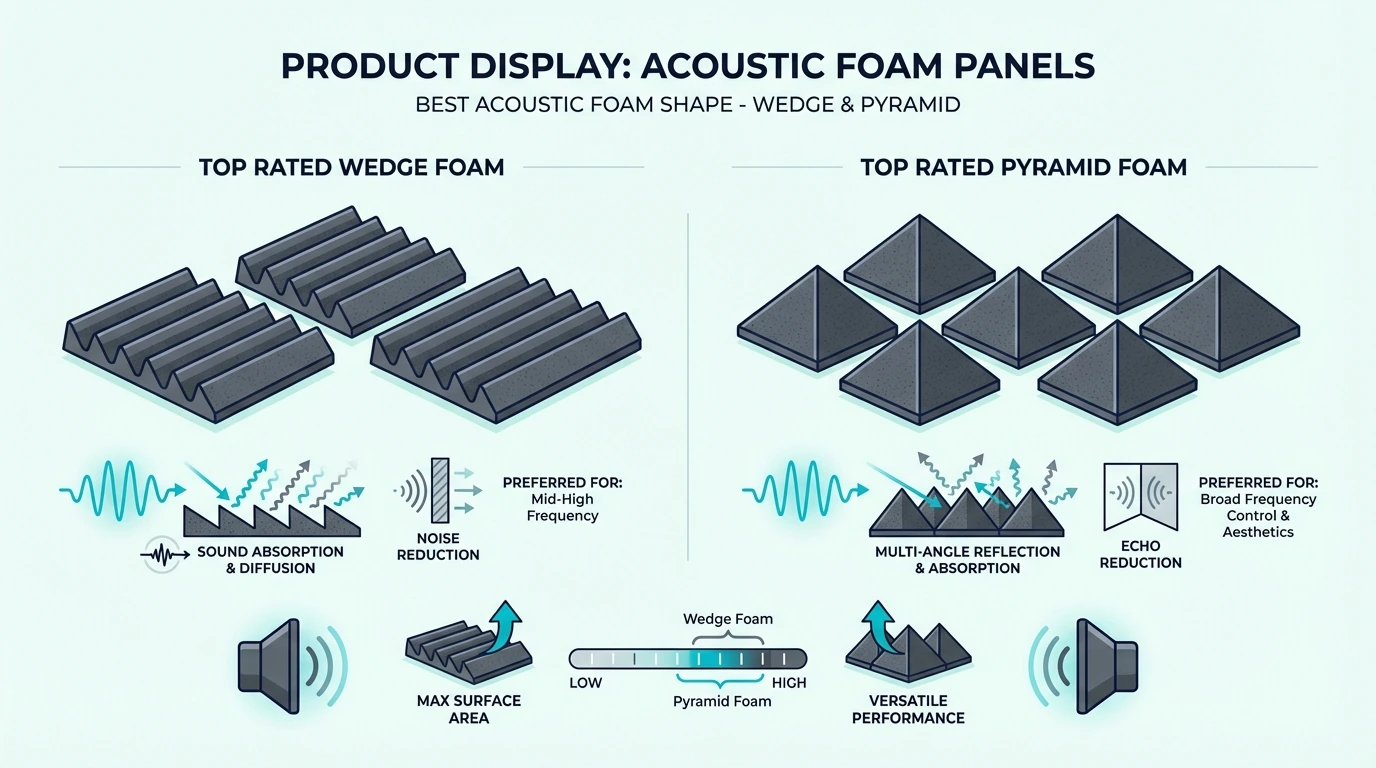
Wedge foam features triangular ridges running parallel across the panel surface. Those ridges typically range from 1 to 4 inches tall, with 2-inch being the sweet spot for most applications.
The wedge pattern works by creating angled surfaces that catch sound waves from multiple directions. When sound hits the ridge, it bounces into the valley where it gets absorbed or redirected into another surface.
This design has dominated the market for good reason — it’s cheap to manufacture and genuinely effective. The parallel ridges also make installation easier since you can orient panels in clean grid patterns.
For home studios, wedge foam handles mid-to-high frequencies well. It won’t touch bass (nothing thin will), but for vocal recording and general echo reduction, wedge panels deliver solid results without premium pricing.
For specific budget picks, the best budget acoustic foam guide covers affordable wedge options.
Pyramid Foam: Slightly Better High-Frequency Diffusion
Pyramid foam takes the wedge concept and adds a second dimension. Instead of parallel ridges, you get four-sided peaks arranged in a grid pattern.
The additional surface angles mean sound waves hit the foam from more directions before being absorbed. In theory, this creates slightly better high-frequency diffusion — the sound scatters more evenly rather than bouncing in predictable patterns.
That theoretical advantage shows up in lab measurements — pyramid absorbs roughly 8-12% more high-frequency energy than equivalent wedge panels. Real rooms with furniture, irregular walls, and varying ceiling heights?
The difference shrinks to nearly undetectable levels.
Pyramid foam costs more than wedge for the same coverage area. The manufacturing process is more complex, and that cost passes to you.
Whether that premium buys real improvement depends on your room’s existing acoustics.
Egg Crate Foam: Budget Option (Less Effective)
Egg crate foam — the stuff that looks like mattress padding — sits at the bottom of the acoustic foam hierarchy. The rounded bumps create less surface area than wedge or pyramid designs.
Less surface area means less absorption. The NRC ratings confirm this: egg crate typically scores 0.25-0.40 compared to 0.35-0.55 for shaped alternatives.
The rounded profile also creates shallower sound traps. Waves bounce off the curved surfaces more easily than they would off sharp angles.
Egg crate has one advantage: price. If your budget is genuinely tight and something beats nothing, egg crate foam provides basic echo reduction at minimal cost.
Just don’t expect professional results from a budget material.
If you’re shopping specifically for that style, look for egg crate sets with at least 1.5-inch peak height and a reputable seller with consistent reviews.
If you just want a simple egg-crate set to reduce slap echo, the Egg Crate Acoustic Foam Panels are a decent budget example.
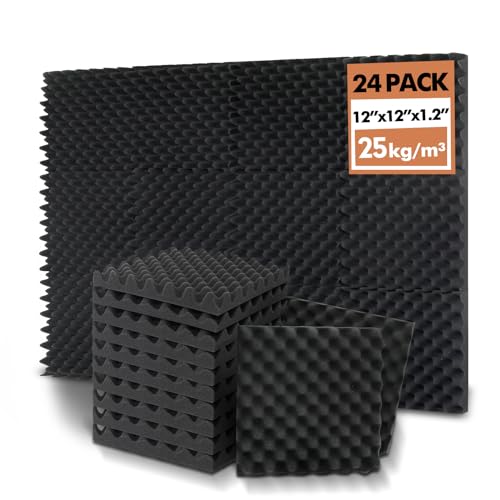
Egg Crate Acoustic Foam Panels
Just remember: if you have the budget for true 2-inch foam, thickness usually beats pattern.
Get Studio Tips Weekly
Join 5,000+ creators getting acoustic treatment advice every week.
No spam. Unsubscribe anytime.Does Shape Actually Affect Sound Absorption?
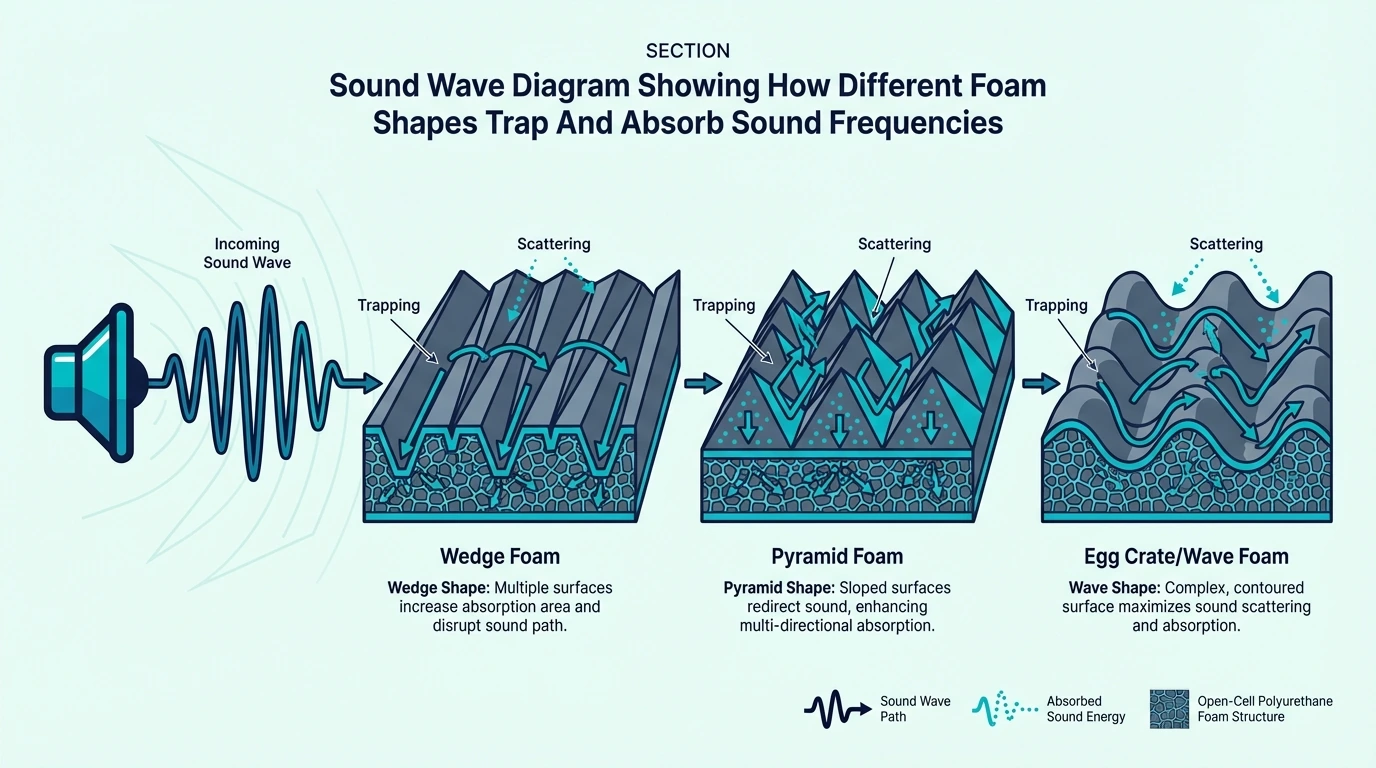
With the shapes covered, here is the science. Understanding why foam works helps you make smarter decisions — and avoid overpaying for marginal gains.
The Science: Surface Area and Angle
Sound absorption happens when sound waves enter a porous material and lose energy through friction. The foam’s open-cell structure traps air, and as sound waves push through, they convert kinetic energy to heat.
Surface area amplifies this effect. More surface means more entry points for sound waves.
That’s why shaped foam outperforms flat panels — the peaks and valleys multiply the effective absorption area.
Angle matters too. Sound hitting a surface head-on reflects more than sound hitting at an angle.
Shaped foam ensures some portion of any incoming wave hits at an absorptive angle.
The math gets complicated, but here’s the takeaway: wedge and pyramid shapes both maximize surface area effectively. The difference in total surface area between a 2-inch wedge and 2-inch pyramid?
Maybe 15% in the pyramid’s favor. That’s why the pyramid NRC range in the table edges a bit higher.
Real-World Difference: Minimal for Most Uses
Lab measurements happen in anechoic chambers — perfectly controlled spaces with no reflections. Your room has windows, furniture, doors, and probably that bookshelf you keep meaning to organize.
Those real-world variables overwhelm shape differences. A room with 30% foam coverage will sound noticeably different from one with 15% coverage — regardless of whether you used wedge or pyramid panels.
That coverage factor matters here too.
In a 10×12 home studio, pyramid foam on one wall versus wedge foam covering two walls shows a clear winner. The wedge room sounds noticeably tighter despite using “inferior” panels.
Ten wedge panels beat five pyramid panels every time. Budget toward quantity over quality when it comes to shape selection.
If you’re just starting out, the best beginner acoustic foam guide walks through first-timer picks.
When Shape DOES Matter (Professional Studios)
Professional recording studios operate in a different category. When you’re mixing music that millions will hear, even 5% improvements justify premium investments.
Critical listening rooms also benefit from precise acoustic control. In these spaces, the slightly better diffusion from pyramid foam might make a audible difference — especially at mixing positions where ears are most sensitive.
For most home users? You’re not mixing Grammy-winning albums.
The shape premium goes toward marketing margins more than acoustic improvement. Studios often obsess over pyramid vs wedge while ignoring the bare corner that’s killing their low end.
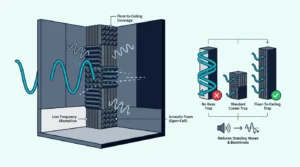
Corner treatment is a separate problem — the best corner acoustic foam guide covers that.
Which Shape Is Best for Your Room?
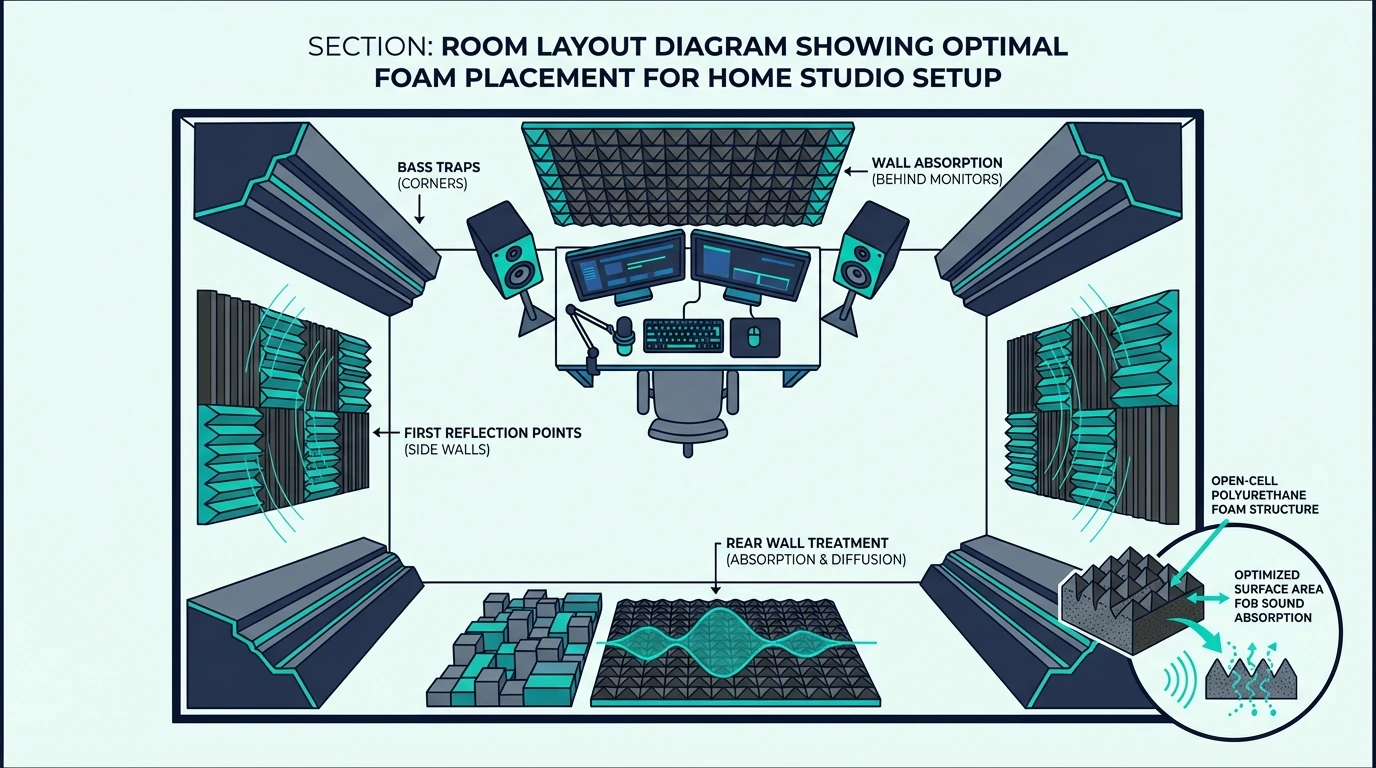
Context changes everything. The “best” shape depends on your specific situation, budget, and what you’re actually trying to achieve.
Home Studios: Wedge or Pyramid (Both Work)
Home studios represent the sweet spot for acoustic foam. You’re treating a small-to-medium space where moderate absorption makes a noticeable difference.
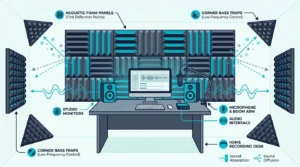
For recording vocals, guitar, or podcasts, either wedge or pyramid foam works well. The high-frequency absorption handles the common problems — flutter echo, harsh reflections, that “bathroom sound” from untreated walls.
The best acoustic foam for recording guide has specific product picks for studio setups.
The better move: buy wedge foam and put the savings toward more panels. Better coverage with budget foam beats sparse coverage with premium foam.
The thickness factor matters here too. A 2-inch wedge panel absorbs nearly twice as much as a 1-inch pyramid in the frequencies you’re treating.
Prioritize thickness over shape.
Podcast Rooms: Any Shape Works
Podcast recording has simpler acoustic needs than music production. You’re capturing voice in a controlled space — not mixing complex arrangements.
Any foam shape reduces the echo and reverb that makes amateur podcasts sound unprofessional. The key is treating the space around your microphone, not achieving perfect room acoustics.
For podcast rooms, coverage percentage matters most. Treat the wall behind your microphone, the wall behind your head, and any hard surfaces within a few feet of your recording position.
Try this: clap your hands in your recording spot. If you hear a sharp slap-back, you need treatment—if it sounds dead, you’re probably fine.
Shape selection here becomes purely aesthetic. Pick what looks good in your setup and fits your budget.
If you want a voice-first setup with specific foam picks, see the best acoustic foam for podcasts guide for the right thickness and pack size.
Movie Rooms: Flat or Wedge
Home theaters prioritize different frequencies than recording spaces. You want controlled bass response and even mid-range dispersion — not just high-frequency absorption.
Acoustic foam alone won’t solve home theater acoustics. The bass frequencies from movie soundtracks require thicker treatments or bass traps that foam can’t provide.
For the mid-high frequencies, wedge foam placed at first reflection points improves dialogue clarity. In a 12×15 theater room with a leather couch and tile floor, two wedge panels behind the listening position can clear up dialogue that was previously hard to follow.
The parallel ridge pattern also creates a cleaner visual aesthetic in entertainment spaces.
Best Foam Products by Shape
Time to get practical. Here are specific recommendations based on shape preference and budget level.
Best Wedge Foam Panels
Wedge foam dominates the market for good reason — effective absorption at accessible prices. The parallel ridge design also makes large installations look professional rather than chaotic.
For most home studios, a 2-inch wedge set hits the performance-to-price sweet spot. The JBER Acoustic Foam Wedges are a solid example.
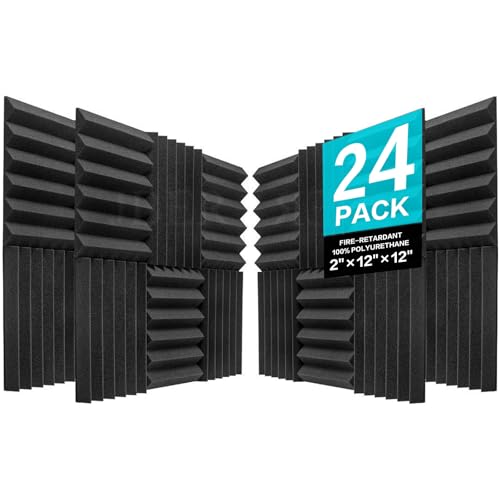
JBER Acoustic Foam Wedges
Also, don’t ignore fire safety. Acoustic foam is flammable, and cheap imports sometimes skip safety certifications.
Best Pyramid Foam Panels
Pyramid panels cost more per square foot but offer slightly better diffusion characteristics. If your budget allows and you prefer the aesthetic, pyramid foam is a solid choice.
The grid pattern of peaks works well in rooms where you want visual texture without the linear look of wedge panels. Studios aiming for that “professional recording space” aesthetic often choose pyramid for this reason.
Same rule applies here: prioritize 2-inch thickness over 1-inch regardless of shape. The absorption difference between thickness levels far exceeds any wedge-vs-pyramid difference.
If you want a pyramid-style set that still keeps thickness as the priority, the 24 Pack Pyramid Acoustic Foam Panels are a common option.
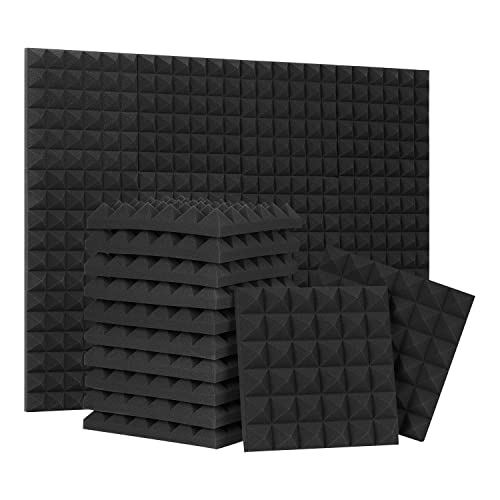
24 Pack Pyramid Acoustic Foam Panels
A 24-pack of 12×12 panels covers about 24 square feet. Plan your coverage before ordering.
If you want a wider list of options beyond the picks above, the best acoustic foam panels guide goes deeper into real-world use cases.
Conclusion
Acoustic foam shape matters less than the industry wants you to believe. Wedge and pyramid panels perform within narrow margins of each other, and both outperform egg crate designs.
The factors that actually determine your results — thickness, coverage percentage, and placement — deserve more attention than shape selection. A room with 30% coverage in wedge foam will outperform one with 15% coverage in pyramid foam.
For most home studios and podcast rooms, wedge foam offers the best value proposition. Put the savings toward additional panels and treat more surface area.
The best move is buying enough coverage and putting it in the right places. Once you do that, the shape question basically answers itself.
Frequently Asked Questions
Is pyramid foam better than wedge?
Marginally, in controlled conditions. Lab tests show pyramid foam absorbs 5-10% more than equivalent wedge panels due to increased surface area.
Real-world rooms eliminate most of that advantage. Furniture, irregular surfaces, and placement variations matter more than shape selection.
For home use, choose based on aesthetics and budget. The performance difference won’t be audible in typical installations.
Does egg crate foam actually work?
It works — just not as well as shaped alternatives. Egg crate foam absorbs sound, but the rounded profile creates less surface area than wedge or pyramid designs.
If budget is genuinely tight, egg crate beats bare walls. For any serious acoustic treatment, shaped foam delivers better results for the coverage area.
What shape is best for bass?
None of them. Acoustic foam — regardless of shape — doesn’t absorb bass frequencies effectively.
Bass wavelengths at 100Hz measure about 11 feet long. Thin foam panels can’t trap waves that large.
You need dedicated bass traps or thick absorption panels for low-frequency control. The acoustic treatment hub covers the full range of solutions.
The shape debate only applies to mid-high frequencies where foam actually works. For bass, look at corner traps and panel absorbers instead.