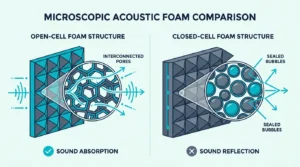
What Can You Use Instead of Acoustic Foam? 12 Alternatives That Actually Work
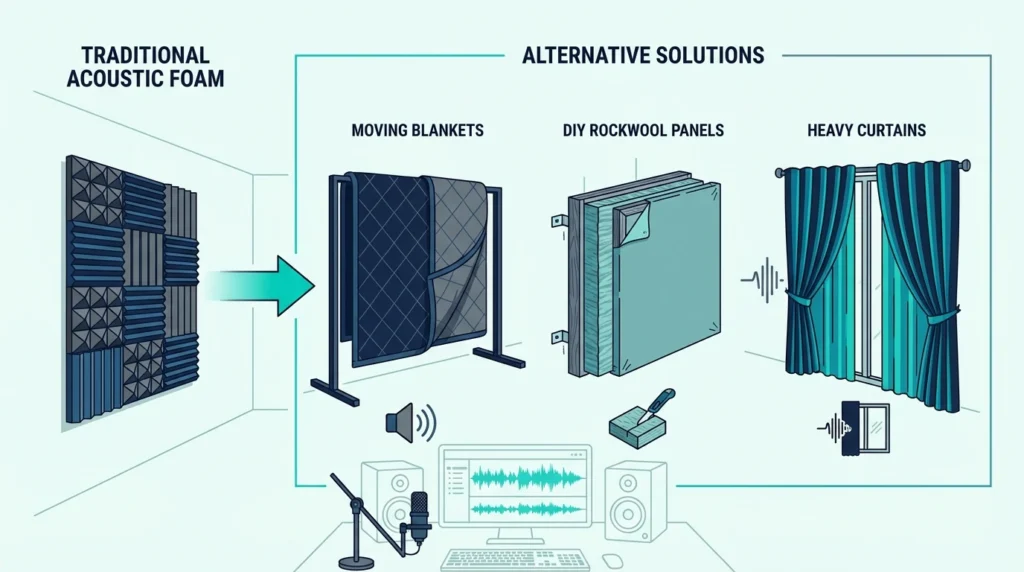
What can you use instead of acoustic foam? Moving blankets, DIY rockwool panels, and heavy curtains all absorb sound, but most other “alternatives” people recommend online are myths that waste your money just as fast as cheap foam.
The real problem is echo and flutter bouncing off bare walls and hard floors, making recordings sound boxy and mixes unreliable. Egg cartons won’t fix that, and neither will mattress foam or thin curtains.
Match the right material to your room, though, and you get cleaner sound for less money than generic pyramid panels ever delivered.
Start with your budget tier—free, under $50, or under $150—then treat the first reflection point near your mic or monitors.
To decide on the best acoustic foam alternative, consider your budget and goals:
- Free options: Rearrange furniture, hang clothes in closets, use existing blankets
- Budget tier ($0-50): Moving blankets, heavy curtains, thick rugs
- Mid-range ($50-150): DIY rockwool panels, cork boards, fabric-wrapped frames
- Professional ($150+): Commercial fabric panels, polyester acoustic panels
The best alternative depends on whether you need temporary treatment, rental-friendly solutions, or permanent upgrades. DIY rockwool panels offer the best performance-to-cost ratio, while moving blankets provide the quickest budget fix.
Why Look for Acoustic Foam Alternatives?
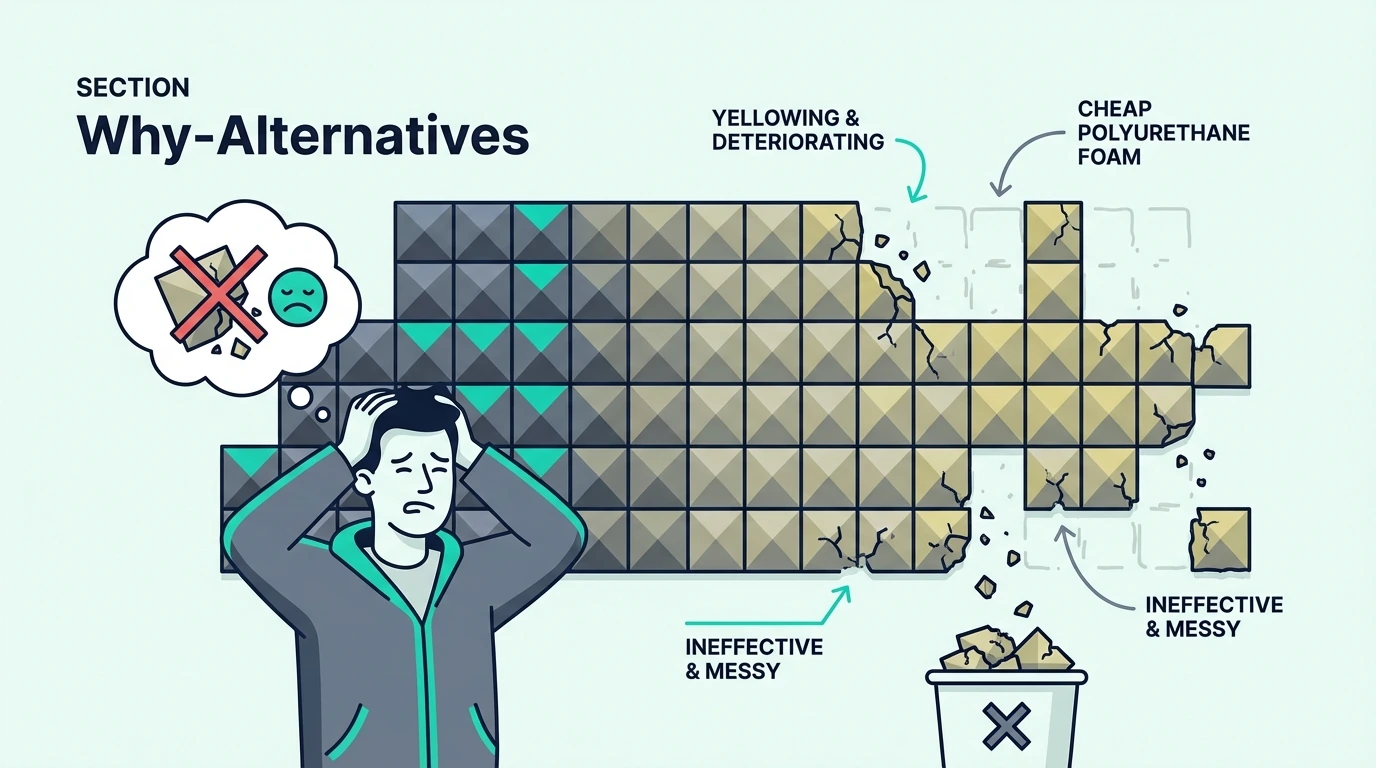
Not everyone needs—or wants—acoustic foam. Understanding your motivation helps narrow down which alternative makes sense for your situation.
Budget Constraints Hit Hard
Acoustic foam adds up fast. Covering even a small room requires dozens of panels, and quality foam isn’t cheap.
A 10×10 room needs roughly 40-60 square feet of treatment for basic echo control. At typical foam prices, you’re looking at a significant investment before you’ve even bought a microphone or interface.
Aesthetics Matter More Than You Think
Let’s be honest—most acoustic foam looks terrible. Those black or gray pyramids scream “budget YouTube setup” regardless of how much you spent.
Some people want their space to look like a living room, not a recording booth. Alternatives like fabric panels, curtains, or strategically placed furniture achieve the same acoustic goals without the visual compromise.
Rental Restrictions Are Real
Landlords don’t appreciate tenants gluing foam to their walls. Even “removable” adhesives can damage paint or leave residue that costs you your deposit.
If you’re renting, you need solutions that come down cleanly when you move. That rules out most permanent mounting methods and pushes you toward freestanding or temporary options.
Budget DIY Alternatives ($0-50)
You don’t need to spend much—or anything—to improve your room’s acoustics. These options work surprisingly well for the price.
Moving Blankets: The Budget Champion
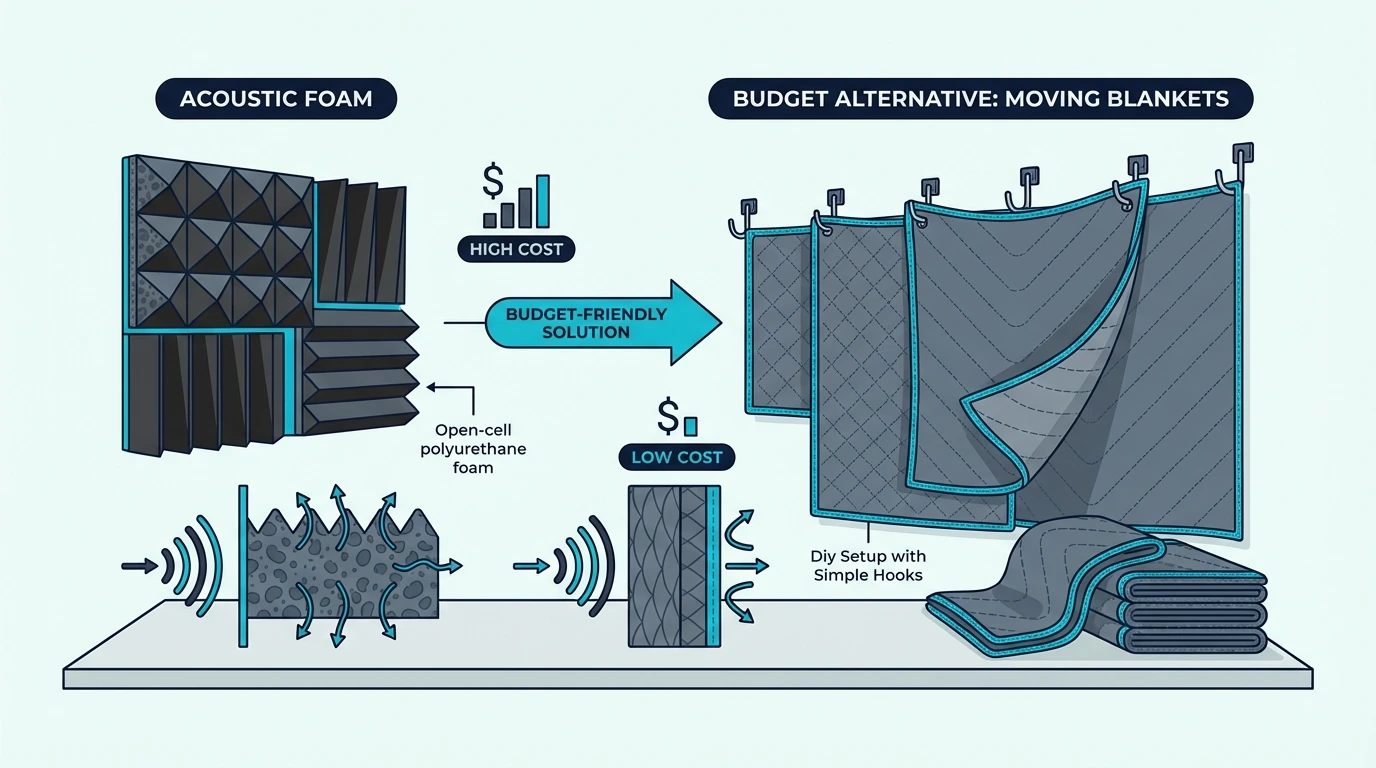
Moving blankets are the go-to recommendation in audio forums for good reason. They’re thick, dense, and designed to absorb impact—which translates to decent sound absorption.
A single moving blanket hung behind your recording position reduces flutter echo noticeably. The dense padding absorbs mid and high frequencies similar to budget foam, though bass frequencies pass right through.
For comparison, see how acoustic foam stacks up against blankets in our detailed breakdown.
You can find moving blankets for a few dollars each at hardware stores. For a purpose-built option, VEVOR sound dampening blankets include grommets and hang from simple hooks—no wall damage required.
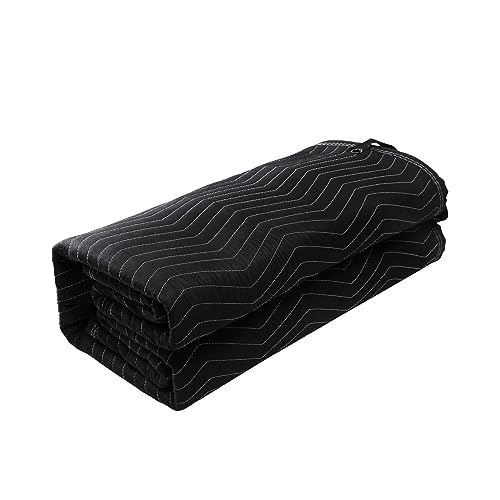
VEVOR sound dampening blankets
The downside is they look exactly like what they are: blankets hanging on your wall. For temporary setups or spaces where aesthetics don’t matter, though, they’re hard to beat.
Heavy Curtains Work Better Than Expected
Thick, floor-to-ceiling curtains do double duty. They treat your windows (a major source of reflections) while adding absorption to the room.
Velvet or heavy blackout curtains perform best because denser material absorbs more sound energy. Thin, decorative curtains do almost nothing—you need weight and thickness.
Position curtains so they hang with some space behind them, not flat against the wall. That air gap improves low-frequency absorption significantly—even a 2-4 inch gap makes a measurable difference.
Thick Rugs and Carpets
Hard floors reflect sound like mirrors reflect light—every clap, footstep, and spoken word bounces back and creates flutter echo. Understanding how sound absorption actually works helps explain why soft materials make such a difference.
A thick area rug breaks up floor reflections immediately. You’ll hear the difference the moment you lay it down—the room sounds less “live” and more controlled.
Rugs work best when placed between you and your monitors or microphone. The reflection point on the floor matters just as much as the walls, and most people ignore it completely.
Furniture Placement Costs Nothing
Before buying anything, try rearranging what you already own. Bookshelves scatter sound, couches absorb mid frequencies, and even a messy closet full of clothes acts as a bass trap.
The goal is breaking up parallel surfaces—two bare walls facing each other create flutter echo, that metallic ringing when you clap. Put a bookshelf against one wall, and the problem often disappears.
This isn’t a complete solution, but it’s free and immediate. Start here before spending money on alternatives.
Get Studio Tips Weekly
Join 5,000+ creators getting acoustic treatment advice every week.
No spam. Unsubscribe anytime.Mid-Range Alternatives ($50-150)
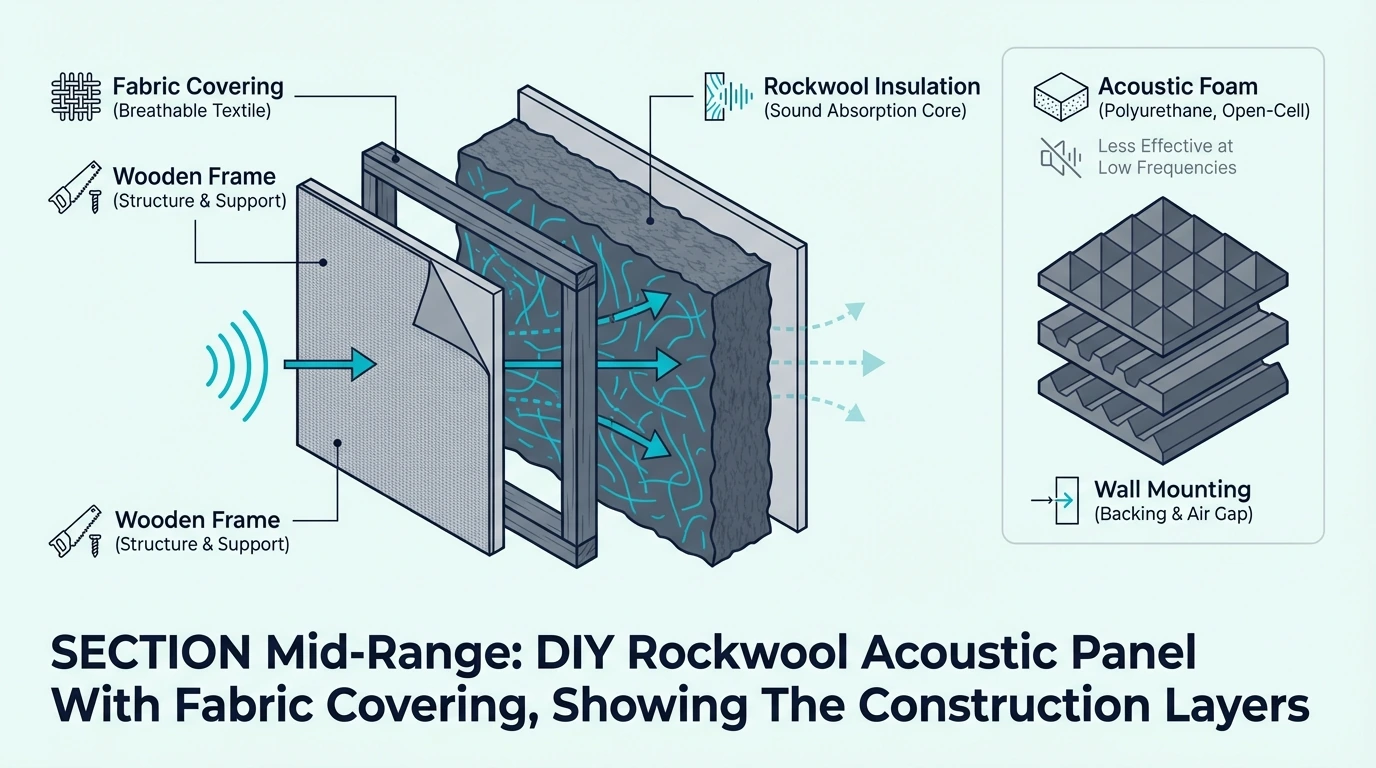
When budget options aren’t enough, these mid-range solutions offer serious performance without professional prices.
DIY Rockwool Panels: Best Bang for Your Buck
If you’re willing to build something, DIY rockwool panels outperform acoustic foam in every measurable way. They absorb more sound across a wider frequency range, last longer, and cost less per square foot than quality foam.
Rockwool (mineral wool insulation) has an NRC rating around 0.95-1.0, meaning it absorbs 95-100% of sound energy hitting it. Compare that to budget foam at 0.3-0.5, and the difference is dramatic.
Building panels requires basic materials: 2-inch rockwool batts, simple wooden frames, and breathable fabric to wrap them. Total cost per panel runs less than half what commercial panels cost.
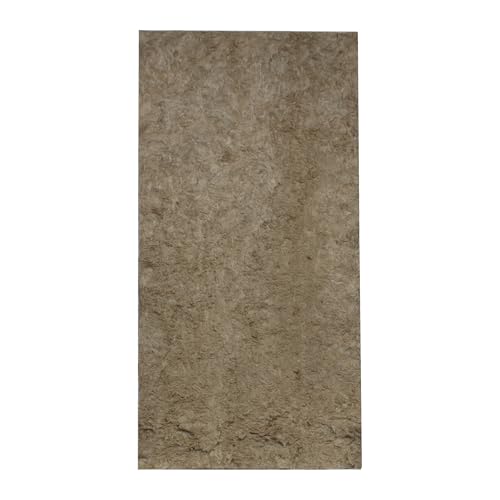
2-inch rockwool batts
The tradeoff is time—each panel takes 30-60 minutes to build, and you’ll need basic tools. For anyone comfortable with simple DIY projects, this is the clear winner for performance versus cost.
For a complete guide on building your own, check out our DIY acoustic panel guide.
Fiberglass Panels (DIY)
Fiberglass insulation works similarly to rockwool but requires more careful handling. The fibers irritate skin and lungs, so you’ll need gloves, long sleeves, and a respirator during construction.
Owens Corning 703 is the standard recommendation—it’s rigid, easy to cut, and has excellent absorption characteristics. The 2-inch thickness handles frequencies down to about 500Hz effectively, while 4-inch panels reach into the 250Hz range. If you’re comparing thicknesses, our guide on 1-inch vs 2-inch acoustic foam explains why thickness matters so much.
Fiberglass panels need fabric wrapping to contain the fibers—Guilford of Maine is the industry standard, but any acoustically transparent fabric works. Test by holding it to your mouth and blowing; if air passes through easily, sound will too.
Cork Boards and Tiles
Cork offers a middle ground between aesthetics and function. It absorbs some sound, looks decent on walls, and installs easily with adhesive or pins.
The absorption isn’t as effective as rockwool or fiberglass—cork’s NRC rating hovers around 0.3-0.4. But for light treatment in spaces where appearance matters, it’s a reasonable compromise.
Cork works best for high-frequency absorption. It won’t help with bass buildup or low-mid muddiness, but it takes the edge off harsh reflections and reduces flutter echo in smaller rooms.
Fabric-Wrapped Frames
Stretching fabric over a wooden frame with batting inside creates a decorative panel that actually absorbs sound. It’s essentially a simplified version of commercial acoustic panels.
Use polyester batting, cotton batting, or even old towels as the absorptive material. Thicker is better—aim for at least 2 inches of compressed material inside the frame.
These panels look like art when done well. Choose fabric that matches your room, and nobody will know they’re acoustic treatment. The absorption won’t match rockwool panels, but it’s significantly better than bare walls. For ideas on improving foam aesthetics, check out how to make acoustic foam look good.
Professional Alternatives ($150+)
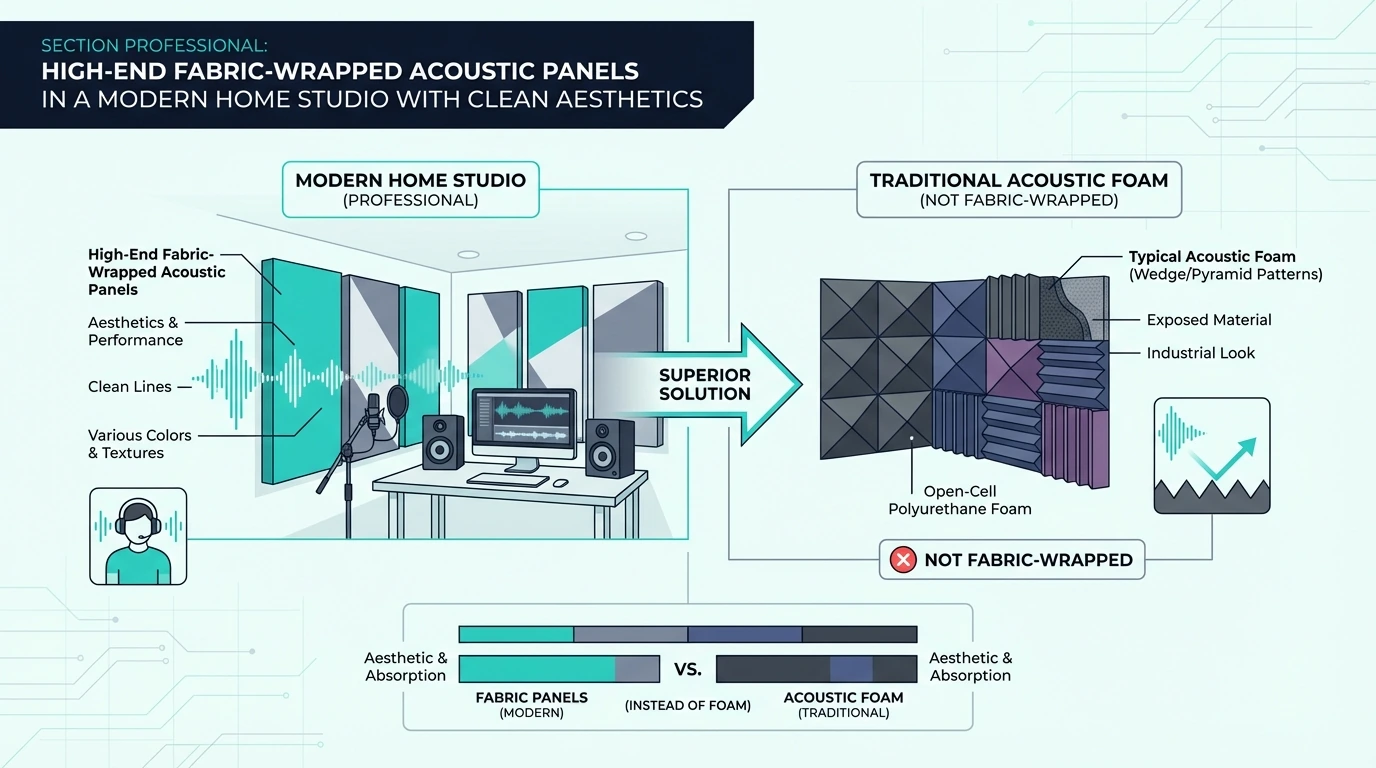
When budget isn’t the primary concern, these options deliver professional performance with professional appearance.
Commercial Fabric-Wrapped Panels
Companies like GIK Acoustics, Acoustimac, and ATS Acoustics sell pre-made panels that look like they belong in a professional studio. They use high-density fiberglass or mineral wool cores wrapped in acoustically transparent fabric.
These panels typically achieve NRC ratings of 0.85-1.0, absorbing nearly all sound energy across the frequency spectrum. They’re what professional studios use, and the performance reflects that.
The premium price buys you consistency, appearance, and convenience—every panel performs identically, the fabric options are extensive, and installation is straightforward. For anyone who values their time over DIY savings, commercial panels make sense.
Polyester Acoustic Panels
PET felt panels (made from recycled plastic bottles) have gained popularity for their combination of performance and aesthetics. They come in various colors, can be cut into custom shapes, and don’t require fabric wrapping.
Absorption varies by thickness and density, but quality polyester panels achieve NRC ratings around 0.7-0.85. That’s better than foam and approaching fiberglass performance.
The material is safe to handle, doesn’t irritate skin, and won’t degrade over time like foam. It’s become the go-to choice for offices and modern studios where appearance matters as much as acoustics.
If you’re curious about foam safety concerns, read our guide on whether acoustic foam is dangerous.
Wood Slat Acoustic Panels
Wood slat panels combine absorption with diffusion. The slats scatter high frequencies while the backing material (usually felt or foam) absorbs mid frequencies.
These panels look stunning—they’re as much a design element as an acoustic treatment. The wood adds warmth to room aesthetics while actually improving sound quality.
Performance varies widely depending on construction—some wood slat panels are purely decorative with minimal acoustic benefit. Others use engineered backing materials that provide genuine absorption, so check the NRC rating before buying.
What About Common Household Items?
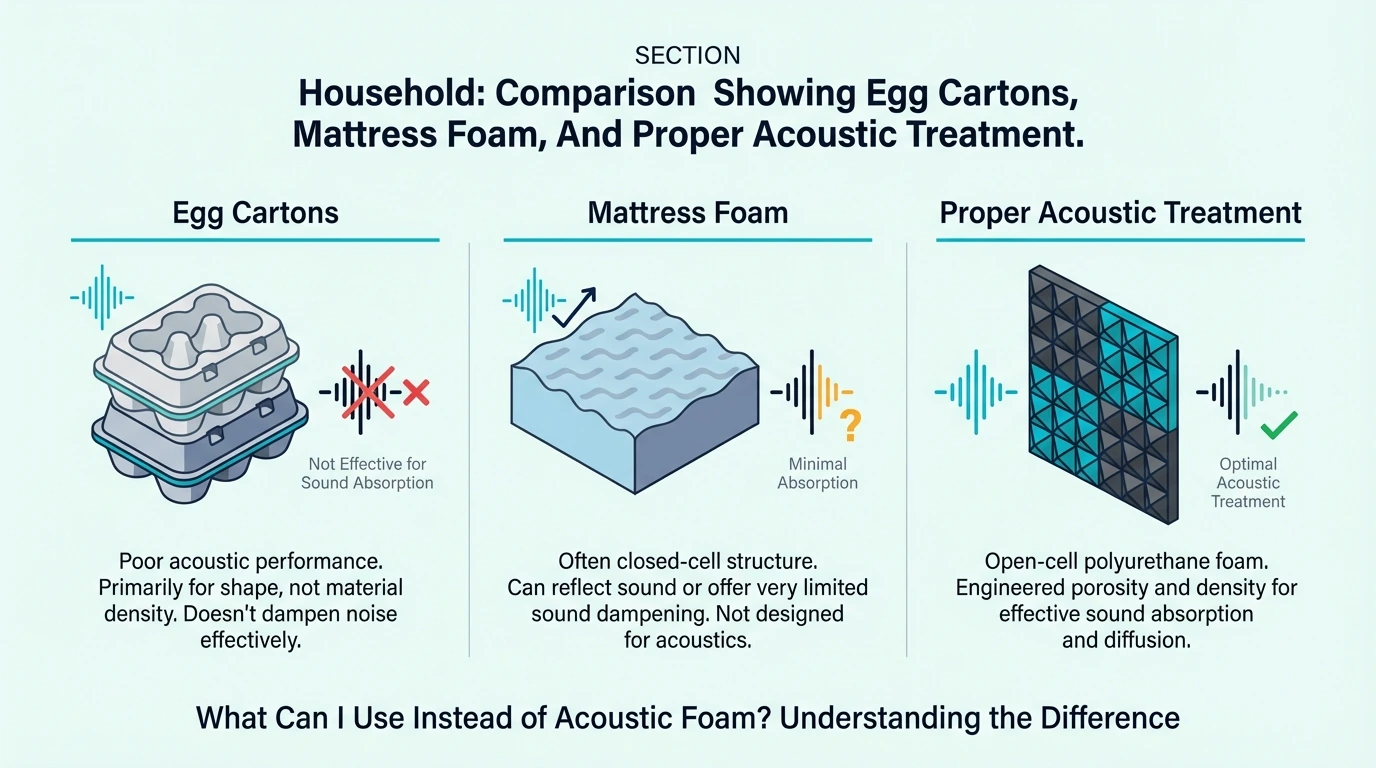
The internet is full of suggestions for household acoustic treatments. Some work, most don’t. Here’s the truth.
Do Egg Cartons Work? (No, Not Really)
Egg cartons are the most persistent myth in home acoustics. They look vaguely like acoustic foam, so people assume they work similarly.
They don’t. Egg cartons are thin cardboard—they have almost zero mass and absorb virtually no sound energy. The shape might scatter some high frequencies slightly, but the effect is negligible.
Worse, cardboard egg cartons are a fire hazard. They’re not treated with flame retardants like proper acoustic materials. Covering your walls with them is genuinely dangerous.
If someone recommends egg cartons, they don’t understand acoustics. Our full egg cartons vs acoustic foam comparison breaks down exactly why. Move on to solutions that actually work.
Can I Use Mattress Foam? (Not Ideal)
Mattress foam and acoustic foam are different products. Mattress foam is designed for comfort and support, not sound absorption.
Some mattress foam does absorb sound—particularly open-cell varieties. But the density and cell structure aren’t optimized for acoustics, so performance is inconsistent and generally poor.
The bigger issue is fire safety. Acoustic foam is treated with flame retardants; mattress foam often isn’t. Using untreated foam on your walls creates a fire risk that’s not worth the minimal acoustic benefit.
If you have old mattress foam lying around, it’s better than nothing for temporary use. Our acoustic foam vs mattress foam guide covers the differences in detail. But don’t buy mattress foam expecting acoustic performance—spend that money on proper materials instead.
Do Carpets and Rugs Help? (Yes, Somewhat)
Unlike egg cartons, carpets and rugs genuinely improve room acoustics. They absorb high and mid frequencies, reduce floor reflections, and add mass to the room.
A thick carpet won’t solve all your acoustic problems, but it addresses one of the most common issues: hard floor reflections. The improvement is immediate and noticeable.
Rugs work best when combined with wall treatment. They handle floor reflections while panels or curtains handle wall reflections. Together, they create a balanced acoustic environment.
For more on how different materials compare, see our guide on acoustic foam vs carpet.
Comparison Table: Alternatives vs Acoustic Foam
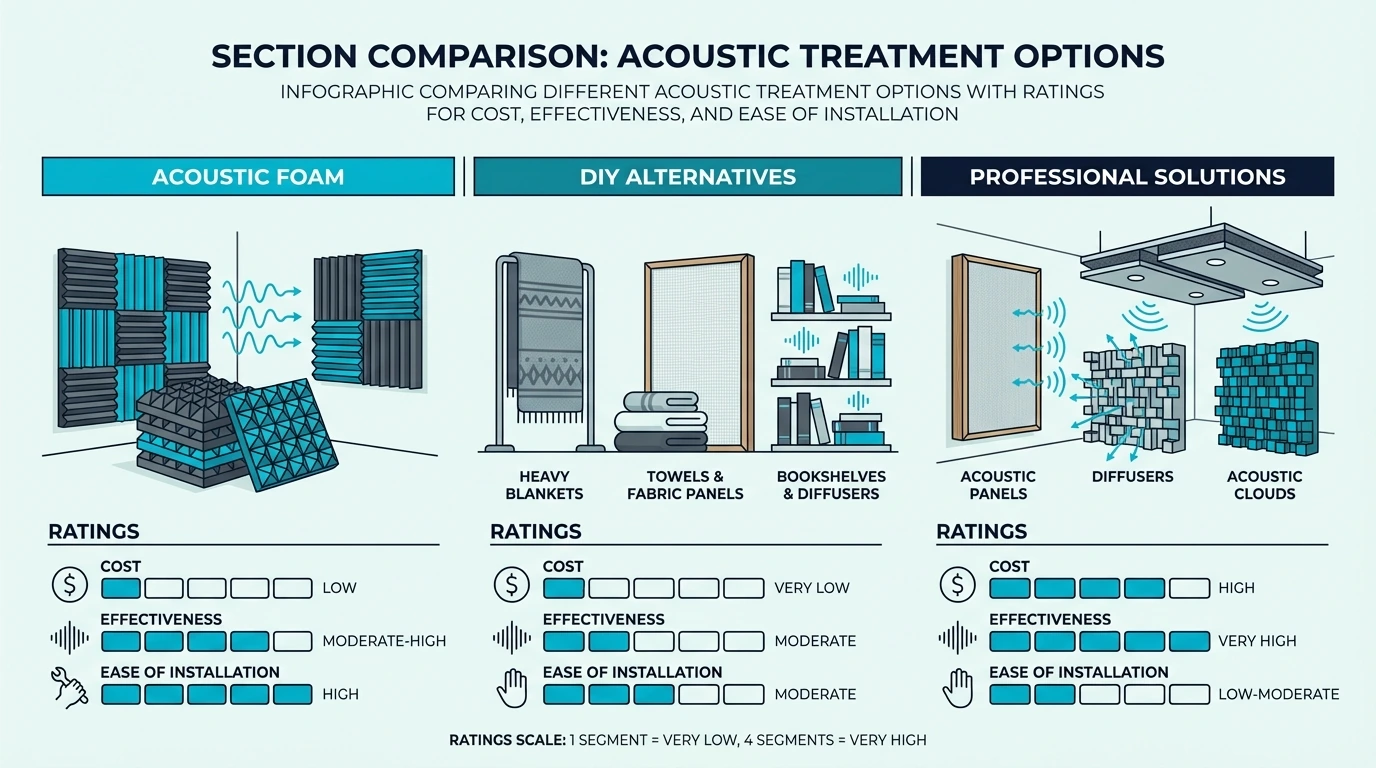
Here’s how the alternatives stack up against standard acoustic foam:
| Alternative | Cost | NRC Rating | Ease of Install | Appearance | Best For |
|---|---|---|---|---|---|
| Moving Blankets | $5-15 each | 0.4-0.6 | Very Easy | Poor | Temporary setups |
| Heavy Curtains | $30-100 | 0.3-0.5 | Easy | Good | Windows, rentals |
| DIY Rockwool Panels | $15-25/panel | 0.95-1.0 | Moderate | Good | Best performance/cost |
| Cork Tiles | $2-5/sqft | 0.3-0.4 | Easy | Good | Light treatment |
| Commercial Panels | $50-150/panel | 0.85-1.0 | Easy | Excellent | Professional results |
| Polyester (PET) Panels | $40-100/panel | 0.7-0.85 | Easy | Excellent | Modern aesthetics |
| Budget Acoustic Foam | $1-3/sqft | 0.3-0.5 | Easy | Poor | Basic echo reduction |
The numbers tell the story. DIY rockwool panels deliver professional-grade absorption at budget prices—if you’re willing to build them. Commercial panels cost more but save time and look better. Budget foam sits at the bottom for performance but remains the easiest option.
When Should You Just Buy Foam?
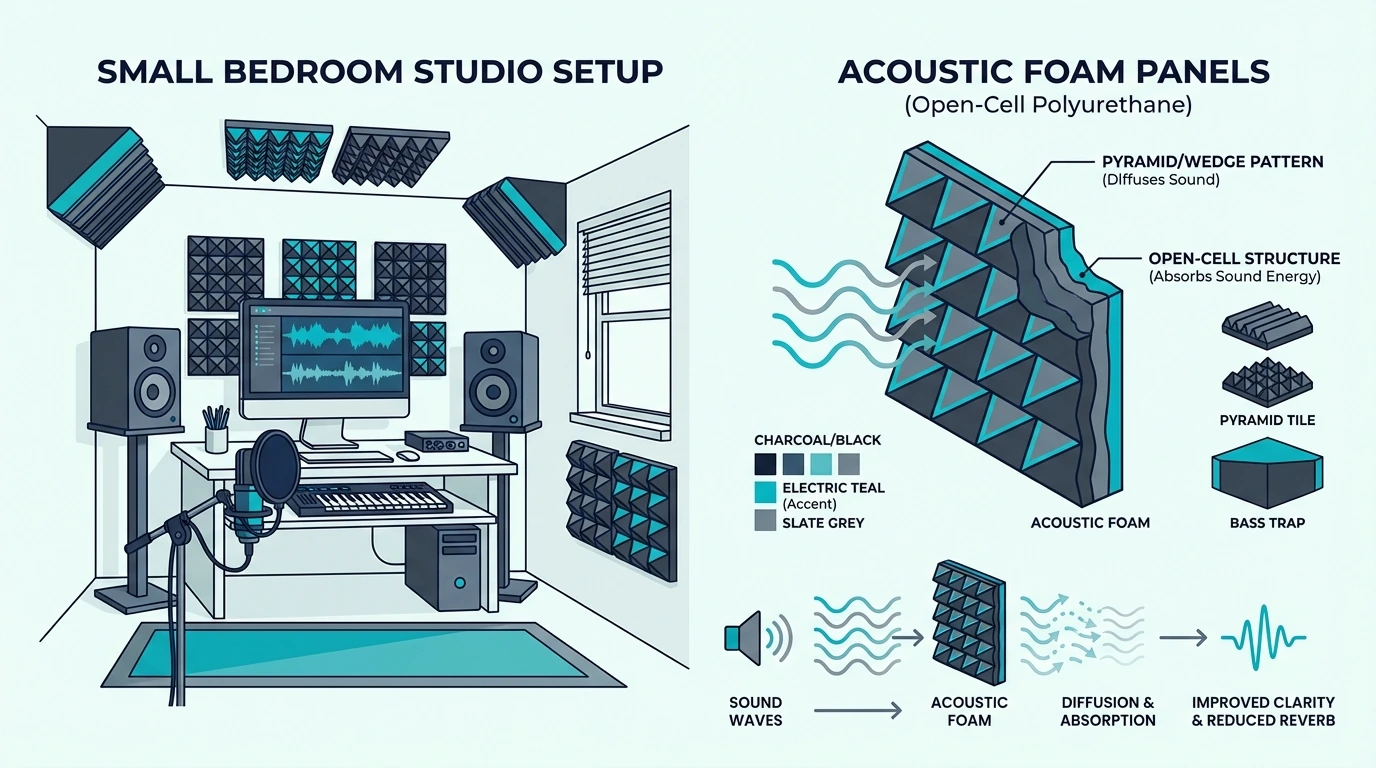
Sometimes acoustic foam is actually the right choice. Here’s when alternatives don’t make sense.
When Budget Alternatives Fall Short
Moving blankets and curtains work for basic treatment, but they have limits. If you’re recording vocals professionally or mixing music, you need more absorption than household items provide.
The gap between “good enough” and “actually good” matters when audio quality is your goal. Budget alternatives get you partway there; proper treatment gets you all the way.
When Foam Is Actually Cheaper
DIY panels cost less per square foot than commercial panels, but they require time and tools. If your time is valuable and you only need a few panels, buying foam might cost less overall.
Calculate the true cost: materials plus your hourly rate times build time. For small projects pre-made foam often wins, but for larger rooms DIY savings add up quickly.
The Time vs Money Tradeoff
Building eight DIY panels takes a full weekend. Ordering foam takes five minutes.
Some people enjoy building things. Others want to start recording immediately. Neither approach is wrong—it depends on your priorities and how you value your time.
If you’re leaning toward foam, a 52-pack foam bundle covers a small room for under $35. Check our guide to the best acoustic foam panels to compare options.
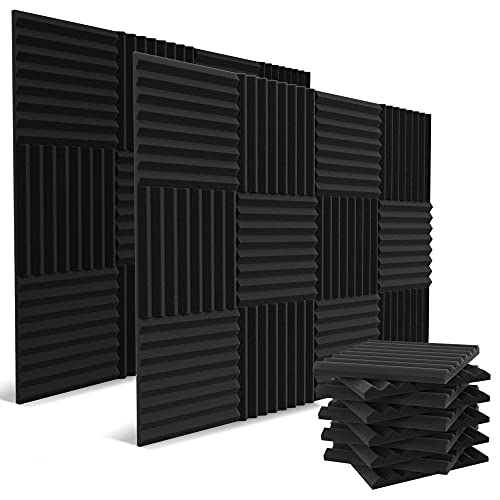
52-pack foam bundle
Rental-Friendly Solutions That Actually Work
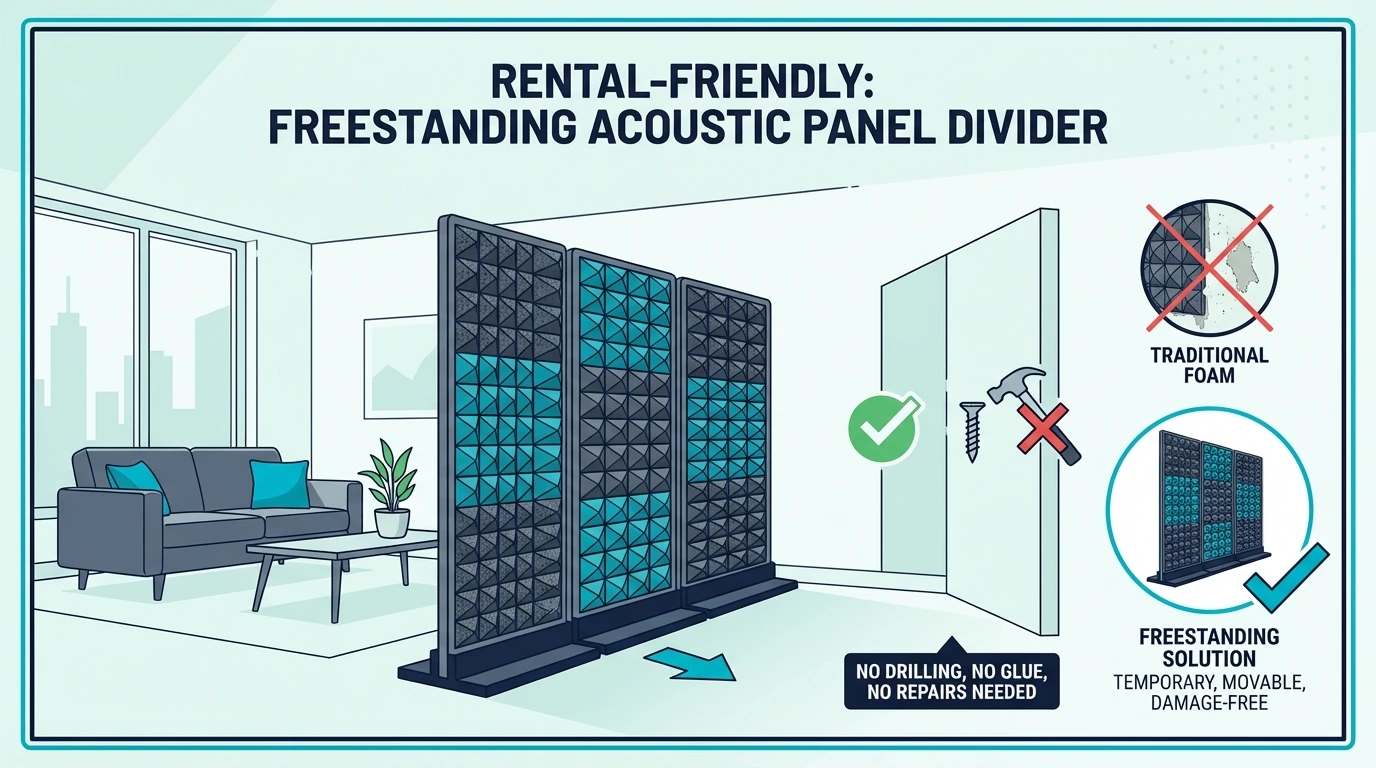
Renters face unique challenges. You need treatment that works but leaves no trace when you move out.
Freestanding Panel Dividers
Acoustic panel dividers stand on their own—no wall mounting required. They’re essentially acoustic panels on legs or frames that you position around your recording space.
These work particularly well for vocal recording. Place a divider behind you and another to the side, and you’ve created a semi-isolated recording environment without touching the walls.
The downside is floor space. Freestanding panels take up room that wall-mounted panels don’t. In small apartments, this tradeoff might not work.
Tension Rod Curtains
Heavy curtains hung from tension rods require zero wall damage. The rods press against the walls or window frames without screws or adhesive.
This approach works for windows, doorways, and even creating temporary room dividers. The curtains absorb sound while the tension rods leave no marks when removed.
For maximum effect, use the thickest curtains you can find and hang them with space behind. The air gap improves absorption significantly.
Portable Vocal Booths
Reflection filters and portable vocal booths mount to mic stands, not walls. They surround your microphone with absorptive material, reducing room reflections at the source.
These don’t treat the room—they treat the recording. The room still sounds echoey if you’re listening to playback, but your recorded vocals come out cleaner.
For podcasters and voice-over artists, portable booths often provide enough improvement without any room treatment at all—they’re the ultimate rental-friendly solution. Learn more about optimal foam placement in home studios if you decide to add room treatment later.
How to Choose the Right Alternative
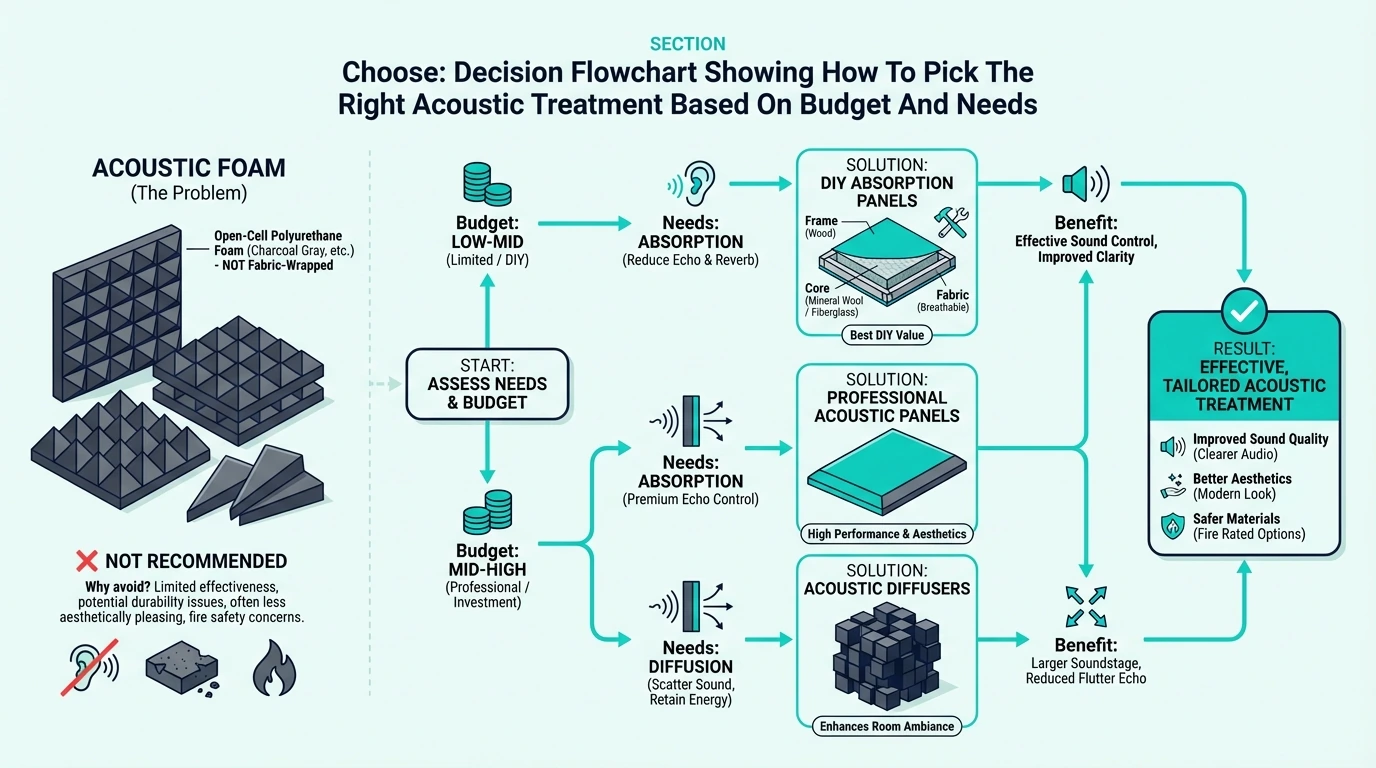
With so many options, picking the right one comes down to answering a few questions.
What’s Your Primary Goal?
Recording vocals requires different treatment than mixing music or reducing echo for video calls. Vocal recording benefits most from absorption behind and around the microphone.
Mixing requires balanced treatment across the entire room. Video calls just need basic echo reduction.
Match your treatment to your goal—over-treating a room for video calls wastes money. Under-treating for professional mixing wastes time fixing problems in post.
How Much Can You Spend?
Be honest about your budget before researching options. It’s easy to convince yourself you need commercial panels when moving blankets would solve your actual problem.
Start with the cheapest solution that might work, and upgrade if it’s not enough. This approach costs less than buying expensive treatment you might not need.
How Long Will You Stay?
Temporary living situations call for temporary solutions. Don’t invest in permanent acoustic treatment for an apartment you’ll leave in a year.
Conversely, if you own your space and plan to stay, investing in quality treatment pays dividends for years. The cost-per-use drops dramatically over time.
Do You Enjoy DIY Projects?
Building panels is satisfying if you like working with your hands, but frustrating if you don’t. Be honest about which category you fall into.
There’s no shame in buying pre-made solutions. Your time has value, and spending it on projects you don’t enjoy isn’t a good trade.
The Bottom Line
Acoustic foam isn’t your only option—and often isn’t your best option. Moving blankets provide cheap immediate improvement, DIY rockwool panels deliver professional performance at budget prices, and commercial fabric panels offer the best combination of looks and function.
The right choice depends on your budget, your space, and how much effort you’re willing to invest. Start with the simplest solution that might work, then upgrade if needed.
For most home studios, a combination of approaches works best: rugs on the floor, curtains on windows, and panels at first reflection points. You don’t need to cover every surface—strategic placement of the right materials beats random coverage with the wrong ones.
Whatever you choose, remember that any treatment beats no treatment. Even imperfect solutions improve your recordings and make your space more pleasant to work in.
Frequently Asked Questions
What is the cheapest acoustic treatment?
Rearranging furniture costs nothing—bookshelves, couches, and closets all absorb and scatter sound. After that, moving blankets at a few dollars each offer the best budget absorption, and heavy curtains you already own also help.
Can I use blankets instead of acoustic foam?
Yes, thick blankets absorb sound effectively—sometimes better than cheap foam, and moving blankets work best because they’re dense and heavy. The main tradeoff is appearance: blankets look like blankets, not professional treatment.
Are DIY panels as good as commercial acoustic foam?
DIY rockwool or fiberglass panels actually outperform most acoustic foam, achieving NRC ratings of 0.95-1.0 compared to foam’s 0.3-0.5. The materials cost less per square foot than quality foam, though you invest time in building them.
What absorbs sound in a room naturally?
Soft, porous materials absorb sound—upholstered furniture, thick curtains, carpets, and bookshelves—while hard, flat surfaces like bare walls and glass windows reflect it. Adding soft materials and breaking up flat surfaces improves any room’s acoustics.
Is rockwool better than acoustic foam?
Rockwool significantly outperforms acoustic foam in absorption tests—it handles a wider frequency range, absorbs more energy at each frequency, and lasts longer without degrading. The only advantages foam has are easier installation and lower skill requirements.
Do acoustic panels work for blocking neighbor noise?
No—acoustic panels and foam absorb sound inside a room, but they don’t block sound from entering or leaving. Blocking neighbor noise requires mass (thick walls, solid doors, sealed gaps), which is soundproofing, not acoustic treatment—completely different solutions.