How Acoustic Treatment Works (The Science Behind Better Sound)
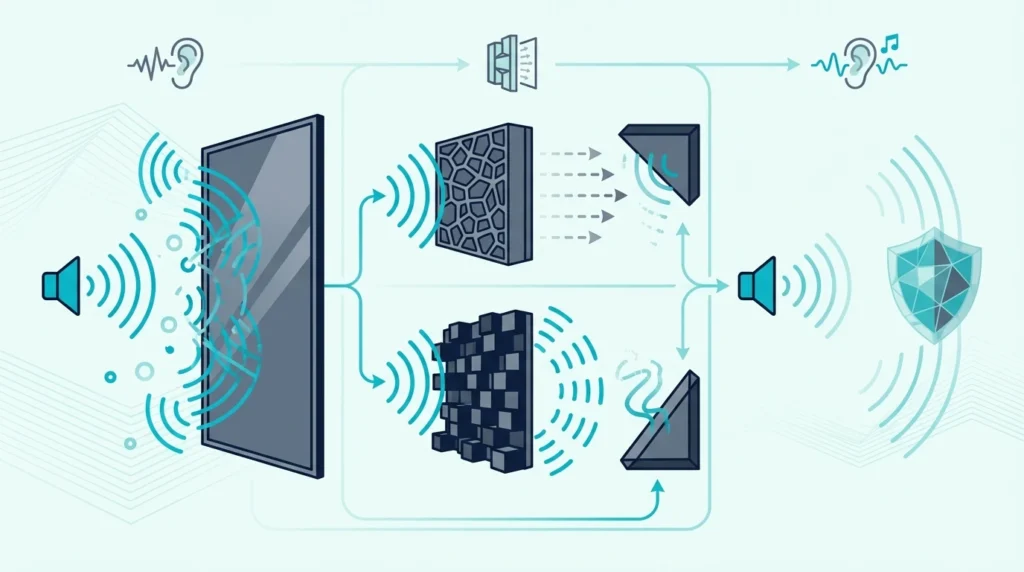
How acoustic treatment works is simple in theory — absorb, diffuse, or trap sound energy before it bounces around the room — but most people get the execution wrong, wasting money on the wrong materials in the wrong places.
You can hear the problem in any untreated room. Clap your hands in a bare bedroom and you hear a metallic ring that sustains for a second or more.
That ring is sound bouncing between parallel walls hundreds of times per second, and it colors everything you record or mix in that space.
The fix is not complicated. Strategic placement of absorbers, diffusers, and bass traps intercepts those reflections and either converts them to heat or scatters them so they no longer cause problems.
The starting point is understanding which type of treatment targets which problem, because absorption, diffusion, and bass trapping each work through different physical mechanisms.
Below, this guide explains exactly how each type of acoustic treatment works at a physics level, why thickness and placement matter more than coverage area, and how to prioritize treatment for the biggest impact in your room.
Acoustic treatment works by controlling sound reflections inside a room. Absorption panels convert sound energy to heat through friction in porous materials. Diffusers scatter sound in multiple directions to eliminate hot spots. Bass traps use thick, dense material in corners to absorb low frequencies. The most effective approach combines all three, starting with bass traps in corners and absorption panels at first reflection points.
How Acoustic Treatment Works — The Science In Plain Language
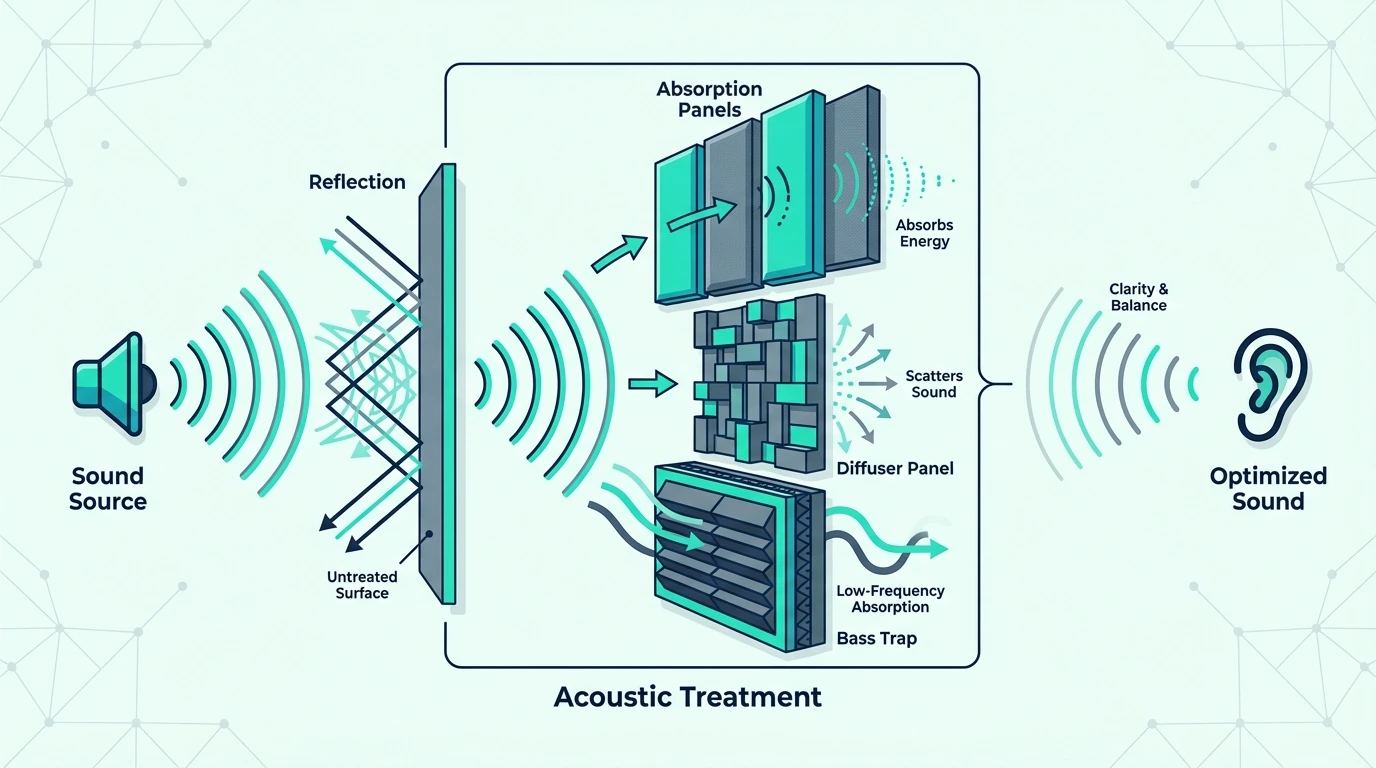
Sound is pressure waves moving through air. When those waves hit a surface, three things can happen: the sound reflects (bounces back), absorbs (converts to heat), or transmits (passes through to the other side).
In an untreated room, most surfaces — drywall, glass, concrete, hardwood — reflect the vast majority of sound energy back into the space. A bare drywall wall reflects roughly 95% of the sound that hits it.
Those reflections combine with the direct sound from your speakers or instruments and create a distorted version of reality. Some frequencies get louder when direct and reflected waves arrive in phase, and others cancel out when they arrive out of phase.
The result is a frequency response at your listening position that looks nothing like what your speakers are actually producing. You might have a 15 dB peak at 80 Hz and a 10 dB null at 120 Hz — and every mix decision you make is a reaction to that distortion rather than the actual music.
Acoustic treatment works by intercepting those reflections before they reach your ears. Absorbers remove energy from the room.
Diffusers redistribute it more evenly. Bass traps target the low frequency problems that are hardest to control.
For a broader overview of the three treatment types, see what is acoustic treatment.
How Does Sound Absorption Work?
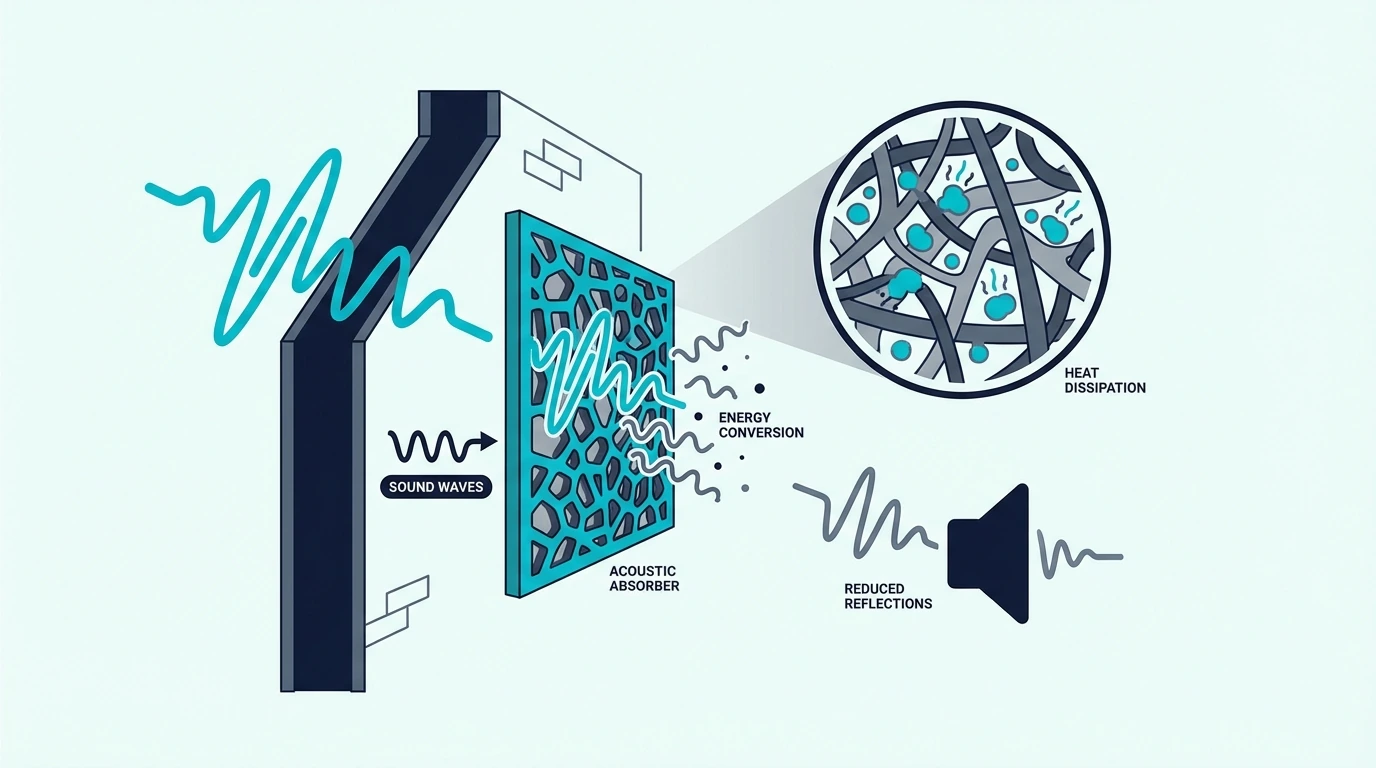
Sound absorption is the most common form of acoustic treatment. It works through a simple physical process: sound waves enter a porous material, and the air molecules vibrating inside the material’s fibers lose energy through friction.
That lost energy converts to a tiny amount of heat — not enough to feel, but enough to significantly reduce the reflected sound. The denser the material and the more internal surface area it has, the more friction occurs and the more sound gets absorbed.
The process is frequency-dependent. High frequencies have short wavelengths and lose energy quickly in even thin materials.
Low frequencies have long wavelengths and need much more material depth to slow down.
This frequency dependency is why a single type of panel cannot solve every acoustic problem. Effective treatment requires matching material thickness to the frequency range you need to control.
The standard measurement is NRC (Noise Reduction Coefficient), which ranges from 0 to 1.0. An NRC of 0.95 means 95% of sound energy is absorbed.
A bare drywall wall has an NRC of about 0.05. A 2-inch fiberglass acoustic panel hits NRC 0.95 or higher.
The three main absorption materials are fiberglass (rigid boards like Owens Corning 703), mineral wool (rockwool), and open-cell foam. Fiberglass and mineral wool perform similarly and both outperform foam, especially at lower frequencies.
For panels that deliver professional-grade absorption, the UMIACOUSTICS Fiberglass Acoustic Panels use a 2-inch fiberglass core that absorbs across the full mid and high frequency range.
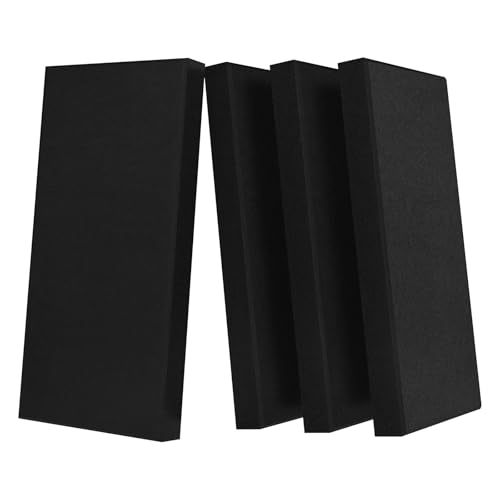
UMIACOUSTICS Fiberglass Acoustic Panels
Why Thickness Matters
Thickness is the single most important variable in absorption panel performance. A panel absorbs frequencies whose quarter-wavelength is equal to or shorter than the panel’s thickness.
A 1-inch foam panel absorbs well above 2,000 Hz but does almost nothing at 500 Hz. A 2-inch fiberglass panel absorbs effectively down to about 500 Hz.
A 4-inch panel reaches down to about 250 Hz.
This is why foam — which is typically 1 to 2 inches thick — fails as a complete treatment solution. It handles the flutter echo and sibilance range but leaves the mid-bass and bass completely untreated.
Those are the frequencies that cause the worst problems in small rooms. For a deeper look at why egg cartons and cheap foam alternatives fall short, we break down the specific frequency limitations.
For broadband absorption that reaches into the bass range, you need panels that are at least 2 inches thick, and ideally 4 inches for any panel that doubles as a bass absorber. Larger panels in the 24×48-inch range provide the surface area needed for serious broadband treatment.
The Air Gap Trick
One of the most effective techniques in acoustic treatment is mounting panels with an air gap between the panel and the wall. This shifts the absorption curve lower without adding any material thickness.
A 2-inch panel mounted flush against the wall absorbs effectively down to about 500 Hz. The same panel mounted with a 2-inch air gap absorbs down to about 250 Hz — because the air gap effectively doubles the depth of the absorber for low frequencies.
The physics behind this is straightforward. Sound absorption is most effective where air particle velocity is highest, which is a quarter-wavelength from the wall surface.
An air gap moves the absorption material to that optimal position for lower frequencies.
This technique is especially powerful for small room treatment where wall space is limited. You get deeper absorption without building thicker panels.
The practical application is straightforward. Use standoff brackets or spacers to mount your panels 2-4 inches from the wall.
The total effective depth becomes the panel thickness plus the air gap, giving a thin panel the bass absorption of a much thicker one.
Combining this technique with corner mounting is how professional studios achieve deep bass absorption without filling the room with massive traps. A 2-inch panel straddled across a corner with a 4-inch air gap behind it absorbs as effectively as a 6-inch panel mounted flat. Rockboard 60 mineral wool boards are popular for this technique because the 6 lb per cubic foot density maximizes absorption per inch of thickness.
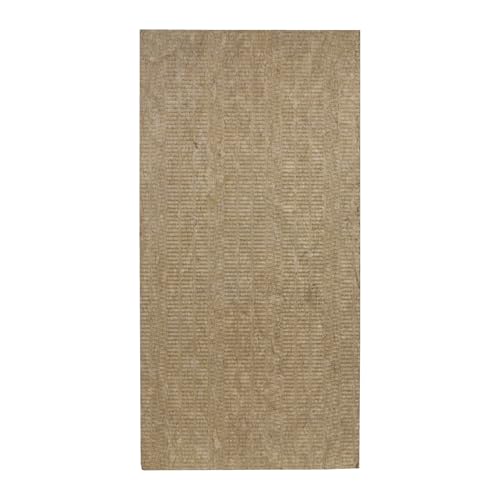
Rockboard 60 mineral wool boards
Get Studio Tips Weekly
Join 5,000+ creators getting acoustic treatment advice every week.
No spam. Unsubscribe anytime.How Does Sound Diffusion Work?
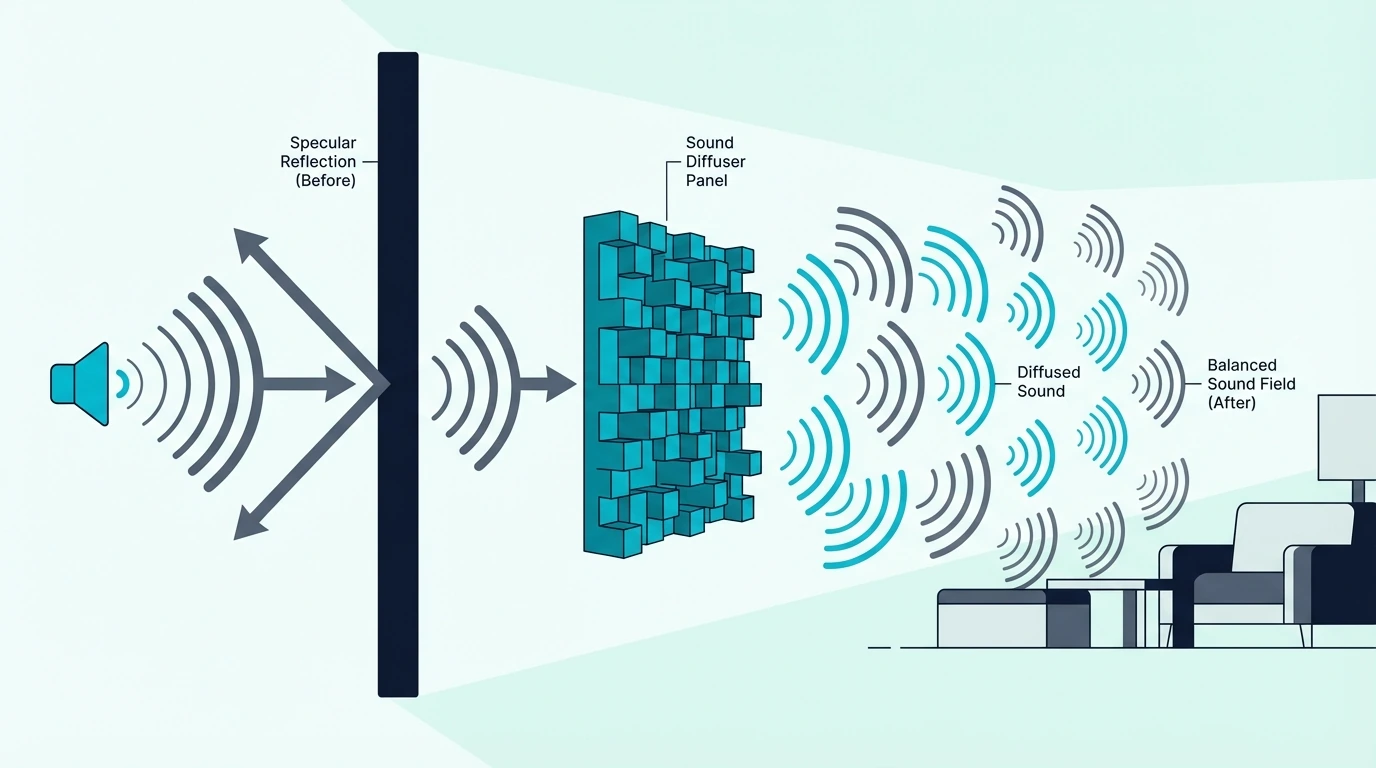
Diffusion takes the opposite approach from absorption. Instead of removing sound energy from the room, diffusers scatter it in multiple directions so that no single strong reflection reaches your ears.
The room stays lively and natural-sounding, but without the problematic echoes and comb filtering that come from flat, hard surfaces. This is why professional studios use diffusers alongside absorbers — a room that is 100% absorbed sounds dead and lifeless.
Diffusers work by presenting surfaces at varying depths to incoming sound waves. When a sound wave hits a diffuser, different parts of the wave reflect off surfaces at different distances, causing the reflected wave to break apart and scatter.
QRD And Skyline Diffusers
The two most common diffuser designs are QRD (Quadratic Residue Diffusers) and skyline diffusers, both based on mathematical sequences.
QRD diffusers use a series of wells at varying depths calculated from a quadratic residue sequence. The depth differences cause the reflected sound to scatter in a specific, mathematically optimal pattern.
One-dimensional QRD diffusers scatter sound in one plane (left-right), while two-dimensional designs scatter in all directions.
Skyline diffusers use blocks of varying heights arranged in a grid pattern. The effect is similar to QRD — different block heights create different reflection path lengths, scattering the sound evenly across the room.
Natural diffusion also exists in everyday objects. A bookshelf filled with books of different sizes acts as an accidental diffuser, scattering sound off the irregular surfaces of book spines at varying depths.
This is why well-furnished rooms often sound better than bare ones even without any intentional acoustic treatment.
The effective frequency range of a diffuser depends on its well depths and overall size. Deeper wells scatter lower frequencies.
The diffuser must also be large enough relative to the wavelength — a small diffuser only scatters high frequencies. This is why diffusers work best in rooms where the rear wall is at least 8 feet from the listening position.
Diffusion matters most on the rear wall of a mixing room and on the ceiling above the listening position. For mixing room treatment, the front of the room should be absorptive while the rear benefits from diffusion to maintain natural ambience.
How Do Bass Traps Work?
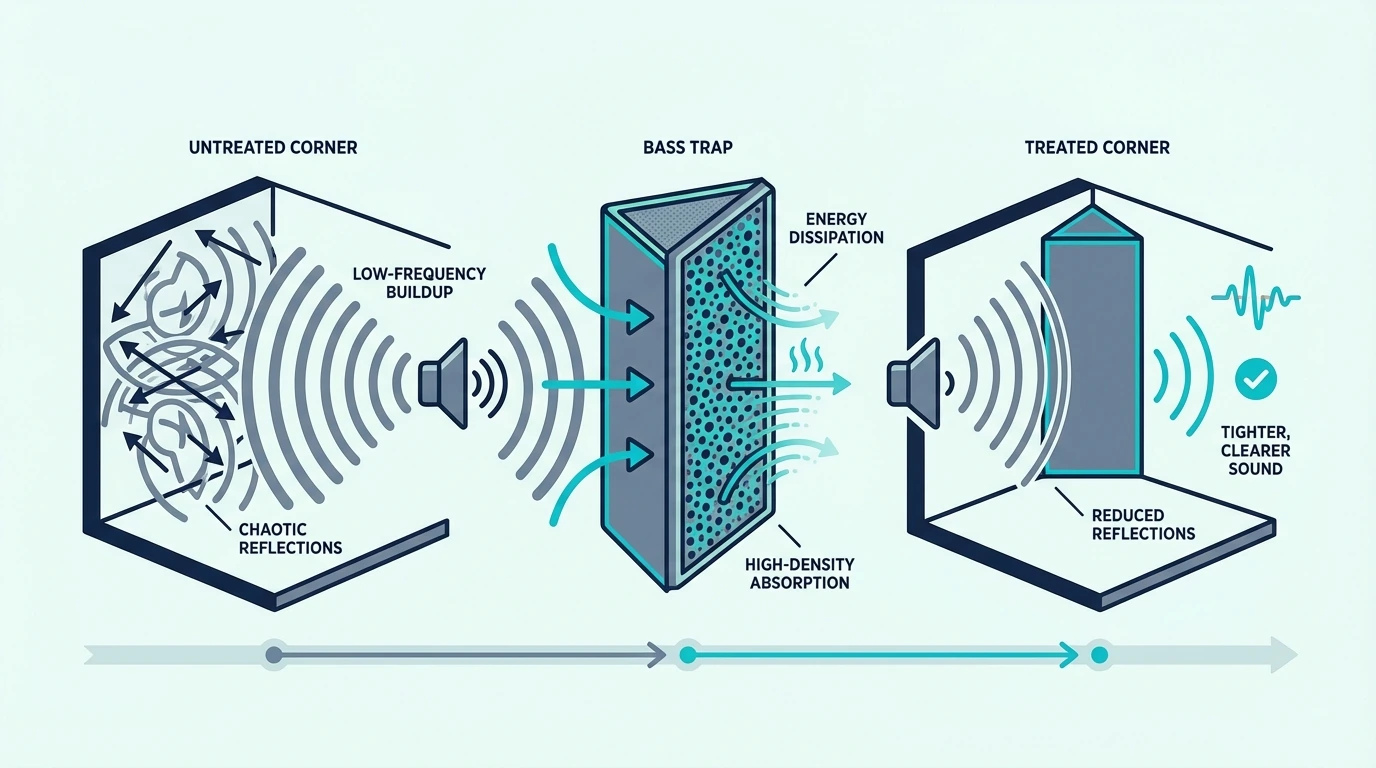
Low frequencies are the hardest to control because their wavelengths are extremely long. A 100 Hz wave is 11 feet long, and a 50 Hz wave stretches 22 feet.
Thin panels cannot absorb these wavelengths because the material is simply too shallow relative to the wave.
Bass traps solve this by using thick, dense absorptive material — typically 4 to 6 inches of fiberglass or mineral wool — positioned where bass energy naturally concentrates.
The physics is the same as standard absorption, but scaled up. More material depth means more friction over a longer path, which captures more low-frequency energy.
A 4-inch mineral wool bass trap with a 4-inch air gap behind it effectively behaves like an 8-inch absorber for bass frequencies.
For a budget-friendly corner treatment, the TroyStudio Bass Traps 24-Pack provide immediate corner treatment while you plan a more serious fiberglass solution.
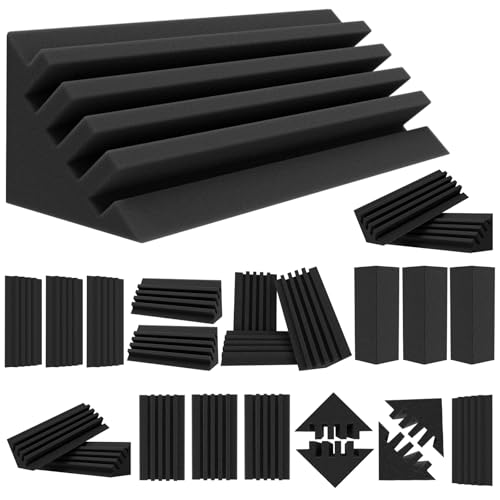
TroyStudio Bass Traps 24-Pack
Why Corners Are Critical
Sound pressure doubles at every wall boundary and quadruples where two walls meet (a corner). In a tri-corner — where two walls meet the ceiling or floor — pressure is eight times higher than in open space.
This means corners are where bass energy is most concentrated, which makes them the most effective location for bass traps. A bass trap in a corner absorbs far more low-frequency energy than the same trap placed on a flat wall.
The math works in your favor here. Because pressure is multiplied at boundaries, a relatively small amount of absorptive material in a corner has an outsized impact on the room’s overall bass response.
Four corner traps spanning floor to ceiling can reduce room mode severity by more than half.
The front two corners of a mixing room should be the first priority, because they are closest to the monitoring position and have the most direct impact on what you hear. Rear corners come next, followed by ceiling-wall junctions.
Standing waves — the resonant frequencies determined by room dimensions — create predictable patterns of peaks and nulls. At a peak, bass is unnaturally loud, and at a null, it nearly disappears.
Corner bass traps reduce the severity of these peaks, flattening the bass response toward what the speakers are actually producing.
Before-and-after measurements typically show a 10-15 dB reduction in the worst standing wave peaks after installing corner bass traps. That translates directly to more accurate bass at your listening position.
The improvement is not subtle. Mixes made in a room with proper bass trapping translate to other systems on the first bounce, because you are finally hearing what the speakers are actually producing instead of what the room is adding on top.
For home theater setups, bass traps also tighten dialogue and reduce the boomy, one-note bass that plagues most living room systems.
The Bottom Line
Acoustic treatment works by controlling three things: absorption removes excess sound energy, diffusion scatters it evenly, and bass trapping targets the low frequencies that are hardest to manage.
The priority order is clear. Start with bass traps in corners — they address the biggest problems in any small room.
Add absorption panels at first reflection points to clean up the mid and high frequency imaging. Add diffusion to the rear wall last, if the room feels too dead after absorption.
Understanding how each mechanism works helps you make smarter decisions about what to buy and where to place it. A 4-inch panel in the right spot outperforms ten 1-inch foam tiles scattered randomly across your walls.
If you are deciding whether your space actually needs treatment, see is acoustic treatment necessary. For the complete picture of setting up a home studio treatment plan, we walk through every step.
For budget-conscious builders, the DIY acoustic treatment guide shows how to build panels that perform as well as commercial options at a third of the cost.
Frequently Asked Questions
Does acoustic treatment block sound?
No — acoustic treatment and soundproofing are completely different things. Treatment controls sound reflections within a room to improve what you hear inside it.
Blocking sound between rooms requires mass, isolation, and sealed air gaps — which is soundproofing, not treatment. No amount of foam or fiberglass panels will stop sound from passing through a wall.
How does acoustic foam work?
Acoustic foam absorbs sound through the same friction mechanism as fiberglass — sound waves enter the open-cell structure and lose energy as air molecules vibrate against the foam walls.
The limitation is thickness. Most foam panels are 1-2 inches thick, which means they only absorb mid and high frequencies effectively.
For bass absorption, you need denser, thicker materials like rockwool or rigid fiberglass. Our acoustic treatment cost guide breaks down what each material costs per square foot.
What is the difference between absorption and diffusion?
Absorption removes sound energy from the room by converting it to heat. The room gets quieter and reflections decrease.
Diffusion scatters sound energy in multiple directions without removing it. The room stays lively and natural, but without the focused reflections and echoes that cause problems. Most professional studios use both — absorption at first reflection points and diffusion on the rear wall.