Do Egg Cartons Work For Acoustic Treatment (The Honest Answer)
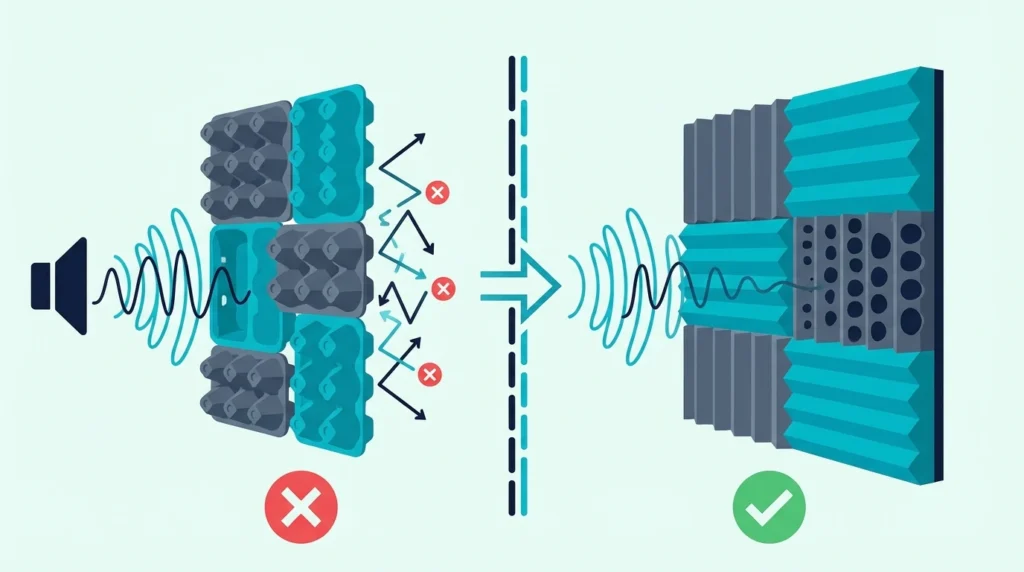
Do egg cartons work for acoustic treatment is one of the most persistent myths in home recording — but the honest answer is no, egg cartons provide essentially zero meaningful acoustic absorption and using them wastes time you could spend on solutions that actually improve your room.
The myth persists because egg cartons look like acoustic foam. The bumpy, textured surface appears similar to the pyramid or wedge patterns used on real acoustic panels.
But acoustic treatment works because of material density and thickness, not surface shape. A material needs to be porous and thick enough for sound waves to enter and lose energy through friction.
Egg cartons are thin cardboard with almost no mass. They do not absorb sound — they scatter a tiny amount of high-frequency energy while doing nothing at the mid and low frequencies where room problems actually exist.
Real treatment costs less than most people expect and delivers dramatically better results. Even the cheapest proper acoustic panel outperforms any amount of egg cartons by a wide margin.
Below you will find exactly why egg cartons fail acoustically, what they actually do to sound, and the specific alternatives that solve room problems starting at 15 dollars per panel. Start with two fiberglass panels at first reflection points — that single upgrade outperforms a room completely covered in egg cartons.
Egg cartons do not work for acoustic treatment. They are thin cardboard that absorbs less than 5% of sound energy at any frequency. The bumpy shape scatters a tiny amount of high-frequency sound but provides no meaningful absorption. Real acoustic panels made from fiberglass or mineral wool absorb 90%+ of mid and high frequency energy. Two DIY panels at first reflection points cost 30-50 dollars total and outperform an entire room covered in egg cartons.
Why Do People Think Egg Cartons Work?
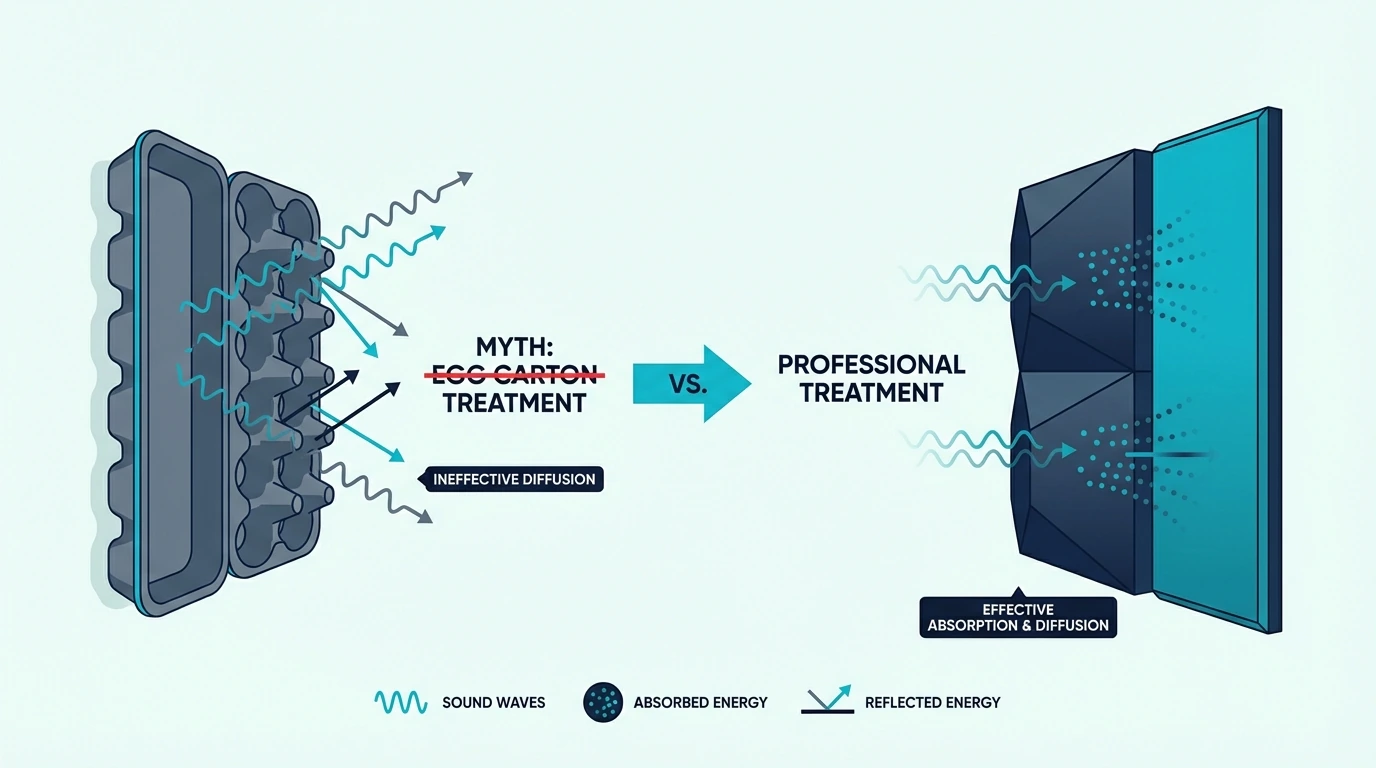
The egg carton myth comes from a visual association. Acoustic foam panels have textured surfaces — pyramids, wedges, or egg-crate patterns — and egg cartons have a similar bumpy shape.
The assumption is that the shape is what makes acoustic treatment work.
That assumption is wrong. The shape of acoustic foam is a secondary design feature that helps with high-frequency scattering.
The primary mechanism of sound absorption is the material itself — open-cell foam with a porous structure that converts sound energy into heat through friction as air molecules move through the material.
Shape Vs Material — Why It Matters
Sound absorption happens when sound waves enter a porous material and lose energy through friction with the material fibers or cell walls. The denser and thicker the material, the more energy it absorbs across a wider frequency range.
Acoustic foam works because it is an open-cell porous material. Sound enters the foam, passes through the interconnected air pockets, and loses energy with each interaction.
A 2-inch thick acoustic foam panel absorbs 50-80% of mid and high frequency energy. That is 10-80 times more absorption than egg cartons provide.
Egg cartons are closed-cell cardboard — a thin, rigid material with no internal air pockets for sound to pass through. Sound hits the cardboard surface and bounces off almost entirely.
The absorption coefficient of cardboard is approximately 0.01-0.05, meaning it absorbs 1-5% of sound energy.
What Egg Cartons Actually Do
Egg cartons scatter a small amount of high-frequency sound due to their uneven surface. When a sound wave hits the bumpy surface, the reflections break into multiple directions rather than bouncing back in a single coherent reflection.
This scattering slightly reduces flutter echo — the rapid metallic ringing between two parallel walls. But it does not remove the sound energy from the room.
The same energy is still present, just redirected. A room with egg cartons on every wall still has the same reverb time and the same frequency response problems as a bare room.
At frequencies below approximately 2,000 Hz — where the majority of room problems exist — egg cartons have no measurable effect. Bass buildup, muddy low-mids, and comb filtering from wall reflections remain completely unchanged.
The same goes for blocking sound: egg cartons don’t keep noise in or out either, and our page on whether egg cartons soundproof a room explains why.
Egg cartons also present a fire hazard. Cardboard is flammable, and covering walls with it near studio lighting and electrical equipment creates a genuine safety risk that real acoustic materials — which are typically fire-rated — do not.
The how treatment works guide explains the physics of sound absorption in detail, including why material porosity matters more than surface shape.
What Should You Use Instead Of Egg Cartons?
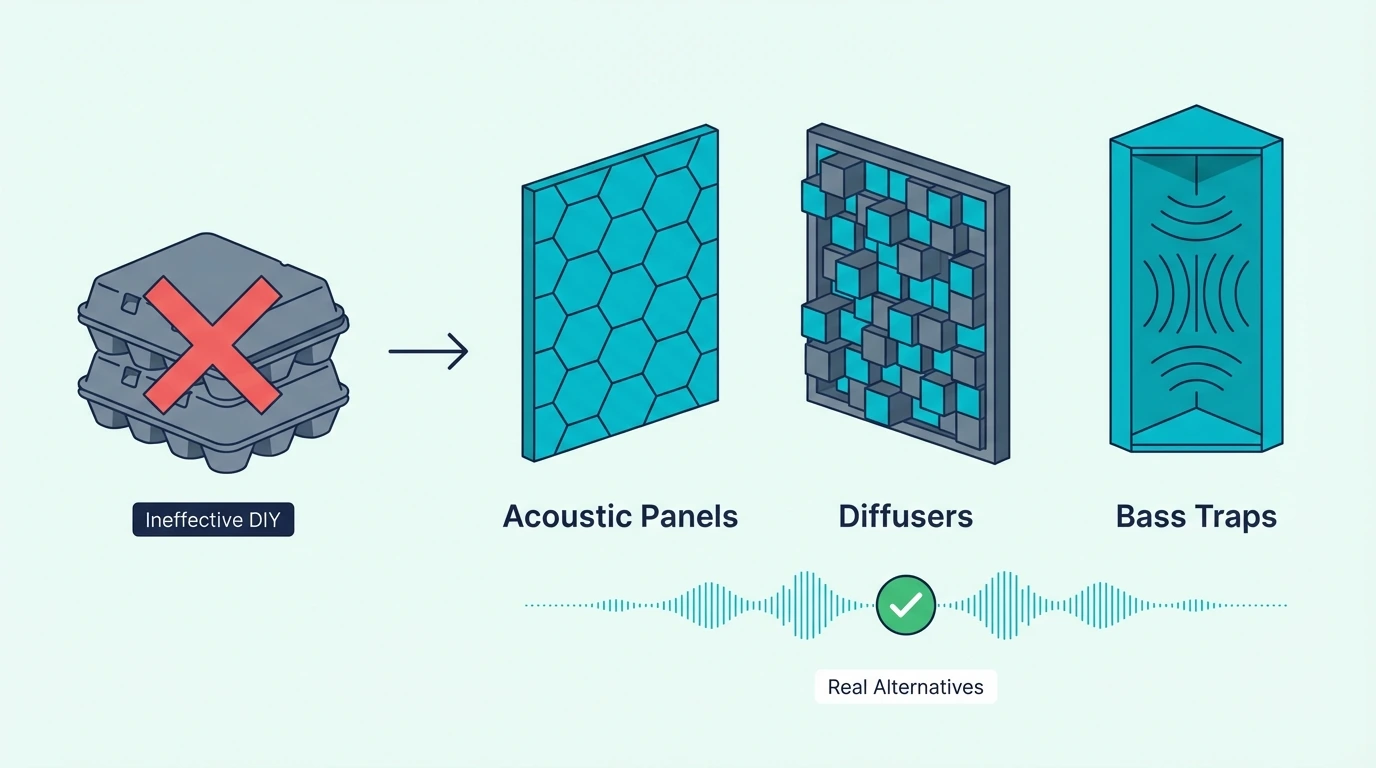
Real acoustic treatment uses materials that absorb sound through their porous structure. The three most common options, ranked from best to most budget-friendly:
DIY Rockwool Or Fiberglass Panels
DIY panels built from rigid fiberglass or mineral wool insulation are the best-performing budget option. A 2-inch panel made from 3 lb per cubic foot insulation achieves NRC 1.0 — absorbing virtually all mid and high frequency energy.
The total cost per panel is approximately 15-25 dollars in materials: a wooden frame, insulation board, and fabric wrap. Two panels at first reflection points on your side walls produce a dramatic, immediately audible improvement.
The small room guide explains first reflection point placement using the mirror trick — the process takes five minutes and tells you exactly where your panels need to go.
For those who prefer a ready-to-hang solution, UMIACOUSTICS fiberglass panels include hanging brackets and a 2-inch fiberglass core that absorbs 90%+ of mid and high frequency sound. A 4-pack treats two first reflection points — the highest-priority positions in any room.
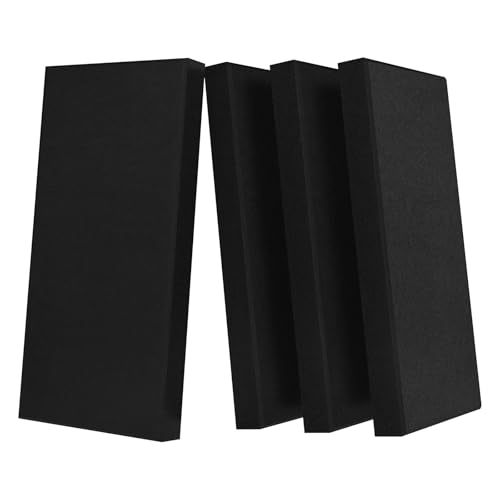
UMIACOUSTICS fiberglass panels
Budget Acoustic Foam
Acoustic foam is not as effective as fiberglass or mineral wool panels, but it is infinitely better than egg cartons. A 2-inch acoustic foam panel absorbs 50-80% of mid and high frequency energy compared to the 1-5% that egg cartons provide.
Foam works best for controlling flutter echo and reducing high-frequency harshness. It does not absorb low frequencies effectively — bass problems require thicker, denser materials like the fiberglass and mineral wool panels described above.
If you are choosing between foam and fiberglass, fiberglass wins at every price point and every frequency. Foam only makes sense when you need the lightest possible panel for a surface that cannot support heavier materials.
The cost breakdown guide compares foam pricing against fiberglass and mineral wool panels across different room sizes.
Moving Blankets
Heavy moving blankets hung on walls provide NRC 0.2-0.4 — absorbing 20-40% of mid and high frequency energy. They are not as effective as fiberglass panels, but they cost 10-20 dollars each and can be hung temporarily.
Moving blankets are a reasonable temporary solution while you save for proper panels. The blankets as treatment guide covers hanging methods and realistic performance expectations.
For budget-conscious setups, Olanglab fiberglass panels offer a step up from blankets with real fiberglass absorption in a fabric-wrapped panel that mounts with command strips. The 1-inch thickness handles mid and high frequencies where egg cartons and blankets fall short.
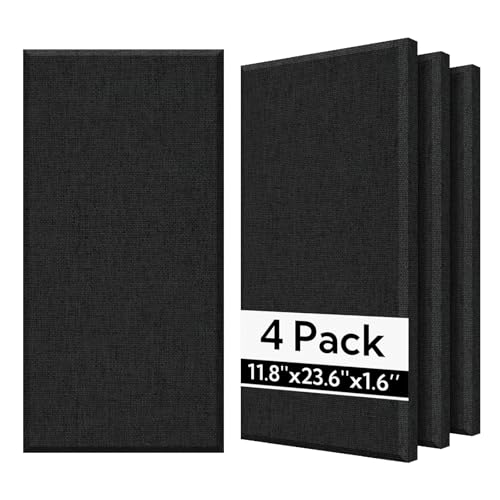
Olanglab fiberglass panels
Get Studio Tips Weekly
Join 5,000+ creators getting acoustic treatment advice every week.
No spam. Unsubscribe anytime.The Bottom Line
Egg cartons do not work for acoustic treatment. They are thin cardboard that absorbs less than 5% of sound energy.
The bumpy shape scatters a tiny amount of high-frequency sound but provides no meaningful improvement.
Two DIY fiberglass panels at first reflection points cost 30-50 dollars and absorb 90%+ of the reflections that damage your recordings and mixes. That single upgrade outperforms a room completely covered in egg cartons.
The full guide to acoustic treatment covers the complete treatment workflow from first panel through full room setup. For the home studio setup guide, treatment priorities are ranked by impact so you know exactly where to start.
The fiberglass treatment guide covers panel thickness, density options, and construction details for the most effective treatment material.
Frequently Asked Questions
Do egg cartons reduce echo?
Barely. Egg cartons scatter a tiny amount of high-frequency sound due to their uneven surface, which can slightly reduce flutter echo between parallel walls.
But they do not absorb any meaningful amount of sound energy.
Real echo reduction requires absorption — materials that convert sound energy into heat. Even a heavy blanket absorbs 20-40% of mid-high frequency sound, which is 4-40 times more than egg cartons.
What is the cheapest effective acoustic treatment?
DIY panels with mineral wool or fiberglass in wooden frames cost 15-25 dollars per panel and achieve NRC 1.0. Two panels at first reflection points dramatically improve room acoustics for a total investment of 30-50 dollars.
The budget treatment guide ranks every option by performance per dollar from free techniques through commercial panel packages.
Can cardboard soundproof a room?
No. Cardboard has almost no mass or absorption properties.
Soundproofing — blocking sound from entering or leaving a room — requires dense, heavy materials like mass loaded vinyl, concrete, or double layers of drywall.
Acoustic treatment and soundproofing are different things. Treatment controls sound reflections inside a room.
Soundproofing blocks sound transmission between rooms. Cardboard does neither effectively.
The is treatment necessary guide explains when you need treatment, when you need soundproofing, and how to tell the difference based on your specific recording or mixing problems.