Can I Take My DJ Controller on a Plane? Rules, Sizes and Cases
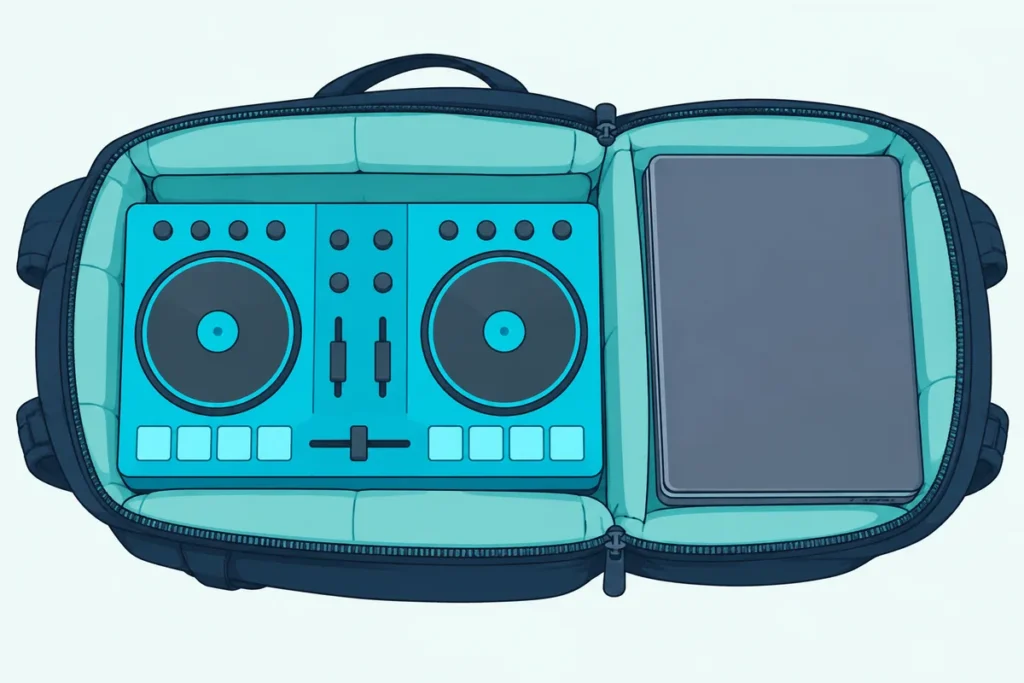
Can I take my DJ controller on a plane? Yes, but whether it arrives in one piece depends on where it sits: in the cabin with you, or in the hold with the baggage handlers.
Picture a gate agent tagging your controller case for the hold because the bins are full, while the gear you saved months for disappears down the jet bridge.
This guide covers what the rules say, which controllers fit in a carry-on, how to handle batteries and security, and what to do if the airline takes your bag at the gate.
You’ll also see the limits airline by airline, four travel-friendly picks, and when insurance, paperwork or shipping beats flying with it.
Start with what the authorities say, because the short answer is simpler than most advice suggests.
Can I Take My DJ Controller on a Plane?
Yes, because nothing in TSA’s or the airlines’ published rules bans one. TSA’s complete list of what you can bring says electronics are allowed in carry-on and checked bags, and it recommends packing expensive, fragile electronics in your carry-on (TSA’s complete list).
That list doesn’t name DJ controllers, so they fall under the general electronics rules. TSA asks you to pack electronics carefully and make sure all cords are wrapped.
The airline sets the size and weight limits, and TSA says the same about musical instruments: check with your airline before your flight to make sure the item meets the aircraft size requirements. Delta’s carry-on page allows one carry-on bag and one personal item, and American’s page allows the same (Delta, American).
The Department of Transportation has a rule for musical instruments, and it reads well for a keyboard player. It says each covered carrier shall permit a passenger to carry a violin, guitar or other small musical instrument in the cabin without an extra fee, if the instrument can be stowed safely and there’s space when the passenger boards (14 CFR 251.3).
A DJ controller doesn’t make sound by itself, and the rule doesn’t mention DJ gear, so don’t count on it. Treat the controller as ordinary carry-on baggage and plan around the airline’s bag limits.
Delta does add that its carry-on size limits don’t apply to small musical instruments that fit in the overhead or under-seat space. That’s a helpful sentence if a gate agent questions a small controller, but it isn’t a promise for DJ equipment.
Should You Carry It On or Check It?
Carry it on, and the rules and the odds both point that way. TSA recommends carry-on for expensive, fragile electronics, and the Department of Transportation says to avoid packing fragile items and valuables in luggage that could be checked (DOT’s baggage page).
The money side is the stronger argument. DOT says airlines often exclude liability for certain categories of items, such as fragile items and electronics, and that for domestic travel they aren’t required to compensate you for items they have excluded in their contracts of carriage.
That means a controller in a checked bag may not be covered at all on a domestic flight. DOT suggests considering extra insurance for valuable items.
International trips differ. DOT says airlines are responsible for those excluded items on international itineraries if they’ve accepted them for transportation, even if you didn’t disclose what was in the bag.
The hold has a second problem, which is the battery rule. The FAA says spare lithium batteries and power banks must be in carry-on baggage only, and devices with installed lithium-ion batteries can only be checked when powered off and protected from short circuit and unintentional activation (FAA PackSafe).
A USB-powered controller has no battery, but the laptop and power bank that travel with it do. Keeping the whole kit in the cabin avoids sorting out which piece can go where.
Delta also notes that computers can’t be checked unless security directs you to. So the laptop is already in the cabin, and the controller should be too.
Get Studio Tips Weekly
Join 5,000+ creators getting acoustic treatment advice every week.
No spam. Unsubscribe anytime.What Are the Carry-On and Personal Item Limits at Major US Airlines?
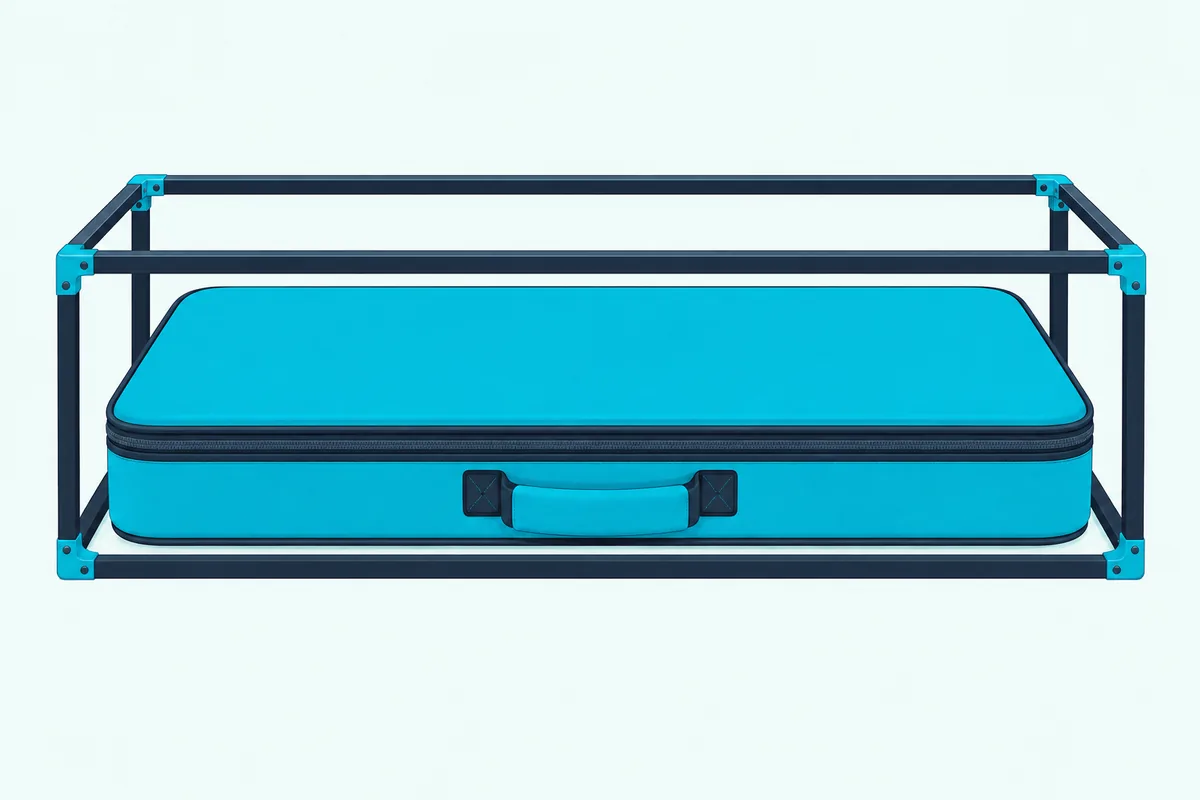
Most big US airlines allow a 22 by 14 by 9 inch carry-on, and their personal items run from 17 by 10 by 9 inches at United to 18 by 14 by 8 inches at American and Frontier. The table uses each airline’s own baggage page, read on 1 October 2026.
| Airline | Carry-on bag (inches) | Personal item (inches) | Worth knowing |
|---|---|---|---|
| Alaska | 22 x 14 x 9 | One item, no size listed | At least one of your two items goes under the seat |
| American | 22 x 14 x 9 | 18 x 14 x 8 | American Eagle regional flights have limited bin space |
| Delta | 22 x 14 x 9 | Under the seat, no size listed | Delta Connection flights with 50 seats or fewer take personal items only |
| Frontier | 24 x 16 x 10 | 18 x 14 x 8 | The personal item is included and the carry-on is a paid add-on |
| JetBlue | 22 x 14 x 9 | 17 x 13 x 8 | The carry-on goes in the bin if there’s space |
| Southwest | 24 x 16 x 10 | Under the seat, no size listed | Wheels, handles and attachments count toward the size |
| United | 22 x 14 x 9 | 17 x 10 x 9 | Basic Economy usually allows a personal item only |
Five of the seven airlines use the 22 by 14 by 9 inch carry-on, while Frontier and Southwest allow the larger 24 by 16 by 10 inches. All seven count handles and wheels toward the size, so a padded case is measured as a whole.
The personal item is where a controller gets stuck, because United’s limit is 17 by 10 by 9 inches and JetBlue’s is 17 by 13 by 8. American and Frontier allow 18 by 14 by 8.
Two fare rules matter as much as the sizes. United says Basic Economy passengers can bring only a personal item on most trips, and Frontier includes only a personal item with every fare and sells the carry-on separately.
Spirit isn’t in the table because its baggage page wasn’t readable on 1 October 2026, so look up its current limits before you fly it. Alaska also suggests measuring a soft-sided bag again once it’s packed, which is good advice for a padded controller case.
Will a DJ Controller Fit in a Carry-On?
Against those limits, most two-channel controllers fit, but the margin is smaller than it looks. Delta adds that a carry-on can’t pass 45 linear inches, which is length, width and height added together.
The table puts seven controllers against the 22-inch length of a standard carry-on, using each maker’s own numbers.
| Controller | Size in inches (L x W x H) | Weight | Spare length in a 22-inch carry-on |
|---|---|---|---|
| Numark DJ2GO2 Touch | 12.4 x 3.4 x 0.6 | 0.34 kg (0.75 lb) | 9.6 in |
| Numark Party Mix II | 12.8 x 7.8 x 2.0 | 0.95 kg (2.1 lb) | 9.2 in |
| AlphaTheta DDJ-FLX2 | 15.1 x 8.2 x 1.9 | 1.2 kg (2.6 lb) | 6.9 in |
| Pioneer DJ DDJ-FLX4 | 19.0 x 10.7 x 2.3 | 2.1 kg (4.6 lb) | 3.0 in |
| Numark Mixtrack Pro FX | 21.1 x 9.7 x 2.0 | 2.4 kg (5.35 lb) | 0.9 in |
| Numark Mixstream Pro Go | 22.3 x 11.2 x 2.9 | 3.7 kg (11 lb) | -0.3 in |
| Pioneer DJ DDJ-FLX10 | 28.2 x 15.8 x 2.9 | 6.7 kg (14.8 lb) | -6.2 in |
The sizes come from Numark’s DJ2GO2 Touch user guide and its Party Mix II, Mixtrack Pro FX and Mixstream Pro Go pages, AlphaTheta’s DDJ-FLX2 page, Pioneer DJ’s DDJ-FLX4 manual and its DDJ-FLX10 page, with the metric figures converted to inches.
Read the last column as the most a case can add to the length, because a padded case adds inches on every side. The three smallest controllers fit easily, the FLX4 has about three inches to spare, and the Mixtrack Pro FX has less than one.
Only the DJ2GO2 Touch, the Party Mix II and the DDJ-FLX2 fit a personal item bare, and the FLX2 leaves under two inches for a case at United or JetBlue. The FLX4 is one inch too long for the 18-inch personal items at American and Frontier, and two inches too long for the 17-inch ones.
The Mixstream Pro Go is a fraction over 22 inches, so it only fits the 24-inch carry-ons at Southwest and Frontier, with under two inches left for a case. The 4-channel DDJ-FLX10 is far beyond a standard carry-on in both length and width.
If you own a big 4-channel unit, our guide to 4 channel DJ controllers lists their sizes and why they’re desk fixtures rather than carry-on gear. Plan to check one in a proper case or ship it ahead.
What Kind of Case Should You Use to Fly With a Controller?
A padded case that matches the controller’s size is the usual answer, and the size decides which kind you can carry on. Soft padded bags and molded EVA bags are light and stay inside carry-on limits, while hard cases protect better but add weight and thickness.
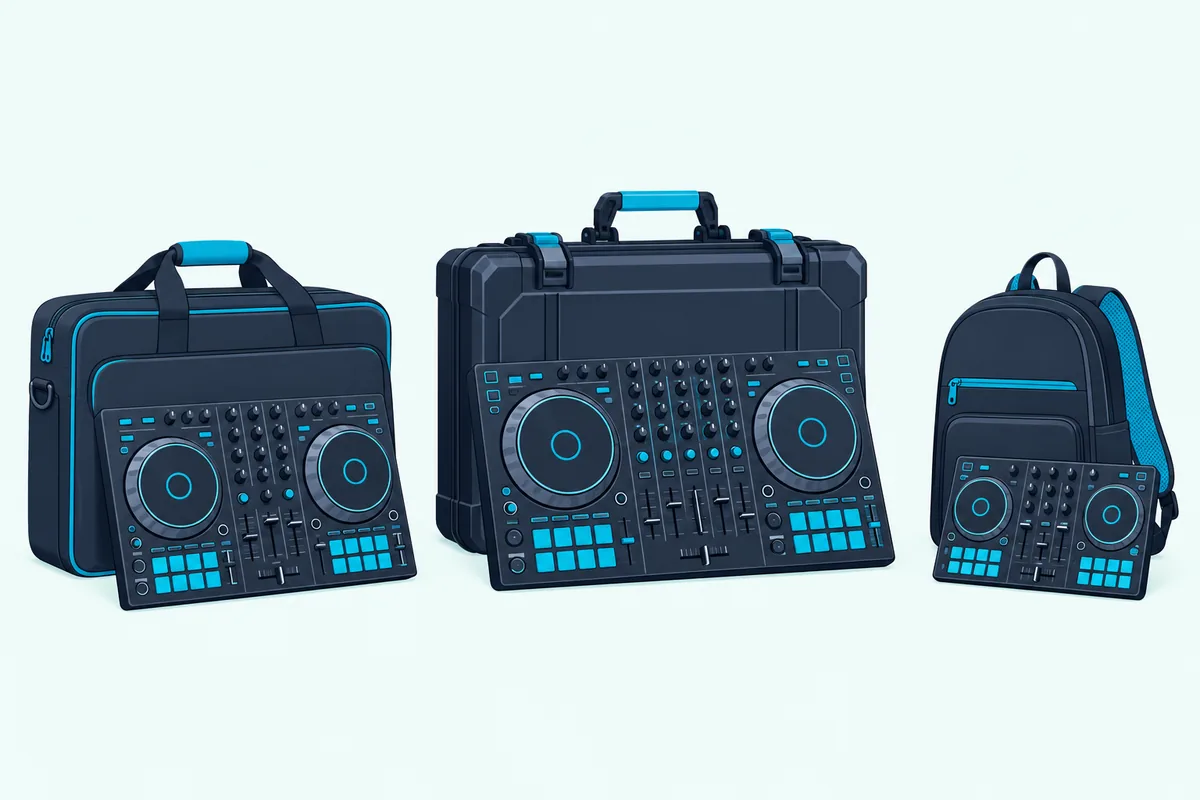
Measure first. Compare the controller’s length, width and height with the bag’s interior size, and leave room for padding on every side, because the airline measures the bag, not the gear.
The length matters most, since 22 inches is the standard limit. One popular DJ backpack for controllers as big as the DDJ-FLX10 lists a size of 31 by 18 by 3.8 inches, which is well over a standard carry-on length.
A laptop compartment earns its place. Delta counts a laptop bag as a personal item, so a controller case with a laptop sleeve keeps your two most valuable items together and in the cabin.
Label the bag. American says its carry-on should be labeled in case it needs to be checked, and DOT advises labeling checked baggage with your name, phone number and email address.
Flight cases and rack-style cases are made for checked freight, not cabin use. They’re heavy and rigid, and they rarely fit under 22 inches, so save them for shipping a large controller rather than flying with one.
If you check the controller or ship it, Delta’s musical-instrument page asks for cases that meet the ATA 300 standard from the Air Transport Association. Category I cases are designed to withstand at least 100 round trips and Category II cases at least 10.
Can You Buy a Seat for a Large or Fragile Controller?
Sometimes, and it’s the option to know about when a controller is too big for the bin and too valuable for the hold. Delta’s musical-instrument page says you may buy a full-fare ticket for an item you feel is too fragile to check, and United’s carry-on page says you can buy a ticket for an item that’s too fragile or bulky to check.
Delta sets the terms for that seat: the item can’t weigh more than 165 pounds, a seatbelt has to secure it, and it can’t block an exit, an aisle or anyone’s view of a required sign. Delta also says the item goes in a seat with a bulkhead or divider in front of it, preferably next to its owner.
Both rules sit on pages written for instruments and bulky items, and neither names DJ gear, so call the airline before you book. A full-fare ticket is a real expense, so this only makes sense for a large, expensive unit like a 4-channel controller on a paid booking.
How Do You Get a DJ Controller Through Airport Security?
Expect it to be screened as electronics, and give yourself time. TSA says to pack electronics carefully with cords wrapped, and to take laptops out of the bag and put them in a separate bin for X-ray screening.
TSA’s list says PreCheck travelers don’t need to take laptops out of the bag. A controller isn’t a laptop, so that rule doesn’t apply to it, but officers can still ask to look at it.
TSA’s FAQ says musical instruments carried on require a physical inspection at the checkpoint, and to tell the officer if the instrument needs special care. It’s written for instruments, but the advice is sensible for a fragile controller: if an officer wants to inspect it, ask them to handle it flat and by the edges.
Keep the pieces easy to see. A case that opens flat, with cables wrapped and the controller visible under a padded lid, lets an officer check it quickly without pulling everything out.
Wrapped cables matter for a practical reason. TSA specifically asks for it, and a tangle of USB and RCA cables is the thing most likely to slow an inspection.
Don’t pack anything in the controller’s case that you can’t afford to have removed. Put the power bank in a separate pouch, because spare lithium batteries get their own rules.
What About Batteries, Power Banks and Standalone Units?
Those battery rules matter less than you’d think, because most controllers have no battery at all, which makes flying simple. Pioneer DJ’s DDJ-FLX4 manual lists USB bus power at 5 volts and 500 milliamps, and Numark’s Party Mix II and Mixtrack Pro FX pages list power via USB.
Power banks and spare batteries are the regulated part. The FAA says each spare lithium-ion battery or power bank is limited to 100 watt hours, and with airline approval you may carry up to two spare batteries of 101 to 160 watt hours (FAA PackSafe lithium batteries).
Spares must go in the cabin, never the hold, and the terminals must be protected from short circuit. The FAA lists retail packaging, tape over the terminals, a battery case, a sleeve or a snug plastic bag as ways to do that.
To work out watt hours, the FAA says to multiply volts by amp hours, so a 12-volt battery rated at 8 amp hours is 96 watt hours. For milliamp hours, divide by 1,000 first.
Standalone units, the kind covered in our guide to standalone DJ controllers, are the one case to check. Numark says the Mixstream Pro Go has a built-in rechargeable battery and a power connection of 19 volts at 3.42 amps, so it counts as a device with an installed lithium battery.
For installed batteries the FAA says the same watt-hour limits apply as for spares, and the device can only be checked when it’s powered off and protected. Look for the battery’s watt-hour rating in the manual or on the unit, and ask the airline if you can’t find it.
The FAA also notes that many airlines set stricter quantity and watt-hour limits for power banks than the federal minimum. Check your airline’s policy before you pack a large bank for a long gig.
What Are the Power Bank Rules at Each Airline?
Southwest allows one power bank per customer, and American and Delta allow two, with every bank capped at 100 watt hours. Those limits are stricter than the FAA’s, and the table uses each airline’s own battery page, read on 1 October 2026.
| Airline | Power banks allowed | Size cap | Where to keep it |
|---|---|---|---|
| Southwest | One per customer, from April 20, 2026 | 100 Wh | In a personal item under the seat; visible when in use |
| American | Two per passenger | 100 Wh each | Within reach and visible when in use, never in an overhead bin |
| Delta | Two per person | 100 Wh each | Under the seat or in the seatback pocket, never in an overhead bin |
None of the three lets you recharge a power bank from seat power in flight, and all three keep it out of the overhead bin. Southwest adds that a bank in use must be visible rather than stored in a bag.
To check your own bank, use American’s formula of milliamp hours times 3.7, divided by 1,000. A 20,000 mAh bank works out to about 74 watt hours and passes every limit here, while a 30,000 mAh bank is about 111 watt hours and doesn’t.
If you carry one bank for a phone and another for a tablet, Southwest will only let you keep one, so count them at home rather than at the gate. Southwest also notes that partner airlines may have different rules, which is worth remembering on a codeshare ticket.
American goes further for big batteries: its restricted-items page says large portable power banks and lithium-ion generators aren’t allowed in carry-on or checked bags, and it names EcoFlow, Jackery and Bluetti among the brands. A battery station for an outdoor gig has to be rented or bought at the destination.
Delta tells passengers to review the portable charger rules of the countries they’re visiting, because some countries and airlines limit how many chargers or watt hours are allowed. It singles out South Korea, where breaking the rules could mean significant financial penalties.
Finally, flight crews are trained to respond to lithium battery fires in the cabin, which is a good reason to keep batteries where you can see them. The FAA asks passengers to tell the crew right away if a battery or device is overheating, expanding, smoking or burning.
How Should You Pack a DJ Controller and Its Gear?
Pack it so that nothing has to come out, and so the heavy, valuable pieces stay with you. Start with the controller in its padded case, then add the cables, headphones and a small pouch for a spare USB cable.
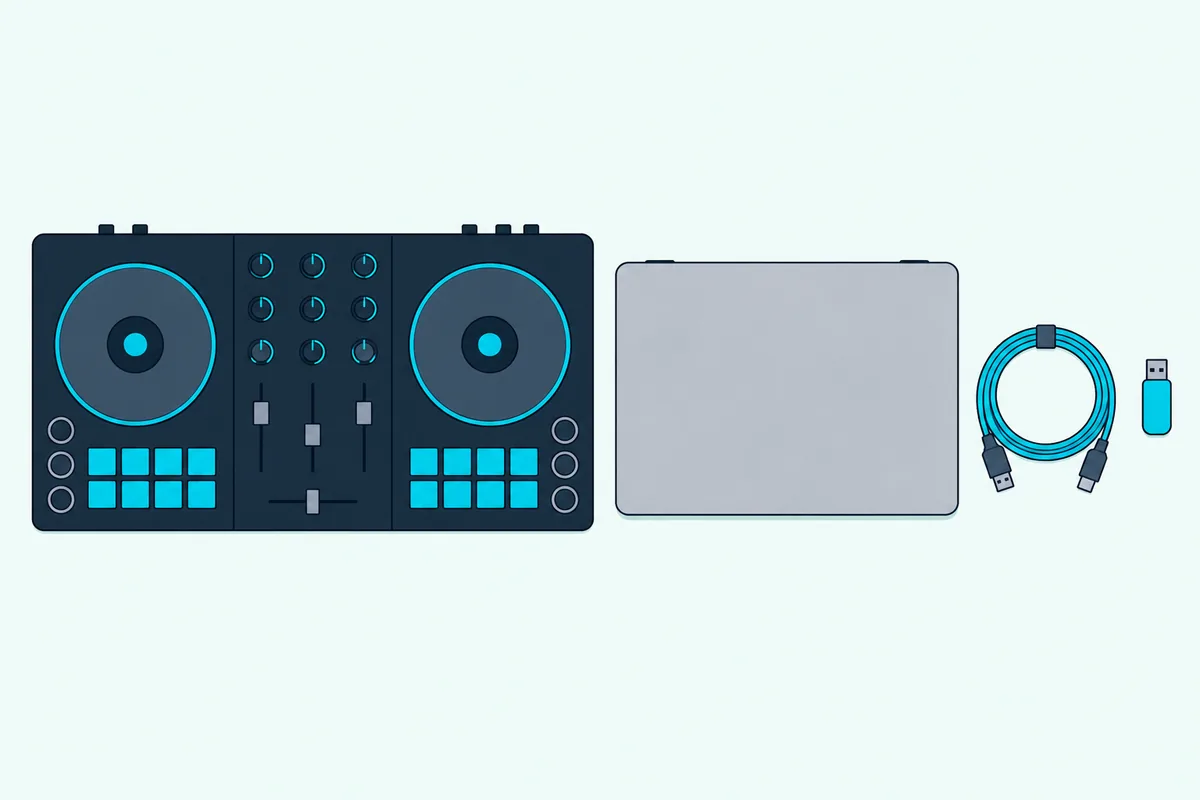
Put the laptop in the personal item or laptop bag, because Delta counts a laptop bag as a personal item and says computers can’t be checked unless security directs you to. The laptop carries your music library, so back it up to a USB drive that goes in a different bag.
Wrap every cable. TSA asks for wrapped cords, and loose cables also catch on the controller’s knobs and faders in transit.
Keep critical items on you. DOT lists keys, passports and business papers among the things to keep out of luggage that could be checked, and a gig booking confirmation or a USB stick with your set belongs in that group too.
Carry a spare USB cable. Most controllers get power and data from a single cable, so a broken one ends the night before it starts.
Put your name, phone number and email on the case. American says its carry-on should be labeled, and DOT says proper labeling helps the airline contact you and return a delayed bag.
Close the case before the airport, not at the gate. A case that’s still open or overstuffed at check-in is one that a gate agent may tag and take.
What If the Airline Makes You Gate-Check Your Controller?
Plan for it, because it happens when bins fill. Delta says that if your bag doesn’t fit or a flight is short on overhead bin space, a gate agent or flight attendant can check it at the gate, and on Delta Connection flights some carry-on bags may be gate-checked free of charge.
Delta also says Delta Connection flights with 50 seats or fewer only permit personal items on board. A controller in a backpack that fits under the seat survives that rule, and a controller in a rolling case doesn’t.
American’s regional flights work the same way. The airline says flights on American Eagle planes have limited overhead bin space, so a carry-on larger than the personal item size must be valeted before boarding, and the bag is tagged and checked at the gate for no charge and returned on the jet bridge.
American adds one instruction that matters: before your valet bag is checked, remove any batteries, electronic cigarettes and other restricted items. The FAA says the same, that all spare lithium batteries and power banks must be removed and kept with you in the cabin.
The safest answer is to take the controller out of a bag that’s about to be gate-checked and carry it on as your personal item if it fits. Only the three smallest controllers in the table fit an 18-inch personal item bare, so a FLX4-size controller will likely need a bigger bag you’d rather not lose.
If you must hand over the case, say the controller is fragile electronics and ask for a fragile tag. Delta says it doesn’t assume liability for unchecked items unless they’re given to its personnel for storage, and a gate-checked bag is given to its personnel.
That’s not a guarantee of payment, though. DOT says domestic airlines can exclude electronics and fragile items in their contracts of carriage, so a gate-checked controller may still not be covered.
Take photos of the controller and the packed case before you leave home. They help if you have to file a claim, which is what the next section walks through.
What If Your DJ Controller Arrives Damaged or Late?
Report it before you leave the airport, and insist on a written report. DOT says that if a bag arrives open, unlocked or visibly damaged you should check the contents right away, and JetBlue’s baggage page gives the same advice: file the report as soon as possible, preferably before leaving the airport.
DOT says airlines must repair or reimburse damage that happens while a bag is under their control, up to the liability limits. It also says they aren’t responsible for damage that was already there or that came from improper packing, which is why the padded case and the photos matter.
If a controller can’t be repaired, DOT says the airline negotiates compensation based on its value and depreciation. Airlines may ask for receipts or other proof for valuable items, so keep the receipt and the serial number somewhere other than the bag.
Late bags have their own rules. DOT says airlines must cover reasonable, verifiable and actual expenses caused by the delay, and that on a domestic flight a bag counts as significantly delayed if it isn’t delivered within 12 hours of arrival.
A significantly delayed bag earns a refund of the bag fee if you’ve filed a report, and DOT says most airlines declare a bag lost between five and fourteen days after the flight. Keep receipts for anything you buy or rent while you wait, because DOT says the expenses have to be verifiable.
Do You Need Insurance or Customs Paperwork for a DJ Controller?
For a domestic trip with the controller in the cabin, usually not, though the claim limits above still apply to anything you hand over. Delta says it doesn’t assume liability for carry-on items that stay in your care, so your own travel or renters insurance is the place to check.
Checked bags are different, and DOT gives the numbers. It says the maximum domestic liability allowed by regulation is $4,700 per passenger, and for most international flights the Montreal Convention limit is currently 1,519 Special Drawing Rights, about $2,175, per passenger.
Those are ceilings, not guarantees, and DOT notes airlines are free to pay more but not required to. Airlines may also require receipts or other proof for valuable items in a lost bag, so keep your purchase receipt and the controller’s serial number.
International trips add customs. If you’re a US traveler taking foreign-made equipment abroad, CBP lets you register items before you leave: take them to a CBP office, and the officer compares them with Form 4457 and returns it to show on re-entry (CBP’s registration page).
CBP says the form stays valid for re-importation as long as it’s legible, and that it isn’t transferable. For a single laptop and controller it may be unnecessary, but it costs nothing to ask.
Touring professionals have another tool. USCIB, the sole issuing association for ATA Carnets in the US, describes the carnet as a unified customs document that allows duty-free and tax-free temporary imports of goods for up to one year, and says 81 countries accept it for professional equipment (USCIB).
Hobby DJs rarely need a carnet. If you’re flying abroad for paid gigs with a lot of gear, ask the destination country’s customs authority what it requires before you book.
Do You Need to Bring a DJ Controller at All?
Not always, because many venues already own the decks, so ask what’s in the booth before you pack. The rekordbox USB export page lists players such as the CDJ-3000X, the CDJ-3000 and the XDJ-1000MK2, and all-in-one systems such as the XDJ-RX3 and the XDJ-AZ, as units that work with an exported USB library.
The exported library carries more than songs. rekordbox describes its OneLibrary format as one that takes essential performance data, including playlists, cue points and beatgrids.
A controller is still the right call when the venue has no DJ gear, such as at a private party, and that’s where a pocket model earns its place. The DJ2GO2 Touch weighs 0.75 pounds and powers over USB, so it fits a laptop bag even when everything else ships separately.
Your music has to travel too. Serato’s Beatport Streaming FAQ says tracks downloaded to the Streaming Locker play without an internet connection, up to 100 tracks depending on your plan, and that they need to finish caching before you turn off the network.
If you’d rather skip the hardware and travel with only a laptop, our guide on how to DJ without a controller covers the programs that work from a keyboard and mouse.
What About the Rest of Your DJ Setup?
That depends on the piece, because weight and depth rule out most of it. AlphaTheta lists the CDJ-3000X at 6.0 kilograms (13.2 pounds) and 13.6 by 19.3 by 5.1 inches, so one player fits a standard carry-on bare, but a pair weighs 12 kilograms before a case is added.
A turntable is heavier still. Technics lists the SL-1200MK7 at about 9.6 kilograms (21.2 pounds) and 17.8 by 13.9 by 6.7 inches, so it only just fits the 14-inch width of a standard carry-on, with no room for padding.
Gear like that is shipping territory, and UPS has packing rules for it. UPS says to use a rigid box with flaps, cushion the contents, seal it with shipping tape only and put a duplicate address label inside.
For electronics, UPS adds a warning about packing peanuts, since polystyrene causes static electricity that may damage electronic items. It recommends anti-static foam with bubble sheeting around the item instead.
The small pieces are easy to carry: headphones, a spare USB cable, a flash drive and a microphone all belong in the personal item. A battery-powered speaker is a device with an installed lithium battery, so the FAA’s rules for installed batteries apply to it too.
How Do You Fly With a DJ Controller, Step by Step?
These steps put everything above in order, from a week out to the baggage claim.
| When | What to do |
|---|---|
| A week before | Look up your airline’s carry-on, personal item and power bank rules, and check which bag your fare includes |
| Two days before | Export your library to a USB drive or download streaming tracks to the offline locker, and back up the laptop |
| The night before | Photograph the packed case, save the receipt and serial number, and put the power bank in your personal item |
| At the airport | Keep the controller in the cabin, with cables wrapped and the case easy to open for a screening officer |
| At the gate | If the bag is tagged for the hold, take out the controller, laptop, power bank and batteries first |
| After landing | Check the controller before you leave the airport and report any damage on the spot |
When you reach the venue, the next job is the sound system, and our guide to connecting a DJ controller to powered speakers covers it.
Which DJ Controllers Are Easiest to Fly With?
The easiest ones are light, small and powered over USB, so there’s no power brick and no battery to explain. All four picks below have maker-listed sizes, all four run from USB power, and all four were in stock on Amazon on 1 October 2026, though each showed only a few left.
Is the Numark DJ2GO2 Touch the Smallest Pick to Fly With?
It’s the smallest of the four, and Numark calls it a pocket DJ controller. The Numark DJ2GO2 Touch measures 3.4 by 12.4 by 0.63 inches and weighs 0.75 pounds, and Numark lists power from a mini-USB port, according to Numark’s user guide.
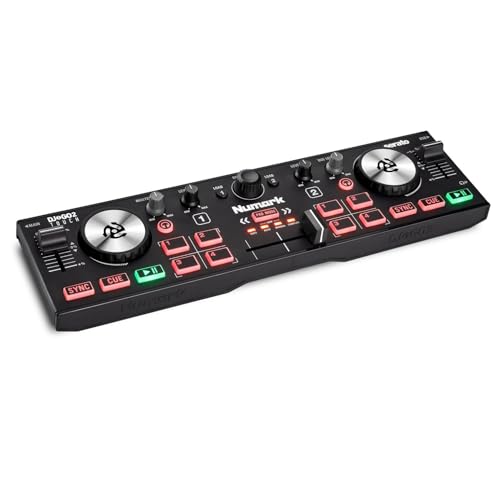
The Numark DJ2GO2 Touch
It has two channels, a crossfader, pitch faders, capacitive touch jog wheels and eight pads with four pad modes, and the box includes a 1/8-inch-to-RCA cable. Numark says it comes pre-mapped for Serato DJ Lite, which is included.
Is the Numark Party Mix II the Easiest Backpack Pick?
It’s the next size up from the DJ2GO2, and it’s built for a backpack. The Numark Party Mix II measures 12.8 by 7.8 by 2 inches and weighs 2.1 pounds, and Numark lists power via USB, according to Numark.
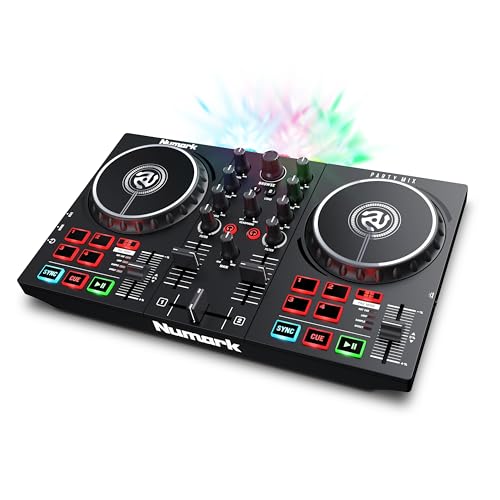
The Numark Party Mix II
It has large touch-sensitive jog wheels, four performance pads per deck, sync buttons and a 2-band EQ on each deck, plus a built-in light show. Its main output and headphone output are both 1/8-inch jacks.
Is the AlphaTheta DDJ-FLX2 the Best Lightweight Pick?
The FLX2 gives you a fuller layout in a slim body. The AlphaTheta DDJ-FLX2 weighs 1.2 kilograms and measures 383.2 by 208 by 48.2 millimeters, according to AlphaTheta.
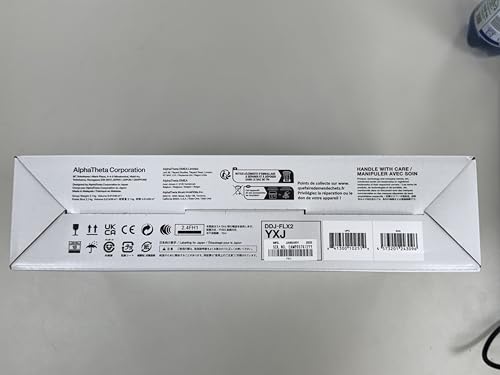
The AlphaTheta DDJ-FLX2
AlphaTheta calls it its lightest and most compact DJ controller and lists rekordbox, djay, Serato DJ Lite and Traktor Play among its compatible software. It runs on USB bus power through its USB Type-C port.
Is the Pioneer DJ DDJ-FLX4 the Best Step-Up Pick for Flying?
The FLX4 is the one to choose if you want more controls and accept a bigger bag. The Pioneer DJ DDJ-FLX4 measures 482 by 272.8 by 59.2 millimeters (19 by 10.7 by 2.3 inches) and weighs 2.1 kilograms (4.6 pounds), according to Pioneer DJ’s manual.
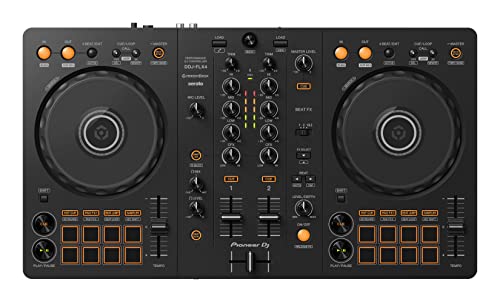
The Pioneer DJ DDJ-FLX4
The manual lists USB bus power and a microphone input and RCA master outputs on the rear panel. It fits a 22-inch carry-on with about three inches to spare.
The Bottom Line
Yes, you can bring a DJ controller on a plane, and the cabin is where it should ride. TSA, the FAA and the Department of Transportation all point the same way: carry electronics on, keep batteries with you, and don’t rely on a checked bag to cover a fragile controller.
Measure the controller first, because a padded case adds inches and the standard carry-on limit is 22 by 14 by 9 inches. The smallest controllers fit a personal item, mid-size ones need the carry-on, and a 4-channel unit needs shipping or a checked flight case.
The safest way to travel with a DJ controller is a padded case in the cabin, with the laptop and a counted power bank beside it, the cables wrapped and the case labeled. If the airline gate-checks your bag, take out the batteries and the controller first.
Frequently Asked Questions
Can I take a DJ controller as a carry-on?
Yes, if it fits the airline’s carry-on limit. Delta and American both allow one carry-on bag up to 22 by 14 by 9 inches plus a personal item, so a controller has to fit inside that bag with its case.
Can I pack a DJ controller in checked luggage?
You can, but it’s not the best idea. TSA recommends packing expensive, fragile electronics in carry-on, and DOT says domestic airlines can exclude fragile items and electronics from liability in their contracts of carriage.
Will TSA make me take a DJ controller out of my bag?
TSA’s published rule is to take laptops out for X-ray screening, and it doesn’t name DJ controllers. Officers can still ask to inspect one, so keep it easy to reach and the cables wrapped.
Are DJ controllers allowed on planes with batteries?
Most have no battery and run from USB power. For anything with a lithium battery, the FAA limits each battery to 100 watt hours, or two spares of 101 to 160 watt hours with airline approval, and spare batteries go in the cabin only.
How big a DJ controller can you take on a plane?
As large as the bag you carry on, which at most big US airlines is 22 by 14 by 9 inches, or 24 by 16 by 10 at Southwest and Frontier. A controller much over about 20 inches long leaves no room for a case, and the 28-inch DDJ-FLX10 is beyond even the larger limit.
Do I need a carnet to fly abroad with a DJ controller?
Usually not for personal use. USCIB says a carnet allows temporary duty-free imports of goods such as professional equipment for up to one year, and CBP offers registration on Form 4457 for foreign-made items you take abroad.
Can I take a DJ controller on a plane in a backpack?
Yes, if the backpack is your personal item or fits the carry-on limit. Personal items run from 17 by 10 by 9 inches at United to 18 by 14 by 8 inches at American and Frontier, so a padded backpack around a DDJ-FLX2 or something smaller is the safest fit.
How many power banks can I bring on a plane?
It depends on the airline. Southwest allows one, American and Delta allow two, and all three cap each bank at 100 watt hours and keep it out of the overhead bin.
What if my DJ controller is damaged on the flight?
Report it to the airline before you leave the airport and insist on a written report. DOT says airlines aren’t responsible for damage caused by improper packing, and that domestic airlines can exclude fragile items and electronics in their contracts of carriage.
Can I take a CDJ or a DJ mixer on a plane?
Yes, but the weight adds up. A CDJ-3000X weighs 6.0 kilograms (13.2 pounds) and is 19.3 inches deep, so one fits a standard carry-on bare, while a pair and a mixer are better shipped or checked in a flight case.
Can I take a turntable on a plane?
Yes, but it’s heavy and large. The Technics SL-1200MK7 weighs about 9.6 kilograms (21.2 pounds) and measures 17.8 by 13.9 by 6.7 inches, so pack it in a padded case and check it, or ship it.