How to Soundproof a Sliding Glass Door: What Works, What Doesn’t
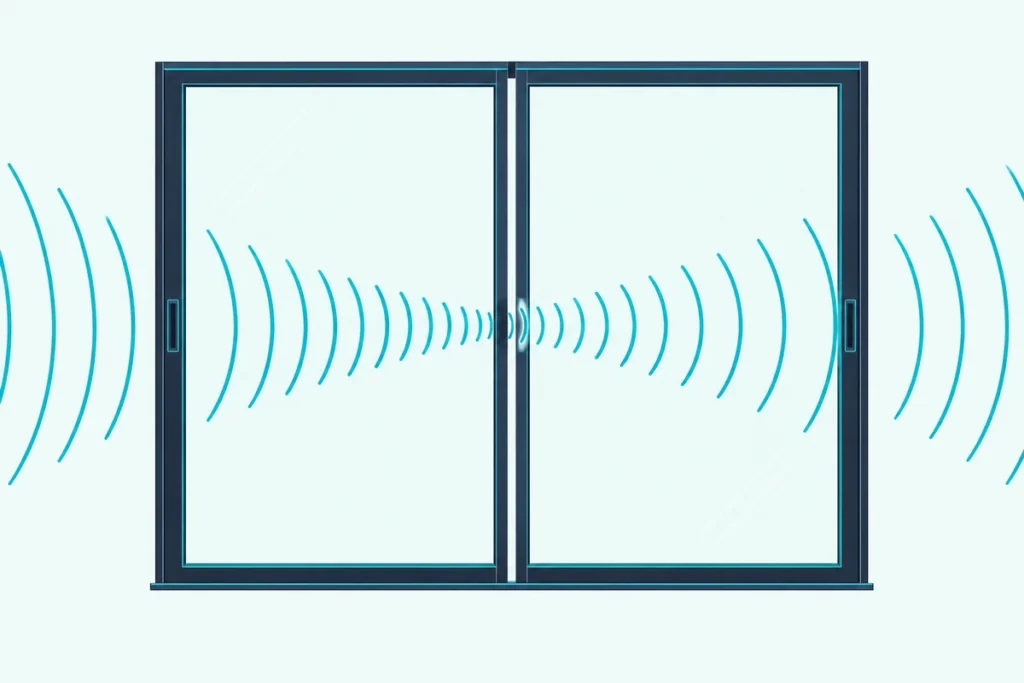
How to soundproof a sliding glass door starts with its gaps, not its glass: seal the track and the meeting edges first, then add weight, then upgrade the glass if you still hear it.
Picture a patio door that hums with every passing truck, while a conversation outside sounds as if it’s happening in the room.
HUD’s noise guidebook, Marvin’s test tables and Guardian’s glass tables point to where the sound gets in, and which fixes add decibels.
You’ll see why a sliding door rates lower than its glass, which gaps to seal, what curtains and extra panes can and can’t do, and when replacing the door pays off.
Start with the four steps, because the order matters as much as the fixes.
How to Soundproof a Sliding Glass Door in Four Steps
That order runs from the cheapest fix to the most expensive, and each step has numbers behind it in the sections below:
- Seal the gaps. HUD says a one-inch square hole, or a 1/16-inch crack 16 inches long, will reduce a 50 STC wall to 40, and a sliding door has several long cracks.
- Add weight over the glass. A heavy curtain hung past the frame adds a few decibels at mid and high pitches, and our curtains page has the lab numbers.
- Upgrade the glass. Marvin’s complete sliding doors rise from STC 29 with plain glass to 33 with a thick laminated pane.
- Replace the door only if steps one to three aren’t enough. Marvin’s inswing doors reach STC 36, three points above its sliding door with the same glass.
Start at step one even if you plan to replace the door. It’s the cheapest step, and a door that leaks around its edges wastes whatever the glass can do.
Why Does a Sliding Glass Door Let So Much Noise In?
That comes down to weight and gaps, and HUD’s Noise Guidebook names windows and doors as a building’s weak points. It says sound enters a building through its acoustically weakest points, and that doors are even weaker than windows.
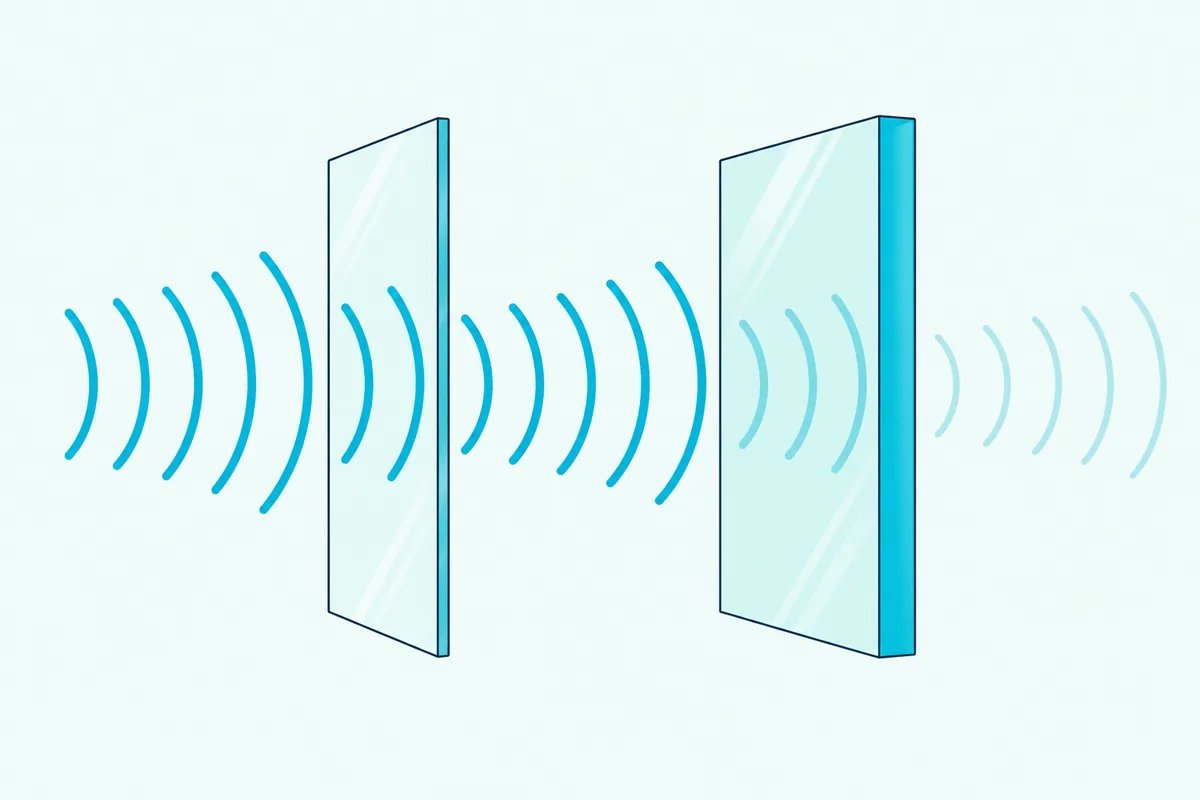
Glass is light, and HUD says a material’s transmission loss typically improves with its surface weight. Guardian Glass’s laboratory table shows the effect for a single pane: 3 mm glass rates STC 28, 6 mm rates 30 and 12 mm rates 36.
A door adds a second problem, because it’s full of joints where the panels meet the frame. Marvin’s tables make the point: the same glass in a sliding door and a swinging door doesn’t rate the same.
Marvin’s manual rates one sliding door with a 7/32-inch tempered pane, a 17/32-inch air space and a 7/16-inch laminated pane at STC 33. The same glass in its inswing door rates STC 36, three points higher.
Our soundproof glass guide applies the same Marvin listings to windows, including how tempered glass compares with laminated.
Windows that swing shut do better too. Marvin rates its casement window with two 1/4-inch laminated panes and a 9/32-inch air space at STC 35, while its sliding patio door with the same panes and air space rates STC 32.
A door also takes up wall. HUD gives an example of a wall rated STC 45 with a window of STC 26 covering 30% of its area, which has an overall STC of 35, a drop of 10 dB.
HUD adds that shrinking a window from 50% to 20% of the wall reduces noise by only 3 decibels. You can’t fix a big glass door by making it smaller, so the fix has to come from the door itself.
Get Studio Tips Weekly
Join 5,000+ creators getting acoustic treatment advice every week.
No spam. Unsubscribe anytime.How Much Noise Does a Sliding Glass Door Block?
Those test numbers set the scale, and STC is the one to know. HUD defines Sound Transmission Class as the number of decibels a sound is reduced as it passes through a material, so a higher number blocks more.
This table gathers published STC ratings for doors and windows like yours:
| Door or window | STC | Source |
|---|---|---|
| Aluminum sliding window, latched, single glazing | 24 | HUD, from a 1975 government test |
| Wood French door with brass weatherstripping | 26 | HUD, from a 1975 government test |
| Marvin Ultimate Sliding Patio Door, two 1/8-inch tempered panes | 29 | Marvin |
| Marvin Ultimate Sliding Patio Door, two 1/4-inch laminated panes | 32 | Marvin |
| Marvin Ultimate Sliding Door, 7/16-inch laminated inner pane | 33 | Marvin |
| Marvin Ultimate Inswing Door, same laminated glass | 36 | Marvin |
Marvin lists STC 29 to 32 across eleven glass combinations for its Ultimate Sliding Patio Door, and 32 to 36 for its inswing doors. The older HUD numbers come from single-glazed windows and doors, so they show where an old slider starts rather than where a new one ends.
Andersen gives the numbers a meaning for windows. STC 30 is where most dual-pane windows perform, and you’d hear and understand a loud conversation outside.
STC 30 to 35 lets you hear a loud conversation but not follow it, and STC 36 to 40 makes even loud conversations hardly audible. By that guide, Marvin’s best sliding door sits in the middle band, where speech stays unintelligible but the street doesn’t disappear.
Are You Hearing Speech or Traffic Through the Door?
That decides which rating to trust, because STC and OITC cover different sounds. Cardinal Glass says STC measures frequencies from 125 Hz to 4,000 Hz, while OITC, the Outdoor-Indoor Transmission Class, includes lower sounds from 80 Hz up.
Andersen puts it in everyday terms. STC measures indoor sounds like people talking, TV and music, and OITC measures outdoor-to-indoor sounds like traffic, airplane noise and construction.
Guardian warns that the two ratings aren’t linearly related, so a strong STC doesn’t guarantee a similar OITC. Its table shows a 6 mm single pane at STC 30 and OITC 28, and a double pane with a 1/2-inch air space at STC 34 and OITC 29.
Marvin lists both numbers for its doors. Its Ultimate Sliding Door rates OITC 25 with two plain 5/32-inch panes and OITC 30 with a 7/16-inch laminated inner pane, so for a door facing a road, check the OITC column.
What If the Noise Is Mostly Bass?
That’s the hard case, because the ratings barely reach it. Cardinal says STC starts at 125 Hz and OITC at 80 Hz, so neither number says how a door handles deeper rumble.
Guardian’s table shows how much glass it takes to score well on OITC. Its highest figure is OITC 40, for two 12 mm panes with an acoustic layer, and even its dual-laminated acoustic double unit, at STC 48, scores OITC 38.
None of the complete sliding doors in Marvin’s tables goes that far, since they top out at OITC 30. Heavy bass from a road or a neighbor’s speakers will still come through, and it will come through more than the STC number suggests.
How Do You Find Where the Noise Gets In?
That’s worth ten minutes, because the weakest path sets the result. HUD says to review the wall’s rating first and then the windows and doors, and its Figure 17 graph subtracts decibels from the wall’s STC based on how much of the wall the door takes up.
On the door itself, close and lock it and listen from inside while someone plays a steady sound outside. Move along the edges and feel for air, since a draft marks a gap that sound uses too.
The same trick works after dark. Switch off the room lights, shine a bright flashlight along the outside edges, and any gap shows as a line of light.
Mark each leak with a bit of tape so you can seal them all in one pass. HUD says the one-inch hole and the long hairline crack both cost the same ten points, so the small gaps count.
Which Gaps Should You Seal First?
That’s the cheapest step, and it works with whatever glass you have. HUD says small holes and cracks can be devastating to a wall’s insulation value.
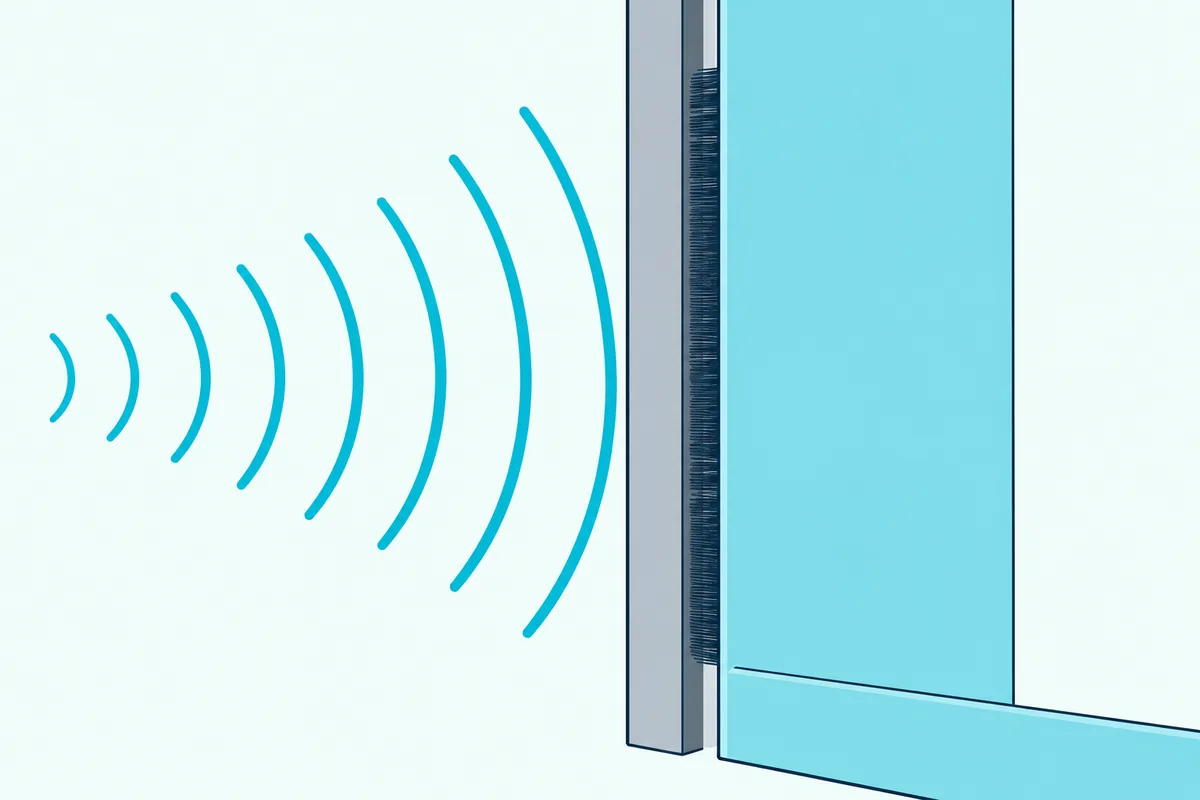
A sliding door has long cracks along every moving edge. With the door closed and locked, check these four places:
- The meeting edge, where the moving panel overlaps the fixed one.
- The side channels the moving panel slides against.
- The top and bottom of the panel along the track.
- The frame where it meets the wall.
For the sliding edges, a pile strip is the usual choice, since its bristles keep touching as the panel moves. TamBee’s self-adhesive pile weatherstrip is sold for sliding window and door frames, and its listing gives the size as 3/8 inch by 3/8 inch by 16.5 feet.
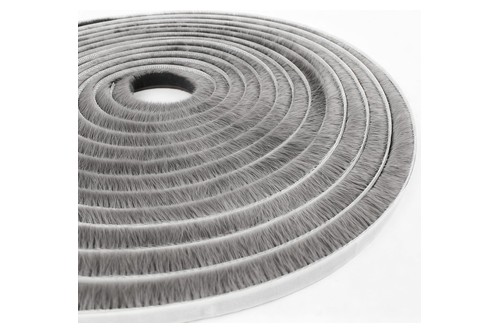
TamBee’s self-adhesive pile weatherstrip
Its listing says to measure the gap, cut the strip to length and peel off the backing, and to clean the surface first. It also says the strip isn’t recommended on oily, greasy or dusty surfaces, so wipe the frame before you stick it down.
Seal the frame to the wall too. HUD says a high performance wall has to be well sealed at the perimeter, and the same holds for the opening a door sits in.
Do Heavy Curtains Help on a Sliding Glass Door?
A little, and mostly on mid and high sounds, as our page on what lab numbers say about soundproof curtains shows. It reports about 3 to 6 dB of loss for plain woven fabric in one university’s tube tests, and STC 13 to 21 for the best curtain sheets measured.
Those numbers sit below the glass they’d cover, since HUD rates a single-glazed aluminum sliding window at STC 24. A curtain adds a few decibels at best, and bass walks straight through it.
A slider gives a curtain one advantage, which is area: it can cover the whole door at once. The same page says to extend the fabric past the frame on every side and down to the floor, and to seal the leaks around the frame before relying on fabric.
It also says to choose weight first, with a stated weight per area and a dense middle layer rather than a porous weave alone. A curtain that only says “blackout” tells you about light, not sound.
How Should You Hang a Curtain Over a Sliding Door?
That advice turns into four steps for a slider:
- Seal the door’s edges first, so the curtain isn’t covering a leak.
- Hang the rod or track wider than the frame, so the fabric extends past it on every side.
- Let the curtain reach the floor, since our curtains page says noise gets in wherever air can.
- Gather the fabric rather than hanging it flat. That page cites Commercial Acoustics for 50 to 75 percent fullness, which means fabric 1.5 to 2 times the rod length.
The fullness advice is about absorption, which calms echo inside the room, rather than about blocking sound. The same page lists ordinary window glass at 0.1 to 0.2 on the absorption scale, so a bare glass door bounces most sound back and a gathered curtain calms that echo.
Can You Add a Second Pane to a Sliding Glass Door?
Not with the best-known insert, because Indow says its inserts aren’t made for sliding doors. Its FAQ says Indow doesn’t install inserts inside sliding glass doors, that door frames are usually not ideal, and that an insert in a door opening would be too big and heavy to remove easily for egress.
On windows, the idea works. Indow reports 18.9 dBA of noise reduction over single-pane windows in a Portland State University lab study and STC 42 to 45 over double-pane windows in a British Columbia Institute of Technology study, and our guide to window inserts that seal air gaps covers the windows beside your door.
HUD explains why the gap between panes matters. It says the airspace between double panes should be at least 2 to 4 inches if you want an STC above 40, and Marvin’s window results show what a real air gap can do:
| Marvin window | STC without an added pane | STC with an added pane |
|---|---|---|
| Ultimate Double Hung G2, two 1/8-inch panes with a 5/8-inch air space | 27 | 35, with a 1/8-inch clad storm combination |
| Ultimate Casement, two 1/8-inch panes with a 1/2-inch air space | 29 | 46, with a 1/8-inch interior sash and a 4 1/4-inch air space |
Those are windows, not doors, but they follow HUD’s rule that the second pane needs a wide air space.
HUD’s own table shows the risk of a second pane set close to the first. An aluminum sliding window with a storm sash 1/8 inch away rates STC 22, two points below an aluminum sliding window with single glazing at STC 24.
I found no maker test numbers for a second pane added inside a sliding door, so I can’t rate that fix. A glazing company would need to give you a figure for the whole door.
Is Laminated or Double Glass Worth It?
That’s where the biggest published gains are, and Guardian Glass lists them. This table shows its laboratory estimates for the center of the glass:
| Glass | STC |
|---|---|
| Single pane, 6 mm | 30 |
| Single pane, 12 mm | 36 |
| Laminated, 6 mm and 6 mm with a standard 0.060-inch PVB layer | 36 |
| Laminated, 6 mm and 6 mm with an acoustic 0.060-inch PVB layer | 40 |
| Double pane, 6 mm, 1/2-inch air, 6 mm | 34 |
| Double pane, 6 mm, 1/2-inch air, then 6 mm plus acoustic PVB plus 6 mm | 41 |
| Double pane, both panes 6 mm plus acoustic PVB plus 6 mm | 48 |
| Triple pane, 6 mm, 1/2-inch air, 6 mm, 1/2-inch air, 6 mm | 37 |
Laminated glass wins because of what’s inside it. Andersen says its glass, interlayer, glass makeup is more effective than plain glass, because the rigidity reduces the vibration of the glass and so sound’s ability to travel through it.
The table also shows that a third pane isn’t the answer. The triple pane rates STC 37, below the double pane with an acoustic laminated pane at 41, and Andersen says going from dual-pane to triple-pane won’t necessarily give the same dramatic result.
These are lab figures for the glass alone. Guardian warns that a site-installed panel can lose about 6 dB against a lab specimen.
Marvin’s complete doors show the same ceiling. In its Ultimate Sliding Door tests, two plain 5/32-inch panes with a 5/8-inch air space rate STC 29, a 1/4-inch laminated inner pane rates 31 to 32, and a 7/16-inch laminated inner pane rates 33.
So a thicker laminated pane can add up to four points to a complete sliding door. Ask a door or glazing company for an STC for the complete door, not the glass.
What Should You Ask a Door or Glazing Company?
Those numbers are only as good as the questions behind them, and five answers separate a real rating from a sales line:
- Is the STC for the complete door or only the center of the glass? Guardian’s table covers the center of the glass alone.
- What is the OITC? Marvin lists both numbers for each door, and OITC is the one that matters for traffic.
- What is the glass makeup? Ask for the thickness of each pane, the air space and whether the inner pane is laminated.
- Which test standard and report is behind the number? Guardian lists ASTM E1425 as the practice for testing windows, doors and glazed wall systems, and Marvin gives a report number for each result.
- What size was tested? Marvin names the size in its table, such as 6068 for its sliding patio door, so you can check it against yours.
A company that can’t answer the first and fourth questions is quoting a glass number, not a door number.
Should You Replace a Sliding Door With a Hinged One?
Marvin’s tables suggest the swing helps, because its inswing doors rate 32 to 36 against 29 to 33 for its sliding doors. With identical glass, the gap was three points, 33 for the slider and 36 for the hinged door.
That gain comes with trade-offs the tables don’t measure, such as the floor space a swinging door needs. If you keep or choose a hinged door, our page on sealing a hinged door and its sweeps covers the seals.
What Can Renters Do Without Changing the Door?
Two steps need no tools beyond scissors and a rod. Adhesive pile weatherstrip goes on the sliding edges, and a heavy curtain hangs past the frame to the floor.
Both come off without drilling into the frame, though adhesive can mark a finish, so test a hidden spot first. Glass upgrades and door replacements need your landlord’s approval.
The two steps follow the same order as the rest of this page, seal first and weight second. Neither will turn a slider into a wall.
Will These Fixes Also Keep Sound Inside?
Mostly yes, because a rating describes the barrier rather than the direction. HUD describes STC as the difference between the sound level on the side where the noise starts and the side where it’s received.
So a sealed, laminated door that quiets a truck outside also quiets a television leaving the room, and its weak points are the same edges. The seal and glass steps above apply either way.
How Do You Check That the Fix Worked?
Measure it, because your ears adjust quickly. NIOSH’s free Sound Level Meter app runs on iOS devices and is accurate within 2 dBA, according to NIOSH, and NIOSH says it can’t verify an Android version.
Stand in the same spot with the door closed, measure the same outside sound before and after, and compare the A-weighted level. The FHWA’s noise primer gives the scale: a 3 dBA drop is barely perceptible, 5 dBA is readily perceptible, and 10 dBA is perceived as half as loud.
An old single-glazed slider at STC 24 changing to a laminated one at STC 32 is an 8-point gain on paper. That falls between a readily perceptible change and a halving of loudness, though STC and in-room results differ.
Sealing gaps can add decibels without changing the glass, since HUD’s 50 STC wall loses 10 points to a single crack. Measure after sealing, before you spend on glass.
How Loud Will It Still Be?
Guardian reproduces the CDC’s approximate sound levels, and they put the ratings in context. A refrigerator hum is about 40 dB, an air conditioner 60 dB, a lawn mower 80 dB and a nearby car horn 100 dB.
On paper, an 80 dB lawn mower outside a door rated STC 32 comes through at about 48 dB, a little louder than a refrigerator hum. A 100 dB horn would still arrive near 68 dB, louder than an air conditioner.
Real levels depend on the pitch of the sound, so treat those figures as rough guides. They do show that an STC in the low 30s leaves loud sources audible.
Which Fix Adds the Most Decibels?
Here’s how the published numbers line up, from the cheapest fix to the most expensive. The figures come from different tests, so treat them as a guide to the order rather than an exact ranking:
| Fix | Published figure | Source |
|---|---|---|
| Seal a 1/16-inch crack, 16 inches long | Restores up to 10 points on a 50 STC wall | HUD |
| Plain woven curtain | About 3 to 6 dB average loss in tube tests | University lab tests cited on our curtains page |
| Thicker laminated inner pane | Up to 4 STC points on a complete door | Marvin |
| Acoustic laminated glass in a double unit | STC 41 against 34 for plain double glass | Guardian |
| Second pane with a wide air space, on a window | STC 29 to 46 on a casement | Marvin |
| Hinged door with the same glass | 3 STC points over the sliding version | Marvin |
The Bottom Line
To soundproof a sliding glass door, seal the edges, hang a heavy curtain past the frame, and upgrade to laminated or double glass if you still hear the street. Marvin’s complete sliding doors rate STC 29 to 33, so even the best slider keeps conversation unintelligible rather than silent.
Replace the door only when the first three steps aren’t enough, and ask for an STC for the whole door.
If you rent, stop after the first two steps and ask your landlord about glass. If you own the door, get the complete-door STC and OITC before you buy.
Frequently Asked Questions
Are sliding glass doors soundproof?
No. Marvin’s tested Ultimate Sliding Patio Door rates STC 29 to 32, and Andersen says STC 30 is where most dual-pane windows perform, with a loud conversation still audible.
Can you soundproof a patio door?
Yes, to a degree. Sealing the edges, adding a heavy curtain and upgrading to laminated or double glass each add decibels, and Marvin’s laminated sliding doors reach STC 32 to 33.
Do window inserts work on sliding glass doors?
Indow says no. Its FAQ says it doesn’t install inserts inside sliding glass doors and that sliding doors and other doors aren’t appropriate applications.
Do soundproof curtains work on a glass door?
A little. Our curtains page reports about 3 to 6 dB of loss for plain woven fabric in lab tests, so seals and glass matter more.
Does laminated glass help a sliding door?
Yes. Guardian rates 6 mm laminated glass with an acoustic layer at STC 40 against 30 for a single 6 mm pane, and Marvin’s laminated sliding doors rate 32 to 33 as complete doors.
Does window film soundproof a sliding door?
I found no maker test numbers for film on a sliding door, so I can’t rate it. Glass, seals and mass are the fixes with published figures.
What is the cheapest way to quiet a sliding glass door?
Seal the gaps. HUD says a one-inch square hole or a 1/16-inch crack 16 inches long will reduce a 50 STC wall to 40, and pile weatherstrip along the sliding edges closes the long cracks.