How to Soundproof a Laundry Room: Quiet the Washer Before the Walls
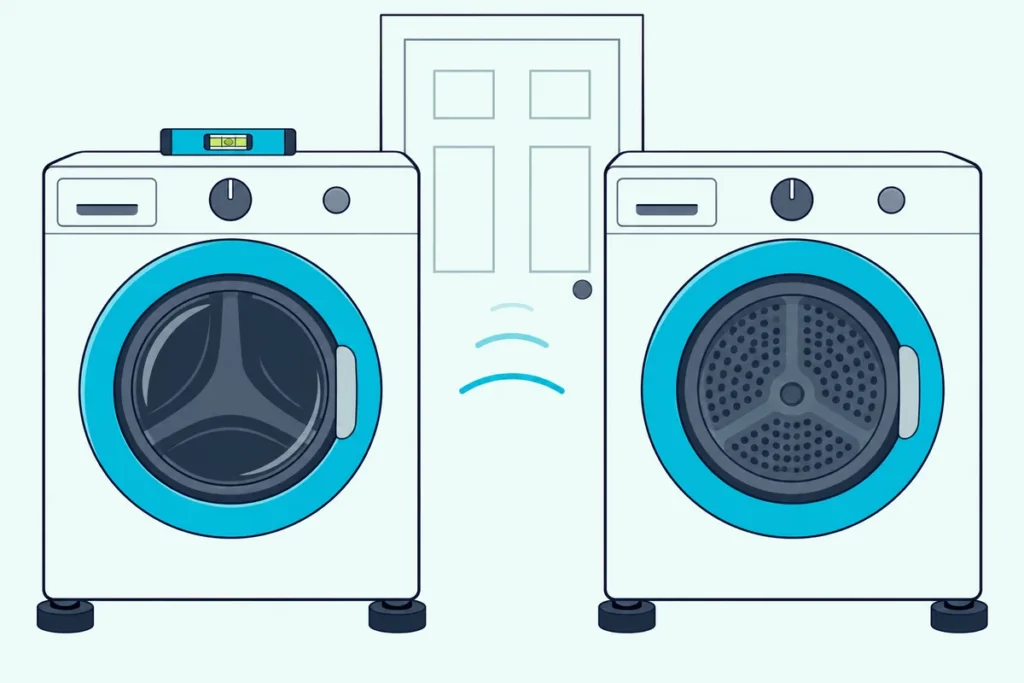
The washer hits its spin cycle, the floor starts to hum and the bedroom next door hears every thump, which is when you start looking up how to soundproof a laundry room.
Much of that noise starts as vibration in the machine and the floor rather than sound in the air, so padding the walls first rarely quiets it.
This guide works from the machine outward, using Whirlpool’s and LG’s own help pages and manuals, Sioux Chief’s plumbing documents and HUD’s noise guidebook.
You’ll see what to check on the washer and dryer, which pads and fittings are worth buying, and how to treat the floor, the door, the walls and the dryer vent.
Start with the six steps in order, because each one makes the next one cheaper.
How to Soundproof a Laundry Room in Six Steps
That order is the whole method, since each step removes noise at its source before you pay to block what’s left. You soundproof a laundry room by quieting the machines first, stiffening the floor next and sealing the door and walls last.
| Step | What you do | What it fixes |
|---|---|---|
| 1. Fix the washer | Remove the shipping bolts, level all four feet and spread the load | Thumping, banging and walking |
| 2. Fix the dryer | Clear pockets, check the legs and lint, and leave a gap beside the washer | Rattles, squeals and pounding |
| 3. Isolate the feet | Add anti-vibration pads once both machines are level | Vibration passing into the floor |
| 4. Stiffen the floor | Secure ¾ in plywood under the pair and skip carpet | A hum you can feel across the room |
| 5. Seal the door | Close its gaps, or swap a hollow door for a solid-core one, without blocking the vents a dryer needs | Sound leaving through the weakest spot |
| 6. Treat the walls | Seal gaps, then fill the cavity with insulation or acoustical blankets | What still reaches the next room |
Steps one and two cost almost nothing, and Whirlpool’s help page for a vibrating, walking or thumping washer starts with installation and loading rather than repairs (Whirlpool).
Skip ahead only if both machines already sit level on a solid floor, because the later steps can’t fix a washer rocking on one foot.
Why Is a Laundry Room So Loud?
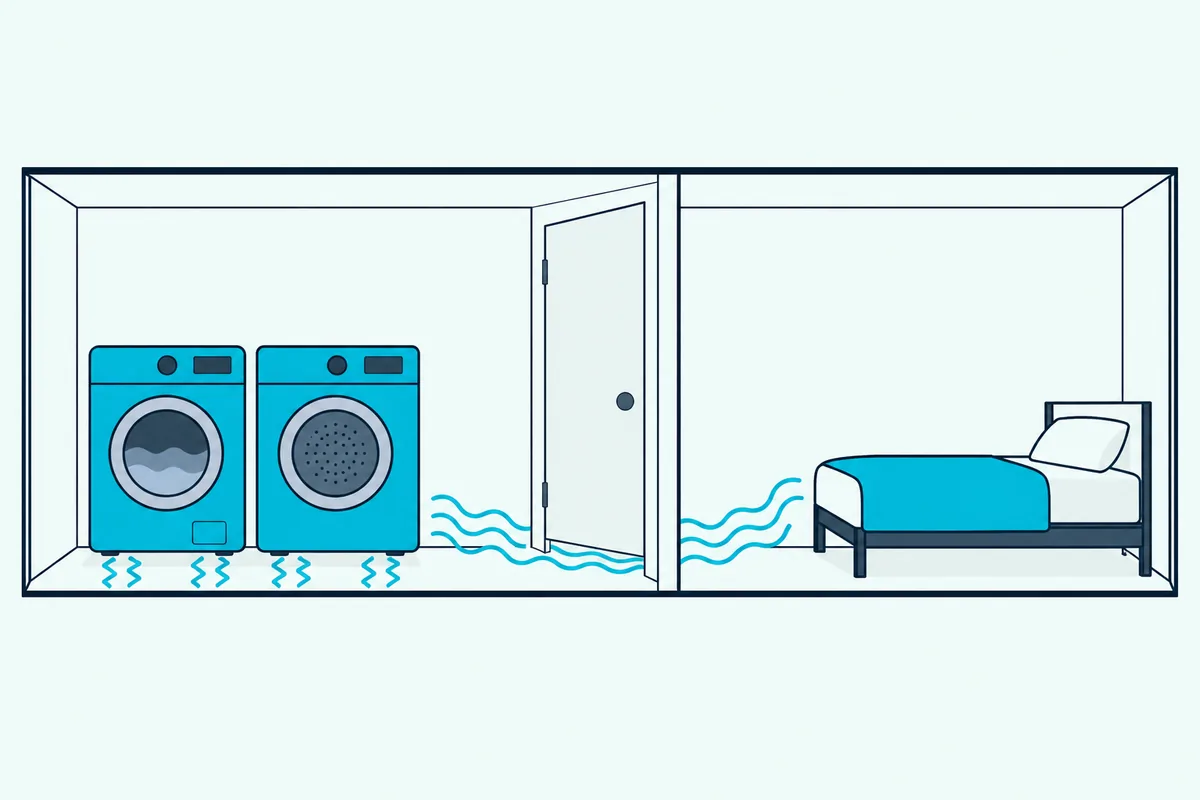
Those six steps make sense once you split the noise into source, path and receiver, the three parts HUD’s Noise Guidebook says a noise problem can be changed through (HUD). A laundry room is loud because two heavy machines shake a floor, a door and a few pipes at the same time.
| Part | In a laundry room | Where this guide fixes it |
|---|---|---|
| Source | The washer’s spin, the dryer’s drum and the water valves | Steps 1 to 3 |
| Path | The floor and the machines’ frames, door gaps, the wall cavity and the dryer duct | Steps 4 to 6 |
| Receiver | The bedroom, nursery or office on the other side | Distance, the door and the walls |
Whirlpool’s leveling page says a vibration you can feel in the floor from across the room can signal a flexing floor, and that flexing or uneven flooring adds to washer noise and vibration (Whirlpool).
Modern washers spin fast to wring out more water, and the same page says those high-spin machines need sturdy floors.
If the laundry room sits above a bedroom, our guide to stopping noise between floors covers the ceiling below it.
Get Studio Tips Weekly
Join 5,000+ creators getting acoustic treatment advice every week.
No spam. Unsubscribe anytime.What Should You Check on the Washer First?
But none of that holds until the machine itself is set up right, because LG’s and Whirlpool’s help pages list installation and loading before service. Check the shipping bolts, the four feet, the level and the load, in that order.
| Check | How | Maker |
|---|---|---|
| Shipping bolts | Look for the bolts on the back panel, or open the door and push the tub forward and back, since LG says a tub that won’t move still has them in | LG, Whirlpool |
| Four feet | Rock the washer from corner to corner, adjust any foot that teeters, then tighten the lock nuts against the cabinet | Whirlpool, LG |
| Level | Check side to side and front to back with a level | Whirlpool |
| Load | Spread laundry evenly around the tub, don’t pack it tight, and balance a single bulky item with a few more | LG, Whirlpool |
| Space | Leave 1 in on every side and don’t push the washer against a wall or the dryer | Whirlpool |
| Test | Run a rinse and spin, then a spin-only cycle at high speed | LG |
A Whirlpool washer installation sheet also asks for a floor that slopes no more than 1 in under the whole washer, and it says carpet and foam-backed surfaces aren’t recommended (Whirlpool).
On a pedestal, Whirlpool says to check that the mounting screws are tight and that the pedestal’s own feet touch the floor.
If the washer still shakes after the high-speed test, LG says it needs service.
Why Is the Dryer Making Noise Too?
That checklist covers the washer, but the dryer makes its own sounds, and Whirlpool’s dryer help page ties each one to a different cause. A dryer thumps, pounds, scrapes, squeals or rattles for reasons you can usually find in a few minutes (Whirlpool).
| Sound | What Whirlpool says causes it | What to do |
|---|---|---|
| Thump after sitting idle | The drum support rollers flatten where they touch the drum | It fades once the dryer has run a while |
| Thump with sheets or curtains | A large item rolls into a ball | Load big items loosely and shake out the bunching |
| Thump with sneakers | Tumbling tennis shoes shakes the dryer | Dry them on a rack |
| Pounding | A missing or uneven leg on a floor that isn’t level | Replace missing legs and level the dryer front to back and side to side |
| Scraping | A coin, pin, screw or other hardware caught where the drum meets the front or rear | Switch it off and clear the seam |
| Knocking or rattling | Zippers, buckles, loose coins, items on top, or the washer’s spin shaking the dryer cabinet | Clear pockets and the top, and leave space between the two machines |
| Squealing | Lint around the belt and pulleys, or a worn belt and pulleys on an older dryer | Cleaning or new parts, possibly a service call |
Whirlpool adds that clicking from a gas dryer is the gas valve and is normal.
For its 29-inch electric dryers, a Whirlpool installation sheet recommends 1 in of extra space on every side to reduce noise transfer, and a level floor with no more than 1 in of slope under the whole dryer (Whirlpool).
Do Anti-Vibration Pads Really Work?
Once both machines are level, rubber pads are the next cheap step, but only a level machine gets much from them. Yes, as an extra: pads give each foot a rubber grip and some cushioning against the floor, though neither listing below publishes a decibel figure, so they aren’t the fix.
ELEON’s own listing says leveling is the only way to stop a washer walking, and that a mat alone can’t solve it.
Measure the foot before you buy, because ELEON’s pads fit round feet under 1.75 in and need 1 in of clearance above the washer, while Sumato’s VibeGuard pads fit feet up to 2.25 in and raise the machine about ¾ in.
If you pad only the washer, it ends up taller than the dryer, and Sumato’s listing suggests a second set for a side-by-side pair so both sit at the same height.
ELEON’s listing also names nine Samsung washer models its pads don’t fit, so check that list first.
For standard round feet, the ELEON anti-vibration pads come with a bubble level, and the listing says to tilt the machine and slip one under each foot.
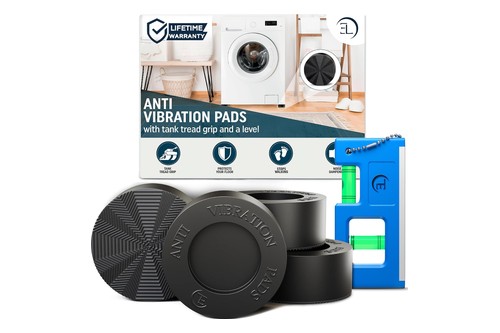
the ELEON anti-vibration pads
For larger feet, the Sumato Stuff VibeGuard pads raise the washer only about ¾ in, and the listing says to level the machine before fitting them.
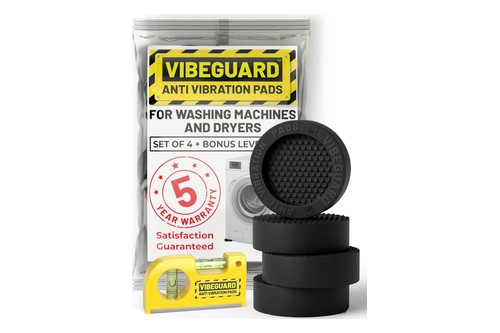
the Sumato Stuff VibeGuard pads
Check the level once more after the pads are in, since ELEON’s listing says to finish with the feet adjusted on its included level.
Can You Fix a Flexing Floor Under a Washer?
But pads can’t stiffen a floor, and Whirlpool says flooring that flexes or is uneven adds to washer noise and vibration. You can reduce that by placing and securing a ¾ in (19.1 mm) sheet of plywood to the floor beneath the washer and dryer, which Whirlpool says may cut the noise and vibration (Whirlpool).
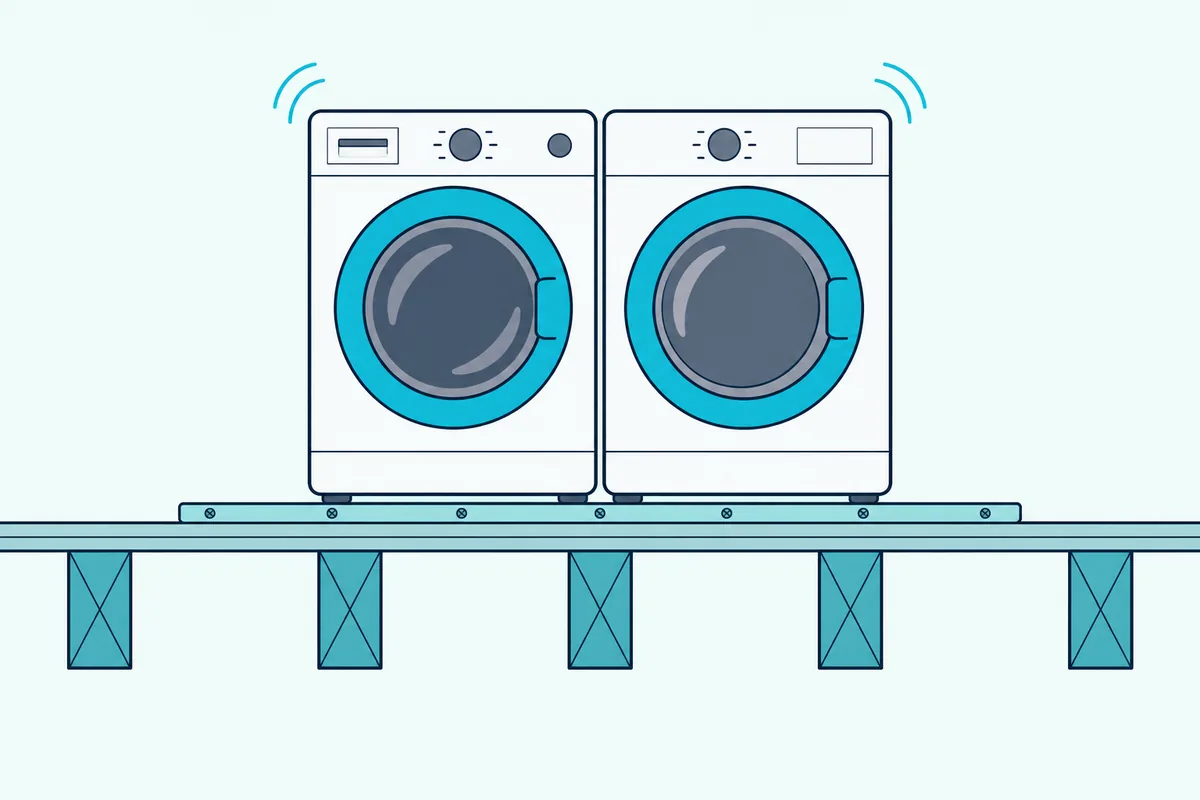
That’s a floor repair and not a platform, because Whirlpool also says not to install the washer on a raised wooden platform.
The floor still has to carry the load, and one Whirlpool washer sheet gives 315 lbs for a washer with water and a load while one dryer sheet gives 200 lbs for a dryer with a load.
How Do You Soundproof a Laundry Room Door?
Once the floor stops flexing, the door is usually the weakest part of the wall, and HUD’s guidebook puts numbers on it. You soundproof a laundry room door by sealing its edges and bottom first, then swapping a hollow-core door for a solid-core one if sound still leaks.
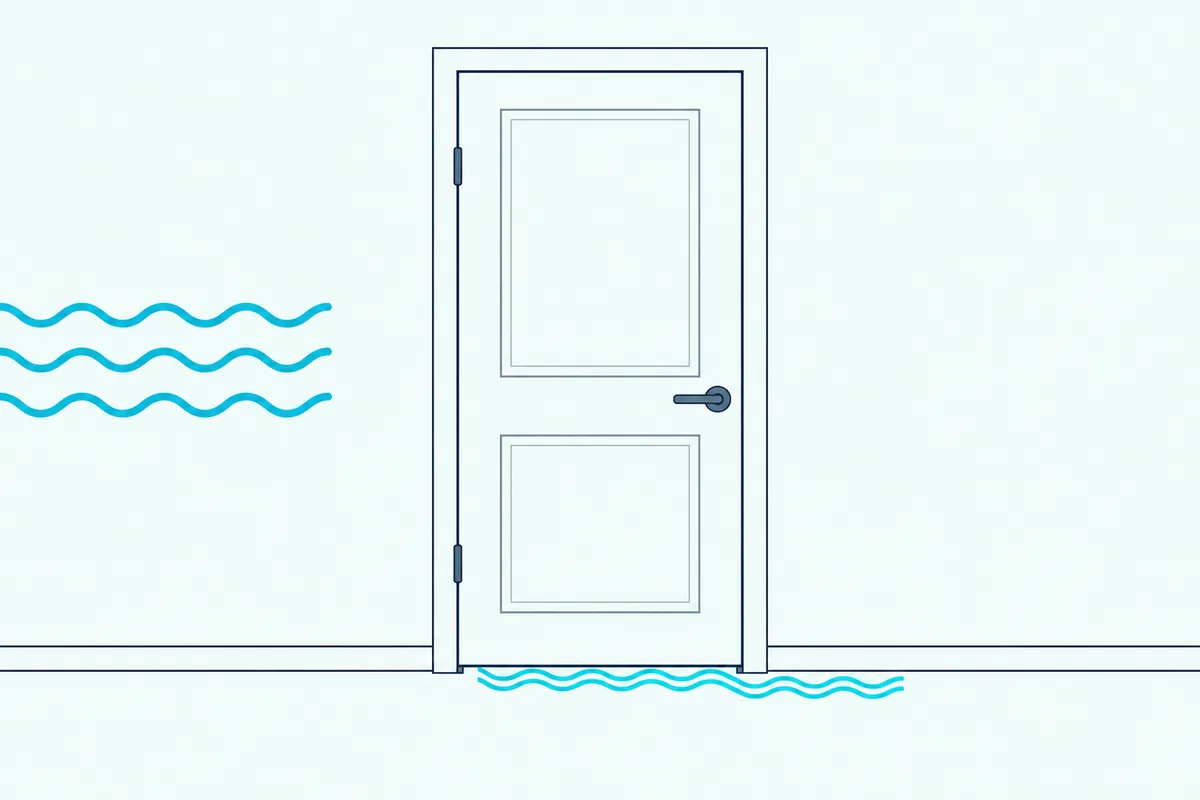
HUD rates a common hollow-core wood door at STC 17 and says a door taking up about 20% of a 48 STC wall pulls the wall down to 24.
| Door setup (HUD) | Result for a 48 STC wall |
|---|---|
| Hollow-core wood door, about 20% of the wall | 24 |
| Solid-core wood door, vinyl seal around the edges and carpet at the door | 33 |
| The same, plus gasketed stops or a drop-bar threshold closer at the bottom edge | Higher still, with no figure given |
A tight door costs less than a new one, and our guide to door sweeps that close the bottom gap shows which seals are worth buying.
Our full guide to sealing and upgrading the door itself covers the order to work in.
If the room is really a closet, read the next section before you seal anything.
Can You Soundproof a Laundry Closet or Utility Room?
If your machines sit in a closet or a utility room, the door fix changes, because both Whirlpool sheets require air openings in a closet door. You can soundproof a laundry closet by working on the machines, floor and walls and keeping the door vents the maker requires.
Whirlpool’s dryer sheet says a closet door needs minimum ventilation openings at the top and bottom and accepts louvered doors with equivalent openings, and a Whirlpool washer sheet requires top and bottom air openings in a closet door too.
The dryer sheet adds that some codes limit or don’t permit a dryer in a closet, so it points you to your local building inspector.
That’s why a closet’s noise fixes sit mostly at the machines: the level, the pads and the 1 in of space Whirlpool recommends around each one.
A utility room may add a furnace or water heater to the same walls, and each has its own manual and code clearances, so check them before you add seals, panels or insulation around anything with a flame.
How Do You Soundproof Laundry Room Walls?
That leaves the walls, where HUD’s guidebook says small gaps can wreck a wall’s rating. You soundproof laundry room walls by sealing every crack first, then filling the cavity with insulation or acoustical blankets, and only then adding layers.
HUD’s example is a one-inch square hole or a 1/16 in crack 16 inches long, either of which drops a 50 STC wall to 40.
It also says blankets of mineral or rock wool, fiberglass, hair felt or wood fiber placed in the airspace can cut noise by as much as 10 dB, mainly in lightweight construction.
| Wall (HUD Figure 16) | STC |
|---|---|
| Common stud wall | 35 |
| Staggered stud wall | 39 |
| Staggered stud wall with absorbent blanket | 43 |
Our guide to which insulation suits a wall cavity compares the options, and HUD’s table shows the blanket adding 4 points to the same staggered-stud wall.
Can You Soundproof a Dryer Vent?
But the vent is the one opening you can’t simply seal, because Whirlpool’s venting sheet says a dryer must exhaust outdoors. You can add noise control around a dryer vent, but you can’t block, crush or restrict the duct itself (Whirlpool).
Whirlpool gives five reasons for venting outdoors: codes, moisture, lint, excess heat and, for gas dryers, exhaust gases.
It says not to use flexible plastic or foil-type metal duct, with one exception for a flexible metal type the maker names for dryers. Flexible duct is known to collapse, crush easily and trap lint, which obstructs airflow and raises the risk of fire.
It also says not to add a booster fan, to clean the lint screen each load and to have the duct cleaned periodically by qualified service personnel.
| Rigid metal vent with a box or louvered hood (Whirlpool’s electric dryer sheet) | Maximum length |
|---|---|
| No elbows | 64 ft |
| One elbow | 54 ft |
| Two elbows | 44 ft |
Most installations need at least 5½ in behind the dryer for the vent and its elbow, so leave that gap when you slide the dryer back.
Why Do the Pipes Bang When the Washer Stops Filling?
And one noise has nothing to do with the drum, because a washer’s valves can slam shut and make the supply pipes bang. You can quiet that bang with a water hammer arrester on both the hot and cold inlets, which Sioux Chief’s spec sheet says belongs on washing machine valves (Sioux Chief).
The spec says an arrester needs enough trapped air to dissipate the energy of closing washing machine valves, and Sioux Chief’s sizing guide calls for an AA-size arrester at the point of use on both hot and cold lines while saying to consult local plumbing codes (Sioux Chief).
For banging supply lines, the Sioux Chief 660-HB threads on at the washing machine, and Sioux Chief says not to use thread sealant on the swivel threads.
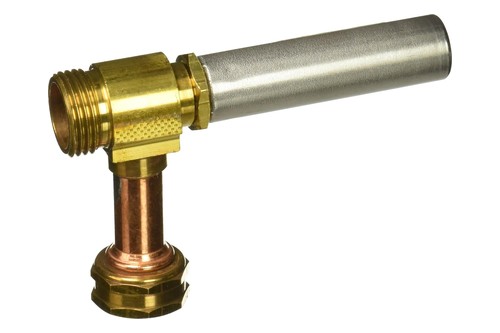
the Sioux Chief 660-HB
A gurgling drain is a different problem, and our guide to quieting noisy drain pipes covers it.
How Much Quieter Will the Room Get?
Those fixes pay off unevenly, so a before-and-after measurement beats guessing. No source above gives one decibel drop for a whole laundry room, but FHWA’s noise primer rates a 3 dBA drop as barely perceptible, a 5 dBA drop as readily perceptible and a 10 dBA drop as half as loud (FHWA).
The same primer says two equal sources are only 3 dB louder than one, and that a source 10 dB or more below another adds nothing to the total, so quiet the loudest machine first.
CDC’s NIOSH Sound Level Meter app is free, runs on iOS only and is accurate within 2 dBA, and CDC says an Android app’s accuracy can’t currently be verified (CDC).
Measure in the room that bothers you with the door shut, run the same load and cycle each time, and write the numbers down.
The Bottom Line
Quiet the washer and dryer first, since the makers’ own pages start with shipping bolts, level and load, then add pads, stiffen the floor, seal the door and leave the dryer vent alone.
If a number matters, measure before and after, because 3 dBA is barely noticeable and 10 dBA sounds half as loud.
Frequently Asked Questions
How do you soundproof a laundry room cheaply?
Start with the free checks: remove the shipping bolts, level every foot and spread the load, then add pads and a door seal. Whirlpool’s and LG’s help pages put those checks ahead of any repair.
How do you soundproof a washer and dryer?
Level both, give each 1 in of space on every side and keep them from touching each other, since Whirlpool says the washer’s spin can shake the dryer cabinet. Pads under the feet come after that.
Do anti-vibration pads reduce washing machine noise?
They add grip and a rubber cushion under each foot, but the two listings above give no decibel figure, and ELEON’s says leveling is what stops a washer walking. Check your foot size before ordering.
How do you stop a washing machine from vibrating the floor?
Level it, balance the load and, if the floor flexes, secure ¾ in plywood to the floor beneath the washer and dryer. Whirlpool says that may reduce the noise and vibration.
How do you soundproof a laundry room door?
Seal the edges and bottom, and replace a hollow-core door with a solid-core one if you can. HUD rates a hollow-core door at STC 17 and shows a sealed solid-core door lifting a 48 STC wall to 33.
Can you soundproof a dryer vent?
Not by blocking or lining it. Whirlpool says the dryer must exhaust outdoors, with no flexible plastic or foil-type duct unless the maker names it for dryers, and no booster fan.
Why do my pipes bang when the washer shuts off?
The valves close fast and the moving water hits them, which is the surge a water hammer arrester absorbs. Sioux Chief’s spec calls for one on both the hot and cold inlets.
Can you soundproof a laundry closet?
Yes, at the machines, the floor and the walls, but a closet door needs the top and bottom openings Whirlpool requires. Some codes limit a dryer in a closet, so ask your local building inspector.