How to Soundproof a Closet, Starting With the Door

If you’re working out how to soundproof a closet, start with the door, because the published figures put a plain hollow door far below the walls around it.
HUD’s Noise Guidebook rates the common hollow-core wood door at STC 17, while NBS Handbook 119 puts most interior walls in a home between STC 30 and 35.
Get that door solid and sealed, and the walls you share with the next room become the limit, which is where added drywall and insulation come in.
The steps run in that order: the door and its seals, the gaps around outlets and lights, the shared walls, the ceiling and floor, then the inside for recording, fresh air and the no-demolition fixes.
Each step names the source and figure behind it, so you can see what a fix adds and stop once your closet is quiet enough.
How to Soundproof a Closet, Step by Step
That gap between the door and the walls sets the order of the work. Fix the door first, with a solid-core slab and gaskets on all four sides, then close the holes around outlets and lights, then add mass to the walls you share with a room, with insulation in any wall you open.
| Step | What to do | What the sources show |
|---|---|---|
| 1. Door | Swap a hollow slab for a solid core | Masonite’s 1-3/8-inch flush door: STC 24 hollow, 29 to 31 solid, sealed shut |
| 2. Gaskets | Line the head and jambs, close the bottom | NGP: STC 15 to 20 without gasketing, about 28 to 30 for solid-core wood with it |
| 3. Gaps | Fill outlets, the light and edge cracks | HUD: a one-inch-square hole takes a 50 STC wall to 40 |
| 4. Walls | Add a second layer of drywall | National Gypsum: STC 35 to 40 on a 2×4 wall |
| 5. Cavity | Fill an open wall with batts | National Gypsum: STC 35 empty, 36 with glass fiber |
| 6. Inside | Absorb echo for recording | PABCO: absorption acts mainly within a room, not between rooms |
The figures come from the door, seal and insulation makers’ data sheets and the gypsum makers’ tested-assembly tables. To read them, NBS Handbook 119 rates STC 30 as normal speech audible but not intelligible, 35 as loud speech audible and fairly understandable, and 40 as loud speech audible but not intelligible.
Keeping sound in and keeping it out are the same job, since the same door, gaps and walls carry it either way. A closet that holds a furnace, water heater or air handler is a different job, though: NBS Handbook 119 notes that the louvers on a furnace closet’s door supply its air for heating and combustion, and the utility closet section of Burton Acoustix’s guide to quieting a laundry room covers the openings and clearances to check first.
How Much Sound Gets Through a Closet Door?
Step one carries the most weight because the door is the thinnest part of the closet. A hollow-core door lets through far more than the wall around it: HUD’s Noise Guidebook rates the common hollow-core wood door at STC 17 and says that, filling about 20% of a wall, it takes a 48 STC wall down to 24.
The makers’ lab figures sit higher. Masonite’s acoustical sheet, tested to ASTM E90 with the slab inoperable and its perimeter sealed, lists a 1-3/8-inch flush hollow-core door at STC 24, and JELD-WEN’s STC Rating Guide gives its flush hollow-core door the same 24.
In a frame with gaps around it, a working door does worse. National Guard Products (NGP) says standard doors without gasketing have no sound control and test at STC 15 to 20.
Should You Swap a Hollow Closet Door for a Solid-Core One?
Those lab figures also show what a heavier slab adds. A solid core raises the door’s own rating by about five to seven points: on Masonite’s acoustical sheet the 1-3/8-inch flush door rates 24 hollow, 29 with Masonite’s DorCor core and 31 with particleboard, and JELD-WEN’s STC Rating Guide, which it calls reference only, lists its flush doors at 24 hollow and 30 solid.
Masonite’s data sheet says its 1-3/8-inch Flush Solid Core door is made with DorCor, so expect the 29 row unless a dealer confirms another core. Masonite describes its solid-core doors as made with more material than its hollow-core ones, and heavier, and Acoustical Surfaces’ door page lists a standard 1-3/4-inch solid-core door at 5 pounds per square foot.
For ratings across more door lines, see how soundproof solid core doors are, and if the slab is staying, soundproofing a hollow door you keep goes further than this page.
Some closet doors need a different fix altogether. NBS Handbook 119 lists louvered doors among the paths that carry sound between rooms, NGP says pairs of doors are harder to control than single ones, and folding closet doors are covered in what a bifold closet door can and can’t seal.
Which Seals Soundproof a Closet Door?
A solid slab still needs its edges closed, because the core’s rating only holds when nothing leaks around it. Close all four sides: Zero International says gasketing that doesn’t seal every side of a door gives little or no sound-control value, and that a small hole transmits almost as much sound as a much larger gap.
NGP’s own list for a standard door is a perimeter gasket for the head and jambs, an automatic door bottom, and a threshold so the door bottom can do its job. With that gasketing, NGP says solid-core wood doors test at about STC 28 to 30.
Acoustical Surfaces sells the head, jamb and bottom parts as a kit, pairing its 320C automatic door bottom with a three-piece adjustable jamb strip of two 7-foot lengths and one 3-foot length. Its door seal page lists a standard 1-3/4-inch solid-core door at STC 22 with no seals and 33 with its seals.
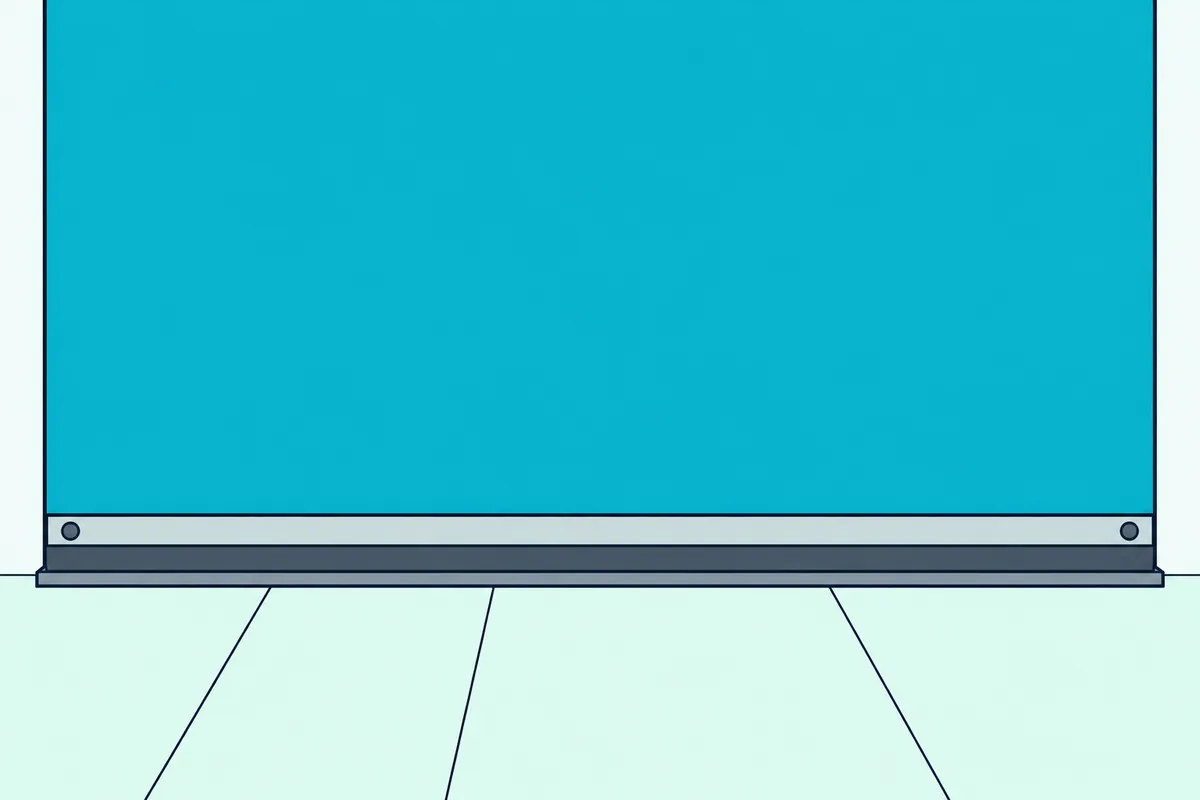
On an automatic door bottom, NGP recommends a 1/4-inch drop for the best acoustic results and 3/8 inch at most, so measure the gap under your door before you buy one.
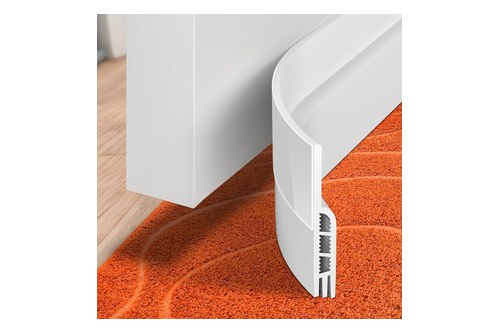
For a door you can’t drill, M-D’s Cinch piece just slides on, fits standard 32-inch-wide, 1-3/8-inch-thick interior doors and closes gaps of 1/2 to 1-1/2 inches, and M-D says it reduces sound infiltration from room to room. Stick-on parts cover the same two jobs: Bantie’s silicone D-shaped strip for the stops, and Holikme’s stick-on silicone sweep for the bottom.
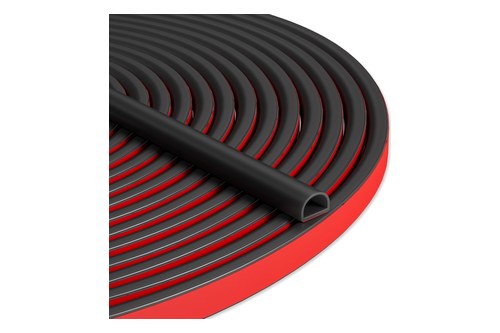
Bantie’s silicone D-shaped strip
Every pick met Burton Acoustix’s rating, review and stock checks on 3 November 2026. The whole order for any interior door is in Burton Acoustix’s door-sealing steps.
Which Gaps Let Sound Out of a Closet?
The door’s edges aren’t the only openings, and the smaller ones are easy to miss. Outlets, the ceiling light and cracks along the wall edges leak too: HUD’s Noise Guidebook says a one-inch-square hole or a 1/16-inch crack 16 inches long will reduce a 50 STC wall to 40.
PABCO’s Sound Design Guide shows the same kind of loss in a figure, a wall rated STC 46 when properly sealed and 36 with a 1/8-inch gap spanning one foot. It cites ASTM C919’s call for a non-hardening sealant to prevent sound leakage, and says outlet boxes must be plugged, with acoustic putty for example.
NBS Handbook 119 names back-to-back electrical outlets as a common cause of noise leakage. Its fix is to fill the openings around outlets, ducts and grilles with glass fiber packing and close them completely with a resilient caulk.
A recessed ceiling light is the hard one. PABCO says recessed lights create large open holes in the ceiling that are very difficult to treat, and it suggests building a box around the light inside the joist cavity, or using track lighting instead.
Does a Second Layer of Drywall Help a Closet Wall?
Once the gaps are shut, the walls you share with the next room carry what’s left. A second layer adds about three to five STC points in the makers’ tests: National Gypsum’s SoundBook lists a 2×4 wall with one layer of 5/8-inch Fire-Shield board per side at STC 35 empty and 40 with two layers per side, and 36 against 41 with glass fiber in the cavity.
PABCO’s insulated 2×4 wall went from STC 35 to 38 with a second layer of 5/8-inch board per side, its weight from about 5.5 to 9.9 pounds per square foot. On NBS Handbook 119’s scale from earlier, that’s the step from loud speech fairly understandable at 35 toward loud speech not intelligible at 40.
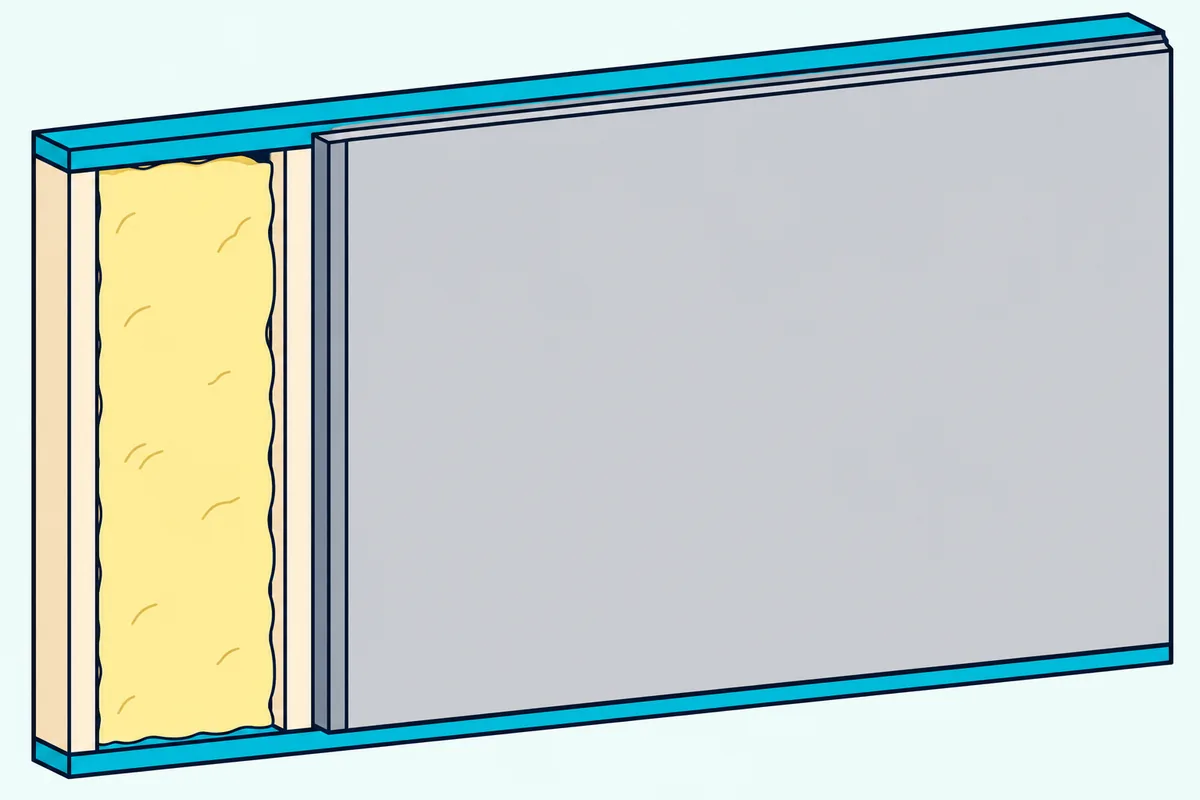
Those figures come from adding a layer to both sides of the wall. If you can only work from inside the closet, National Gypsum also lists a one-sided upgrade on plain studs: its insulated wall rated STC 42 with one face of 5/8-inch SoundBreak XP, a damped board, against 36 with plain board on both faces.
Space is the trade-off inside a closet. PABCO’s home brochure notes that added layers mean thicker walls and less floor space, and that doors and trim need building out to match.
Does Insulation in a Closet Wall Make a Difference?
The same brochure calls insulation a minimal improvement in sound isolation, and on wood studs the tables agree. Filling an open 2×4 wall adds about one STC point on its own: National Gypsum’s wall with 5/8-inch board rated STC 35 empty and 36 with 3-1/2 inches of glass fiber, and PABCO’s label covers both fiberglass and mineral wool.
So batts belong in a wall you’re already opening; they’re not a reason to open one. ROCKWOOL’s Safe’n’Sound data sheet describes a stone wool batt for interior partitions, made 3 and 6 inches thick and 15.25 by 47 inches for wood studs 16 inches apart, with an easy friction fit.
ROCKWOOL’s wall catalog lists a 2×4 wall with 1/2-inch gypsum and 3 inches of Safe’n’Sound at STC 38. Which fiber you pick changes little: NAIMA’s report on Intertek’s wall tests found 3 STC points or less between insulation types, and how fiberglass and Rockwool batts compare in one wall sets out the rows.
What About the Closet Ceiling and Floor?
The leaks that matter at the walls matter where the walls meet the ceiling and floor. NBS Handbook 119 says noise leaks may occur particularly along the ceiling, floor and side edges of a wall, and it fills settlement cracks there with resilient caulk, taking off the baseboards if a thorough job needs it.
It also lists open ceiling spaces that span two rooms among the flanking paths, and PABCO asks for walls built from the floor to the structural ceiling, not partial-height partitions.
How Do You Soundproof a Closet for Recording?
Recording adds a second job, because the mic hears the closet’s own echo as well as whatever gets in. Treat it as two jobs: block outside noise with the door, gaskets and walls, then absorb inside to control what the mic hears.
PABCO draws the line plainly: absorption converts sound energy into tiny amounts of heat inside a material, while transmission is sound passing through a partition. Its home brochure adds that absorption primarily affects sound within a room rather than its transfer into another.
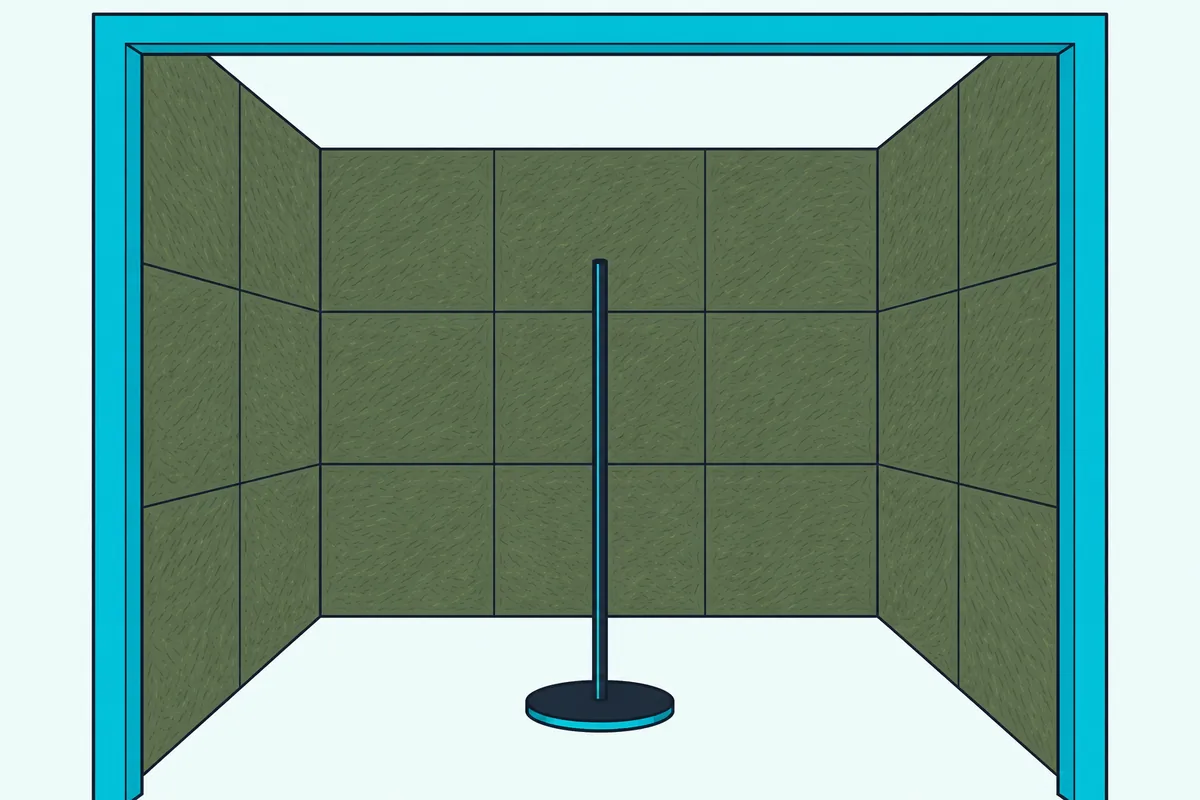
So foam or acoustic panels inside change how the closet sounds to the mic, not how much of your voice reaches the bedroom next door. For the inside, see where acoustic foam goes in a vocal booth, acoustic foam or a portable vocal booth, and recording in a closet full of clothes with no treatment at all.
For a dedicated room, the guide on how to build a soundproof booth covers a full booth’s shell, door and airflow.
What Do Booth Makers Do About Air and Heat?
A closet closed up well enough to record in also shuts out the air that used to leak in around the door. Booth makers build in quiet ventilation: VocalBooth says its standard system exchanges the air once every five minutes, pulling warmer air out through a baffle box while cooler room air comes in through a separate passive one.
WhisperRoom sells ventilation upgrades to improve circulation and keep the air fresh while keeping its booths’ isolation, including a silencing system with exhaust ducts, hoses and adapters. It also describes its studio lights as silent and heat-free.
Can You Soundproof a Closet Cheaply?
The fixes that need no drilling or demolition follow the same order, just with lighter parts. Start with the gaps, using a stick-on or slide-on strip at the bottom of the door and putty or sealant at the outlets, then hang a heavy blanket over the door if you need more.
Blankets come in two kinds, and the label doesn’t always say which. Steel Guard Safety describes acoustic blankets as designed for absorbing sound and reducing echo, and sound barrier blankets as including mass loaded vinyl to help block sound transmission.
NetWell cuts its door covers to extend 2 inches beyond the door’s edges, to cover the jambs where sound leaks through. For the picks, see Burton Acoustix’s soundproof blanket guide, and for what a plain moving pad can and can’t do, whether moving blankets block noise.
Frequently Asked Questions
Are closets more soundproof than other rooms?
Not by construction. NBS Handbook 119 puts most interior walls in a home between STC 30 and 35, and it lists thin hollow-core doors, open gaps under doors and light interior walls among the causes of poor privacy at home. A closet built the same way blocks no more than the rooms around it until its door and gaps are dealt with.
Can you soundproof a closet with sliding or double doors?
Yes, but it’s harder than with a single swinging door. NGP says pairs of doors are intrinsically more difficult to control sound through, because the gap between the meeting edges and under the doors has to be closed too. Sliding and folding doors add more meeting edges to close, and the makers’ ratings describe single doors.
How do you soundproof a closet without damaging the walls?
Work on the door and the gaps, which need no demolition. A slide-on or stick-on strip fits the bottom of the door, a self-adhesive strip lines the stops, a heavy blanket can hang over the door, and outlet and edge gaps take sealant. Drywall and insulation mean opening or building out the walls, so leave them for last.
Can you record vocals in a closet?
Yes, as long as you treat it as two jobs. The door, gaskets and walls decide how much outside noise reaches the mic, and absorption inside decides how roomy the voice sounds. The untreated-room guide linked above counts a walk-in closet full of hanging clothes as a usable space with no treatment at all, and the vocal booth guides cover what to add for a DIY setup.