Are Solid Core Doors More Soundproof? What the Ratings Show
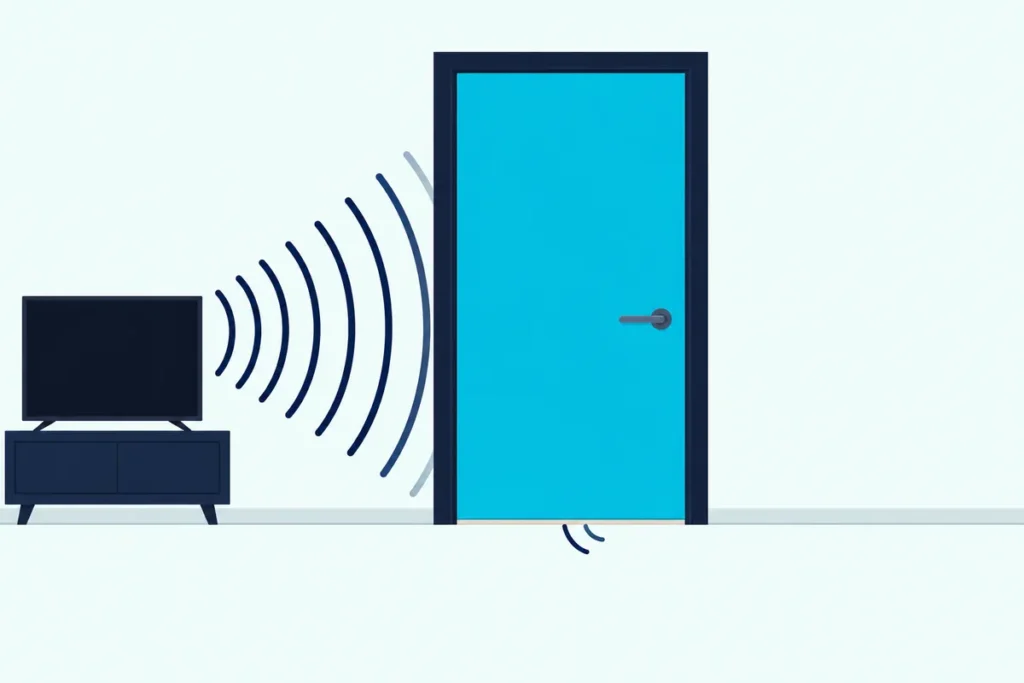
If you can follow every word of the TV through a closed bedroom door, you’ve probably wondered: are solid core doors soundproof, or just heavier?
The common hollow door is the usual culprit, and JELD-WEN rates most of its hollow molded designs at STC 25, the level at which it says normal speech is easily understood through the closed door.
Its solid-core versions of the same designs rate STC 29 to 32, a real step up that still stops well short of soundproof.
This guide uses the door makers’ lab ratings, the Steel Door Institute’s hearing scale and HUD’s noise guidebook to show how much a solid core blocks, why it still leaks and whether solid wood does any better.
Start with the ratings, because they show both the gain and its limit.
Are Solid Core Doors Soundproof?
Those ratings come from JELD-WEN’s 2023 acoustic guide, which lists hollow and solid versions of the same doors side by side. Solid core doors aren’t soundproof: the guide puts its solid-core molded doors at STC 29 to 32 and their hollow-core twins at 25 (27 for the Colonist), so a solid slab does block sound better but still lets loud voices through (JELD-WEN).
| JELD-WEN interior door (2023 guide) | Hollow core STC | Solid core STC | Hollow core OITC | Solid core OITC |
|---|---|---|---|---|
| Molded: Birkdale, Conmore, Craftsman III, Madison, Monroe | 25 | 32 | 22 | 29 |
| Molded: Caiman, Cambridge, Camden, Carrara, RockPort, Santa Fe | 25 | 30 | 20 | 29 |
| Molded: Colonist | 27 | 29 | 19 | 28 |
| Flush wood composite | 24 | 30 | 19 | 29 |
Every solid-core version beats its hollow twin, by 2 points on the Colonist and by 5 to 7 on the rest. JELD-WEN adds that the figures are for new products, are for reference only and can vary with the components and options chosen.
The Steel Door Institute’s scale turns those numbers into hearing: at 25 to 29, normal conversation can be understood quite easily, while at 30 to 34 loud speech can be understood and normal speech may be audible but hard to understand (SDI). So most of JELD-WEN’s solid-core doors move a room up one band, from following the conversation to catching mainly raised voices.
If you’re shopping for soundproof interior doors rather than judging the one you have, our roundup of the best doors for soundproofing sorts the solid-core options by use.
How Much More Sound Does a Solid Core Door Block?
That one-band jump is the headline, and the table’s second rating shows where the gain is biggest. JELD-WEN’s solid cores rate 2 to 7 STC points above their hollow twins and 7 to 10 OITC points above them, with OITC rising from 19 to 22 up to 28 or 29.
OITC is the outdoor-indoor rating, and SDI explains that it takes in a lower range of frequencies than STC to mimic road and rail noise. The bigger OITC gain fits TruStile’s point that mass is especially important at lower frequencies, which suggests the extra weight does more for the deep end of a TV than the STC gain alone shows (TruStile).
HUD’s noise guidebook shows the same swap at the scale of a whole wall. In its example, the common hollow wood door, rated STC 17, takes up about 20% of a 48 STC wall and drags it down to 24, while a solid core wood door with vinyl seals around its edges and carpet on the floor leaves the same wall at 33 (HUD).
That’s a 9-point gain for the wall, but notice that HUD’s solid door came with seals.
Get Studio Tips Weekly
Join 5,000+ creators getting acoustic treatment advice every week.
No spam. Unsubscribe anytime.Why Does a Solid Core Block More Sound?
Within each pair in JELD-WEN’s table only the core changes, and what a dense core adds is weight. A solid core blocks more because it’s heavier: TruStile names mass, damping and stiffness as what decide how well a barrier resists sound, and says the greater the mass, the less sound gets through.
JELD-WEN describes the lightweight honeycomb inside a hollow door as less dense than a solid core, which gives it less weight, a lower price and more noise transmission (JELD-WEN). VT Industries lists its particleboard-core wood doors at 3.7 lb per square foot at 1-3/8 in thick, so a 30 by 80 in slab of that construction weighs about 62 lb by our arithmetic (VT Industries).
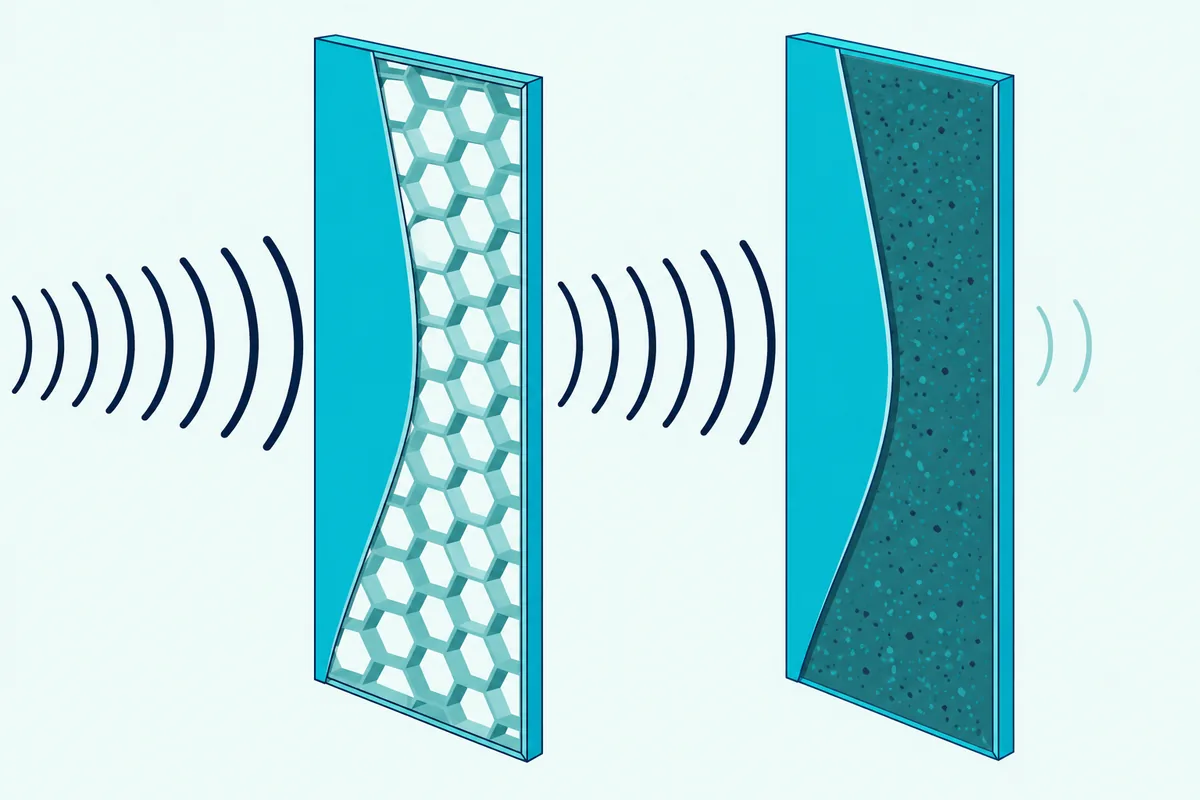
The word “solid” isn’t enough on its own, though. JELD-WEN’s TRIA C Series door with a foam core rates STC 27, no better than its hollow Colonist, while the same series rates 36 as a 20-minute fire-rated door.
VT’s foam-core doors weigh 1.8 lb per square foot even at 1-3/4 in, against 4.8 for its three-ply particleboard core at that thickness, which is the difference between a light core and a dense one. So when a listing says solid, look for a particleboard, MDF or mineral core, the cores JELD-WEN and National Guard Products name.
If your door turns out to be hollow, you can still make a hollow core door more soundproof with seals before you replace it.
Is a Solid Wood Door More Soundproof Than a Solid Core Door?
Density beats the label, and that also settles the solid wood question. Not by default: the fir, meranti and hemlock stile-and-rail doors in JELD-WEN’s guide rate STC 27 to 31, with the six-panel versions at 30, 29 and 27, against 29 to 32 for its solid-core molded doors.
JELD-WEN adds that most doors we call wood today are solid engineered wood under a real wood veneer. TruStile’s ratings show the same pattern with identical hardware: with its Package A seals, its MDF doors rate 33 and 34 and its wood doors in the same style groups rate 32 and 30 (TruStile).
| Door (maker’s rating) | STC |
|---|---|
| JELD-WEN hollow-core molded | 25 (Colonist 27) |
| JELD-WEN solid-core molded | 29 to 32 |
| JELD-WEN stile-and-rail wood, six-panel | 27 to 30 |
| TruStile wood, Package A seals | 30 to 32 |
| TruStile MDF, Package A seals | 33 to 34 |
| JELD-WEN fire-rated TRIA with Seal Set D or E | 36 to 37 |
Some sellers call solid wood the quietest choice, but none of these makers’ figures backs that up. The Steel Door Institute’s advice fits the table: when sound matters, choose by the tested STC rating rather than by core material, because makers use their own proprietary cores.
Why Do Solid Core Doors Still Let Noise Through?
Those are lab ratings, and TruStile warns how fast a gap erases them. Solid core doors leak through their gaps: TruStile says 1/8 in clearances around the edges cut the effective rating of an STC 52 door to 21, because a tiny opening passes almost as much sound as a much larger one.
National Guard Products, a seal maker, says standard doors without gasketing test at only STC 15 to 20, while solid core wood doors with gasketing reach about 28 to 30 (NGP). TruStile’s wood doors in its TS5000 to TS9000 styles rate 30 with its fullest seal package and 18 with a lighter one, the same style of door in both cases.
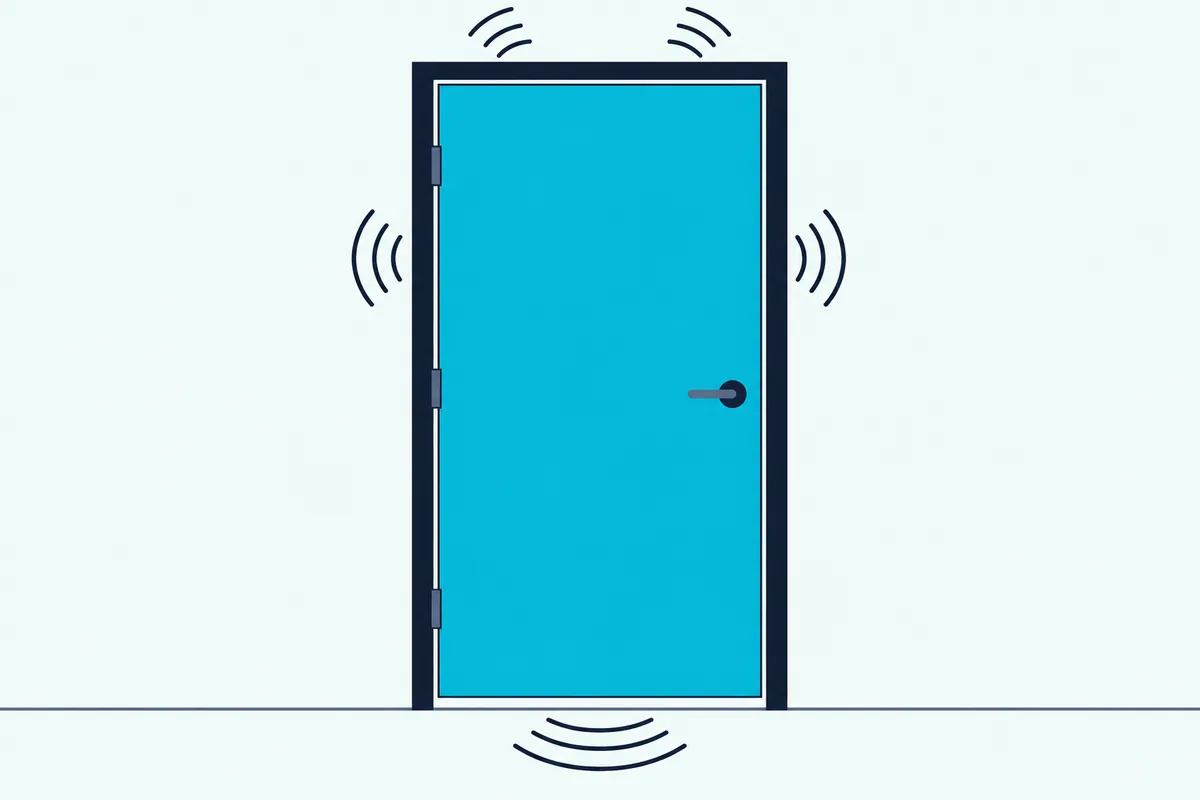
Around a 30 by 80 in door, a 1/8 in gap at the sides and top adds up to about 24 square inches of open air by our arithmetic. SDI adds that the quality of the seal and threshold alone can move a door assembly by 1 to 5 STC points.
ASTM adds that its lab ratings are an upper limit for a building, where sound also travels around the door through other paths (ASTM).
Does a Solid Core Door Make the Whole Wall Quieter?
Those other paths are a reminder that the door is only part of the wall it hangs in. A solid core door lifts the wall only up to the wall’s own rating: JELD-WEN says a typical 2×4 interior wall carries STC 36, so an interior door has no need to go beyond 36.
The table uses the standard area-weighted average of the sound each part lets through, with the door taking 20% of a 36 STC wall. Those are our figures, and the same arithmetic reproduces HUD’s example of a 17 STC door pulling a 48 STC wall down to 24.
| Door in a 36 STC wall | Door STC | Wall and door together |
|---|---|---|
| Hollow core (JELD-WEN) | 25 | About 31 |
| Solid core (JELD-WEN) | 30 | About 34 |
| Solid core (JELD-WEN) | 32 | About 35 |
| TRIA C Series, 20-minute (JELD-WEN) | 36 | 36 |
In this example the swap from hollow to solid is worth 3 to 4 points for the wall, and a door rated above 36 adds almost nothing until the wall improves. SDI tells of an STC-rated door that still left occupants complaining, because the room had a drop ceiling and drywall walls that sound passed straight through.
How Do You Get the Full Rating From a Solid Core Door?
With the wall setting the ceiling, the door’s job is to reach it, and that comes down to closing every gap. Seal the head, jambs and bottom: NGP recommends a perimeter seal, an automatic door bottom and a threshold for it to seal against, and TruStile says the seals must be complete, uninterrupted, airtight and all on the same side of the door and frame.
HUD adds that gasketed stops or a drop bar threshold closer at the bottom edge raise the result beyond its sealed 33. SDI says assemblies rated 35 or more need rigorous attention to hardware, seals and installation.
For the sides and top, Kikerike’s high-density foam weatherstrip comes as two 21 ft rolls, 1/2 in wide and 1/4 in thick. Its listing asks for a clean, dry surface before the adhesive goes on.
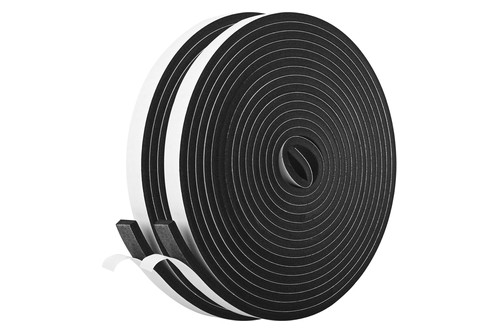
Kikerike’s high-density foam weatherstrip
For the bottom, VITAM AMO’s peel-and-stick door sweep is a 2 by 39 in silicone strip that trims to length. Its listing says it seals gaps up to 1-3/32 in and works on carpet or hardwood.
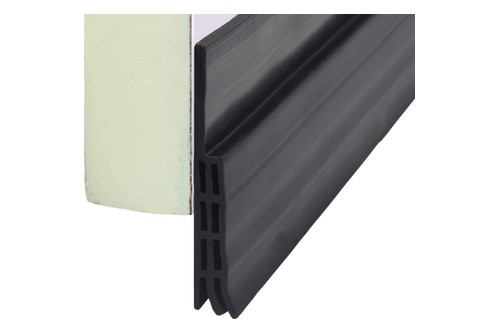
VITAM AMO’s peel-and-stick door sweep
Neither is a rated acoustic seal like the ones in NGP’s or TruStile’s tests, so treat them as the budget version of the same idea. Burton Acoustix’s guide to soundproofing a door covers the frame, the threshold and the stronger seals in order.
If the door carries a fire label, its seals have to suit that listing, and the rules for sealing a fire-rated door explain what you may add.
Are Solid Core Doors Worth It for Soundproofing?
Seals are the cheap half of the job, so is the slab itself worth changing? Yes, when a hollow door is the weak point and you want normal speech blurred: the step from STC 25 to 30 or 32 moves a room out of SDI’s “understood quite easily” band, and HUD calls a well-sealed solid core wood door relatively inexpensive.
Masonite pitches its solid core interior doors for laundry rooms, bathrooms and home offices, with hollow-versus-solid audio clips, and says solid core doors are better at managing sound (Masonite). JELD-WEN offers solid core upgrades on its molded and flush designs to improve sound insulation, so a quiet bedroom can keep its look.
The disadvantages are weight and cost: that particleboard slab weighs about 62 lb, and JELD-WEN says hollow cores cost less because they use fewer materials. A solid core can’t reach a studio target either, since SDI says it takes STC 50 to 54 to turn instruments and high-volume stereos into tolerable background sound, and 55 or more needs a door at least 2-1/4 in thick.
The Bottom Line
Solid core doors aren’t soundproof, but they’re clearly quieter: JELD-WEN’s solid cores rate STC 29 to 32 against 24 to 27 for its hollow doors, and from 30 up that’s enough to blur normal speech. They only get there with every gap sealed, and they can’t lift a wall past its own rating, which is STC 36 for a typical 2×4 interior wall.
So check the maker’s tested rating rather than the word solid, seal the head, jambs and bottom, and save bigger upgrades for walls that can use them.
Frequently Asked Questions
What are the disadvantages of solid core doors?
Weight and cost are the main ones. VT Industries lists particleboard-core doors at 3.7 lb per square foot at 1-3/8 in thick, which makes a 30 by 80 in slab about 62 lb by our arithmetic, a much heavier door to lift and install. JELD-WEN says hollow cores cost less because they use fewer materials. And a solid core doesn’t fix gaps: National Guard Products says standard doors without gasketing test at only STC 15 to 20.
Do solid core doors reduce noise between rooms?
Yes. JELD-WEN’s solid-core doors rate STC 29 to 32 against 24 to 27 for its hollow doors, and on the Steel Door Institute’s scale that’s the move from normal conversation being understood quite easily to normal speech being hard to understand. That noise reduction holds only with the gaps sealed, since TruStile says 1/8 in clearances can cut an STC 52 door to 21.
What STC rating does a solid core door have?
JELD-WEN’s 2023 guide lists its solid-core molded doors at STC 29 to 32 and its solid-core flush door at 30. National Guard Products puts gasketed solid core wood doors at about 28 to 30. Doors with dedicated seal sets go higher, such as JELD-WEN’s TRIA doors at 36 and 37, and ASTM calls lab ratings like these an upper limit for a building.
Does a solid core door block bass?
Better than a hollow door, but not enough for loud music. JELD-WEN’s solid cores gain 7 to 10 points on OITC, the rating that takes in lower frequencies than STC, and TruStile says mass is especially important at lower frequencies. Still, SDI says it takes STC 50 to 54 to turn instruments and high-volume stereos into tolerable background sound, far above a solid core’s 29 to 32.
What type of door is best for soundproofing?
For a home, a solid core door with a published STC rating and full seals is the practical choice, and SDI advises choosing by that tested rating rather than by core material. Rooms for loud music need acoustic door assemblies in the STC 50s, the range SDI gives for instruments and loud stereos.