Best Soundproof Blankets, Sorted by What They Really Stop
For a door or a bare wall the Boxer BXR Pro Studio is the best soundproof blanket, at 14 lb for 96 x 80 inches with grommets along the top.
| Job | Pick | What its listing gives | Weight per sq ft |
|---|---|---|---|
| A door or a bare wall | Boxer BXR Pro Studio, 96 x 80 in | 14 lb, woven diamond-stitched shell, 9 grommets and loops | 0.26 lb |
| A smaller door or a window | US Cargo Control, 80 x 72 in | 9 lb, heavy woven polyester, 18 grommets | 0.23 lb |
| A recording wall, two at once | AMUFON, 96 x 80 in, pair | 19.8 lb for the pair, recycled cotton between non-woven layers | 0.19 lb |
| A narrow window | Tudomro, 40 x 72 in, pair | 3.53 lb each, non-woven fabric and recycled quilted cotton | 0.18 lb |
| A heavier moving blanket | JourneyO Heavy Duty Pro, 80 x 72 in, six | 90 lb a dozen, 7.5 lb each, polyester | 0.19 lb |
| The lightest first test | Sure-Max Deluxe Pro, 80 x 72 in | 40 lb a dozen, 3.3 lb | 0.08 lb |
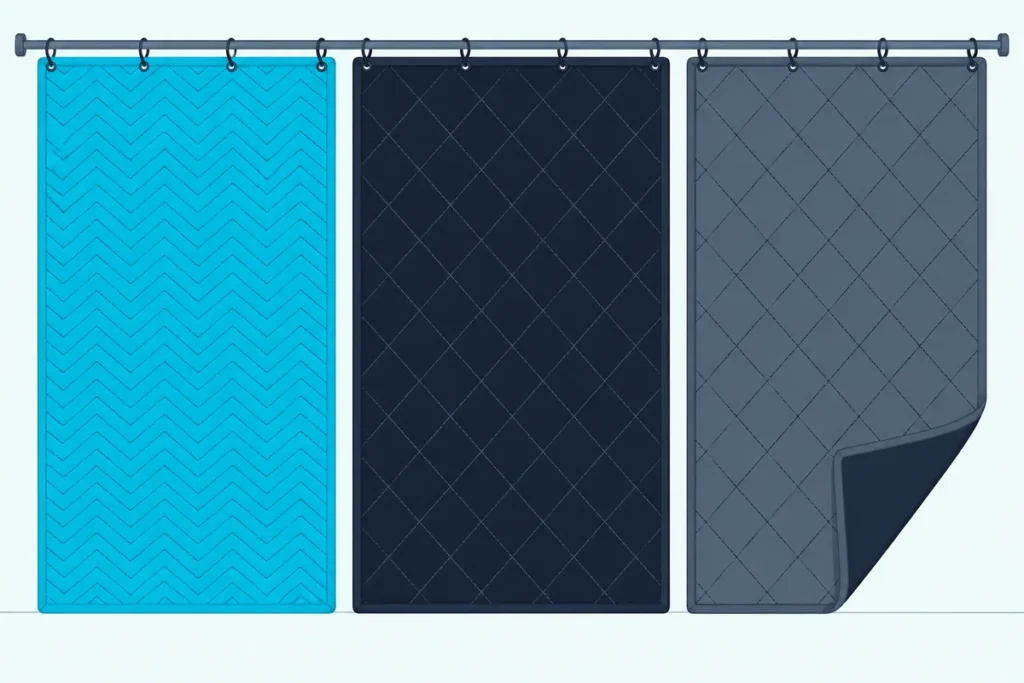
Shopping for a soundproof blanket means choosing between two different jobs: soaking up echo inside a room, or blocking noise that travels through a door, window or wall.
Most listings blur the two, and a light quilted blanket hung to stop a neighbor’s TV will mostly quiet your own room’s echo instead.
Buy for the right job and the spec sheet tells you what you’re getting, from a lab-tested absorption rating to the weight that does the blocking.
The picks below run from a 14-pound studio blanket for a door to moving blankets for a first test, each listed with the weight its listing gives.
Start with the table, then see why weight per square foot says more than the word soundproof on the label.
Which Soundproof Blanket Fits Your Noise Problem?
This table matches each pick to the job it suits, with the listing’s weight worked out per square foot of blanket.
For a door or a bare wall, the blanket to buy is the Boxer BXR Pro Studio, the heaviest of these at 14 pounds for 96 by 80 inches. For a recording wall the AMUFON pair brings two full-size blankets with hanging straps, the Tudomro pair fits narrow windows, and the Sure-Max Deluxe Pro is the lightest way to find out whether a blanket helps at all.
Weight per square foot is the listing’s weight over the blanket’s area. The descriptions come from the makers’ manuals and spec pages.
Every pick met Burton Acoustix’s rating, review and stock checks on 28 October 2026. Whether a blanket like these can block noise at all is its own question, which our guide to whether moving blankets are good for soundproofing works through, so this page sticks to what to buy.
How Do the Picks Compare Up Close?
That last column is where the picks part ways. Up close, they differ in weight, size and hanging hardware, from the Boxer’s 14 pounds on nine grommets and loops to a 3.3-pound Sure-Max pad sold on its own.
Boxer BXR Pro Studio, for a Door or a Bare Wall
For the most weight in one blanket, the Boxer BXR Pro Studio Thicker Sound Dampening Blanket is listed at 14 pounds for 96 by 80 inches, with a woven, diamond-stitched shell and nine grommets and loops. Boxer’s listing also calls it machine washable.
That’s about 0.26 pound per square foot, the most of these picks, and hung 96 inches tall it covers an 80-inch door with 16 inches to spare. It’s still under a fifth of the 1.45 pounds per square foot of Acoustical Surfaces’ vinyl-backed barrier blankets, so buy it to calm echo and cover an opening, not to block.
US Cargo Control 80 x 72, for a Smaller Door or a Window
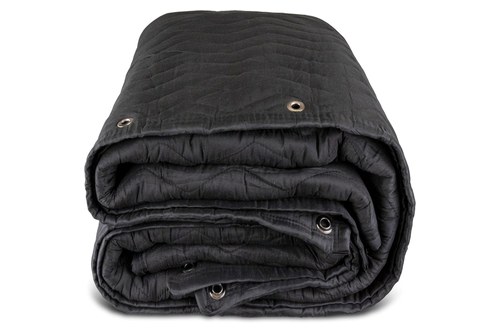
For a smaller opening, the US Cargo Control Large Sound Dampening Blanket, 80 x 72 in is listed at 9 pounds of heavy woven polyester with 18 grommets. Its listing calls it machine washable too.
US Cargo Control Large Sound Dampening Blanket (80 x 72 in)
At about 0.23 pound per square foot it’s close to the Boxer, in a size that’s easier to hang over a window.
AMUFON Pair, for Treating a Recording Wall
For covering a recording wall with ready-to-hang blankets, the AMUFON Large Sound Dampening Blanket, 2-Pack gives you two 96 by 80-inch blankets, each a layer of recycled cotton between two non-woven layers. They hang by metal grommets and straps from a rod or from the hooks and screws the listing says come with them.
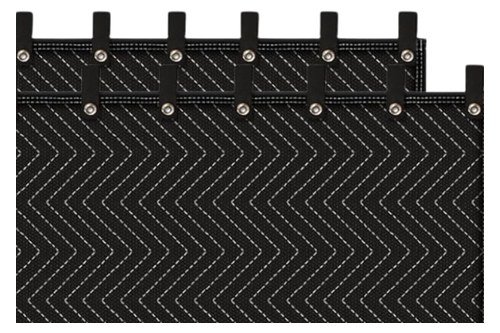
AMUFON Large Sound Dampening Blanket (96 x 80 in, 2-Pack)
The listing’s photos give 19.8 pounds for the pair, about 0.19 pound per square foot, and hung side by side at 96 inches tall the two span more than 13 feet of wall.
Tudomro Pair, for Narrow Windows
For a narrow opening, the Tudomro Sound Dampening Blanket, 2-Pack (40 x 72 in) brings two 40 by 72-inch blankets at 3.53 pounds each, made of non-woven fabric and recycled quilted cotton. Each hangs from straps with metal grommets that the listing shows hooked or hung.
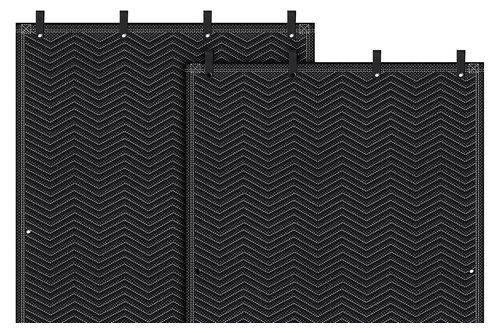
Tudomro Sound Dampening Blanket (40 x 72 in, 2-Pack)
That’s about 0.18 pound per square foot, and side by side the pair covers an opening up to 80 inches wide.
JourneyO Heavy Duty Pro, a Heavier Moving Blanket
If you’d rather hang moving blankets, the JourneyO Heavy Duty Pro Moving Blankets, 80 x 72 in are rated at 90 pounds a dozen, or 7.5 pounds a blanket by the listing’s own figures. They come six to a pack.
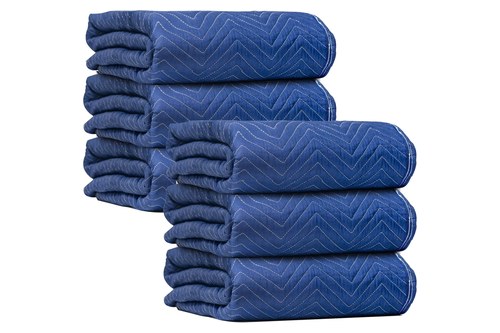
JourneyO Heavy Duty Pro Moving Blankets (80 x 72 in)
Trucking Depot calls weight per dozen the moving trade’s standard measure, and 90 pounds sits near the top of the 54 to 93-pound range it gives from warehouse pads to furniture pads. It also says heavier pads absorb more, while VocalBoothToGo warns that some moving blankets get their weight from dense outer fabric that reflects sound before the fiber can absorb it.
Sure-Max Deluxe Pro, the Lightest First Test
To find out whether a blanket helps before buying heavier ones, the Sure-Max Deluxe Pro Moving Blanket, 80 x 72 in is a single 40-pound-a-dozen pad, 3.3 pounds by its listing. The buying guide in the same listing ranks Sure-Max’s pads at 35, 40, 65 and 90 pounds a dozen, so a test that works can move up the range.
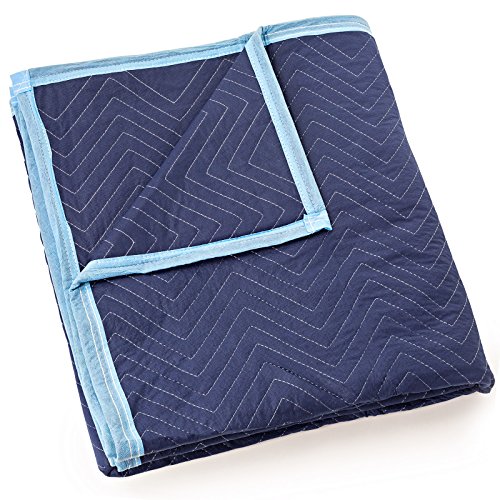
Sure-Max Deluxe Pro Moving Blanket (80 x 72 in)
At about 0.08 pound per square foot it’s the lightest pick here, a third of the Boxer’s weight for the same area.
What Can a Soundproof Blanket Actually Stop?
Every one of those picks is a quilted fabric blanket, as its listing describes it, and that sets the limit. A soundproof blanket made of fiber alone stops echo far better than it stops sound passing through a door or wall, because fiber soaks up sound bouncing around a room, while blocking sound on its way through takes heavy, dense material.
OSHA’s Technical Manual says sound-absorbing material reduces the buildup of reflected sound in a room and does nothing for sound traveling straight from its source. The materials that block transmission, it adds, are typically heavy and dense.
For scale, a 5/8-inch Sheetrock Firecode X panel weighs a nominal 2.2 pounds per square foot, more than eight times the Boxer. Johns Manville’s mass loaded vinyl, a flexible 1-pound-per-square-foot sheet with no fiber in it, earns STC 26 on its own data sheet.
Even purpose-made absorbers fade at the low end. Riverbank Acoustical Laboratories tested VocalBoothToGo’s Producer’s Choice blankets hung as two layers 3 inches apart and measured an absorption coefficient of 0.27 at 125 Hz, against more than 1.0 from 500 Hz up (report RAL-A19-502).
So buy a blanket where echo is the complaint, in a bare room, a podcast corner or a practice space, and count any drop in a neighbor’s noise as a bonus. The same split shows up in a tent, where a hung blanket mostly absorbs echo, as our soundproof tent guide shows with its vinyl and vent numbers.
For echo alone, a fabric-wrapped panel is the other way to go, and our page on acoustic blankets vs panels weighs the two for a recording space.
What Do NRC and STC Mean on a Sound Blanket?
That split between absorbing and blocking gets a rating for each side. NRC, the noise reduction coefficient, rates absorption on a scale where 0 reflects everything and 1 absorbs everything, and STC, the sound transmission class, rates blocking, with a higher number blocking more.
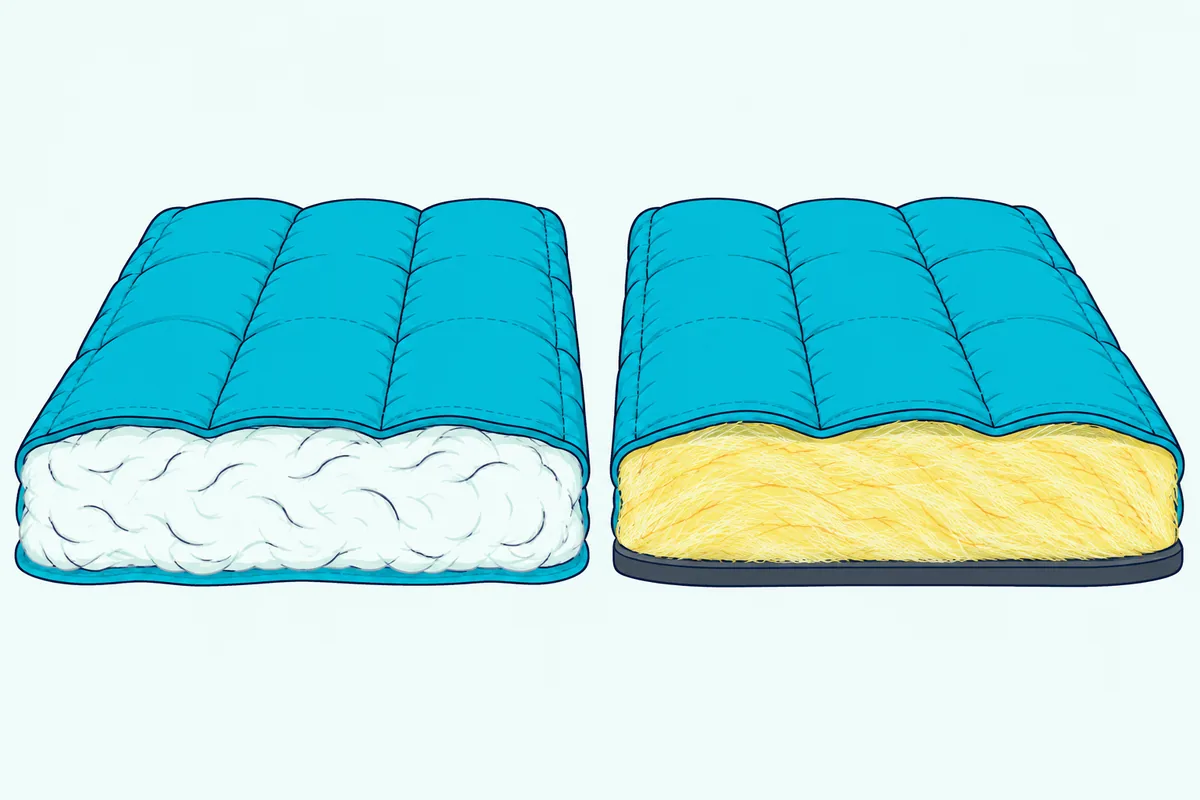
NRC comes from the reverberation-room test in ASTM C423, and Riverbank’s report defines it as the average of a material’s absorption coefficients at 250, 500, 1,000 and 2,000 Hz, rounded to the nearest 0.05. STC comes from the lab transmission-loss test in ASTM E90, turned into a single number by the classification in ASTM E413.
E413 says its rating tracks speech, radio and television noise in buildings and isn’t appropriate for sources such as machinery. NetWell puts its QBS-1 barrier blanket at STC 29 in a lab and says the same blanket rates 40 at 1,000 Hz but only 12 at 125 Hz.
| Blanket and maker | Build | Weight per sq ft | NRC | STC |
|---|---|---|---|---|
| Producer’s Choice, two layers 3 in apart (VocalBoothToGo, Riverbank test) | Quilted blankets, 0.286 in each | 0.45 lb for the pair | 1.00 | None listed |
| SCC-8 (Steel Guard Safety) | 1 in quilted fiberglass | 0.25 lb | 0.70 | None listed |
| SCC-9 (Steel Guard Safety) | 2 in quilted fiberglass | 0.50 lb | 0.85 | 19 |
| Insul-Quilt (Acoustical Surfaces) | 2 in fiberglass, cloth face, foil back | 0.44 lb | 1.00 | 16 |
| BBC-13X-2 (Acoustical Surfaces) | 2 in quilted fiberglass bonded to 1 lb/sq ft loaded vinyl | 1.45 lb | 0.85 | 32 |
| BBC-EXT-R-2 (Acoustical Surfaces) | 2 in fiberglass under an exterior face, 1 lb/sq ft vinyl | 1.45 lb | 0.75 | 33 |
| QBS and QBS-1 (NetWell) | Fiberglass batting with mass loaded vinyl | 1.5 to 2.5 lb (its blankets’ range) | 0.75 | 29 |
Read across the rows and the pattern is plain: the fiber-only blankets list STCs of 16 to 19, and every blanket in the table with an STC above 25 carries a vinyl layer and weighs 1.45 pounds a square foot or more. The picks in the first table weigh 0.08 to 0.26 pound a square foot, which puts them with the absorbers on weight.
The low end tells the same story. At 125 Hz the absorption figures these makers publish fall to between 0.07 and 0.45, well under their figures from 500 Hz up, and NetWell says the lower the frequency, the more easily sound passes through any barrier blanket.
When Is a Barrier Blanket With Vinyl Worth It?
That vinyl layer is what you pay for when blocking is the goal. A barrier blanket with vinyl is worth it when one noisy source can be screened or surrounded, such as a generator, a pump or a work area, since the 1-pound vinyl layer is what lifts the makers’ ratings to STC 27 to 33.
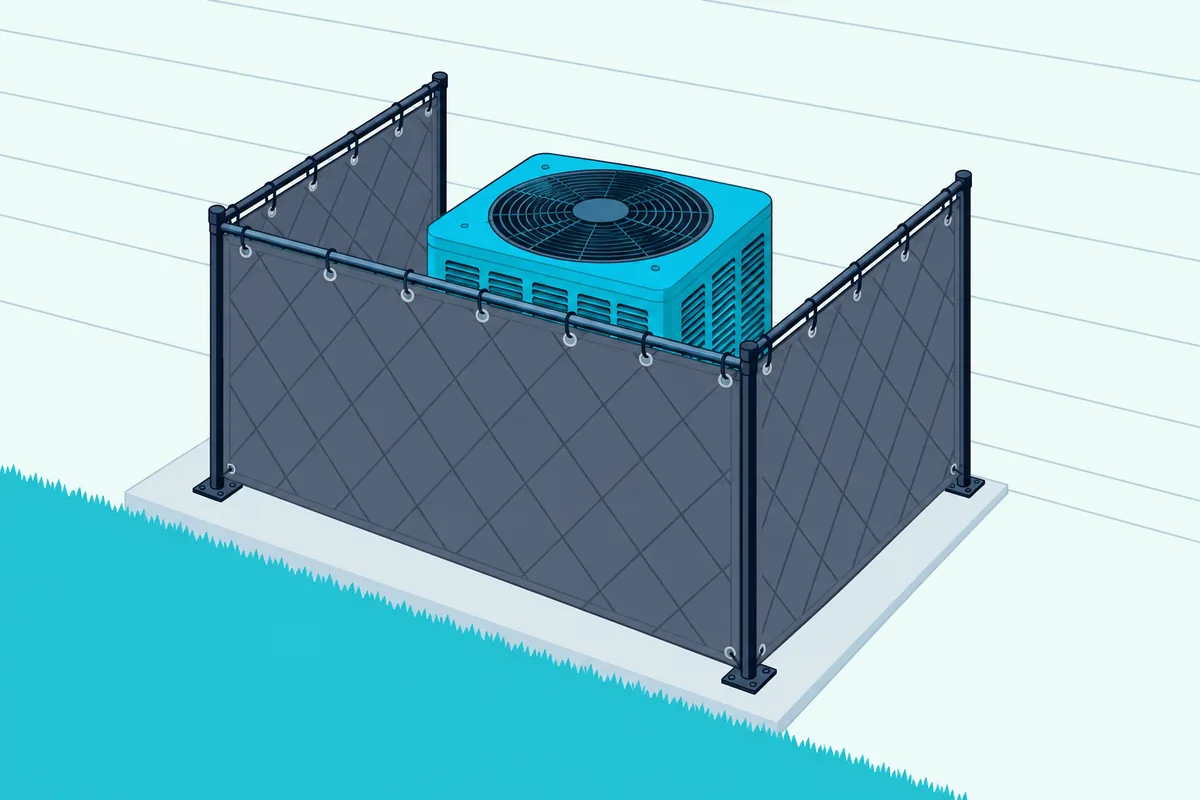
NetWell says a solid 12 to 18 dB drop is realistic for most machine noise behind its barrier blankets, and that a 10 dB drop cuts perceived noise in half. Its blankets average 1.5 to 2.5 pounds per square foot, so whatever holds them has to carry six to ten times the Boxer’s weight for the same area.
For outdoor noise, Acoustical Surfaces’ BBC-EXT-R-2 pairs a UV-resistant vinyl-coated polyester face and 2 inches of fiberglass with a 1-pound vinyl barrier, rated STC 33 and NRC 0.75 from -20°F to 180°F. Its panels join along overlapping hook-and-loop edges, the same way NetWell seals its sections together for continuous coverage.
Steel Guard Safety sells the same split: its Sound Shield acoustic blankets absorb, and its barrier versions add 1 pound of vinyl per square foot for STC 27 with 1 inch of fiberglass or STC 32 with 2 inches.
These come from acoustics suppliers, often made to size: NetWell builds sections up to 54 inches wide and 25 feet long, and the BBC-EXT-R-2 comes 54 inches wide in lengths up to 25 feet. Acoustical Surfaces even labels its fiber-only quilts as designed to absorb sound and sends buyers who need to block it to another product.
Which Blanket Works Over a Door or a Window?
Doors and windows are where those weights meet real noise. The blanket that works over a door or a window covers the whole opening with overlap on every side, and NetWell, which cuts door covers from its barrier blankets, runs them 2 inches past the door’s edges to cover the jambs where sound leaks through.
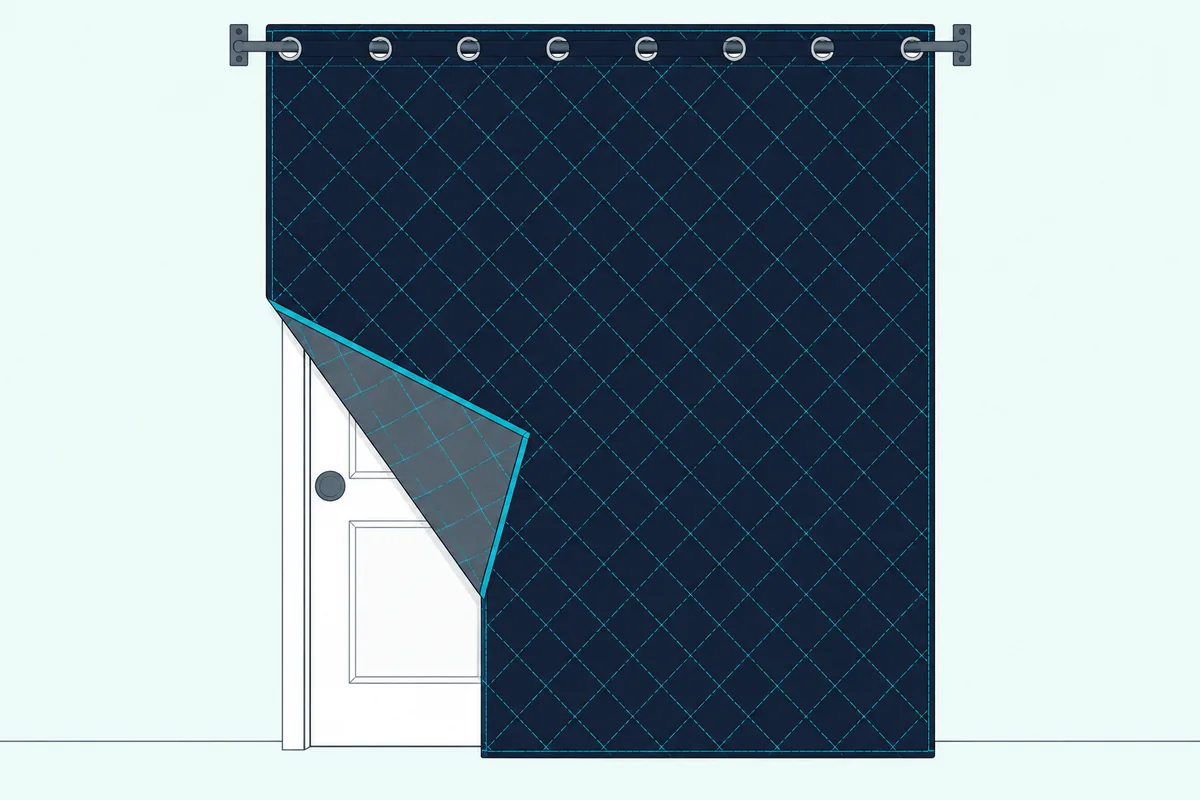
That’s where the Boxer’s extra 16 inches of height earn their keep. NetWell suggests oversizing window covers the same way, to seal the perimeter between the window and the wall framing, where much of the leakage happens.
Gaps undo the rest: HUD’s Noise Guidebook says a 1-inch-square hole or a 1/16-inch crack 16 inches long will reduce a 50 STC wall to 40. Close the gap under the door with the best door sweep for soundproofing before you judge the blanket.
When a blanket over the door isn’t enough, the next step is a heavier slab from our list of the best soundproof interior doors. For glass you look through every day, the best soundproof window inserts fit inside the frame, best soundproof curtains hang more neatly, and the best soundproof windows for home are the tier above both.
Where Should a Sound Blanket Hang in a Recording Room?
Echo is the job these blankets do best, so placement counts for more than brand. In a recording room, hang the blanket on the bare, hard wall nearest where you speak or play, a few inches out from it: Riverbank tested the Producer’s Choice pair 3 inches from the wall with 3 inches between layers, and Trucking Depot suggests about 2 inches for moving blankets.
Try a clap test: clap once in the middle of the room and listen for the ring, then hang one blanket and clap again. If the ring shortens, add a second layer behind the first, the arrangement that earned VocalBoothToGo’s pair its NRC of 1.00, against the 0.8 the company quotes for its Producer’s Choice line.
Use hooks, anchors or a rod rated above the blanket’s weight, since the Boxer’s 14 pounds is a lot to ask of adhesive strips. For a fuller walk-through of this setup, see our page on covering walls in moving blankets for acoustic treatment.
When Is a Blanket the Wrong Buy?
That recording-room advice assumes echo is the problem. A blanket is the wrong buy when the noise comes through a shared wall, floor or ceiling, because that path needs mass, sealing and decoupling, which our guide to the best soundproofing panels covers.
Foam won’t fix it either, as our best soundproof foam guide explains: like a blanket, it treats echo inside the room. Burton Acoustix’s comparison of acoustic foam and blankets sets the two side by side for that job.
Keep any blanket clear of heat, too, since NFPA’s heating safety tips say to keep anything that can burn at least 3 feet from heating equipment. And for a subwoofer or a drum kit, the 125 Hz figures above, under half the sound absorbed at best and a rating of 12 for NetWell’s barrier blanket, are the honest forecast.
The Bottom Line
So the right blanket depends on the job: the Boxer BXR Pro Studio for a door or a bare wall, the AMUFON pair for a recording wall, the Tudomro pair for narrow windows and a Sure-Max pad to test the idea. For a soundproof blanket that really blocks, look for a published STC and a vinyl layer, and expect to buy it from an acoustics supplier.
Measure the opening, add overlap, close the gaps a blanket can’t, and judge the result by ear before you spend more.
Frequently Asked Questions
How heavy should a soundproof blanket be?
It depends on the job. For echo, weight matters less than the fiber: VocalBoothToGo’s double layer reached NRC 1.00 at 0.45 pound per square foot for the pair, and Steel Guard Safety’s 1-inch quilt lists NRC 0.70 at 0.25 pound. For blocking, the makers’ figures point to about 1.45 pounds per square foot and up, the weight of a fiberglass quilt with a 1-pound vinyl layer, which earns Acoustical Surfaces’ BBC blankets STC 32 to 33. The studio and moving blankets on this page weigh 0.08 to 0.26 pound per square foot, so treat them as absorbers.
What is the best material for a soundproof blanket?
The best material depends on whether you want to absorb or block. Singer Safety lists fiberglass, cotton and wool as absorbing materials and says mass loaded vinyl adds the mass that helps block low-frequency sound such as bass or machinery hum. Steel Guard Safety draws the same line in its own terms: acoustic blankets absorb echo, sound barrier blankets include mass loaded vinyl to block transmission, and “soundproof blanket” is a common name for both. So choose fiber for echo, and for blocking look for a vinyl layer with a published STC.
What size soundproof blanket do I need?
Measure the opening and add overlap on every side. NetWell runs its door covers 2 inches past the door’s edges and suggests oversizing window covers to seal around the perimeter. A 96 by 80-inch blanket, like the Boxer or each AMUFON, covers an 80-inch door hung tall with 16 inches to spare, while 40 by 72-inch blankets like the Tudomro pair suit narrow windows and can sit side by side for wider ones. For a wall, add up the widths: two blankets 80 inches wide cover a little over 13 feet.
Can you use a soundproof blanket outdoors?
Yes, if it’s built for it. Acoustical Surfaces’ BBC-EXT-R-2 has a UV-resistant vinyl-coated polyester face and a 1-pound vinyl barrier, with STC 33 and a rated range of -20°F to 180°F, and the company’s BBC-13X-2 construction barrier lists a 3 to 5-year life outdoors when installed properly. Among the stock picks here, Tudomro’s listing names indoor or outdoor use, while the others are sold for studios or moving. Outdoors, sound reaches you mostly straight from the source rather than off walls, and OSHA notes that absorption does nothing for that direct path, so the blanket has to work as a barrier.