Are Moving Blankets Good for Soundproofing? What They Really Stop
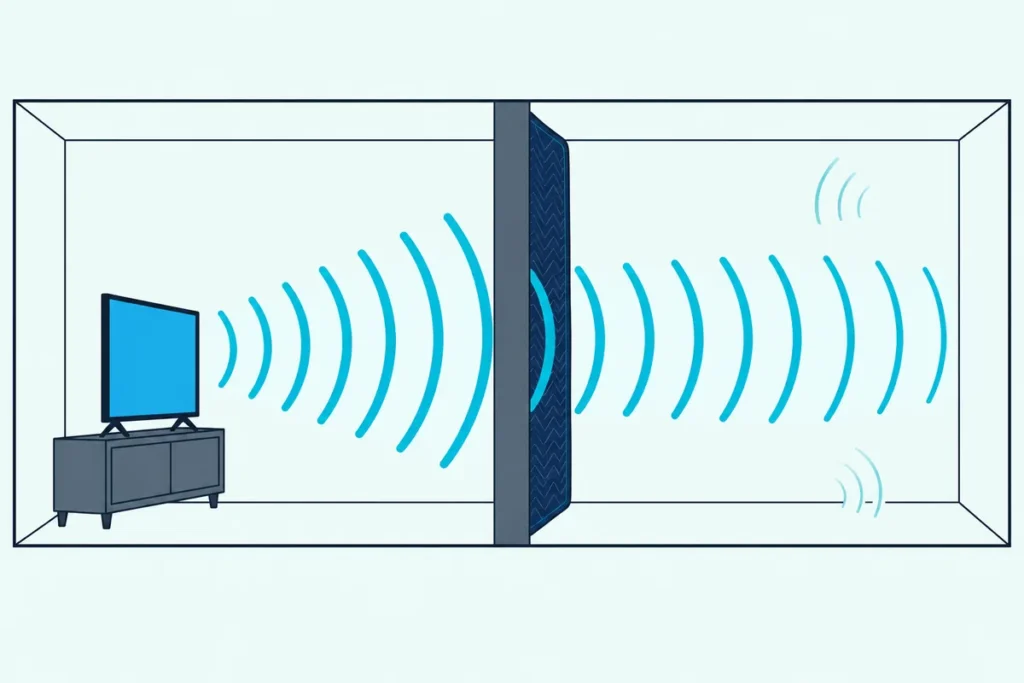
You hang a wall of quilted moving pads, the echo fades, and the neighbor’s TV still comes through, so are moving blankets good for soundproofing at all?
They’re good at one job and poor at the other: soft, porous pads soak up sound bouncing around inside a room, while stopping sound from next door takes weight and an airtight seal.
Put the blankets where absorption matters and they earn their keep, then fix the noise coming through walls, doors and windows with the few things that actually block it.
This guide weighs a moving blanket against drywall and HUD’s 4-pound barrier rule, and it compares lab numbers for absorbing quilts and vinyl-backed sound blankets.
Start with the short answer and the numbers behind it, then work through doors, windows, recording corners and the gaps that leak the most.
Are Moving Blankets Good for Soundproofing?
That split between soaking up sound and blocking it is the whole answer in one line. Moving blankets are good for taming echo inside a room and poor at soundproofing, because blocking sound takes weight and a seal, and a quilted pad has little of either (HUD).
Movers rate pads by the weight of a dozen, and Trucking Depot lists its 72 by 80 inch pads at 54 to 64 pounds a dozen for its lightest warehouse pads and 85 to 93 pounds for its heaviest furniture pads (Trucking Depot). By our arithmetic, that’s 4.5 to 7.75 pounds a pad spread over 40 square feet, or about 0.11 to 0.19 pound per square foot.
HUD’s Noise Guidebook sets the yardstick with its rules for outdoor noise barriers. A barrier heavier than 4 pounds per square foot with no openings usually lets through negligible sound, while openings that add up to 10 percent or more of its area leave it with negligible effect.
Even the heaviest furniture pad weighs about a twentieth of that, so a blanket starts far short before the gaps at its edges are counted. The table puts the pads beside layers that do block sound, using the makers’ and HUD’s own figures.
| Layer | Weight per square foot | What its maker or HUD reports |
|---|---|---|
| Moving pad, warehouse grade, 72 x 80 in | About 0.11 to 0.13 lb | 54 to 64 lb a dozen (Trucking Depot) |
| Moving pad, heaviest furniture grade, 72 x 80 in | About 0.18 to 0.19 lb | 85 to 93 lb a dozen (Trucking Depot) |
| Fiberglass sound quilt, no vinyl layer (Insul-Quilt) | 0.44 lb | NRC 1.00, STC 16 (Acoustical Surfaces) |
| Mass loaded vinyl, 1 lb grade | 1 lb | STC 26 (Johns Manville) |
| Fiberglass quilt bonded to loaded vinyl (BBC-13X-2″) | 1.45 lb | STC 32, NRC 0.85 (Acoustical Surfaces) |
| 5/8 in drywall (Sheetrock Firecode X) | 2.2 lb | Nominal weight (USG) |
| Solid barrier with no openings | Over 4 lb | Transmitted sound usually negligible (HUD) |
The pad figures are our arithmetic from the dozen weights, and the rest are the makers’ or HUD’s published numbers. Read down the middle column and the blocking ratings climb with the weight, which is the pattern every section below comes back to.
So moving blankets earn a place in a recording corner, a practice room or an echoey hallway, but they won’t keep a neighbor’s voice, traffic or a drum kit on the other side of the wall. For a sense of scale, FHWA’s loudness table calls a 3 dB drop barely perceptible and a 10 dB drop half as loud (FHWA).
Why Can’t a Blanket Block Sound Through a Wall?
Those weights explain most of it, because blocking is a contest of mass. A blanket can’t block much sound because a material’s transmission loss typically improves with its surface weight, HUD says, and a fifth of a pound per square foot gives passing sound very little to work against.
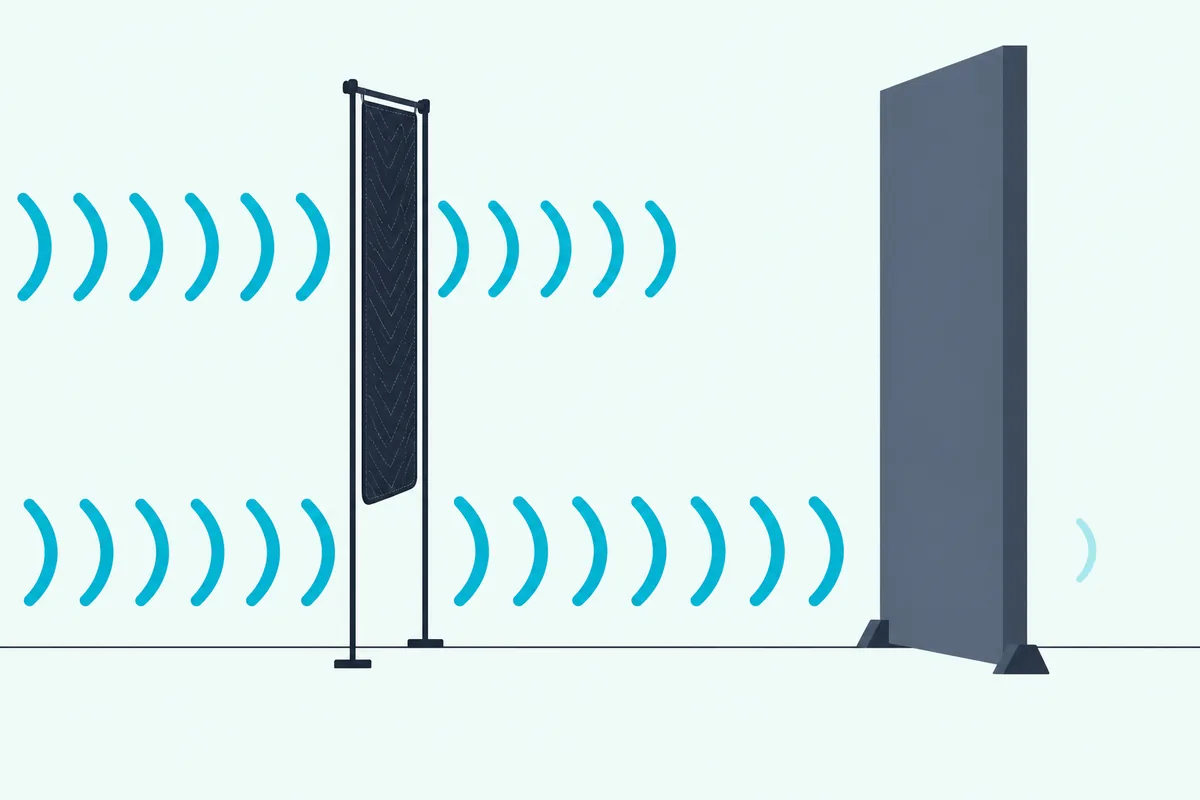
HUD adds that doubling the thickness of a partition can cut the sound passing through it by as much as 6 dB. By our arithmetic, matching one sheet of 5/8-inch drywall at 2.2 pounds per square foot would take 11 or 12 of the heaviest pads stacked together, and reaching HUD’s 4-pound barrier would take about 21 (USG).
Weight isn’t the only problem, because a blanket is porous. USG explains that porous materials such as glass fiber absorb sound by turning part of it into heat, while non-porous materials such as gypsum board tend to reflect it (USG).
Researchers at the National University of Singapore measured what porosity costs a fabric. A standard polyester hospital curtain cut sound by only about 5 dB between 400 and 1,600 Hz, while a PVC-coated polyester fabric reached about 15 to 22 dB, which the team put down to its smooth, impermeable surface and its higher surface density (NUS preprint).
A moving blanket is the porous kind, since Trucking Depot describes its pads as layers of polyester and cotton blend material stitched together in an “S” pattern. Air, and the sound it carries, can work its way through, so a pad behaves like the plain curtain in that test, not the coated one.
HUD defines a Sound Transmission Class rating as the number of decibels a sound is reduced as it passes through a material. On that scale, the 16 points between Acoustical Surfaces’ absorbing Insul-Quilt at STC 16 and its vinyl-backed BBC-13X-2″ quilt at STC 32 are a bigger change than the 10 dB FHWA’s table calls half as loud.
Gaps finish the job. HUD’s figure is stark: a one-inch square hole or a 1/16-inch crack 16 inches long will turn a 50 STC wall into a 40, and a blanket hung over a door or window usually leaves its edges open.
Low notes are the hardest of all. Acoustical Surfaces’ vinyl-backed BBC-13X-2″ quilt, rated STC 32, cuts sound by 55 dB at 4,000 Hz but by only 13 dB at 125 Hz, so even a purpose-built barrier blanket lets far more bass through than hiss (Acoustical Surfaces).
Burton Acoustix’s guide to mass, damping and decoupling explains how a real wall gets around these limits. Its section on absorption, which it calls the misunderstood fourth layer, is the one that applies to blankets.
Get Studio Tips Weekly
Join 5,000+ creators getting acoustic treatment advice every week.
No spam. Unsubscribe anytime.Do Moving Blankets Absorb Sound?
That porous build is also what blankets do well. Yes, moving blankets absorb some sound, mostly in the middle and upper frequencies, and Trucking Depot, which sells them, says they dampen sound across the midrange and high frequencies.
Absorbing works on a different part of the noise than blocking does. OSHA’s technical manual explains that absorbing materials reduce the buildup of sound reflecting off hard walls and ceilings, and do nothing to the sound traveling straight from the source (OSHA).
OSHA adds that this kind of treatment works best on middle to high frequency noise and in relatively small rooms. Britain’s Health and Safety Executive makes the same point: absorbent material on walls and ceilings only affects reflected, reverberant sound, not the direct path (HSE).
Thickness explains the frequency limit. OSHA’s rule of thumb is that an absorber performs best when it’s at least a quarter of a wavelength thick, and with sound traveling about 1,130 feet per second, a 1,000 Hz tone has a wavelength of about 13.6 inches.
By our arithmetic, a quarter wavelength is about 3.4 inches at 1,000 Hz, under an inch at 4,000 Hz and about 27 inches at 125 Hz. No quilted pad comes close to 2 feet thick, so blankets work on the upper range, including much of speech, which OSHA places between 500 and 4,000 Hz, and leave the bass largely alone.
Trucking Depot pitches its pads for podcasts, music releases, voiceovers and video productions, much the same work VocalBoothToGo sells its sound blankets for, including a studio-size blanket listed for recording studio treatment. The difference between the two kinds of blanket is in what their makers can show about sound absorption.
Nobody publishes how well a moving blanket absorbs, though. VocalBoothToGo, which makes sound blankets, says most moving blankets aren’t tested because they’re designed for moving, and that their tough, dense outer fabric with less absorbing filler can reflect sound before it reaches the fill (VocalBoothToGo).
The two sellers disagree about weight, so read a dozen weight with care. Trucking Depot says a heavier dozen absorbs more sound, while VocalBoothToGo says the extra weight can come from heavier outer fabric rather than more absorbing fiber.
Try this in your own room: clap once and listen to the ring that follows, then hang the blankets and clap again. A shorter, duller tail means the blankets are absorbing, while a neighbor’s TV that sounds just as loud means the noise is coming through the structure, which blankets don’t touch.
For a home studio, our guide to moving blankets for acoustic treatment covers where to hang them so a voice or a mix sounds drier. The rest of this page stays with noise coming in or going out.
How Are Sound Blankets Different From Moving Blankets?
That untested label is where sound blankets part ways with moving pads. The sound blankets that acoustics makers sell are built and tested to absorb, and the strongest add a heavy vinyl layer to block: Acoustical Surfaces’ BBC-13X-2″ bonds a 2-inch quilted fiberglass absorber to 1 pound per square foot of reinforced loaded vinyl and rates STC 32 and NRC 0.85.
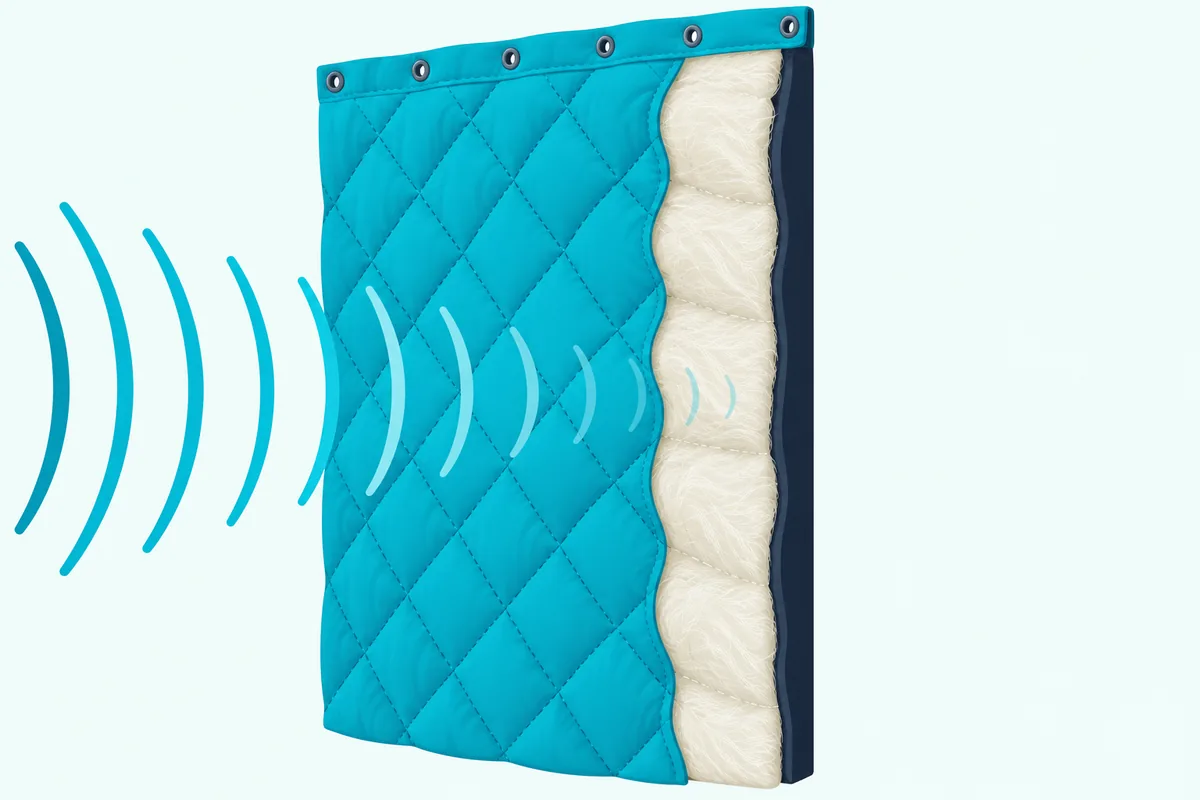
VocalBoothToGo’s side-by-side shows the build difference on the absorbing side. Its sample moving blanket weighed 86 pounds a dozen against 106 pounds for its Producer’s Choice sound blanket, which pairs a light outer shell with a thick layer of absorbing fiber, where moving blankets usually have three layers of outer fabric.
Riverbank Acoustical Laboratories tested a double layer from the same Producer’s Choice line in 2019 under ASTM C423-17, with a slightly undersized sample whose two layers hung 3 inches apart and 3 inches from the wall, and measured an NRC of 1.00 (Riverbank report). The same report puts the pair at just 0.45 pound per square foot, so a top absorption score came with almost no blocking weight.
Acoustical Surfaces’ own range draws the same line. Its Insul-Quilt fiberglass blanket scores an NRC of 1.00 yet rates only STC 16 at 0.44 pound per square foot (Insul-Quilt).
The maker’s absorptive quilted curtains even come with a note that they’re intended to absorb sound, pointing anyone who needs to block it to a barrier product instead (QFA curtains). That’s a manufacturer telling buyers in plain words that absorbing and blocking are different jobs.
| Blanket | Weight per square foot | Absorption (NRC) | Blocking (STC) |
|---|---|---|---|
| Moving pad, heaviest furniture grade | About 0.19 lb (our arithmetic) | Not published | Not published |
| Producer’s Choice sound blanket, two layers with air gaps | 0.45 lb for the pair | 1.00 | Not published |
| Insul-Quilt fiberglass blanket | 0.44 lb | 1.00 | 16 |
| BBC-13X-2″ quilt bonded to 1 lb vinyl | 1.45 lb | 0.85 | 32 |
The pattern is hard to miss: absorption scores sit near the top of the scale for every thick, fibrous blanket in the table, while the blocking number only moves when vinyl adds weight. Acoustical Surfaces lists the same split for its enclosure panels, from STC 27 for its standard BBC-13 to STC 32 for the 2-pound version (Acoustical Surfaces).
So read a listing’s numbers before its adjectives. An NRC tells you about echo, only an STC or a transmission loss figure measured to a standard such as ASTM E90 tells you about blocking, and a blanket sold as soundproof with neither is making a claim, not a measurement.
When you’re ready to compare specific products, our roundup of the best blankets for soundproofing sorts them by door, window and studio use. It’s the place to shop, while this page is the place to decide whether a blanket fits your noise at all.
Where Do Moving Blankets Actually Help With Noise?
Those ratings sort the everyday uses quickly. Moving blankets help most where echo is the problem, such as a recording corner, a practice room or a bare room with hard floors, and least where sound arrives through the structure, such as a shared wall, a ceiling or a floor.
In a recording corner or a closet booth
This is the job moving blankets do best, because a microphone hears the room’s reflections along with your voice. USG says absorption reduces reverberation and helps the clarity of speech, which is exactly what a voice recording needs.
Cover the hard surfaces nearest the mic, behind it and to its sides, and leave an air gap like the one in the lab test above. In a closet, blankets on the bare walls and the back of the door do the same job in a smaller space.
What they won’t do is keep traffic, a barking dog or a neighbor’s footsteps off the recording. Those arrive through the walls, floor and windows, so record at a quiet time or deal with the leaks first.
In a home office or on video calls
Calls and meetings are an echo problem as much as a noise problem, and GSA’s office acoustics guide names absorb, block and cover as the three tools (GSA). Its specification for federal conference and training rooms calls for absorptive panels rated at least NRC 0.8 on a quarter of the walls.
Moving blankets carry no NRC, so treat that quarter as a rough coverage guide, not a target they’re proven to meet. By our arithmetic, a 10 by 12 foot room with 8-foot ceilings has 352 square feet of wall, so a quarter is 88 square feet, or two to three 72 by 80 inch pads once the seams overlap.
Blocking is a separate line in GSA’s book: it asks for walls rated at least STC 40 between private offices for normal speech privacy and STC 45 where conversations must stay confidential. A blanket adds almost nothing toward those numbers, so your calls can sound better on your end while the next room still hears every word.
Over a door
A door is a natural first spot for a blanket, and it’s also where the gaps matter most. HUD’s crack figure is why the openings around and under a door come first, and a blanket hanging over the door leaves those edges open.
Seal the bottom with a sweep and the sides and top with weatherstrip before you hang anything. For the bottom, the VITAM AMO silicone door sweep is self-adhesive and trims to length, and its listing says it seals gaps up to 1-3/32 inch.
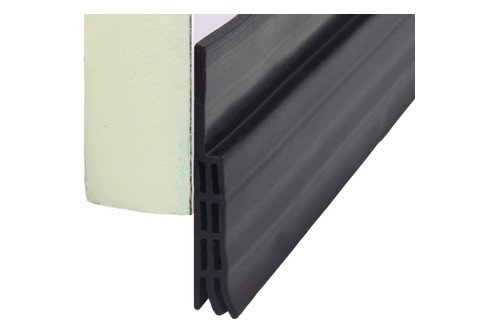
the VITAM AMO silicone door sweep
Where the door closes against its frame, Kikerike’s self-adhesive foam weatherstrip comes as a 1/2 by 1/4 inch strip, 42 feet in all, and its listing sells it for door and window sound isolation. Our walkthrough on how to soundproof a hollow door covers the gaps, the seals and when a solid door is worth it.
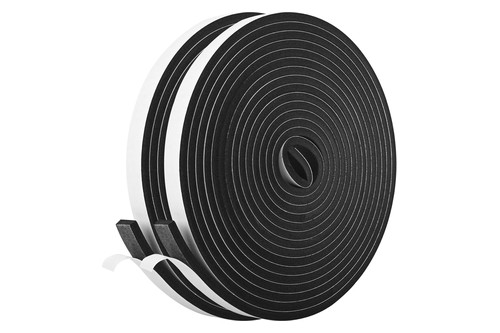
Kikerike’s self-adhesive foam weatherstrip
Once the gaps are sealed, a blanket over the door adds a little absorption on your side, and a vinyl-backed blanket adds some real blocking weight. Hang either one so it overlaps the frame on every side, because an open edge is the same kind of leak HUD’s crack figure describes.
Over a window
Windows leak at the same places doors do, around the sash and the frame, and HUD says proper sealing is crucial to a window’s performance. To prevent sound leaks, HUD adds, single windows can be mounted in resilient material such as rubber, cork or felt, which does for a window what a seal does for a door.
A moving blanket hung over the glass behaves like a heavy curtain. The NUS team measured only about 5 dB for plain curtain fabric between 400 and 1,600 Hz, so expect a small change at best, and less if the blanket’s edges stay open.
Covering the window edge to edge and pressing the blanket against the frame helps, but it also blocks the light and the view. Our breakdown of how far curtain fabric gets at a window also covers the heavier, layered and sealed treatments that go further.
On a shared wall
A shared wall is where blankets disappoint most, because the wall already outweighs them many times over. One layer of 5/8-inch drywall weighs 2.2 pounds per square foot, so by our arithmetic a 0.19-pound pad adds less than a tenth to that single layer.
The blanket can still soften the echo on your side, which makes the room feel calmer, but the voices and TV next door arrive through the wall and the gaps around it. Sealing those gaps and adding mass, such as mass loaded vinyl or another layer of drywall, is what moves the number, and our look at when mass loaded vinyl earns its place covers the vinyl option.
On a floor or a ceiling
Footsteps, dropped keys and dragged chairs travel differently from voices. USG explains that sound can travel through a structure when it’s energized directly by an impact, such as footsteps, and a blanket hung on your ceiling never touches that path.
Hung overhead, a blanket only absorbs echo on your side, and a heavy pad needs fixings strong enough to hold it. Fixes for footsteps work on the floor above or inside the ceiling itself, not on its surface.
Around a noisy machine
Blankets do have a place around loud equipment, as the lining of a proper enclosure. Acoustical Surfaces sells its vinyl-backed quilts for HVAC enclosures, generator enclosure panels and machinery, and OSHA says solid enclosures with no acoustical leaks can provide 20 to 40 dB of noise reduction.
A loose moving blanket thrown over a machine is neither solid nor leak-free, so expect far less from it. OSHA also warns that taking an enclosure apart and putting it back together tends to open gaps along the panel joints, so even a proper enclosure needs its seals and gaskets maintained.
The safety section below explains why some machines should never be covered at all. Heat and exhaust are the reasons.
How Should You Hang Moving Blankets?
Every spot in that list works better when the blankets go up the right way. Hang them from grommets on hooks or a rod so they cover the whole surface, overlap at the seams and sit a few inches off the wall, as the blankets in Riverbank’s test did at 3 inches.
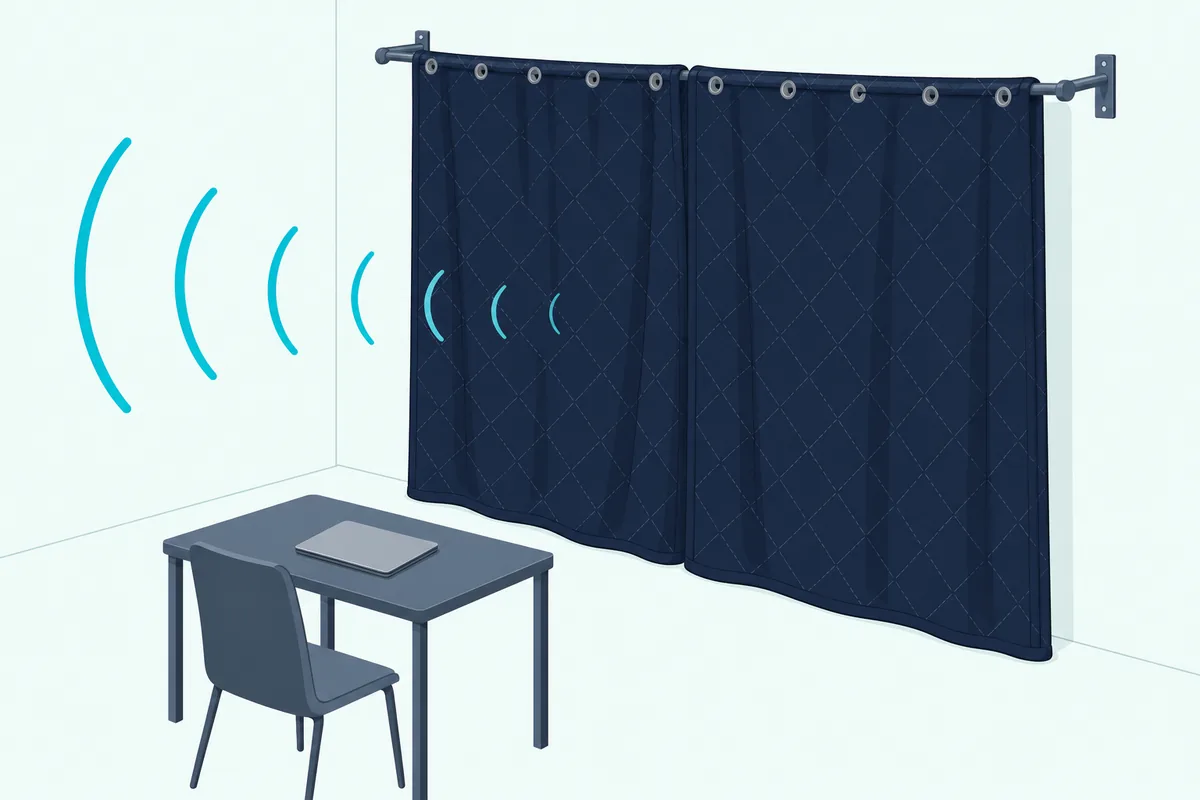
The air gap is our suggestion for moving pads, borrowed from that sound-blanket test, since none of the moving-blanket pages we read publishes a mounting test. Trucking Depot’s own advice is to leave about 2 inches between the blanket and the wall.
- Cover edge to edge. Overlap neighboring blankets by a few inches, the way Acoustical Surfaces joins its exterior panels with overlapping hook-and-loop seams.
- Leave an air gap. A curtain rod on brackets holds the blankets off the wall without extra hardware.
- Double up where echo is worst. A second layer adds thickness, which OSHA’s quarter-wavelength rule favors, and the lab result above came from a pair.
- Hang, don’t glue, in a rental. Trucking Depot lists grommets, double-sided tape, glue, staples and nails, and in a rental, grommets on hooks or a tension rod are the easiest to undo.
Count before you buy. Each 72 by 80 inch pad covers 40 square feet laid flat, so by our arithmetic a 12-foot wall 8 feet high, 96 square feet, takes three pads once you allow for overlapping seams.
Size the hardware for the load. A heavy furniture pad weighs about 7.75 pounds by our arithmetic from Trucking Depot’s 93 pounds a dozen, so pick hooks and brackets rated well above that, especially for a double layer.
Then repeat the clap test from earlier. If the ring is shorter and duller but the noise from outside is unchanged, the blankets are doing their real job, and the next fixes belong to the gaps and the walls.
Are Moving Blankets Safe Near Heaters and Appliances?
Hanging that much fabric in a room raises one more question before the job is done. Only at a distance: NFPA’s heating safety sheet says to keep anything that can burn at least 3 feet from a furnace, fireplace, wood stove or portable space heater (NFPA tip sheet), and appliance vents need to stay uncovered.
Acoustical Surfaces lists its Insul-Quilt and BBC-13X-2″ blankets as Class A under ASTM E84, while Trucking Depot’s moving-blanket page gives no flame-spread rating at all. Treat a moving pad like any other fabric throw, which is exactly what NFPA’s 3-foot rule covers.
Airflow matters as much as flame. OSHA lists heat buildup inside an enclosure as a problem, so leave every vent, fan and grille uncovered on a portable air conditioner, a dehumidifier or a computer, and keep blankets clear of anything that runs hot.
A boiler cupboard is no place for them either, since the boiler’s manual sets the clearances and air openings that have to stay empty, and these boiler cupboard rules list them maker by maker.
Generators are the hard line. CPSC says never to run a portable generator indoors or in a garage, basement or shed, and always to run it outside, far from windows, doors and vents, so no blanket or box should ever turn one into an indoor appliance (CPSC).
What Blocks Noise Better Than a Blanket?
Once heat and airflow are taken care of, whatever noise still comes through tells you what to fix next. Sealing gaps and adding mass block noise far better than any blanket, and HUD’s guidebook lists both: seal the cracks and edges, and increase the mass of the wall.
Sealing comes first because it’s small work with an outsized effect. HUD says small holes and cracks can be devastating to a wall’s sound insulation, so caulk the cracks, fit the door sweep and weatherstrip, and close any opening you can see light through.
Mass comes next. Johns Manville rates its 1 pound per square foot vinyl at STC 26, with a loss of 16 dB at 125 Hz rising to 36 dB at 4,000 Hz, and Acoustical Surfaces rates its vinyl-backed quilts from STC 27 to 33 depending on the vinyl and facing (Johns Manville).
A second layer of drywall is the other common way to add weight, at 2.2 pounds per square foot for USG’s 5/8-inch panel. HUD’s rule that doubling a partition’s thickness can buy up to 6 dB is the reason that layer pays off where a blanket doesn’t.
Fiber does help block in one place: inside the wall. HUD says acoustical blankets of mineral wool, fiberglass, hair felt or wood fiber placed in a wall’s airspace can cut noise by as much as 10 dB, mainly in lightweight construction, and its staggered-stud wall example rises from STC 39 to STC 43 with one.
Outdoors or around equipment, a barrier has to be solid and placed close to the source or the listener. OSHA puts the practical limit of a partial barrier at 15 to 20 dB and says it should have no gaps or openings, and HSE adds that a barrier should be made of dense material lined with absorbent material on the side facing the noise.
That HSE description is exactly how a vinyl-backed sound blanket is built: a dense layer to block, with an absorbing quilt facing the noise. A moving pad has the quilt and not the dense layer.
If you do buy a vinyl-backed acoustic blanket for a door, plan for its weight before installing it. At 1.45 pounds per square foot, a 4 by 7 foot piece, enough to overlap a standard door and its frame, weighs about 41 pounds by our arithmetic, so it needs a rail or header fixed firmly to the wall, not hooks hung over the door.
The same weight is why these blankets suit a garage, a workshop or an equipment pad better than a living room in a house or apartment. Where a door has to open many times a day, the sweep and weatherstrip from earlier close its gaps without the weight.
In a woodworking garage, hang them only after the gaps are sealed, because the order that pays off is to start with the tools, not the walls.
| Your noise problem | Do moving blankets help? | What does more |
|---|---|---|
| Echo in a recording corner or practice room | Yes, mostly above the bass | Thicker sound blankets hung with an air gap |
| Voices or TV through a shared wall | Barely | Sealing gaps, then mass such as vinyl or drywall |
| Traffic through a window | A little, like a heavy curtain | Sealing the frame, then a heavier window treatment |
| Noise and light under a door | A little | A door sweep and weatherstrip |
| Footsteps from upstairs | No | Work on the floor above or inside the ceiling |
| A loud machine | Only as an enclosure lining | A ventilated enclosure with vinyl-backed walls |
Take the table one row at a time and start with the cheapest change that blocks, which is nearly always a seal. If the noise continues once the leaks are closed, now is the time to add mass, and the clap test from earlier still tells you whether the room itself needs more absorption.
Each step can reduce noise only along the path it works on. That’s why the order matters more than the budget: a blanket on a wall that still has an open gap is solving the smaller problem first.
The Bottom Line
Moving blankets are good at absorbing echo and poor at soundproofing, because a quilted pad weighs about 0.11 to 0.19 pound per square foot against the 4 pounds HUD gives for a barrier that blocks, and it leaves gaps at every edge. The sound blankets that acoustics makers sell absorb better and come with lab numbers, and only the ones backed with loaded vinyl, such as Acoustical Surfaces’ STC 32 quilt, block in a measurable way.
Hang blankets in a recording corner, a practice room or a bare, echoey space, with an air gap and no gaps between them. For noise coming through walls, doors and windows, seal the gaps first, then add mass.
Frequently Asked Questions
Can you soundproof a room with blankets?
Not in the sense of blocking noise. Blankets absorb sound that’s already in the room, which shortens echo and makes speech clearer, but HUD’s yardstick for a barrier is more than 4 pounds per square foot with no openings, and even the heaviest moving pad works out to about 0.19 pound. To keep sound in or out, seal the gaps around doors and windows and add mass with vinyl or drywall, then use blankets for the echo that’s left.
How do soundproof blankets work?
They do two jobs, and many products do only one of them. The quilted layer, usually fiberglass or dense fiber, absorbs sound by turning part of it into heat, the way USG describes porous materials working, and that cuts echo on the side it faces. Blocking needs a dense layer behind it: Acoustical Surfaces’ BBC-13X-2″ adds 1 pound per square foot of loaded vinyl and rates STC 32, while its Insul-Quilt, with no vinyl, rates STC 16 despite an NRC of 1.00. Check a listing for both an NRC and an STC before you believe the word soundproof.
Do moving blankets block noise from outside?
Only a little. Traffic and street noise reach you through windows, doors and walls, and a moving blanket over a window acts like a heavy curtain, which the NUS team measured at about 5 dB between 400 and 1,600 Hz for plain fabric. Its open edges let more through, so the frame matters more than the fabric. Seal the window and the gaps around exterior doors first, since HUD calls proper sealing crucial to a window’s performance, then decide whether the noise that’s left still bothers you.
Are moving blankets good for soundproofing a ceiling?
No. Footsteps and thumps from above travel through the building’s structure, which USG describes as sound energized directly by an impact, and a blanket on your side of the ceiling never touches that path. Hung overhead, it only absorbs some echo in your room, and a heavy pad needs strong fixings. Fixes for impact noise work on the floor above or inside the ceiling construction.
Do moving blankets help with bass?
Very little. OSHA’s rule that an absorber works best at a quarter wavelength or more means about 27 inches of material at 125 Hz, by our arithmetic. Even a lab-tested pair of sound blankets hung with air gaps absorbed only 0.13 at 100 Hz and 0.27 at 125 Hz in Riverbank’s report, against more than 1 from 500 Hz up. Blocking falls off at low frequencies too: Acoustical Surfaces’ vinyl-backed BBC-13X-2″ quilt cuts 13 dB at 125 Hz and 55 dB at 4,000 Hz.
Is a comforter or a heavy blanket better for soundproofing?
Neither blocks much, and the same rule decides between them: whichever weighs more per square foot blocks slightly more, and whichever is thicker and fluffier absorbs more echo. A weighted blanket follows the same arithmetic. A 48 by 72 inch blanket covers 24 square feet, so it would have to weigh 96 pounds to reach the 4 pounds per square foot HUD gives for a solid barrier, and it would still need its edges sealed.
Will moving blankets keep my music or drums from bothering the neighbors?
No. HUD defines STC as the difference between the level on the side where a sound starts and the side where it’s heard, so a thin layer blocks just as little in either direction. Blankets around a drum kit or an amp can make the room less harsh for you, but the neighbors hear the sound that passes through the walls, floor and gaps. Keeping it in takes sealing, mass and, for loud instruments, a built room.
How do I 100% soundproof my room?
You can’t with any household material, and blankets get you the least of all. HUD’s own example is that bringing an 85 dB outdoor level down to 45 dB indoors takes a partition rated STC 40, which means a sealed wall built for the job, not a covering. A realistic goal is to stack reductions: seal every gap, add mass where the noise comes in, and absorb the echo inside, checking after each step whether the remaining noise still bothers you.
What is the cheapest way to reduce noise through walls?
Seal the leaks. HUD says a one-inch square hole or a 1/16-inch crack 16 inches long can drop a 50 STC wall to 40, so caulking cracks and gaps along the wall and fitting door seals usually does more than any covering. Blankets on the wall mostly change the echo on your side. After the gaps, the next step up is mass, such as a layer of vinyl or drywall.