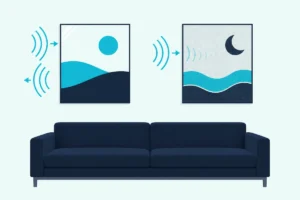
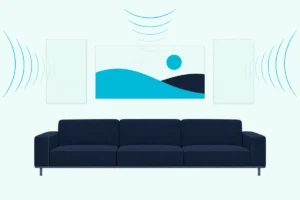
Where to Place Acoustic Panels, Wall by Wall and Room by Room
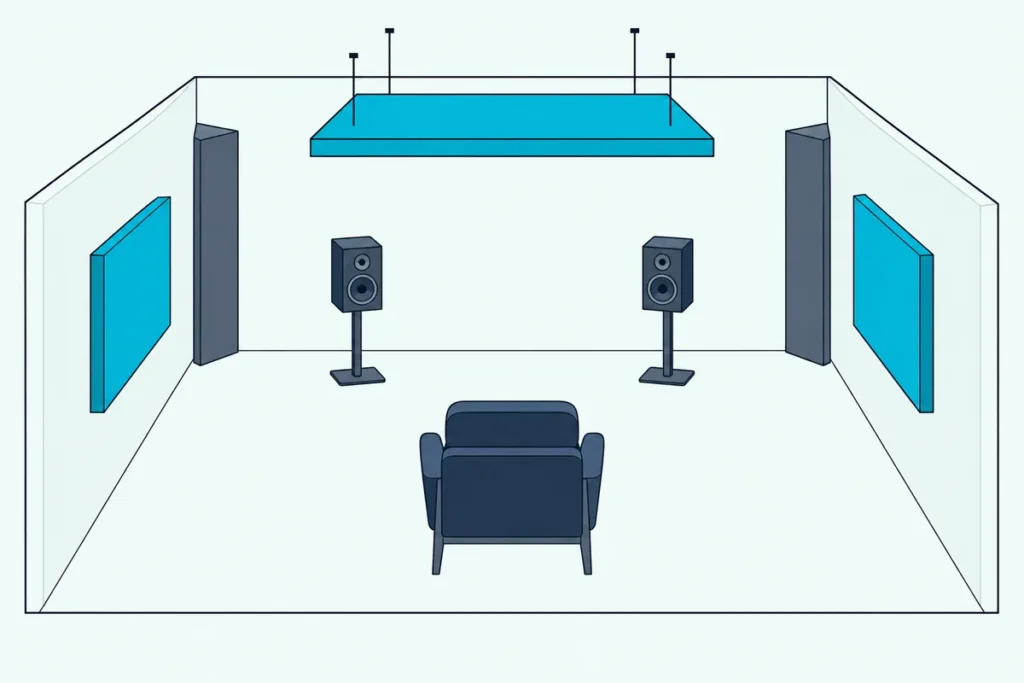
Knowing where to place acoustic panels starts at your seat, because the reflections that blur what you hear bounce off a few spots on the side walls and ceiling between your ears and the speakers.
Miss those spots and the room still sounds smeared and hollow, even with panels hanging on every wall.
Hit them and the stereo image firms up, dialogue gets clearer, and you’ll need fewer panels than you’d guess.
The first job is a mirror and a friend, because that’s how panel makers find the side-wall reflection points.
From there, this guide works through the wall behind you, the corners, a ceiling cloud and how much of the room to cover, then shows how studios, home theaters and home offices change the plan.
Where to Place Acoustic Panels First, and in What Order?
That mirror job comes first for a reason. Start at the side-wall first reflection points, then above your listening position, then the wall behind you, with bass traps in the corners, because Primacoustic, Auralex and Ethan Winer all treat early side and ceiling reflections as the ones that blur the sound at your seat.
The makers order the rest a little differently:
| Surface | What it fixes | Who puts it where |
|---|---|---|
| Side-wall first reflection points | Blurred imaging, comb filtering | First for Primacoustic and Winer |
| Ceiling above the seat | Overhead bounce | After the side walls (Winer, Auralex) |
| Wall behind you | Late echo, flutter | After the side walls (Primacoustic) |
| Corners | Bass buildup | First in a small room (Auralex) |
| Wall behind the speakers | Low-frequency comb filtering | Last, for maximum definition (Primacoustic) |
Only bass changes the order. Auralex starts with corner traps in any small room, then the wall behind the monitors, then the side walls.
How Do You Find the First Reflection Points?
The side walls lead that table, so they’re where the mirror comes out. You find the first reflection points by sitting in your listening position while a friend slides a mirror flat along the side wall, and every spot where you can see a speaker in the mirror needs absorption.
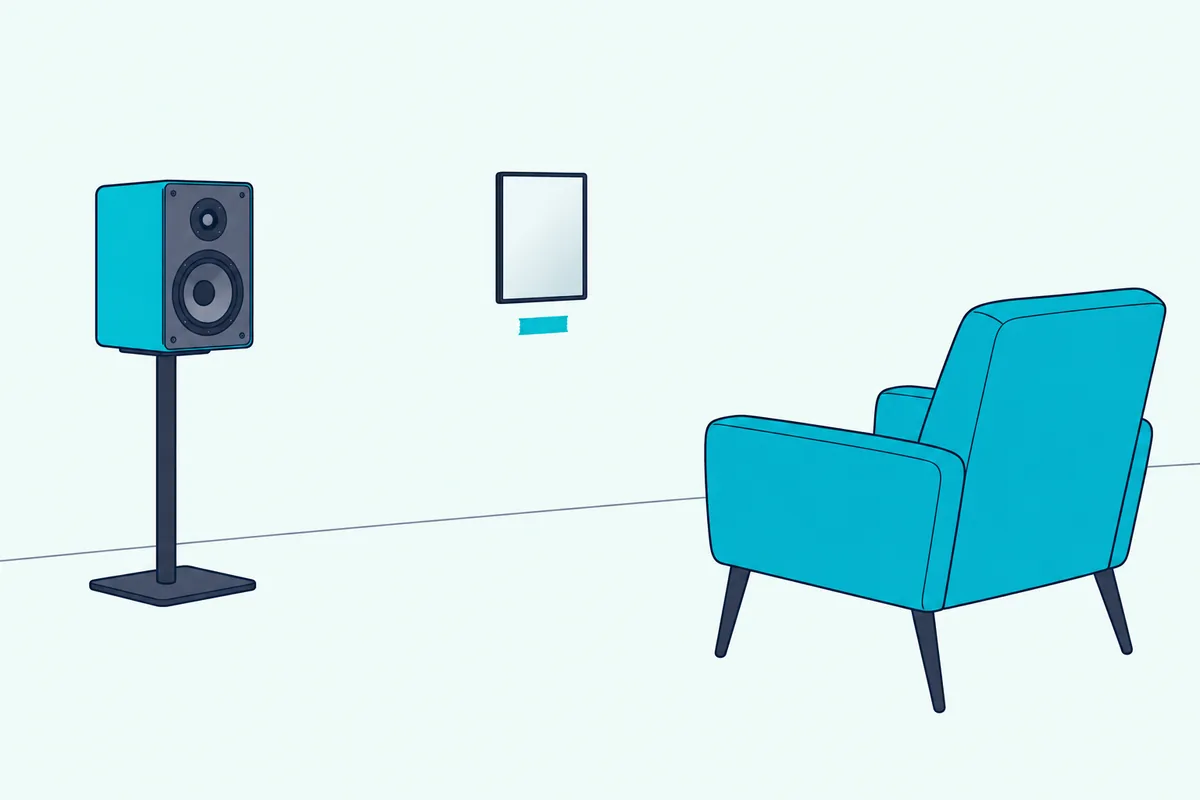
It’s simple geometry. Primacoustic’s mirror trick guide explains that sound waves above 400 Hz are directional and bounce around a room the way light does, so a mirror shows their path:
- Sit in your normal listening position with the speakers where they’ll stay.
- Have a friend hold a mirror flat against the side wall at the height of your speakers.
- Mark where each speaker first appears in the mirror and where it disappears again.
- Check both the left and right speakers, plus the center if you use one, then repeat on the other wall.
Those marks define the area to treat, though Primacoustic says covering most of it is enough. Winer treats a larger area than the mirror shows, so you can move a little without leaving the reflection-free zone.
Height matters too. Primacoustic centers each panel as close to ear height as possible, and Auralex’s home studio guide starts treatment about 30 to 36 inches off the floor for a seated listener.
For a 2-inch panel that covers a full reflection zone, the ATS Acoustic Panel, 24 x 48 x 2 inches fits that job. Stood upright, its 48-inch height runs well above and below a seated ear.
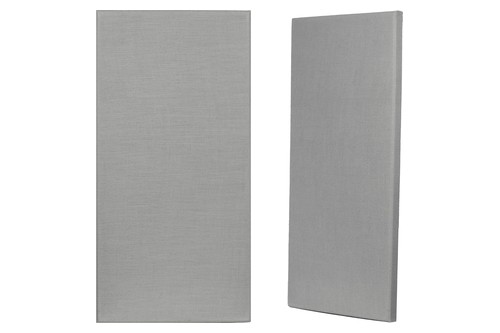
ATS Acoustic Panel, 24 x 48 x 2 inches
Fixing it to the wall is a separate job: see how to hang acoustic panels with the right hardware for clips, anchors and strips.
Get Studio Tips Weekly
Join 5,000+ creators getting acoustic treatment advice every week.
No spam. Unsubscribe anytime.Should You Treat the Wall Behind You?
Once the side walls are marked, turn the chair around. Yes, treat the wall behind you after the side walls: Primacoustic has you stay in the listening position, turn around and mark where the speakers show in the mirror.
That wall needs a lighter, balanced touch. Primacoustic suggests general absorption that doesn’t completely deaden the room, and Winer notes that a totally dead rear wall stops flutter echo but can sound stuffy, while a bare one sounds hollow and boxy.
Diffusion suits only a deep room. Auralex’s Acoustics 101 says a room less than 10 to 12 feet from front to back probably won’t get its money’s worth from rear-wall diffusion.
Try Winer’s clap test to hear the problem. A pitched “boing” or a rapid rat-a-tat after you clap is flutter echo between facing walls.
What About the Wall Behind the Speakers?
The wall behind you faces the one behind the speakers, and that front wall is where the makers part ways. Primacoustic leaves it for last and suggests a couple of 3-inch panels behind the speakers for maximum definition, to cut the comb filtering from low frequencies that spread out behind the cabinets.
Auralex moves it up to its second step, after bass traps. Our guide to acoustic panels behind speakers covers distances and thickness for that wall.
Do Corners Need Bass Traps Instead of Panels?
The front wall deals with low frequencies spilling behind the speakers, and the corners deal with the rest. Corners need bass traps rather than standard panels, because bass builds up most where surfaces meet, and Winer recommends traps in all of the corners at a minimum.
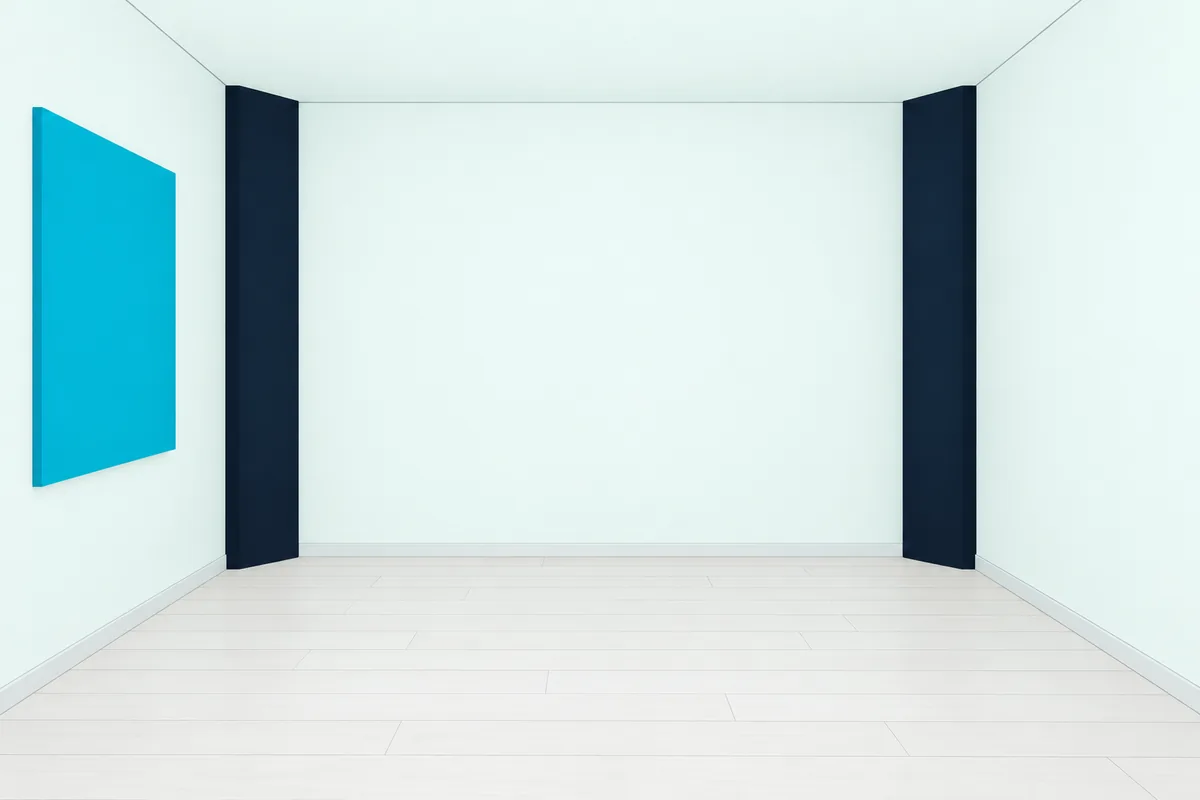
You’ve got more corners than you think. RealTraps’ guide to acoustics for hi-fi and home theater counts 12 in a rectangular room, where walls meet each other, the ceiling and the floor, and all of them work for bass traps.
Bass is the hardest part to tame. RealTraps says reflected bass waves collide and leave nulls as deep as 30 dB, which is why the low end can change from one couch seat to the next.
Coverage matters most here. Winer writes that treating 30 percent of a room’s surfaces with bass traps cuts low-frequency reflections far more than 5 percent.
If you’re weighing a flat panel against a trap for that spot, the comparison of acoustic panels vs bass traps walks through what each one absorbs.
Where Does a Ceiling Cloud Go?
Corners hold the bass, but the ceiling holds the reflection most people forget. A ceiling cloud goes directly above your listening position, where Auralex says treatment is sometimes overlooked even though reflections between the ceiling, the floor and the desk cause problems for critical listening.
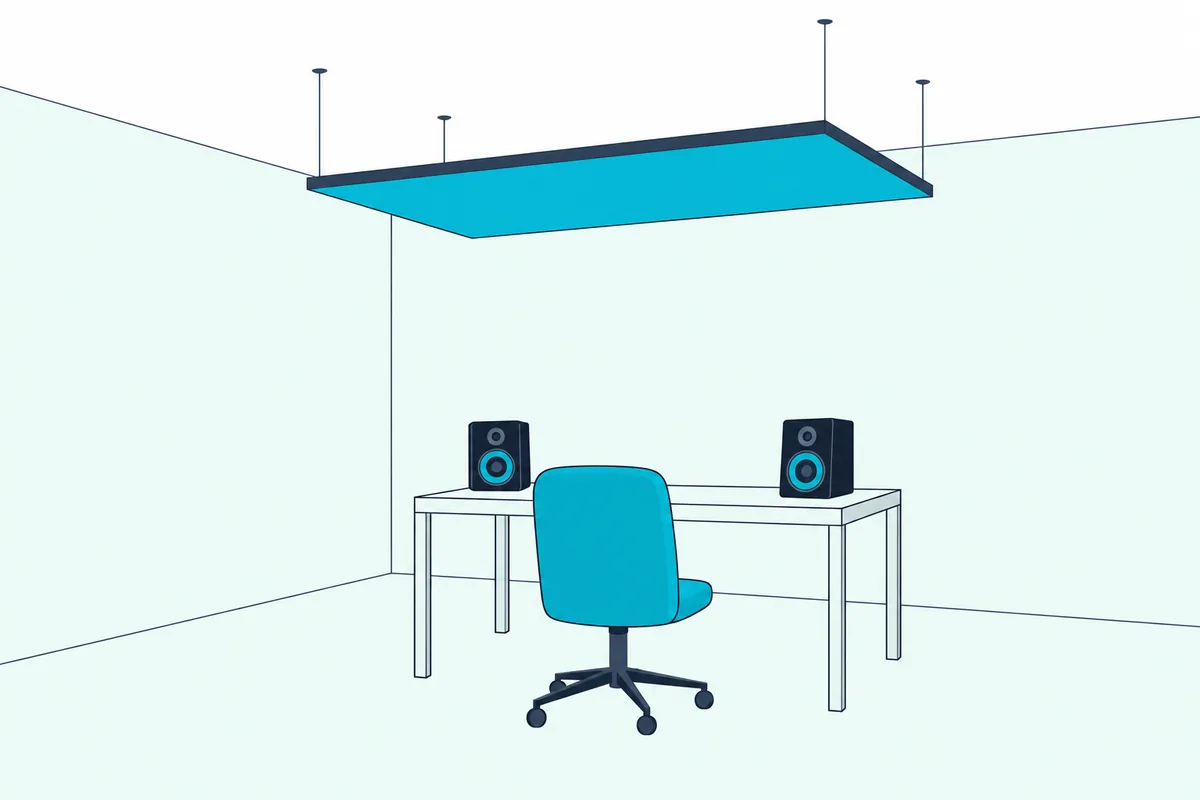
Find its spot with the same mirror. Winer suggests fixing a hand mirror to a broomstick and sliding it across the ceiling.
Hanging it with a gap pays off. Primacoustic says a cloud mounted with space between it and the ceiling catches both primary and secondary reflections, and our guide to air gap distance explains why that space adds absorption.
Mounting overhead follows its own rules, covered in the guide to hanging acoustic panels on a ceiling.
How Much of the Room Should Panels Cover?
The cloud finishes the reflection points, so the last question is how far to go. Primacoustic’s rule of thumb in How Much Acoustic Treatment Do I Need? is to cover 15 to 25 percent of the wall surface area to hear a difference, with studios and theaters at 25 percent or more.
Here’s what that means in Auralex’s 12 x 15 x 8-foot example room. Its four walls add up to 432 square feet, so 15 to 25 percent is about 65 to 108 square feet, or roughly 8 to 14 panels of 2 x 4 feet.
That range isn’t a license to cover everything, since Primacoustic warns that too much absorption takes the life out of a room. Rooms with many noise sources, such as classrooms, boardrooms and gyms, get 15 to 20 percent spread evenly.
The math behind how many acoustic panels do I need sizes this for your room, and acoustic panel spacing covers the gaps between them.
How Does Placement Change From Room to Room?
Those percentages shift with what the room is for, and so does the order. Placement changes with the listening position and the sound source, so a mixing desk, a sofa facing a screen and a desk used for video calls each have different reflection points.
Home studio
Start with symmetry. Auralex centers the desk, speakers and chair and puts the chair at 38 percent of the room’s length, 5.7 feet in a 15-foot room, and Primacoustic keeps the seat out of the exact center, where room modes gather.
For tracking rooms, see the best acoustic panels for recording studios.
Home theater
A theater has more speakers, and each one has its own reflection points. Auralex’s Acoustics 101 says a 5.1 room needs absorption at the boundaries near all five speakers, not just the front two.
RealTraps adds that the speakers should fire the long way down the room, with tweeters at ear level. The guide to home theater acoustic panel placement goes wall by wall, and the best acoustic panels for home theater covers which panels to buy.
Home office and desk setups
At a desk, the same geometry plays out in a smaller space, with the reflection points closer to your chair.
For those tighter spots, the UMIACOUSTICS 4-pack of fiberglass acoustic panels gives you four smaller panels to split between the two side walls. For bigger, full-size options, the roundup of best acoustic panels compares them.
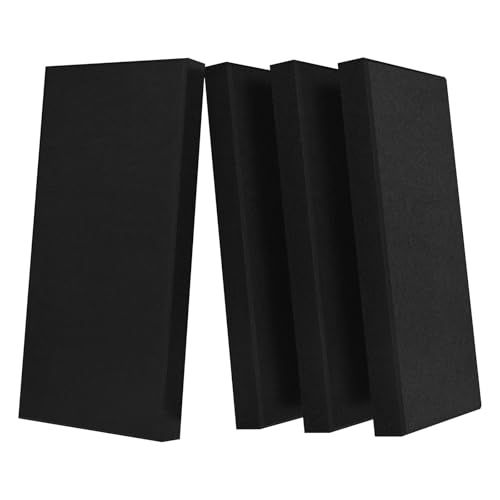
UMIACOUSTICS 4-pack of fiberglass acoustic panels
Bedrooms and living rooms
These rooms rarely have one fixed seat, so the approach Primacoustic gives for rooms with several sound sources fits better than chasing one set of reflection points: spread the panels evenly. Run Winer’s clap test first, since a ring between two bare facing walls shows where the first panels should go.
Frequently Asked Questions
How high should acoustic panels be on the wall?
Center them as close to ear height as you can, Primacoustic’s rule for studio panels. Auralex starts treatment about 30 to 36 inches off the floor for a seated listener, with tweeters at ear level, typically 48 to 50 inches high.
Do acoustic panels need to be directly at the reflection point?
They need to cover it, not hit it to the inch. Primacoustic says covering most of the marked area gives plenty of control, while Ethan Winer treats a larger area so you can shift in your seat.
Can I put acoustic panels on the ceiling?
Yes, starting directly above your listening position, where Auralex highly recommends panels or clouds. Primacoustic adds that clouds hung with a gap catch both primary and secondary reflections and help when wall space is limited.
Should I put acoustic panels behind my speakers?
Yes, though the makers disagree on when. Auralex treats that wall second, after corner bass traps, while Primacoustic leaves it for last and suggests a couple of 3-inch panels for maximum definition.
How many acoustic panels does a small room need?
Work from area, not a fixed count. Primacoustic suggests covering 15 to 25 percent of the wall surface; in a 12 x 15 x 8-foot room that’s roughly 8 to 14 panels of 2 x 4 feet, plus corner bass traps.