Acoustic Treatment For Office Spaces (Stop Losing Productivity To Noise)
Best acoustic treatment for office spaces solves the one problem that open floor plans, glass walls, and hard ceilings were never designed to handle — but every employee notices within minutes of sitting down.
Conversations carry across the room, conference calls echo so badly that remote participants ask you to repeat yourself, and the constant background hum of keyboards, HVAC, and coworker chatter makes focused work nearly impossible without headphones.
The fix isn’t more walls or expensive renovations. Acoustic panels at the right spots, ceiling treatment overhead, and in some cases a sound masking system reduce noise levels enough to restore speech privacy and deep focus — without changing the layout.
In a home office the walls and the door are yours to change, and soundproofing a home office to office targets covers the blocking work that panels and masking don’t do.
Below, this guide covers what makes offices so acoustically hostile, what treatment each type of office space needs, and where to place panels for the biggest improvement with the least disruption.
To treat an office acoustically, start with fabric-wrapped absorption panels on walls near desks and meeting areas at seated ear height, add acoustic ceiling tiles or a ceiling cloud above the noisiest zones, and consider a sound masking system for open-plan spaces where panel treatment alone cannot provide enough speech privacy.
What Makes Offices Acoustically Challenging?
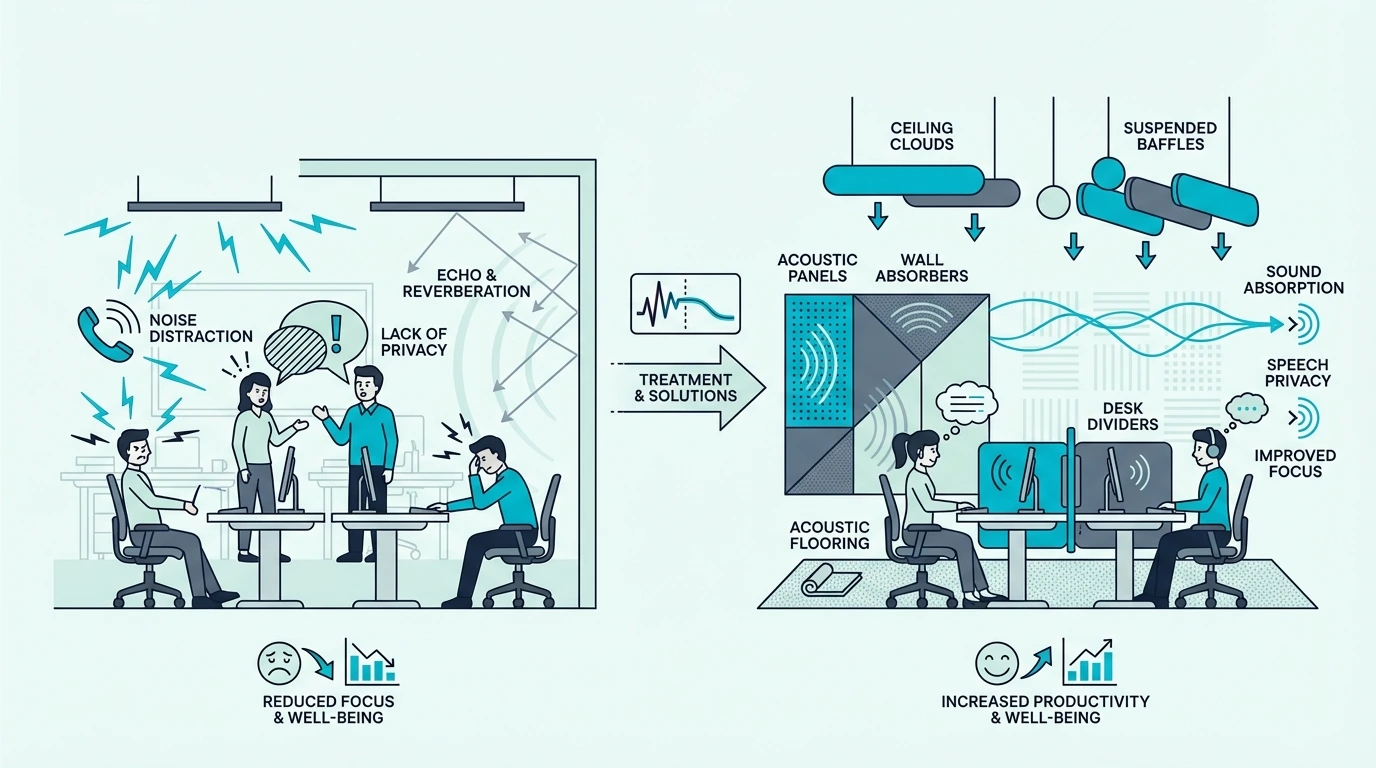
An office is built from the worst possible combination of materials for sound control — hard drywall, glass partitions, concrete floors, and flat ceilings that turn every conversation into a room-wide broadcast. Understanding where the noise problems come from helps you target treatment where it actually matters.
Open-Plan Office Problems
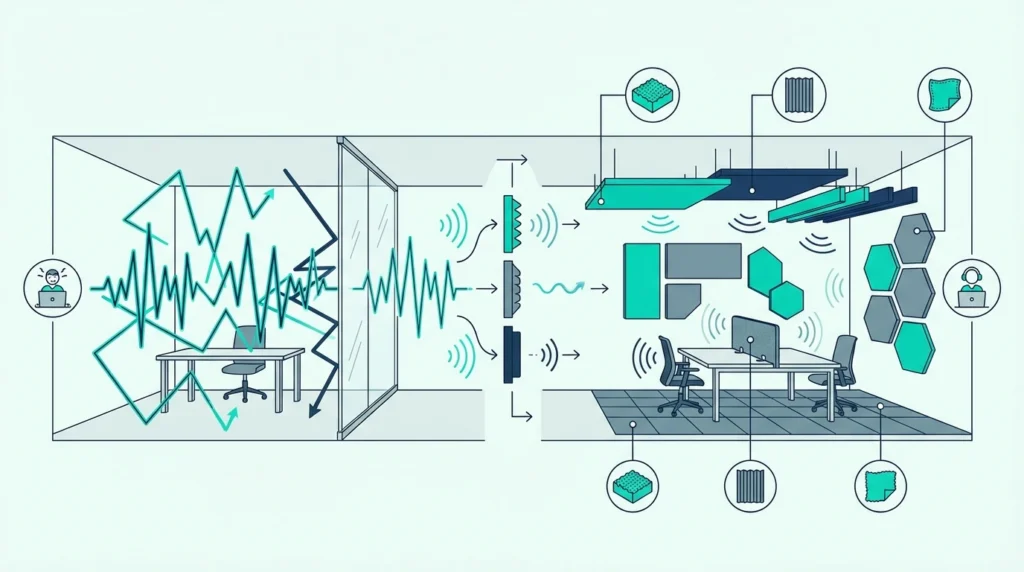
Open floor plans remove the walls that would normally block sound between workstations. Without barriers, a conversation at one desk travels unobstructed to every other desk in the line of sight — and the hard ceiling overhead amplifies the problem by reflecting that sound back down across the entire space.
The result is a constant wash of overlapping speech, keyboard noise, and phone calls that raises the ambient noise floor high enough to make concentration difficult. Studies consistently show that office noise is the number one workplace complaint, ahead of temperature, lighting, and space.
Productivity drops measurably in high-noise environments because the brain spends energy filtering unwanted sound instead of processing the task at hand. Even workers wearing headphones lose focus during the transition between noise and silence as colleagues come and go.
Absorption panels on nearby walls reduce the reflected energy, but they cannot block direct sound paths between desks. That gap is where sound masking fills in — a low-level background noise system that makes individual conversations less intelligible at a distance without adding obvious noise.
Open cubicle walls fall into the same gap, and how little an open cubicle wall absorbs is spelled out with the sellers’ own numbers in our cubicle guide.
Conference Room Problems
Conference rooms suffer from a different version of the same physics. Parallel hard walls create flutter echo — a rapid series of reflections that bounce back and forth between two flat surfaces, producing a metallic ringing quality on every voice.
Remote participants on video calls hear that flutter echo even more clearly than people in the room because the microphone captures the reflected sound alongside the direct voice. The call quality drops, and everyone on the other end starts asking you to repeat yourself.
Glass walls — popular in modern office design — are among the most reflective surfaces in any building. A conference room with two or three glass walls reflects nearly as much sound energy as a tiled bathroom, which is why so many glass-walled meeting rooms sound harsh and echoey despite looking sleek.
What Acoustic Treatment Do Offices Need?
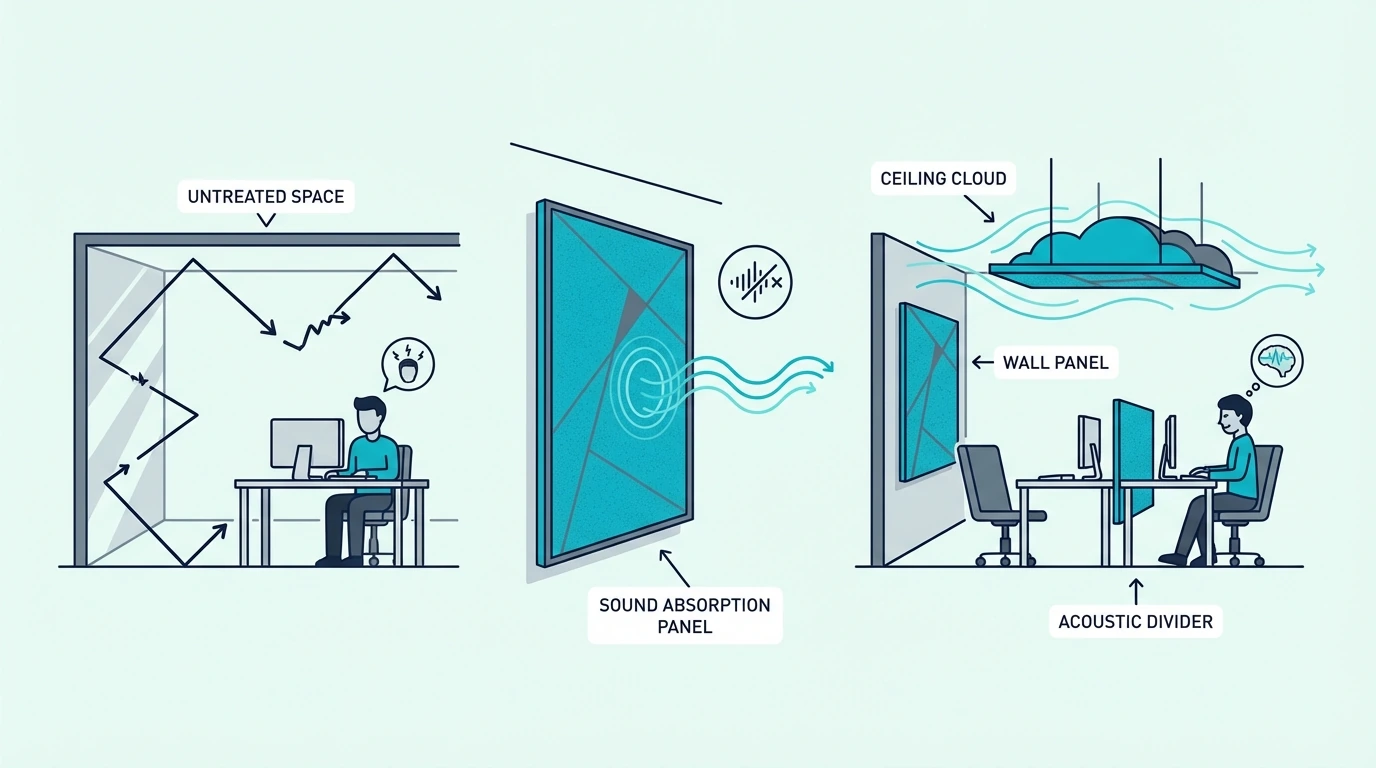
Each noise problem in an office maps to a specific type of treatment. Wall panels handle speech reflections, ceiling treatment controls overhead bounce, and sound masking addresses the direct paths that absorption alone cannot block.
Wall-Mounted Acoustic Panels
Fabric-wrapped acoustic panels mounted at seated ear height — roughly 3-4 feet above the floor — intercept the reflections that carry speech across the room. Panels on walls adjacent to desks and meeting areas deliver the most noticeable improvement because those surfaces reflect the most direct conversational energy.
In conference rooms, panels on the wall opposite the display screen and on at least one side wall eliminate the flutter echo that ruins video calls. Two to four panels per conference room typically handle the worst reflections.
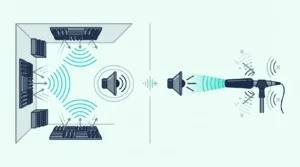
The mirror trick works here too — sit in the main chair and have someone slide a mirror along the wall at ear height. Every spot where you can see the screen or the speaker system in the mirror is a first reflection point that needs a panel.
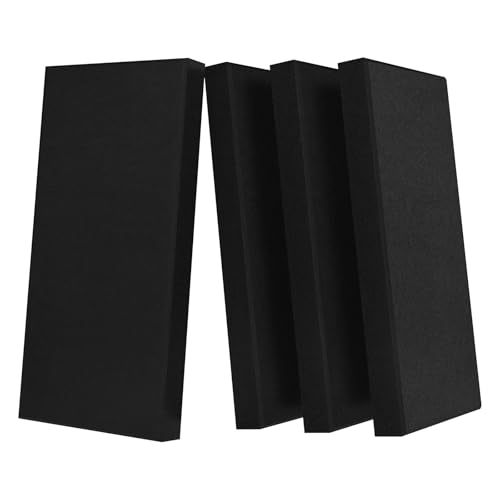
For open-plan areas, fiberglass-core panels like the Olanglab Fiberglass Panels absorb the speech frequencies where most office noise problems live. The neutral fabric wrap blends with professional decor, and the rectangular shape fits between windows and doorframes without looking out of place.
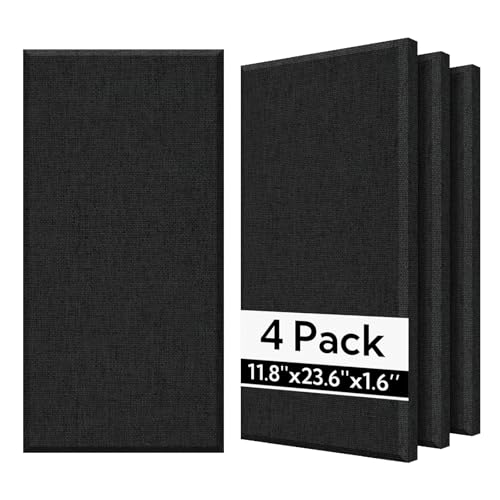
Olanglab Fiberglass Panels
If aesthetics rank as high as performance — and in client-facing offices they usually do — decorative options like the Mollywell Hexagon Acoustic Panels double as wall art while absorbing mid and high frequency reflections. The self-adhesive backing installs in minutes with no holes — a real advantage in leased office spaces where wall damage means losing the deposit.
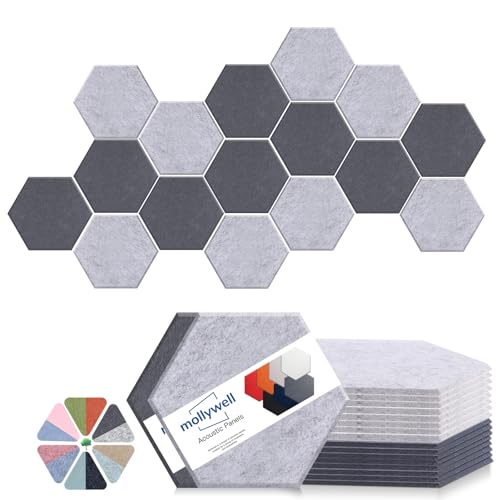
Mollywell Hexagon Acoustic Panels
Ceiling Treatment
The ceiling is the largest unbroken reflective surface in most offices, and it bounces every sound from every direction back down onto the work floor. Acoustic ceiling tiles — the drop-in type that replace standard grid tiles — are the most common office ceiling treatment because they integrate into existing suspended ceiling frameworks without visible modification.
For offices with exposed ceilings (concrete, ductwork, or open structure), suspended acoustic baffles or ceiling clouds hung above the noisiest zones absorb overhead reflections that tile grids cannot reach.
The combination of wall panels and ceiling treatment typically reduces reverberation time by 30-50% in a standard office room. That reduction is enough to noticeably improve speech clarity in meetings and reduce the carry distance of conversations in open areas.
For offices planning a ceiling upgrade, the cost of acoustic treatment varies significantly between replacing drop-ceiling tiles (relatively cheap per square foot) and installing suspended clouds or baffles (higher cost but more effective in exposed-ceiling spaces).
Sound Masking
Sound masking adds a low-level engineered background noise — usually pink or white noise shaped to the speech frequency range — that raises the ambient floor just enough to make conversations unintelligible beyond 10-15 feet.
The concept sounds counterintuitive: adding noise to reduce noise. What masking actually does is narrow the radius within which speech is intelligible, which creates zones of acoustic privacy without physical barriers.
Masking works best in open-plan offices where absorption panels reduce reflections but cannot block the direct sound path between desks. The two strategies complement each other — panels cut the reflected energy, and masking covers the direct energy that panels cannot reach.
For executive offices and boardrooms where aesthetics justify the investment, premium decorative panels like the Art3d Wood Slat Wall Panels deliver a high-end finish with acoustic felt backing that absorbs mid and high frequencies behind the slats. They cover full walls with fewer seams than smaller panel formats.
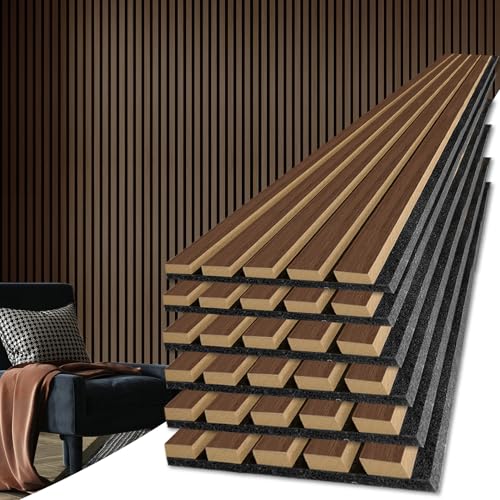
Art3d Wood Slat Wall Panels
Get Studio Tips Weekly
Join 5,000+ creators getting acoustic treatment advice every week.
No spam. Unsubscribe anytime.The Bottom Line
Office acoustic treatment follows a clear three-step priority: wall panels at ear height near desks and in conference rooms first, ceiling treatment to reduce overhead bounce second, and sound masking for open-plan zones where panels alone cannot provide enough speech privacy.
Even a basic setup — four to six wall panels in a conference room and upgraded ceiling tiles in the noisiest areas — transforms a harsh, echoey office into a space where people can focus and communicate without fighting the room.
The full guide to acoustic treatment covers placement priorities for every surface type. If budget is tight, the budget acoustic treatment roundup shows what delivers real results at the lowest cost, and the best treatment kits simplify the buying process for outfitting a full room in one order.
If you need to estimate the total project cost, the pricing guide breaks down DIY, commercial, and professional installation ranges so you can match the approach to your office budget.
Frequently Asked Questions
Do acoustic panels work in offices?
Acoustic panels reduce reverberation time and improve speech intelligibility in every type of office space. In conference rooms, two to four panels eliminate flutter echo and dramatically improve video call quality.
In open-plan areas, panels on nearby walls reduce the reflected energy that carries conversations across the room.
Where should acoustic panels be placed in an office?
Mount panels at seated ear height (3-4 feet above the floor) on walls adjacent to desks, meeting areas, and conference rooms. In conference rooms, prioritize the wall opposite the screen and at least one side wall.
For open-plan offices, focus on the walls closest to the largest clusters of workstations. Panels with included brackets like the UMIACOUSTICS 4-Pack with Brackets simplify office installation — the included hardware handles mounting without extra trips to the hardware store.
What is sound masking?
Sound masking is a system that emits a low-level engineered background noise — typically shaped to the speech frequency range — through ceiling-mounted speakers. The added noise raises the ambient floor just enough to make individual conversations unintelligible beyond a short distance, creating zones of acoustic privacy without physical barriers.