
3.1 vs 5.1 Soundbar: Do You Actually Need Surround Channels?
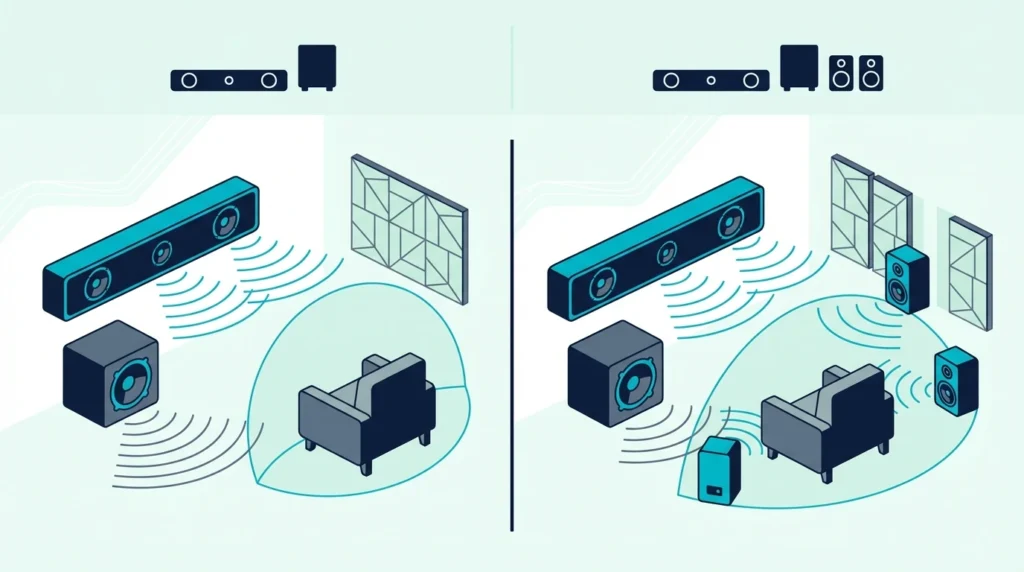
The 3.1 vs 5.1 soundbar question sounds like a simple upgrade path, but the extra channels are not automatically the better buy for every room or viewing habit.
A 3.1 bar gives you left, center, and right channels plus a subwoofer.
A 5.1 bar adds two surround channels that are only worth paying for when they change what you actually hear.
That is where many buyers get it wrong.
They expect 5.1 to fix every TV-audio problem.
Then they discover the bigger issue was muddy dialogue, a weak front stage, or a room that never lets surround effects feel convincing.
Once you separate dialogue clarity from immersion, the decision gets much easier. You can choose the format that actually improves daily listening instead of paying for extra hardware that sits underused.
The first move is to understand what the two extra channels really add.
Then match that to your content, gaming habits, and room layout.
That tells you whether 3.1 is already enough or whether 5.1 is the upgrade that will finally feel different.
Choose a 3.1 soundbar if you mostly watch dialogue-heavy TV, news, and dramas where surround effects are minimal. It gives you the center channel and subwoofer benefits people notice most without paying for surround channels you may barely use.
Choose a 5.1 soundbar if you watch action movies, play games, or want real spatial immersion from surround-mixed content. The two extra channels are only worth it when your room and habits actually let them work.
What Do Two Extra Surround Channels Actually Add?
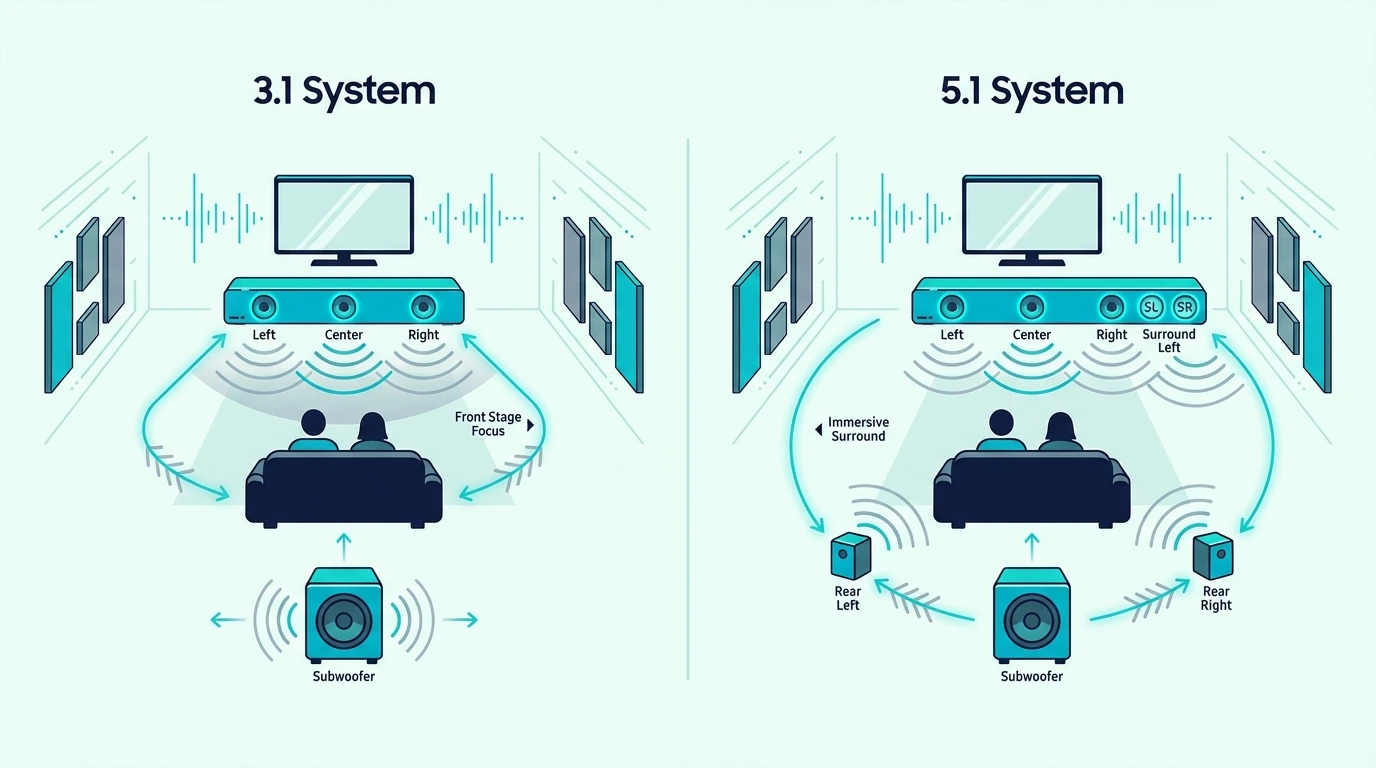
Both 3.1 and 5.1 soundbars share the same core upgrade over basic TV audio.
You get a center channel for clearer dialogue and a subwoofer for deeper bass.
The real difference is whether the two extra surround channels in 5.1 materially change what you hear.
3.1 Soundbars: Front-Focused Excellence
A 3.1 soundbar delivers three front channels — left, center, and right — plus a wireless subwoofer for deep bass.
The dedicated center channel keeps dialogue clear and anchored to the screen.
That is why 3.1 feels like such a meaningful upgrade over 2.1 for everyday TV.
For front-focused content like news, talk shows, dramas, sitcoms, and most music, a 3.1 soundbar reproduces nearly everything the soundtrack is trying to do.
The limitation shows up with surround-mixed movies and games.
Audio meant to come from behind or beside you collapses back into the front soundstage.
The biggest practical advantage of 3.1 is that it already solves the complaint most people notice first.
Voices stop getting buried under background effects.
If clearer dialogue is your goal, 5.1 is not automatically better than 3.1.
It mainly adds immersion around you once the front stage is already doing its job.
Our soundbar fundamentals guide covers the numbering basics, and our how to choose a soundbar guide helps if you’re still narrowing down the right format.
5.1 Soundbars: Spatial Immersion Added
A 5.1 soundbar builds on the 3.1 foundation by adding two surround channels.
Those channels extend audio beyond the bar itself through virtual processing, beam-forming, or separate rear speakers, depending on the model.
To check which method a given model uses, our guide to the best 5.1 surround sound bar systems takes the answer from each maker’s spec sheet or manual.
For immersive movie nights, a current example is Amazon Fire TV Soundbar Plus with Subwoofer and Surround Sound Speakers, which fits buyers who want a more convincing surround presentation from a bundled living-room package.
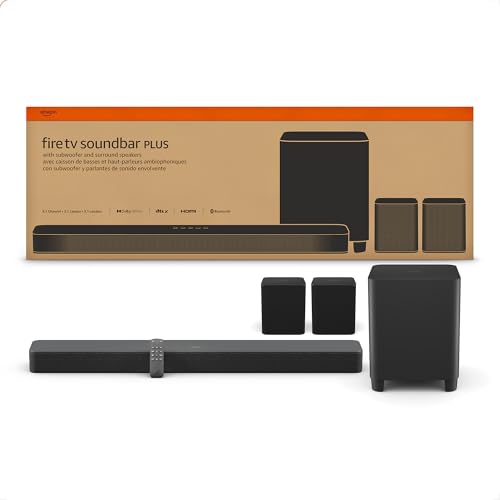
Amazon Fire TV Soundbar Plus with Subwoofer and Surround Sound Speakers
The surround effect changes how action movies and games feel.
Explosions, weather, crowd noise, and directional game audio stop sounding flat.
They start wrapping around the listening position.
What matters is how the 5.1 system creates that immersion.
A bar with dedicated rear speakers usually sounds more convincing.
Virtual 5.1 from a single bar works best when the room gives those side-wall reflections somewhere useful to go.
You also need to manage expectations with virtual surround claims.
Some 5.1 bars create a wider, more spacious front stage rather than a precise behind-you bubble.
The best results still come from rooms and hardware that support real separation.
Our soundbar setup guide explains how placement affects surround performance, and our best Dolby Atmos soundbar guide shows which models are worth considering if immersion is the goal.
When Does 5.1 Actually Beat 3.1?
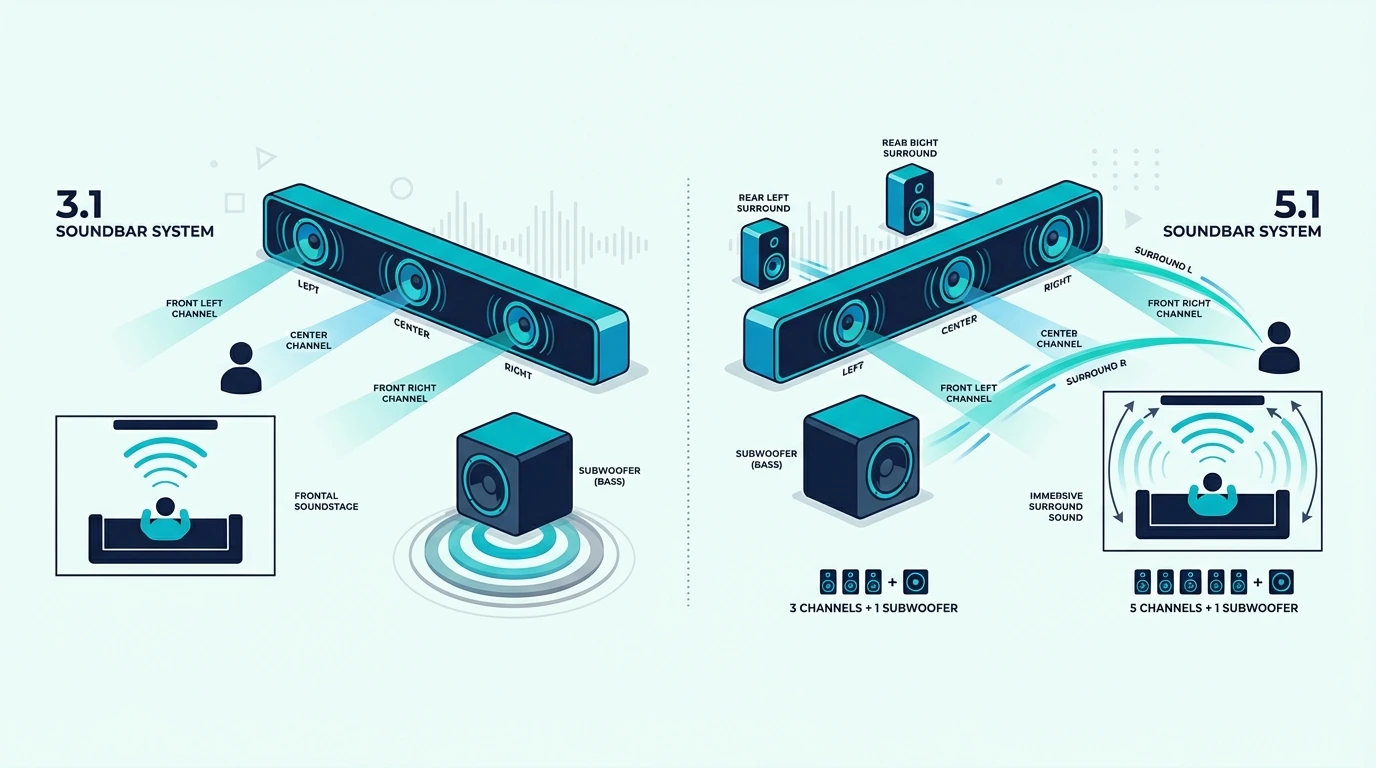
Choosing between 3.1 and 5.1 depends less on spec-sheet bragging rights and more on what you watch, whether you game, and whether your room supports believable surround.
Those practical factors determine whether the two extra channels deliver daily value or just extra complexity.
Dialogue and Music: 3.1 Is Usually Enough
For households that mostly watch dramas, news, documentaries, sitcoms, and music content, a 3.1 soundbar already covers the important upgrade.
The center channel handles dialogue.
The left and right channels carry the rest of the mix.
The subwoofer adds bass without needing surround information that the content barely uses.
Sports, YouTube, podcasts, and casual streaming often land in the same bucket.
You may get a slightly bigger presentation from 5.1 processing.
But the difference is usually smaller than the jump from weak TV speakers to a strong 3.1 bar with a real center channel.
The important thing to remember is that 5.1 does not give you a better center channel by default.
If two bars have similar front-stage quality, the jump from 3.1 to 5.1 is mainly about immersion.
It is not usually about dramatically clearer voices or bigger bass.
For dialogue-first TV use, a current example is LG S70TY 3.1.1ch Soundbar with Wireless Subwoofer, which is a better fit when clear dialogue matters more than surround immersion.
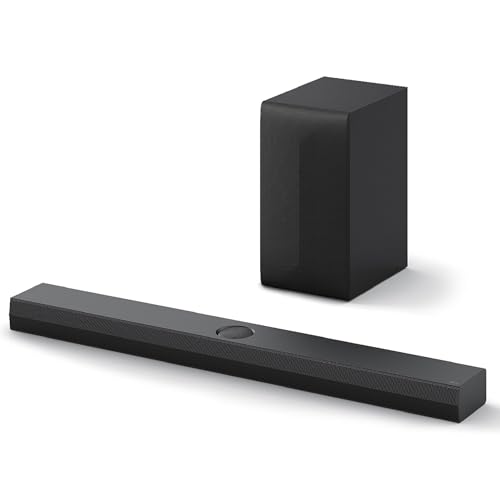
LG S70TY 3.1.1ch Soundbar with Wireless Subwoofer
Our how to choose a soundbar guide helps frame the broader purchase decision, and our best soundbars with subwoofers roundup is useful if dialogue clarity and bass are your top priorities.
Movies and Gaming: 5.1 Delivers Real Value
For households that regularly watch action movies, stream surround-mixed content, and play games, 5.1 delivers a genuinely noticeable improvement over 3.1.
Directional audio cues in competitive games and ambient rear effects in movies are exactly where the extra channels start earning their keep.
Movie soundtracks use those rear channels for rain, crowd noise, vehicles passing behind you, and environmental detail.
That is the difference between simply hearing the soundtrack and feeling pulled into it.
Gaming is where the 5.1 case becomes practical, not just cinematic.
Rear and side cues help you place footsteps, off-screen movement, and environmental hazards faster.
Single-player games also feel more believable because the world extends beyond the front wall.
Streaming habits matter too.
If most of your library is older sitcoms, sports, YouTube, and casual TV, 5.1 often sits underused for most of the week.
If your evenings revolve around action movies, prestige streaming shows with richer mixes, and story-driven games, the surround upgrade becomes much easier to justify.
That is the point where 5.1 starts feeling like a real improvement instead of a spec-sheet bonus.
Our soundbar to TV connection guide covers the setup basics and what HDMI ARC and eARC each carry for multi-channel audio.
What Kind of Room Supports 5.1 Best?
Virtual surround in single-bar 5.1 systems usually needs reflective side walls within a reasonable distance to bounce audio convincingly.
Open floor plans, heavy curtains, and irregular room shapes reduce the effect.
Rooms with cleaner wall symmetry let 5.1 sound more convincing.
If your room has supportive side walls or you plan to use a system with dedicated rear speakers, 5.1 makes more sense.
If the room fights surround or the seating is awkward, 3.1 often ends up being the smarter real-world buy.
Room layout is not just about wall reflections.
If the couch is against the back wall, the space opens into another room, or you do not want extra power near the seating area, 5.1 becomes harder to justify.
The surround channels never get the placement they need.
Household tolerance matters too.
If you do not want extra speaker stands, visible rear hardware, or the hassle of placement and calibration, 3.1 often stays the better long-term fit.
That can be true even when 5.1 sounds more exciting on paper.
Our soundbar setup guide covers placement, and how to choose a soundbar helps you weigh whether the extra hardware is worth it in your space.
Get Studio Tips Weekly
Join 5,000+ creators getting acoustic treatment advice every week.
No spam. Unsubscribe anytime.The Bottom Line
Choose a 3.1 soundbar if you mostly care about clear dialogue, deep bass, and better everyday TV audio.
Choose a 5.1 soundbar if movies, gaming, and surround immersion are central to how you use your system.
If you want the simplest answer, 3.1 is the safer default for most households.
5.1 is the right step only when your room and viewing habits can actually reward the extra channels.
Our soundbar setup guide helps with placement.
Our how to choose a soundbar guide helps once you’re ready to buy.
If you are unsure, start by asking which problem you are actually trying to solve.
If the answer is muddy dialogue and weak bass, 3.1 is usually enough.
If the answer is flat movie sound and missing positional audio, 5.1 is the step that addresses it.
That framing prevents the most common mistake in this comparison.
People often pay for surround when what they really wanted was a cleaner center channel.
Others stay with 3.1 when what they actually wanted was immersion.
Frequently Asked Questions
Is a 5.1 soundbar worth it?
Yes, if you regularly watch action movies, stream surround-mixed content, or play games where positional audio matters.
In those cases, the extra channels create immersion that a 3.1 bar simply cannot reproduce.
For a budget-friendly 5.1 example, a current option is ULTIMEA 5.1 Sound Bar for Smart TV.
It makes more sense for buyers who specifically want a first step into surround without jumping straight to a pricier system.
For dialogue-heavy TV, though, the surround channels add much less value and 3.1 usually remains the smarter buy.
Is a 3.1 sound system worth it?
Yes.
A 3.1 soundbar gives you the two TV-audio upgrades people notice most.
You get a dedicated center channel for clearer speech and a subwoofer for fuller bass.
It does that without the extra room demands that come with surround.
Why does Netflix show 5.1 instead of Atmos?
Netflix shows 5.1 when the title does not have an Atmos mix available.
It can also happen when your soundbar or TV does not support Atmos properly, or when the connection path is not passing Atmos through.
5.1 is the more common fallback surround format and still delivers meaningful multi-channel audio.
You also need the app, TV, and connection chain to support Atmos negotiation end to end.
If any one part falls back to standard Dolby Digital or Dolby Digital Plus without height metadata, Netflix labels the stream as 5.1 instead.