How to Soundproof a Ceiling Without Construction: What Helps
If you’re trying to work out how to soundproof a ceiling without construction, the honest answer is that you can soften a lot of the noise from upstairs but block only a little of it.
Maybe the foam squares went up and the thuds didn’t change, or the lease rules out opening the ceiling, which takes most of the usual advice off the table.
Once you know whether the sound reaches you through the air or through the building’s frame, you can stop paying for products that can’t touch it.
The first move happens upstairs with a rug and a thick pad, then come sealing gaps, adding absorption, masking what’s left and upgrading any drop ceiling you have.
Each fix below comes with what the makers and the labs actually measured, so you can pick the ones your ceiling, your lease and your patience allow.
How to Soundproof a Ceiling Without Construction, Step by Step
Those six fixes run from the least invasive to the most, so you can stop at whichever one solves your problem. Start at the source upstairs, close the leaks, treat your own room, and save anything that touches the ceiling’s structure for last.
| Fix | What it works on | What it can realistically do | Construction or permission? |
|---|---|---|---|
| 1. A rug and thick pad upstairs | Footsteps and thuds | The biggest single change for impact noise in the lab data below | No, but the neighbor has to agree |
| 2. Seal gaps at fixtures and edges | Voices, TV, music | Stops the leaks that drag a ceiling below its rating | Caulk needs the owner’s OK |
| 3. Panels or clouds on the ceiling | Echo in your room | Trims the build-up of noise inside the room by a few decibels | Usually no, if mounted without damage |
| 4. White noise or a fan | Anything still audible | Covers sound rather than reducing it | No |
| 5. Better tiles in an existing drop ceiling | Airborne noise through the tiles | Heavier, higher-CAC tiles block more | No new build |
| 6. A build you own or the landlord approves | Both kinds | Decoupling and insulation gain the most | Yes |
That’s the default order, but the one that matters for you depends on what you’re hearing. If voices come through clearly, sealing comes first; if thuds rattle the light fixture, the rug does.
Which Kind of Ceiling Noise Are You Hearing?
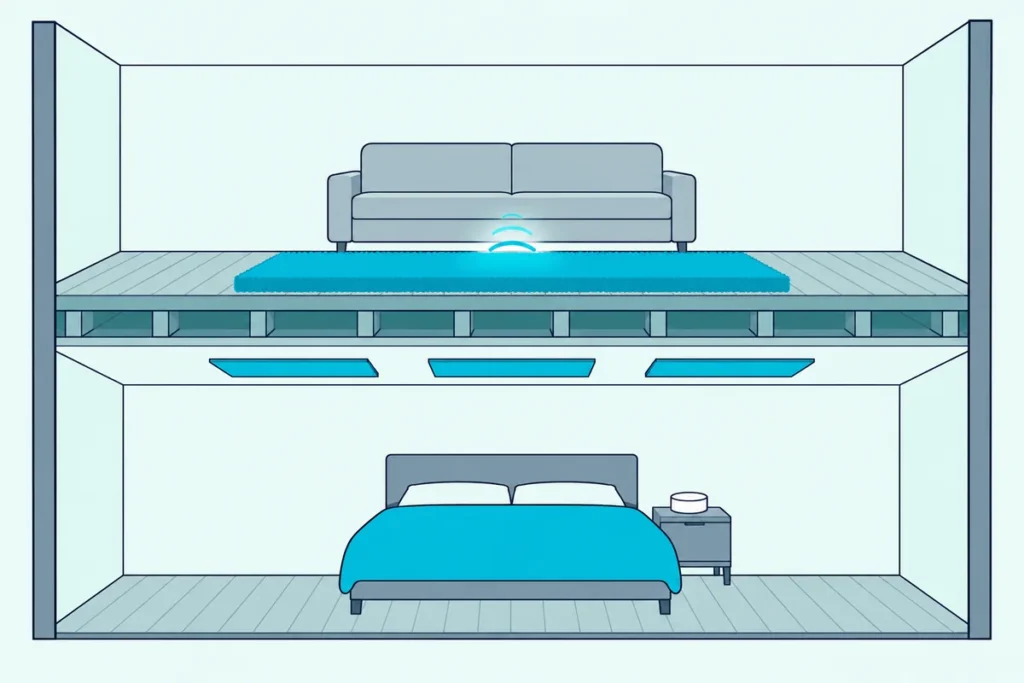
That order depends on one split: sound that travels through the air and sound that travels through the structure. Voices, TV and music arrive as airborne sound, while footsteps and dropped objects set the floor above vibrating directly, sound that NRC Canada’s acoustics digest describes as structure-borne waves traveling through the building and radiating as airborne sound somewhere else (NRC Canada, MIT-hosted copy).
USG’s acoustics primer makes the same split, noting that sound can travel through solid structures when an impact such as a footstep energizes the structure directly. The difference decides everything that follows, because a fix aimed at one path barely touches the other.
Try this the next time the noise starts. If you can follow words or a melody, the main path is airborne, and if you mostly notice dull thumps you could almost feel, it’s impact.
Plenty of ceilings carry both, so plan around whichever one bothers you more. Thuds tend to be the harder of the two from below, partly because they’re low-pitched, and low pitches are where absorbing materials do the least.
NRC Canada notes that the ear is less sensitive at low frequencies, judging a 50 Hz sound at 79 dB about as loud as a 3,000 Hz sound at 54 dB. The carpet industry’s acoustics paper adds that real footfalls make annoying low-frequency sounds that the standard tapping machine has trouble measuring.
Keep a simple log for a week: the time, what you heard and where in the room it was loudest. It tells you which fix to try first, and it’s the record a landlord will want to see if you end up asking for a build.
If the noise comes from a neighbor’s routine rather than the building itself, our guide on how to soundproof an apartment from upstairs neighbors covers the conversation, the lease and the building code. This page stays on the ceiling itself and what you can change without opening it.
Get Studio Tips Weekly
Join 5,000+ creators getting acoustic treatment advice every week.
No spam. Unsubscribe anytime.Is the Sound Really Coming Through the Ceiling?
That impact path doesn’t always end at your ceiling, so it’s worth checking before you spend anything overhead. Sound from upstairs can also travel down through the walls and the building’s frame and come out around the ceiling, and a fix on the ceiling alone won’t catch that share.
NRC Canada’s digest on transmission loss calls these flanking paths. In a poor design they can carry more sound energy than the direct path through the floor, and the digest singles out floors as prone to extra impact transmission through the supporting structure.
Lab ratings leave flanking out on purpose, since the test rooms are built so the only real path runs through the sample. Armstrong’s FAQ makes the same distinction, describing STC, CAC and NRC as lab measures of a material and NIC as an estimate of the total isolation between rooms connected by many paths.
Try a walk-around during a noisy stretch. If the sound seems loudest at a wall, a closet, a door or an air register rather than straight overhead, the main path probably isn’t the ceiling, and Owens Corning’s assembly guide notes that ducts can easily transmit sound between spaces.
What’s the Difference Between Absorbing Sound and Blocking It?
Those paths, direct or flanking, all meet two very different kinds of material, and it pays to keep them apart before buying anything. Absorbing materials are porous and let sound pass through them fairly easily while turning some of it into heat, whereas blocking materials are heavy, airtight and reflective, so most of the sound bounces back instead of getting through.
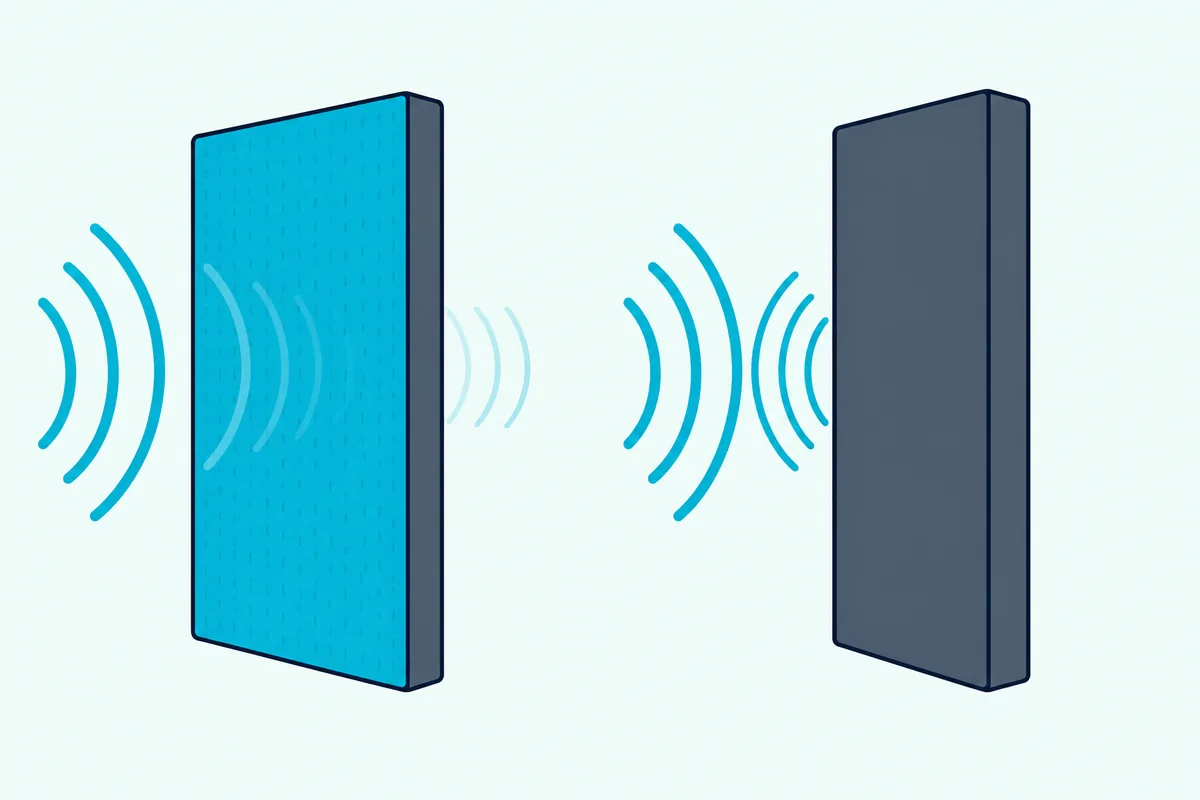
NRC Canada’s digest draws that line in nearly the same words: absorbers control sound within a space, while good barriers are usually non-porous and reflect sound. USG adds that porous glass fiber and mineral fiber make efficient absorbers, while non-porous materials such as gypsum board tend to reflect.
Think of a screen door and a storm door. Air, and sound with it, passes through the screen, while the storm door stops most of it as long as it seals.
The ratings follow the same split. NRC, the noise reduction coefficient, averages a material’s absorption at 250, 500, 1,000 and 2,000 Hz under ASTM C423, and Armstrong’s ceiling FAQ puts the scale at 0.00 for a concrete floor and 1.00 for its best acoustical products (Armstrong).
Blocking gets different numbers: STC for walls and floor-ceilings under ASTM E90, IIC for footsteps under ASTM E492 with a tapping machine, and CAC for ceiling tiles. Armstrong describes CAC as a two-pass test, with sound going up through one room’s ceiling, across the shared space above, and down through the next room’s ceiling.
That detail matters later, because no CAC test involves a floor above. A tile can rate well for privacy between two offices and still tell you nothing about a neighbor’s footsteps.
The physics of blocking is mostly weight. NRC Canada’s digest on transmission loss gives the mass law as about 6 dB more for each doubling of a single layer’s weight per square foot, so a 12 dB gain needs four times the weight.
Why Won’t Foam or Acoustic Panels Stop Footsteps?
That weight rule is where foam and fiberglass panels fall short, along with their trouble at low pitches. Panels are light, they leave the ceiling’s joints and edges as they were, and they absorb least in the bass range where footsteps sit.
Owens Corning’s data sheet for the rigid fiberglass board it makes for fabric-wrapped acoustical panels shows the problem (Owens Corning). Its 1-inch Type 706 board rates NRC 0.75, but its absorption coefficient at 125 Hz is 0.01, and the 2-inch board reaches only 0.19 there against an NRC of 1.05.
Those figures come from Type A mounting, flat against a solid backing, under ASTM C423. Since NRC averages only 250 to 2,000 Hz, a high NRC says nothing about 125 Hz, the low end where footfalls make their thump.
Weight tells the same story. At Owens Corning’s listed density of 6 pounds per cubic foot, a 1-inch board weighs about half a pound per square foot, while one sheet of USG’s 5/8-inch Firecode X drywall weighs 2.2 pounds per square foot.
Even a ceiling covered wall to wall in 1-inch panels gains less than a quarter of the weight one more drywall layer would add, and by the mass law that’s worth well under 6 dB. The gaps between panels and around fixtures also stay open, and the ceiling stays screwed to the same joists that carry footstep vibration down to you.
So a stick-on product sold as a ceiling soundproofing panel can make the room sound softer while the footsteps come through as before. That’s not a defect in the panel; it’s a different job.
What Do Ceiling Panels Actually Change in Your Room?
That different job is controlling echo, and it’s a real one. Absorbing panels lower the reverberant build-up inside your room, which takes the edge off whatever noise gets in, typically by a few decibels rather than the big drop the word soundproofing promises.
NRC Canada’s digest says the reverberant sound level in a room can be reduced by installing sound-absorbing materials. The FHWA, estimating how much outside noise a house keeps out, enters a room’s absorption as the term 10 log S/A, so each doubling of the absorption changes the result by 3 dB.
Three decibels sits right at the edge of what counts. NRC Canada treats changes under 3 dB as not significant in practice, and a 10 dB change as roughly a doubling of perceived loudness.
How much a few panels add depends on what the room already has. The FHWA names drapes, carpeting and upholstered furniture as examples of materials that absorb sound inside a home, so a bare room with hard floors starts low and doubles easily, while a carpeted, furnished bedroom already has a lot.
Owens Corning’s own assembly guide is more upbeat, saying absorbing material in both rooms can give a significant reduction in intruding noise with no change to the partition between them. The catch for anyone downstairs is the word both, because you control only your own room.
Ceiling clouds and hanging baffles are often rated differently. USG notes that the absorption of separate pieces like baffles, canopies and clouds is usually given in sabins, a measure of total absorption, rather than as an NRC, so compare like with like when you shop.
If you do hang panels as a DIY job, think about the mounting before the brand. Ceiling panels need a method that holds without harming a rental’s finish, so check the panel maker’s mounting instructions and find the joists before you start.
Can a Rug Upstairs Beat Anything You Put on Your Ceiling?
That gap between what panels promise and what they deliver is why the strongest footstep fix happens on the floor above. For impact noise, a carpet or rug with a thick pad upstairs does more than anything you can put on your side without construction, because it softens each step before it reaches the structure.
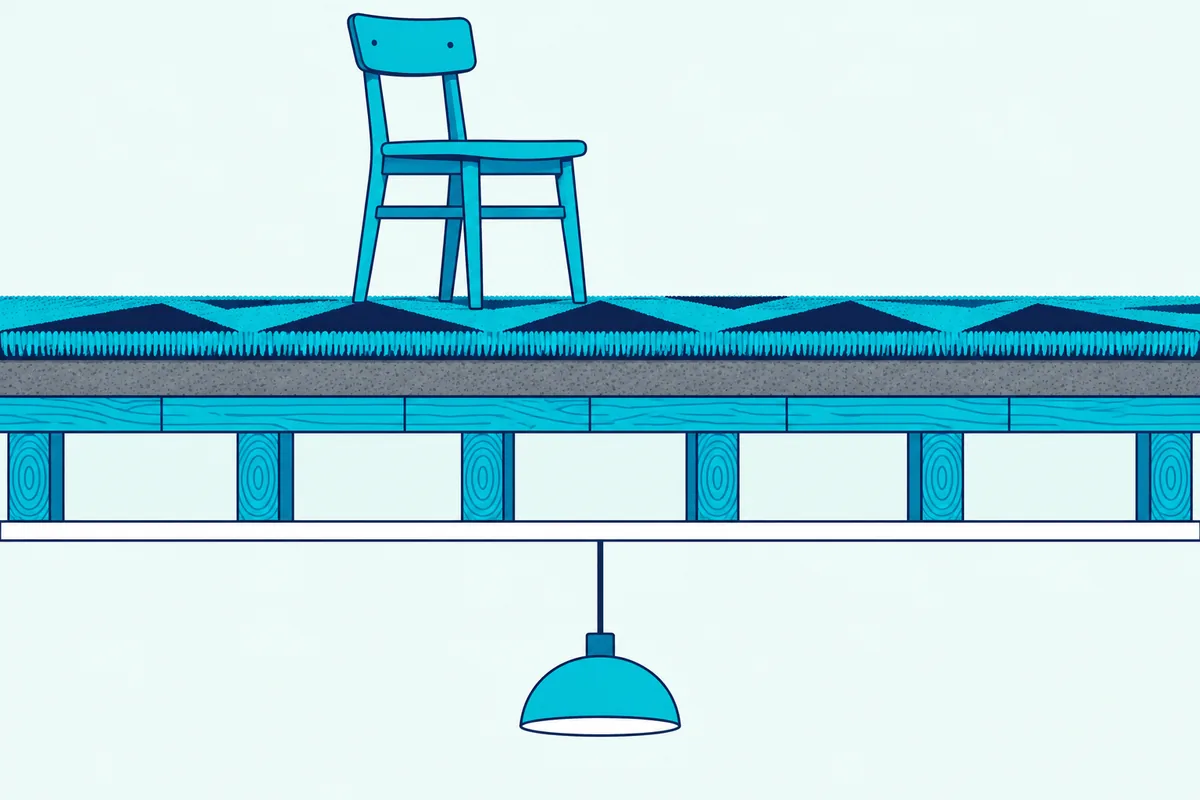
Owens Corning’s assembly guide calls carpet and pad the best way to improve a floor-ceiling’s impact isolation, because the tapping machine’s hammers are isolated from the hard floor. In its table for a wood-joist floor with resilient channels and 6 inches of batts, adding carpet over a 3/8-inch foam pad raised the IIC from 46 to 67 while the STC moved only from 52 to 53.
The carpet industry’s lab data point the same way. On a wood-joist floor with a 5/8-inch plywood subfloor, the bare floor rated IIC 32, and six carpet-and-cushion combinations rated IIC 54 to 68 (CRI).
Those tests used wall-to-wall carpet, and no source here rates an area rug, so treat the numbers as the upper end of what a rug can do. CRI also found that cushion materials, in general, added significantly to the impact ratings, so the pad is the part not to skip.
Asking is the hard part. Lead with a short, friendly note that names the times you hear it and the room it’s over, and offer to pay for the pad, which makes yes easier.
If you buy the pad yourself, RUGPADUSA’s Dual Surface pad is a felt-and-rubber option that grips the floor. Its title and photos claim no acoustic rating, so think of it as the cushion layer from the lab tests above, not a tested product.
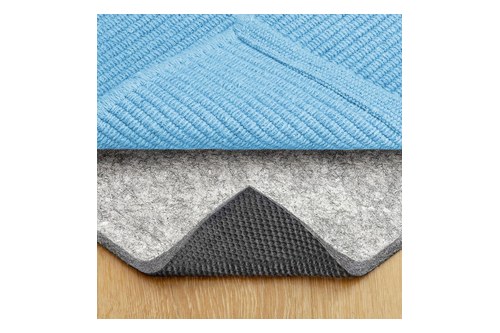
RUGPADUSA’s Dual Surface pad
For the rug itself, our roundup of carpet and pad picks for soundproofing compares pile and pad. In CRI’s tests without cushion, the carpets with the greater pile weight scored highest, which is worth knowing if the neighbor is choosing a new rug.
Which Gaps Can You Seal Without Opening the Ceiling?
That rug handles the thuds, but voices and TV find a different route: every gap in the ceiling’s surface. Seal what you can reach without opening anything, usually the joint where the ceiling meets the walls and the trim around fixtures, and ask the building to handle anything behind a cover plate.
Small openings cost far more than their size suggests. HUD’s Noise Guidebook gives the example of a wall rated STC 50 that drops to STC 40 with a one-inch-square hole or a 1/16-inch crack 16 inches long (HUD).
A ceiling works the same way, since NRC Canada lists holes, fissures and similar defects among the paths that increase sound transmission between rooms. USG adds that sound can bend around barriers and squeeze through small openings.
The usual suspects overhead are the canopy of a light fixture, a ceiling fan’s mount, an air register and the line where the ceiling meets the walls. A gap you can see, or feel air moving through, is an open path for sound, much like a storm door left open a crack.
Owners can run a bead of acoustical sealant along the ceiling’s edge and around fixture trims, in line with Owens Corning’s advice that openings in walls and floors be caulked. Renters should ask before caulking anything, and everyone should leave light housings, smoke alarms and air registers to whoever maintains the building.
Sealing won’t fix footsteps, and it won’t turn a thin ceiling into a thick one. What it does is close the easiest path, which is why it comes before anything you buy for your room.
Does White Noise Help When the Ceiling Can’t Change?
Those leaks and thuds will still leave something audible, and that’s where covering sound earns its place. White noise doesn’t reduce the noise from upstairs at all, but it can make it less noticeable by filling the silence that lets a single thump stand out.
The GSA’s workplace acoustics guide groups noise control into absorb, block and cover, and it explains why cover works. A very quiet space lets interruptions contrast with the quiet, which causes more distraction than a space with a higher level of background sound.
At home, that background sound can come from a fan, an app or a dedicated machine. GSA lists apps and desktop systems among its masking options, and the same idea scales down to a nightstand.
For a machine that makes its sound with a real fan, the Yogasleep Dohm Classic is the long-running choice. Its listing describes natural sound from a real fan, adjustable tone and volume, and a body about 5.6 inches across.
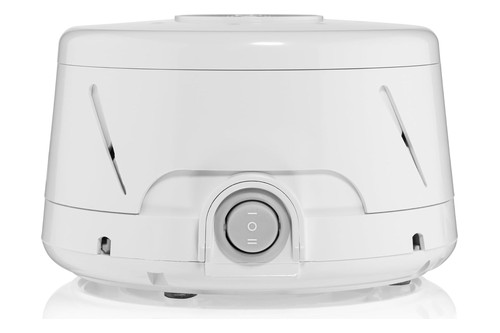
the Yogasleep Dohm Classic
Masking has a limit worth knowing before you count on it for thuds. NRC Canada notes that electronically generated masking noise tends to have less low-frequency energy than a standard noise-rating curve, and low frequencies are where footsteps sit.
For sleep, earplugs work at your ears, where no ceiling fix reaches, and the upstairs-neighbors guide linked above covers how to choose and wear them. Pair either one with the rug request rather than in place of it.
What If You Already Have a Drop Ceiling?
A drop ceiling is the one exception to the no-construction limits above, because its grid is already there. Swapping in heavier, higher-CAC tiles improves what the ceiling blocks without touching the structure, and insulation in the space above can add more, within the tile maker’s limits.
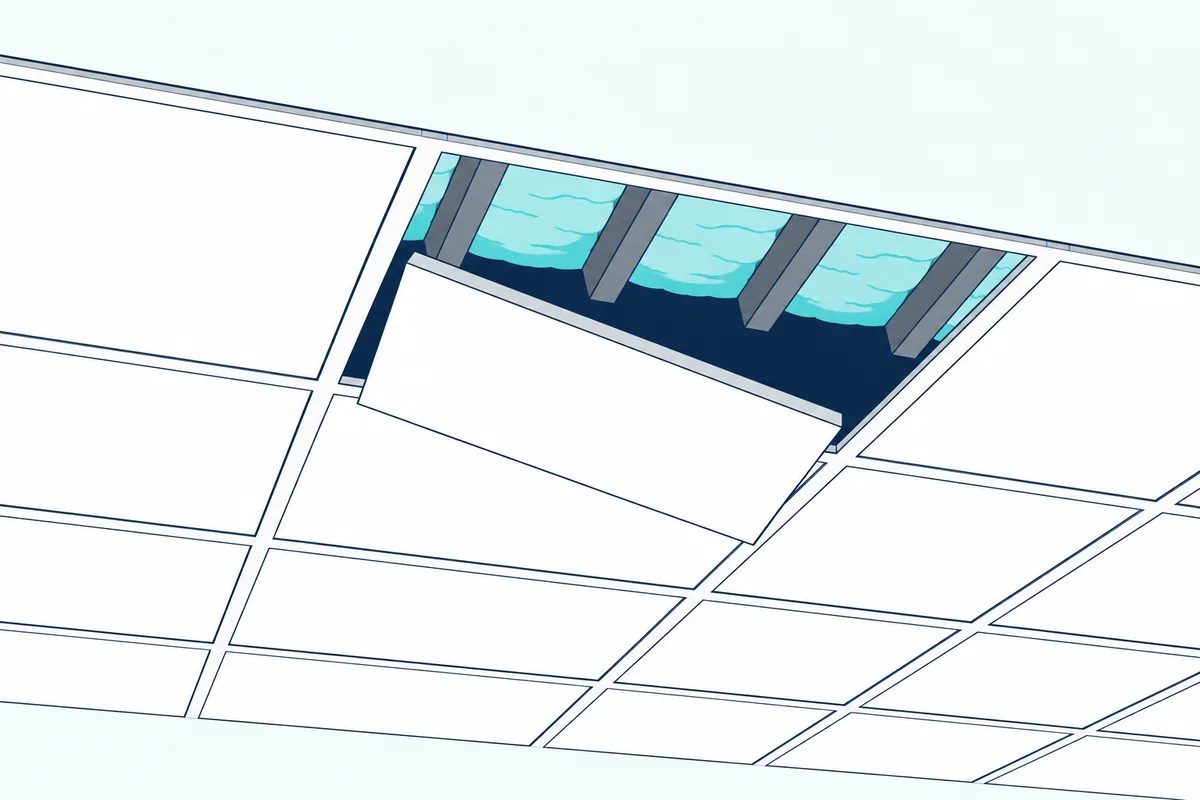
Armstrong rates its tiles on both scales. Its Ultima High NRC panels list NRC up to 0.85 with CAC 35, and its Dune 1774 tile lists NRC 0.50 and CAC 35 at 0.75 pounds per square foot.
Armstrong calls CAC 35 or higher high performance and CAC under 25 low. For absorption, it calls NRC above 0.70 high and NRC under 0.50 low.
Owens Corning says laying its batts on the back of suspended ceiling panels can raise the ceiling’s STC by 7 to 12 points, depending on the panels. Armstrong’s consumer brand, Kanopi, says in its own guide that insulation sprayed into the framing above a drop ceiling shouldn’t lie on the ceiling itself, so check your tile maker’s guidance on added weight before you load the grid.
The tiles’ CAC still describes sound between rooms through a shared plenum, not footsteps from a floor above. A drop ceiling’s real limit is everything set into it, and Burton Acoustix’s drop ceiling tile guide covers what lights and grilles cost and which tiles rate highest.
If your grid takes 2 x 2 lay-in tiles, Armstrong’s Dune 1774 is a budget swap with published ratings. Measure your grid’s openings and edge style first, since Dune’s angled tegular edge is made for a 15/16-inch grid.
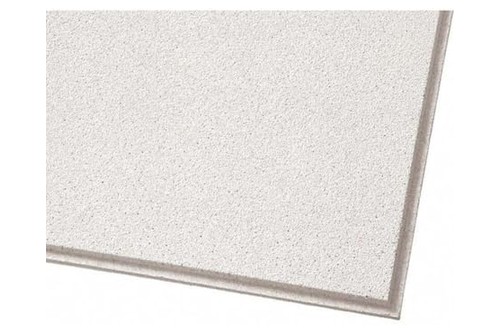
Armstrong’s Dune 1774
Will Blowing Insulation Into the Ceiling Help?
Those batts above a drop ceiling work in part because the tiles hang free of the structure, which is exactly what a normal drywall ceiling lacks. Filling the cavity above drywall that’s screwed straight to the joists is likely to add only a few points, because much of the sound crosses through the joists themselves.
NRC Canada’s digest gives the example of a typical wood-stud wall with drywall attached directly to both sides, rated about STC 33. Adding sound-absorbing material raised it only about 3 points, because sound energy passes from one layer to the other through the studs, while the same material adds about 8 points once the layers are decoupled.
A ceiling screwed to joists is the same kind of rigid connection, which the digest compares to an electrical short circuit. Blowing insulation in also means drilling and patching holes in the ceiling, so it isn’t truly construction-free either.
Insulation still has its place in a build. In the Owens Corning floor table below, it comes paired with resilient channels, and that pairing is where the bigger numbers come from.
What About Blankets, Vinyl Sheets and Soundproof Paint?
That same mix of weight and airtightness explains the other products sold for ceilings. Blankets and quilts are porous absorbers, so they behave like the panels above, and a heavy vinyl sheet blocks only as well as its seams.
HUD’s leak numbers apply to anything you hang, because a sheet with gaps at its edges and joints leaves the easy path open. Mass loaded vinyl is a blocking material, but fastening it overhead as a sealed, continuous layer is a construction job, and loose sheets leave exactly those gaps.
Paint is the easiest to rule out for blocking. Burton Acoustix’s answer to does soundproof paint work on a ceiling rests on the best lab result it found, a thick sprayed coating that added about 8 percent to a drywall face’s weight, which the mass law puts well under 1 dB.
When Does It Make Sense to Ask for Construction?
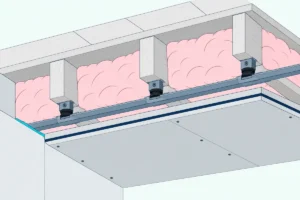
Those limits add up to a plain answer: when footsteps are the problem and the floor above can’t change, the fixes that work need construction. The two builds that matter are a second layer of drywall over the existing ceiling, which needs no demolition, and a decoupled ceiling on resilient channels or isolation clips with insulation above it.
Owens Corning’s floor table shows what decoupling and insulation buy, using two carpeted joist floors with the same lightweight concrete topping, both tested at Geiger and Hamme. With no insulation and drywall fastened straight to the joists, the floor rated STC 47 and IIC 59; with 3.5 inches of batts and resilient channels, it rated STC 58 and IIC 74.
That’s 11 STC points and 15 IIC points from changes made entirely on the ceiling side. Both ratings are built from decibel measurements, and NRC Canada treats a 10 dB change as roughly a doubling of perceived loudness, so a gap that size is one you’d expect to notice.
A suspended ceiling hung below the old one is a lighter build with the same idea, a separate layer under the floor. MP Global’s spec sheet for its SoundStep LV underlayment rates a 4 mm floating plank over it on a 6-inch concrete floor at IIC 50 and STC 51 with no ceiling, and IIC 70 and STC 62 with a suspended ceiling below, though it doesn’t describe that ceiling.
The second-layer build is the one an owner can do without tearing anything out, and the full ceiling soundproofing build walks through both, including what each costs in ceiling height. In a rental, either one is a request for the landlord.
Armstrong’s Kanopi guide counts panels and drop ceiling tiles among the jobs you can install yourself. It suggests leaving more advanced installations, such as isolation clips and multi-layer drywall, to a professional.
For renters, the same guide draws the line in one sentence: avoid major structural changes unless you have the landlord’s permission. A written request with your log is the way to get it.
Make the request specific. Say whether the problem is voices or footsteps, list the times from your log, and name the fix you’re asking for, whether that’s sealing around fixtures, a second drywall layer or a decoupled ceiling, so the answer can’t be a vague promise.
Which Fixes Fit a Renter, an Owner or a Basement?
Those options sort differently depending on what you’re allowed to touch. A renter starts upstairs and at the gaps, an owner can go straight to a second drywall layer or a decoupled ceiling, and a basement or condo with a drop ceiling can upgrade the tiles and the space above them.
| Your situation | Start with | Then | Skip |
|---|---|---|---|
| Renting, mostly footsteps | A rug and thick pad upstairs | White noise at night; log the times and ask management | Foam or panels bought to block |
| Renting, mostly voices or TV | Ask management to seal gaps at fixtures | Panels if your room echoes; white noise | Blankets stapled to the ceiling |
| Owner, either kind | Seal, then a second drywall layer | A decoupled ceiling if footsteps dominate | Stick-on products |
| Basement or condo with a drop ceiling | Heavier, higher-CAC tiles | Insulation above, within the tile maker’s limits | Thin decorative tiles |
The table assumes the noise really comes through the ceiling. If the sound seems loudest near a wall, a door or a vent, the leak is there instead, and work on the ceiling won’t touch it.
Condo owners sit in between. The ceiling may count as part of the building rather than your unit, so check the association’s rules before any build, even one that adds a layer without removing anything.
The Bottom Line
That leaves a short list for soundproofing a ceiling without construction: a rug and pad upstairs for footsteps, sealing for voices, panels only for echo, and white noise for what’s left. A drop ceiling you already have can take better tiles, but anything that truly blocks sound through a plain drywall ceiling adds weight, seals the gaps or separates the layers, and all three mean building something.
Frequently Asked Questions
Can you soundproof a ceiling without removing drywall?
Yes, but the effective way still counts as construction. You can add a second layer of drywall over the existing ceiling, which adds weight without demolition, or build a decoupled ceiling below the old one on resilient channels or isolation clips. Without any construction, your options are the ones on this page: a rug and pad upstairs, sealing gaps, panels for echo and white noise. NRC Canada’s mass law is the reason the drywall route works where panels don’t: each doubling of a layer’s weight adds about 6 dB, and USG lists 5/8-inch drywall at 2.2 pounds per square foot, about four times a 1-inch acoustic board.
What can I put on my ceiling to stop noise from upstairs?
Nothing you can stick on will stop much of it. Panels, foam and blankets absorb sound inside your room, and Owens Corning’s data put a 1-inch acoustic board’s absorption at 0.01 at 125 Hz, the range where footsteps sit. What stops noise is weight, airtightness and separation: a sealed extra drywall layer for voices, and a decoupled ceiling or a rug and pad upstairs for footsteps. If you have a drop ceiling, heavier tiles with a higher CAC block more airborne sound than standard ones.
How do you soundproof a ceiling cheaply?
Start with the steps that cost little or nothing. Ask the upstairs neighbor for a rug with a thick pad over their main walking path, and offer to pay for the pad, since Owens Corning calls carpet and pad the best way to improve a floor’s impact rating. Next, seal the visible gaps around fixtures and the ceiling’s edge if you own the place or have permission, because HUD shows how much a small crack costs. White noise is the cheapest way to make what’s left less noticeable. Skip products sold as cheap ceiling soundproofing panels if footsteps are the problem.
How do you soundproof an apartment ceiling without construction?
Treat it as a renter’s problem first. Talk to the upstairs neighbor about rugs and pads, check the lease for floor-covering rules, and keep a dated log of the noise. Ask management to seal gaps around light fixtures and registers, since you shouldn’t open or caulk them yourself without permission. Inside your unit, panels can calm an echoey room, and white noise or earplugs help at night. If the building’s floor is simply too light, the fix that works is a ceiling build the landlord approves.
Do acoustic panels block noise from upstairs?
No. They absorb sound that’s already in your room, which cuts echo and the build-up of noise, but they let sound pass through them and add very little weight. NRC Canada’s digest describes absorbers as materials that let sound through relatively easily, while good barriers are non-porous and reflective. Panels can still make a hard, echoey room feel calmer, which is worth something, but they won’t stop footsteps or a neighbor’s TV from reaching you.
Can renters soundproof a ceiling?
Partly. Renters can ask the upstairs neighbor for rugs and pads, use white noise or earplugs, hang panels with damage-free mounting, and swap tiles in an existing drop ceiling if the lease allows. Anything that changes the ceiling itself, such as caulking, adding drywall or building a decoupled ceiling, needs the landlord’s permission. Armstrong’s Kanopi guide puts the same limit on renters: avoid major structural changes without permission.
How much quieter can a ceiling get without construction?
Less than the word soundproofing on a package suggests, and it depends on the fix. Absorbing panels trim the reverberant build-up by about 3 dB each time they double your room’s absorption, which NRC Canada treats as the edge of significant. Sealing gaps restores what leaks were costing, and HUD’s example shows a small crack taking a wall from STC 50 to 40. The big impact numbers come from the floor above: carpet and pad raised one floor’s IIC from 46 to 67 in Owens Corning’s table. White noise reduces nothing, but it makes what’s left less noticeable.
Does a suspended ceiling count as construction?
It’s a light build rather than none, since the grid hangs below the structural ceiling with a gap between them, which Armstrong’s Kanopi guide says makes drop ceilings decoupled by design. MP Global’s spec sheet shows why owners consider one: the same concrete floor rated IIC 50 with no ceiling and IIC 70 with a suspended ceiling below. In a rental it needs the landlord’s approval, while in a basement you own it’s one of the lighter ways to add a separate layer under the floor above.