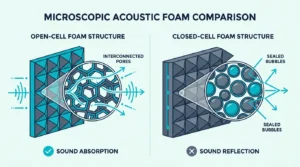
Will Acoustic Foam Improve Recording? The Honest Answer
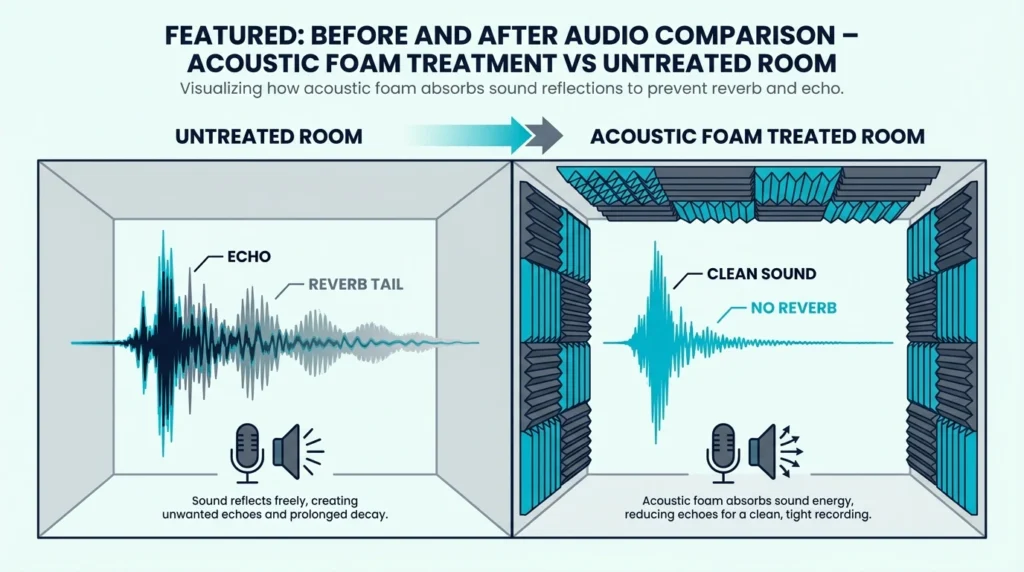
Will acoustic foam improve recording? Yes—in most untreated rooms. Foam absorbs room reflections that contaminate your recordings, producing cleaner audio that requires less post-processing.
But the improvement depends on your current situation. A room with hard walls and no treatment sees massive gains from foam.
A carpeted bedroom with curtains and furniture might only see modest improvement. Understanding what foam actually does helps you avoid wasting money on panels that won’t fix your problem.
Below you’ll find how foam improves recordings, when it helps most, and when to start with a different solution. For a deeper understanding of the science, see how acoustic foam works.
Acoustic foam improves recording by reducing room reflections that reach your microphone, shortening reverb decay for tighter captures, eliminating flutter echo, and improving clarity so your voice sounds more present. The biggest improvements come from treating the wall behind your microphone and first reflection points on side walls. Foam won’t help with neighbor noise, outside traffic, or sound through walls—those require soundproofing, not acoustic treatment.
How Acoustic Foam Improves Recordings
Understanding the mechanics helps you use foam effectively. The improvement isn’t magic—it’s physics.
The Reflection Problem
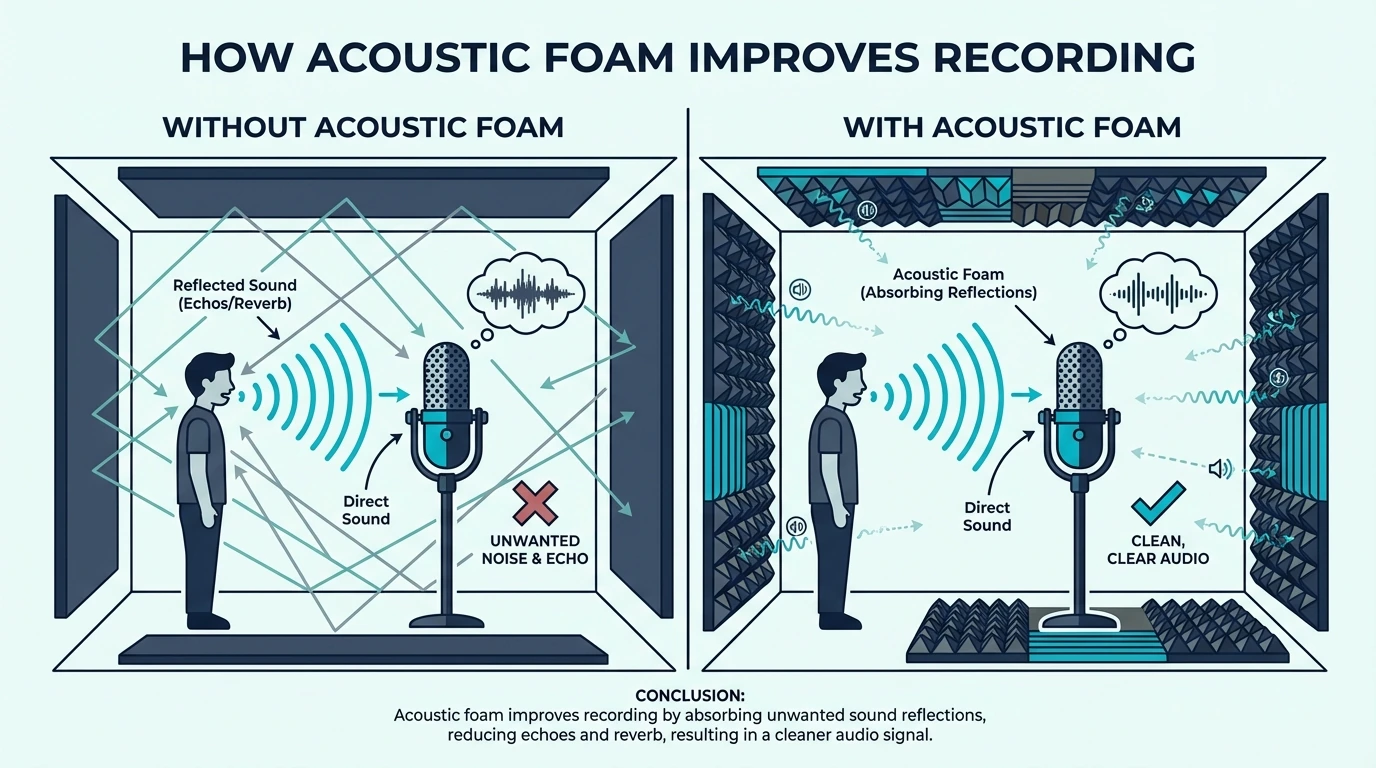
When you speak or play an instrument, sound radiates in all directions. Some travels directly to your microphone—this is the sound you want to capture.
But most of it hits walls, ceiling, and floor first.
These surfaces reflect sound back into the room. The reflections eventually reach your microphone too, arriving milliseconds after the direct sound.
Your recording captures both: the clean direct sound plus all the messy reflections.
The result sounds “roomy”—like you recorded in a bathroom or empty warehouse. The reflections add reverb, reduce clarity, and make your voice sound distant and unprofessional.
How Foam Solves This
Acoustic foam absorbs sound energy instead of reflecting it. When sound waves hit the foam’s porous surface, they enter the material and convert to tiny amounts of heat through friction.
With foam on your walls, reflections that would have bounced back to your microphone get absorbed instead. Your mic captures more direct sound and less room sound.
The recording sounds tighter, cleaner, and more professional.
The effect is immediate and obvious. Record yourself speaking in an untreated room, add foam, then record again.
The difference is stark—even to untrained ears. A starter pack like the Foamily 12-Pack Acoustic Wedge Panels is enough to test the difference at first reflection points. For product recommendations, see best acoustic foam for recording.
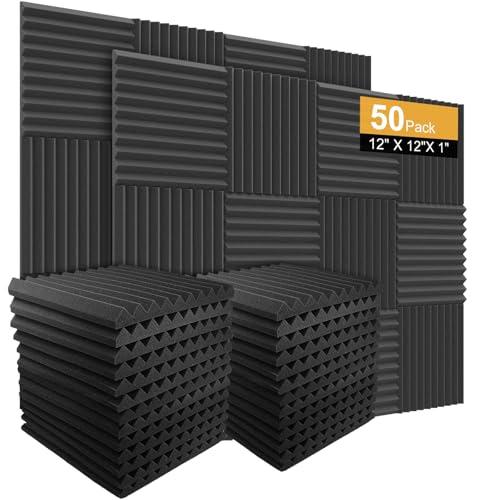
Foamily 12-Pack Acoustic Wedge Panels
What Frequencies Foam Affects
Standard acoustic foam (1-2 inches thick) primarily absorbs mid and high frequencies—roughly 500 Hz and above. This range includes most vocal frequencies (85-255 Hz fundamental, but 1-4 kHz for clarity and presence) and the “presence” range that makes recordings sound clear.
Lower frequencies pass through thin foam largely unaffected. A 2-inch foam panel might absorb 80% of sound at 2000 Hz but only 15-25% at 250 Hz.
If your room has bass problems (boomy, muddy low end), standard foam won’t fix them. You’d need thicker bass traps (4+ inches) for low-frequency issues.
For vocal recording, podcasting, and most instrument recording, mid/high frequency absorption is exactly what you need. The frequencies foam handles are the ones that cause the most audible problems in recordings.
Before and After: Real Recording Differences
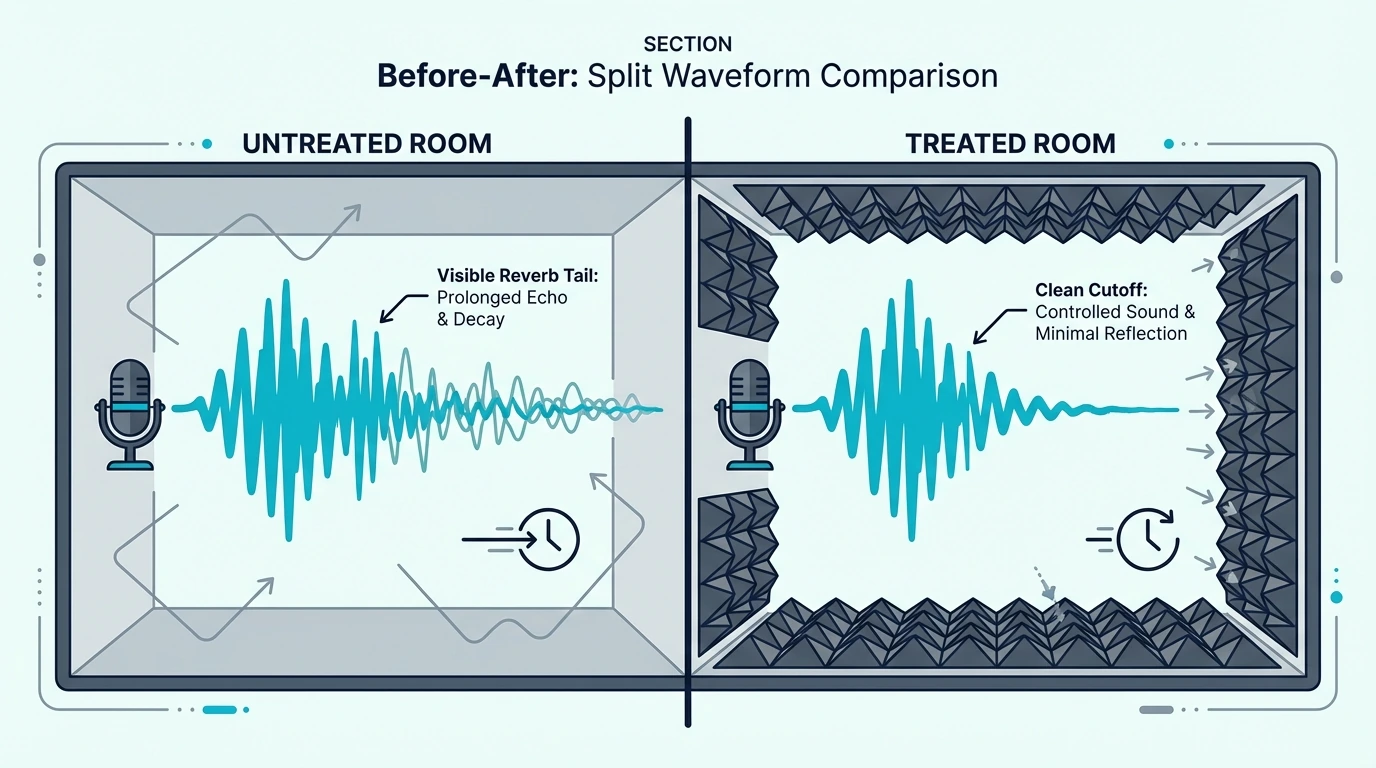
The improvement from foam isn’t subtle. Here’s what actually changes in your recordings.
Reverb Reduction
Untreated rooms have long reverb tails—sound continues ringing for 500-800 milliseconds after you stop speaking in a typical bedroom with hard walls. This reverb overlaps with subsequent words, reducing intelligibility.
Foam shortens the reverb tail noticeably—often to 200-300 milliseconds or less. Sound dies quickly instead of bouncing around.
Each word or note stands distinct rather than blurring into the next.
In practical terms, this means your recordings sound “tighter.” There’s space between words.
Transients (the attack of sounds) come through clearly. The recording sounds controlled rather than chaotic.
Clarity Improvement
Room reflections create comb filtering—certain frequencies cancel out while others reinforce. This colors your recording unpredictably, making some frequencies 3-6 dB too loud and others 3-6 dB too quiet.
Foam reduces comb filtering by eliminating the reflections that cause it. Your recording captures a more accurate representation of your voice or instrument.
What you hear in the recording matches what you heard in the room.
For mixing and post-production, this clarity matters. Clean recordings are easier to process.
You spend less time fixing problems and more time enhancing what’s already good.
Presence and Proximity
Untreated recordings often sound distant—like the performer is far from the microphone even when they’re close. This happens because reflections dilute the direct sound.
Foam increases the ratio of direct sound to reflected sound. Your voice sounds closer, more present, more intimate.
This “in your face” quality is what separates professional recordings from amateur ones.
The improvement is especially noticeable for vocals and spoken word. Podcasts, voice-overs, and singing all benefit from the increased presence that foam provides.
Get Studio Tips Weekly
Join 5,000+ creators getting acoustic treatment advice every week.
No spam. Unsubscribe anytime.When Foam Helps Most
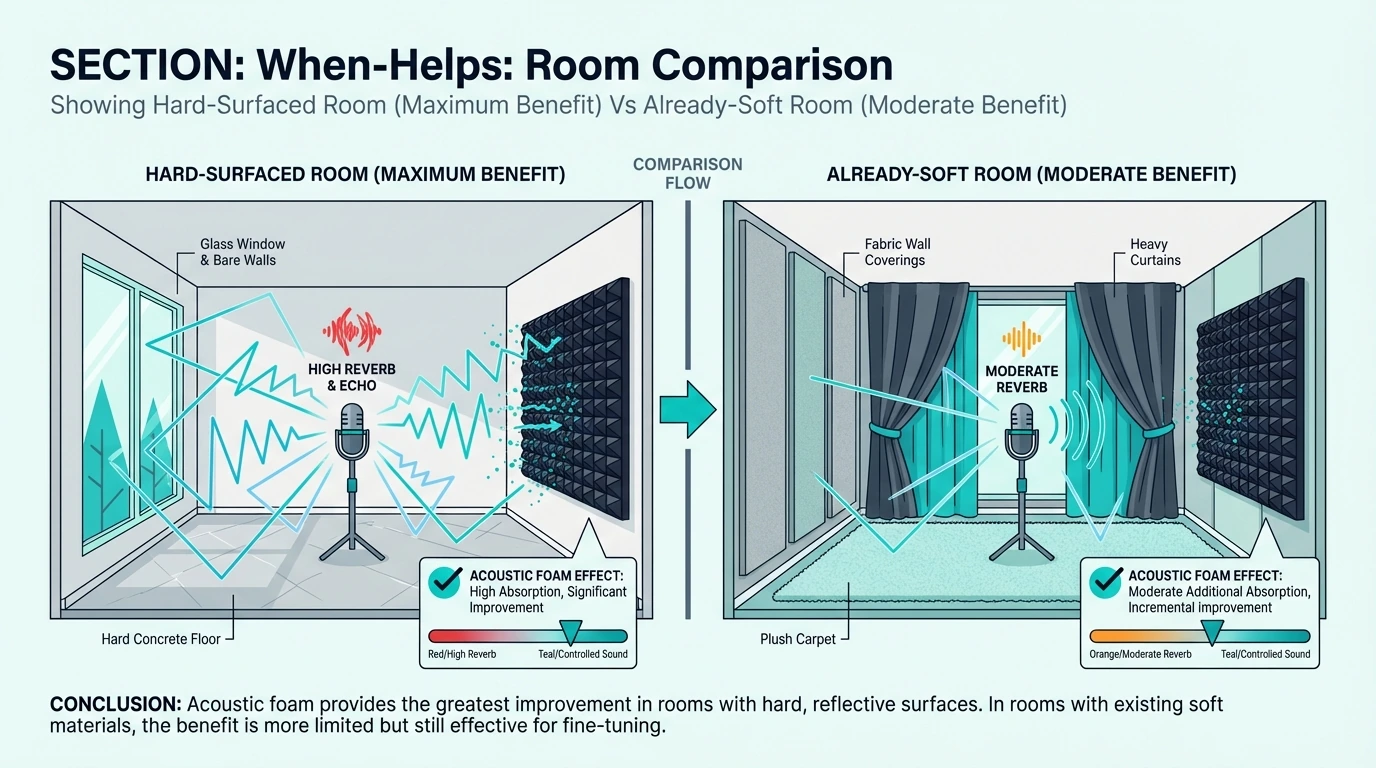
Foam doesn’t help every situation equally. Some rooms see clear improvement; others see modest gains.
Hard-Surfaced Rooms
Rooms with hard walls, hard floors, and minimal soft furnishings benefit most from foam. These spaces have nothing absorbing sound—every surface reflects.
A spare bedroom with hardwood floors and bare drywall is a prime candidate. Add foam and the transformation is clear.
The room goes from echoey nightmare to usable recording space.
If your room sounds like a gymnasium when you clap, foam will help enormously.
Small Rooms
Small rooms accumulate reflections quickly because the walls are close together. Sound bounces back and forth rapidly, creating dense reverb and flutter echo.
Foam in small rooms provides outsized improvement because you’re treating a higher percentage of the reflective surface area. A few panels in a small room cover more of the problem than the same panels in a large room.
Bedroom studios, closet vocal booths, and small home offices all see clear improvement from modest foam treatment.
Untreated Spaces
If your room has zero acoustic treatment currently, foam provides the biggest improvement. Going from nothing to something is the largest jump in recording quality.
Rooms that already have carpet, curtains, upholstered furniture, and bookshelves have built-in absorption. Adding foam helps, but the improvement is incremental rather than transformative.
Do the clap test: if your room rings when you clap, foam will help. If the clap sounds relatively dead already, you may not need much additional treatment.
When Foam Helps Less
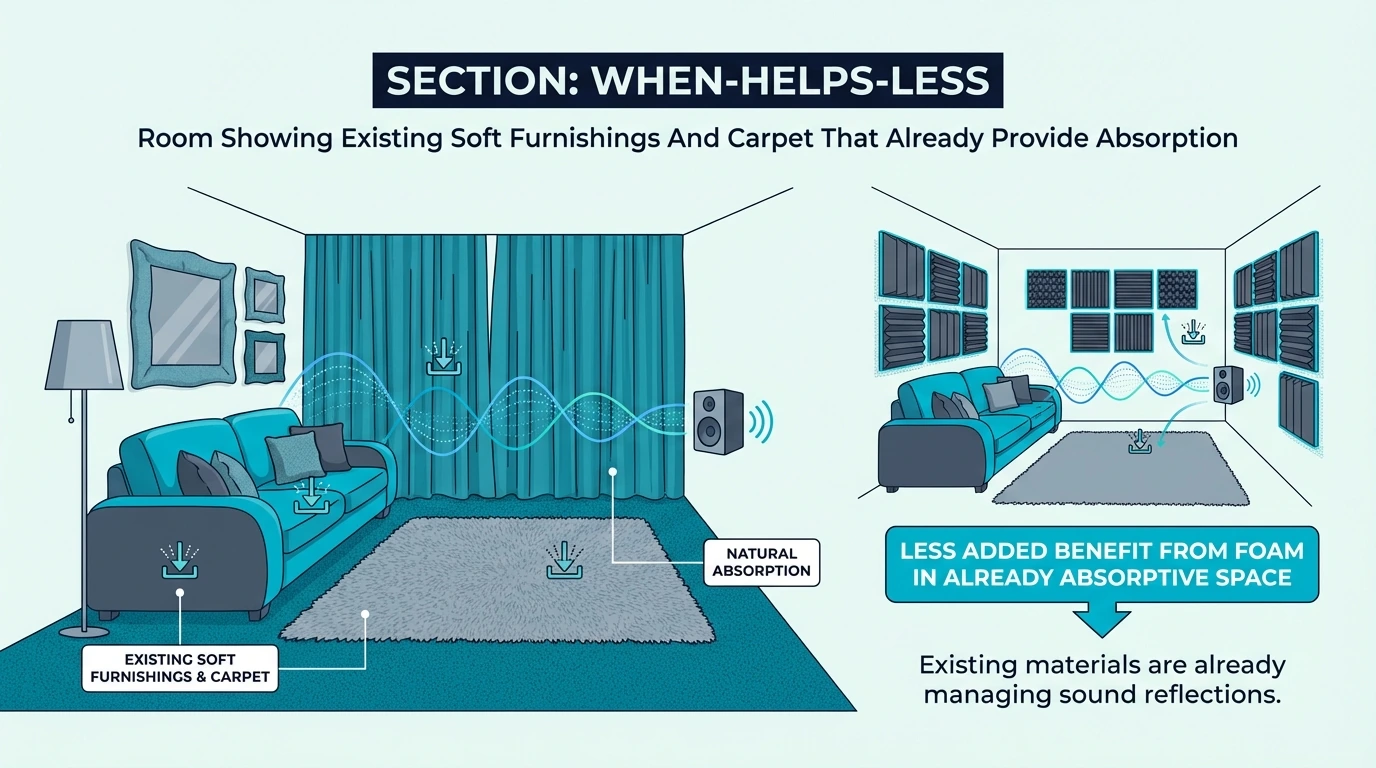
Foam isn’t always the answer. Some situations call for different solutions.
Already-Soft Rooms
Bedrooms with carpet, heavy curtains, upholstered furniture, and closets full of clothes already have plenty of absorption. The soft materials do what foam does—absorb reflections.
Adding foam to these rooms helps, but the improvement may be subtle. You might not notice much difference because the existing materials already handle most reflections.
Test before buying: record in your room as-is. If the recording sounds reasonably clean, you may not need foam.
Or you may need only minimal treatment at first reflection points. The guide on whether acoustic foam works can help you assess your situation.
Bass Problems
If your recordings sound boomy or muddy in the low frequencies, standard foam won’t help. Thin foam panels don’t absorb bass—the wavelengths are too long.
Bass problems require bass traps: thick, dense absorbers placed in corners where low frequencies accumulate. These are different products from standard wall panels.
Don’t keep adding foam hoping to fix bass issues. It won’t work.
Identify whether your problem is mid/high frequency reflections (foam helps) or low frequency buildup (bass traps help).
For more on this distinction, see bass traps vs acoustic foam.
Noise From Outside
Foam absorbs sound inside your room. It doesn’t block sound from entering or leaving.
If your problem is traffic noise, neighbor noise, or HVAC rumble, foam won’t help.
Blocking external noise requires soundproofing: adding mass to walls, sealing gaps, and sometimes construction work. This is completely different from acoustic treatment.
Many people buy foam hoping to block outside noise, then feel disappointed when it doesn’t work. Understand the distinction: foam treats acoustics inside; soundproofing blocks transmission between spaces.
For more on this common confusion, see whether acoustic foam works.
How Much Improvement to Expect
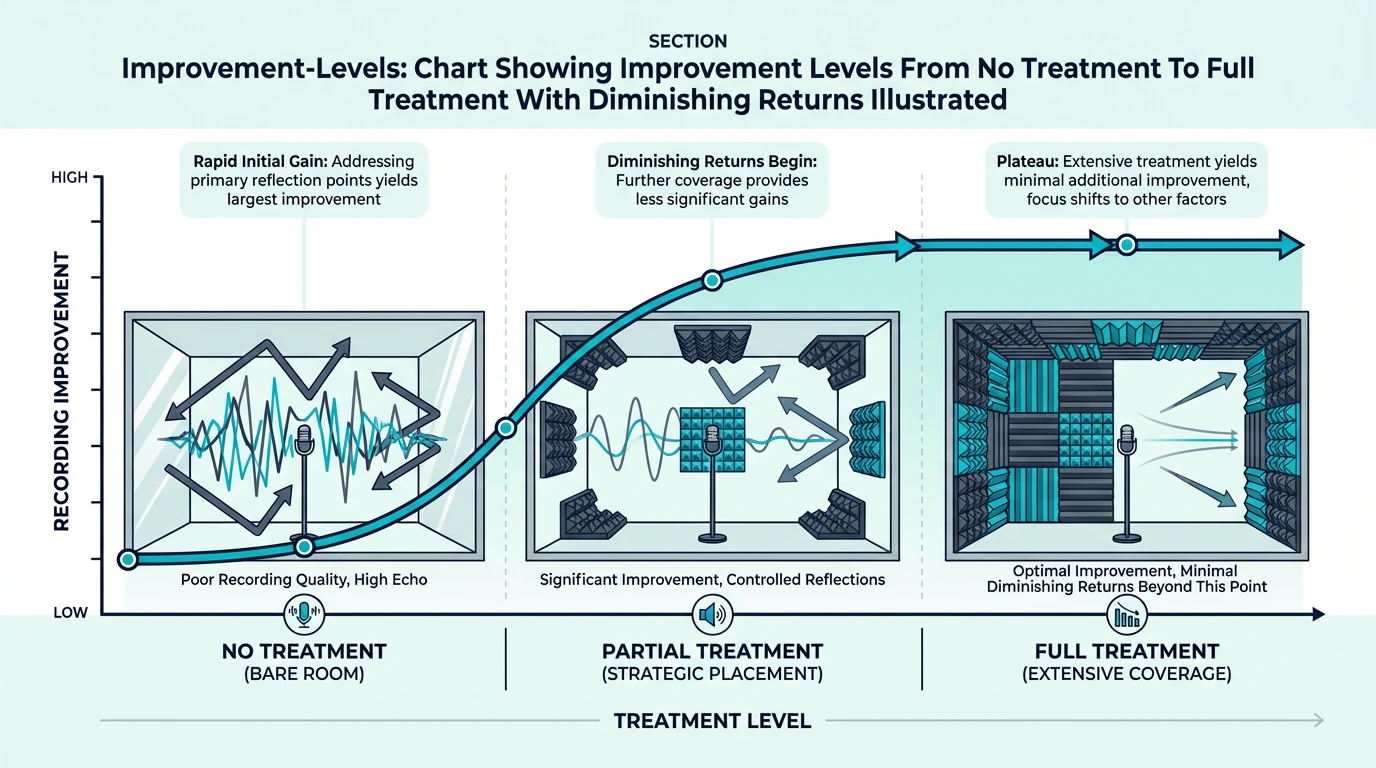
Setting realistic expectations prevents disappointment. Here’s what different levels of treatment typically achieve.
Minimal Treatment (4-6 Panels)
Treating just first reflection points—two panels on each side wall at ear height—provides surprising improvement. This minimal setup (roughly 4-6 square feet of coverage) addresses the most problematic reflections.
Expect: noticeably cleaner recordings with 20-30% reduction in audible room sound, reduced flutter echo, improved clarity. The room still has some reverb, but the worst problems are solved.
This level works well for: podcasting, video calls, casual music recording, voice-overs for personal projects.
Moderate Treatment (12-20 Panels)
Adding treatment behind your microphone, on the ceiling above you, and expanding side wall coverage creates a more controlled recording environment. This typically covers 15-25 square feet—about 20-30% of a small room’s wall area.
Expect: noticeably cleaner recordings approaching semi-professional quality. Reverb time drops by 40-50%.
Clarity is good. Post-processing requirements are minimal.
This level works well for: serious home recording, YouTube content creation, podcast production, demo recordings.
Full Treatment (30+ Panels)
Full room treatment with panels on all walls, ceiling clouds, and corner bass traps creates a professional-grade recording environment. Coverage reaches 40-60% of available wall and ceiling space.
Expect: very clean, dry recordings with minimal room sound. RT60 (reverb time) under 0.3 seconds.
Professional quality achievable with good technique and equipment.
This level works well for: professional voice-over, commercial music production, broadcast-quality content.
Diminishing Returns
Each additional panel provides less improvement than the previous one. The jump from 0 to 6 panels is huge.
The jump from 20 to 30 panels is modest. The jump from 50 to 60 panels is barely noticeable.
Don’t over-treat. Find the level that solves your problems and stop there.
More foam beyond that point wastes money and can make your room sound unnaturally dead. For guidance on the right coverage level, see whether you can put too much acoustic foam.
Best Foam Placement for Recording
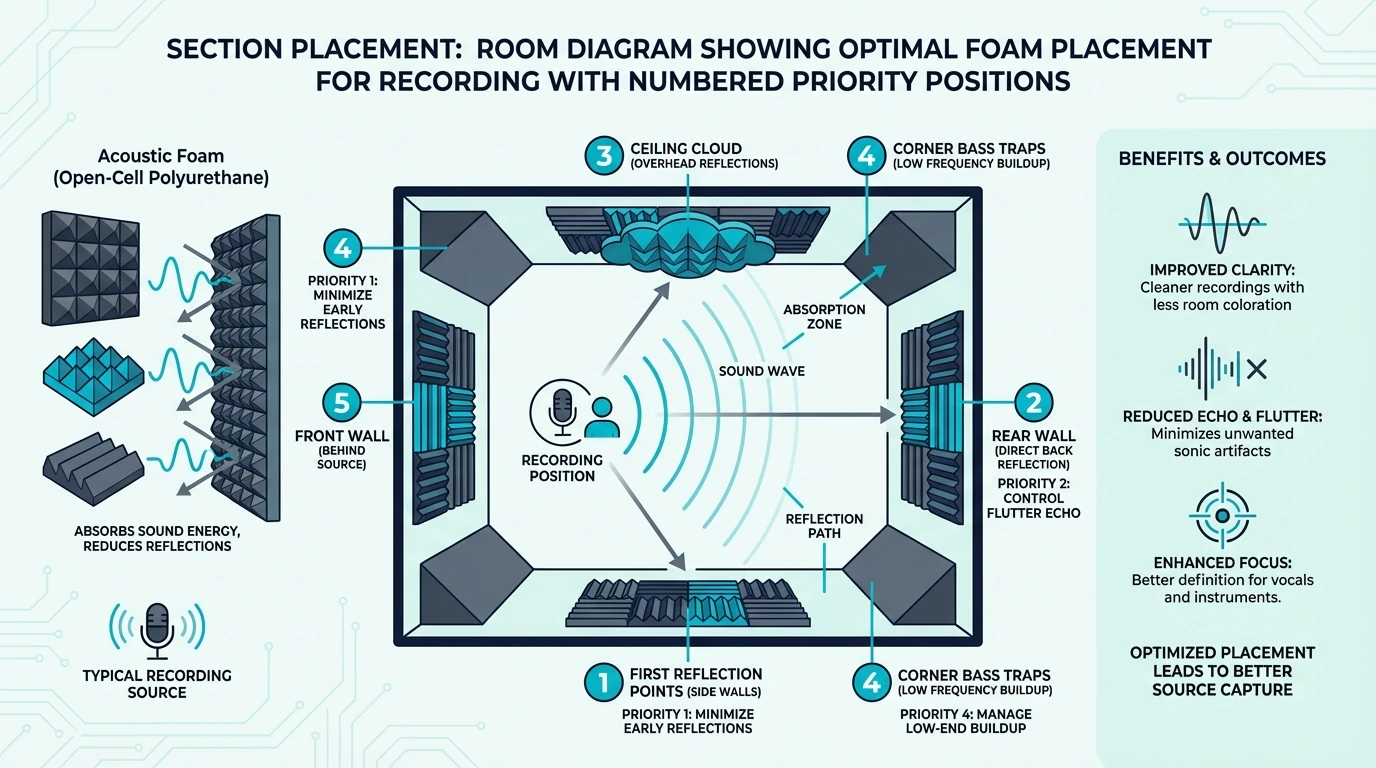
Where you put foam matters more than how much you buy. Strategic placement maximizes improvement.
Priority 1: Behind the Microphone
The wall your microphone faces (behind you when recording) is the highest priority. Sound from your voice travels past the mic, hits this wall, and reflects back into the mic.
Treat this wall with 50-70% coverage at head height. This single treatment often provides more improvement than panels anywhere else.
Priority 2: First Reflection Points
Side walls at ear/mic height create first reflections that arrive at your microphone milliseconds after direct sound. These cause comb filtering and reduce clarity.
Use the mirror trick to find exact positions, then place 1-2 panels at each first reflection point. This targeted treatment is highly effective.
For thicker coverage at these spots, the TroyStudio 2-inch Self-Adhesive Panels handle the voice range better than 1-inch alternatives. For arrangement strategies, see how to arrange acoustic foam.
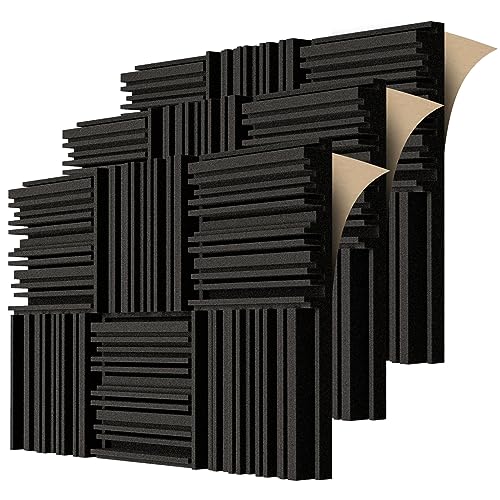
TroyStudio 2-inch Self-Adhesive Panels
Priority 3: Ceiling Above Recording Position
If your ceiling is hard (drywall, plaster), it reflects sound down to your microphone. A ceiling “cloud” of 2-4 panels above your recording position addresses this.
Ceiling treatment is often overlooked but provides real improvement, especially in rooms with low, hard ceilings.
Priority 4: Corners (If Bass Is Problematic)
If your recordings sound boomy, add bass traps to corners—especially the corners behind your recording position. Standard foam won’t help here; you need thick corner absorbers.
A set like the Dekiru 8 Pack Acoustic Bass Traps can handle the corners at a low cost. For detailed placement guidance, see how to arrange acoustic foam.

Dekiru 8 Pack Acoustic Bass Traps
Foam vs Other Recording Improvements
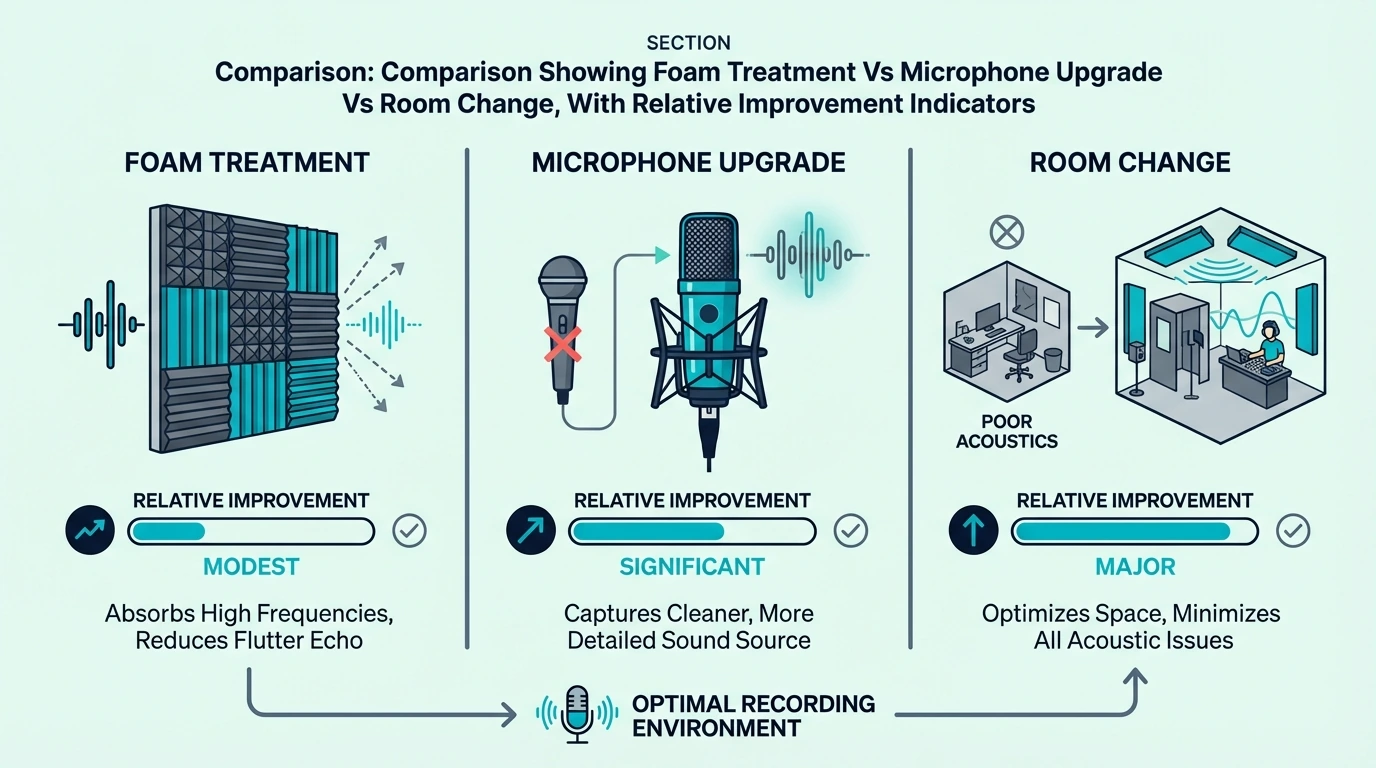
Foam is one of several ways to improve recording quality. How does it compare?
Foam vs Better Microphone
A common question: should I buy foam or upgrade my microphone? The answer depends on your current situation.
If your room is untreated and echoey, foam provides more improvement than a microphone upgrade. Even an expensive mic sounds bad in a bad room—it just captures the room problems more accurately.
If your room is already reasonably controlled, a better microphone might be the next step. But for most home recordists, room treatment should come before microphone upgrades.
Foam vs Recording Technique
Microphone technique—distance, angle, position—affects recording quality more than most people expect. Good technique in an untreated room beats bad technique in a treated room.
But technique and treatment work together. Foam gives you more flexibility with technique because the room is more forgiving.
You can move around without noticeable changes in sound quality.
Learn good technique AND treat your room. They’re complementary, not competing improvements.
Foam vs Post-Processing
Modern software can reduce reverb and room sound in post-production. Why not just fix it later instead of treating the room?
Post-processing has limits. Heavy de-reverb processing creates artifacts and degrades audio quality.
It’s better to capture clean audio than to fix dirty audio later.
Foam reduces the need for post-processing, saving time and preserving audio quality. The cleaner your capture, the better your final product.
The Bottom Line
Acoustic foam improves recording quality by absorbing reflections that contaminate your microphone captures. The improvement ranges from dramatic (in hard, untreated rooms) to modest (in already-soft spaces), but some improvement is almost guaranteed.
Start with minimal treatment at high-impact positions: behind your microphone and at first reflection points. This strategic approach provides maximum improvement with minimum investment.
Add more treatment only if problems persist after testing.
Foam won’t fix everything. Bass problems need bass traps. External noise needs soundproofing.
But for the mid and high frequency reflections that cause most recording problems, acoustic foam is effective and affordable.
The difference between amateur and professional-sounding recordings often comes down to room acoustics. Foam is the most accessible way to improve yours.
For recording-specific product picks, see best acoustic foam for recording.
For more guides on foam types, placement, and mounting, start at the acoustic foam hub.
Frequently Asked Questions
How much does acoustic foam improve recording quality?
The improvement depends on your starting point. Untreated rooms with hard surfaces see the biggest gains—recordings go from obviously amateur to reasonably professional.
Rooms with existing soft furnishings see more modest improvement. In most cases, properly placed foam makes recordings noticeably cleaner and more professional-sounding.
Where should I put acoustic foam for recording?
Prioritize the wall behind your microphone (the wall you face while recording), then first reflection points on side walls at ear height. A ceiling panel above your recording position helps too.
Start with these locations before adding general wall coverage.
Will cheap acoustic foam work for recording?
Budget foam provides real improvement over no treatment. The absorption may be less consistent than premium options, and durability is typically lower, but cheap foam still absorbs reflections.
For beginners testing whether treatment helps, budget foam is a reasonable starting point.
How many acoustic foam panels do I need for recording?
Most home recording setups need 8-16 panels for effective treatment. Start with 4-6 panels at priority positions (behind mic, first reflections) and add more based on results.
Strategic placement of fewer panels outperforms random placement of many panels.
Does acoustic foam help with vocal recording specifically?
Yes—vocals benefit heavily from foam treatment. Human voice frequencies fall squarely in the range that standard foam absorbs effectively.
Foam reduces the “roomy” quality that makes vocal recordings sound amateur, increases presence and clarity, and produces tighter results.
Can acoustic foam make recordings sound too dead?
Yes, over-treatment is possible. Too much foam creates an unnaturally dead sound that feels uncomfortable and makes recordings sound lifeless.
Aim for 20-30% wall coverage at strategic positions rather than covering everything. If your room sounds muffled after treatment, remove some panels.