Soundbar vs No Soundbar: Is the Upgrade Actually Worth It? [2026]

The soundbar vs no soundbar question answers itself the first time you turn on subtitles just to follow a conversation — but most people assume they just need a better TV, not realizing the audio problem only gets worse with every upgrade.
If you’re adjusting volume every few minutes — up for dialogue, down for explosions, up again when someone whispers — your TV speakers are the problem, not the content.
The frustrating reality is that modern TVs are physically too thin for decent audio. Manufacturers spend their entire budget on display technology while speakers get whatever space remains in a half-inch-deep enclosure.
Even a $2,000 TV fires its tiny speakers downward or backward into a wall. A $120 soundbar with front-facing drivers and a wireless subwoofer immediately fixes everything wrong with that equation.
Once you understand why TV speakers fail and what a soundbar actually changes, the decision becomes obvious.
Below, we break down what improves when you add a soundbar, the differences you’ll hear, and whether it’s worth it for your setup.
A soundbar is the single biggest audio upgrade you can make for your TV.
Even a modest budget model produces clearer dialogue, more usable volume, and deeper bass than the built-in speakers on an expensive flat-screen.
If you rely on subtitles because speech gets buried under music or effects, a soundbar fixes the core problem immediately.Why TV Speakers Sound Bad (And Keep Getting Worse)
The Physics Problem: Thinner TVs Mean Worse Audio
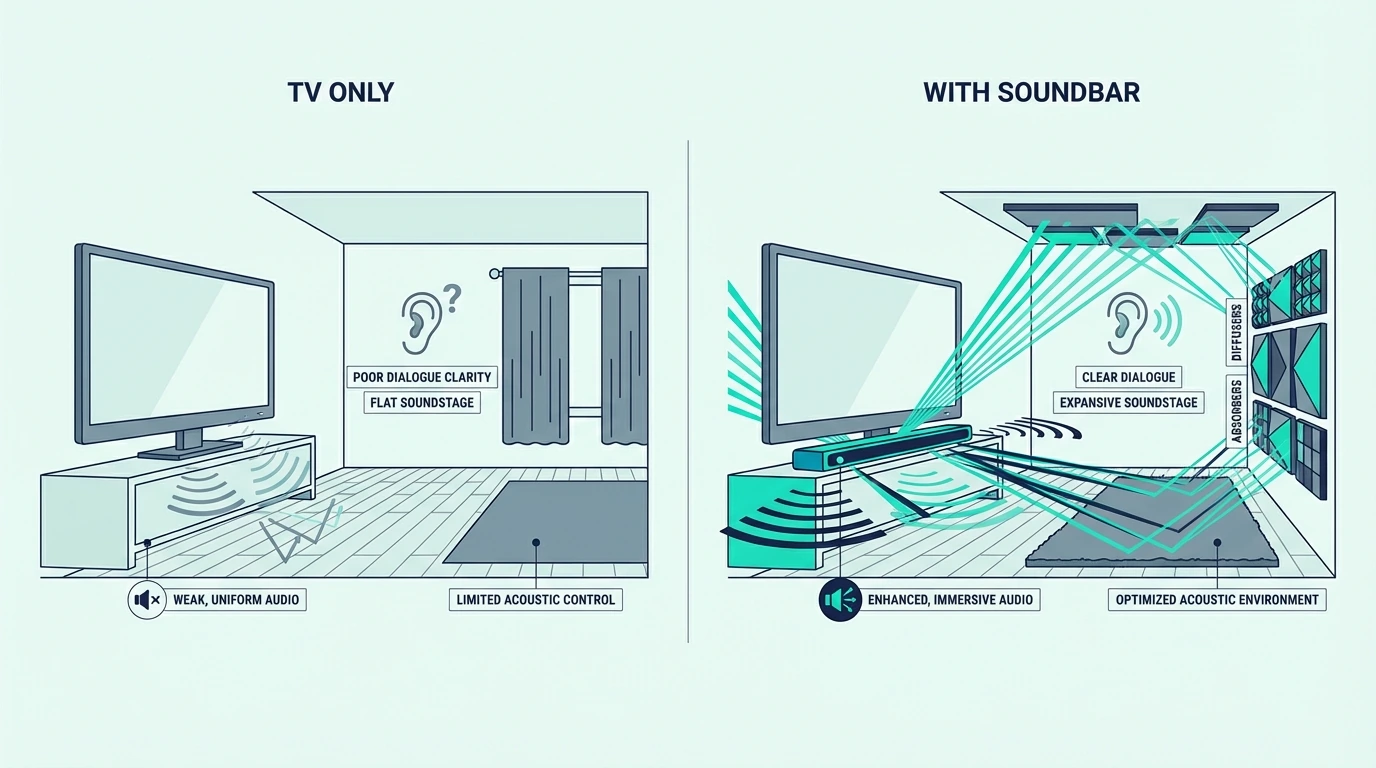
Modern TVs are 0.5–1.5 inches deep at their thinnest point. A TV speaker enclosure has roughly 2–5 cubic inches of air space.
Even a compact soundbar has 50–150 cubic inches of internal volume. That’s not a marginal difference — it’s an order of magnitude more room for drivers to move air and produce actual bass.
TV speakers fire downward or backward rather than toward you. Sound bounces off the TV stand or wall before reaching your ears, adding delay and frequency smearing that makes dialogue muddy.
What You’re Actually Missing Without a Soundbar
Without a soundbar, you’re missing three specific things that TV speakers can’t physically deliver regardless of brand or price point.
First, bass below roughly 150Hz is completely absent.
TV speakers are simply too small to move enough air. Explosions land with a click, music sounds thin, and deep male voices lose their weight.
Second, dialogue separation suffers.
TV speakers push everything through the same tiny drivers, so speech and effects compete for the same narrow frequency range.
A soundbar with a center channel or dialogue enhancement mode isolates and boosts vocal frequencies so you hear every word clearly over background noise.
Third, volume headroom runs out fast. TV speakers distort at moderate volumes because the drivers hit their physical limits.
Turning up the volume makes dialogue harsher, not clearer. That is why so many people think streaming apps are mixed badly when the real issue is their TV running out of clean output.
A decent soundbar gives the soundtrack room to breathe, so voices stay intelligible even when the scene gets busy.
Our is a soundbar worth it guide covers the full value proposition and helps you decide if the upgrade makes sense for your specific situation.
What Changes When You Add a Soundbar
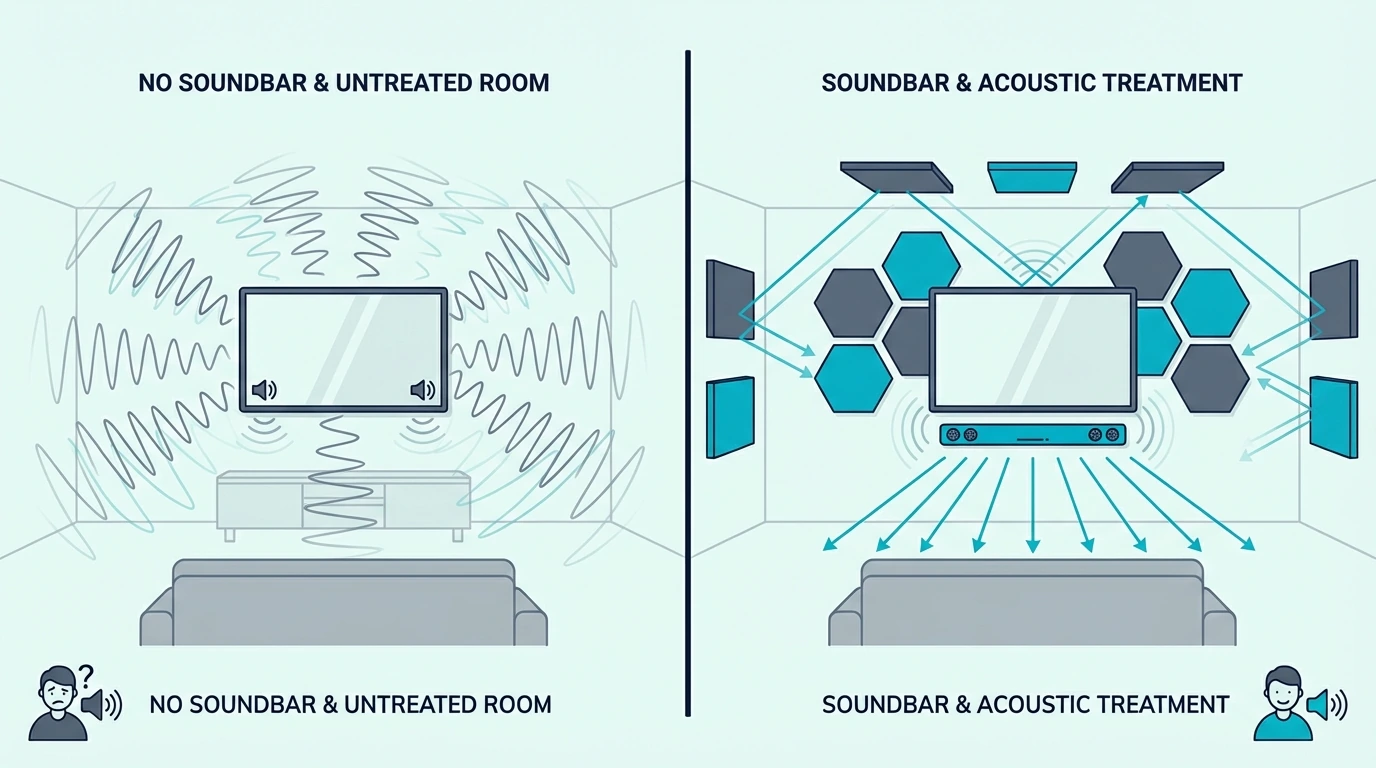
The difference isn’t subtle. People consistently describe it as hearing their TV properly for the first time — like removing a blanket that was draped over their speakers.
What surprises most people is not just that movies sound bigger, but that normal everyday viewing becomes less tiring because you stop straining to decode speech scene after scene.
Dialogue Clarity: The Most Noticeable Improvement
The biggest improvement is dialogue clarity. TV speakers compress all audio into the same narrow frequency band, making everything compete for the same tiny drivers.
A soundbar separates frequencies across multiple dedicated drivers and applies DSP to keep dialogue intelligible even during loud action sequences. The volume roller coaster stops — you set a comfortable level and leave it there.
That matters even more for late-night viewing when you want speech clarity without waking everyone else up.
For this kind of small-room, dialogue-first setup, a current example is Polk Audio Signa S2 Sound Bar for Smart TV with Subwoofer, which is a strong fit for TV and movies when you want fuller bass.
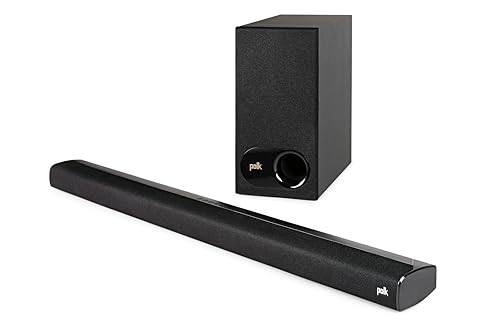
Polk Audio Signa S2 Sound Bar for Smart TV with Subwoofer
This single feature eliminates the most common complaint about TV audio. You stop constantly adjusting volume between quiet dialogue scenes and loud action sequences.
Bass Response: Sound You Can Feel
TV speakers produce essentially zero bass below 150Hz.
A soundbar with a subwoofer extends down to 40 to 60Hz. Those are frequencies you feel in your chest during explosions, in a car engine’s rumble, and in low movie-soundtrack notes.
This is an entire range of sound your TV speakers literally cannot produce regardless of any settings you adjust or sound modes you enable.
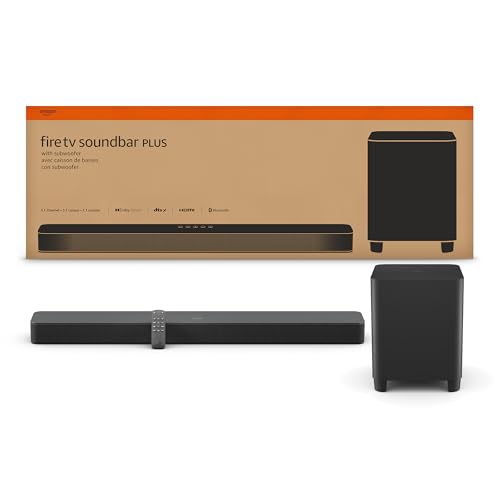
For large-room movie use, a current example is Amazon Fire TV Soundbar Plus (newest model) with built-in subwoofer, which is a strong fit for Atmos movies and TV with stronger bass.
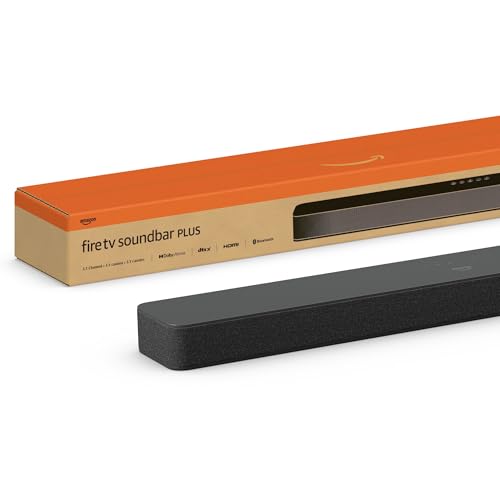
Amazon Fire TV Soundbar Plus (newest model) with built-in subwoofer
That is the difference between hearing an action scene and feeling the pressure, rumble, and scale that make movies sound exciting instead of flat.
Our soundbar setup guide covers the complete installation process, and our soundbar to TV connection guide explains how to connect via HDMI ARC for one-cable setup with TV remote volume control.
Surround Sound and Spatial Audio
Higher-end soundbars add Dolby Atmos and simulated surround that creates convincing spatial audio from around and above you.
TV speakers can’t attempt any of that regardless of virtual surround settings. Even without discrete rear speakers, an Atmos soundbar bounces sound off your ceiling and walls for realistic height and width effects.
This spatial dimension turns movie watching from a flat, front-facing experience into something that fills the room.
Overhead rain, passing aircraft, and crowd ambience gain directionality that TV speakers physically cannot create.
Even if you never care about perfect Atmos demos, that added width makes everyday Netflix viewing feel less cramped and less tiring because the sound is no longer trapped inside the screen.
Our soundbar vs surround sound guide covers how simulated surround compares to discrete speaker systems, and our soundbar vs home theater comparison explains when upgrading beyond a soundbar makes sense.
Small Rooms and Apartments
A soundbar improves audio just as dramatically in small rooms and apartments. Dialogue clarity and bass improvements are completely room-size independent — the physics advantage over TV speakers exists regardless of square footage.
In fact, smaller rooms often benefit more because listeners sit closer to the TV and notice harsh, thin built-in speakers faster than they would in a larger family room.
Even a compact 2.0 or 2.1 soundbar fills a small space with clear, full-range audio without overwhelming it.
Our 2.1 vs 5.1 soundbar guide helps you choose the right channel configuration for your room size.
For connecting your soundbar regardless of your TV’s available ports, our HDMI vs optical guide explains both connection methods and when each is appropriate, and our Bluetooth vs optical guide covers wireless alternatives.
Get Studio Tips Weekly
Join 5,000+ creators getting acoustic treatment advice every week.
No spam. Unsubscribe anytime.The Bottom Line
A soundbar is the single most impactful audio upgrade for any TV. It fixes muffled dialogue, adds real bass, and increases clean volume headroom.
Even a $120 soundbar with a wireless sub delivers improvements no TV setting or EQ can replicate. The limitation is physical speaker size, not software.
No amount of processing can make a half-inch driver produce bass.
Our best soundbar guide ranks the top picks at every budget. If dialogue clarity is the main reason you’re shopping, our best soundbar for dialogue guide covers the bars tuned specifically for speech.
Our do you need a soundbar for smart TV guide covers the specific case for smart TVs, and our soundbar vs speakers comparison explains alternatives if you want to explore beyond soundbars.
Frequently Asked Questions
Do you really need a soundbar?
If you use subtitles because you can’t hear dialogue or constantly adjust volume between quiet and loud scenes, yes, you need a soundbar.
It fixes all three of those complaints immediately. You don’t have to listen carefully to notice.
Does a TV sound better with a soundbar?
Dramatically and immediately better.
Dialogue becomes clear without subtitles from the moment you connect it. Bass adds physical weight to music and action scenes.
Audio fills the room instead of sounding thin and flat. People routinely describe it as the single best upgrade they’ve made to their TV setup.
What are the disadvantages of a soundbar?
The main disadvantage is cost. A budget model with a wireless subwoofer runs $100 to $150, plus a nearby power outlet and shelf space or wall mounting.
You also need to choose the right size and feature set. An oversized soundbar looks awkward under a small bedroom TV, and a barebones mini bar may not satisfy a large living room.
But HDMI ARC with CEC means your TV remote controls volume automatically, so in daily use it adds zero complexity.
For this kind of small-room, dialogue-first setup, a current example is Amazon Fire TV Soundbar Plus with subwoofer (newest model), which is a strong fit for Atmos movies and TV with stronger bass.