LG sells its Dolby Atmos systems complete with the subwoofer and rears, while Sony sells its top bars alone so you can add them later.
Products in this guide
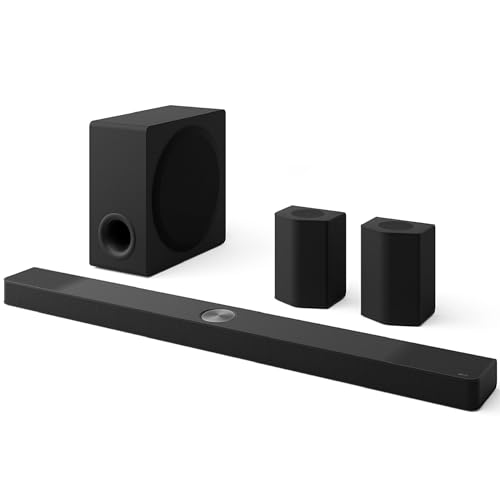
- 9.1.5 channels, counting the wireless rear speakers in the box
- HDMI input with 4K at 120 Hz pass-through
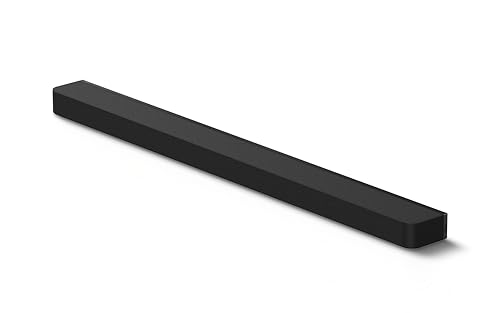
- HDMI input defaults to 4K120 and 8K
- Takes optional rear speakers and up to two subwoofers
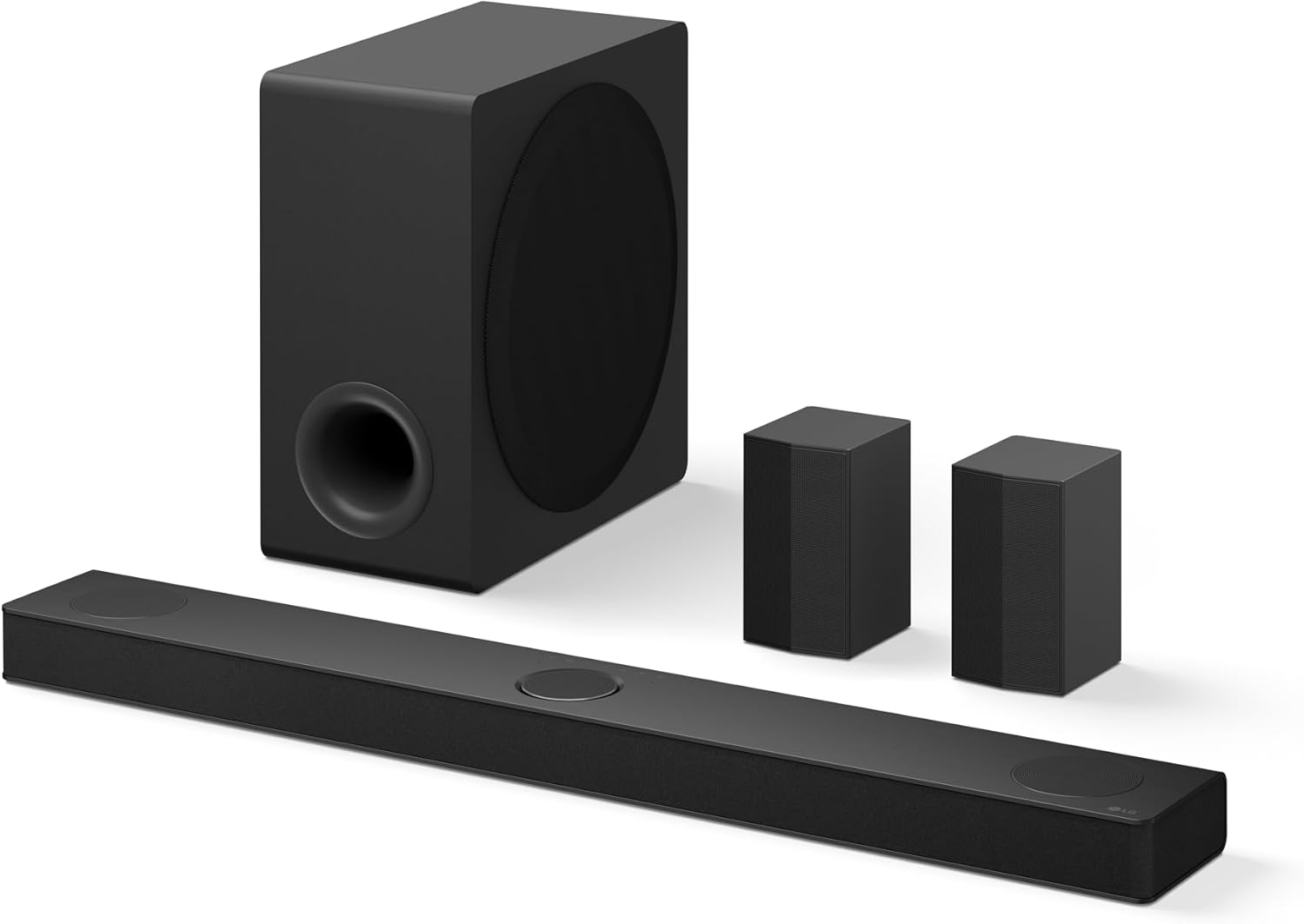
- Subwoofer and rear speakers included for 5.1.3 channels
- HDMI input and a microphone for AI Room Calibration
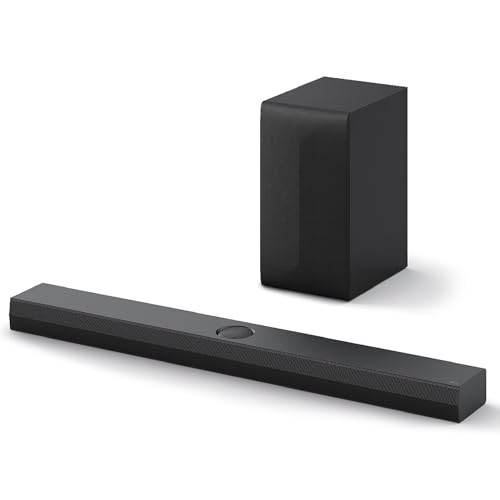
- HDMI input with 4K at 120 Hz pass-through
- SPT8-S rear speakers can take it to 5.1.1 later
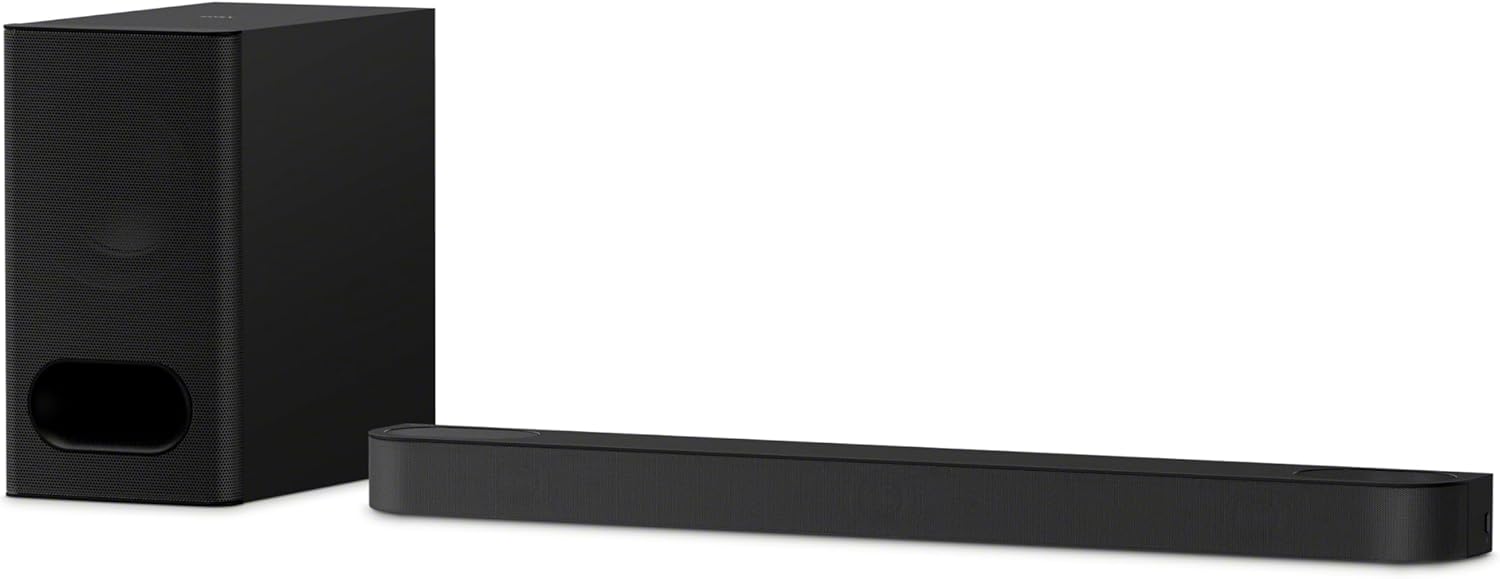
- Front, center and top speakers for Dolby Atmos and DTS:X
- Voice Zoom with a compatible Sony TV
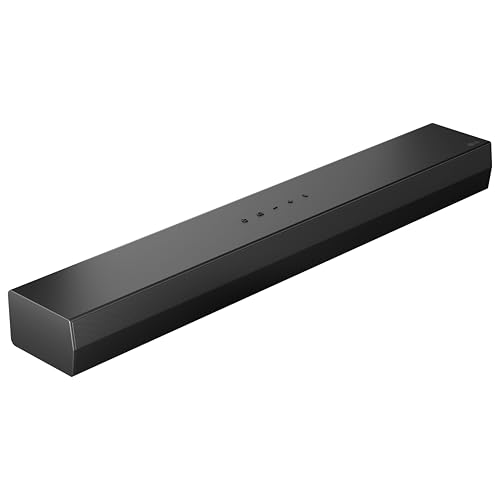
- A 650 mm bar with two 50 W RMS channels
- One HDMI ARC cable to the TV
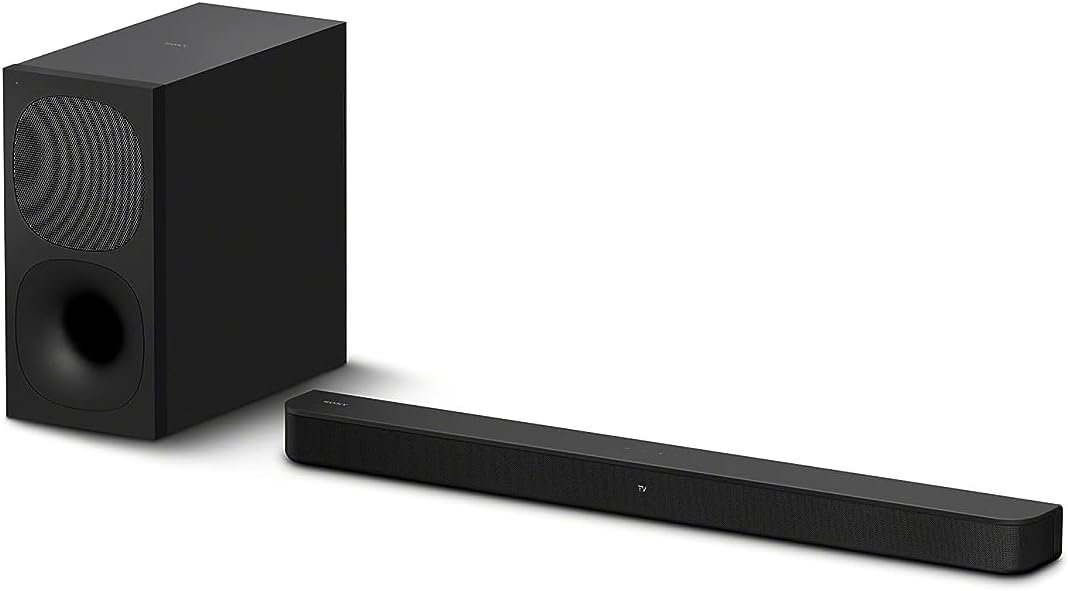
- 330 W in total with a wireless subwoofer
- Wireless connection to compatible BRAVIA TVs
Weighing an LG soundbar vs Sony soundbar on reputation misses the real split: what comes in the box, what plugs into the bar and what each does with its own brand of TV.
Buy on the badge and the gap shows up later, when the rear speakers you expected are a separate purchase or a game console has nowhere to plug in.

Match the system to your screen, your room and how far you plan to grow, and either maker can give you Dolby Atmos and DTS:X from one bar under the TV.
The short answer and a side-by-side table come first, then the head-to-head pairs, from LG’s S95TR against Sony’s BRAVIA Theater Bar 9 down to the small bars for a bedroom.
By the end, you’ll know which maker’s system fits your TV and what each choice commits you to buying later.
Which Is Better, an LG Soundbar or a Sony Soundbar?
That split in the box is where the answer starts. Neither brand is better across the board: LG sells more of its Dolby Atmos systems complete, with the subwoofer and rear speakers included, while Sony sells its top bars on their own and lets you add a subwoofer, a second subwoofer and rear speakers later.
LG’s S95TR is the clearest case, a 9.1.5-channel system that its owner’s manual lists with a wireless subwoofer and wireless rear speakers. Sony’s help guide for the BRAVIA Theater Bar 9 and Bar 8 describes the subwoofer and rear speakers as optional, with room for two subwoofers in a dual-subwoofer connection.
The TV tie-ins split the same way. LG’s manuals describe WOW Orchestra, which plays sound through an LG TV’s speakers and the bar together, while Sony’s guide describes Acoustic Center Sync, which sends the center part of the bar’s sound to a BRAVIA TV’s speakers over an S-CENTER cable.
So the choice comes down to three questions: how much of the system you want in one box, which brand of TV the bar will sit under, and what has to plug into the bar. Each gets its own section below, after the side-by-side table.
If Samsung is also on your shortlist, our comparison of how LG’s bars stack up against Samsung’s sets LG against that maker’s range.
How Does an LG Soundbar vs Sony Soundbar Compare Side by Side?
Those three questions map onto a handful of hardware differences, and they line up cleanly by brand. An LG soundbar vs Sony soundbar comparison comes down to what’s in the box, the HDMI input, room calibration, the TV tie-in and the add-ons, as the table shows for each maker’s current Dolby Atmos bars.
| Feature | LG S95TR, S90TR, S80TR and S70TY | Sony BRAVIA Theater Bar 9, Bar 8, Bar 7 and Bar 6 |
|---|---|---|
| In the box | Subwoofer and rear speakers with the S95TR, S90TR and S80TR; a subwoofer with the S70TY | The bar alone with the Bar 9, Bar 8 and Bar 7; a bar and subwoofer with the Bar 6 |
| Height speakers for Dolby Atmos | 9.1.5, 7.1.3 and 5.1.3 channels with the included rears; 3.1.1 on the S70TY | Top speakers in all four bars, per Sony’s specifications |
| HDMI input | One on all four, with 4K at 120 Hz in YCbCr 4:2:0 | One on the Bar 9, Bar 8 and Bar 7, set to 4K120 and 8K by default; none on the Bar 6 |
| Room calibration | AI Room Calibration with a microphone in the S95TR, S90TR and S80TR | Sound Field Optimization in the BRAVIA Connect app on the Bar 9, Bar 8 and Bar 7 |
| Own-brand TV feature | WOW Orchestra, playing the LG TV’s speakers with the bar | Acoustic Center Sync on the Bar 9 and Bar 8, plus Voice Zoom |
| Add-ons | LG rear kits for bars sold without rears, such as the SPT8-S for the S70TY | Optional rear speakers and up to two subwoofers for the Bar 9, Bar 8 and Bar 7 |
| Bar width | 1,250 mm (S95TR, S90TR), 1,000 mm (S80TR), 950 mm (S70TY) | 1,300 mm (Bar 9), 1,100 mm (Bar 8), 950 mm (Bar 7 and Bar 6) |
The table leaves out the smaller bars, and they share one limit. LG’s spec pages list Dolby Digital, DTS and PCM as the input formats for the S60TR, S40T and S20A, and Sony’s spec sheet gives Dolby Digital for the HT-S400, so none of the four decodes Dolby Atmos.
If channel numbers like 5.1.3 are new to you, our soundbar fundamentals guide shows how to read a bar’s specs. The first number counts the main speakers, the second the subwoofer and the third the height speakers aimed at the ceiling.
Which Is Better, the LG S95TR or the Sony BRAVIA Theater Bar 9?
The flagships show the in-the-box question at its sharpest. The LG S95TR is the more complete system out of the box, with a wireless subwoofer and wireless rear speakers for 9.1.5 channels, while the Sony Bar 9 is a bar you build on, adding a subwoofer, a second subwoofer or rear speakers when you’re ready.
LG’s S95TR owner’s manual says the bar plays Dolby Atmos and DTS:X in 5.1.3 channels on its own and in 9.1.5 once the rear speakers are connected. LG’s specifications put the system at 810 W RMS, with a rear, a rear-side and a rear-top speaker in each wireless rear unit.
Sony’s Bar 9 measures 1,300 mm (51 1/4 inches) across, against 1,250 mm (about 49.2 inches) for the S95TR. Its help guide covers an optional subwoofer, two of them in a dual-subwoofer connection, and optional rear speakers whose built-in rechargeable battery the app can check.
Both bars take an HDMI source as well as the TV’s eARC connection. LG’s spec page gives one HDMI input with 4K at 120 Hz in YCbCr 4:2:0, and Sony’s Bar 9 and Bar 8 help guide lists an HDMI IN jack whose default Enhanced format setting covers 4K120 and 8K, with VRR and ALLM tied to it.
The formats overlap more than they differ. LG’s manual lists Dolby TrueHD, Dolby Atmos, DTS-HD Master Audio and DTS:X over eARC, and Sony’s guide adds IMAX Enhanced and 360 Reality Audio to Dolby Atmos and DTS:X.
So the S95TR suits a buyer who wants the whole system in one purchase, and the Bar 9 suits one who’d rather start with the bar and add speakers. Our best LG soundbar guide walks through LG’s full lineup, and our best Sony soundbar guide covers the Bar 9’s siblings.
How Does the LG S80TR Compare With the Sony Bar 8 and Bar 7?
Step down a size and the same pattern holds on narrower bars. The LG S80TR is a 5.1.3-channel system with its subwoofer and rear speakers included on a 1,000 mm (about 39.4-inch) bar, while Sony’s Bar 8 at 1,100 mm (43 3/8 inches) and the newer Bar 7 at 950 mm (37 1/2 inches) are bars you build on.
LG’s S80TR manual gives 3.1.3 channels from the bar and 5.1.3 once the wireless rear speakers are connected, at 580 W RMS in total. Its front panel carries the built-in microphone that AI Room Calibration uses in the LG ThinQ app.
LG’s S90TR sits between the S80TR and the S95TR. It’s a 1,250 mm bar with 5.1.3 channels on its own and 7.1.3 with its rear speakers, so it keeps the flagship’s width with two fewer surround channels and two fewer height channels.
Sony’s Bar 8 shares the Bar 9’s help guide, so it gets the same HDMI input, Sound Field Optimization, Acoustic Center Sync and optional speakers in a bar 200 mm narrower. The 2026 Bar 7 (HT-A7100) has a guide of its own, with an HDMI input, LDAC Bluetooth, IMAX Enhanced, Sound Field Optimization, the optional SA-RS5 rear speakers and room for two subwoofers.
The Bar 7’s guide doesn’t mention 360 Spatial Sound Mapping or Acoustic Center Sync, both of which the Bar 9 and Bar 8 guide covers. If your TV is a BRAVIA with an S-CENTER SPEAKER IN jack, that makes the Bar 8 the narrower Sony bar that still uses it.
Size is the practical test here. A 55-inch TV is about 48 inches wide, so the S80TR, Bar 8 and Bar 7 all sit inside its edges, while the S95TR, S90TR and Bar 9 run wider than the screen.
Should You Pick the LG S70TY or the Sony Bar 6 for a Bar and Subwoofer?
Below those systems, both makers sell a bar and wireless subwoofer pair at the same 950 mm width. The LG S70TY adds an HDMI input and an optional rear-speaker kit, while the Sony Bar 6 connects only to the TV, over HDMI eARC or ARC or an optical cable.
LG’s S70TY owner’s manual gives 3.1.1 channels for Dolby Atmos and DTS:X, or 5.1.1 with the separately sold SPT8-S rear speakers, from 400 W RMS in total. It also lists an HDMI input with 4K at 120 Hz in YCbCr 4:2:0, so a console or streaming box can run through the bar.
Sony’s Bar 6 help guide lists the bar’s front, center and top speakers and a wireless subwoofer with a 160 mm cone. Its connections are an optical TV IN and an HDMI OUT for the TV’s eARC or ARC, and the guide has no rear-speaker setup.
That makes the S70TY the more flexible of the two and the Bar 6 the simpler one, which suits a TV whose HDMI ports already take every source. The Bar 6 does add Voice Zoom with a compatible Sony TV, a feature the next sections come back to.
Sony’s 2026 Bar 5 is the narrower version at 900 mm (35 1/2 inches), with the same optical and HDMI eARC/ARC connections and a wireless subwoofer. Our best soundbar with subwoofer guide sets bars in this class against other makers’ pairs.
What About Budget Surround Systems Like the LG S60TR?
Rear speakers don’t need a flagship, and both makers sell smaller systems with them in the box. LG’s S60TR and Sony’s BRAVIA Theater System 6 both include a subwoofer and rear speakers, but Sony’s system handles Dolby Atmos and DTS:X over HDMI eARC, while LG’s spec page lists Dolby Digital, DTS and PCM over HDMI ARC or optical.
LG’s S60TR is an 850 mm (33.4-inch) bar, a wireless subwoofer and SPT8-S rear speakers with their own wireless receiver, at 440 W RMS in total. Sony’s System 6 Help Guide connects its rear speakers by cable to a wireless amplifier, which the subwoofer feeds wirelessly, the layout that puts it first among 5.1 soundbars with real rear speakers.
Neither system has an HDMI input on the bar, so HDMI sources plug into the TV in both cases. That’s the same trade the Bar 6 makes, and it matters most if your TV is short of HDMI ports.
Which Small LG or Sony Bar Suits a Bedroom TV?
All of those systems are more than a 32- or 43-inch screen needs, and both makers sell plain bars for that job. LG’s S20A is the smallest at 650 mm (about 25.6 inches), with two channels and 50 W RMS, while Sony’s HT-S400 adds a wireless subwoofer for 2.1 channels and 330 W in a 35.5-inch bar.
LG’s S40T sits between them, a 720 mm (about 28.3-inch) bar with a wireless subwoofer and 300 W RMS. Its owner’s manual lists an optical input, HDMI ARC and Bluetooth 5.3 with the SBC and AAC codecs.
Sony’s HT-S400 spec sheet describes S-Force PRO Front Surround with Dolby Digital, an HDMI ARC or optical connection, and Bluetooth 5.0. It can also take sound wirelessly from a compatible BRAVIA TV.
LG’s S20A manual, in its UK edition, lists one HDMI ARC connection. If you need an optical input for an older TV, check the box of the unit you’re buying before you count on one.
A 32-inch TV is about 27.9 inches wide, so the S20A fits inside its edges and the S40T runs just past them. The HT-S400 suits a 43-inch screen or larger, which is about 37.5 inches wide.
How Do LG and Sony Tune a Bar to Your Room?
Size settles where a bar fits, and calibration decides how it sounds once it’s there. LG’s bigger bars analyze the sound in your room through a microphone built into the bar, using AI Room Calibration in LG’s app, while Sony’s Bar 9, Bar 8 and Bar 7 run Sound Field Optimization from the BRAVIA Connect app.
LG’s S95TR, S90TR and S80TR manuals place that built-in microphone on the front of the bar. LG says AI Room Calibration analyzes the sound coming from the product and fine-tunes the audio settings, and it warns that the bar may play louder than you expect when calibration starts.
The S70TY’s owner’s manual has no room calibration step. That bar relies on its sound effects and speaker level settings instead, the tools LG’s S40T and S20A manuals describe for those bars too.

Sony’s Bar 9 and Bar 8 help guide lists 360 Spatial Sound Mapping as the bar’s sound field setting for two-channel TV sound. The measuring is a separate step, Sound Field Optimization in Sony’s app, which the guide says to run again when you move the speakers or rearrange the furniture.
The same guide adds a Viewing Position setting that optimizes the sound field for your seat, and it works only after that measurement succeeds. It also asks for a new measurement when you change where you usually sit.
Sony’s 2026 Trio goes a step further and ships a USB-C calibration microphone for Sound Field Optimization. Sony’s Bar 6 guide lists no calibration at all, so that bar leans on the sound field, voice and night buttons on its remote, the same settings Sony’s HT-S400 spec sheet names.
The practical test is simple for either brand. Run the calibration with the room set up the way you watch, sofa in place and doors as you’d normally leave them, since that’s the room the result describes.
What Does Each Brand Add With Its Own TV?
Calibration works under any TV, but the next features need the matching brand. With an LG TV, LG’s bars offer WOW Orchestra, which plays the TV’s speakers and the bar together, and with a BRAVIA, Sony’s Bar 9 and Bar 8 offer Acoustic Center Sync, which turns the TV’s speakers into the center channel.
LG’s S95TR and S70TY manuals say WOW Orchestra turns on automatically when the bar is connected and is chosen in the TV’s sound out menu. LG adds that it works on some LG TV and soundbar models, follows the audio codec the TV supports and needs eARC enabled on the TV.
The connection rules differ by bar. The S95TR’s manual allows an HDMI cable or an LG WOWCAST connection, while the S70TY’s allows only an HDMI cable.
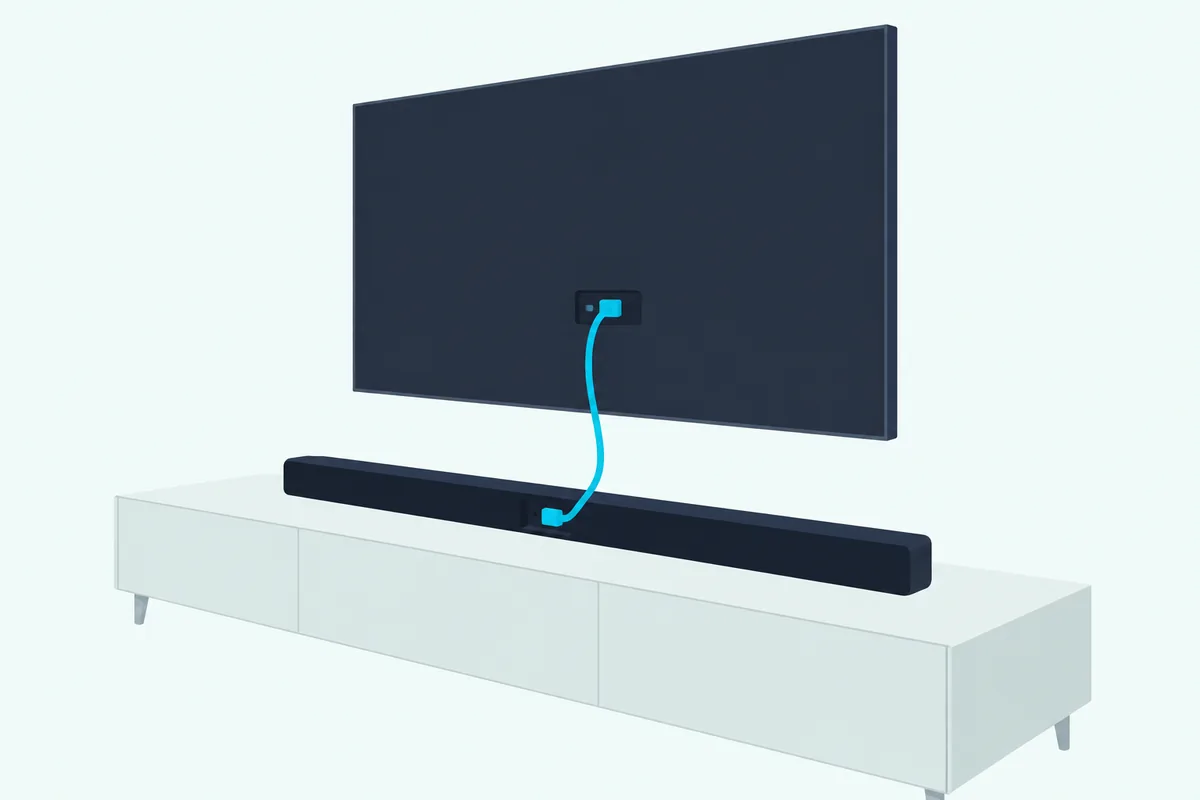
LG’s webOS user guide describes WOWCAST as a way to enjoy rich sound without degraded quality from a soundbar that supports it, with no cable. It recommends a 5 GHz Wi-Fi network and warns that screen sharing or Wi-Fi Direct on 2.4 GHz will disconnect it.
On Sony’s side, a BRAVIA with an S-CENTER SPEAKER IN jack takes the center part of the Bar 9’s or Bar 8’s sound from the bar’s S-CENTER OUT jack, once Acoustic Center Sync is turned on in the app. Sony’s BRAVIA TV help guide describes the same link from the TV’s side, using a TV center speaker mode cable.
Sony’s bar guides also switch the VOICE button to the TV’s Voice Zoom when a compatible Sony TV is connected. The HT-S400 adds a wireless connection to compatible BRAVIA TVs, as the small-bar section mentioned.
If your bar will sit under an LG set, our roundup of bars that make the most of an LG TV goes model by model. For a BRAVIA, our guide to hooking a soundbar up to a BRAVIA walks through the cables.
Can You Plug a Game Console Into an LG or Sony Soundbar?
Those TV links run over HDMI, and so does the next difference, the bar’s own input. You can on LG’s S95TR, S90TR, S80TR, SC9S and S70TY and on Sony’s Bar 9, Bar 8 and Bar 7, which each have an HDMI input, but not on LG’s S60TR, S40T or S20A or Sony’s Bar 6, Bar 5, System 6 or HT-S400, which have no HDMI input.
LG’s spec pages give that input 4K pass-through with HDCP 2.3, and 4K at 120 Hz in YCbCr 4:2:0 on the S95TR, S90TR, S80TR and S70TY. Sony’s Bar 9 and Bar 8 guide sets the HDMI input to Enhanced format (4K120, 8K) by default and links VRR, ALLM and SBTM to that setting, and the Bar 7’s guide adds QMS.
The input matters most on a TV with plain ARC. Sony’s guide explains that eARC carries object-based audio and multichannel LPCM that ARC can’t, so a player plugged into the bar’s own input keeps those formats even when the TV link is ARC.
LG’s SC9S is a special case among the input bars. It’s a 975 mm (38.4-inch) 3.1.3-channel bar that also lists IMAX DTS:X, and its manual has a chapter on installing it with an LG TV.
With a console plugged into the bar, the TV shows the picture through the bar’s HDMI output. Our best Dolby Atmos soundbar guide lists which other makers’ Atmos bars have HDMI inputs too.
Which Brand Is Easier to Expand With Rear Speakers and a Subwoofer?
An HDMI input is fixed when you buy, but speakers can come later, and that’s where Sony’s range is wider. Sony is easier to expand: its Bar 9, Bar 8 and Bar 7 take optional rear speakers and up to two subwoofers, and its add-ons also connect to older Sony bars, Sony receivers and some BRAVIA TVs, while the LG add-ons in its manuals are rear-speaker kits for bars sold without rears.
Sony’s current add-ons include the BRAVIA Theater Sub 7, Sub 8 and Sub 9 and the Rear 8 and Rear 9. Their help guides describe connecting to a sound bar that supports the BRAVIA Connect app, to the HT-A7000, HT-A5000 or HT-A3000, to Sony AV receivers, and to a BRAVIA TV that supports the wireless speaker connection.
The Rear 9’s guide adds that it works only with specific models, so check the list it points to before you buy. The Bar 9 and Bar 8 guide pairs two subwoofers in a dual-subwoofer connection for more powerful bass.
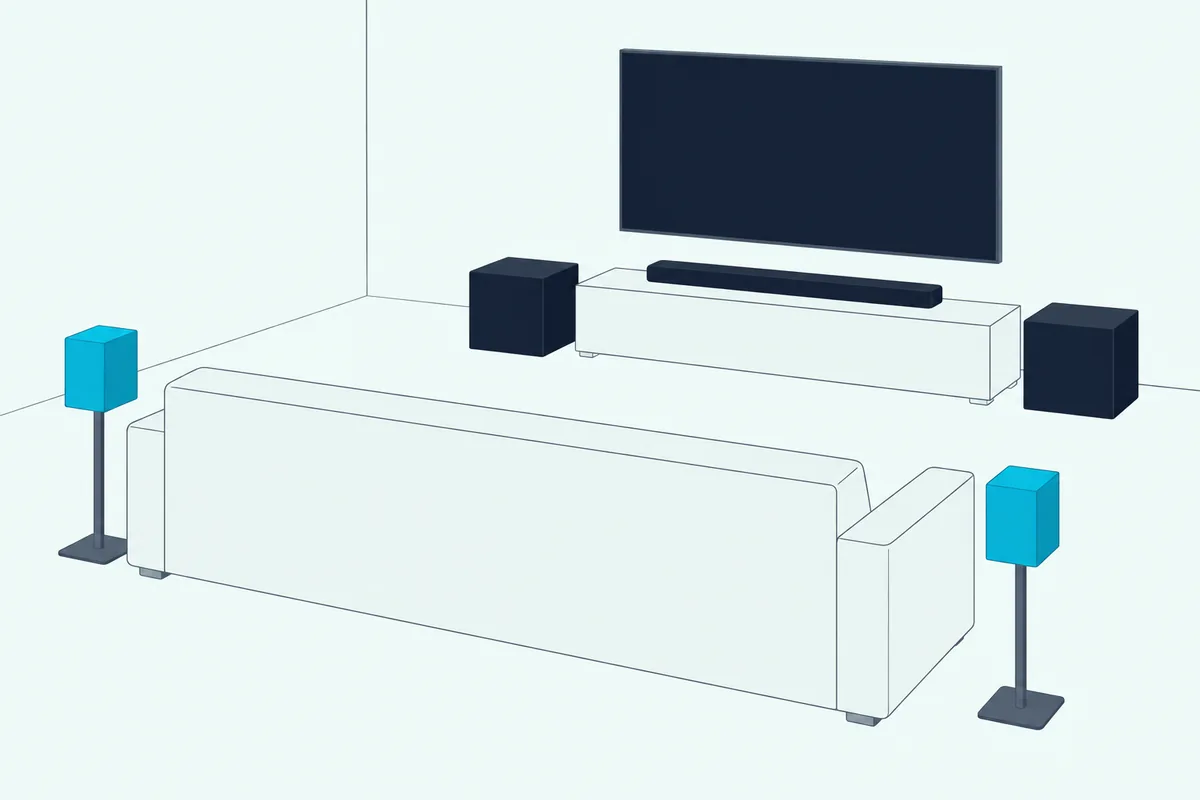
LG’s S70TY manual pairs the separately sold SPT8-S rear speakers, which take it from 3.1.1 to 5.1.1 channels. The SC9S’s spec page lists the SPQ8-S kit, rear speakers with a wireless receiver, sold separately, which takes it from 3.1.3 to 5.1.3.
LG’s spec pages for the S95TR, S90TR and S80TR list their rear speakers as part of the system rather than as an option. That’s the trade in one line: LG front-loads the speakers, and Sony spreads them across later purchases.
For the subwoofer’s pairing steps, our guide to setting up a Sony subwoofer with its bar covers the app route and the one without it.
Do LG and Sony Bars Stream Music the Same Way?
Once the speakers are placed, music is the other daily use, and the two streaming lists overlap more than they differ. Mostly yes: LG’s S95TR manual has chapters for Google Assistant, Apple AirPlay, Spotify Connect, Alexa and Tidal Connect, and Sony’s Bar 9 and Bar 8 guide covers AirPlay, Spotify Connect and 360 Reality Audio.
Bluetooth is the clearest difference on paper. Sony’s Bar 9, Bar 8 and Bar 7 guides list LDAC alongside SBC and AAC, while LG’s S95TR and S70TY manuals list Bluetooth 5.1 with SBC and AAC.
Voice works differently too. Sony’s guide notes the Bar 9 and Bar 8 have no microphone, so you can’t talk to the bar itself, but once it’s added to an iPhone’s Home app you can ask Siri to stream music to it.
Each maker also uses its own app. LG’s manuals name the LG ThinQ app or the LG Soundbar app, depending on the model and edition, while Sony’s bars use the Sony | BRAVIA Connect app for setup, settings and add-ons.
Does LG Still Tune Its Soundbars With Meridian?
Music is also where LG’s old selling point, Meridian, used to come in. LG’s current manuals don’t name it: the manuals for the SP9YA (copyright 2021) and the S80QR (2023) describe sound modes with “premium sound technology from MERIDIAN,” but the full owner’s manuals for the S95TR and S40T (2024) and the S70TY (2023) don’t mention Meridian at all.
So a claim that Meridian tunes every LG bar doesn’t hold for the current range on LG’s own paperwork. What those newer manuals describe instead is a list of sound effects, which on the S95TR runs AI Sound Pro, Standard, Cinema, Clear Voice Pro, Sports, Music, Game and Bass Blast.
Those names are LG’s guide to what each mode does, not a measurement of how it sounds. Pick by content, then judge the result in your own room.
Sony’s guides name fewer modes. The remote has sound field, voice and night buttons, and the Bar 9 and Bar 8 use Dolby Speaker Virtualizer and DTS Neural:X for multichannel sources and 360 Spatial Sound Mapping for two-channel TV sound.
Which LG or Sony Soundbar Should You Buy?
Those differences narrow most shortlists to one pair per TV size, from a small bar for a bedroom to a full system for a 65-inch screen. Buy LG if you want the subwoofer and rear speakers in the box or WOW Orchestra with an LG TV, and buy Sony if you’d rather add speakers over time, want LDAC or IMAX Enhanced, or own a BRAVIA with an S-CENTER jack.
The descriptions come from the makers’ manuals and spec pages. Every pick met Burton Acoustix’s rating, review and stock checks on 29 October 2026.
A Full System for a 65-Inch TV or Larger
If you want everything at once, the LG S95TR, with its wireless subwoofer and rear speakers in the box is the pick. A 65-inch TV is about 56.7 inches wide, so the bar sits well inside the screen’s edges.
LG S95TR
If you’d rather build the system up, the Sony BRAVIA Theater Bar 9, sold as the bar alone is the pick. Add a Sony subwoofer first, then rear speakers, and rerun Sound Field Optimization after each one.
Sony BRAVIA Theater Bar 9
A Full System for a Narrower TV Stand
For a 55-inch TV, the LG S80TR, a 1,000 mm bar with its subwoofer and rear speakers is the pick. It sits inside a 55-inch screen’s 48 inches with room to spare.
LG S80TR
Sony’s Bar 8 is the narrower Sony bar at 43 3/8 inches, with the Bar 9’s features and add-ons. It’s described here without a buying link because its listing wasn’t in stock when the picks were checked.
A Bar and Subwoofer for a 50- or 55-Inch TV
For an HDMI input and the option of rear speakers later, the LG S70TY, a 950 mm bar with a wireless subwoofer is the pick.
LG S70TY
If every source already plugs into your TV, the Sony BRAVIA Theater Bar 6, a 950 mm bar with a wireless subwoofer is the simpler pick. Its one HDMI cable runs to the TV’s eARC or ARC port.
Sony BRAVIA Theater Bar 6
A Small Bar for a Bedroom or a Smaller TV
For a 32-inch TV, the LG S20A, a 650 mm two-channel bar is the pick, since it sits inside the screen’s edges.
LG S20A
For a 43-inch screen or larger, the Sony HT-S400, a 2.1-channel bar with a wireless subwoofer is the pick. It adds the wireless subwoofer that the S20A goes without.
Sony HT-S400
The Bottom Line
Those picks come back to the three questions from the top of the page: how much of the system you want in one box, which TV the bar sits under and what has to plug into it.
Choose LG when you want the subwoofer and rear speakers included, an HDMI input further down the range, AI Room Calibration from a microphone in the bar, or WOW Orchestra with an LG TV. Choose Sony when you’d rather start with the bar and add one or two subwoofers and rear speakers later, want LDAC or IMAX Enhanced, or own a BRAVIA with an S-CENTER jack for Acoustic Center Sync.
Our guide to choosing a soundbar covers the features that matter at each budget, and our soundbar setup guide helps you place and tune whichever brand you choose. If neither maker suits you, our best soundbar roundup looks across the market.
Frequently Asked Questions
Which LG sound bar is the best?
LG’s S95TR is its most complete system, with a wireless subwoofer and wireless rear speakers in the box for 9.1.5 channels, plus an HDMI input and AI Room Calibration. The S90TR keeps the same 1,250 mm bar width at 7.1.3 channels, and the S80TR brings 5.1.3 to a 1,000 mm bar. For a bar and subwoofer without rears, the S70TY adds an HDMI input and can take SPT8-S rear speakers later.
Can you use a Sony soundbar with an LG TV?
Yes. Sony’s bars connect to a TV’s HDMI eARC or ARC port and support Control for HDMI, Sony’s name for the HDMI-CEC link that LG’s manuals call SIMPLINK, and LG’s manuals list Sony’s BRAVIA Sync/Link among other makers’ names for the same link, so an LG bar under a BRAVIA works the same way. What you give up are the same-brand extras: WOW Orchestra needs an LG bar with an LG TV, and Acoustic Center Sync and Voice Zoom need a Sony TV. Our soundbar to TV connection guide covers the HDMI setup for either brand.
Does WOW Orchestra work with a Sony TV?
No. LG’s manuals describe WOW Orchestra as the combination of an LG soundbar and an LG TV playing sound through both at once, chosen in the LG TV’s sound out menu and available on some LG TV and soundbar models. Sony’s version of the idea, Acoustic Center Sync, needs a BRAVIA with an S-CENTER SPEAKER IN jack and a Sony bar with an S-CENTER OUT jack, such as the Bar 9 or Bar 8.
Do LG and Sony soundbars support DTS:X?
Most of their Dolby Atmos bars do. LG’s spec pages list DTS:X for the S95TR, S90TR, S80TR, SC9S and S70TY, and Sony’s help guides say the Bar 9, Bar 8, Bar 7, Bar 6 and Bar 5 support Dolby Atmos and DTS:X. The smaller bars stop at DTS or Dolby Digital: LG lists DTS Digital Surround for the S60TR, S40T and S20A, and Sony’s HT-S400 spec sheet gives Dolby Digital.
Does the Sony Bar 9 come with a subwoofer?
No. Sony sells the BRAVIA Theater Bar 9 as the bar alone, and its help guide lists the subwoofer and rear speakers as optional add-ons, with two subwoofers allowed in a dual-subwoofer connection. LG’s S95TR, its closest rival, includes a wireless subwoofer and wireless rear speakers, so compare the full cost of each system rather than the bars alone.