Are Double Glazed Windows Soundproof? What the Lab Ratings Show
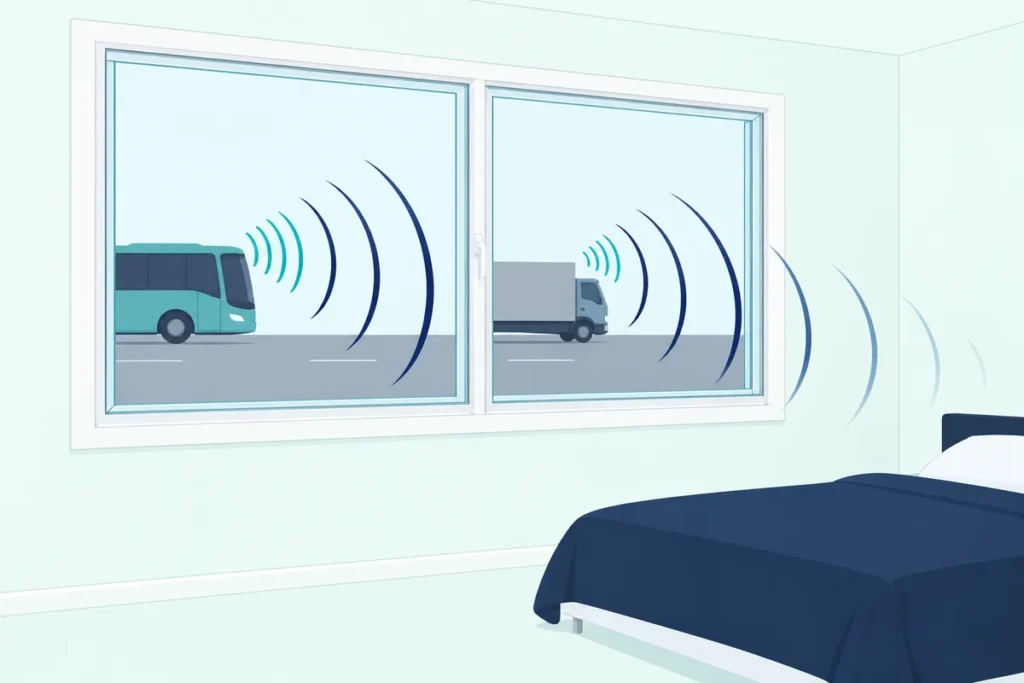
If traffic still reaches your bedroom through new windows, you’ve probably asked yourself: are double glazed windows soundproof, or were they only ever about heat?
A standard sealed unit lets the low rumble of trucks and buses through, because the narrow air gap between its two panes resonates at the frequencies traffic noise carries.
Andersen’s lab reports put its standard dual-pane windows at STC 26 to 30, a level at which, by Andersen’s own scale, you’d still understand a loud conversation outside.
This guide uses those reports, Marvin’s and Guardian Glass’s tables and NRC Canada’s research to show what a double pane window blocks, where it leaks and which upgrades add real points.
Start with the ratings themselves, because every fix later on is measured against them.
Are Double Glazed Windows Soundproof?
Those ratings answer the question directly: double glazed windows aren’t soundproof. Andersen says there’s no such thing as a soundproof window, only windows that reduce sound, and that the glass construction has the greatest influence on how much (Andersen).
Its 400 Series acoustic report, based on independent lab tests to ASTM E90, E413 and E1332, lists every standard dual-pane window it rates between STC 26 and 30 (Andersen 400 Series report). Here are six of them:
| Andersen 400 Series window, standard dual-pane glass | STC | OITC |
|---|---|---|
| Perma-Shield casement | 26 | 22 |
| Perma-Shield awning | 26 | 21 |
| Woodwright double-hung | 28 | 23 |
| Tilt-Wash double-hung | 29 | 24 |
| Perma-Shield picture window | 29 | 25 |
| Flexiframe | 30 | 25 |
STC is the speech-oriented rating and OITC the traffic-oriented one, and every OITC figure in the report sits below its STC.
Andersen’s own scale puts most dual-pane windows at about STC 30, where you’d still hear and understand a loud conversation outside. It puts the point where even loud conversations are hardly audible at STC 36 to 40.
Makers and agencies use several names for the same thing. Marvin’s glossary defines a dual glaze as insulating glass with two panes, and HUD’s noise guidebook describes double-glazed windows as paired panes separated by an airspace.
So double pane, dual-pane and double glazed windows are one product, and the ratings above apply whichever name your installer uses.
How Much Noise Does a Double Pane Window Block?
Those ratings translate into loudness: by Guardian Glass’s reading, a rating of 30 cuts a sound to roughly an eighth of its perceived volume, and a rating of 40 to roughly a sixteenth (Guardian Glass). So a standard double pane window near STC 30 leaves a loud voice outside at roughly an eighth of its volume, which fits Andersen’s point that you can still follow it.
Which noise you’re measuring matters, though. STC comes from ASTM E413, which says its ratings correlate in a general way with speech, radio and television, and aren’t appropriate for transportation noise such as motor vehicles, aircraft and trains (ASTM E413).
OITC, defined in ASTM E1332, rates a window against an average of aircraft takeoff, road traffic and diesel locomotive noise from 80 to 4,000 Hz, so it’s the better guide to street noise (ASTM E1332). Cardinal Glass adds that STC covers 125 to 4,000 Hz, which leaves out the lowest bands OITC keeps (Cardinal).
Burton Acoustix’s guide to STC ratings explains how the lab arrives at the number itself.
The wall around the window matters as well. HUD’s guidebook shows a 45 STC wall with a 26 STC window covering 30 percent of it performing at STC 35 overall, 10 points lost to the glass (HUD).
UK and European makers quote Rw instead, a rating from ISO 717-1 that ASTM says differs from STC by only one or two points for most partitions. Saint-Gobain Glass lists a plain unit of two 6 mm panes around a 16 mm argon-filled gap at Rw 33, with a Ctr correction of minus 5 (Saint-Gobain Glass).
Saint-Gobain’s buyer’s guide explains Ctr as the correction for low-frequency noise such as slow city traffic and heavy trucks. So the same unit’s Rw plus Ctr, the figure for that kind of noise, works out at 28.
Get Studio Tips Weekly
Join 5,000+ creators getting acoustic treatment advice every week.
No spam. Unsubscribe anytime.Is Double Glazing Better Than Single Glazing for Noise?
Those modest ratings raise the obvious question of what the second pane adds. It does help, but by less than most buyers expect: Guardian’s lab estimates put a single 6 mm pane at STC 30 and two 6 mm panes with a half-inch air gap at STC 34, while the traffic-weighted OITC moves only from 28 to 29.
NRC Canada’s digest on window acoustics explains the small gain. When the two layers of glass sit close together, it says, double glazing rates only slightly higher than a single layer of the same glass, and sometimes lower (NRC Canada).
HUD’s table of measured windows shows it happening. A wood double-hung window, closed but unlocked, rated STC 23 with single glazing and STC 22 with 7/16-inch insulating glass.
Andersen still says that replacing single-pane windows with new dual-pane ones makes a noticeable difference in reducing sound, as well as improving energy efficiency. Expect an improvement from the second pane, then, not silence.
The panes themselves get a fuller treatment in our guide to whether soundproof glass works, which compares laminated, tempered and double glazed builds.
Why Can You Still Hear Traffic Through Double Glazing?
That narrow gap is the culprit, and its weak spot falls right where traffic carries much of its energy. NRC Canada explains that the air between two closely spaced panes acts like a spring, passing vibration from one pane to the other and causing a sharp drop in sound insulation called the mass-air-mass resonance.
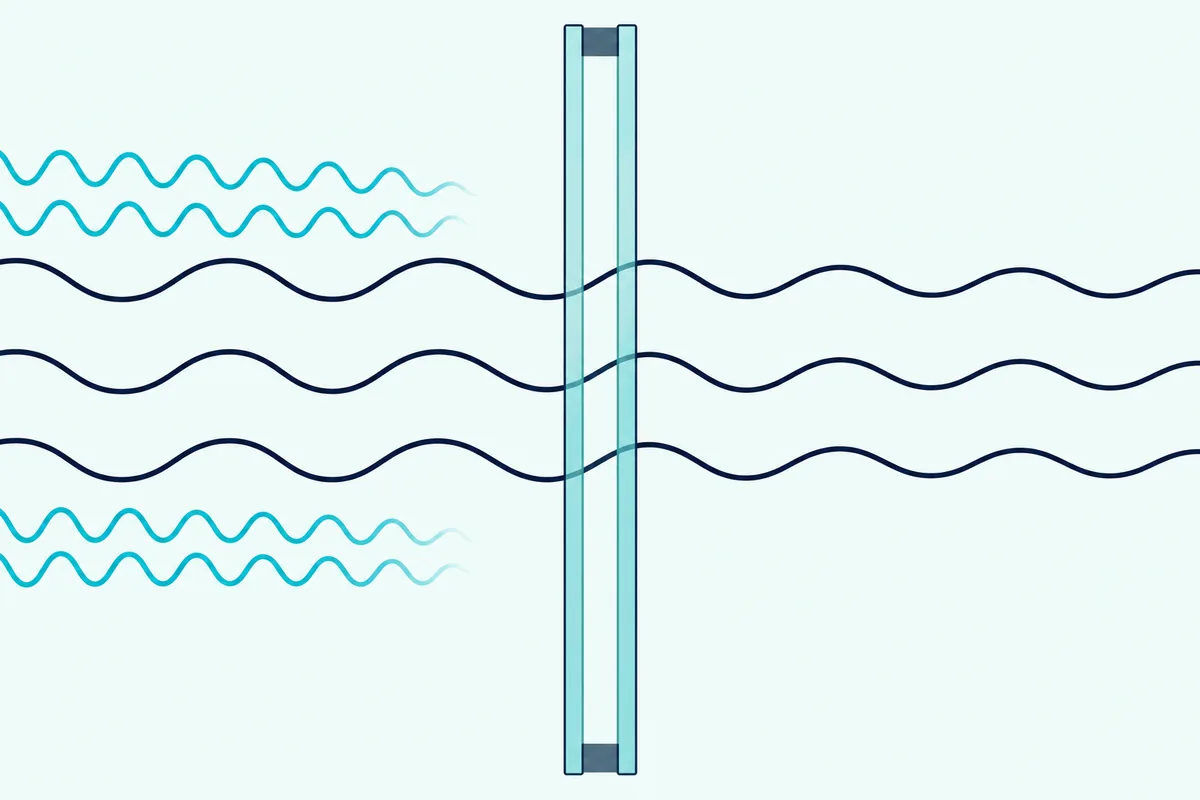
For typical factory-sealed double glazing, NRC puts that resonance between 200 and 400 Hz. It adds that much of the sound energy from aircraft and road traffic falls in the same range.
Saint-Gobain’s figures for its plain 6 mm, 16 mm argon, 6 mm unit show the dip clearly. The unit cuts 39 dB at 1,000 Hz but only 21 dB at 125 Hz and 20 dB at 250 Hz.
| Saint-Gobain unit: 6 mm glass, 16 mm argon gap, 6 mm glass | 125 Hz | 250 Hz | 500 Hz | 1,000 Hz | 2,000 Hz |
|---|---|---|---|---|---|
| Sound reduction, dB | 21 | 20 | 30 | 39 | 35 |
That’s why OITC trails STC on every window in Andersen’s report, with its Tilt-Wash double-hung at STC 29 but OITC 24. Marvin’s Ultimate Double Hung with two 1/8-inch panes shows the same pattern, rating STC 27 and OITC 23 (Marvin).
So hearing heavy traffic through standard double glazing is normal. The low rumble of traffic passes far more easily than the higher-pitched part of the noise, which this unit cuts by about twice as many decibels, 39 against 20.
Try this at a closed window when a bus or truck goes by. If the deep rumble comes through while the higher-pitched sound fades, you’re hearing the low band that the glass handles worst.
Does the Gap Between the Panes Matter?
Yes, and it’s the most direct lever you have, because the resonance comes from the air space. NRC’s digest says the STC of sealed double glazing rises by about 3 for each doubling of the air space, and that a wider gap and heavier glass lower the resonance frequency, improving insulation against traffic and aircraft noise.
Pilkington makes the same point about insulating glass units: the larger the gap between the panes, the better the insulation (Pilkington).
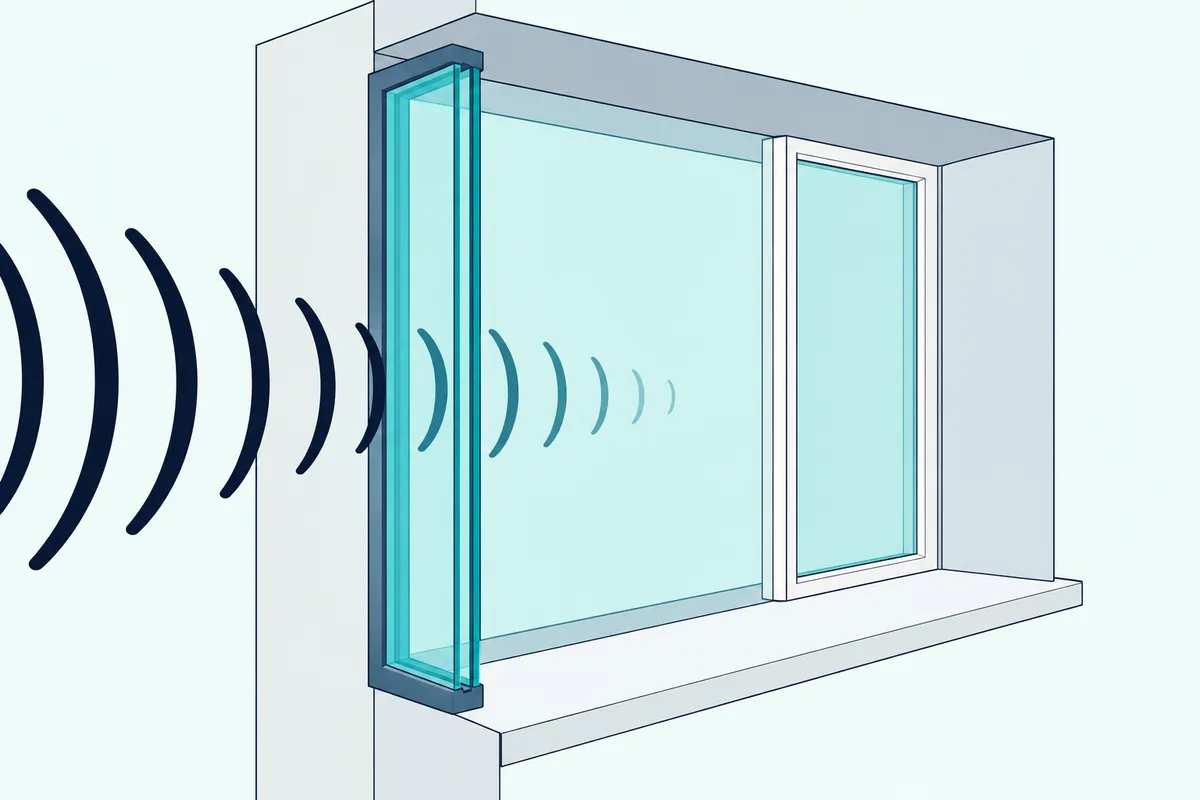
HUD advises an airspace of at least 2 to 4 inches between double panes if you want a rating above STC 40. It also says the sealant and the airspace width do the most to determine a window’s noise resistance.
Typical sealed units are far narrower than that. Marvin’s double-hung example uses a 5/8-inch air space, and Saint-Gobain’s plain unit a 16 mm one, which is about the same.
A second sash with a deep gap is a different story. Marvin’s Ultimate Casement with two 1/8-inch panes and a 1/2-inch air space rates STC 29 and OITC 23, and the same window with an interior sash of 1/8-inch glass on a 4 1/4-inch air space rates STC 46 and OITC 34.
HUD’s measured windows show what happens when the second layer sits too close. An aluminum sliding window with a single-glazed storm sash 1/8 inch away rated STC 22, while a sealed wood double-hung with 7/16-inch insulating glass and a storm sash 2 1/8 inches out rated STC 35.
NRC adds a refinement for double windows. Lining the frame around the perimeter of the cavity with sound-absorbing material raises the STC only slightly, it says, although it can add up to 10 dB at high frequencies.
Many units fill the gap with argon, which Marvin’s glossary describes as an inert gas known for its insulating properties. None of the sound tables used here isolates its effect on noise, because their gas-filled rows also change the glass or the gap.
Is Triple Glazing More Soundproof Than Double Glazing?
That gap rule also explains why a third pane disappoints. NRC’s digest says triple glazing gives essentially the same noise reduction as double glazing unless the spacing is very large, and in its comparison of a double and a triple window of similar total thickness, the STC ratings were the same.
Below the resonance, the triple window gained about 3 dB, in line with its 50 percent extra mass of glass. At higher frequencies the two curves were almost identical.
In the makers’ own figures, the third pane adds little:
| Window or glass | Double pane, STC / OITC | Triple pane, STC / OITC |
|---|---|---|
| Andersen 400 Series casement | 26 / 22 | 29 / 25 |
| Andersen 400 Series awning | 26 / 21 | 29 / 24 |
| Andersen 400 Series picture window | 29 / 25 | 30 / 25 |
| Marvin Ultimate Double Hung G2 | 27 / 23 | 28 / 24 |
| Guardian, center of glass, 6 mm panes and 1/2-inch gaps | 34 / 29 | 37 / 29 |
Andersen’s sound page says going from dual-pane to triple-pane glass won’t necessarily give dramatic results. It recommends a dual-pane window with thicker laminated glass or mismatched panes instead.
Andersen’s triple-pane page calls triple glazing its most insulating option and says it will almost always outperform dual-pane glass for sound (Andersen). It also notes that a triple-pane window typically weighs 1.5 times as much, while the table above puts the sound gain at 1 to 3 points.
Which Double Glazing Blocks the Most Noise?
Those small triple-pane gains are beaten by a two-pane unit with acoustic laminated glass, mismatched panes or both, the quietest double glazing in the makers’ tables. Guardian’s estimates put a double unit with one acoustic laminated pane at STC 41 against 34 for plain double glazing, and one with two acoustic laminated panes at STC 48.
Mismatched panes work because each pane’s resonances fall at different frequencies, NRC explains, and it calls a thickness ratio of about 2 the most effective. Andersen sells mismatched panes as an STC upgrade.
In Marvin’s double-hung, swapping one 1/8-inch pane for a 3/16-inch pane, with a slightly narrower 19/32-inch gap, raises the window from STC 27 to 30. Heavier glass helps too: Saint-Gobain’s figures climb from Rw 33 for a unit of two 6 mm panes to Rw 36 with one pane at 8 mm and Rw 39 with one at 10 mm, all on the same 16 mm argon gap.
Laminated glass works differently, by damping: NRC attributes its gain to the plastic interlayer dissipating vibration.
Saint-Gobain’s table shows the interlayer itself doing the work. The same unit of an 8 mm pane, a 16 mm argon gap and a 10.8 mm laminated pane rates Rw 44 with its acoustic interlayer and Rw 41 with a standard one.
Whole windows follow the same order in Andersen’s report, where the laminated option lifts the Tilt-Wash double-hung from STC 29 to 32 and the casement from 26 to 32. Andersen notes that this option typically laminates only one of the two panes.
The same report rates Andersen’s Stormwatch impact glass, and Burton Acoustix’s impact window noise guide puts those ratings beside the laminated and standard options.
Marvin’s figures for its Ultimate Double Hung G2 put every option on one ladder:
| Marvin Ultimate Double Hung G2 glazing | STC | OITC |
|---|---|---|
| Two 1/8-inch panes, 5/8-inch air space | 27 | 23 |
| Three 1/8-inch panes, two 1/4-inch air spaces | 28 | 24 |
| 1/8-inch and 3/16-inch panes, 19/32-inch air space | 30 | 26 |
| Two 1/4-inch laminated panes, 3/8-inch air space | 31 | 27 |
| 3/16-inch pane and 11/32-inch laminated pane, 5/16-inch air space | 32 | 29 |
| Two 1/8-inch panes plus a 1/8-inch clad storm combination | 35 | 28 |
| Two 1/4-inch laminated panes plus the storm combination | 40 | 33 |
Every change to the glass adds a few points, and the extra pane with its own air space adds the most. One caveat from NRC: damping depends on temperature, and at typical Canadian winter temperatures the gain from lamination may be drastically reduced.
Are Soundproof Windows Different From Double Glazing?
Those upgraded builds are what makers sell as acoustic or soundproof windows, so the difference lies in the glass, the gap and the frame rather than the pane count. Pilkington says the highest noise insulation comes from acoustic laminated glass, best of all inside an insulating glass unit, and that its range reaches sound reduction above Rw 50.
One of its acoustic double glazed units, an 8.5 mm acoustic laminated pane, a 16 mm argon gap and an 8 mm pane, tested at Rw 42 at the ift Rosenheim lab (Pilkington test report). That’s 9 points above the Rw 33 Saint-Gobain lists for its plain 6 mm unit.
Saint-Gobain’s buyer’s guide puts the gain from acoustic glazing at up to 5 dB over a classic double glazed unit of the same build (Saint-Gobain). It describes a 10 dB gain as roughly halving the noise that gets through.
A separate interior sash with its own deep gap is the other route, and it’s what lifted Marvin’s casement to STC 46. Our comparison of the best soundproof replacement windows covers the buying side of both routes.
Whichever you choose, ask for the whole-window STC and OITC rather than a glass figure. Guardian warns that a site-installed panel can lose about 6 dB against its lab specimen, which it equates with losing a third of the perceived sound reduction.
Why Do Frames and Seals Matter as Much as the Glass?
Even an acoustic unit only performs if the window around it is tight. NRC’s digest warns that sound passing through cracks can drastically reduce a window’s noise reduction, and that openable windows with good weatherstripping usually rate 3 to 5 STC below an equivalent sealed window.
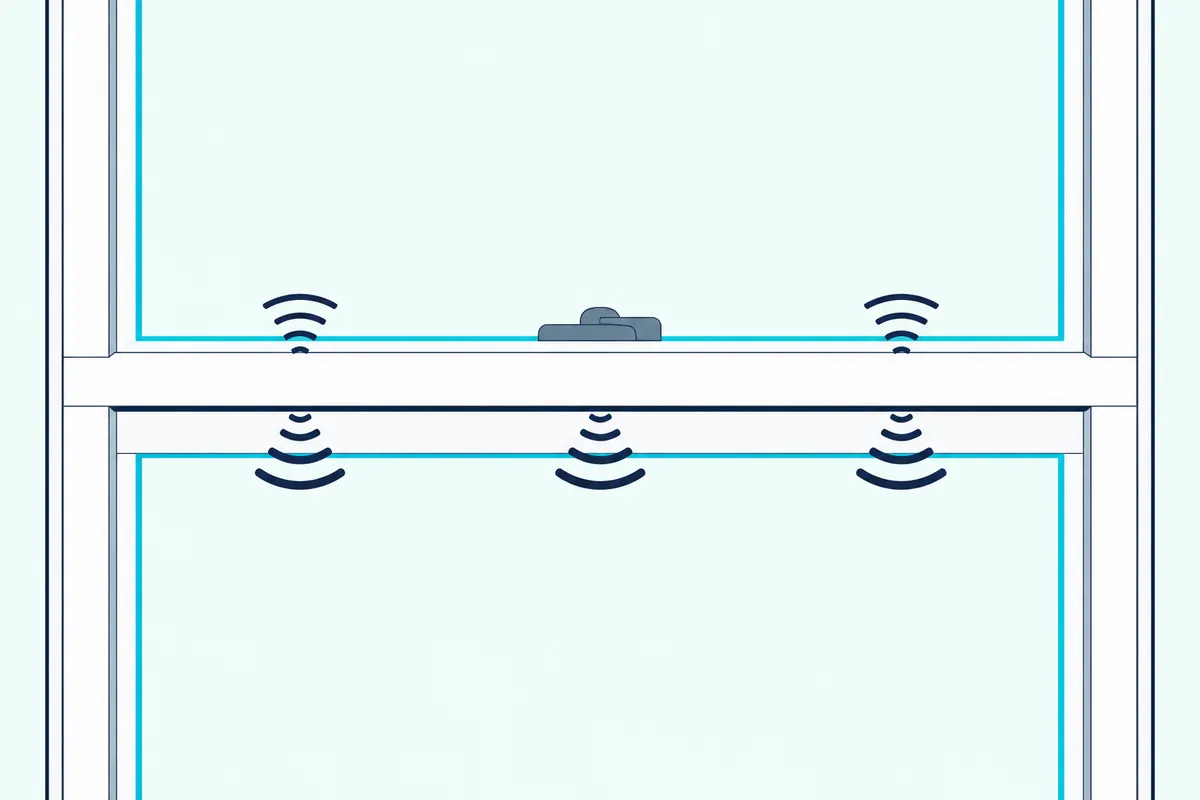
It adds that the higher a sealed window’s STC, the more a given leak takes from it. Seals matter most, in other words, on exactly the windows people pay extra for.
HUD’s guidebook makes the scale concrete: a one-inch-square hole or a 1/16-inch crack 16 inches long cuts a 50 STC wall to STC 40. For double glazing, HUD says a window should be sealed permanently to go above STC 43, and that openable windows with special frames and seals top out at 43.
Frames count as well. NRC reports that some tests with lightweight metal frames gave lower ratings, apparently from vibration carried through the frame, and it advises avoiding lightweight frames.
ASTM’s lab method carries the same warning in general form: a lab rating is an upper limit for what a field test in a real building would measure (ASTM E90). So a window installed with gaps around its frame will fall short of its rating.
Try this on a windy day: close and lock the window, then run the back of your hand along the meeting rail and the sash edges. Any draft you feel marks a gap that sound uses too.
How Do You Make Double Glazed Windows More Soundproof?
Those leaks are the cheapest place to start, and none of the first four steps involves replacing the window. Seal the sashes, then add a second sash with a wide gap, and replace the glass last, checking after each step whether the noise still bothers you:
| Step | What you do | What the sources show |
|---|---|---|
| 1. Close and seal | Keep the window shut and latched | HUD lists closing and sealing the windows as the first step in cutting noise |
| 2. Renew the seals | Replace worn or missing weatherstripping on every sash that opens | NRC: even well weatherstripped windows rate 3 to 5 STC below sealed ones |
| 3. Seal the edges | Fill gaps left by the installation between the frame, the trim and the wall | HUD: a 1/16-inch crack 16 inches long takes a 50 STC wall to 40 |
| 4. Add a second sash | Fit a storm window, interior sash or insert with a wide gap | Andersen: STC 29 to 33 with its combination unit; Marvin: 27 to 35 with a storm |
| 5. Upgrade the glass | Replace the sealed unit with acoustic laminated, mismatched glass | Guardian: STC 34 to 41 with one acoustic laminated pane |
Step 2 is where a small purchase earns its place. For sliding sashes, TamBee’s gray pile brush strip is a 3/8-inch self-adhesive weatherstrip that its listing sells for sliding windows and door frames.
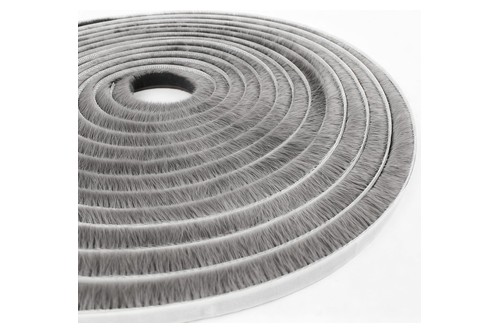
TamBee’s gray pile brush strip
Step 4 gives the biggest jump you can add without replacing the window. Andersen’s report lifts its Tilt-Wash double-hung from STC 29 to 33 with its storm window and screen combination unit, and from 32 to 37 when the main glass is laminated too, although the traffic-weighted OITC moved only from 24 to 25 on the standard glass.
Interior inserts work on the same principle of a second layer with its own air space. Our roundup of soundproof window inserts compares removable and permanent options.
Step 5 pays only once steps 1 to 3 are done, because NRC shows that leaks cost a high-rated window the most. If you’d rather keep the windows you have for now, these window soundproofing steps go further into curtains, plugs and inserts.
Is Double Glazing Enough for Your Noise Problem?
Which of those steps you need depends on what you hear. If it’s voices or a neighbor’s TV, watch the STC: Andersen’s scale says STC 30 still lets a loud conversation through, so aim for 36 to 40 if speech is the problem.
If it’s traffic, trains or aircraft, judge by OITC, because standard double glazing scores lowest there, at OITC 21 to 26 in Andersen’s report. The changes that move OITC most in the makers’ tables are laminated glass, up 4 to 6 points on Andersen’s casement, awning and double-hung, and a wide second gap, up 11 points on Marvin’s casement.
A smaller window is no substitute for a better one: HUD notes that cutting the window area from 50 to 20 percent of a wall reduces noise by only 3 decibels. Check the walls too, since HUD’s table rates a basic wood-frame exterior wall at STC 39, against 56 for a brick veneer wall.
The Bottom Line
So double glazed windows aren’t soundproof: standard dual-pane windows rate STC 26 to 30 and OITC 21 to 26 in Andersen’s tests, because the narrow gap between the panes resonates in the traffic range.
Seal the sashes first, add a second sash with a wide gap if traffic still gets through, and choose acoustic laminated, mismatched glass when you replace a unit.
Frequently Asked Questions
Should you be able to hear traffic through double glazing?
Usually, yes. Standard double glazing is weakest against low-frequency sound: NRC Canada puts the resonance of typical sealed units at 200 to 400 Hz, where much traffic noise sits, and Andersen’s standard dual-pane windows rate only OITC 21 to 26. If you can feel a draft at the sash, a leaking seal is adding to the noise.
What are the disadvantages of double glazing for noise?
Its narrow air gap resonates in the traffic range, so it blocks speech better than rumble, and a third pane barely changes that. Openable sashes also leak: NRC Canada says even well weatherstripped windows rate 3 to 5 STC below sealed ones, and HUD caps openable double glazing at STC 43.
What type of window is most soundproof?
A sealed window with acoustic laminated, mismatched panes and a wide air space, or a double window with a separate inner sash. Marvin’s casement reaches STC 46 with an interior sash on a 4 1/4-inch air space, and Guardian’s best double unit, with two acoustic laminated panes, lists at STC 48 for the center of the glass.
Are double pane and double glazed windows the same?
Yes. All three names describe two panes of glass sealed around a gap: Andersen calls it dual-pane glass, Marvin’s glossary defines a dual glaze as insulating glass with two panes, and HUD calls it a double-glazed window.
Does window film make double glazing soundproof?
None of the makers’ tables used here lists window film, so there’s no published figure to judge it by. The published gains come from heavier or laminated glass, mismatched panes, wider air spaces and better seals.
Can you soundproof double glazed windows without replacing them?
Partly. Renew the weatherstripping, seal gaps around the frame and add a storm window or interior insert with a wide air gap. Andersen’s combination unit lifts its double-hung from STC 29 to 33, and Marvin’s casement with an interior sash 4 1/4 inches from the glass shows what a deep second layer can do, STC 29 to 46.
Is double glazing good enough for a recording room?
Only with a wide gap. NRC Canada says double glazing is the sensible choice where substantial noise reduction is needed, with an air space large enough for the target, and it reports no discernible benefit from the slanted glass common in recording studio windows.