Are Hurricane Impact Windows Soundproof? Quieter, Not Silent
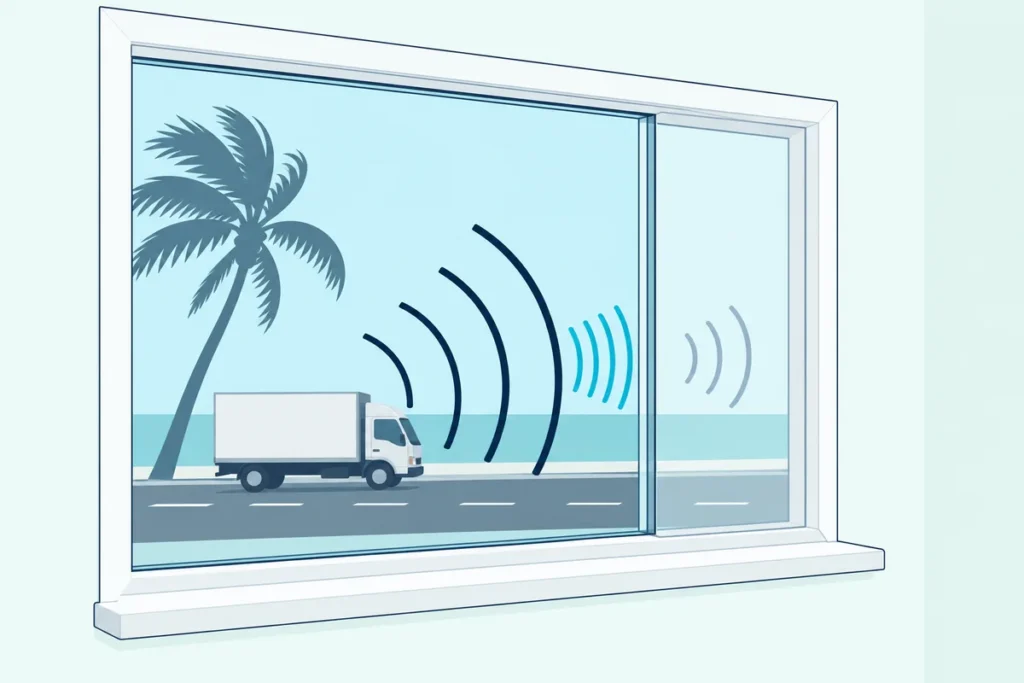
Living near a highway in hurricane country raises a fair question before you sign a window quote: are hurricane impact windows soundproof, or does all that glass only stop flying debris?
The impact approval on the label proves the window held against a 2×4 fired at it in a lab, but nothing in that approval measures road noise.
Read the right two numbers, though, and the same laminated glass that stops debris rates 4 to 8 STC points higher than standard double pane glass in one maker’s lab reports.
This guide uses Andersen’s tested impact windows, a Miami-Dade product approval, ASTM’s test standards and glass makers’ sound tables to show what the label covers, how much quieter impact glass is and where noise still gets in.
Start with the label, because it’s the part most buyers misread.
Are Hurricane Impact Windows Soundproof?
That label leaves the real question open, so here’s the short answer. Hurricane impact windows aren’t soundproof, and Andersen, which sells them, says there’s no such thing as a soundproof window, only windows that reduce sound (Andersen).
What they are is quieter than standard glass. Andersen’s 400 Series acoustic report, based on independent lab tests to ASTM E90, E413, E1332 and E1425, lists the same windows with each glass option it tested (Andersen 400 Series report):
| Andersen 400 Series window (STC / OITC) | Standard dual pane | Laminated, non-impact | Stormwatch impact | Stormwatch impact, laminated monolithic |
|---|---|---|---|---|
| Perma-Shield casement | 26 / 22 | 32 / 28 | 30 / 26 | 34 / 29 |
| Perma-Shield awning | 26 / 21 | 31 / 27 | Not tested | 34 / 31 |
| Perma-Shield picture transom | 29 / 25 | 34 / 28 | 35 / 30 | 37 / 34 |
| Tilt-Wash picture | 30 / 25 | Not tested | 34 / 28 | Not available |
| Flexiframe | 30 / 25 | 35 / 29 | 35 / 29 | 36 / 32 |
Read across the rows and the Stormwatch impact glass adds 4 to 6 STC points over standard dual pane glass in the same frame, while the laminated monolithic version adds 6 to 8. Andersen’s own scale puts most dual-pane windows near STC 30, where you’d hear and understand a loud conversation outside, and calls 30 to 35 the range where you might hear it but couldn’t follow it.
What Does an Impact Rating Actually Test?
Those sound numbers come from a different test from the one that earns the impact label. An impact rating checks whether the window still closes off the opening after flying debris hits it and cycles of wind pressure load it, and it doesn’t measure sound at all.
ASTM E1886, the test method, strikes a window with a missile first and then puts it through a set number of positive and negative pressure cycles (ASTM E1886). Its pass or fail criteria come from the authority specifying the test and may allow deformation, deflection or even broken glass.
The companion specification, ASTM E1996, says passing gives a basis for judging whether the building envelope will remain unbreached during a hurricane (ASTM E1996). Think of it as a crash rating, not a comfort rating.
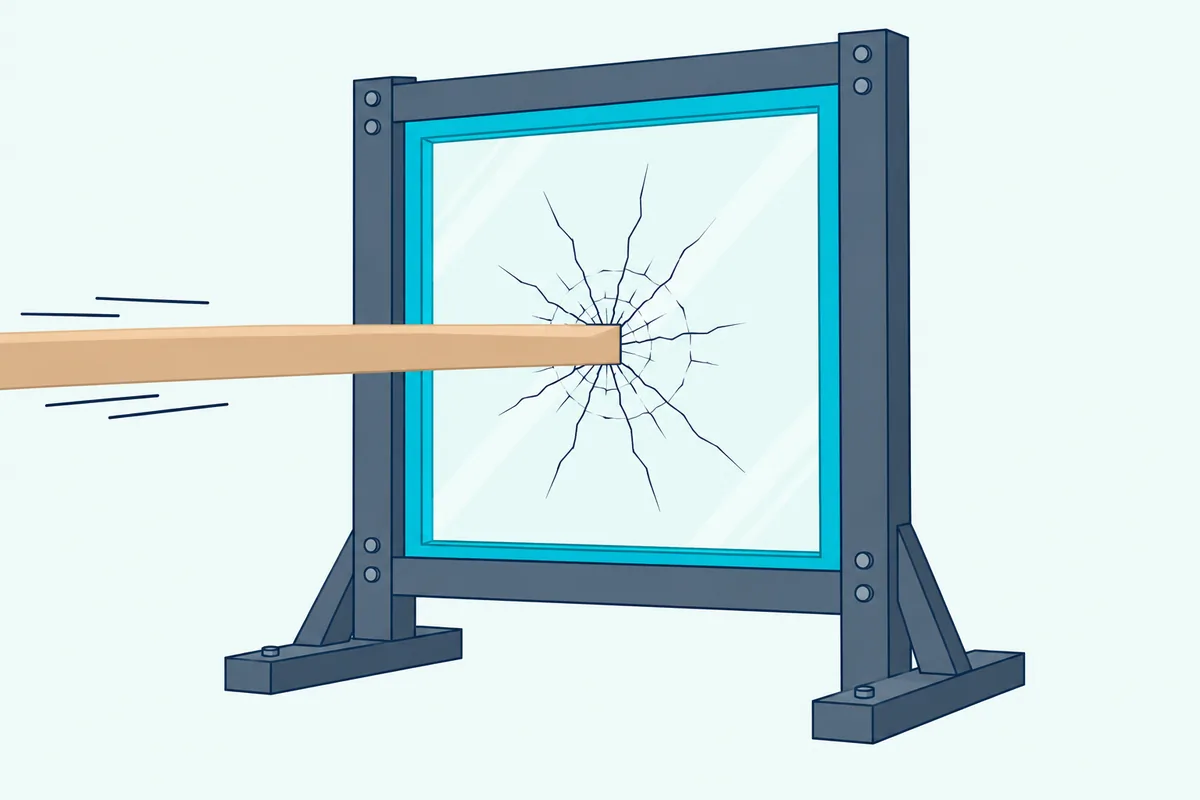
Marvin describes the impact test on its windows as an 8-foot 2×4 stud launched at 50 feet per second at the center and corners, plus pressure tests of 9,000 cycles to simulate hurricane-force winds (Marvin).
Miami-Dade County’s July 2026 approval for ES Windows’ ES-P252 aluminum casement lists every test behind it: air infiltration, static air pressure, water resistance, large and small missile impact, cyclic wind pressure and forced entry (Miami-Dade NOA 26-0506.04). There’s no sound test in that list, and the approval rates the window simply as large and small missile impact resistant.
Andersen’s Stormwatch windows follow the same route. Its 400 Series info sheet says they’re designed to satisfy the large missile test of ASTM E1886 and E1996 and the Florida Building Code’s TAS 201, 202 and 203, except the tilt-wash double-hung, and its coastal guide says the impact glass units were tested to Large Missile D, Wind Zone 4 and Florida’s High Velocity Hurricane Zone requirements.
Get Studio Tips Weekly
Join 5,000+ creators getting acoustic treatment advice every week.
No spam. Unsubscribe anytime.Why Is Impact Glass Quieter Than Regular Glass?
So if the test ignores sound, the quieter results come from what it takes to pass: laminated glass. Impact glass in these windows is two panes bonded to a plastic interlayer, and that layered build damps the vibration that carries sound through a plain pane.
Andersen’s monolithic impact glass is a clear laminate interlayer sandwiched between two panes, which Andersen says resists impact, forced entry and unwanted noise (Andersen coastal product guide). Its insulating impact glass keeps that laminate and adds an air space with an inner pane.
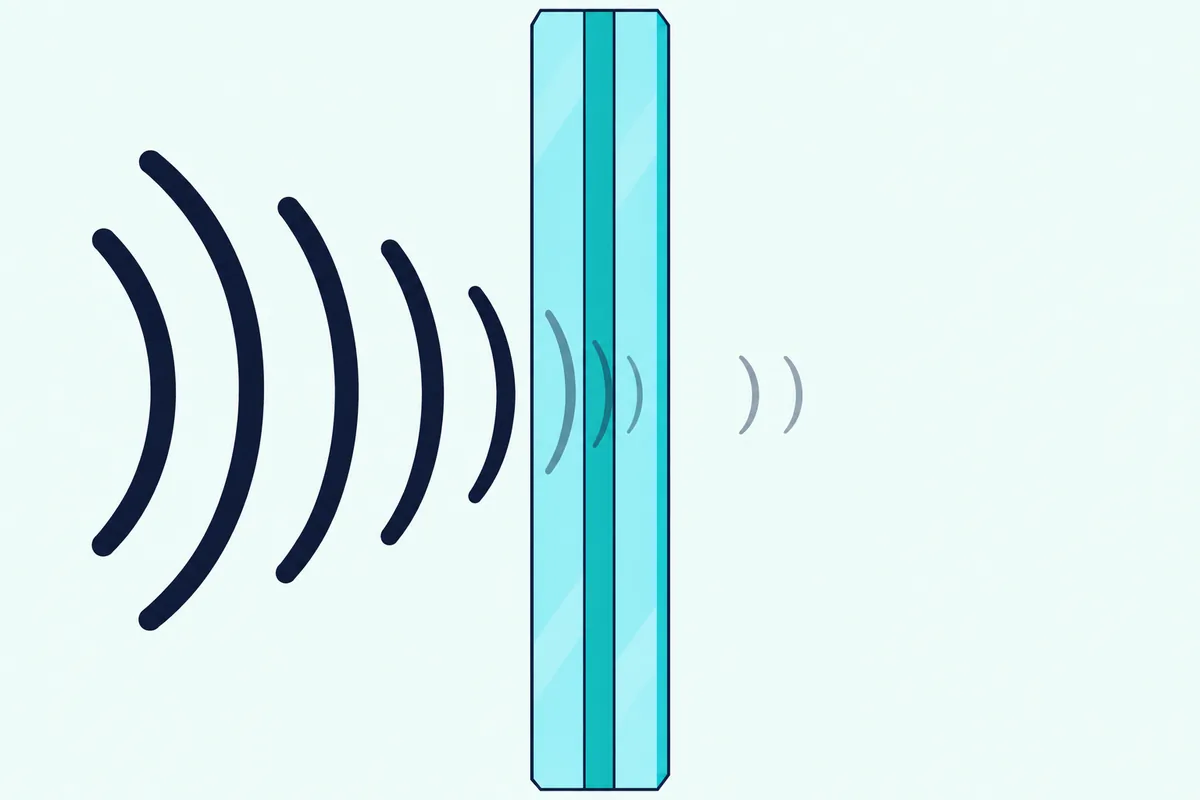
Andersen’s sound guidance makes the link directly: laminated glass is common in coastal windows, and its glass-interlayer-glass build reduces the vibration of the glass and so the sound passing through. NRC Canada’s window digest explains why: above a pane’s coincidence frequency, where bending waves let sound through plain glass, laminated glass can block far more, apparently because its plastic interlayers damp the vibration (NRC Canada).
It works like a hand pressed on a ringing bell. The same digest warns that the damping depends on temperature, and that in cold winters the gain from lamination may drop sharply, which matters more for coastal homes up north than in Florida.
The interlayer in impact glass has to pass the impact test first. Miami-Dade’s ES Windows approval lists four approved interlayers, Kuraray’s SentryGlas and Trosifol PVB, Eastman’s Saflex PVB and Chang Chun’s Winlite PVB, and Marvin uses either SentryGlas or PVB in its Impact Zone 3 glass depending on the size of the unit.
For the glass alone, our guide to whether soundproof glass actually works ranks laminated, tempered and double glazed builds by their lab ratings.
How Much Quieter Are Impact Windows Than Standard Double Pane?
That damping shows up in the table at the top as a steady gain. In Andersen’s tests, impact glass made the same window 4 to 6 STC points quieter than standard double pane glass, and 3 to 5 points better on OITC, the rating built around traffic and aircraft noise.
Guardian Glass translates ratings into loudness: each 10 points roughly halves the perceived volume, so a rating of 30 cuts a sound to about an eighth and 40 to about a sixteenth (Guardian Glass). By our arithmetic on that rule, a 5-point gain makes a noise sound roughly 30% quieter, a clear step but not a silent room.
Picture a casement bedroom window facing a busy road. Swapping Andersen’s standard glass for its Stormwatch impact glass takes it from STC 26 to 30 and OITC 22 to 26, and its laminated monolithic impact glass reaches 34 and 29.
That last option lands where Andersen’s scale says you’d hear a loud conversation outside without following it. For the full picture on ordinary units, Burton Acoustix’s guide to double pane window ratings covers why standard dual-pane glass stalls at STC 26 to 30.
Do Impact Windows Block Traffic Noise as Well as Voices?
Those OITC gains run smaller than the STC gains for a reason. Impact windows block traffic noise less well than voices: every impact window in Andersen’s report lists an OITC 3 to 6 points below its STC.
Andersen says STC measures indoor sounds like talking, TV and music, while OITC measures outdoor sounds like traffic, airplanes and construction. ASTM E413, which defines STC, says it isn’t appropriate for transportation noise, and ASTM E1332 builds OITC on road, aircraft and rail noise from 80 to 4,000 Hz (ASTM E1332).
Acoustic interlayers aim at the upper range as well. Eastman says its Saflex Acoustic PVB targets 1,000 to 4,000 Hz, a range human hearing is sensitive to (Eastman).
Guardian adds that the two ratings aren’t linearly related, so a strong STC doesn’t promise a similar OITC. If your noise is a highway’s rumble, compare OITC; if it’s voices and music next door, STC tells you more.
Why Can You Still Hear Noise Through Impact Windows?
That low-frequency weakness is the first reason impact windows still let noise in. You still hear noise because the narrow air gap in an insulating unit resonates at traffic frequencies, and because frames, seals and opening sashes let sound around even the best glass.
NRC Canada puts that resonance between 200 and 400 Hz for typical factory-sealed double glazing, the range where much of road and aircraft noise sits. A wider air space lowers it, and the digest finds the rating rises about 3 points each time the air space doubles.
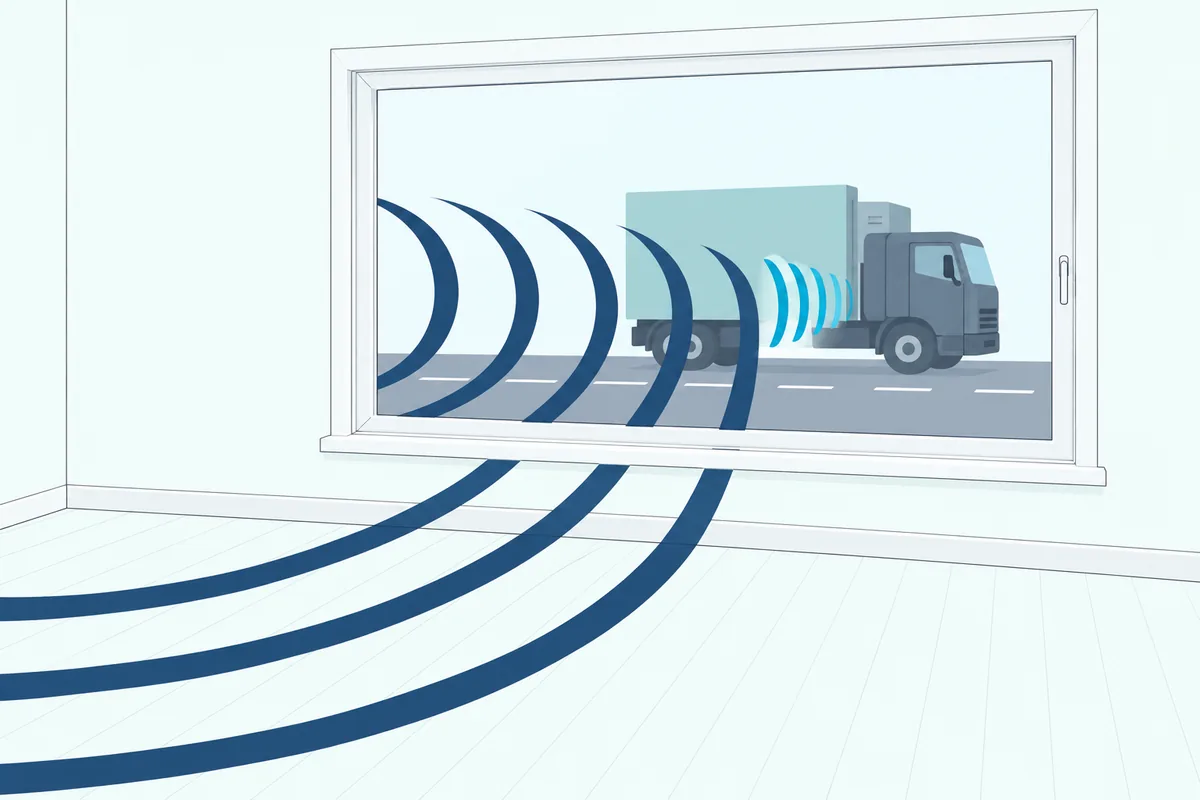
Openings cost more. NRC says a well weatherstripped openable window usually rates 3 to 5 points below the same window sealed shut, and that the higher a window’s rating, the more a given leak takes away.
Frames matter as well. NRC reports that some tests with lightweight metal frames gave lower ratings, apparently from vibration carried through the frame, which is worth knowing because impact windows such as the ES-P252 come in aluminum frames.
Then there’s the gap between a lab and your wall. ASTM E90 says its lab ratings are an upper limit to what would be measured in a field test, and Guardian notes a possible 6 dB loss between a lab sample and installed glazing, about a third of the perceived reduction.
Which Impact Windows Block the Most Noise?
Since the glass, the air gap and the seals all matter, the quietest impact windows get all three right. In Andersen’s tables, the best-rated impact window is a fixed picture window with laminated monolithic impact glass, at STC 37 and OITC 34, against 35 and 30 for insulating impact glass in the same frame.
That pattern holds in every frame with both: the laminated monolithic glass beats the insulating impact glass by 1 to 4 STC points. Andersen doesn’t give the glass thicknesses, but NRC’s digest notes that a small gap between two panes rates only slightly higher than one layer of the same glass, or even lower.
Glass makers’ tables show where the extra points come from. Guardian lists two 6 mm panes laminated with standard PVB at STC 36, the same as a single 12 mm pane, and the same two panes with acoustic PVB at STC 40, so much of a standard laminate’s gain is simply more glass.
Cardinal’s estimates for insulating glass with standard PVB rise from STC 32 for two plain 6 mm panes to 37 when one becomes a 7 mm laminate, and to 42 when the air space grows from 6.5 to 19.5 mm (Cardinal). Cardinal adds that argon filling has no measurable effect on sound.
Those are glass-only figures, so a finished window typically scores lower. Still, they point to four things to ask an impact window dealer for:
- An acoustic interlayer, not only a storm or structural one
- Panes of different thickness, which NRC finds most effective at a ratio of about 2
- The widest air space the frame allows
- Fixed glass wherever you don’t need the window to open
Eastman’s own lineup shows why the first item needs asking. It sells Saflex Storm for windborne debris, listing acoustic control as an added benefit, and a separate Saflex Acoustic interlayer built for sound that it says also meets impact standards, so ask whether the window’s approval covers it.
Is Non-Impact Laminated Glass Just as Quiet?
Those interlayer choices raise a fair question if you don’t need storm protection. Non-impact laminated glass matched Andersen’s impact glass within 2 STC points: 32 against 30 on the casement, 34 against 35 on the picture transom and 35 for both on the Flexiframe.
So most of the sound benefit comes from lamination, not from the impact approval. Andersen notes that its non-coastal laminated option usually laminates just one pane of the insulating unit.
That’s the inland case. If your building code doesn’t require impact protection and noise is your only goal, laminated glass gets you nearly the same STC without the storm rating.
Would a Storm Window Do the Same Job?
If laminated glass does most of the work, then a second layer of glass outside the window is the other classic fix. A storm window raises STC about as much as impact glass but does less for traffic: Andersen’s Tilt-Wash double-hung goes from STC 29 to 33 with its combination unit, a storm window and screen in one, while its OITC moves only from 24 to 25.
Laminated glass alone takes the same window to STC 32 and OITC 28. Add the combination unit to the laminated window and it reaches STC 37, with OITC still at 28.
So for traffic, the laminated glass did more than the extra pane in Andersen’s tests. The model codes FEMA summarizes require impact-resistant glazing or an impact-resistant covering, such as shutters, in windborne debris regions, so a storm panel only counts if it meets that standard (FEMA fact sheet, Town of Edisto Beach copy).
An interior pane adds a layer and an air space from the inside, and a sealed insert with a deep air space is the version you can add without replacing the window.
How Do You Check an Impact Window’s Sound Rating?
Whichever route you take, the rating on the quote still has to be the right kind of number. Ask for the STC and OITC of the whole window, tested to ASTM E90 and rated to E413 and E1332, with the test report number, because the impact approval won’t list them.
Andersen prints a report number beside every rating, and its coastal guide says its ratings represent the entire unit. Glass makers’ figures don’t: Cardinal and Guardian give estimates for the glass alone, and Eastman says all its SoundPro data is glass-only, tested without frames.
So a glass rating of STC 40 isn’t a window rating of STC 40. Cardinal says a finished window’s rating will typically come in lower than the base glass.
Keep the approval too. Miami-Dade’s approval says a copy must be given to the user and be available at the job site for the building official, so you can check the window against its approved drawings.
Try this before you buy: on a busy evening, close the windows you have and listen at the edges of each sash. If the noise is loudest at the edges, leaks are doing much of the damage, and the installation and seals of any new window matter as much as its glass.
Are Impact Windows Worth It Just for Noise?
Those checks lead to a simple rule. Impact windows are worth it for noise mainly when you need impact protection anyway, because non-impact laminated glass gave nearly the same STC in Andersen’s tests.
If your code requires them, choose the glass for sound as well: an acoustic interlayer, mismatched panes, a wide air space and fixed glass where you can live without ventilation. Then compare quotes by OITC if traffic is your problem.
If you’re inland, start with the smaller fixes: seal the gaps first, then try inserts before new glass, and our guide on how to soundproof existing windows walks through those steps in order.
The Bottom Line
Impact windows aren’t soundproof, and their impact approval says nothing about sound. In Andersen’s lab reports, though, their laminated glass rated 4 to 8 STC points above standard double pane glass in the same frames.
That gain comes from lamination, so it shrinks for traffic rumble, is eroded by leaks and is nearly matched by non-impact laminated glass. Ask for the whole window’s STC and OITC, with the report behind them, before you pay for quiet.
Frequently Asked Questions
Do impact windows reduce noise?
Yes, but by a measurable amount rather than to silence. In Andersen’s 400 Series acoustic report, Stormwatch impact glass rated 4 to 6 STC points above standard dual-pane glass in the same windows, and its laminated monolithic impact glass 6 to 8 points above. Traffic ratings improved less, by 3 to 5 OITC points for the insulating impact glass.
What are the negatives of impact windows?
For noise, the main negatives are what the label leaves out. The impact approval includes no sound test, the OITC traffic ratings run 3 to 6 points below STC, and the narrow air gap in insulating units resonates where traffic noise sits. ASTM E1886 can also allow broken glass in a passing test, so a pane that cracks in a storm has done its job but still needs replacing.
Can impact windows withstand Category 5 hurricanes?
Impact windows aren’t rated by hurricane category. The National Hurricane Center starts Category 5 at sustained winds of 157 mph, while window ratings are written as a design pressure in pounds per square foot plus the missile test passed. Andersen says building codes set the design pressure from wind zone, building height, exposure and other factors, so ask what your address requires and check the rating against it.
Are hurricane windows and impact windows the same?
Yes, the names describe the same product: windows built to resist windborne debris and wind pressure, such as the impact-rated lines Marvin sells as hurricane impact windows. A storm window is different. It’s a separate pane added to an existing window, like Andersen’s storm window and screen combination unit.
Do impact windows block low bass and engine rumble?
Less than they block voices. NRC Canada places the resonance of typical sealed double glazing at 200 to 400 Hz, where much traffic noise sits, and every Andersen impact rating lists OITC below STC. Laminated monolithic impact glass, a wider air space and mismatched panes all help, but no window removes deep rumble entirely.
Does impact glass have to stay unbroken to pass?
No. ASTM E1886 lets the specifying authority’s criteria allow deformation, deflection or glass breakage, and ASTM E1996 judges whether the opening remains unbreached. Eastman says laminated glass made with its storm interlayer is designed to retain glass shards after breakage, which is how a cracked window can still keep the opening closed.