How to Soundproof a Home Gym From the Floor Up
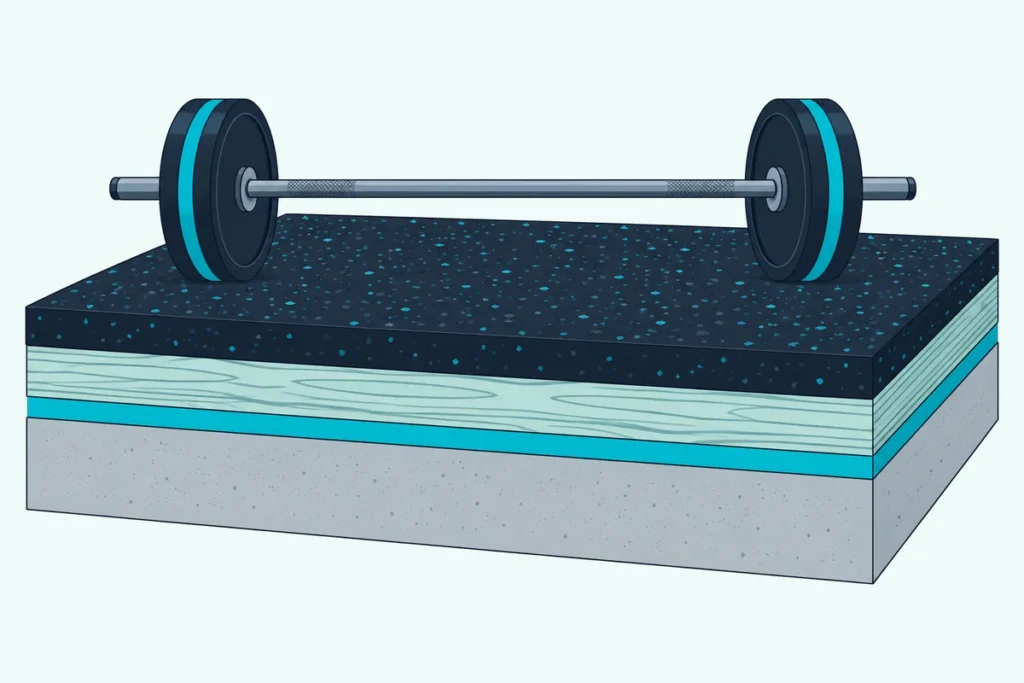
If you’re working out how to soundproof a home gym, start with the floor, because dropped weights, treadmill strides and jump-rope landings push their noise into the structure, not the air.
That’s why the room below gets a deep thud from every landing, and why foam on the walls or a closed door changes so little for the people in it.
Get the layers right and the gap is large: in one flooring maker’s tests, a 100-lb kettlebell falling 18 inches measured 98 dBA on one of its surfaces and 65 dBA on its sound-control tile.
This guide sets out the full order, from choosing the room to rubber, thick tiles, a floating platform and treadmill pads, with music and echo last.
The six steps come first, then the lab numbers behind each and a drop test you can run on your floor.
How to Soundproof a Home Gym in Six Steps
That order holds whether the gym is in a garage, a basement or a spare bedroom, and the table below sums it up. To soundproof a home gym, put the heavy work on the lowest, heaviest floor you have, cover the floor in rubber, go thick where weights land, float the lifting zone, isolate the treadmill, then deal with music and echo.
| Step | What to do | What the lab numbers say |
|---|---|---|
| 1 | Put the gym on a concrete slab, away from bedrooms | Wood-joist floors pass thumps below 100 Hz that the usual IIC rating doesn’t count (NRC Canada) |
| 2 | Cover the floor with rubber | A thin rubber mat cut tapping noise by 40 dB at 2,000 Hz but changed it by under 2 dB from 100 to 160 Hz (University of Salford) |
| 3 | Go thick where weights land | A 100-lb weight measured 95 dB on a 30 mm tile, 84 dB on 70 mm and 80 dB on 100 mm (Pliteq) |
| 4 | Float the lifting zone | The same 70 mm tile on 3/4-inch plywood over a resilient mat measured 72 dB (Pliteq) |
| 5 | Put the treadmill on isolation pads | Pads under the feet took about 14 dB off a 40 Hz rumble that 3/4-inch rubber left behind (Pliteq) |
| 6 | Treat music and echo last | Absorption tames echo inside the room, and mass is what blocks airborne sound (ECORE) |
Steps 1 to 3 need no construction, while steps 4 and 5 add layers for heavy drops and machines over living space. Step 6 is for the stereo and the echo, which travel by air rather than through the floor.
Why Does Gym Noise Travel Through the Floor?
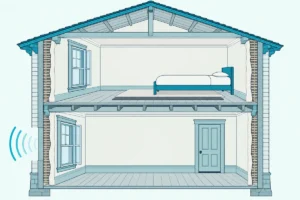
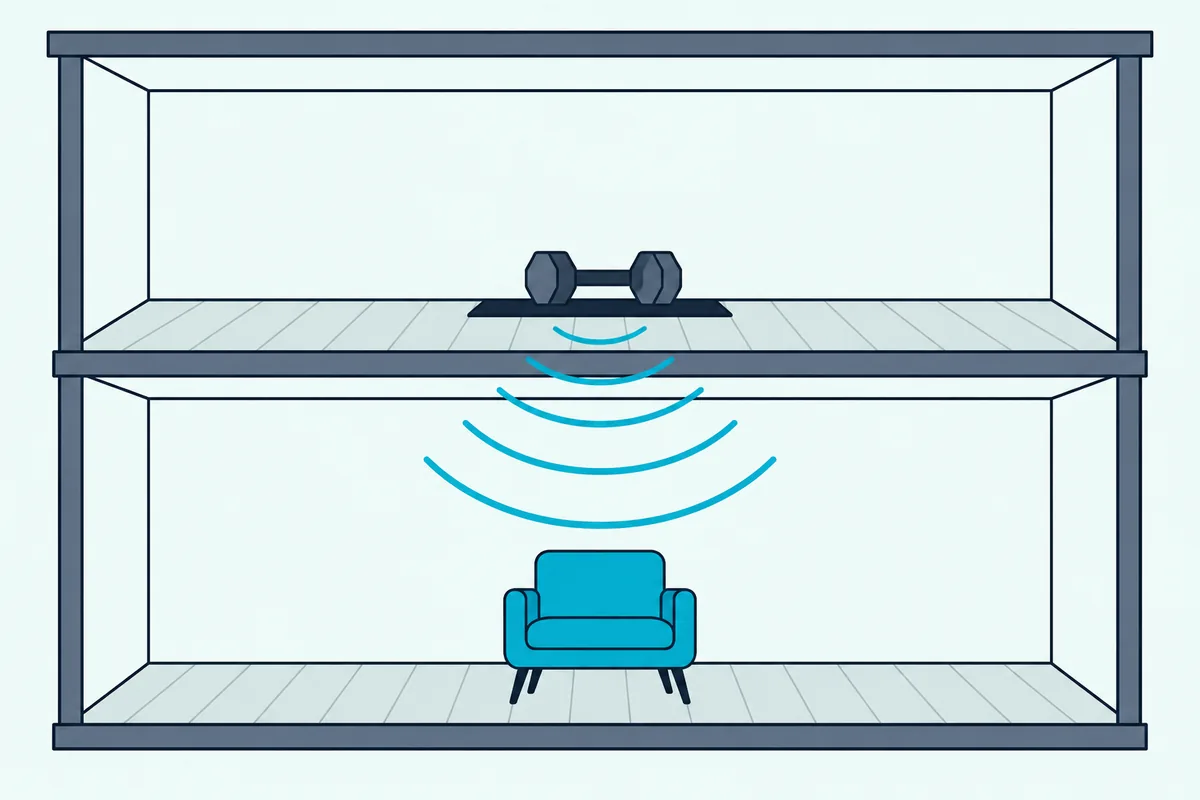
Those six steps start at the floor because of where a gym’s noise begins. Gym noise travels through the floor because most of it starts as an impact, and ECORE, a maker of gym flooring, explains that a falling weight’s energy goes back into the weight as a bounce, into the room and the room below as impact sound, and into the floor as heat (ECORE).
Think of the floor as a drum skin and the ceiling below as a speaker cone: the hit happens upstairs, but the sound is made by the structure shaking underneath. ECORE’s white paper on athletic flooring adds that dropped items and pounding are low-frequency sounds, and that a class’s music can reach the office below as nothing but the thumping bass line.
Canada’s National Research Council describes the same split by floor type (NRC Canada, via the AIVC library’s copy). On a concrete slab with a hard finish, impacts sound like a click, a cluck or a sharp tap, and on a lightweight wood-joist floor they sound like a thump, a boom or a thud, with most of the energy at low frequencies.
That difference decides which fixes work. A soft layer on top takes the sting out of a click, but a boom is the floor itself moving, and the next section shows how little thin rubber does about it.
Get Studio Tips Weekly
Join 5,000+ creators getting acoustic treatment advice every week.
No spam. Unsubscribe anytime.Can a Rubber Mat Stop a Dropped Weight’s Thud?
That click-versus-boom split is exactly where thin rubber helps and where it stops. A thin rubber mat removes the sharp click but barely touches the thud: in a 2020 lab test at the University of Salford, a rubber mat weighing 5 kg per square meter cut the tapping noise reaching the room below by 40 dB at 2,000 Hz and changed it by under 2 dB from 100 to 160 Hz (University of Salford).
Here’s how lopsided that result was, band by band, on the lab’s heavyweight standard floor:
| Frequency | What you hear there | Reduction from the rubber mat |
|---|---|---|
| 100 Hz | The deep thud | -0.6 dB (slightly louder) |
| 125 Hz | The thud | 0.4 dB |
| 250 Hz | The body of the knock | 5.4 dB |
| 500 Hz | The knock | 8.6 dB |
| 1,000 Hz | The click | 16.4 dB |
| 2,000 Hz | The sharp click | 40.1 dB |
The lab’s single-number rating for that sample was a 17 dB reduction, which sounds solid until you see that the big reductions all sit above 500 Hz. The middle column is a rough guide to what each band sounds like, not part of the lab report.
ECORE’s acoustic engineer Mike Raley makes the same point about weights: it takes a lot of deflection, or “squish,” to manage a falling weight’s energy, and thin rubber floors aren’t up to the task when you need a big cut in impact noise (ECORE). None of the 3/4-inch rubber mats checked for this guide, stall mats included, lists an impact rating, so a mat’s effect on a dropped deadlift stays a guess until you test it on your floor.
Carpet with a good pad scores far higher on footstep tests, and our guide to the best carpet and pad for soundproofing breaks down its lab ratings. For a workout floor, though, ECORE’s white paper calls carpet seldom a good choice.
How Thick Should Home Gym Flooring Be?
That leaves thickness, since thin rubber can’t soak up a falling weight. For dropped weights, think in inches rather than millimeters: Pliteq puts its 70 mm (2 3/4-inch) tile under free weights, and in its tests on a 6-inch concrete slab, a 100-lb hard weight measured 95 dB in the 63 Hz octave band on its 30 mm (1 1/4-inch) tile, 84 dB on the 70 mm tile and 80 dB on its 100 mm (4-inch) tile (Pliteq).
The rest of Pliteq’s range follows the same logic. Its 8 mm (5/16-inch) roll is for group fitness areas, spinning studios and locker rooms, the 30 mm tile for cardio, personal training and machine areas, the 70 mm tile for high-impact studios as well as free weights, and its thicker xFIT tiles for CrossFit and Olympic lifting.
Pliteq rates the 70 mm tile for 100-lb drops from about 3 feet, and its brochure explains why thickness works: extending the contact time and lowering the peak force reduces the sound. It’s the same reason you bend your knees when you land a jump, since a longer stop means a smaller jolt.
ECORE’s May 2026 performance summary tells the same story in A-weighted decibels, for surfaces whose build ECORE describes:
| ECORE surface | Build, per ECORE | 16-lb shot from 39 3/8 in. | 50-lb kettlebell from 18 in. | 100-lb kettlebell from 18 in. |
|---|---|---|---|---|
| RageTurf Rally | Turf on a 12 mm base layer | 87 dBA | 88 dBA | Not tested |
| Performance Modzilla (1″) | A 1-inch system | 80 dBA | 79 dBA | 89 dBA |
| Performance Modzilla (42.5 mm) | A 42.5 mm system | 69 dBA | 69 dBA | 74 dBA |
| RageTurf dBTile | Turf molded to a 2.5-inch base layer | 62 dBA | 58 dBA | 65 dBA |
Each step up in thickness bought 7 to 11 dBA for the 16-lb shot, and the 2.5-inch tile finished 25 dBA below the 12 mm turf. The two makers measure differently, Pliteq in the 63 Hz band and ECORE as an overall A-weighted level, so compare rows within one table, never across them.
Does a Higher IIC Mean a Quieter Gym Floor?
Those tables exist because the rating printed on most flooring, IIC (impact insulation class), doesn’t come from a falling weight at all. A higher IIC doesn’t promise a quieter floor under weights, because IIC comes from a tapping machine with five steel-faced hammers, and ECORE’s white paper says IIC tests address light impacts like footfall during a dance class.
ECORE’s own summary shows the gap. Its FlexTurf Monster (10 mm) has the highest delta IIC on the sheet, 39, yet measured 88 to 95 dBA under the heavy drops, while Performance dBTile, at delta IIC 29, measured 60 to 65 dBA.
Delta IIC is also measured on a bare 6-inch concrete slab, and ECORE warns the result may not apply directly to other structures. NRC Canada saw the same effect: vinyl added 8 IIC points on concrete and none on a basic wood-joist floor, and a wood floor floated on strapping added 30 on concrete but only 10 on joists.
The rating also has a floor of its own, because the IIC calculation covers 100 to 3,150 Hz, and NRC says the thumping of footsteps on a lightweight joist floor sits below 100 Hz. That’s why people under joist floors complain about booming even when the floor rates above IIC 50, the level NRC calls the usual minimum for occupant satisfaction.
Mat-only ratings deserve the most suspicion. Second Skin’s spec sheet for its Stomp Mat lists IIC 69 and STC 59 without naming the floor it was tested on, while ECORE’s white paper points out that every rating belongs to a whole assembly, never to one material.
So for a gym, look for a heavy-weight drop test that names the weight, the height and the floor. Treat IIC as a footstep number.
What Does a Floating Platform Add Under the Weights?
When thickness alone runs out, the next layer is separation, and that’s what a floating platform adds. A floating platform puts a rigid layer on a resilient one so an impact spreads out before it reaches the structure: in Pliteq’s tests, its 70 mm tile on 3/4-inch plywood over its GenieMat FF70LDM resilient underlayment measured 72 dB for the 100-lb drop, against 84 dB for the tile alone.
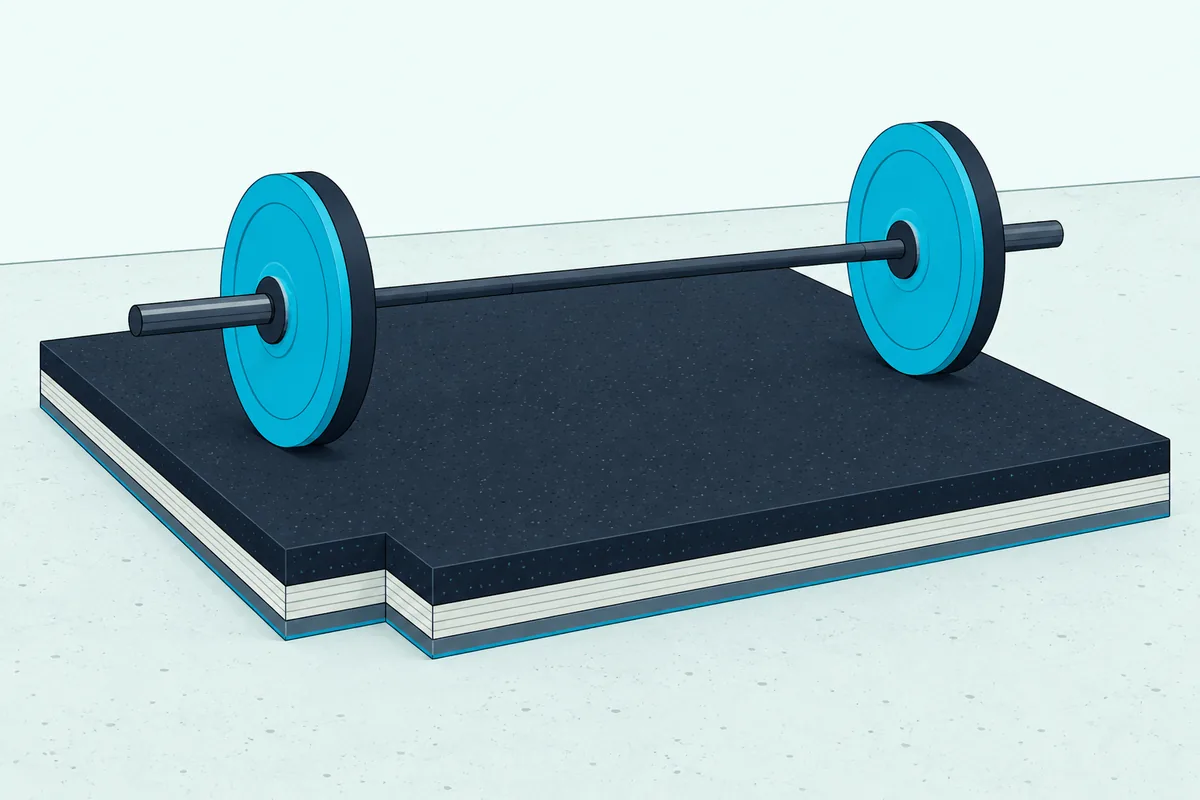
Pliteq calls this a hybrid system: the tile deflects locally under the weight, while the plywood on its resilient layer deflects over a wider area. Its brochure says the combination suits rhythmic loads such as dance studios and treadmill bays, too.
Here’s how Pliteq’s assemblies compared, all on a 6-inch concrete slab with no ceiling, measured in the 63 Hz octave band:
| Assembly | 15-lb hard weight | 100-lb hard weight |
|---|---|---|
| 30 mm tile alone | 84 dB | 95 dB |
| 70 mm tile alone | 81 dB | 84 dB |
| 100 mm tile alone | 80 dB | 80 dB |
| 70 mm tile on 3/4-inch plywood and an FF70 underlayment | 80 dB | 76 dB |
| 70 mm tile on 3/4-inch plywood and an FF70LDM underlayment | 74 dB | 72 dB |
| Bare 3/4-inch plywood on sleepers and springs | 74 dB | 89 dB |
The spring-mounted plywood shows why the top layer still matters. It matched the best assembly in this table with the 15-lb weight, then let the 100-lb weight reach 89 dB with no tile to cushion it.
A home-built lifting platform borrows the same idea, with rubber on top, plywood in the middle and a resilient layer underneath. No lab number in this guide covers a homemade version, though, so judge yours with the drop test further down.
NRC Canada says floating floors must be carefully installed to work, and its advice applies to a platform as well. A resilient edge strip keeps vibration from reaching the walls, and the baseboard shouldn’t touch the floating floor, since either contact gives sound a path around the resilient layer.
Where Should a Home Gym Go in the House?
All of those layers work better on a heavy floor, which makes the room you pick the cheapest fix on this list. Put the gym on the lowest, heaviest floor you have, ideally a concrete slab on the ground, and away from rooms over or beside bedrooms.
NRC Canada’s numbers show why weight matters. On a simple wood-joist floor, each doubling of the total mass of the subfloor and ceiling adds about 7 IIC points, and NRC notes that a heavier floor is less likely to vibrate when walked on.
ECORE’s engineer adds that fitness centers usually sit on concrete slabs, unlike the wood-joist floors typical of single-family homes. That’s one reason a spare bedroom upstairs is the hardest place to put a home gym, and why the joist-floor caveats from the IIC section keep coming back.
A garage gym on a slab has the floor on its side, and its weak spot is usually the roll-up door, which lets music and the clang of plates out to the street. Burton Acoustix’s garage door and wall guide ranks those weak paths, and on a slab the door work comes before any floor upgrade beyond rubber.
An apartment’s floor is rated for light impacts. HUD’s guide to noise control in multifamily dwellings, prepared for the Federal Housing Administration by the National Bureau of Standards, set floor-ceiling criteria of IIC 55, 52 and 48 for its three grades, and IIC comes from the tapping machine, not from a falling weight.
So in an apartment, plan around no drops at all and the thickest floor you’re allowed to lay. If a complaint has already arrived, this guide for the people living under a noisy floor shows what they can and can’t fix from below.
How Do You Quiet a Treadmill or Rower?
Weights aren’t the only impact source, and a treadmill pounds the floor for as long as you run. Put a treadmill on a rubber mat and on isolation pads under its feet: in a field measurement in Pliteq’s brochure, a running treadmill on one layer of 3/4-inch rubber left a peak near 40 Hz about 20 dB above the room’s ambient level, and with Pliteq’s TMIP pads under the feet that peak fell by about 14 dB.
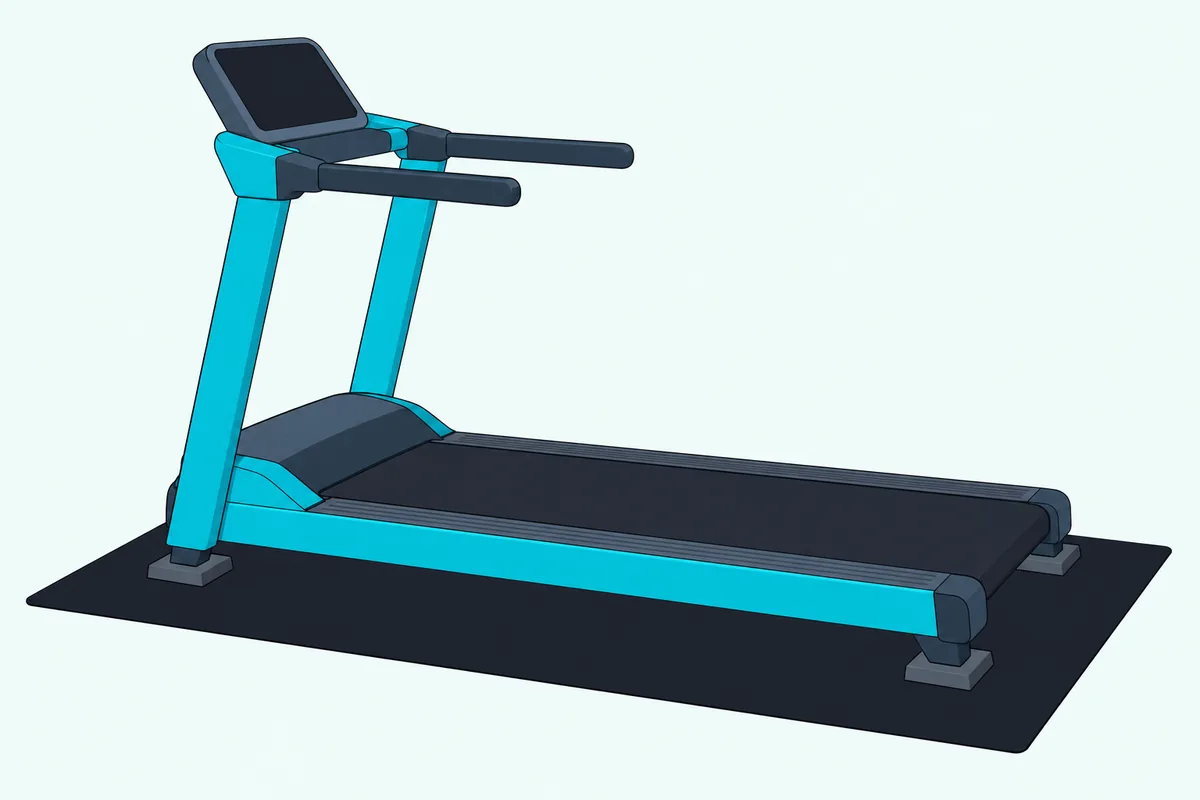
Above about 80 Hz, the three lines in that chart sit almost on top of each other. So the treadmill’s problem in that test was a low rumble, in the same deep range the Salford mat barely touched.
Pliteq’s pads are 2 inches thick, with one under each of the four feet, and the spec gives their deflection for a 100-lb and a 300-lb user. Pliteq says vibration isolation up to 99% and more than 40 dB of noise reduction are commonly achieved, but the chart above is the measured case it publishes, so plan on the smaller number.
Bikes, rowers and ellipticals follow the same logic. Pliteq puts its 30 mm tile under cardio and machine areas and its 8 mm roll in spinning studios, and ECORE lists treadmill footfall alongside dumbbells, footsteps and battle ropes as falling-object impacts.
Placement matters too. Keep cardio machines on the slab or over the least-used room, and leave a gap between each frame and the wall, for the same reason NRC keeps floating floors off the walls.
Which Lifting Habits Cut the Most Noise?
Floors and pads handle the energy that reaches them, but the cheapest decibels are the ones you never make. Lower drops and lighter landings cut the noise at the source: ECORE’s engineer writes that the higher you drop a weight, the harder it hits the floor, and in ECORE’s table the 100-lb kettlebell read 5 to 10 dBA louder than the 50-lb one from the same 18 inches.
So lower the bar to the floor when the set allows it, and save drops from overhead for daytime. Bumper plates and rubber-coated dumbbells put rubber, not iron, on the floor at each landing.
Jump rope, box jumps and burpees are footstep-style impacts repeated over and over. Land softly on the thickest part of the floor, and do them over the slab rather than above a bedroom.
Music is airborne, and its bass is what travels. ECORE’s white paper notes that only the thumping bass line reaches the office below a class, and headphones remove that problem entirely.
Time the loud work, too. Heavy singles, drops and plyometrics fit the afternoon, while stretching, bands and bodyweight work suit early mornings and late nights.
Do Acoustic Panels Soundproof a Gym?
That music point brings up the product most people buy first. Acoustic panels don’t soundproof a gym: they absorb sound inside the room, which tames the echo off hard walls, but they add little mass, so impact and music still reach the next room.
Absorption still has a job: panels reduce echo and reverberation in a room full of hard surfaces, and ECORE’s white paper notes that parallel hard walls can create flutter echoes. If the echo is the real complaint, Burton’s guide on where to place acoustic panels in a gym starts with the ceiling and the upper walls.
Mass is what blocks airborne sound, and ECORE’s white paper puts it plainly: STC is significantly affected by mass and typically not by flooring. So mass loaded vinyl or extra drywall belongs on the walls and ceiling when music is the issue, never under the barbell.
HUD’s same multifamily guide asked for walls rated STC 55, 52 or 48 between units, matching its floor grades. Whatever you add, close the gaps around doors, vents and outlets, since sound slips through any opening.
How Can You Test Your Gym Floor at Home?
Every number so far comes from a lab, and your floor will behave in its own way, so test it before you buy the expensive layer. Run a repeatable drop test: drop the same dumbbell with its handle vertical, from the same height measured from the top of each surface, onto the same spot, while someone listens in the room below.
ECORE’s Mike Raley recommends the vertical handle because a hex dumbbell dropped flat can rock and land differently each time. He cites a 2015 InterNoise paper by John LoVerde and colleagues at Veneklasen that found horizontal drops gave poor repeatability.
- Drop on the bare floor three times to set a baseline.
- Lay each sample and repeat, standing with your back straight and knees and elbows locked so the height stays steady.
- Measure the height from the top of each sample, since a 2.5-inch tile raises the floor.
- Keep the spot fixed and swap the samples, rather than lining them up across the room.
That last rule matters because a slab vibrates in different patterns depending on where it’s hit. Raley compares it to Ernst Chladni’s sand patterns on a vibrating metal plate, where moving the bow changes the whole pattern.
Ask your listener which part changes. If the click fades but the boom stays, you need thickness or a floating layer, not another thin mat.
Which Rubber Flooring Should You Buy for a Home Gym?
Once your own drops have told you where the noise is, the rubber itself is easy to shop for. Buy it by thickness for the job: a 3/4-inch mat where weights land or as a platform’s top layer, 3/8-inch interlocking tiles for a cardio and bodyweight floor, and a mat under the treadmill to protect the floor beneath it.
None of the three listings below publishes an impact rating, so treat them as the floor’s working surface, not its isolation. For heavy drops over living space, look to the engineered tiles in the Pliteq and ECORE tables, sold through project inquiries and sales reps rather than Amazon, where neither turned up in searches on 7 October 2026.
Each pick had at least 4.0 stars and 50 reviews on Amazon and was in stock on 7 October 2026, and no prices appear because they change often.
For Where the Weights Land
For a deadlift spot or a platform’s top layer, American Floor Mats’ 3/4-inch Ultimate Stand-Alone Gym Mat is the straightforward slab of rubber.
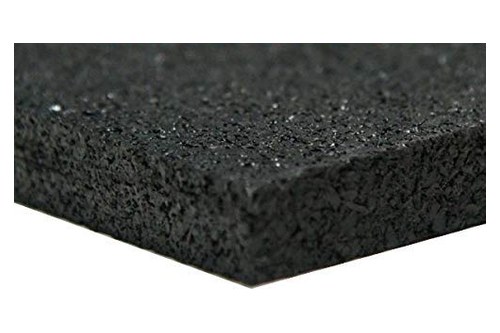
American Floor Mats’ 3/4-inch Ultimate Stand-Alone Gym Mat
American Floor Mats describes it as an indestructible rubber mat for aerobic and weight-lifting areas, sold as one 4 x 6 ft piece. On its own it protects the floor and softens the clang, and on a platform it becomes the top layer over the plywood and the resilient mat.
For a Whole Cardio or Bodyweight Floor
For covering a room wall to wall, American Floor Mats’ Fit-Lock 3/8-inch rubber tiles lock together into one surface.
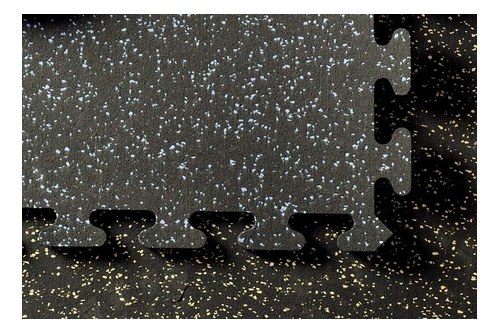
American Floor Mats’ Fit-Lock 3/8-inch rubber tiles
American Floor Mats makes them from commercial-grade recycled rubber and says they lay flat and are non-porous. Use them for cardio, bands and bodyweight work, and put the 3/4-inch mat or a platform on top where weights come down.
Under a Treadmill
For the floor under a treadmill, Rubber-Cal’s Treadmill Mat covers the whole footprint.
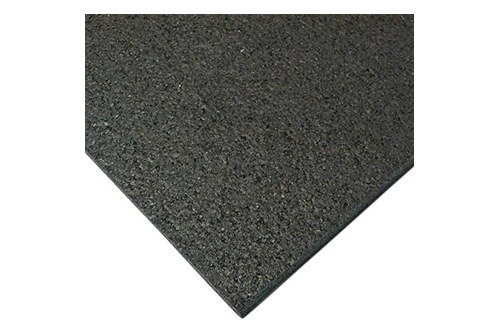
Rubber-Cal’s Treadmill Mat
Rubber-Cal lists it at 3/16 inch thick, molded from recycled tire crumb with a high EPDM content. Treat it as floor protection under the treadmill and its isolation pads, not as the fix for the rumble.
Which Setup Fits Your Gym?
Those three mats slot into the six steps from the top of this guide, and the right stack depends on what you drop and what’s under the floor. A slab with nothing below needs far less than a wood floor over a bedroom, so build for the worst case in your room.
| Your gym | What carries the noise | Floor | Also do |
|---|---|---|---|
| Garage on a slab | Clang and music through the roll-up door | 3/4-inch rubber where weights land | Seal the door and keep the music down |
| Basement on a slab | Drops into the slab, music up through the ceiling | 3/4-inch rubber, a platform for heavy drops | Add mass to the ceiling for music |
| Spare room over a wood-joist floor | Low thuds into the ceiling below | A floating platform or the thickest tiles, pads under the treadmill | No drops from overhead, and train over the least-used room |
| Apartment | Drops and strides into a neighbor’s ceiling | The thickest tiles allowed and a platform for lifting | No drops at all, and talk to the neighbor first |
| Cardio only | Treadmill rumble below about 80 Hz | Rubber mat plus isolation pads | Keep frames off the walls |
The wood-joist rows are the hard ones, for the reasons NRC Canada gives. If you can only change one thing, move the heavy lifting downstairs.
The Bottom Line
Every row in that table comes back to where this guide started: a home gym’s noise goes into the floor first. Rubber takes out the click, thickness and a floating layer take out more of the boom, and pads under a treadmill deal with its rumble.
Read flooring claims with a drop test in mind rather than an IIC, and run your own drop test before you buy the expensive layer. Put the heaviest work on the slab, and save acoustic panels for the echo they’re made for.
Frequently Asked Questions
Can you completely soundproof a home gym?
Not against heavy drops, and nothing in the lab data here reaches silence. Even the quietest assembly for the 100-lb drop in Pliteq’s table, a 70 mm tile on 3/4-inch plywood over a resilient underlayment, still measured 72 dB in the 63 Hz band on a concrete slab. What you can do is move the loud work to a slab, cushion and float the lifting zone, isolate the treadmill and keep music on headphones, which together take most of the sting out for the people around you.
Do horse stall mats reduce noise from dropped weights?
They protect the floor and take the edge off the clang, but none of the 3/4-inch stall mats checked for this guide lists an impact rating. The University of Salford’s thin rubber sample shows what thin rubber tends to do: a big cut in high-frequency noise and almost none from 100 to 160 Hz. For heavy drops over living space, a stall mat works best as the top layer of a platform, with plywood and a resilient layer beneath it.
How do you soundproof a gym floor in an apartment?
Assume the building’s floor is fixed and work on top of it: interlocking rubber over the whole area, a floating platform or the thickest tiles you can fit where weights land, and isolation pads under a treadmill. Then remove the worst impacts entirely, with no drops from overhead and soft landings. HUD’s multifamily noise guide set floor-ceiling targets of IIC 48 to 55, and IIC is a tapping-machine rating, so even a well-built apartment floor was judged on light tapping, not on a falling barbell.
Does carpet help soundproof a gym?
Carpet with a pad is excellent for footsteps, and NRC Canada lists carpet and underlay at IIC 75 to 85 on a 150 mm concrete slab. It’s a poor gym surface, though, and ECORE’s white paper calls carpet seldom a good choice for fitness rooms because it doesn’t wear well, is easily damaged by equipment and holds sweat and odors. Use rubber where you train and keep carpet for the rooms around it.
What material cancels sound?
No material cancels sound. The ones that help a gym either soften impacts, add mass or separate layers: rubber and resilient pads soften the hit, heavy layers such as plywood or concrete add mass, and a resilient layer between them decouples the floor, which is how the best-performing assemblies in Pliteq’s table are built. Cancelling is an electronic trick found in noise-cancelling headphones, which is one more reason to wear them for loud music.