What Frequencies Does Acoustic Foam Absorb? Complete Technical Guide
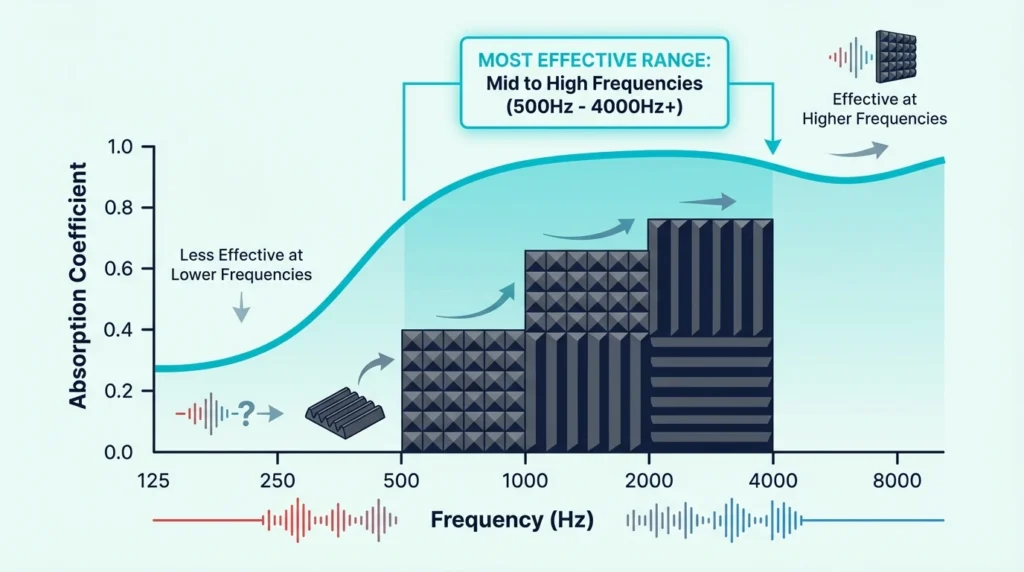
What frequencies does acoustic foam absorb? Standard 2-inch acoustic foam absorbs mid and high frequencies most effectively—roughly 500Hz to 8000Hz—but it provides minimal absorption below 250Hz because the wavelengths in a room are simply too long for thin panels to catch. Thicker foam extends absorption lower, but even 4-inch panels struggle with true bass.
That’s usually the cause of frustration after treating a room: the echo and harshness improve, but the boomy low end bouncing off walls stays untouched.
You’ll find the science behind foam absorption below, plus how thickness affects frequency response and when you need different solutions. Start with the quarter-wavelength rule, then match foam to your specific problems.
For a broader overview, see our guide on how acoustic foam works.
Acoustic foam absorption by thickness:
- 1-inch foam: Absorbs 1000Hz-8000Hz+ (best for high frequency flutter echo)
- 2-inch foam: Absorbs 500Hz-8000Hz+ (best for vocals, speech, general treatment)
- 3-inch foam: Absorbs 350Hz-8000Hz+ (best for music recording, fuller absorption)
- 4-inch foam: Absorbs 250Hz-8000Hz+ (best for extended range, low-mid control)
Key insight: Foam thickness must be approximately 1/4 wavelength of the lowest frequency you want to absorb. Bass frequencies (under 250Hz) have wavelengths too long for practical foam thickness—you need bass traps for low frequencies.
The Science of Foam Absorption
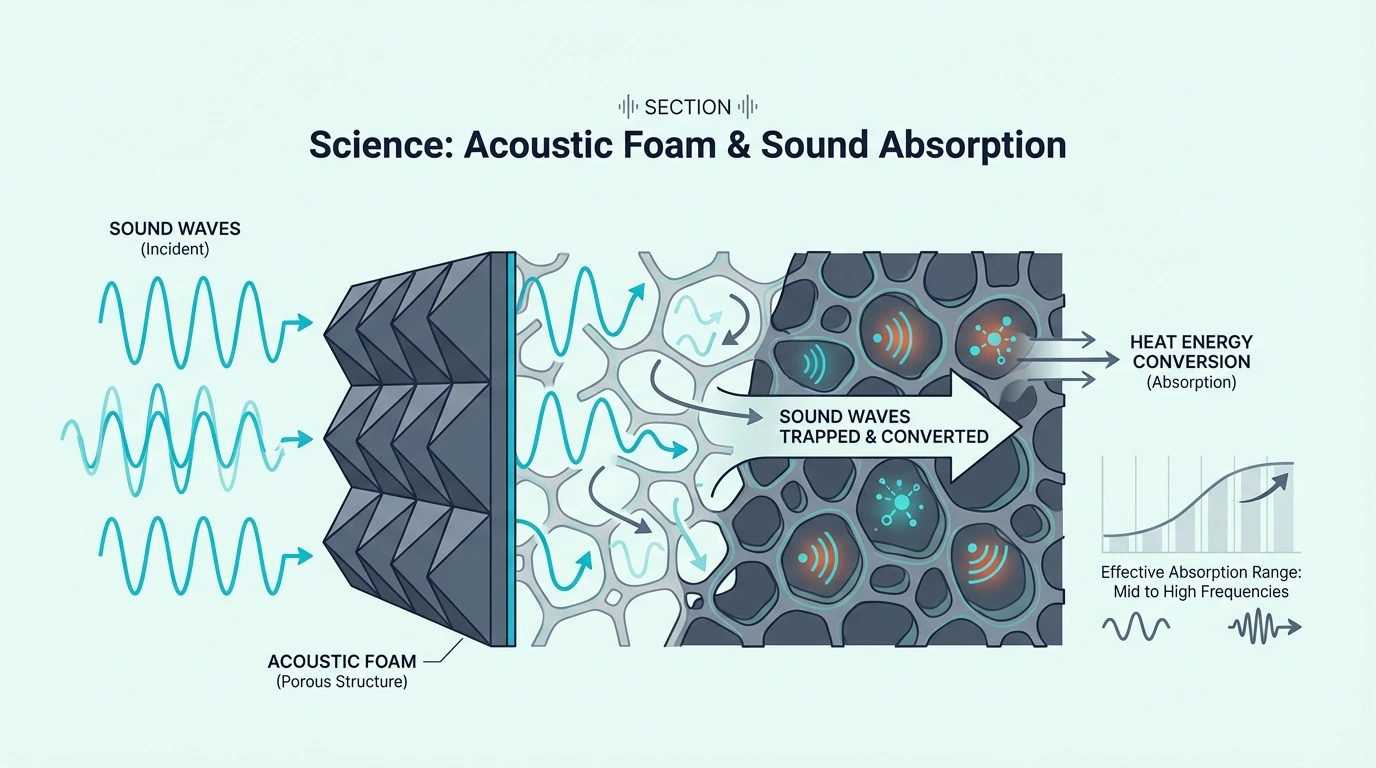
Acoustic foam absorbs sound through a specific physical mechanism. Understanding this explains why foam works well for some frequencies and poorly for others.
How Foam Converts Sound to Heat
Sound waves are pressure variations traveling through air. When these waves enter acoustic foam’s open-cell structure, air molecules move back and forth within the tiny pores and channels.
This movement creates friction between the air and the foam’s cell walls. Friction converts kinetic energy (sound) into thermal energy (heat)—though the temperature increase is far too small to notice.
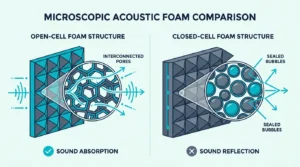
The more the air moves within the foam, the more friction occurs, and the more sound gets absorbed. This is why porous, open-cell materials absorb sound while solid, closed-cell materials reflect it.
Why Thickness Matters
Here’s the critical physics: sound absorption is most effective when the absorber is approximately 1/4 the wavelength of the sound being absorbed.
A 1000Hz tone has a wavelength of about 1.1 feet. One-quarter of that is about 3.3 inches—so 3-4 inch foam absorbs 1000Hz very effectively.
A 100Hz tone has a wavelength of about 11.3 feet. One-quarter of that is nearly 3 feet. No practical foam panel is 3 feet thick, which is why standard foam can’t absorb bass frequencies.
This relationship between thickness and wavelength is fundamental. It’s not a limitation of cheap foam versus expensive foam—it’s physics that applies to all porous absorbers.
The Quarter-Wavelength Rule
The quarter-wavelength rule provides a simple way to estimate foam effectiveness:
Minimum effective frequency ≈ 1130 / (4 × thickness in feet)
For 2-inch foam (0.167 feet): – 1130 / (4 × 0.167) = 1130 / 0.668 ≈ 1692Hz
This means 2-inch foam reaches peak absorption around 1700Hz and above, with decreasing effectiveness at lower frequencies. It still provides some absorption down to about 500Hz, but performance drops significantly below that.
For 4-inch foam (0.333 feet): – 1130 / (4 × 0.333) = 1130 / 1.332 ≈ 848Hz
Thicker foam extends the effective range lower, but even 4-inch panels don’t reach true bass frequencies.
Frequency Absorption by Foam Thickness
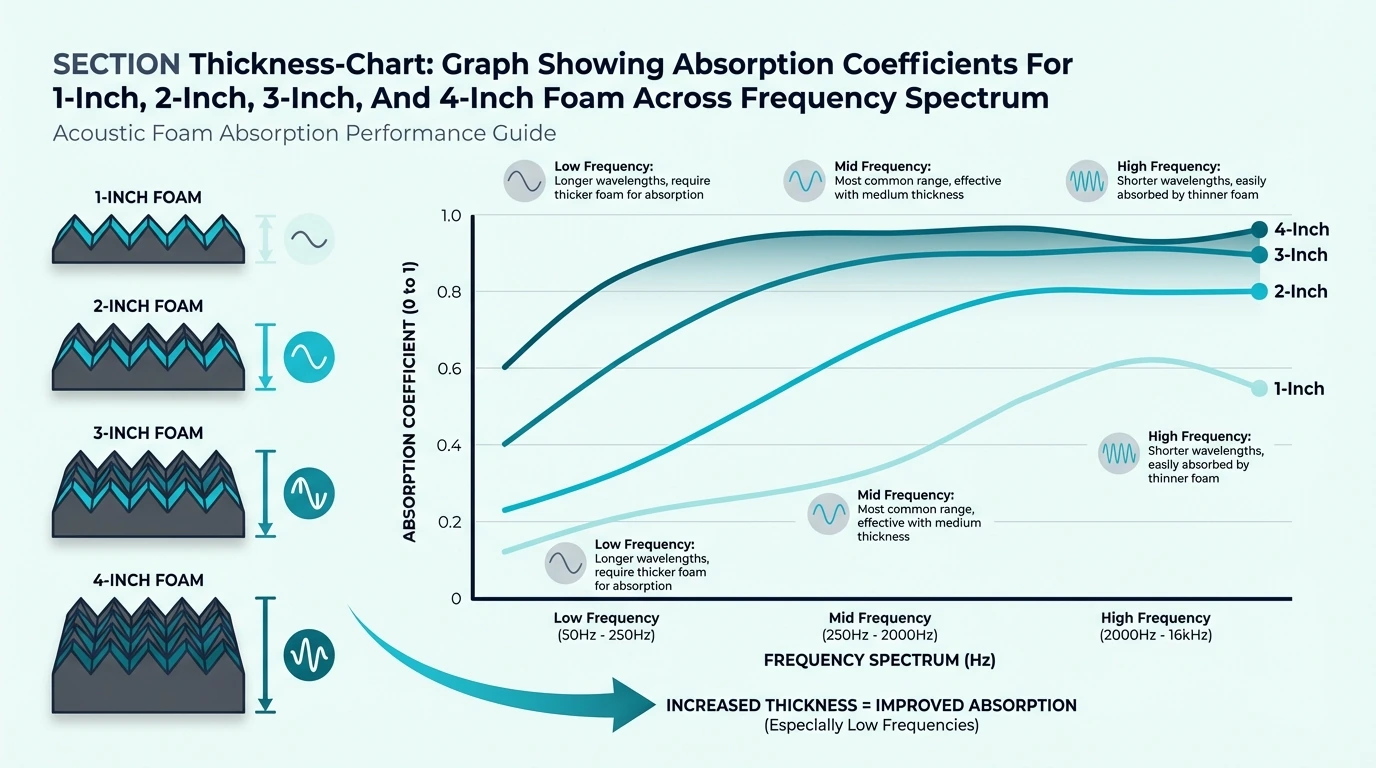
Different thicknesses serve different purposes. Here’s what each provides.
1-Inch Foam: High Frequency Only
One-inch foam absorbs effectively above 1000Hz. It handles high-frequency flutter echo, sibilance reflections, and the “brightness” that makes untreated rooms sound harsh.
This thickness is insufficient for comprehensive room treatment. It misses the mid frequencies where most vocal and instrument energy lives.
Use 1-inch foam only when you specifically need high-frequency absorption without affecting mids.
Common applications: reducing harshness in already-treated rooms, spot treatment for specific high-frequency problems, budget treatment where any absorption helps.
2-Inch Foam: The Standard Choice
Two-inch foam is the most common thickness for good reason. It absorbs effectively from about 500Hz up, covering the critical vocal range (300Hz-3000Hz) and most instrument frequencies.
For speech, podcasting, and vocal recording, 2-inch foam handles the frequencies that matter most. The human voice’s fundamental frequencies and harmonics fall squarely in this range.
This thickness balances effectiveness with practicality. Panels are manageable to handle and mount, don’t protrude excessively from walls, and cost less than thicker options. For product recommendations, see our guide to the best acoustic foam panels.
3-Inch Foam: Extended Range
Three-inch foam extends effective absorption down to roughly 350Hz. This captures more of the low-mid range where muddiness often occurs in recordings.
For music recording and mixing, the extended range is valuable. Instruments like acoustic guitar, piano, and male vocals have significant energy in the 250-500Hz range that 2-inch foam partially misses.
The tradeoff is cost and bulk. Three-inch panels cost more, weigh more, and protrude further from walls. The improvement over 2-inch foam is real but incremental.
4-Inch Foam: Maximum Practical Thickness
Four-inch foam reaches down to approximately 250Hz—the upper edge of the bass range. This is about as low as practical foam panels can effectively absorb.
For comprehensive treatment where budget allows, 4-inch foam provides the fullest absorption. It handles everything from low-mids through highs, leaving only true bass frequencies untreated.
Beyond 4 inches, foam becomes impractical for wall mounting. The panels are heavy, expensive, and protrude significantly into the room. For frequencies below 250Hz, different solutions (bass traps) work better.
For guidance on choosing thickness, see our comparison of 1-inch vs 2-inch acoustic foam. A solid starting point for most rooms is a 24-pack of 2-inch pyramid panels—enough to treat the first reflection points in a small room.
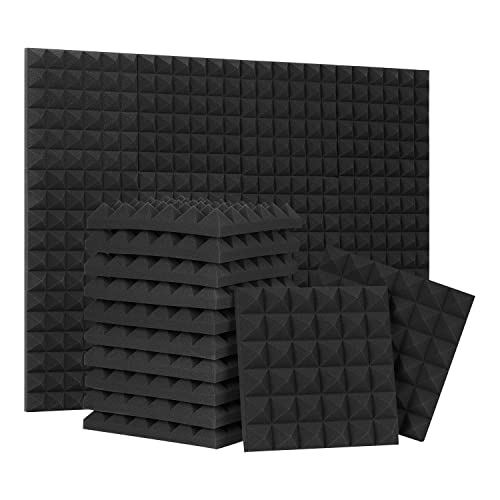
24-pack of 2-inch pyramid panels
Get Studio Tips Weekly
Join 5,000+ creators getting acoustic treatment advice every week.
No spam. Unsubscribe anytime.What Foam Can’t Absorb: Bass Frequencies
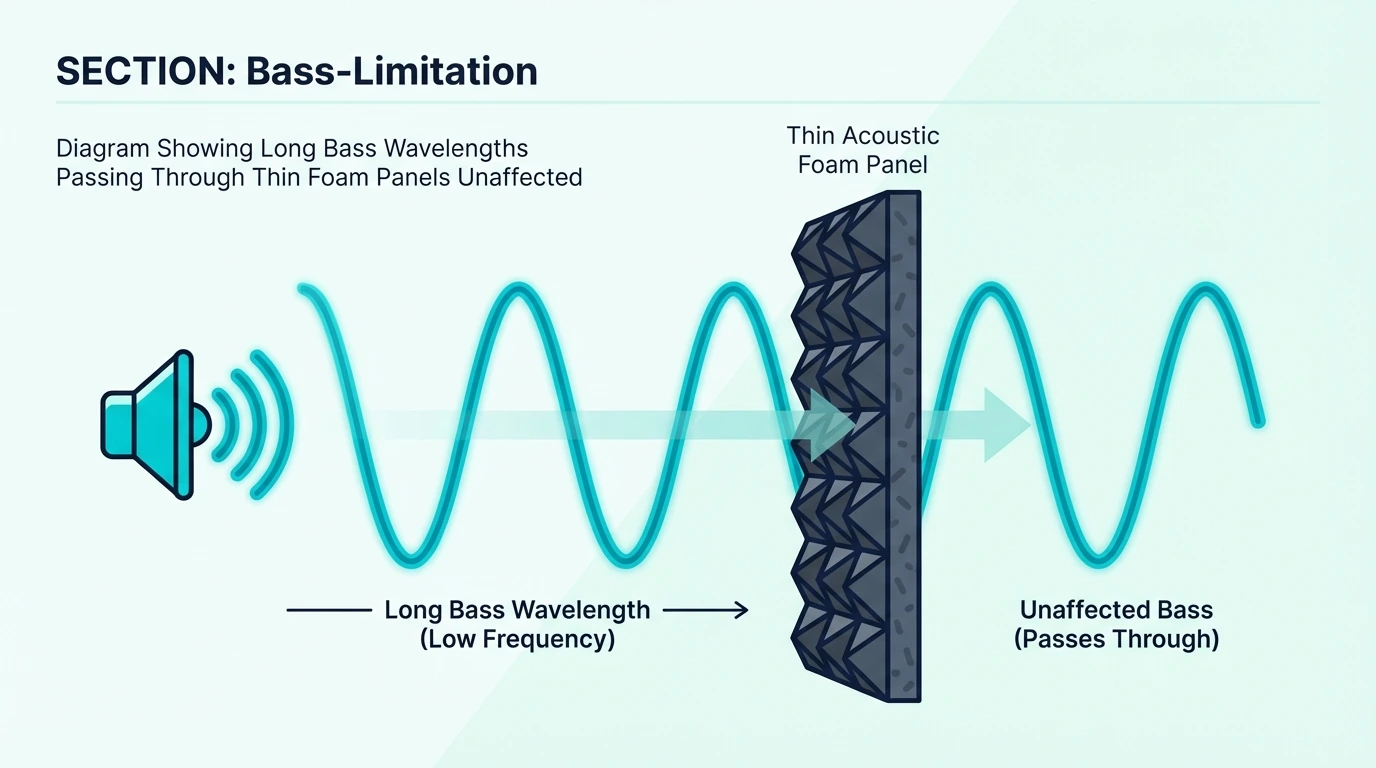
Understanding foam’s bass limitation prevents frustration and wasted money.
Why Bass Passes Through
Bass frequencies have wavelengths measured in feet, not inches. A 60Hz tone (low bass) has a wavelength of nearly 19 feet. A 125Hz tone (upper bass) has a wavelength of about 9 feet.
For foam to absorb these frequencies effectively, it would need to be several feet thick. That’s not practical for wall-mounted panels.
When bass waves encounter thin foam, they essentially don’t “see” it. The foam is so thin relative to the wavelength that the wave passes through with minimal interaction—like ocean waves passing a small buoy.
The Bass Trap Solution
Bass frequencies require different treatment: bass traps. These are thick, dense absorbers—typically 4-6 inches minimum, often thicker—placed in corners where bass energy accumulates.
Corner placement is key because room corners create pressure zones where bass builds up. Treating corners with thick absorbers addresses bass problems that wall-mounted foam can’t touch.
Bass traps and foam panels serve complementary purposes. Foam handles mid/high frequencies on walls; bass traps handle low frequencies in corners. Most well-treated rooms use both.
For more on this topic, see our guide on bass traps vs acoustic foam.
Recognizing Bass Problems
How do you know if your room has bass problems that foam can’t fix?
Signs of bass issues: – Boomy, muddy sound in certain spots – Bass that seems louder in corners – Low-frequency “ringing” after bass notes – Recordings that sound bass-heavy regardless of EQ
Signs of mid/high issues (foam can help): – Flutter echo (metallic ringing when you clap) – Harsh, bright sound – Excessive reverb on vocals – “Roomy” quality in recordings
If your problems are primarily bass-related, foam won’t solve them. If they’re mid/high frequency issues, foam is exactly what you need. Our guide on whether acoustic foam works can help you assess your specific situation.
NRC Ratings and What They Mean
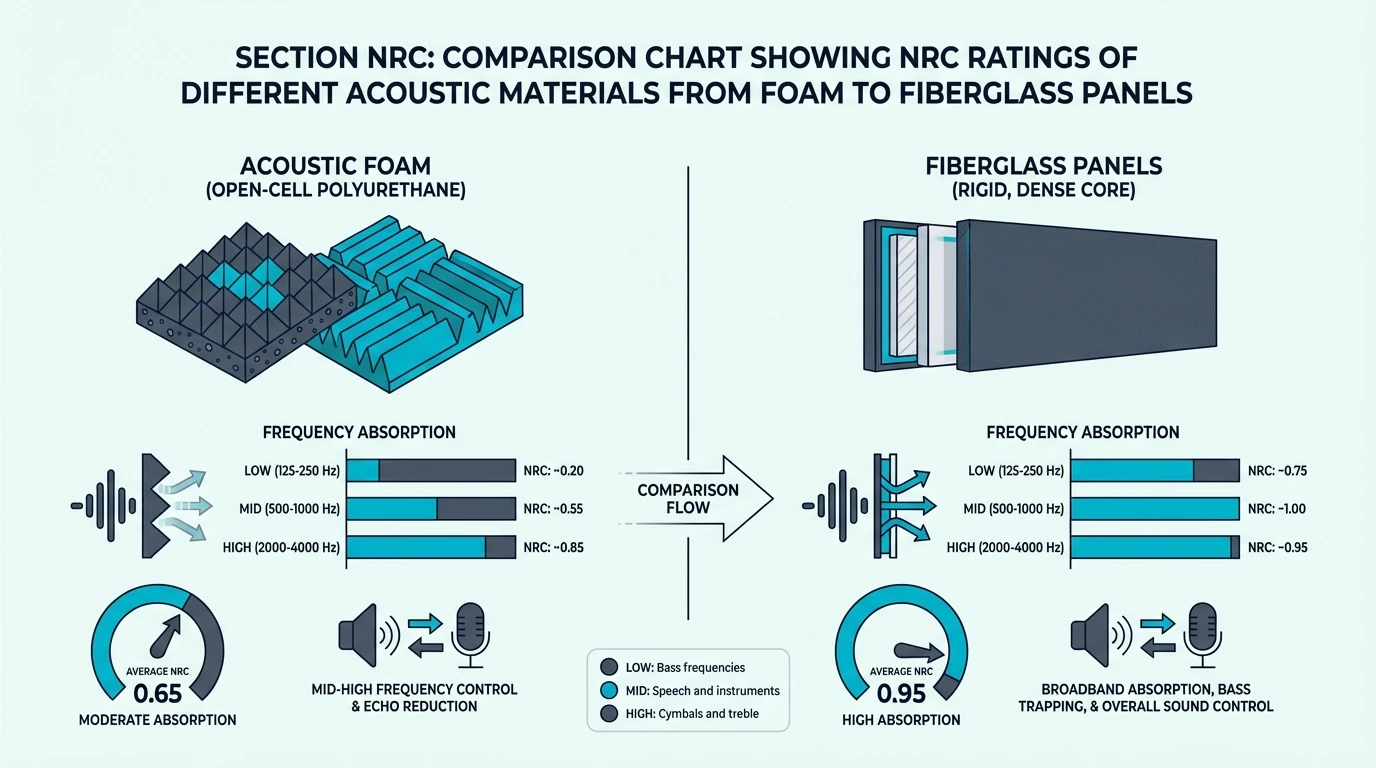
NRC (Noise Reduction Coefficient) ratings help compare absorption effectiveness, but they have limitations.
Understanding NRC
NRC is a single number representing average absorption across four frequencies: 250Hz, 500Hz, 1000Hz, and 2000Hz. A rating of 0.85 means the material absorbs 85% of sound energy on average across these frequencies.
Higher NRC generally means better absorption. Quality acoustic foam typically rates 0.6-0.85 NRC, while professional fiberglass panels often exceed 0.95 NRC.
NRC Limitations
NRC averages hide important details. A material might absorb 95% at 2000Hz but only 30% at 250Hz—the NRC would show a decent number while masking poor low-frequency performance.
For foam specifically, NRC ratings can be misleading because they include 250Hz, where foam performs poorly. A foam panel might show NRC 0.70, but most of that absorption happens above 500Hz.
When comparing products, look for full absorption coefficient charts showing performance at each frequency, not just NRC. This reveals where the material actually works.
Typical Foam NRC Values
Here are typical NRC ranges you’ll see for common foam shapes and thicknesses: – 1-inch wedge: 0.35–0.50 (high frequency only) – 2-inch wedge: 0.60–0.75 (standard treatment) – 2-inch pyramid: 0.55–0.70 (similar to wedge) – 3-inch wedge: 0.70–0.85 (extended range) – 4-inch wedge: 0.80–0.95 (maximum practical foam absorption)
These are typical ranges—specific products vary. Premium foam with higher density generally outperforms budget options at the same thickness.
Matching Foam to Your Frequency Problems
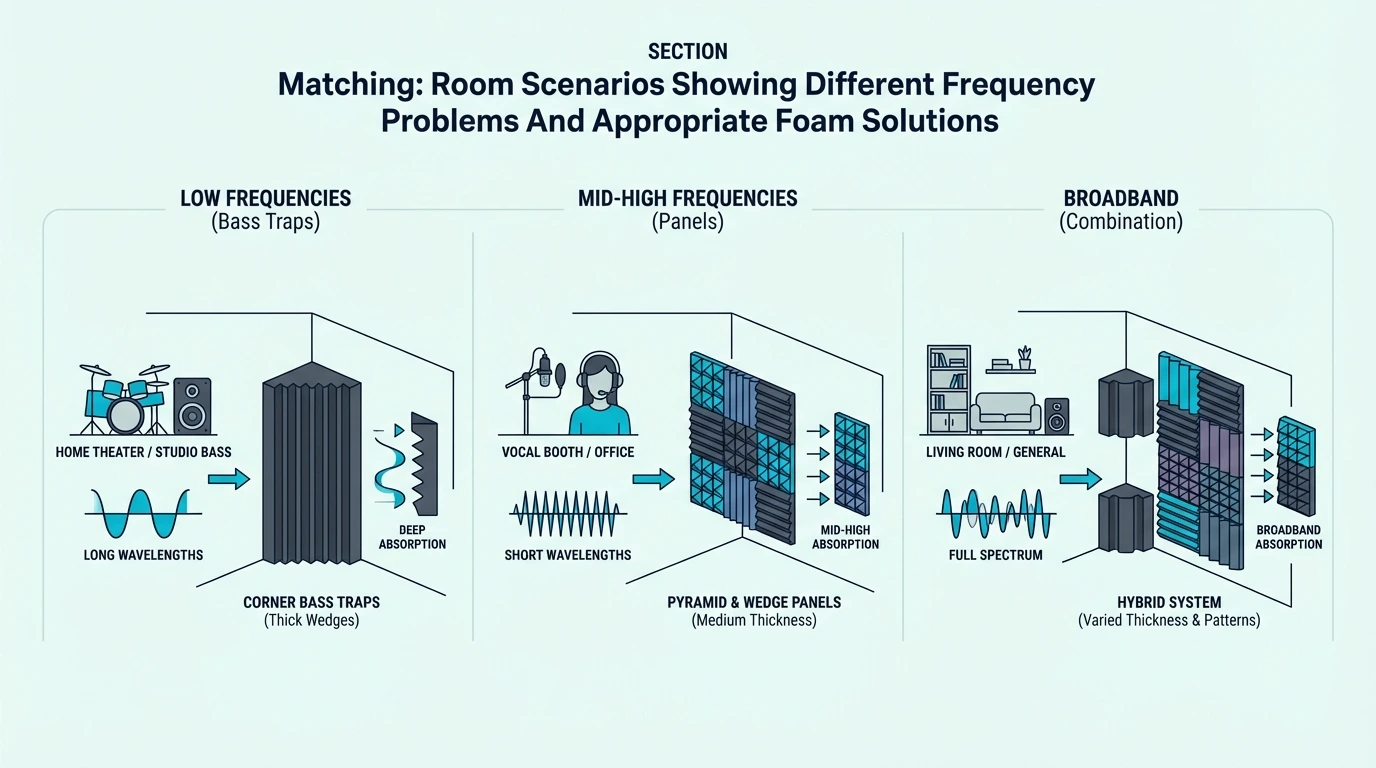
Different acoustic problems require different solutions. Here’s how to match foam to your needs.
Voice and Speech (Podcasting, Voice-Over)
Human speech fundamentals range from about 85Hz (deep male voice) to 300Hz (high female voice), with harmonics extending to 8000Hz and beyond. The critical intelligibility range is 300Hz-3000Hz.
Recommended: 2-inch foam handles speech frequencies effectively. The fundamental frequencies of most voices fall within 2-inch foam’s absorption range, and all the harmonics that create clarity are well-covered.
For deep male voices, 3-inch foam provides slightly better low-mid absorption, but 2-inch is adequate for most applications.
Vocal Music Recording
Singing extends the frequency range compared to speech. Vocal fundamentals can reach lower (bass singers) and harmonics extend higher (soprano overtones).
Recommended: 2-inch foam minimum, 3-inch preferred. The extended range of thicker foam captures more of the low-mid warmth that makes vocal recordings sound full and natural.
Acoustic Instruments
Acoustic guitars, pianos, and similar instruments have significant energy in the 100-500Hz range—lower than vocals. This is where foam starts to struggle.
Recommended: 3-4 inch foam for primary treatment, plus bass traps in corners. The thicker foam handles low-mids while bass traps address the true low frequencies these instruments produce.
Drums and Percussion
Drums produce energy across the entire frequency spectrum, from deep kick drum fundamentals (60-100Hz) to cymbal shimmer (10,000Hz+).
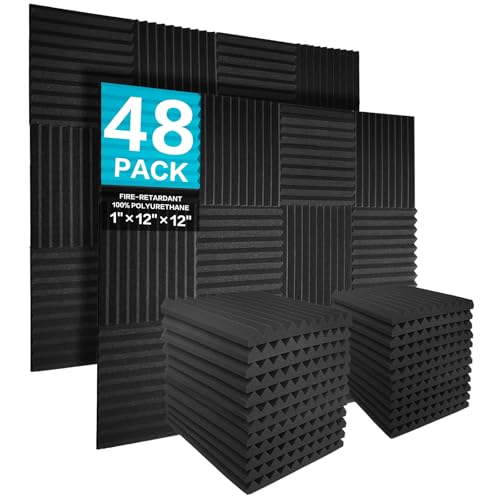
Recommended: Comprehensive treatment with 4-inch foam on walls and substantial bass traps in corners. Drums require more treatment than most sources because of their wide frequency range and high energy output. For a practical starting set, a large quantity pack like JBER 48-pack studio foam covers a lot of wall area on a budget.
JBER 48-pack studio foam
Home Theater / Music Listening
Home theater and music playback benefit from balanced absorption that doesn’t over-deaden the room. You want controlled reflections, not elimination of all ambience.
Recommended: 2-inch foam at first reflection points, bass traps in corners, and possibly diffusion on rear walls. This combination controls problems while maintaining the liveliness that makes music and movies engaging. For placement guidance, see our guide on how to arrange acoustic foam.
Improving Low-Frequency Absorption
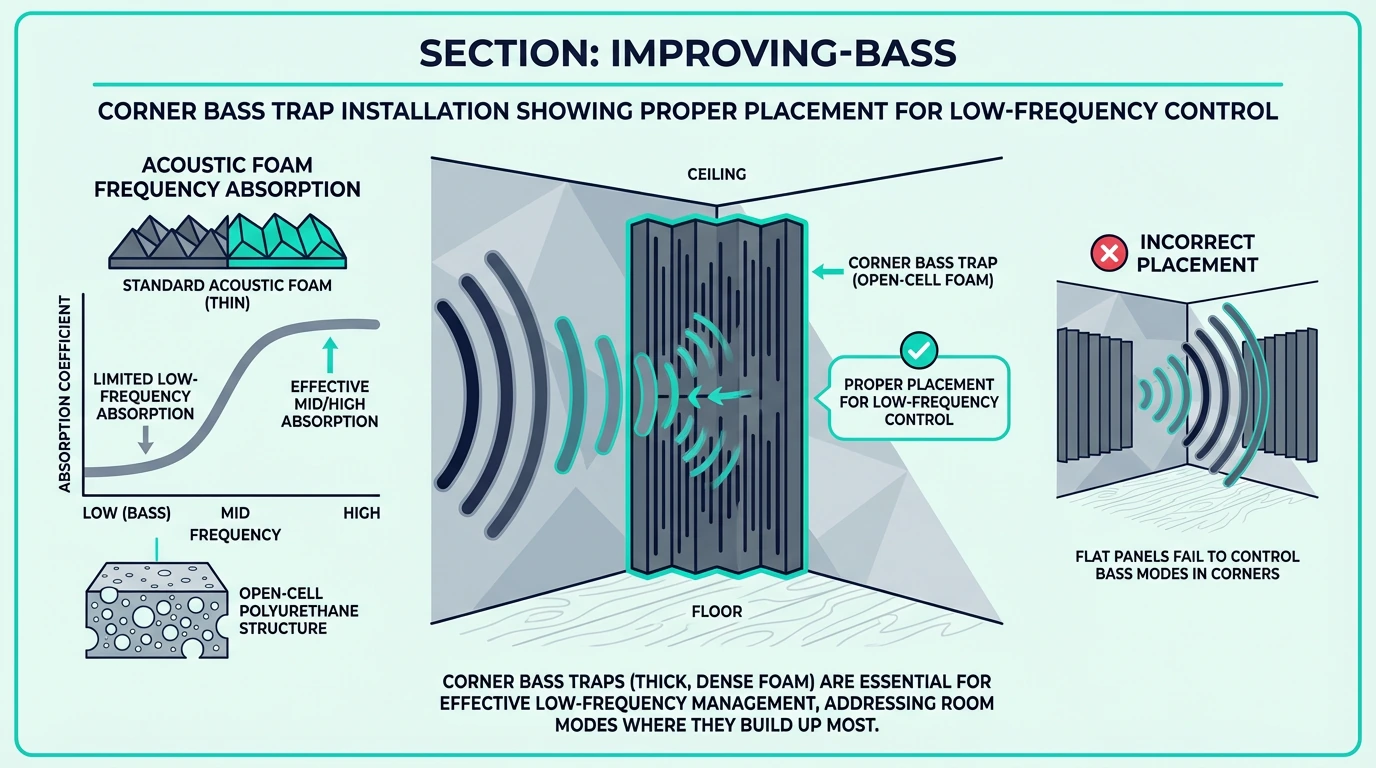
If you need better low-frequency absorption than standard foam provides, several approaches help.
Air Gap Mounting
Mounting foam panels with an air gap behind them improves low-frequency absorption. The gap acts as additional absorptive space, effectively increasing the treatment’s thickness.
A 2-inch panel mounted with a 2-inch air gap performs similarly to a 4-inch panel mounted flush. This technique extracts more low-frequency absorption from thinner, less expensive panels.
Use furring strips or standoff brackets to create consistent gaps. Even 1-2 inches of air space provides meaningful improvement.
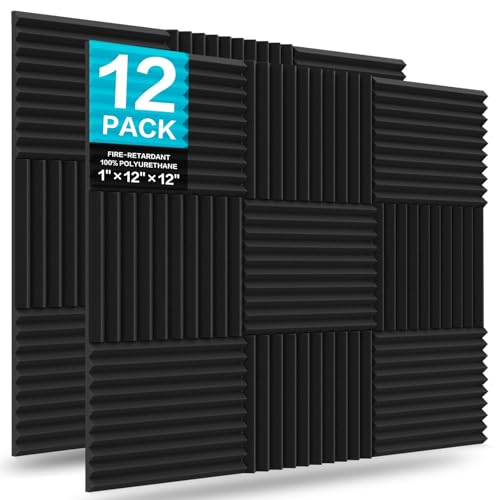
For mounting techniques, see our guide on how to put acoustic foam on walls. If you want an affordable tile to experiment with air-gap mounting, a JBER 12-pack keeps costs low while you test placement.
JBER 12-pack
Corner Placement
Corners naturally have higher sound pressure at low frequencies. Placing absorbers in corners—even standard foam—provides better low-frequency absorption than the same panels on flat walls.
This doesn’t make thin foam effective for bass, but it does improve low-mid performance. Combining corner placement with air gaps maximizes what foam can achieve.
Dedicated Bass Traps
For true bass control, dedicated bass traps are necessary. These are typically:
- Thick foam traps: 4-6 inch triangular corner units
- Fiberglass/rockwool traps: Dense panels 4+ inches thick
- Membrane traps: Tuned absorbers for specific frequencies
- DIY traps: Rigid fiberglass in corner-mounted frames
Bass traps belong in corners, especially the corners behind your speakers or listening position. They complement wall-mounted foam rather than replacing it.
Common Misconceptions
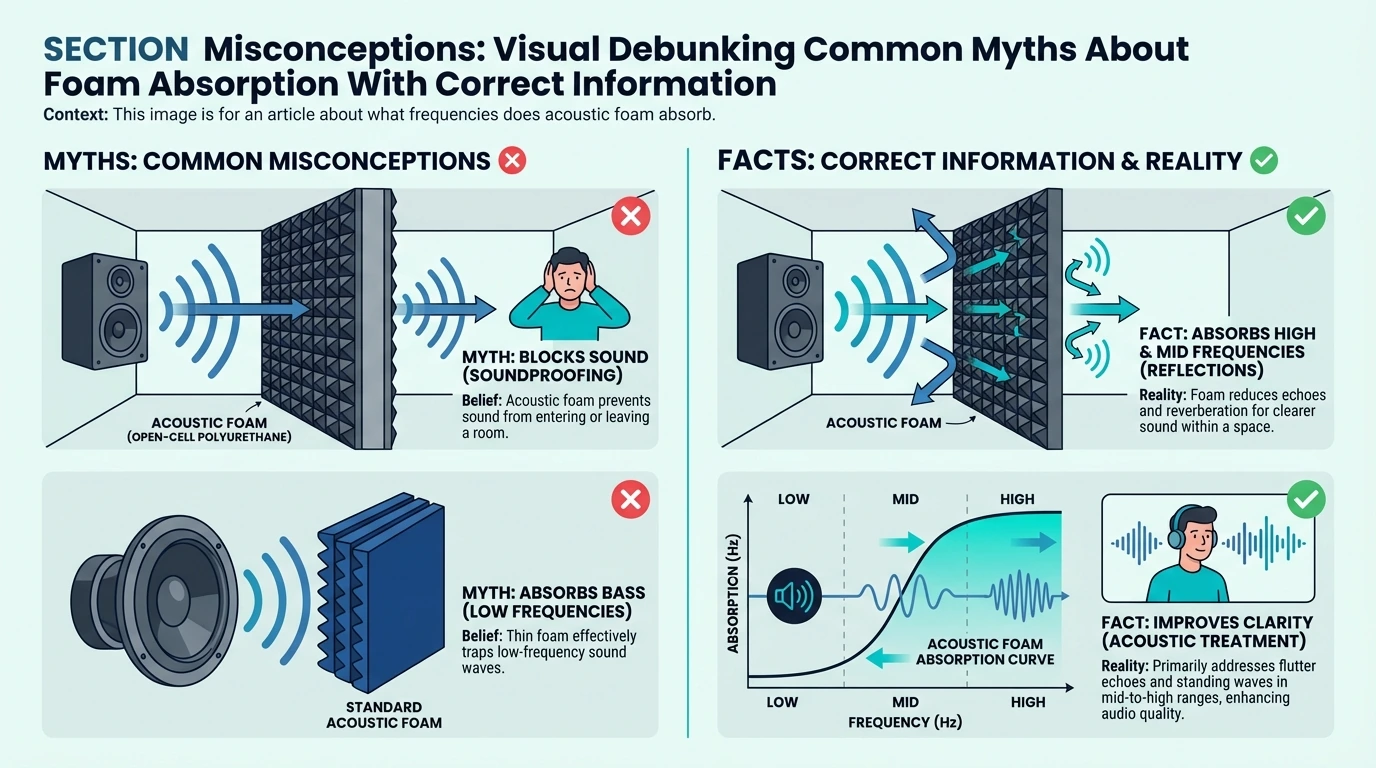
Several myths persist about foam absorption. Here’s the truth.
“More Foam = Better Bass Absorption”
Adding more thin foam panels doesn’t improve bass absorption. Twenty 2-inch panels absorb the same frequencies as two 2-inch panels—just more of them.
Bass absorption requires thickness, not quantity. If you have bass problems, adding more wall foam won’t help. You need thicker treatment or bass traps.
“Expensive Foam Absorbs Bass Better”
Premium foam absorbs mid/high frequencies more consistently than budget foam, but it doesn’t magically absorb bass. The physics of wavelength versus thickness applies regardless of price.
Expensive foam is denser and more durable, which improves performance within its effective frequency range. But no foam product, regardless of cost, effectively absorbs frequencies below about 250Hz at practical thicknesses.
“Foam Absorbs All Sound Equally”
Foam absorption varies dramatically with frequency. A panel might absorb 95% of energy at 2000Hz but only 20% at 250Hz. The absorption curve is not flat.
This is why understanding frequency response matters. Foam is excellent for what it does—mid/high absorption—but it’s not a universal solution for all acoustic problems.
“Thicker Is Always Better”
Thicker foam absorbs a wider frequency range, but “better” depends on your needs. If your problems are purely high-frequency flutter echo, 1-inch foam solves them—thicker foam costs more without additional benefit.
Match thickness to your actual problems—don’t buy 4-inch foam for a room that only needs high-frequency treatment. If you’re unsure what your room needs, our guide on how to stop echo with acoustic foam helps identify specific issues.
The Bottom Line
Acoustic foam absorbs mid and high frequencies effectively—roughly 500Hz and above for standard 2-inch panels. Thicker foam extends absorption lower, but even 4-inch panels don’t reach true bass frequencies—that’s physics, not a product limitation.
For vocals, speech, and most recording applications, 2-inch foam handles the critical frequencies. Music production and situations requiring fuller absorption benefit from 3-4 inch thickness.
Bass problems require dedicated bass traps, not more wall foam.
Understanding these frequency limitations helps you choose appropriate treatment. Foam excels at what it does—controlling mid/high reflections that cause flutter echo, harshness, and “roomy” recordings.
For bass control, combine foam with corner-mounted bass traps for comprehensive treatment. If you want a broader look at foam limitations beyond frequency range, see our cons of acoustic foam guide.
The goal isn’t finding foam that absorbs everything—it’s using the right tools for each frequency range. Foam for mids and highs, bass traps for lows, and your room will sound dramatically better.
For a complete overview of foam’s real-world performance, see how many decibels acoustic foam reduces.
Frequently Asked Questions
Does acoustic foam absorb bass?
Standard acoustic foam (1-4 inches) does not effectively absorb bass frequencies below about 250Hz. Bass wavelengths are too long relative to foam thickness for significant absorption to occur.
For bass control, you need dedicated bass traps—thick absorbers (4-6+ inches) placed in corners where low frequencies accumulate.
What thickness acoustic foam do I need?
For speech and vocals, 2-inch foam is sufficient—it absorbs the critical 500Hz-8000Hz range effectively. For music recording with instruments, 3-4 inch foam provides better low-mid absorption.
Match thickness to your frequency problems: high-frequency flutter echo needs only 1-2 inches, while fuller absorption needs 3-4 inches.
Why doesn’t my foam help with boomy bass?
Foam panels are too thin to absorb bass frequencies. A 100Hz tone has an 11-foot wavelength—foam would need to be nearly 3 feet thick to absorb it effectively.
Your boomy bass requires corner-mounted bass traps, not additional wall foam. Bass traps use thickness and corner placement to address frequencies foam can’t touch.
What’s the difference between NRC 0.5 and NRC 0.8 foam?
NRC 0.8 foam absorbs approximately 80% of sound energy (averaged across test frequencies) versus 50% for NRC 0.5. The difference is audible—higher NRC foam creates tighter, more controlled acoustics.
However, NRC doesn’t indicate which frequencies are absorbed, so check full absorption charts when possible.
Can I improve foam’s bass absorption?
Mounting foam with an air gap behind it improves low-frequency absorption somewhat. A 2-inch panel with a 2-inch air gap performs similarly to a 4-inch panel flush-mounted.
Corner placement also helps because corners have higher bass pressure. However, these techniques only extend absorption modestly—for true bass control, you still need dedicated bass traps.
Is thicker foam always better?
Thicker foam absorbs a wider frequency range, but “better” depends on your needs. If your only problem is high-frequency flutter echo, 2-inch foam solves it—4-inch foam costs more without additional benefit for that specific issue.
Choose thickness based on the frequencies causing your problems, not the assumption that thicker is universally superior. For help deciding what your room needs, see our guide on how to choose acoustic foam.