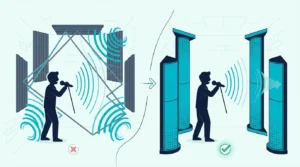
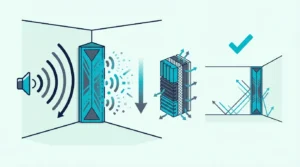
What Is A Bass Trap — And Why Your Room Sounds Wrong Without One
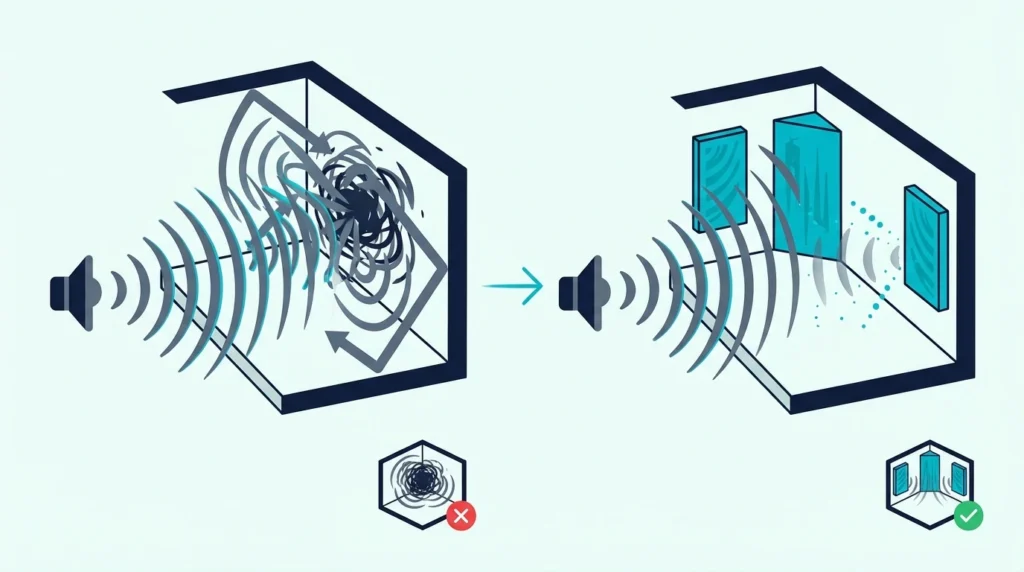
What is a bass trap — it’s the single most effective piece of acoustic treatment you can add to a room, but most people either skip it entirely or confuse it with regular acoustic panels.
That muddy, boomy low end you hear when you clap in your studio or home theater isn’t a speaker problem — it’s your room fighting back with uncontrolled bass energy piling up in the corners.
The right bass trap fixes that by converting excess low-frequency sound into heat, so you get tighter bass response and cleaner mixes that actually translate to other systems.
You don’t need to cover every wall — corners are where bass energy is strongest, and even two or four traps placed correctly make a dramatic difference.
Below, this guide breaks down how bass traps work, the different types available, what they’re made of, and where standing waves cause the most damage in your specific room.
A bass trap is an acoustic treatment device that absorbs low-frequency sound energy to reduce boomy, muddy acoustics in a room. Place porous absorber bass traps in the corners where walls meet each other and the ceiling — that’s where bass energy accumulates most. Even a few well-placed traps dramatically improve bass response for recording studios, home theaters, and listening rooms.
What Is A Bass Trap — And Why Does It Matter?
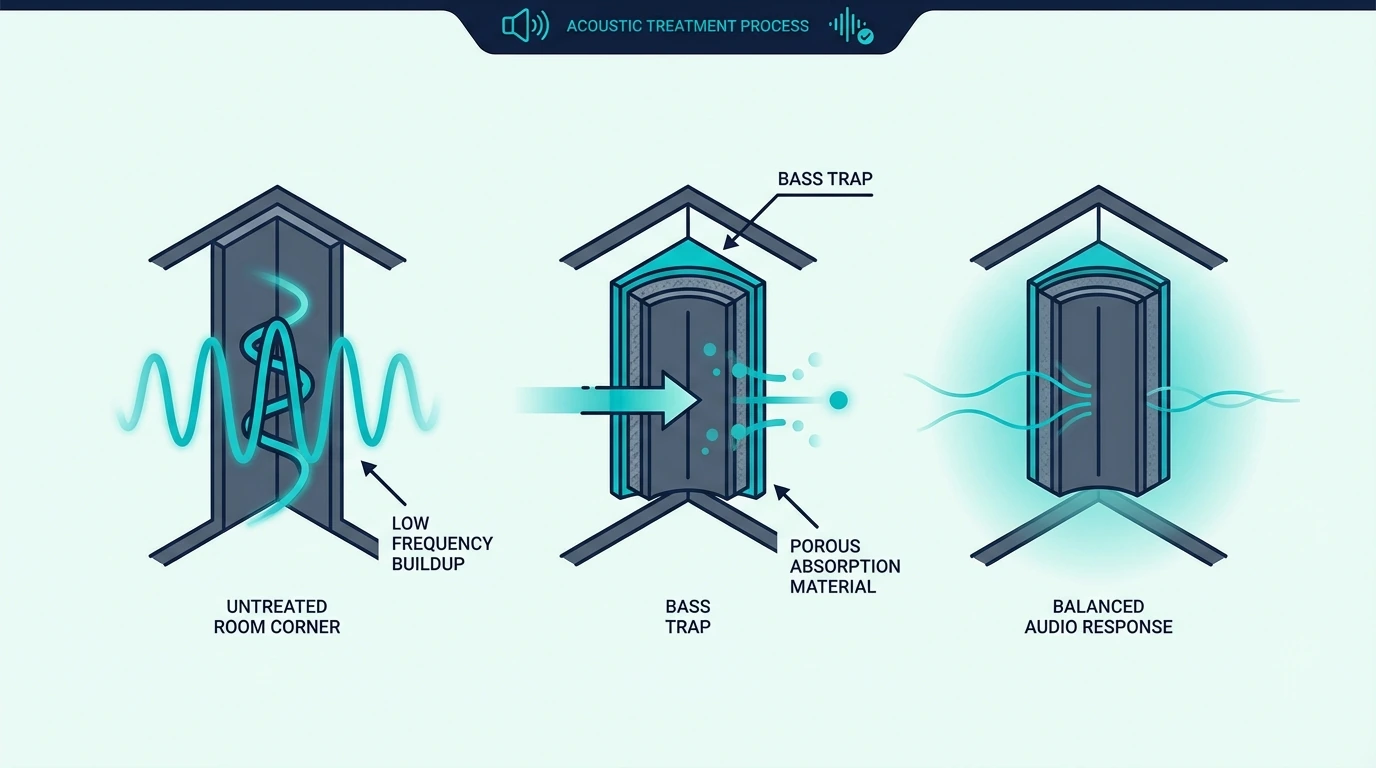
A bass trap does exactly what the name suggests — it traps bass frequencies that would otherwise bounce around your room unchecked. Here’s why that matters more than most people realize.
The Core Concept
Every room has a personality when it comes to sound, and bass is where that personality gets ugly. Low frequencies have wavelengths measured in feet — a 100 Hz tone has a wavelength of about 11 feet — which means they interact with your room’s walls, floor, and ceiling in ways that shorter wavelengths never do.
Those interactions create spots where bass is unnaturally loud and other spots where it nearly disappears. You might sit at your mixing desk and hear booming 80 Hz, then move two feet to the left and the bass drops by 10 dB.
A bass trap absorbs that excess energy before it has the chance to pile up. Think of it like a sponge placed where water pools — it doesn’t remove all the water, but it stops the flooding.
The result isn’t less bass overall. It’s more even, more accurate bass across your entire listening environment.
What A Bass Trap Is Not
The biggest misconception is that bass traps and acoustic foam do the same job. Standard acoustic foam panels — the pyramid and wedge shapes you see everywhere — handle mid and high frequencies well, but they barely touch anything below 300 Hz.
Bass traps are thicker, denser, and specifically designed to absorb the low-frequency sound that regular panels ignore. A 2-inch foam wedge on your wall won’t fix a 60 Hz buildup in your corner — the wavelength is simply too long for thin material to absorb.
That distinction matters because people spend hundreds on foam, wonder why their room still sounds muddy, and blame their speakers or their ears. The room was the problem the entire time.
How Does Bass Absorption Work?
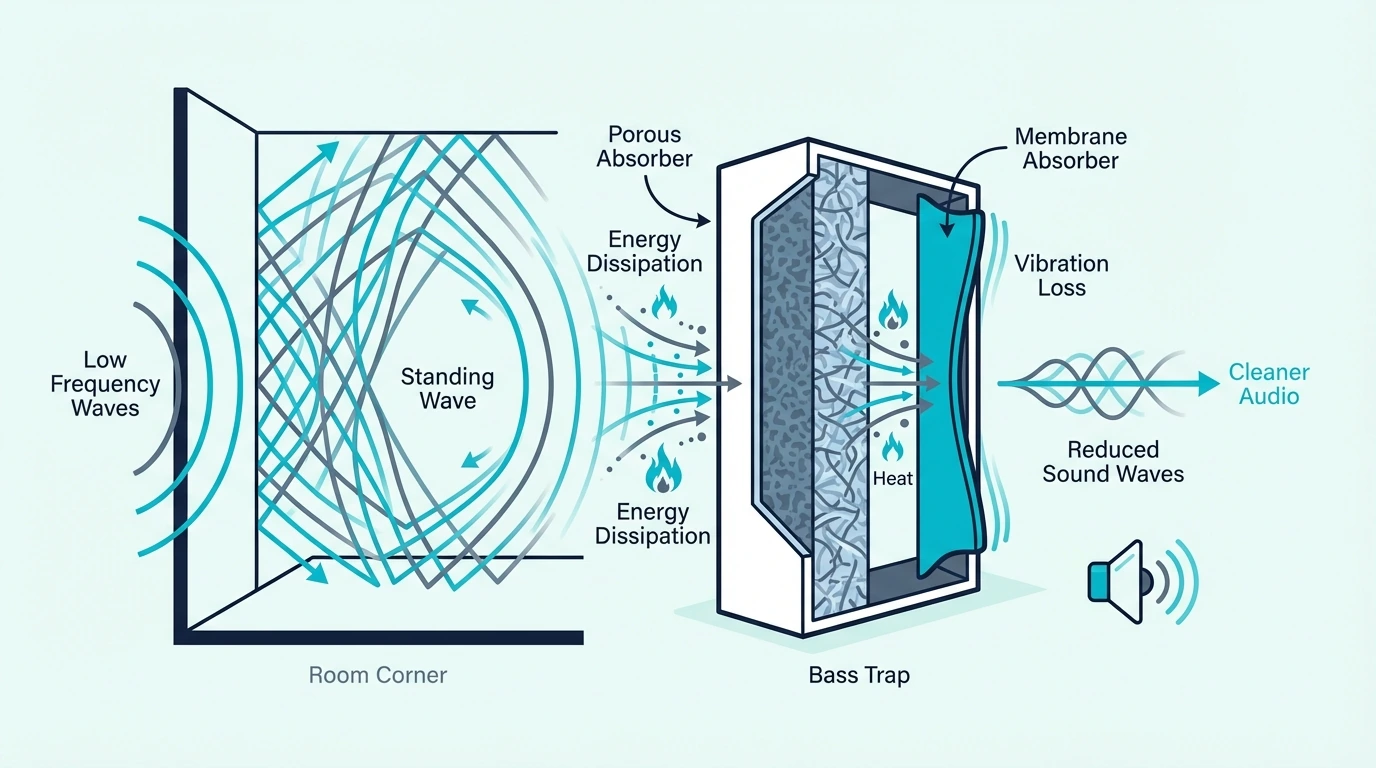
Now that you know what a bass trap does, the natural question is how — and the physics behind it explain why placement and thickness matter so much.
Absorption vs Dissipation
When sound waves hit a porous absorber bass trap, the air molecules vibrating inside the material rub against the fibers. That friction converts acoustic energy into a tiny amount of heat — so small you’d never feel it, but enough to remove the sound from the room.
The key word here is “porous.” The material needs air passages — microscopic channels between fibers — for the sound wave to enter and lose energy. A solid wall reflects sound; a porous absorber lets sound in and doesn’t let it back out.
That’s why the right material determines everything about a bass trap’s performance. Dense fiberglass and mineral wool have the ideal fiber structure for friction-based absorption across a wide frequency range.
Why Low Frequencies Are Harder To Control
Higher frequencies have short wavelengths — a 4,000 Hz tone is about 3.4 inches long. A 2-inch panel intercepts a significant portion of that wavelength, so it absorbs effectively.
Drop down to 80 Hz, and the wavelength stretches to over 14 feet. A 2-inch panel can’t even interact with a meaningful fraction of that wave.
You need much thicker treatment — typically 4 inches minimum, with 6+ inches being far more effective.
That thickness requirement is exactly why bass traps look different from regular acoustic panels. They’re bulkier because they have to be — physics doesn’t negotiate.
Air gaps behind the trap amplify the effect. Mounting a 4-inch trap with a 4-inch air gap behind it gives you performance closer to an 8-inch solid trap, because the air gap positions the absorber where the sound wave’s particle velocity is highest.
Get Studio Tips Weekly
Join 5,000+ creators getting acoustic treatment advice every week.
No spam. Unsubscribe anytime.What Are The Different Types Of Bass Traps?
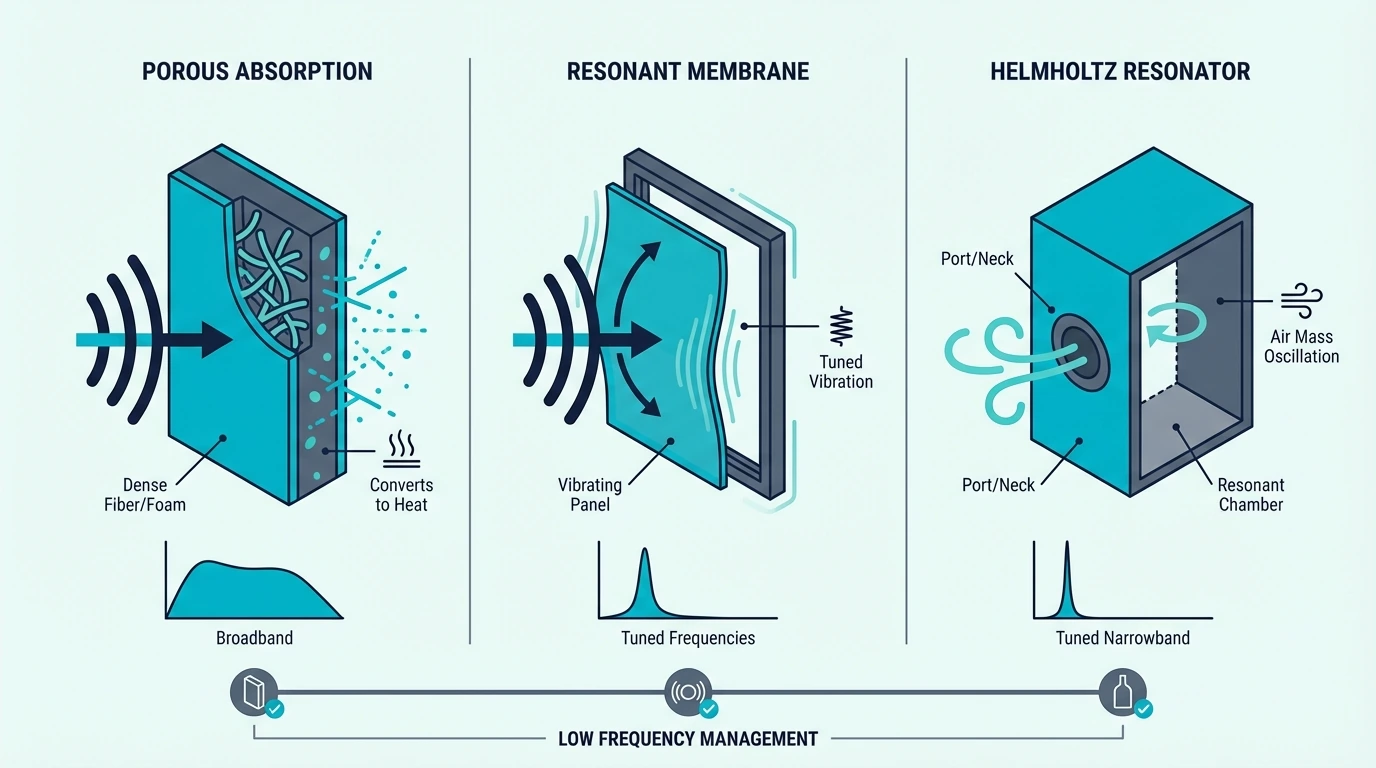
The absorption principle stays the same, but bass traps split into two fundamentally different categories — and picking the wrong one for your situation wastes money. Here’s what separates them.
Porous Absorber Bass Traps
The most common type, and the one most people should start with. Porous absorbers use dense fibrous material — usually rigid fiberglass or mineral wool — to absorb sound across a broad range of frequencies.
Their biggest strength is also their simplest: they work on everything from deep bass up through the highs. A thick porous absorber in a corner doesn’t just tame the 60 Hz boom — it cleans up the 200 Hz muddiness and the 500 Hz boxiness too.
The DIY crowd loves porous traps because the build is simple — a wooden frame stuffed with Owens Corning 703 or Rockwool, wrapped in Guilford of Maine Sona acoustical fabric. Commercial versions from companies like GIK Acoustics and ATS use the same principle with tighter quality control.

Guilford of Maine Sona Acoustical Fabric
The tradeoff is size — effective porous bass traps need to be thick. A 2-inch panel marketed as a “bass trap” won’t do much below 250 Hz, and you need 4-6 inches of dense material to reach into the real bass range.
Resonant Absorber Bass Traps
Where porous absorbers work broadband, resonant absorbers are tuned to specific frequency ranges. The two main subtypes are Helmholtz resonators and membrane (diaphragmatic) absorbers.
A Helmholtz resonator uses an enclosed cavity with a precisely sized opening — when bass hits the opening at the trap’s tuned frequency, the air inside resonates and the energy gets absorbed. Membrane absorbers work differently: a flexible front panel vibrates at its resonant frequency, converting that specific band of bass energy into heat through internal damping.
The advantage of resonant traps is surgical precision — if you have a vicious 63 Hz room mode that porous traps only partially tame, a tuned membrane absorber built for that exact frequency can knock it down hard without touching anything else.
The disadvantage is equally clear: they only work in a narrow band. And they’re harder to build correctly — the tuning depends on cavity depth, membrane mass, and damping material, and getting any of those wrong shifts the absorption away from your target frequency.
Achieving Balanced Bass With The Right Type
Most recording studios and home theaters get the best results by starting with porous absorbers in every corner and adding resonant absorbers only if measurement reveals a stubborn room mode that the broadband traps can’t fully solve.
Jumping straight to Helmholtz resonators without addressing broadband bass first is like trying to tune a guitar with one string wildly out — you fix the obvious problems first, then fine-tune. The full breakdown of trap types covers each design in more detail.
What Are Bass Traps Used For?
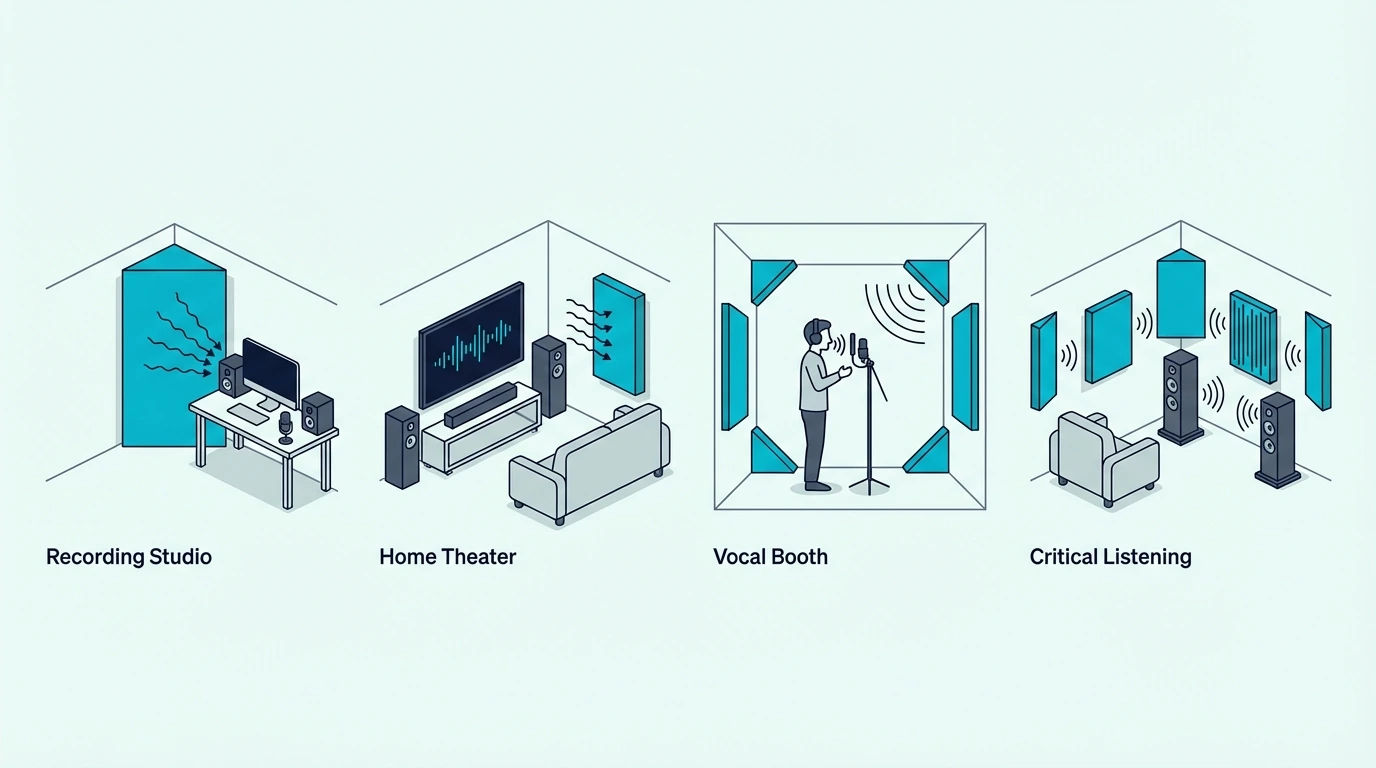
The physics and types make sense in theory — so what does this actually look like in a real room? Every use case benefits differently.
Recording studios rely on bass traps to get an accurate listening environment. Without them, your studio monitors lie to you — that bass-heavy mix you’re hearing at your desk might sound thin three feet away because the room modes are coloring what you hear.
Engineers who treat their rooms with proper bass trapping consistently report tighter low end, better stereo imaging, and mixes that translate to car speakers and headphones without surprises.
Home theaters face a different version of the same problem. That action movie explosion that rattles your chest in one seat turns into a muddy thud in another.
Bass traps smooth out the response across more seats, so the entire couch gets impactful bass instead of just the lucky center spot. Proper bass trapping is necessary in any room where consistent bass reproduction matters.
Even podcast studios and voiceover booths benefit. Low-frequency rumble from HVAC systems, traffic, and footsteps gets amplified by room modes.
Bass traps reduce that ambient buildup so your recordings stay clean without aggressive high-pass filtering that strips warmth from voices.
A solid entry point for any of these scenarios is an ATS Acoustics 2 x 4-foot panel, a ready-made panel with a wood frame and mineral wool core that you can straddle across a corner without building frames yourself.
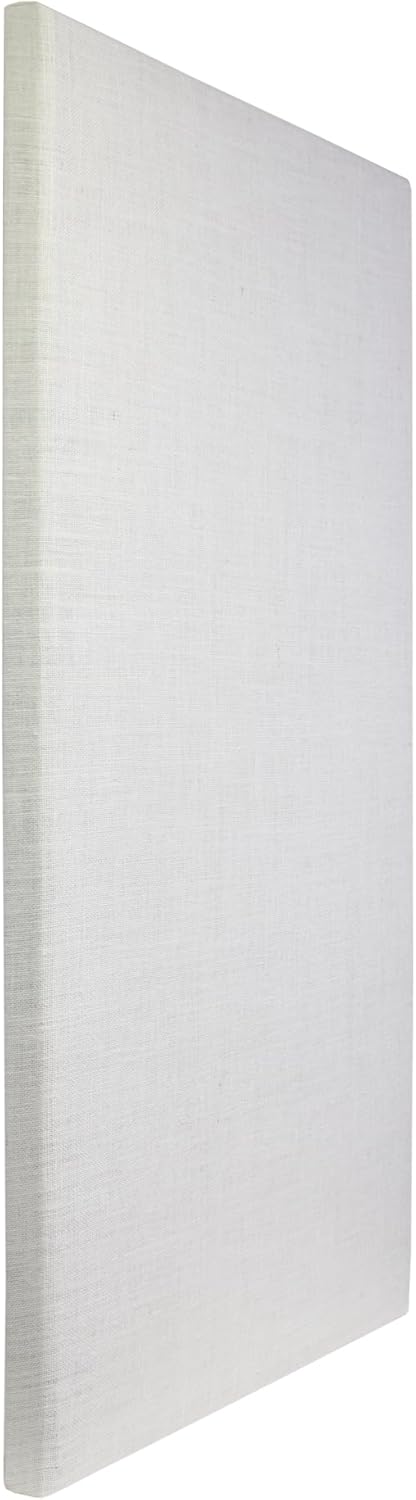
ATS Acoustics 2 x 4-foot panel
What Are Bass Traps Made Of?
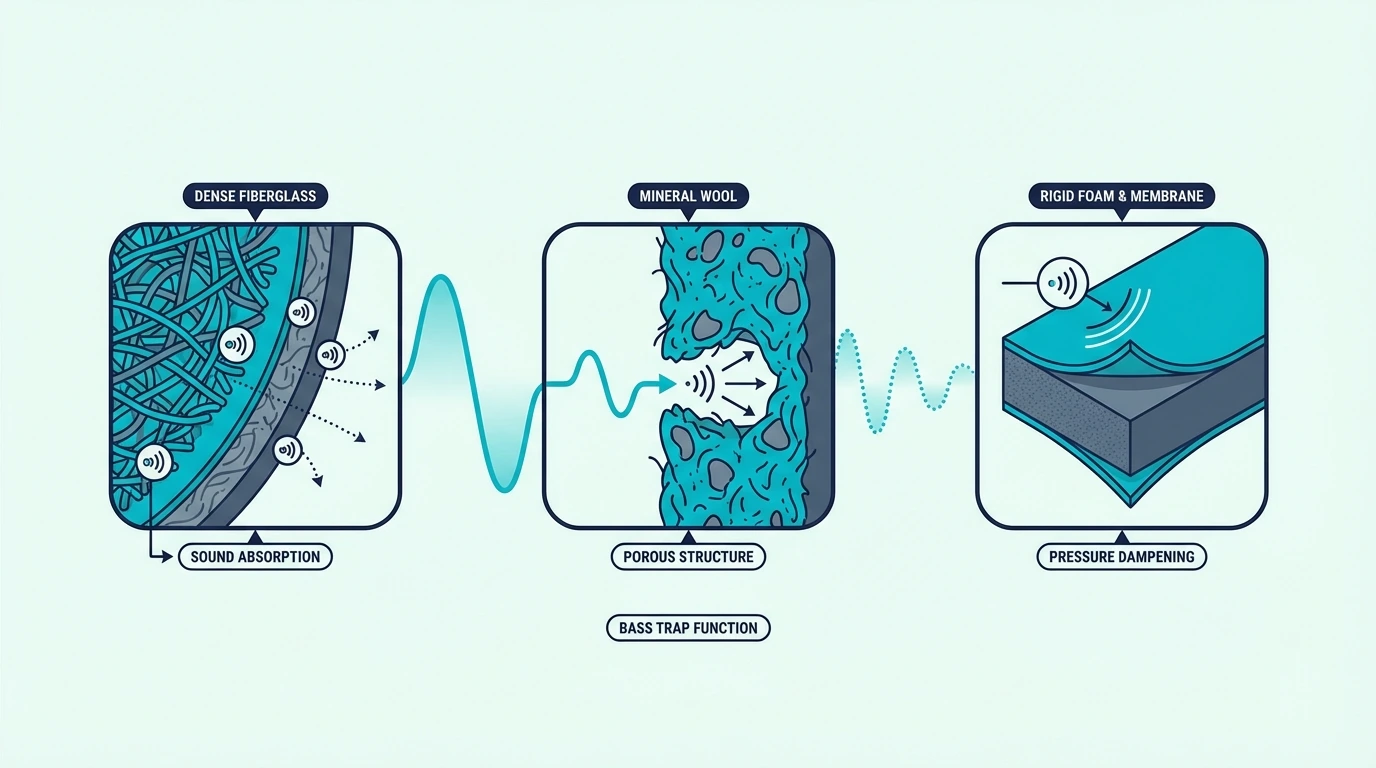
The material inside a bass trap determines how much bass it actually absorbs — and the difference between good and bad materials is massive. Here’s what works, what doesn’t, and why.
Rigid Fiberglass vs Mineral Wool
The two workhorses of professional bass trapping are rigid fiberglass (like Owens Corning 703 or 705) and mineral wool (like Rockwool Safe’n’Sound or Rockwool ComfortBoard).
Rigid fiberglass boards have a higher density — OC 703 hits about 3 lb/ft³, and OC 705 reaches 6 lb/ft³. That density means more fiber per cubic inch, more friction when sound passes through, and stronger absorption particularly in the low-mid range.
OC 705 is the go-to for dedicated bass traps because its density handles lower frequencies more effectively.
Mineral wool (Rockwool) is slightly less dense but significantly cheaper and easier to source. For most home studio builds, the performance difference between mineral wool and rigid fiberglass in a corner trap is smaller than you’d expect — especially when the trap is 4+ inches thick with an air gap behind it.
A DIY-friendly example is Rockboard 60 mineral wool boards, which give you a rigid core that’s easy to frame into a broadband trap.
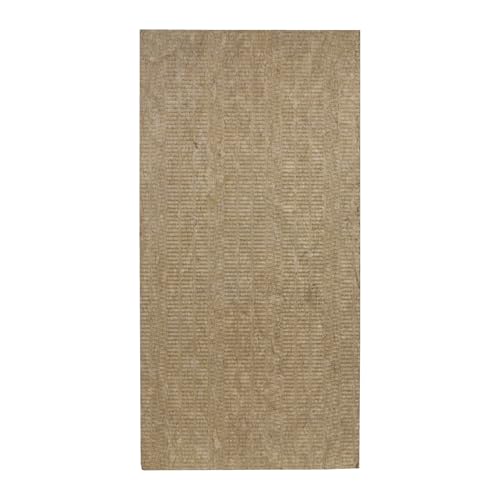
Rockboard 60 Mineral Wool Rigid Acoustic Insulation Board 2 Inch, 4 Pack
The real-world difference shows up below 100 Hz. OC 705 at 4 inches absorbs meaningfully at 80 Hz, while equivalent mineral wool needs 6 inches to match.
If space is tight, fiberglass wins. If budget is tight, mineral wool gets you 80% of the way there.
Can Acoustic Foam Work As A Bass Trap?
Foam bass traps exist — you’ve probably seen the triangular corner wedges. They absorb mid and high frequencies effectively, but their performance drops off sharply below 250 Hz.
The reason is density — acoustic foam is far less dense than fiberglass or mineral wool, typically under 2 lb/ft³. That lower density means fewer fibers for the sound wave to interact with, and low-frequency waves pass right through without losing much.
If you want the best possible bass absorption, step up from lightweight foam wedges to thick fiberglass or mineral-wool traps instead. Foam can help with 250-500 Hz muddiness, but true sub-150 Hz control comes from dense material and real thickness, not just a corner shape.
How Do Bass Traps Handle Standing Waves And Room Modes?
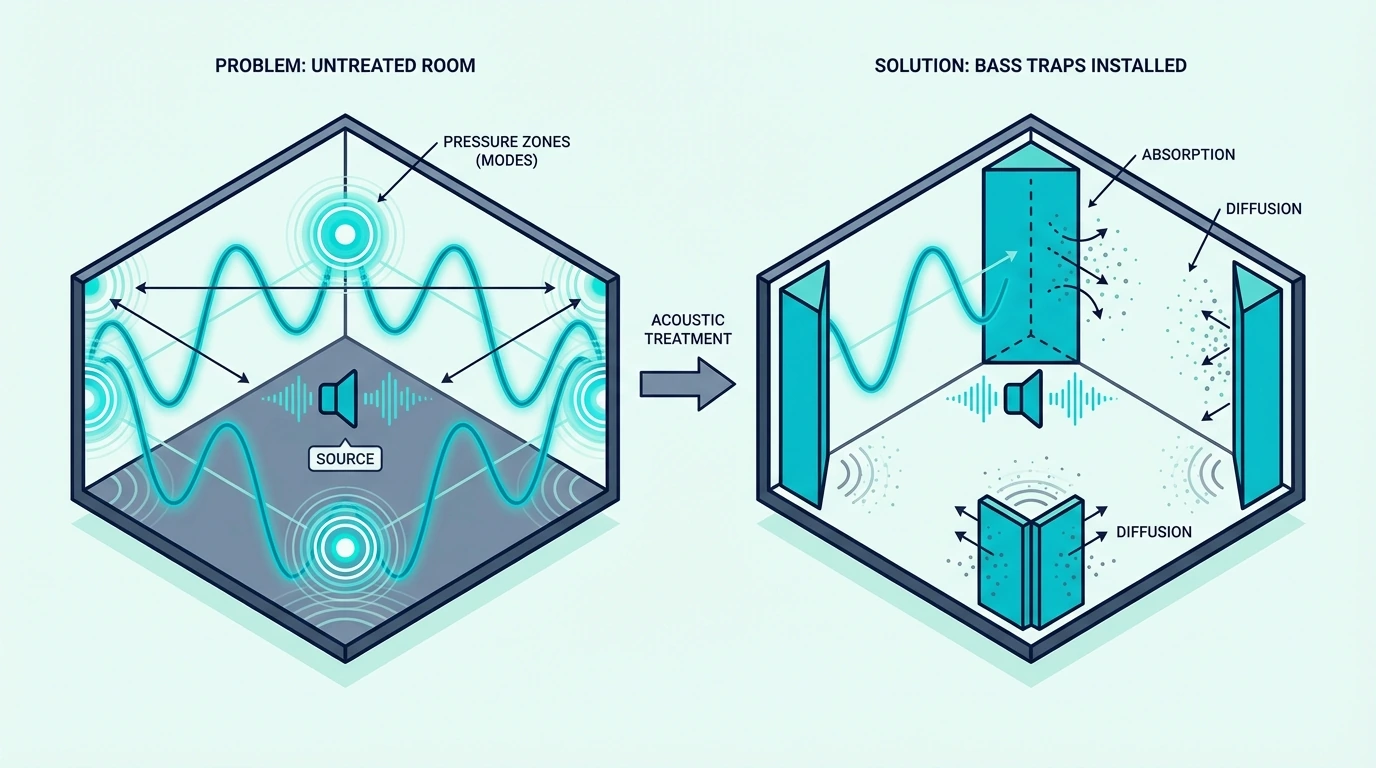
Everything above explains what bass traps do and how they do it — but the reason they’re necessary in the first place comes down to one specific room phenomenon that most people have never heard of.
Standing waves form when bass frequencies bounce between two parallel surfaces — like your front and back walls — and the reflected wave overlaps with the incoming wave. At certain frequencies determined by the distance between those walls, the waves reinforce each other and create a resonance called a room mode.
Every room has multiple modes — a 15-foot room has a fundamental axial mode at about 37 Hz, with harmonics at 74 Hz, 111 Hz, and so on. Those are the frequencies where your room artificially boosts bass, and the places where that boost is strongest are the corners where two or three surfaces meet.
That’s the scientific reason bass trap placement always starts with corners. The corners are where the pressure from multiple room modes stacks up — a tri-corner where two walls meet the ceiling sees pressure buildup from three different axial modes simultaneously.
Try this: play a steady bass tone at your room’s fundamental frequency (you can calculate it by dividing 1,130 by twice your room’s length in feet). Walk from the center of the room toward a corner.
You’ll hear the bass get dramatically louder. That’s the standing wave in action — and that’s exactly what a bass trap in that corner would absorb.
Without treatment, those modes don’t just make bass louder — they make it uneven. One frequency booms while the frequency 20 Hz above it practically vanishes.
The right number of traps in the right corners flattens that response so every note in the bass range plays at roughly the same level.
The Bottom Line
The single most impactful acoustic upgrade for any room isn’t fancy speakers or expensive microphones — it’s addressing the bass energy that your room’s geometry amplifies and distorts.
Start with porous absorber bass traps in two or four corners, as thick as your space allows, and you’ll hear the difference on your very first listening session. Everything else — resonant absorbers, diffusers, broadband panels — builds on that foundation.
Frequently Asked Questions
What is the purpose of a bass trap?
A bass trap absorbs excess low-frequency sound energy that builds up in a room, particularly in corners where walls meet. Without them, bass frequencies resonate unevenly — some notes boom while others disappear — which ruins the accuracy of everything you hear, record, or mix in that space.
How do I know if I need bass traps?
Clap your hands in the center of your room and listen for a low-frequency “ring” or sustained rumble. If bass sounds boomy in some spots and thin in others, or your mixes consistently have bass problems when you play them elsewhere, your room has untreated modal issues that bass traps would fix.
What is the difference between a bass trap and acoustic panel?
Standard acoustic panels are typically 1-2 inches thick and target mid-to-high frequencies (above 300 Hz). Bass traps are 4+ inches thick with denser material, designed specifically to absorb low frequencies below 300 Hz.
Both are acoustic treatment — bass traps just go deeper into the frequency range.
Where not to put bass traps?
Avoid placing bass traps flat against the center of a wall with no air gap — that position wastes their potential because bass energy is weakest at wall centers and strongest at corners. Also avoid blocking ceiling-mounted fixtures or HVAC vents, and never place foam traps near heat sources that could degrade the material.