Helmholtz Resonator Bass Trap — How It Works And How To Build One
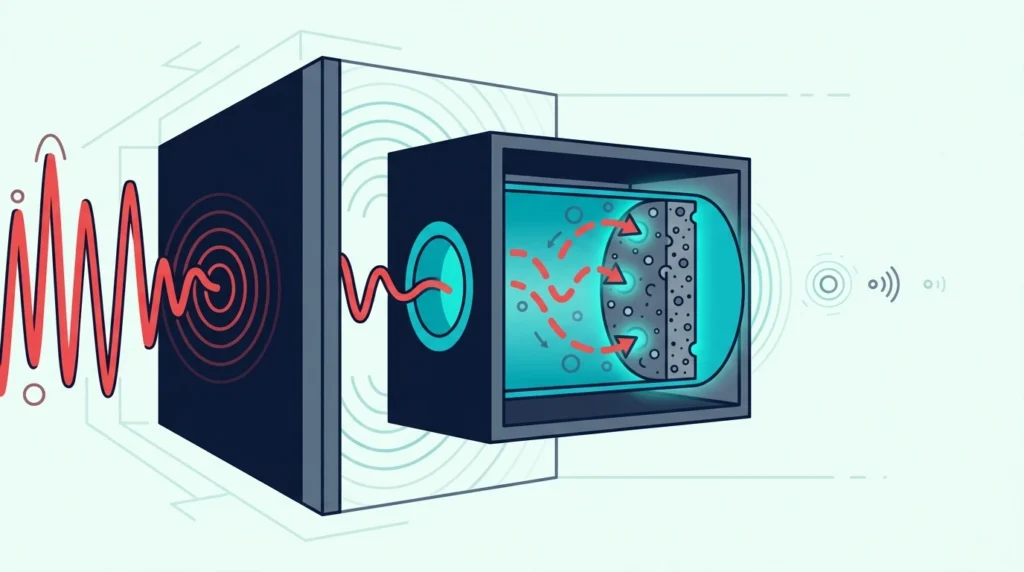
Helmholtz resonator bass trap designs target specific low frequencies that porous absorbers can’t reach, but building one that actually works requires understanding the physics behind the tuning — not just copying dimensions from a forum post.
A Helmholtz resonator is a sealed box with a port (hole or slot) that resonates at a precise frequency determined by the cavity volume and port dimensions. When sound at that frequency enters the port, the air inside oscillates and friction converts the acoustic energy to heat.
This makes Helmholtz traps the surgical tool of acoustic treatment — they eliminate a specific problem frequency without affecting the rest of your room’s sound. Porous absorbers treat everything broadly, while a Helmholtz trap zeros in on the one mode that’s causing havoc.
Below, you’ll see exactly how the resonance mechanism works, when to use a Helmholtz trap instead of standard absorption, how to calculate dimensions for your target frequency, and a step-by-step build guide for a DIY 100 Hz trap.
A Helmholtz resonator bass trap is a sealed cavity with a port that absorbs sound at a specific tuned frequency. It targets frequencies as low as 30-60 Hz that porous absorbers can’t reach without impractical thickness. Build one by calculating port dimensions from the formula f = (c/2π) × √(S/(V×L)), using MDF or plywood for the enclosure and adding internal damping material. Best used alongside broadband porous traps to address stubborn room modes that show up in measurement data.
What Is A Helmholtz Resonator Bass Trap?
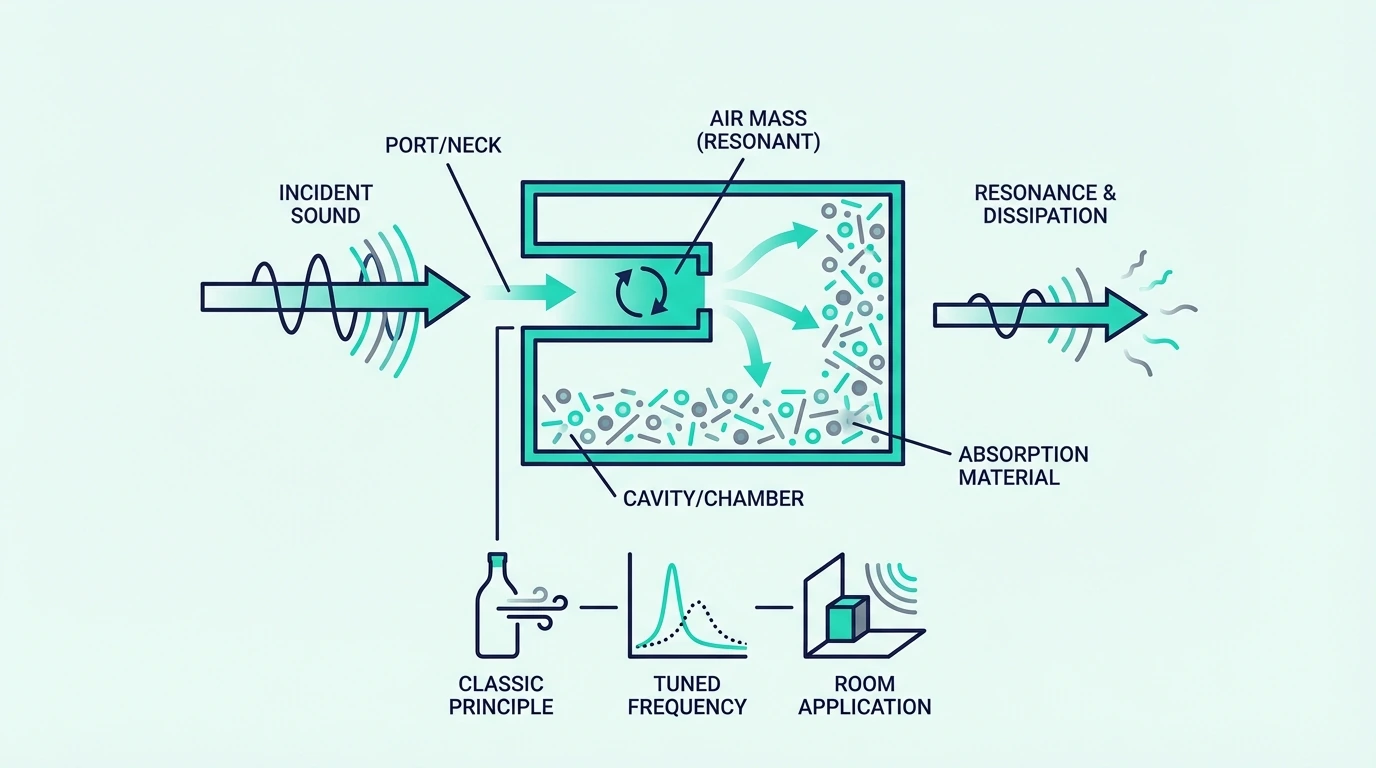
A Helmholtz resonator bass trap is a type of resonant absorber — a sealed enclosure with a carefully sized opening that absorbs sound energy at one specific frequency. The concept dates back to Hermann von Helmholtz in the 1860s, and the physics hasn’t changed since.
The simplest analogy is blowing across the top of an empty bottle — the bottle produces a single tone because the air in the neck and the air in the body form a resonant system. A Helmholtz bass trap works the same way, except instead of producing sound, it absorbs it.
What makes this type of trap valuable is its ability to reach frequencies that porous absorbers can’t touch without extreme thickness. A porous trap needs roughly 34 inches of depth to absorb effectively at 100 Hz, while a Helmholtz resonator can absorb at 100 Hz — or even 40 Hz — in a box just 12-18 inches deep.
The tradeoff is bandwidth — a porous absorber treats everything above its cutoff frequency, while a Helmholtz resonator absorbs strongly at its tuned frequency and within about 10-20 Hz on either side. You’re trading breadth for depth.
How Does A Helmholtz Resonator Work?
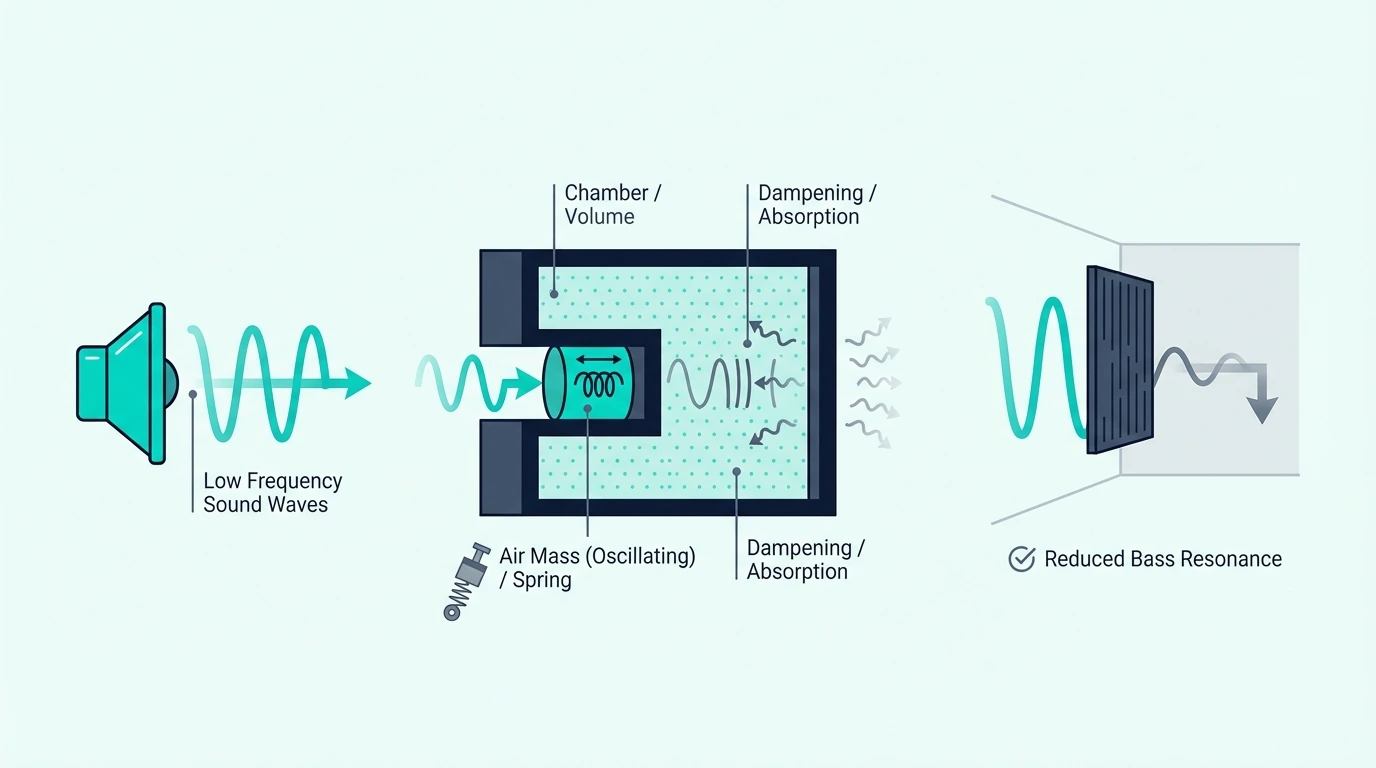
The physics of a Helmholtz resonator involves two elements working together: the air in the port acts as a vibrating mass, and the air in the sealed cavity acts as a spring. Together they form a mass-spring system with a natural resonant frequency.
When a sound wave at the resonant frequency arrives at the port, the air in the neck begins oscillating back and forth. The air in the cavity behind it compresses and expands with each cycle, storing and releasing energy like a spring.
Friction between the moving air and the port walls, plus viscous losses within the cavity, converts that kinetic energy into heat. The energy that entered the port as sound exits as a tiny amount of thermal energy — the sound at that frequency is absorbed.
At frequencies well above or below the resonant point, the impedance mismatch prevents efficient energy transfer into the system. The incoming sound wave essentially bounces off the port instead of coupling into it, which is why absorption drops off sharply away from the tuned frequency.
The Tuning Formula Explained
The resonant frequency of a Helmholtz resonator is calculated with this formula:
f = (c / 2π) × √(S / (V × L))
Where: – f = resonant frequency in Hz – c = speed of sound (343 m/s at room temperature) – S = cross-sectional area of the port (m²) – V = volume of the cavity (m³) – L = effective length of the port (physical length + 0.8 × port radius for end correction)
In practical terms: a larger cavity lowers the frequency, a larger port raises it, and a longer port neck lowers it. You adjust these three variables to hit your target frequency.
For a rectangular slot instead of a circular port, S becomes the slot width × slot length, and L becomes the panel thickness plus end corrections. Slotted designs are common in DIY builds because cutting straight slots in MDF is easier than drilling precise circular ports.
Single-Frequency vs Broadband Helmholtz Traps
A standard Helmholtz resonator with a single port has a narrow absorption band — typically ±10-15 Hz around the center frequency. This is ideal when you have one specific mode dominating your room.
Broadband Helmholtz designs use multiple ports of different sizes, or slotted panels with varying slot widths, to create overlapping resonances that cover a wider frequency range. Some commercial products use perforated panels with hundreds of small holes, effectively creating many tiny Helmholtz resonators that together absorb across a band of 40-60 Hz.
Adding damping material (fiberglass or mineral wool) inside the cavity also widens the absorption band at the cost of peak absorption. A heavily damped Helmholtz resonator behaves more like a hybrid between resonant and porous absorption — broader but less deep at the center frequency.
A cavity-filling material like the AFB Acoustical Fire Batts, Mineral Wool Insulation is the kind of material builders use when they want to damp the cavity without changing the trap into a normal porous absorber.
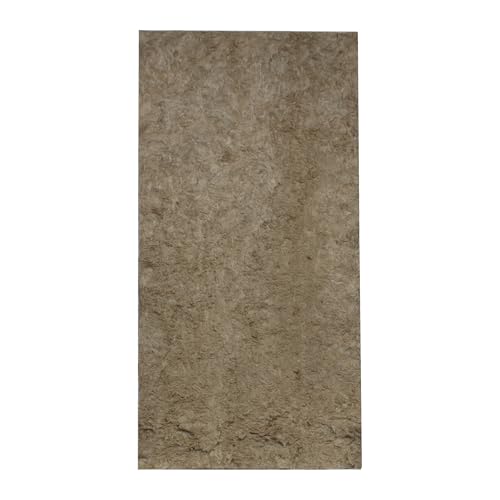
AFB Acoustical Fire Batts, Mineral Wool Insulation
Get Studio Tips Weekly
Join 5,000+ creators getting acoustic treatment advice every week.
No spam. Unsubscribe anytime.When Should You Use A Helmholtz Trap Instead Of A Porous Absorber?
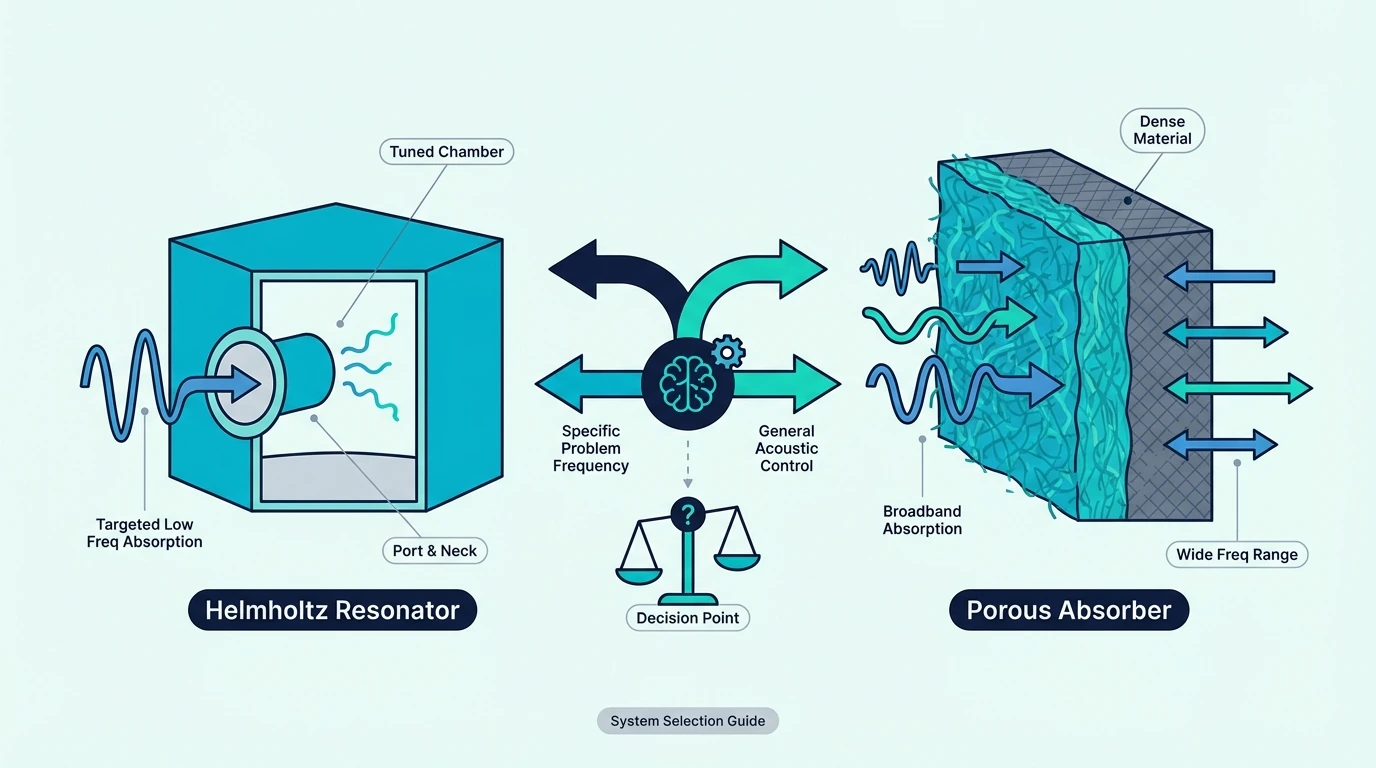
The decision between Helmholtz and porous traps comes down to what your room measurements show. If you have broad, general bass problems across many frequencies, porous absorbers are the right tool — but if you have one or two specific frequencies that spike dramatically above the rest, a Helmholtz trap targets those spikes with precision porous treatment can’t match.
Run a room measurement using REW (Room EQ Wizard) with a calibrated microphone at your listening position and look at the frequency response below 200 Hz. A room with general unevenness (5-8 dB variations across many frequencies) needs broadband porous treatment in the corners first.
A calibrated mic like the miniDSP UMIK-1 USB Measurement Calibrated Microphone makes that measurement step actionable, because tuning a Helmholtz box without knowing the exact problem frequency is mostly guesswork.
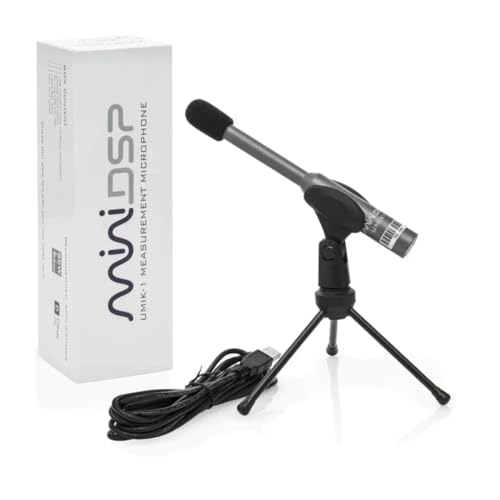
miniDSP UMIK-1 USB Measurement Calibrated Microphone
A room that shows one massive peak — say 15-20 dB at exactly 63 Hz — after porous treatment is installed has a stubborn mode that broadband absorption alone can’t flatten. That’s the case for a Helmholtz resonator tuned to 63 Hz.
If you need help with layout, start with proper bass trap placement before tuning a resonator.
The practical workflow for most rooms follows this sequence:
- Install corner-mounted porous traps first (handles the majority of bass problems).
- Measure again to see what’s left.
- If a specific frequency still dominates, build or buy a Helmholtz resonator tuned to that frequency.
Skipping step 1 and jumping straight to Helmholtz traps is a mistake — you’d need a separate resonator for every problem frequency, which is far more expensive and complex than broadband treatment. Porous traps handle 80% of bass problems, and Helmholtz traps clean up the remaining 20%.
How To Build A DIY Helmholtz Bass Trap
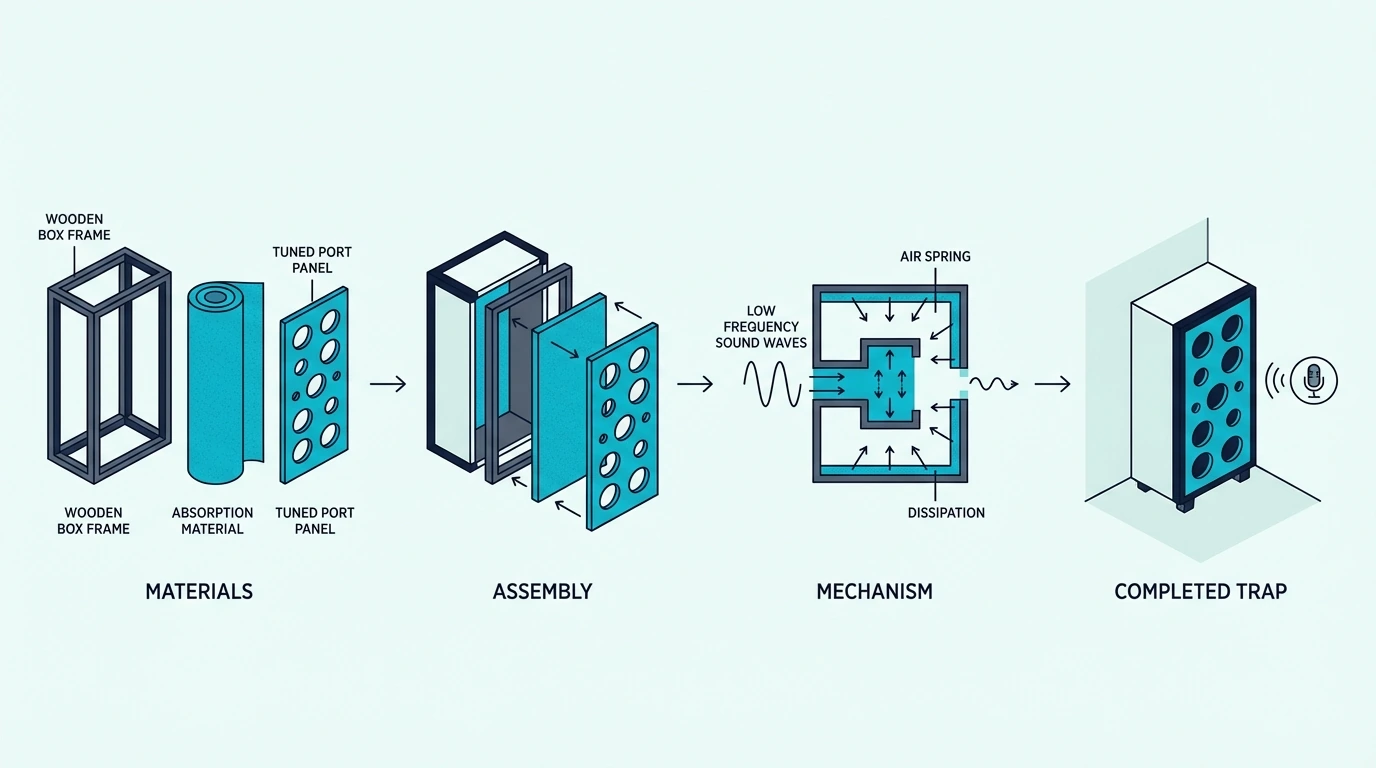
Building a Helmholtz bass trap is a woodworking project that requires precision in the port dimensions but forgives minor variations in the box construction. The enclosure just needs to be airtight and the correct internal volume — the acoustic performance depends almost entirely on the port geometry.
DIY Materials
- 3/4-inch MDF or plywood for the enclosure panels
- Wood glue and screws for assembly
- Acoustic caulk or silicone to seal all joints airtight
- 2-inch rigid fiberglass or mineral wool for internal damping
- A saw and drill (table saw preferred for clean slot cuts)
A sealant like Acoustical Caulk (29 oz) 1 Tube with clean up wipe is the right kind of finishing material for this build, because even small leaks can shift the effective tuning or kill the trap’s performance entirely.
Acoustical Caulk (29 oz) 1 Tube with clean up wipe
The total material cost for a single Helmholtz trap runs $30-60 depending on wood choice and whether you already have tools. Compare that to $200-500+ for commercial tuned absorbers.
Choosing Your Target Frequency
Before cutting any wood, identify which frequency you need to target. You have two approaches.
Room mode calculator: Enter your room dimensions (length × width × height in feet) into an online room mode calculator, and it will show you every axial, tangential, and oblique mode your room produces. The axial modes (single-dimension reflections) are the strongest and most likely to need treatment.
Measurement-based approach: Use REW with a measurement microphone to capture your room’s actual frequency response at your listening position. This shows you not just the theoretical modes but how they interact with your specific speaker placement, existing treatment, and room furnishings — revealing the real problem frequencies, which may differ from calculated modes.
For most rectangular rooms, the worst modes fall between 40-120 Hz — anything below 40 Hz is usually felt more than heard and rarely needs treatment in home studios. Modes above 120 Hz are typically handled well by 4-6 inch porous corner traps.
Building A 100 Hz Helmholtz Trap
Here’s a practical example targeting 100 Hz — a common problem frequency in rooms around 11-12 feet long.
Target: 100 Hz resonant frequency
Design choices: – Cavity volume: 0.027 m³ (roughly 18” × 18” × 6” internal) – Slot width: 1 cm (0.01 m) – Slot length: 40 cm (0.4 m) — runs the full width of one panel – Panel thickness: 19 mm (3/4” MDF) – Effective port length: ~25 mm (with end corrections)
Verification: f = (343 / 6.28) × √(0.004 / (0.027 × 0.025)) = 54.6 × √(5.93) = 54.6 × 2.44 ≈ 133 Hz
To bring that down to 100 Hz, increase the cavity depth to 10 inches or widen the slot slightly. This is the iterative part of the design — adjust one variable at a time until the formula outputs your target frequency.
Assembly steps:
- Cut five MDF panels for the box (top, bottom, two sides, back). The front panel gets the slot.
- Cut the slot in the front panel — a straight 1 cm × 40 cm slot, centered vertically.
- Glue and screw the box together, leaving the front panel off.
- Line the inside back wall with 2-inch rigid fiberglass for internal damping.
- Seal every joint with acoustic caulk — any air leak changes the tuning or kills performance.
- Attach the slotted front panel with screws and seal the perimeter.
- Mount the finished trap against the wall at your problem area (corners or wall centers where the mode is strongest).
The internal damping material widens the absorption band slightly and prevents the resonator from “ringing” — oscillating for too long after the source stops. Without damping, a Helmholtz trap can actually make transient response worse by sustaining energy at its tuned frequency.
How To Make A Tuned Bass Trap
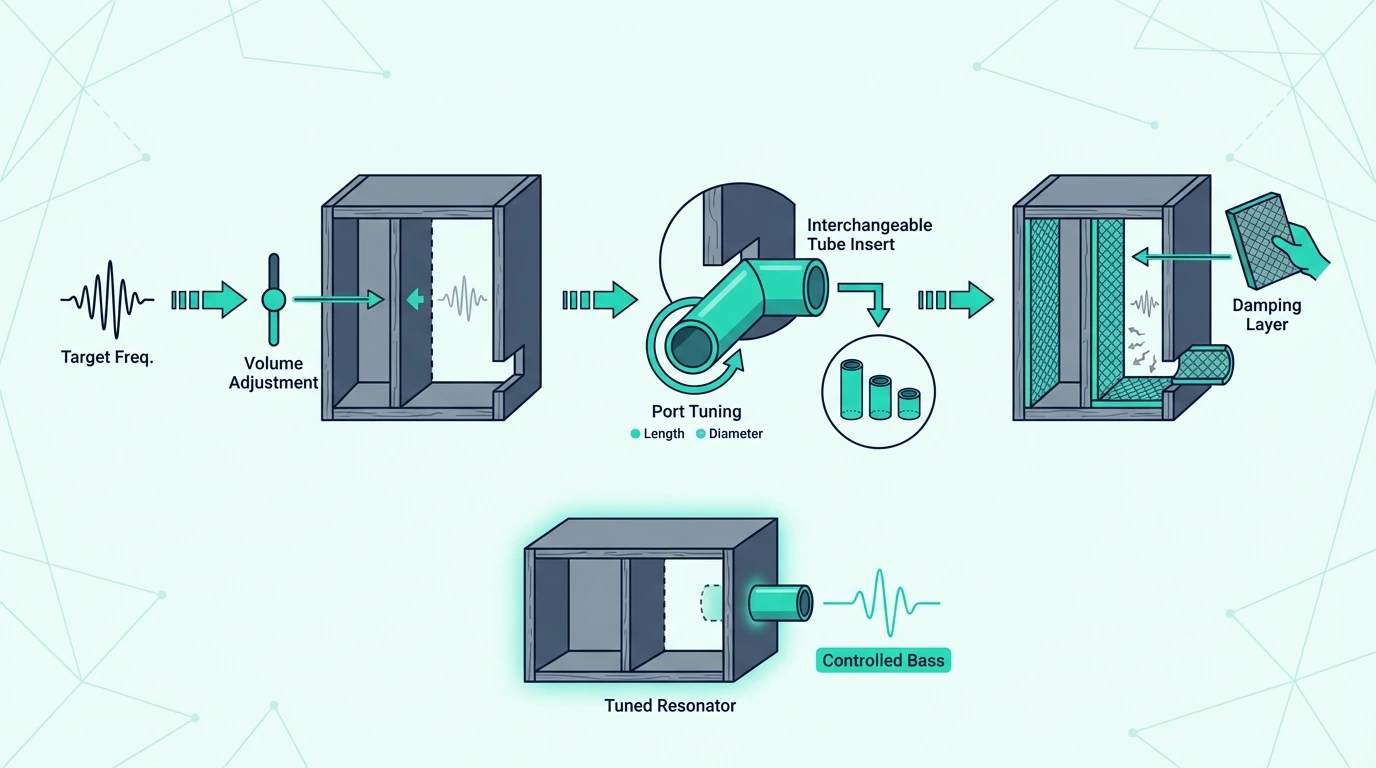
Helmholtz resonators are one approach to making tuned bass traps, but membrane (diaphragmatic) traps offer an alternative tuning method that some DIY builders find simpler to construct.
A membrane trap uses a thin, flexible front panel (typically 1/8” or 3/16” plywood or MDF) mounted over a sealed cavity. The panel mass and cavity depth determine the resonant frequency, and the panel vibrates at that frequency, converting acoustic energy to heat through internal friction.
The membrane tuning formula is simpler: f = 60 / √(m × d), where m is the panel mass in kg/m² and d is the cavity depth in meters.
For example, a 3mm plywood panel (about 1.8 kg/m²) over a 10 cm deep cavity: f = 60 / √(1.8 × 0.1) = 60 / √0.18 = 60 / 0.424 ≈ 141 Hz. Deeper cavity or heavier panel lowers the frequency.
Membrane traps tend to have a slightly wider absorption band than Helmholtz resonators, making them more forgiving of construction tolerances. They’re also easier to build — no precision port cutting required, just a sealed box with a flexible front panel.
The choice between Helmholtz and membrane comes down to target frequency and bandwidth. Helmholtz traps reach lower frequencies more easily (below 60 Hz) with narrower, more precise targeting, while membrane traps work well in the 60-150 Hz range with moderate bandwidth.
Both types complement porous absorber bass traps rather than replacing them. The ideal room treatment pairs broadband porous absorption for general bass control with one or two tuned traps addressing specific stubborn modes identified through measurement.
The Bottom Line
Helmholtz resonator bass traps are precision tools for targeting specific low frequencies that porous bass traps can’t reach without impractical thickness. They work by using a sealed cavity and port to create a resonant system that absorbs energy at one tuned frequency.
Build one only after installing broadband porous treatment and measuring to identify remaining problem frequencies. The DIY build is accessible for anyone comfortable with basic woodworking, and the materials cost a fraction of commercial tuned absorbers.
For most home studios, the combination of corner-mounted porous traps plus one or two Helmholtz resonators for stubborn modes delivers professional-grade bass control without professional-grade pricing.
Frequently Asked Questions
How do you calculate Helmholtz resonator dimensions?
Use the formula f = (c/2π) × √(S/(V×L)), where c is the speed of sound (343 m/s), S is the port area, V is the cavity volume, and L is the effective port length. Adjust cavity volume, port size, or port length until the formula outputs your target frequency.
Can you build a Helmholtz bass trap from plywood?
Plywood works well for Helmholtz bass trap enclosures — 3/4-inch plywood provides sufficient rigidity and mass to prevent the walls from vibrating and changing the tuning. MDF is slightly better because it’s denser and more uniform, but plywood is easier to work with and performs nearly identically for this application.
What is the difference between a Helmholtz trap and a membrane trap?
Both are resonant absorbers that target specific frequencies, but they work differently — a Helmholtz trap uses a port (hole or slot) where air oscillates in and out of a sealed cavity, while a membrane trap uses a flexible front panel that vibrates over a sealed cavity. Helmholtz traps reach lower frequencies with narrower bandwidth, while membrane traps are easier to build and absorb across a slightly wider band.