Best Android MIDI Controller Keyboards, Adapters and Apps
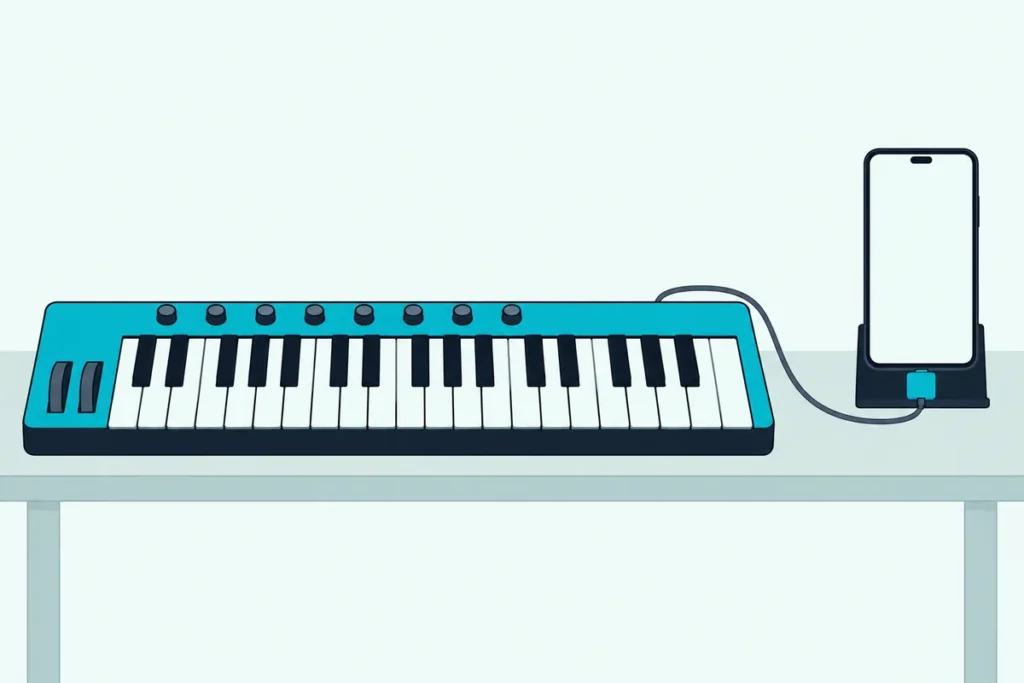
Finding the best Android MIDI controller is harder than it looks, because big names such as Korg, Arturia and Novation list computers and Apple devices, but not Android.
Even a board that should work can sit silent when the Android device can’t act as a USB host, can’t power the keys, or runs an app that never scans for Bluetooth MIDI.
Get the match right and a phone or tablet turns into a pocket studio, either playing apps from real keys or standing in as the controller for a computer.
This guide sticks to hardware whose makers name Android, controller apps as their own developers describe them, and Google’s own rules for USB and Bluetooth MIDI.
The short list comes first, then the cables, pairing steps and fixes that decide whether Android sees the keyboard.
What Is the Best Android MIDI Controller?
That depends on whether you want keys under your fingers or the phone itself as the controller, but for real keys the M-VAVE SMK-25 is the best Android MIDI controller on paper. M-VAVE lists Android, its manual pairs the board over Bluetooth MIDI inside an app such as FL Studio, and a 2,000 mAh battery powers it (M-VAVE).
For the reverse job, TouchDAW turns an Android device into a DAW remote, and our guide on how to use your phone as a MIDI controller covers the USB setup.
Those two answers cover all ten picks:
| Pick | Connection | Best for |
|---|---|---|
| M-VAVE SMK-25 | Bluetooth MIDI or USB | Most players |
| IK Multimedia iRig Keys 2 | USB, with an OTG cable | A wired keyboard |
| CME WIDI Uhost | Bluetooth MIDI | A USB keyboard you own |
| CME C2MIDI Pro | USB-C cable | A 5-pin keyboard |
| TouchDAW app | Wi-Fi, USB or Bluetooth | Running a DAW |
| Midi Commander app | USB host mode | Patch changes |
| MIDIPadidi app | USB MIDI mode | Pads for a computer |
| MIDI Controller app | USB or Bluetooth | Faders and clock |
| DAW IT app | USB | Expression and key switches |
| TouchOSC app | USB MIDI mode | Custom layouts |
Each hardware pick had 4.0+ stars and 50+ Amazon reviews and was in stock on 7 October 2026; prices are left out because they change.
| Product | Link |
|---|---|
Best Overall for Android 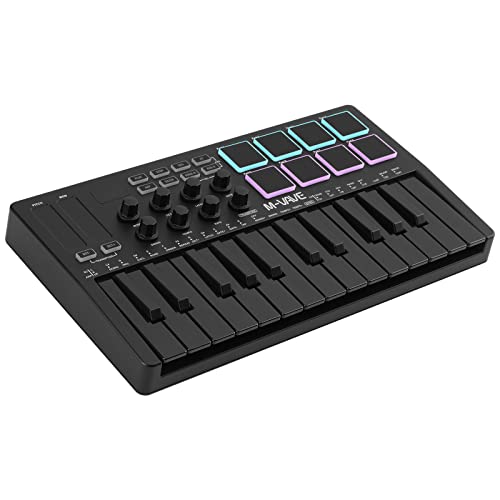 | See ratings |
Best Wired Keyboard 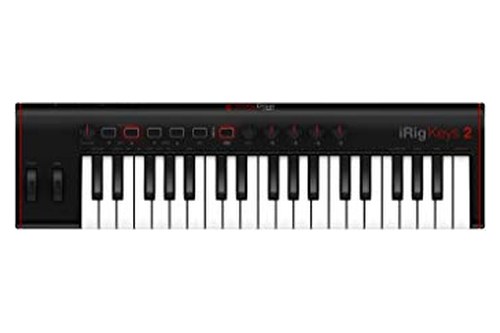 | See ratings |
Best for a USB Keyboard You Own 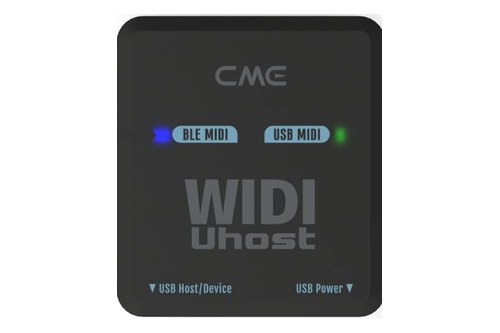 | See ratings |
Best for 5-Pin MIDI 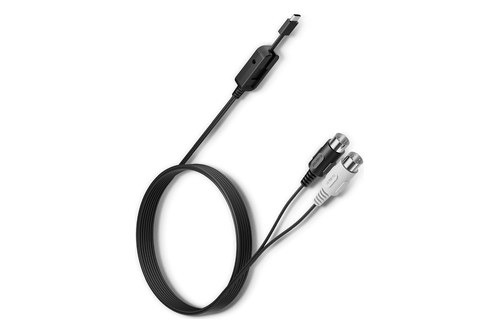 | See ratings |
Which MIDI Keyboard Works Best With Android?
Those four hardware picks split into two keyboards and two CME adapters for a keyboard you already own. Of the keyboards, the M-VAVE SMK-25 works best with Android on paper, offering Bluetooth MIDI and USB with Android listed.
M-VAVE SMK-25
For most Android players, the M-VAVE SMK-25 is the pick.
the M-VAVE SMK-25
M-VAVE’s product data lists Windows, macOS, iOS and Android, with BLE MIDI, a USB-B port, eight RGB pads and eight endless encoders.
USB bus power backs up the battery, though M-VAVE gives no running time, and the pitch and modulation controls are touch strips rather than wheels.
IK Multimedia iRig Keys 2
For a wired keyboard with wheels, the IK Multimedia iRig Keys 2 is the one to get.
the IK Multimedia iRig Keys 2
IK lists Android beside iPhone, iPad, Mac and PC, with one condition in the small print: Android needs a micro-USB to OTG cable, sold separately (IK Multimedia). Lightning, USB-C and USB-A cables come in the box.
Its 37 velocity-sensitive mini keys sit beside pitch and mod wheels, 4+4 assignable knobs and a headphone output, and the 37-key comparison sets it beside Korg’s, Novation’s and Arturia’s boards.
CME WIDI Uhost
For a USB keyboard you already own, the CME WIDI Uhost makes it wireless.
the CME WIDI Uhost
CME calls it a Bluetooth MIDI interface plus USB host that adds Bluetooth MIDI to class-compliant USB controllers, and it lists Android through Android’s built-in BLE MIDI (CME). One Uhost pairs a USB MIDI device with any Bluetooth MIDI device, CME says, so Android talks to the Uhost rather than to the keyboard.
CME C2MIDI Pro
For a keyboard or synth with 5-pin MIDI ports, the CME C2MIDI Pro is the wired route.
the CME C2MIDI Pro
CME lists Android among the systems for its USB-C plug, and the other end splits into MIDI plugs for the hardware’s IN and OUT ports (CME). CME’s U2MIDI Pro is a similar cable with a USB-A plug and the same Android listing.
Get Studio Tips Weekly
Join 5,000+ creators getting acoustic treatment advice every week.
No spam. Unsubscribe anytime.Which App Turns an Android Phone Into a MIDI Controller?
Those picks put real keys in your hands, but the phone can also be the controller itself, sending notes and knob moves from its touchscreen. TouchDAW covers the most ground on paper, with Wi-Fi, USB and Bluetooth MIDI.
TouchDAW
Humatic’s TouchDAW is a full DAW controller with general MIDI tools for Android devices and recent Chromebooks (Humatic). It runs network MIDI over Wi-Fi, works with Apple’s MIDI network on a Mac and rtpMIDI on Windows, and also offers USB and Bluetooth MIDI.
A free demo, limited in features and time, comes before the paid full version.
Midi Commander
Borderò’s Midi Commander sends control change and program change messages from buttons you define, to switch patches on a keyboard or other MIDI gear connected over USB. Its developer sets two conditions: Android must be able to act as a USB host, and the MIDI gear must be class compliant, needing no driver.
The developer also posts the latest .apk file on its own site.
MIDIPadidi
LoRe’s MIDIPadidi is a free app with pads, a piano keyboard and an X/Y touch surface for a DAW on your computer. You set Android’s USB preference to MIDI, the app makes no sound of its own, and the volume buttons shift octaves.
MIDI Controller by Volcano Mobile
Volcano Mobile’s MIDI Controller builds buttons, faders, X/Y buttons and a channel mixer, plus a master clock and metronome. It connects over USB or Bluetooth MIDI, with multiple controller sets kept for the premium version.
DAW IT
Dawvelopment’s DAW IT offers up to 40 faders and 240 buttons per preset, 3D pads that add a third controller under a second finger, and key switches for soft synths. It needs Android 7 or later and uses only the USB port, with no extra drivers.
TouchOSC
Hexler’s TouchOSC is a modular control surface, and on devices whose maker added USB peripheral mode, choosing MIDI in the USB options creates MIDI ports it can send through (Hexler). The port names vary by manufacturer, so look for one called Android USB Peripheral Port or similar.
Does Android Support USB MIDI Controllers?
Yes, though the system MIDI support those apps and keyboards can use only arrived with Android 6.0 Marshmallow. Google’s Android Developers Blog introduced the MIDI API in 2015 with a sample that plays notes from an attached MIDI keyboard (Google).
Android’s MIDI package carries messages over USB, Bluetooth LE and between apps (Android). Support is still optional, though, because Hexler notes that device makers choose whether to enable it.
Android’s compatibility rules say a device with a USB port should, not must, work as a USB host (Android). That’s why one keyboard can work on one phone and not on another.
What Cable Does an Android Phone Need?
That USB host role often starts with an OTG adapter, and Image-Line’s FL Studio Mobile manual says many Android devices need one to take a MIDI controller’s USB-A plug (Image-Line). On some devices you also have to switch on OTG Storage in the Android settings.
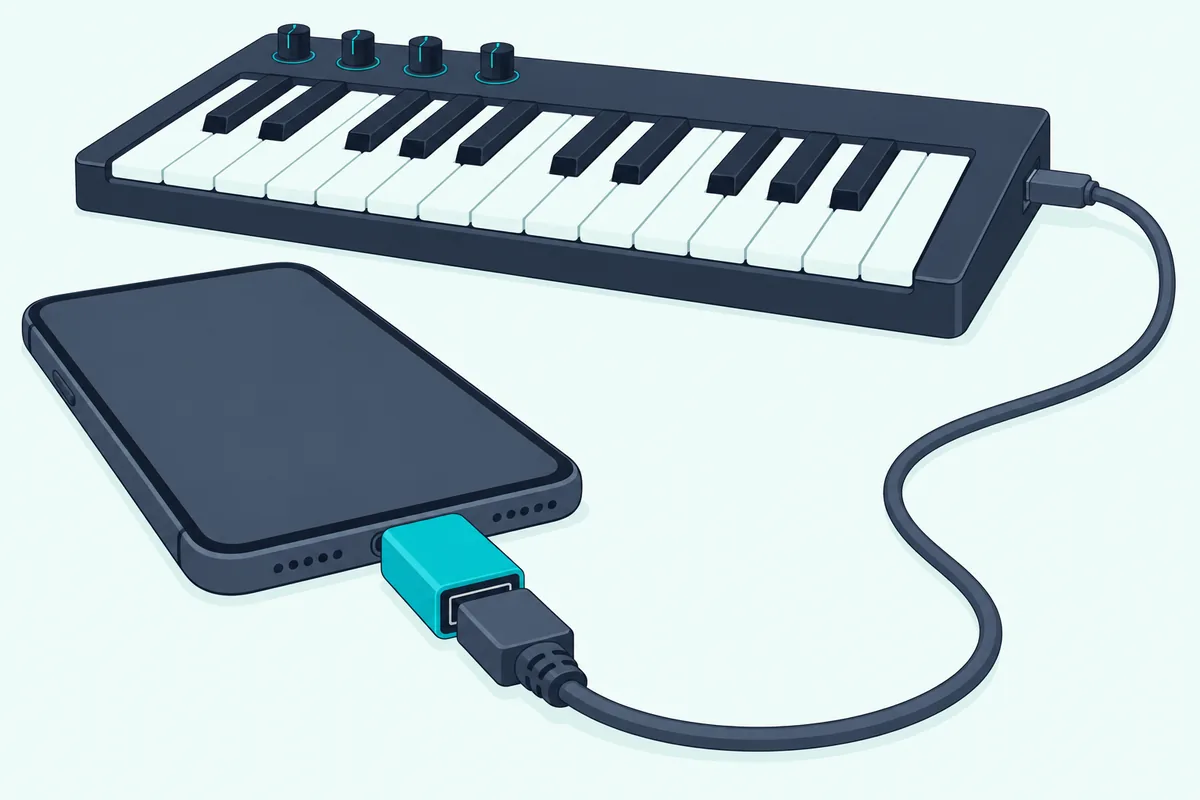
Yamaha’s Android connection manual spells out the parts: a USB cable that fits the keyboard’s port, then an adapter from USB-A female to the phone’s micro-USB or USB-C (Yamaha). Yamaha also wants a cable under 3 meters and rules out USB 3.0 cables.
Power is the other half, since Android’s rules only recommend that a device in host mode can charge what’s connected at 1.5 A or more. FL Studio Mobile’s manual warns that not every mobile device can power a controller and suggests the controller’s own supply.
Does Bluetooth MIDI Work on Android?
Yes, and it skips those cables, but on Android the pairing happens inside an app rather than in the Bluetooth settings. Android’s MIDI documentation says the app has to scan for Bluetooth LE MIDI devices and let you connect, and once one app opens the device, other apps can see it too.
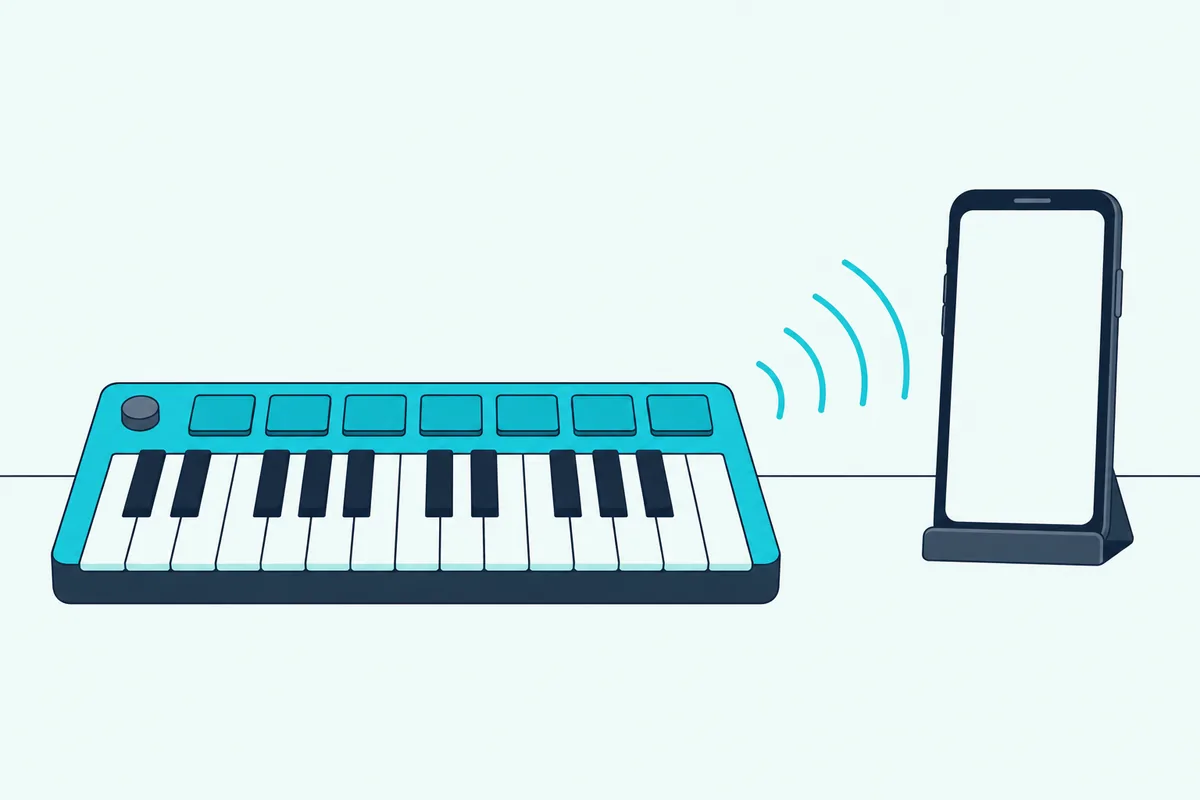
M-VAVE’s manual follows the same route, telling Android users to open a BLE MIDI app such as FL Studio and connect from its MIDI devices. FL Studio Mobile has an Enable MIDI over Bluetooth switch, and Android asks for location permission because nearby Bluetooth devices can reveal where a phone is.
Devices that report MIDI support must handle Bluetooth LE MIDI in the central role, Android’s compatibility rules say, which CME’s guide describes as the side that finds the keyboard and starts the connection. Burton Acoustix’s Bluetooth MIDI keyboard guide covers more wireless boards and the Apple and Windows details.
Why Won’t Android See the Controller?
That in-app pairing explains one invisible keyboard, and the wired ones usually come down to three checks:
- The phone works as a USB host; without it, Midi Commander’s developer warns, the device may not be recognized.
- The keyboard is class compliant and needs no driver.
- For a phone used as the controller, the USB preference is set to MIDI, which Hexler says depends on the device maker.
Yamaha’s connection order is worth copying for any keyboard: power the instrument off, quit open apps, connect the cable, then power it on.
Which Controllers Didn’t Make the List?
Those checks assume the maker supports Android in the first place, and several popular brands don’t say so. Korg’s microKEY2 page lists Mac, Windows, iPad and iPhone, Arturia’s MiniLab 3 page names computers and iPad, and Novation’s Launchkey Mini page lists iOS apps but no Android ones.
Arturia calls the MiniLab 3 class compliant, so it may well work through Android’s USB MIDI support, but Arturia doesn’t promise it. Akai’s and Donner’s pages couldn’t be read for this guide, so their keyboards weren’t checked.
Three boards that do list Android had too few Amazon reviews on 7 October for this guide: IK’s iRig Keys 2 Mini, ESI’s Xkey 25 and M-VAVE’s SMC-PAD. The iRig Keys 2 Pro showed no offer that day and CME’s WIDI Master was down to its last unit, while our best mini MIDI keyboard picks cover compact boards for computers.
The Bottom Line
Buy the M-VAVE SMK-25 for a board that M-VAVE lists for Android, with Bluetooth MIDI and a battery, or the iRig Keys 2 for wheels and a wired link.
Add a WIDI Uhost or C2MIDI Pro for a keyboard you already own, and try TouchDAW or Midi Commander when the phone should be the controller.
Frequently Asked Questions
Is MIDI supported by Android?
Yes, since Android 6.0 Marshmallow, when Google added a MIDI API for USB, Bluetooth LE and app-to-app connections. Support is still up to the phone: Hexler says device makers choose whether to enable it, and Android’s compatibility rules require USB and Bluetooth MIDI only from devices that report MIDI support.
Can you use an Android phone as a MIDI controller?
Yes, with an app. MIDIPadidi and TouchOSC send MIDI over USB once you choose MIDI in Android’s USB options, TouchDAW also works over Wi-Fi, and Volcano Mobile’s MIDI Controller offers USB or Bluetooth.
Can I connect a MIDI keyboard to an Android tablet?
Yes, the same way as a phone. The tablet has to work as a USB host, the keyboard should be class compliant, and Image-Line’s FL Studio Mobile manual says many devices need an OTG adapter for a USB-A plug; a Bluetooth MIDI keyboard pairs inside a music app instead.
Do you need a MIDI player app on Android?
Not just to hear a MIDI file. Android’s compatibility rules require every device with audio output to decode MIDI, so a .mid file can play with no controller attached; a MIDI controller sends live notes to an app instead.