Best Soundproofing Material for Ceiling Noise and Footsteps
If you’re hunting for the best soundproofing material for ceiling noise, start with what you hear, because voices and footsteps get through a ceiling in different ways.
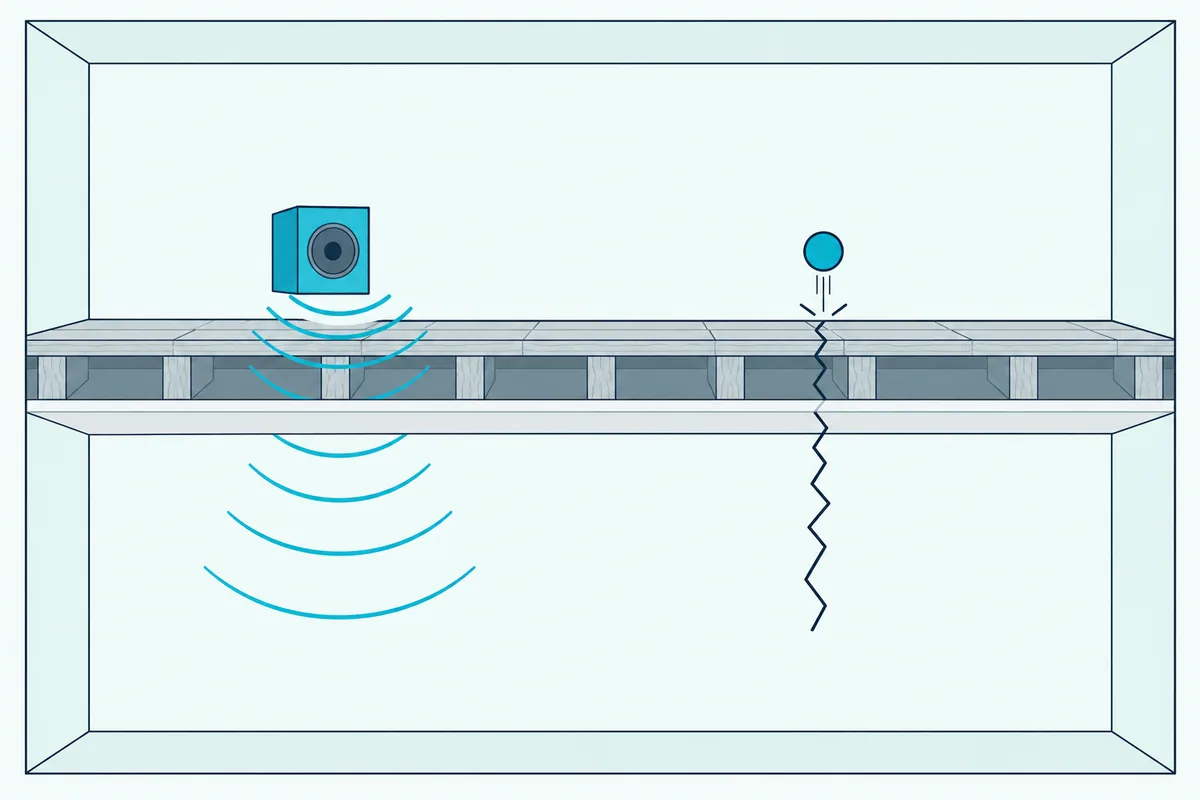
A TV upstairs reaches you as airborne sound, while footsteps strike the floor and travel through the structure, so the foam squares and soft tiles that tame echo in your room do little to block either one.
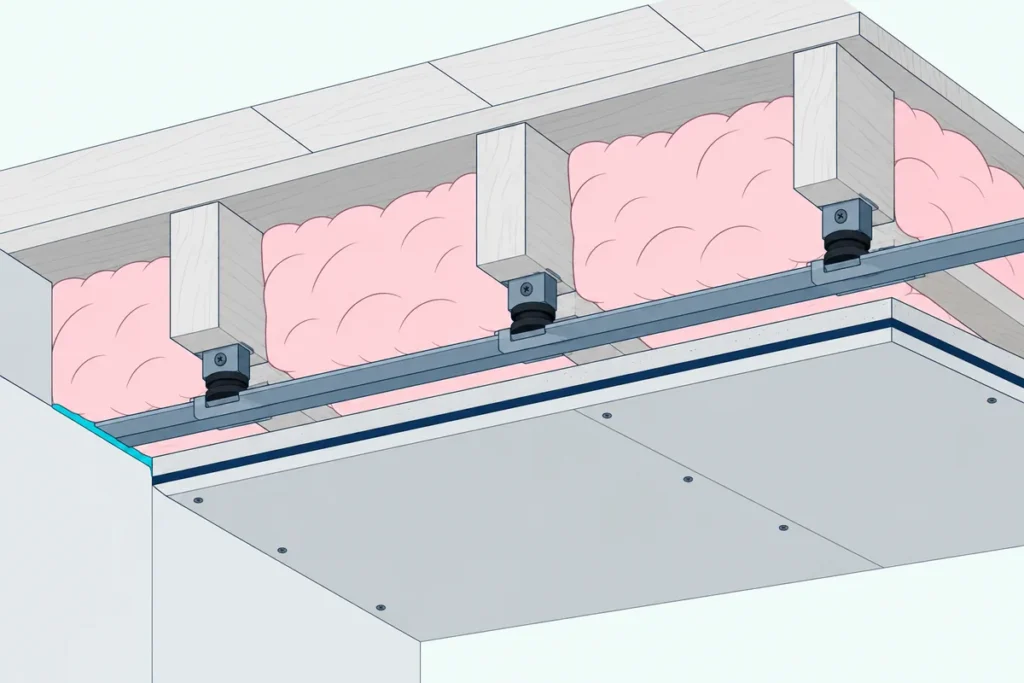
Match the layer to the noise and each material has a measured job, from insulation and decoupling clips to a damped second layer of drywall and a bead of sealant.
This guide compares those, plus mass loaded vinyl and ceiling tiles, by the two ratings that matter overhead: STC for airborne sound and IIC for impact.
Every figure names the maker or lab behind it, so you can see what a layer adds before anyone opens the ceiling.
What Is the Best Soundproofing Material for a Ceiling?
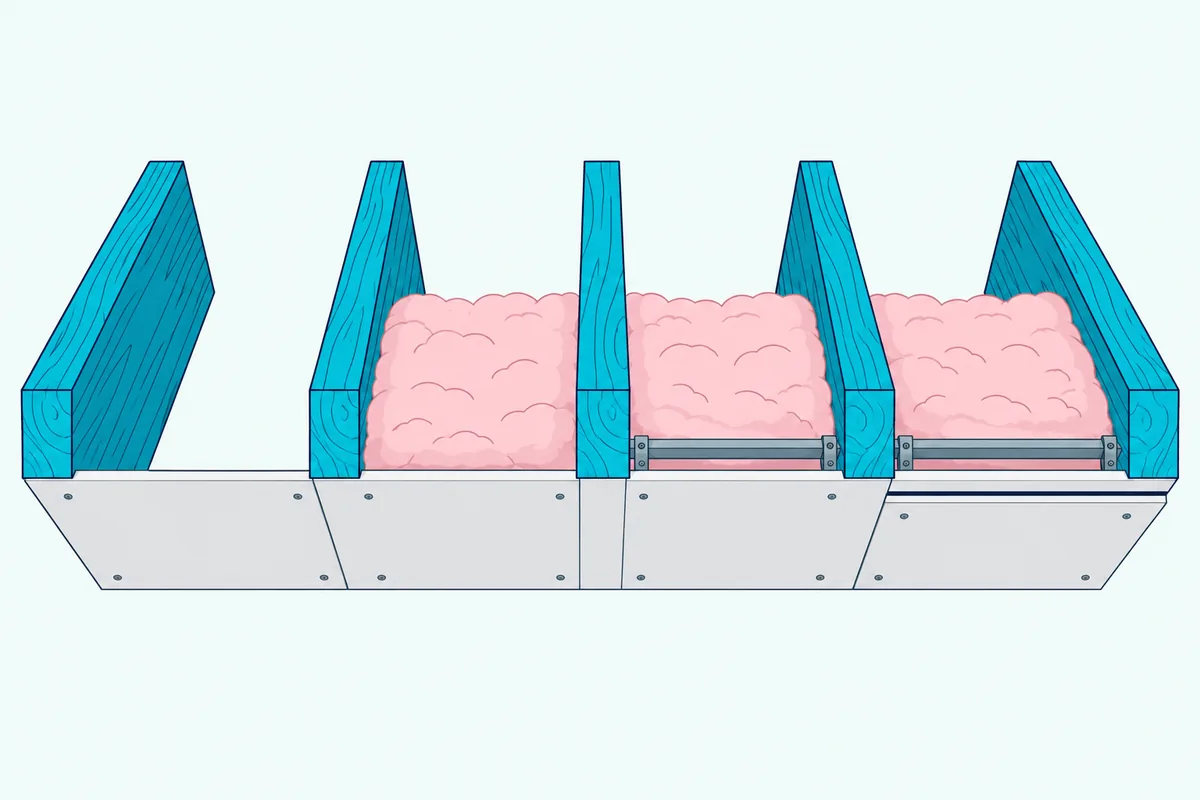
That split between voices and footsteps decides the answer. For airborne noise, the best soundproofing material for a ceiling is a system of insulation in the joists plus drywall hung on resilient channel or clips, each of which added 8 STC points in a National Gypsum test, while footsteps respond most to what covers the floor above.
| Material | What it does | Published figure | Measured by |
|---|---|---|---|
| Insulation batts | Absorb sound in the joist cavity | STC 52 to 60, IIC 51 to 60 | National Gypsum |
| Resilient channel or clips | Hold the drywall off the joists | STC 37 to 45 | National Gypsum |
| Damped drywall | Adds mass, turns vibration into heat | STC 59 vs 57 with a plain board | National Gypsum |
| Mass loaded vinyl, 1 lb per sq ft | Adds thin mass | STC 27 alone | Soundsulate |
| Acoustical sealant | Closes leaks | A 1/16-in. crack takes STC 50 to 40 | HUD |
| Ceiling tiles | Absorb echo in your room | NRC 0.50, CAC 35 (Dune 1774) | Armstrong |
Each card below was in stock on Amazon on 16 October 2026. Insulation has none, because Amazon’s results for ROCKWOOL Safe’n’Sound that day showed no ceiling batt.
Insulation Batts (Best Cavity Fill)
Fiberglass or mineral wool batts are the first layer to add when the joists are open. In National Gypsum’s tests of one truss floor over drywall on a suspended grid, adding 3-1/2 inches of glass fiber raised the rating from STC 52 to 60 and from IIC 51 to 60 (National Gypsum).
Going from 3-1/2 to 18 inches in a second pair added just 1 STC point and 2 IIC points, and National Gypsum’s design notes say an insulation’s thickness matters more than its density. NRC Canada’s Building Digest 239 adds that insulation gives only about 3 points to a wall with drywall attached directly to the studs, because the sound crosses through the framing instead of the air in the cavity.
ROCKWOOL rates its own ceiling, 6-inch Safe’n’Sound between 2×10 joists with 5/8-inch Type X drywall on resilient channels, at STC 50 (ROCKWOOL). Our guide to soundproofing a basement ceiling with open joists walks through that build in order.
Resilient Channel or Sound Clips (Best for Decoupling)
To hold the drywall off the joists, PAC’s RSIC-1 clips come 10 to a pack with mounting screws. National Gypsum’s pair of 2×10 joist floors shows decoupling alone: with no insulation, a 1/2-inch drywall ceiling fastened directly to the joists rated STC 37, and the same board on RC-1 resilient channel rated 45.
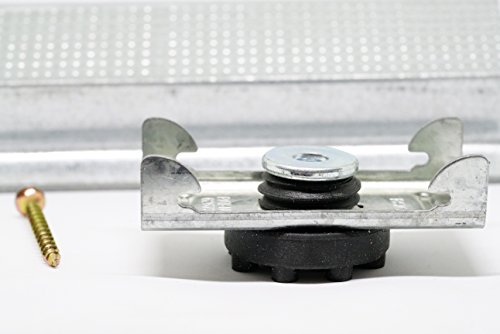
PAC’s RSIC-1 clips
NRC Canada’s Building Digest 239 calls rigid connections “the acoustical equivalent of an electrical short circuit,” and a channel or clip breaks that path. PAC’s installation guide spaces RSIC-1 clips no more than 48 by 24 inches apart on ceilings, rates each for a 36 lb acoustical design load and leaves a 1/4-inch gap around the edge, filled with acoustical sealant (PAC).
The same guide keeps heavy loads such as dropped ceilings and speakers off the clips and channel. National Gypsum’s clip-hung ceilings rated IIC 61 and 65 against 59 and 60 on RC-1, over a thinner subfloor.
A Second Drywall Layer With Damping Compound (Best Upgrade From Below)
If the ceiling has to stay up, the usual upgrade is another layer of drywall, and Green Glue Noiseproofing Compound goes between the two. Its listing says it can go over any existing wall, floor or ceiling under another layer, and quotes an STC of 56 from third-party tests of a single-stud wall without naming the lab.
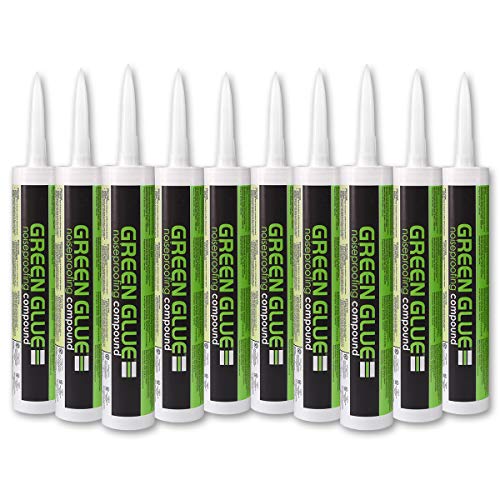
Green Glue Noiseproofing Compound
National Gypsum calls the principle constrained layer damping: a viscoelastic material between two stiffer layers turns vibration into negligible heat. On one truss floor, its 3/4-inch damped SoundBreak XP ceiling board on RC-1 rated 2 STC points above a plain 5/8-inch board under each of three floor finishes, though the book doesn’t say how the plain board was hung.
The second sheet adds mass too. USG lists its 5/8-inch Firecode X board at 2.2 lb per square foot, and Building Digest 239’s mass law adds only about 6 dB for each doubling of a layer’s mass.
Mass Loaded Vinyl (Best Thin Barrier)
Where every fraction of an inch counts, Soundsulate’s 1 lb mass loaded vinyl adds mass in a thin sheet that Soundsulate rates at STC 27 on its own (Soundsulate). Johns Manville’s data sheet gives its own 1 lb per square foot vinyl STC 26 under ASTM E90, with just 16 dB of loss at 125 Hz.
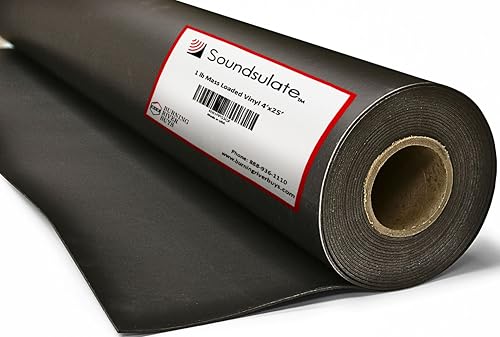
Soundsulate’s 1 lb mass loaded vinyl
Soundsulate also says vinyl installed on a ceiling does nothing measurable for footfall from above, and at 1 lb per square foot it weighs less than half as much as USG’s drywall. So treat it as a thin extra layer of mass, sealed at every seam, since Soundsulate warns that a gap over just 1% of the barrier can cut its effective STC roughly in half.
Acoustical Sealant (Best for Sealing the Edges)
Every other layer depends on this one, and TMS acoustical caulk is sold to seal sound leaks at perimeters, holes, gaps and spaces. HUD’s Noise Guidebook says a one-inch-square hole or a 1/16-inch crack 16 inches long will reduce an STC 50 wall to 40.
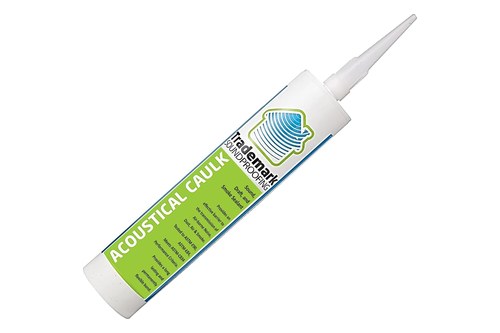
TMS acoustical caulk
PAC’s guide leaves that 1/4-inch gap around a clip-hung ceiling for the sealant, and National Gypsum’s checklist seals every penetration with acoustical sealant or putty pads. NBS Handbook 119 lists openings around pipes and ducts, and cracks at the ceiling edges of walls, among the causes of noise leakage.
Ceiling Tiles (Best for a Drop Ceiling)
If you have a drop ceiling, Armstrong’s Dune 1774 tiles are rated by Armstrong at NRC 0.50 and CAC 35. Armstrong defines NRC as a ceiling’s sound absorption and CAC as how well it blocks airborne sound between side-by-side rooms that share the air space above it.
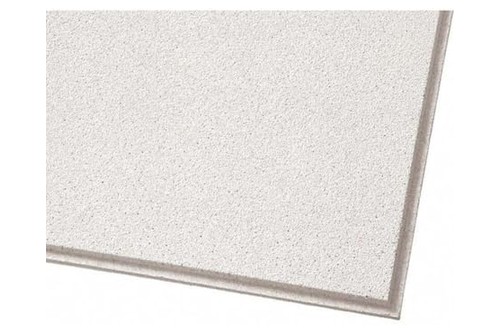
Armstrong’s Dune 1774 tiles
To block more, Owens Corning’s assembly guide lays batts on the back of the ceiling panels, which it says improves a ceiling’s STC by 7 to 12 points depending on the panels. Burton Acoustix’s guide to drop ceiling tiles compares more tiles by those two ratings.
| Product | Link |
|---|---|
Best for Decoupling | See ratings |
Best Between Two Drywall Layers | See ratings |
Best Thin Barrier | See ratings |
Best for Sealing the Edges | See ratings |
Best for a Drop Ceiling | See ratings |
What Do STC and IIC Mean for a Ceiling?
Those two ratings are the ones to hold every product against. STC, the Sound Transmission Class, rates how much airborne sound an assembly stops in a lab test under ASTM E90 and E413, and IIC, the Impact Insulation Class, rates how well a floor-ceiling stops the blows of a standard tapping machine under ASTM E492 and E989.
Higher is better for both, and NBS Handbook 119 turns STC into what you’d hear through a partition:
| STC | What NBS Handbook 119 says you hear |
|---|---|
| 35 | Loud speech audible and fairly understandable |
| 45 | Loud speech barely audible |
| 50 | Shouting barely audible |
| 55 | Shouting not audible |
On that scale, National Gypsum’s plain joist ceiling at STC 37 sits just above the 35 row, and its insulated, decoupled ceilings at 58 to 60 sit past the top. California’s building code asks for at least STC 50 and IIC 50 in the lab for floor-ceilings between dwelling units, or 45 on its field measures.
ASTM E90 adds that lab ratings are an upper limit to what a field test would measure, because buildings carry sound around a partition through flanking paths.
Get Studio Tips Weekly
Join 5,000+ creators getting acoustic treatment advice every week.
No spam. Unsubscribe anytime.How Much Does Each Layer Add to a Ceiling?
Ratings belong to whole assemblies, so the fairest test of one material is a pair that differs by that material alone. In National Gypsum’s SoundBook, insulation and resilient channel each added 8 STC points that way, and carpet on the floor above added 19 IIC points:
| What changed, the rest kept the same | STC | IIC |
|---|---|---|
| 3-1/2 in. of glass fiber added (truss floor, drywall on a suspended grid) | 52 to 60 | 51 to 60 |
| Glass fiber deepened from 3-1/2 to 18 in. (truss floor) | 57 to 58 | 58 to 60 |
| Drywall moved onto RC-1 channel (2×10 joists, no insulation) | 37 to 45 | 66 and 63, both with carpet and pad |
| Engineered wood, vinyl tile, then carpet on the floor above (damped board on RC-1) | 58 each time | 59, 60, then 78 |
Read down the IIC column and the floor finish stands out: carpet lifted one assembly 19 points while the ceiling under it stayed the same. Owens Corning’s guide calls carpet and pad the best way to improve a floor-ceiling’s impact isolation, since the tapping hammers are isolated from the hard floor surface, while the STC barely changes because they add little weight.
Owens Corning recommends resilient channels and insulation for both impact and airborne sound, and the two work together: Building Digest 239 says cavity insulation helps far more once the layers are decoupled.
Why Do Footsteps Need a Different Fix?
That carpet result is the key to footsteps. NRC Canada’s Building Digest 236 describes impact noise as a solid object striking the structure, with the vibration traveling through the building and coming out as sound somewhere else.
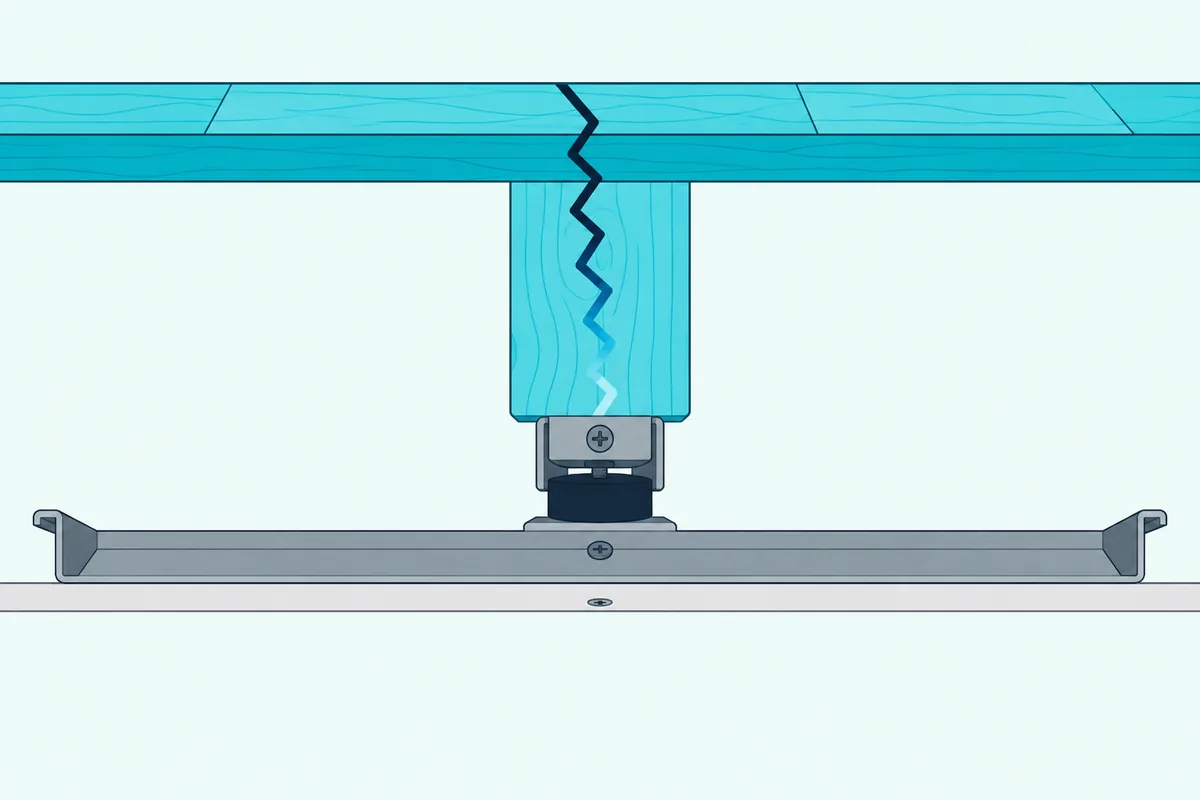
So the biggest step usually sits on the floor above, with carpet and pad or a resilient underlayment, and our roundup of floor underlayments with IIC ratings compares them. From below, decoupling is what helps, since Soundsulate says added mass alone does nothing measurable for footfall.
IIC also has blind spots. ASTM E492 says its tapping machine doesn’t simulate the weight of a person walking, and ASTM E989 says the rating doesn’t cover the sounds below 100 Hz that walking typically produces under lightweight joist floors, or squeaks and rattles (ASTM).
So a ceiling with a good IIC can still pass the low thud of walking, which leaves decoupling and the floor above as the places to work.
Which Ceiling Material Fits Your Situation?
Those limits shape the choice. With open joists, as in an unfinished basement, fill the cavities with insulation, hang the drywall on clips and channel, and seal every edge.
With a finished ceiling and voices coming through, a damped second layer with sealed edges is the upgrade from below. Our guide to soundproofing an existing ceiling covers that build and a new decoupled ceiling hung below the old one.
If you rent or can’t open the ceiling, the fixes that work without opening the ceiling start with the floor above and the gaps you can reach.
With a drop ceiling, lay batts above the tiles and choose tiles with a published CAC. If the problem is echo in your own room, these acoustic ceiling panels for echo are the tool.
The Bottom Line
So the answer depends on the noise. For voices and TV, the best soundproofing material for ceiling work is insulation in the joists with drywall decoupled on clips or channel, plus damping, a second layer and sealant, while footsteps start with carpet or underlayment upstairs.
Vinyl and tiles have narrower jobs, and every layer needs sealed edges, since HUD’s 1/16-inch crack takes ten points off an STC 50 wall.
Frequently Asked Questions
What Material Absorbs Sound the Best?
Soft, porous materials absorb sound best, and their absorption is rated by NRC under ASTM C423. Armstrong’s ceiling FAQ describes the scale as running from 0.00 for a concrete floor to 1.00 for its high-performance acoustical products, and its Dune 1774 tile rates 0.50. Absorbing isn’t blocking, though: NBS Handbook 119 calls acoustical tile and similar absorbers relatively poor sound insulators, so an absorbent ceiling softens echo without stopping much noise from upstairs.
What Is a Ceiling Material That Absorbs Sound?
Acoustical ceiling tiles are the usual answer. Armstrong’s Dune tiles are wet-formed mineral fiber rated NRC 0.50, and its Ultima tiles reach NRC 0.85, per Armstrong’s data sheets. Choose by NRC for echo and by CAC when rooms share the space above a drop ceiling; neither rating covers footfall from upstairs.
How Do You Block Out 100% of Noise?
You aim for a target instead. NBS Handbook 119 puts STC 55 at “shouting not audible,” and National Gypsum’s insulated, decoupled floor-ceilings reach STC 58 to 60 in the lab. ASTM E90 says field results fall below lab numbers because of flanking paths, and Soundsulate notes that bass below 125 Hz passes mass-based barriers with much less resistance. Seal every gap, decouple, insulate and add mass, then treat the floor above for footsteps.
Is Mass Loaded Vinyl Better Than Drywall for a Ceiling?
Not by weight. Soundsulate’s 1 lb vinyl and Johns Manville’s 1 lb per square foot sheet rate STC 27 and 26 on their own, while USG lists 5/8-inch Firecode X drywall at 2.2 lb per square foot, more than twice the mass. Vinyl’s advantage is thinness, so it suits a ceiling where height is tight. For footsteps, Soundsulate says vinyl on a ceiling does nothing measurable, since impact noise needs decoupling or work on the floor above.