Can a Soundproof Tent Block Noise? What Actually Works
You start shopping for a soundproof tent after a night of a neighbor’s generator, slamming car doors and campfire laughter, and the hard truth is that tent fabric blocks very little of it.
Blocking sound takes weight and a seal, and HUD’s noise guidebook says a barrier needs more than 4 pounds per square foot and no openings before the sound coming through it usually becomes negligible.
What does help costs less than a new tent: distance, something solid between you and the noise, the right campground loop and earplugs that fit.
This guide draws on HUD’s and FHWA’s noise guidance, National Park Service rules, NIOSH’s earplug advice and two job-site enclosure makers’ own figures.
Start with the short answer and the numbers behind it, then work down to the fixes that cost nothing.
Can You Soundproof a Tent?
That 4-pound figure is the short answer in one number. No, you can’t soundproof a fabric tent in the sense of blocking sound, because thin fabric, zippered doors and vents give it neither the weight nor the seal that blocking takes (HUD).
You can make a tent noticeably quieter, though, and every fix that works acts on the noise before it reaches the tent or on your ears once it has. Here’s what each one is worth by its source’s own figures.
| Fix | What it does | What the source says |
|---|---|---|
| Earplugs, fitted well | Cut what reaches your ears | Almost any hearing protector fitted correctly can reduce noise by 10 dB (CDC) |
| Twice the distance from a generator or speaker | Lets the sound spread out | About 6 dBA less for each doubling from a point source (FHWA) |
| Twice the distance from a busy road | Lets traffic noise spread out, more slowly | About 3 dBA less per doubling, or 4.5 dBA over soft ground (FHWA) |
| Something solid that hides the source | Makes the sound bend over it | Little or nothing unless it breaks the line of sight, and over 10 dB is hard to get (HUD) |
| A tent-only loop | Keeps generators away from you | Generators aren’t allowed in Lassen Volcanic’s tent-only areas (NPS) |
| A steady background sound | Makes sudden noises stand out less | “Cover” is the third step in GSA’s absorb, block, cover approach |
| Blankets inside the tent | Absorb some echo inside | Absorbing sound isn’t the same as blocking it (USG) |
For scale, FHWA says a drop of 10 dB sounds half as loud and a drop of 3 dB is barely perceptible (FHWA). So stacking two or three of these fixes does far more than any one of them alone.
Why Does Tent Fabric Let Sound Through?
That table leans on one idea, so it helps to see what blocking sound takes. Tent fabric lets sound through because it’s light and has openings built in, and HUD’s guidebook says the denser a wall is, the more noise it reduces, with a doubled thickness worth as much as 6 dB.
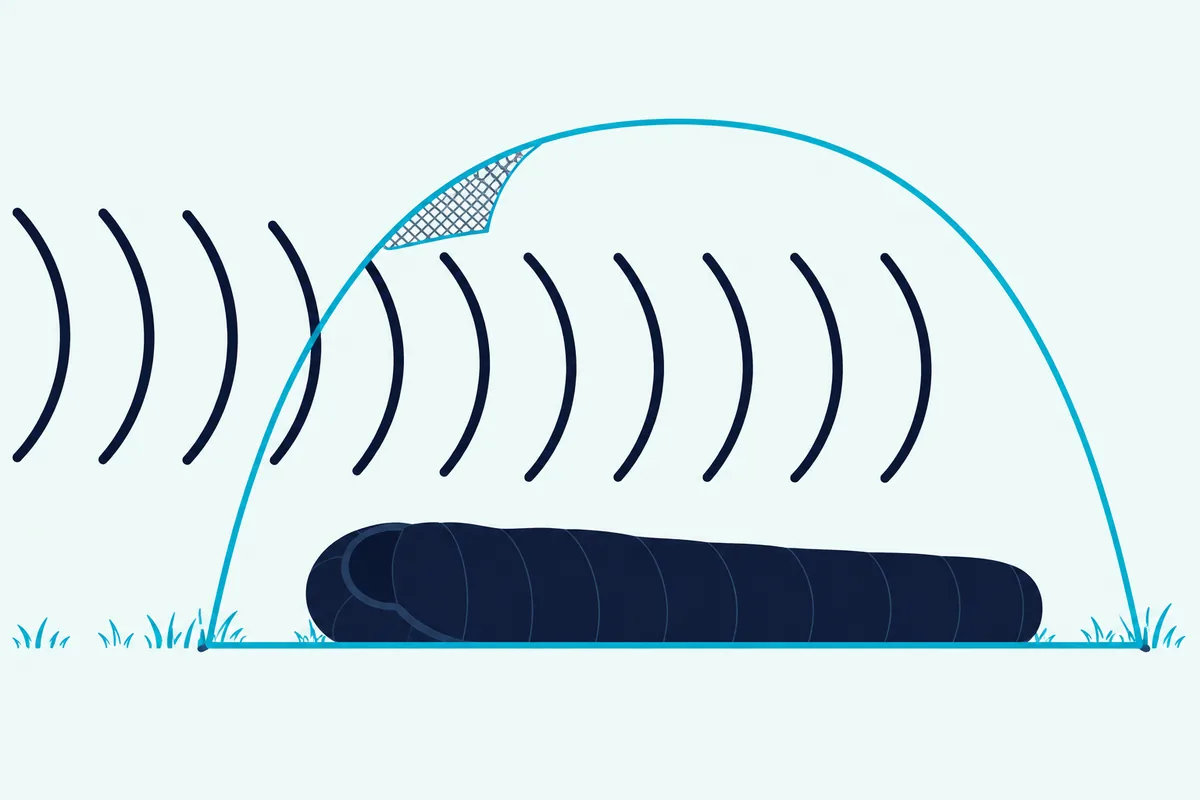
USG separates the two jobs people mix up: absorption reduces echo inside a space, while sound transmission is what has to be reduced to keep sound from traveling between two spaces (USG). Porous materials such as glass fiber or mineral fiber insulation absorb well by turning part of the sound into heat, USG says, while non-porous ones such as stone or gypsum board tend to reflect it.
Openings matter as much as weight. HUD says a one-inch square hole or a 1/16-inch crack 16 inches long will turn a 50 STC wall into a 40, and that a barrier with openings totaling 10 percent or more of its area gives negligible reduction.
A tent is built the other way around, because makers such as Terra Nova design vents in and tell you to use them. Terra Nova says a person can produce more than a liter of perspiration in a single night, so maximum ventilation is the key to keeping condensation down (Terra Nova).
HUD defines Sound Transmission Class, or STC, as the number of decibels a sound is reduced as it passes through a material. Its own example is that bringing an 85 dB outdoor level down to 45 dB inside takes an STC 40 wall.
Low sounds are the hardest part. Johns Manville’s data sheet for its 1 lb per square foot mass-loaded vinyl shows 16 dB of loss at 125 Hz against 36 dB at 4,000 Hz (JM), so even that heavy sheet stops far less of a low rumble than of a hiss.
Our answer to how does soundproofing work covers sealing, mass, damping and decoupling in a house wall, and the same rules decide what any layer on a tent can do.
Get Studio Tips Weekly
Join 5,000+ creators getting acoustic treatment advice every week.
No spam. Unsubscribe anytime.Do Blankets or Mass-Loaded Vinyl Make a Tent Quieter?
That vinyl is where most DIY plans for a tent start, so it’s worth running the numbers. Blankets make the inside a little less echoey but don’t add the weight or seal that blocking takes, and mass loaded vinyl blocks well only as a sealed sheet: Johns Manville rates its 1 lb per square foot vinyl at STC 26 in an ASTM E-90 test.
A standard roll of that vinyl is 35.5 inches by 36 feet, which by our arithmetic is about 106 square feet and about 106 pounds of material. That’s before you work out how to hang it from a tent’s poles.
Even a lined tent still has its door, vents and seams for sound to get around. HUD’s wall example shows how little that takes, because a single one-inch square hole drops a 50 STC wall to 40.
Sealing those openings works against the tent itself. Terra Nova says to leave the flysheet doors and vents open as much as possible on still, dry nights to prevent condensation, and for freezing winter nights it warns that condensation can form as hoarfrost inside the tent, where its answer is again maximum ventilation.
Moving blankets, rugs and thick curtains are porous, so by USG’s split they mostly absorb sound already inside the tent. That can soften echo, but it won’t do much about a generator outside, and this breakdown of curtain lab tests shows how modest the measured blocking numbers for curtain fabric are.
The same split decides what blankets do on a bedroom wall, and our guide to what moving blankets can and can’t block weighs a heavy furniture pad at about a fifth of a pound per square foot.
The verdict on adding layers is simple: each one adds weight, and any that cover the vents add condensation, long before they add much quiet. If you’re weighing vinyl for a wall at home instead, our guide to whether MLV soundproofing works explains why it only pays off as part of a sealed wall assembly.
Is There Such a Thing as a Soundproof Tent?
Real sound-reducing tents do exist, and they show what that vinyl lesson looks like when a maker builds it for the job. Yes, as job-site acoustic enclosures rather than camping gear: Echo Barrier says its H2O enclosure cuts noise by up to 32 dB in lab tests and up to 20 dB on site, and Flexshield gives a transmission loss of 14 to 18 dBA for its Sonic acoustic mobile tent.
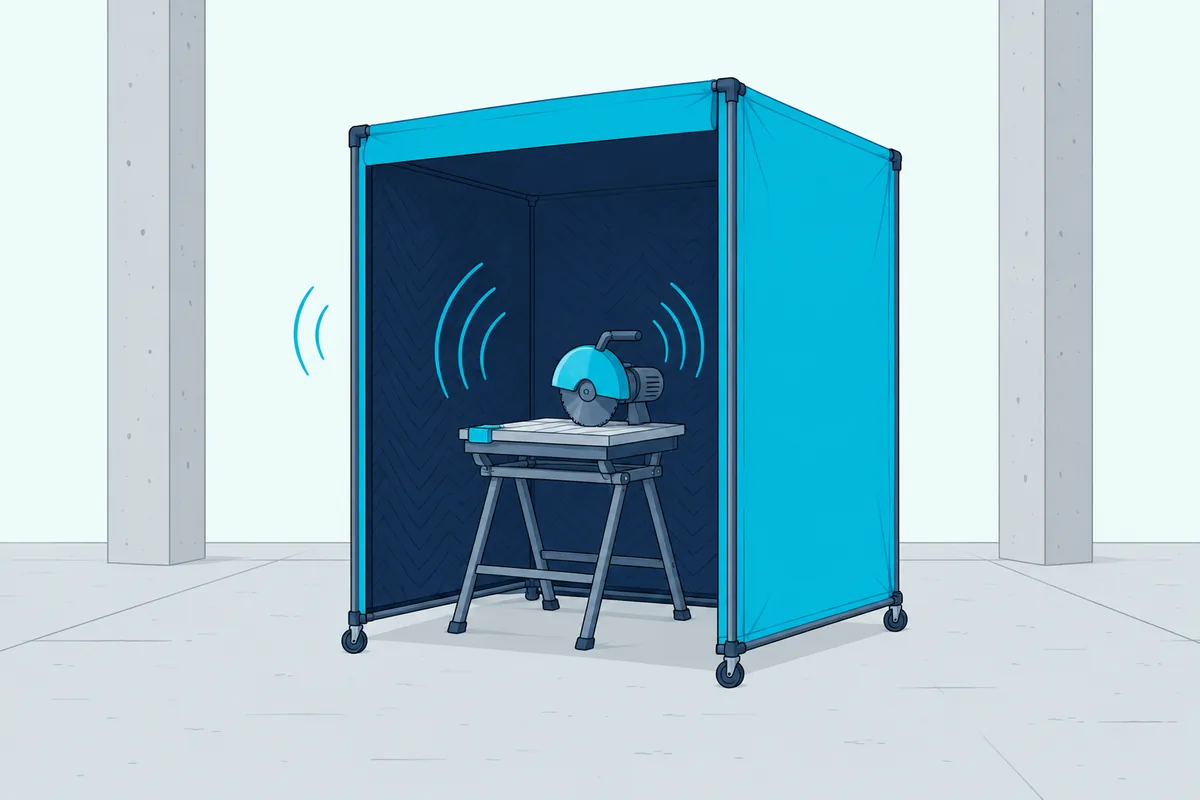
Echo Barrier’s enclosure measures 2.3 by 2.2 meters, about 7.5 by 7.2 feet, rolls on wheels and has a lightweight frame and panels that one person can put up in about 15 minutes (Echo Barrier). Each wall layers a waterproof PVC face, an absorbent composite made from recycled materials and a breathable membrane, on a glass-fiber reinforced plastic frame.
The maker sells it for work inside a building or next to high-rise structures, and its full spec sheet sits behind a download form. It also breaks down onto a pallet for transport, which tells you how far it is from a backpacking tent.
Flexshield lists concrete sawing, tile cutting and work in occupied buildings as typical uses, calls its 14 to 18 dBA figure a preliminary test result and asks buyers to contact its team to specify one (Flexshield). Neither enclosure is a camping tent you’d carry to a campsite.
Notice the gap between Echo Barrier’s lab and site figures. Even a purpose-built enclosure gives up 12 dB between a test chamber and a real job, by its maker’s own numbers.
Event-tent makers sell “soundproof” tents too. GS Tents describes multi-layer wall panels and noise-reducing fabrics on its soundproof church tents and offers PVC, glass, ABS and sandwich-panel sidewalls, but its page gives no decibel figure (GS Tents).
If you’re shopping for any tent sold as soundproof, ask for a transmission-loss or STC figure measured to a standard such as ASTM E90, the test behind JM’s vinyl rating. Treat a listing without one as a claim, however thick the walls look, before you pay for an expensive tent on the strength of one word.
How Do You Make a Tent Quieter at a Campsite?
Since both enclosures are job-site equipment sold through a quote or a consultation, the campsite itself has to do the work for a camper. You make a tent quieter by putting distance and solid ground between you and the noise, choosing a loop where the loud things aren’t allowed and protecting your ears, in that order.
Put distance on your side
FHWA’s rule of thumb is that sound from a point source such as a generator or a speaker drops about 6 dBA each time the distance doubles. Moving from 50 feet away to 200 feet away is two doublings, so it’s about 12 dBA quieter.
Roads behave differently, because a stream of traffic acts as a line source that drops about 3 dBA per doubling, or about 4.5 dBA over soft ground such as grass. FHWA adds that traffic noise usually isn’t a serious problem for people who live more than 150 meters from a heavily traveled freeway or 30 to 60 meters from a lightly traveled road, which is about 490 feet and 100 to 200 feet.
Pick the loop, not just the site
Noise that can’t be controlled at the tent wall can often be controlled by the campground’s rules. Lassen Volcanic National Park sets quiet hours from 10 p.m. to 6 a.m., allows generators only from 8 to 10 a.m., noon to 2 p.m. and 5 to 7 p.m., and bans them from tent-only areas (NPS).
Bryce Canyon’s campground rules allow generators only in Loops A and B, from 8 to 10 a.m. and 6 to 8 p.m., with quiet hours from 10 p.m. to 8 a.m. (NPS). A tent-only loop, or one without generators, is the cheapest noise fix on this page, so check the park’s rules before you book.
Put something solid between you and the noise
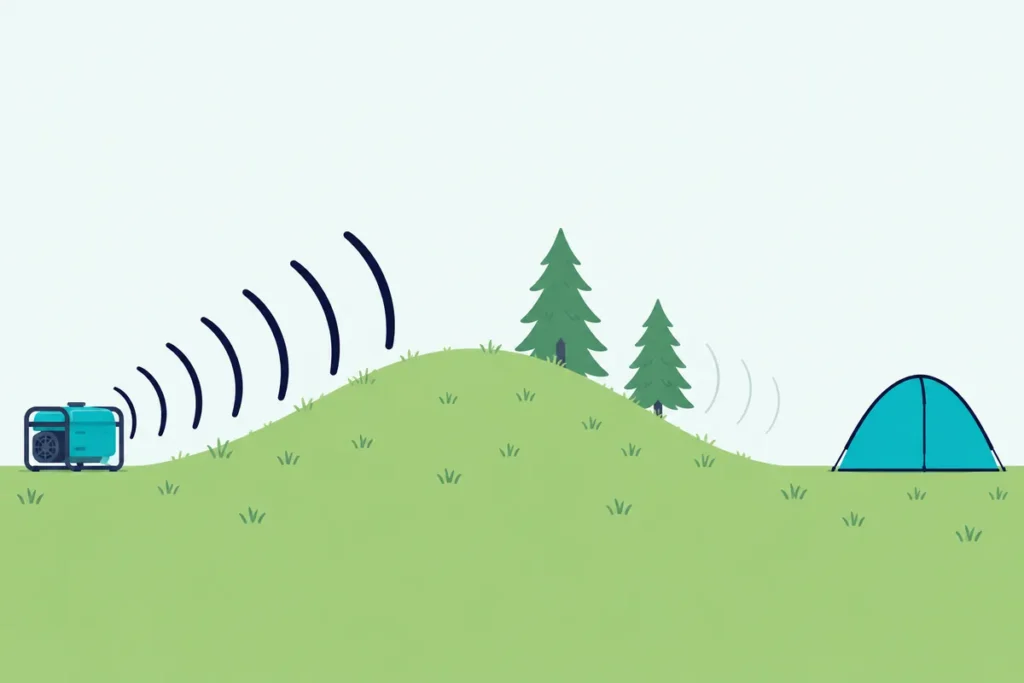
HUD’s barrier rules carry straight over to a campsite: a barrier gives little or no reduction unless it blocks the line of sight between the source and the listener, and it works better the closer it sits to the source. HUD counts earth mounds and even other buildings as barriers, so a rise in the ground, a large rock or a parked vehicle that hides the generator from your tent can do the same job.
Keep your expectations in proportion, because HUD says barrier reductions above 10 dB are difficult to get. Even 5 dB, which FHWA’s table calls a readily perceptible change, adds to whatever distance has already bought you.
Stop the noise your own tent makes
A loose flysheet that flaps in the wind is noise you bring yourself. Our suggestion is to pitch it taut, peg out the guy lines your tent came with and leave the vents open, since Terra Nova says the wind’s action on a well-ventilated flysheet pumps the damp air out.
Which Earplugs Work Best for Sleeping in a Tent?
Distance and barriers work on the path, and this last step works on you. Foam earplugs with a high rating are the strongest fix you can carry in a pocket, since CDC says almost any hearing protector, fitted correctly, can reduce noise by 10 dB (CDC).
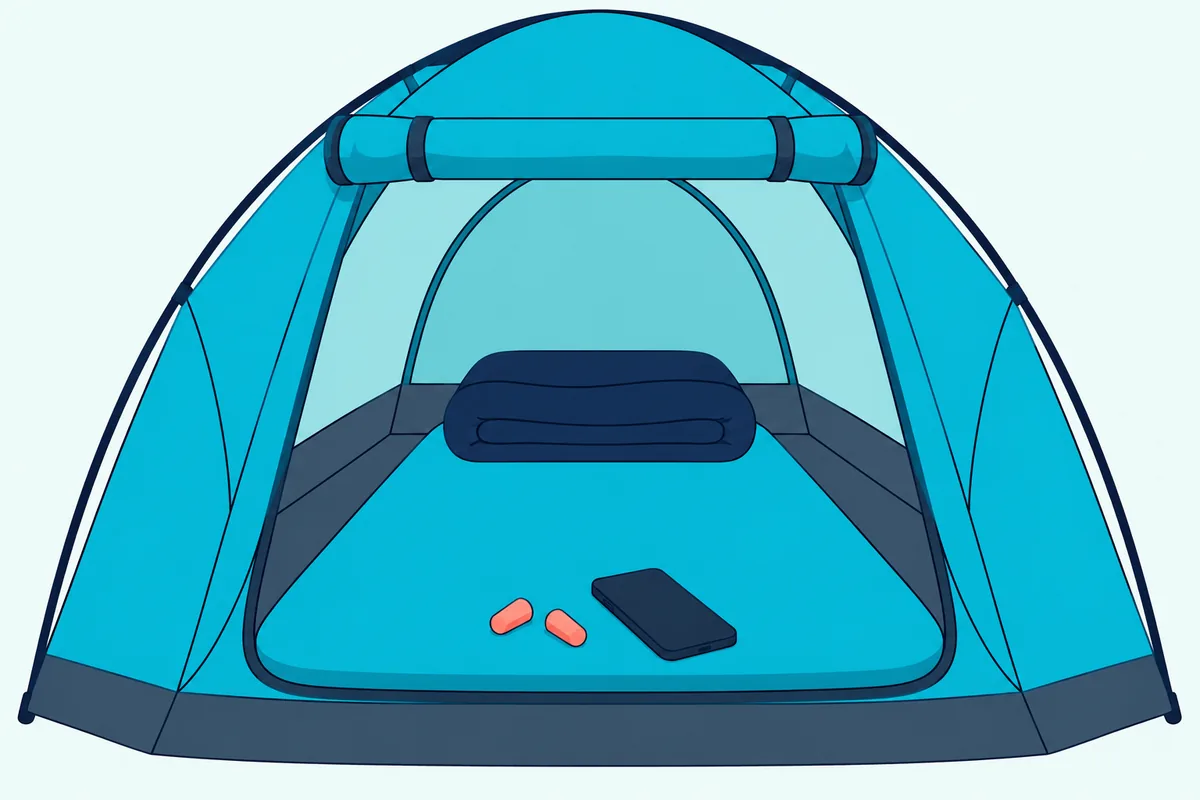
The label overstates what you’ll hear, though. A rating of NRR 33 works out to about 16.5 dB once NIOSH’s 50% derating for foam plugs is applied (NIOSH), and CDC adds that the label often doesn’t reflect the protection a person actually gets.
NIOSH derates other earplugs by 70%, so foam keeps more of its label than other earplug types do. That derating comes from workplace guidance, so read it as a cautious yardstick for a night in a sleeping bag, and note that even 16.5 dB beats the 10 dB HUD says a barrier rarely exceeds.
For a campsite, Mack’s Ultra Soft Foam Earplugs carry the maker’s top rating of NRR 33, and Mack’s lists sleep among their uses. Its steps are to roll the plug into a tight, crease-free cylinder, reach over your head to pull the outer ear up and back, insert it quickly and hold it until it expands (Mack’s).
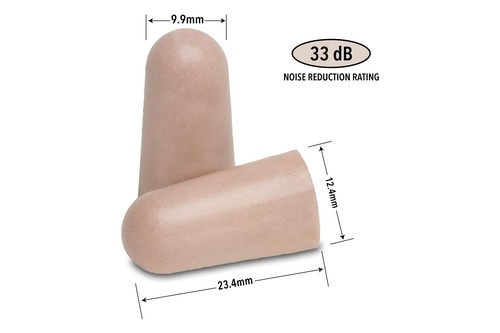
Mack’s Ultra Soft Foam Earplugs
CDC’s fit check is to count out loud while slowly cupping and uncupping your hands over your ears, and a good fit sounds about the same either way. CDC also warns that too much sound reduction can make people less aware of their surroundings, so agree with whoever shares the tent on how they’ll wake you.
A steady background sound helps with whatever the plugs let through. GSA’s guide to office acoustics names cover, or masking, as the third step in its absorb, block, cover approach and lists phone apps among the ways to provide it (GSA).
GSA’s reasoning also explains why one car door can be so jarring in a quiet campground: a low level of background noise lets interruptions contrast with the quiet and distract more than they would against a higher one. That’s the idea behind playing a masking app at low volume, so the sounds that get through stand out less.
What Can You Do About a Neighbor’s Generator or Music?
Earplugs handle what’s left, but at a national park the rules can deal with the source itself. In National Park Service areas, a federal rule bans running a generator, vehicle or audio device, including a musical instrument, louder than 60 dB(A) measured at 50 feet, or in a way that’s unreasonable for the time and place (eCFR).
The camping rule adds a ban on creating or sustaining unreasonable noise between 10 p.m. and 6 a.m., judged partly by its impact on other park users (eCFR). So a polite word with the neighbor, then with the camp host or a ranger, is a legitimate step and not just a complaint.
For scale, that limit is measured 50 feet from the source, and by FHWA’s point-source rule a generator right at the limit would read about 54 dB(A) at 100 feet. Moving your tent from beside a busy site to the far edge of the loop therefore buys you real decibels, even when the neighbor is within the rules.
If the generator is yours, the safety rule comes before the noise rule. CPSC says never to run a portable generator indoors or in garages, basements or sheds, and always to run it outside, far from windows, doors and vents (CPSC).
So don’t wrap a running generator in a tent or a homemade box to quiet it. Burton Acoustix’s generator guide covers how far to move it, quieter models and what a screen or box can and can’t do safely.
Can a Tent Keep Your Own Noise In?
Those rules cut both ways, because the 60 dB(A) limit covers your own speaker or instrument too. No, a tent won’t hold in your music, drums or party noise, since a wall’s rating describes how much it cuts sound passing from the noisy side to the quiet side, and fabric that can’t keep a generator out can’t keep a bass line in.
HUD’s definition makes the point: STC is the difference between the sound level on the side where the noise starts and the side where it’s received. A thin wall gives a small reduction whichever side the party is on.
For recording, a tent of blankets around the mic does help one thing. USG says absorption reduces reverberation and improves the clarity of speech, so a voice recorded inside can sound drier.
It won’t stop traffic or a barking dog from reaching the microphone, though, because that’s a transmission problem. If you need real isolation, our guide on how to make a soundproof booth covers DIY booths and when buying one makes more sense.
For a party, event tents with solid sidewalls are the closest thing to a soundproof party tent, and the one maker’s page we read gives no decibel figure for them. Plan the music around the campground’s quiet hours instead of around the tent.
The Bottom Line
A fabric tent can’t be soundproofed, because blocking sound takes weight and a seal that a breathable tent doesn’t have. The sound-reducing tents that do exist are job-site enclosures, and their makers quote 14 to 18 dBA and up to 20 dB on site.
For camping, choose a tent-only or generator-free loop, double your distance from the noise, put solid ground or a vehicle between you and it, and sleep in well-fitted foam earplugs. Save the vinyl and blankets for walls at home.
Frequently Asked Questions
Does a soundproof bed tent work?
Not for blocking noise. A bed tent made of fabric can soften echo around the bed, but by HUD’s rule that denser walls reduce more noise, a fabric canopy can’t do much to stop a neighbor’s music or traffic coming through. Well-fitted earplugs, which CDC credits with about 10 dB, do more, and soundproofing the bedroom itself works on the walls, windows and doors where the noise gets in.
Can a tent work as a vocal booth for recording?
Partly. Blankets or a padded tent around the mic absorb reflections, and USG says absorption reduces reverberation and improves speech clarity, so the recording can sound drier. They don’t block traffic or a neighbor’s TV, which is a transmission problem, so record at a quiet time in the quietest room you have, or use an isolation booth.
What material cancels sound?
No passive material cancels sound. Heavy, airtight materials block it, porous ones such as glass fiber absorb it, and only electronics cancel it. CDC notes that active noise cancellation in headphones or earbuds shouldn’t be considered hearing protection unless it’s labeled with an NRR.
How do you block out 100% of noise?
You can’t, in a tent or anywhere else. Even a foam earplug labeled NRR 33 counts as about 16.5 dB under NIOSH’s derating, and HUD says barrier reductions above 10 dB are hard to get. The practical goal is to stack reductions: a quiet loop, distance, a barrier and earplugs, until what’s left stops waking you.
How loud can a generator be at a national park campground?
No louder than 60 dB(A) measured at 50 feet under the federal rule for National Park Service areas, and quieter if the noise is unreasonable for the time and place. Parks also set generator hours: Lassen Volcanic allows them from 8 to 10 a.m., noon to 2 p.m. and 5 to 7 p.m., and not at all in tent-only areas.
Does a canvas tent block more noise than a nylon tent?
A little, if the canvas is heavier, since HUD’s guidebook says denser walls reduce more noise. Both still have doors, windows and vents, though, and HUD says a barrier with openings totaling 10 percent or more of its area gives negligible reduction, so neither is soundproof.
Does a rug or carpet on the tent floor reduce noise?
Only inside the tent. A rug is porous, so it absorbs some of the sound already in the space, which is what USG calls absorption, but it doesn’t add the weight or seal that blocking takes. Bring one for comfort if you like, not as soundproofing.