What frequencies does acoustic foam absorb? Standard 2-inch acoustic foam absorbs most in the mid and high frequencies: Auralex’s published test of its 2-inch Studiofoam Wedges gives 0.97 at 1,000 Hz and 1.10 at 2,000 Hz, against 0.24 at 250 Hz and 0.21 at 125 Hz. Thicker foam extends absorption lower, though Auralex’s 4-inch wedges still test at 0.31 at 125 Hz.
So after a room is treated with thin foam, the echo and harshness improve, but the boomy low end bouncing off walls is still there.
You’ll find the science behind foam absorption below, plus how thickness affects frequency response and when you need different solutions. Start with the quarter-wavelength rule, then match foam to your specific problems.
For a broader overview, see our guide on how acoustic foam works.
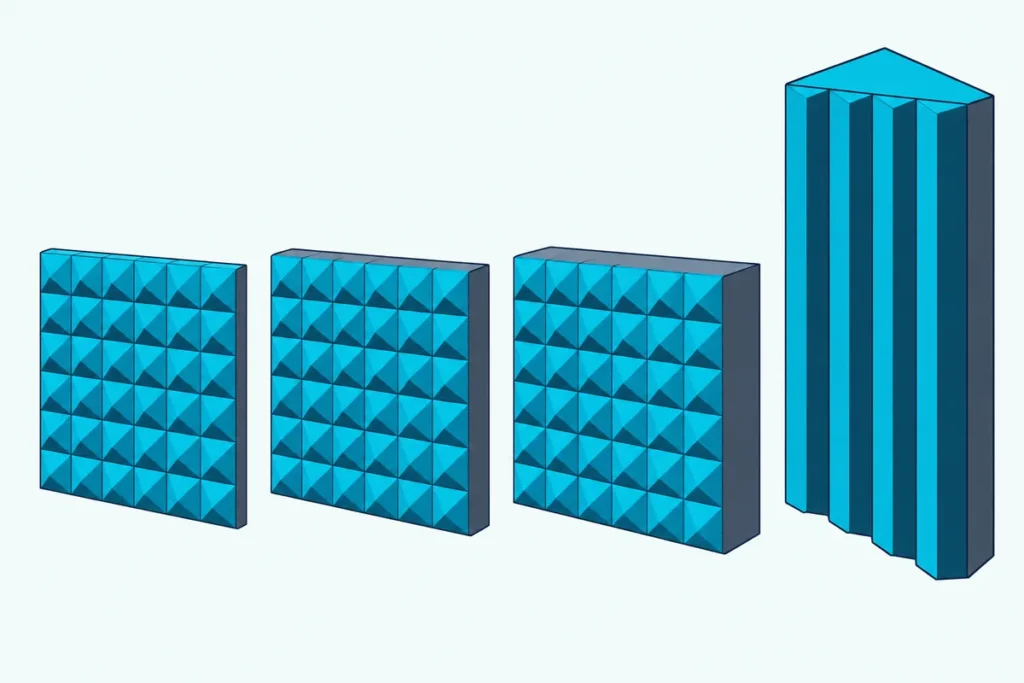
Acoustic foam absorption by thickness, in Auralex’s published tests of its Studiofoam Wedges:
- 2-inch foam: 0.24 at 250 Hz, 0.63 at 500 Hz, 0.97 at 1,000 Hz and 1.10 at 2,000 Hz
- 4-inch foam: 0.31 at 125 Hz, 0.85 at 250 Hz and 1.25 at 500 Hz
Key insight: Auralex’s Acoustics 101 says thicker acoustic foam is better at absorbing low frequency sounds. Bass frequencies (under 250Hz) are where foam absorbs least: Auralex’s 2-inch Studiofoam Wedges test at 0.21 at 125 Hz, so you need bass traps for low frequencies.
The Science of Foam Absorption

Acoustic foam absorbs sound through a specific physical mechanism. Understanding this explains why foam works well for some frequencies and poorly for others.
How Foam Converts Sound to Heat
Sound waves are pressure variations traveling through air. When these waves enter acoustic foam’s open-cell structure, air molecules move back and forth within the tiny pores and channels.
This movement creates friction between the air and the foam’s cell walls. Friction converts kinetic energy (sound) into thermal energy (heat)—though the temperature increase is far too small to notice.
The more the air moves within the foam, the more friction occurs, and the more sound gets absorbed. This is why porous, open-cell materials absorb sound while solid, closed-cell materials reflect it.
Why Thickness Matters
Wavelength explains why. Auralex’s Acoustics 101 says thicker acoustic foam is better at absorbing low frequency sounds, and a quarter of a sound’s wavelength gives a simple yardstick to set beside foam thickness.
A 1000Hz tone has a wavelength of about 1.1 feet. One-quarter of that is about 3.3 inches.
A 100Hz tone has a wavelength of about 11.3 feet. One-quarter of that is nearly 3 feet. No practical foam panel is 3 feet thick, and standard 2-inch foam absorbs little bass: Auralex’s 2-inch Studiofoam Wedges test at 0.21 at 125 Hz.
This relationship between thickness and wavelength is fundamental. It applies to every porous absorber.
The Quarter-Wavelength Rule
The quarter-wavelength arithmetic gives the frequency whose quarter wavelength equals the foam’s thickness, with sound at 1130 feet per second:
Frequency whose quarter wavelength equals the thickness ≈ 1130 / (4 × thickness in feet)
For 2-inch foam (0.167 feet): – 1130 / (4 × 0.167) = 1130 / 0.668 ≈ 1692Hz
So 2 inches is a quarter wavelength at about 1692 Hz, yet the foam still absorbs at lower frequencies: Auralex’s published test of its 2-inch Studiofoam Wedges gives 0.97 at 1,000 Hz and 0.63 at 500 Hz, falling to 0.24 at 250 Hz.
For 4-inch foam (0.333 feet): – 1130 / (4 × 0.333) = 1130 / 1.332 ≈ 848Hz
Thicker foam extends the effective range lower.
Frequency Absorption by Foam Thickness
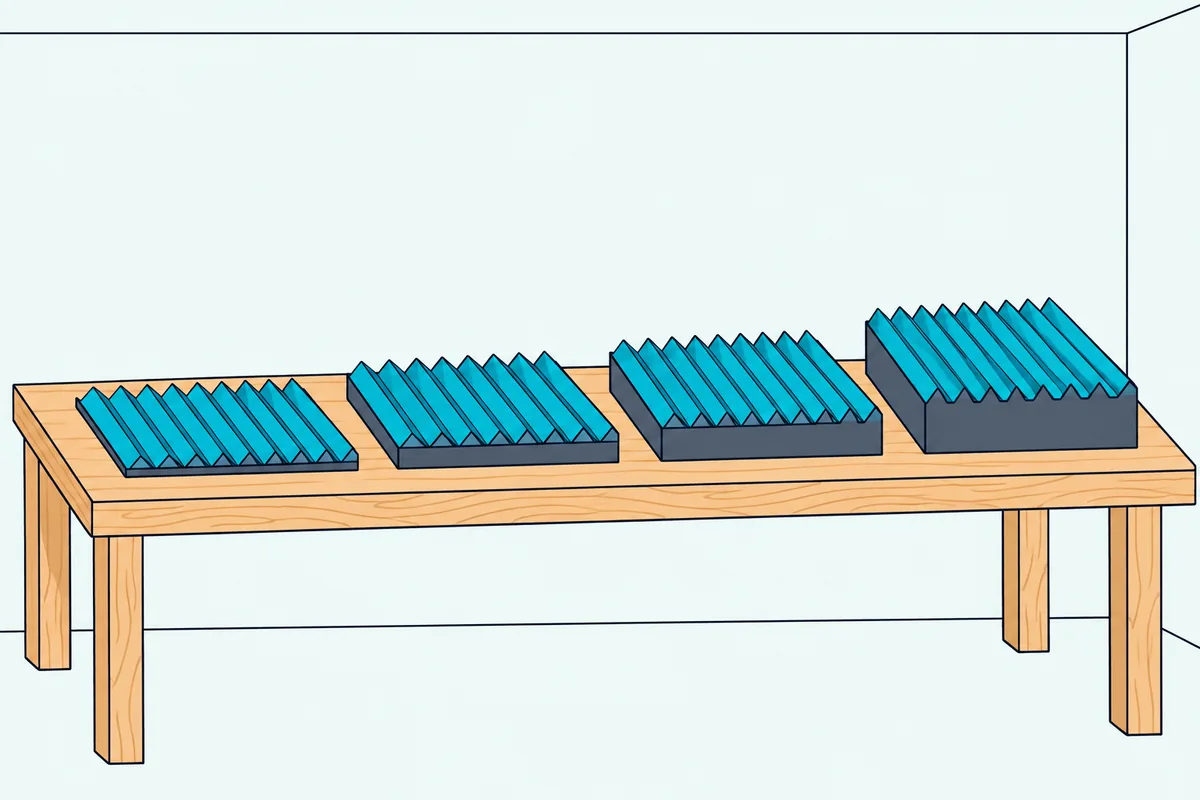
Different thicknesses serve different purposes. Here’s what each provides.
1-Inch Foam: High Frequency Only
One-inch foam is the thinnest of the four, and Auralex’s Acoustics 101 says thicker acoustic foam is better at absorbing low frequency sounds. It handles high-frequency flutter echo, sibilance reflections, and the “brightness” that makes untreated rooms sound harsh.
For the mid frequencies, thicker foam reaches further: Auralex’s 2-inch wedges test at 0.63 at 500 Hz.
Use 1-inch foam only when you specifically need high-frequency absorption without affecting mids.
Common applications: reducing harshness in already-treated rooms and spot treatment for specific high-frequency problems.
2-Inch Foam: The Standard Choice
Two-inch foam absorbs most from about 500 Hz up: Auralex’s published test of its 2-inch Studiofoam Wedges gives 0.63 at 500 Hz, 0.97 at 1,000 Hz and 1.10 at 2,000 Hz.
For speech, podcasting, and vocal recording, that covers the upper part of the speech range, which USG gives as 125 Hz to 4,000 Hz; at 250 Hz the same wedges test at 0.24.
This thickness balances effectiveness with practicality. Panels are manageable to handle and mount and don’t protrude excessively from walls. For product recommendations, see our guide to the best acoustic foam panels.
3-Inch Foam: Extended Range
Three-inch foam sits between Auralex’s tested 2-inch and 4-inch wedges, and its Acoustics 101 says thicker acoustic foam is better at absorbing low frequency sounds.
For music recording and mixing, that matters below 500 Hz, where the 2-inch wedges test at 0.24 (250 Hz) to 0.63 (500 Hz) and the 4-inch at 0.85 to 1.25.
The tradeoff is bulk: three-inch panels weigh more and protrude further from walls.
4-Inch Foam: Maximum Practical Thickness
Four-inch foam reaches down to about 250Hz, the upper edge of the bass range: Auralex’s published test of its 4-inch Studiofoam Wedges gives 0.85 at 250 Hz and 0.31 at 125 Hz.
Of the four thicknesses, 4-inch foam reaches lowest: Auralex’s 4-inch wedges test at 1.25 at 500 Hz, against 0.63 for its 2-inch, and at 0.31 at 125 Hz.
For frequencies below 250Hz, bass traps go in the corners, where Auralex’s home-studio guide says low frequencies build up.
For guidance on choosing thickness, see our comparison of 1-inch vs 2-inch acoustic foam.
Where Foam Absorbs Least: Bass Frequencies

Foam’s bass limitation comes down to wavelength.
Why Bass Passes Through
Bass frequencies have wavelengths measured in feet, not inches. A 60Hz tone (low bass) has a wavelength of nearly 19 feet. A 125Hz tone (upper bass) has a wavelength of about 9 feet.
A quarter of those wavelengths is over 2 feet at 125 Hz and over 4.5 feet at 60 Hz, far beyond 4-inch foam.
Thin foam absorbs little of these long waves: Auralex’s 2-inch Studiofoam Wedges test at 0.21 at 125 Hz.
The Bass Trap Solution
Bass frequencies require different treatment: bass traps. These are thick absorbers placed in the corners, where Auralex’s home-studio guide says low frequencies build up.
Corner placement is key because room corners create pressure zones where bass builds up.
Bass traps and foam panels serve complementary purposes. Foam handles mid/high frequencies on walls; bass traps handle low frequencies in corners.
For more on this topic, see our guide on bass traps vs acoustic foam.
Recognizing Bass Problems
How do you know if your room has bass problems that foam can’t fix?
Signs of bass issues: – Boomy, muddy sound in certain spots – Bass that seems louder in corners – Low-frequency “ringing” after bass notes – Recordings that sound bass-heavy regardless of EQ
Signs of mid/high issues (foam can help): – Flutter echo (metallic ringing when you clap) – Harsh, bright sound – Excessive reverb on vocals – “Roomy” quality in recordings
If your problems are primarily bass-related, that is the range foam absorbs least. If they’re mid/high frequency issues, that is the range foam absorbs most. Our guide on whether acoustic foam works can help you assess your specific situation.
NRC Ratings and What They Mean
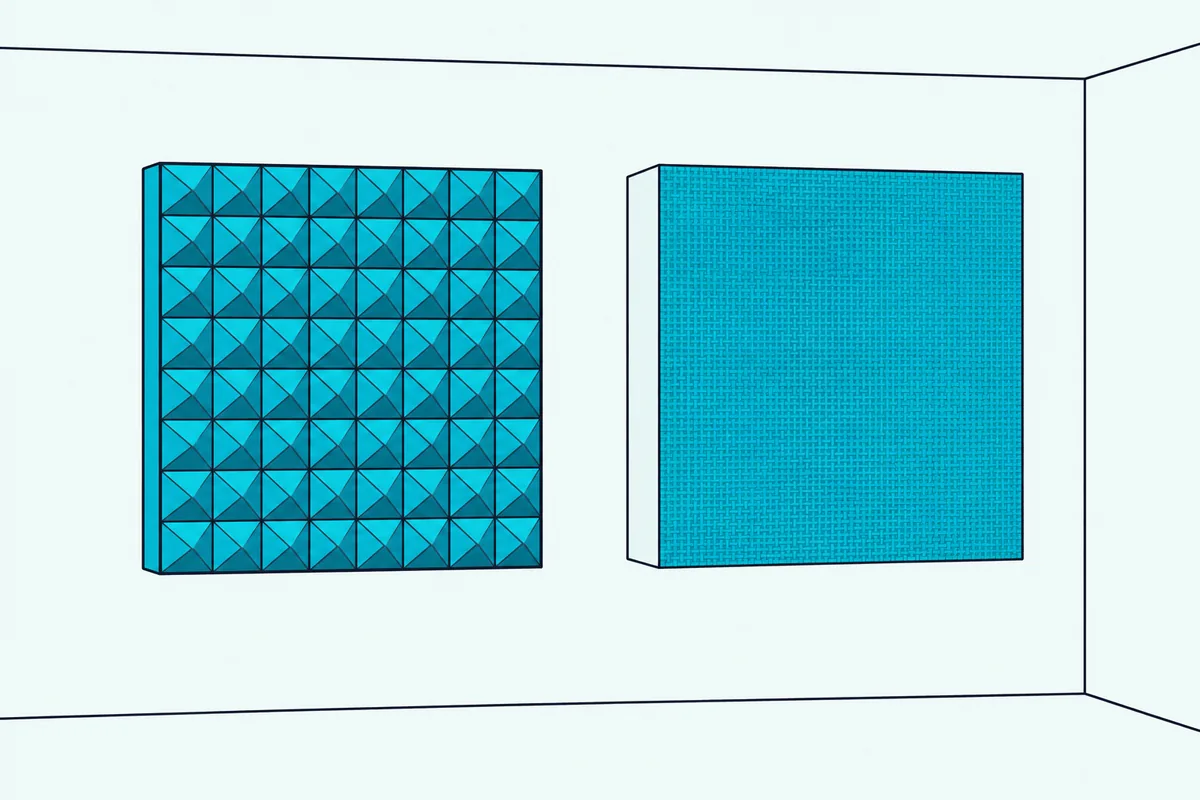
NRC (Noise Reduction Coefficient) ratings help compare absorption effectiveness, but they have limitations.
Understanding NRC
NRC is a single number representing average absorption across four frequencies: 250Hz, 500Hz, 1000Hz, and 2000Hz. Auralex’s Acoustics 101 notes that absorption coefficients and NRCs are not percentages: an NRC of 1.10 simply means more sound is absorbed, on average, than by a material with an NRC of 0.50.
Higher NRC generally means better absorption. Auralex’s published test gives its 2-inch Studiofoam Wedges an NRC of 0.75, and Owens Corning lists its 2-inch 703 fiberglass board at 1.00.
NRC Limitations
NRC averages hide important details: Auralex’s 2-inch Studiofoam Wedges test at 1.10 at 2,000 Hz but 0.24 at 250 Hz, for an NRC of 0.75 that masks the low-frequency gap.
For foam specifically, NRC ratings can be misleading because they include 250Hz, where foam absorbs least of the four bands.
When comparing products, look for full absorption coefficient charts showing performance at each frequency, not just NRC. This reveals where the material actually works.
Published Foam NRC Values
Auralex publishes its own tests: its 2-inch Studiofoam Wedges test at an NRC of 0.75 (Riverbank, 2019) and its 4-inch Studiofoam Wedges at 1.10 (Riverbank, 1993).
Specific products vary, so look for each product’s own published test.
Matching Foam to Your Frequency Problems

Different acoustic problems require different solutions. Here’s how to match foam to your needs.
Voice and Speech (Podcasting, Voice-Over)
USG gives the range of human speech as 125 Hz to 4,000 Hz.
Recommended: 2-inch foam for the upper part of the speech range, with thicker foam where the low end of the voice needs more absorption.
Vocal Music Recording
Singing extends the frequency range compared to speech. Vocal fundamentals can reach lower (bass singers) and harmonics extend higher (soprano overtones).
Recommended: 2-inch foam minimum, 3-inch preferred: Auralex’s Acoustics 101 says thicker acoustic foam is better at absorbing low frequency sounds.
Acoustic Instruments
For acoustic guitars, pianos, and similar instruments, foam’s weak spot is the low end: Auralex’s 2-inch wedges test at 0.24 at 250 Hz and 0.21 at 125 Hz.
Recommended: 3-4 inch foam for primary treatment (Auralex’s 4-inch wedges test at 0.85 at 250 Hz), plus bass traps in corners for the lower frequencies.
Drums and Percussion
Drums bring both problems at once: one room in Auralex’s Acoustics 101 had excessive slap echo and reverb along with excessive low-end buildup from a drum kit in one corner.
Recommended: 4-inch foam on walls and bass traps in corners. For a starting set at that thickness, a pack such as TroyStudio 12 x 12 x 4-inch foam panels gives 12 tiles of 4-inch foam.

TroyStudio 12 x 12 x 4-inch foam panels
Home Theater / Music Listening
Home theater and music playback benefit from balanced absorption that doesn’t over-deaden the room. You want controlled reflections, not elimination of all ambience.
Recommended: 2-inch foam at first reflection points, bass traps in corners, and possibly diffusion on rear walls: in its stereo mix room, Auralex’s Acoustics 101 puts broadband diffusion on the rear wall to spread out the sound energy without killing it. For placement guidance, see our guide on how to arrange acoustic foam.
Improving Low-Frequency Absorption
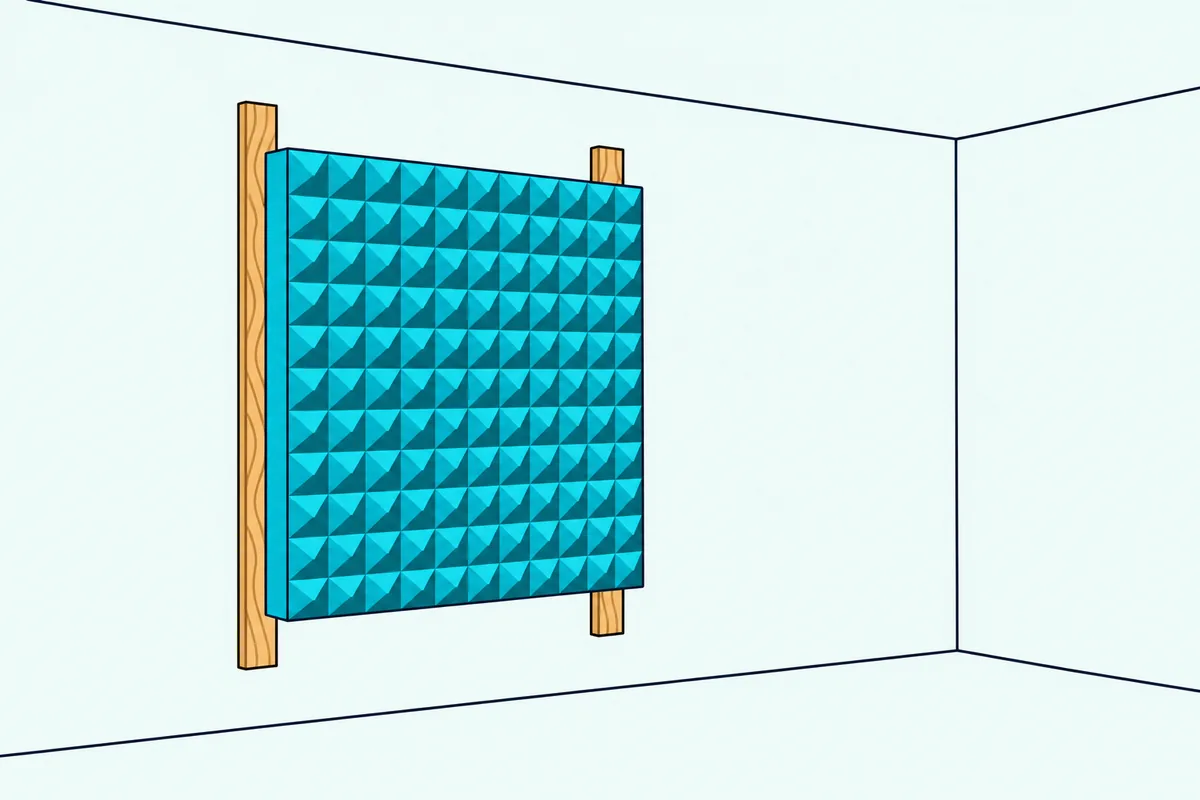
If you need better low-frequency absorption than standard foam provides, several approaches help.
Air Gap Mounting
Auralex’s Acoustics 101 describes one way to control sound in general and low frequency sound in particular: make the sound waves fight their way through multiple layers of different materials and dead air before they can strike the room boundary. A panel mounted with an air gap puts a layer of dead air between the panel and the wall.
Use furring strips or standoff brackets to create consistent gaps.
For mounting techniques, see our guide on how to put acoustic foam on walls.
Corner Placement
Auralex’s home-studio guide names the buildup of low frequencies, especially in corners of the room, as one of the most common problems in small rooms, and makes bass traps in all of the corners the first step.
Dedicated Bass Traps
For true bass control, dedicated bass traps are necessary. These are typically:
- Thick foam traps: Triangular corner units
- Fiberglass or mineral wool traps: Thick panels
- Membrane traps: Tuned absorbers for specific frequencies
- DIY traps: Rigid fiberglass in corner-mounted frames
Bass traps belong in corners, especially the corners behind your speakers or listening position. They complement wall-mounted foam rather than replacing it.
Common Misconceptions

Four claims about foam absorption, each answered below.
“More Foam = Better Bass Absorption”
Adding more thin foam panels doesn’t improve bass absorption. Twenty 2-inch panels absorb the same frequencies as two 2-inch panels—just more of them.
Bass absorption requires thickness, not quantity. If you have bass problems, more wall foam of the same thickness still absorbs little bass: Auralex’s 2-inch wedges test at 0.21 at 125 Hz. You need thicker treatment or bass traps.
“Denser Foam Absorbs Bass Better”
No foam escapes the physics of wavelength versus thickness: Auralex’s Acoustics 101 says thicker acoustic foam is better at absorbing low frequency sounds.
Even Auralex’s 4-inch Studiofoam Wedges test at 0.31 at 125 Hz, against 0.85 at 250 Hz, so at practical thicknesses foam absorbs much less below about 250Hz.
“Foam Absorbs All Sound Equally”
Foam absorption varies with frequency: Auralex’s 2-inch Studiofoam Wedges test at 1.10 at 2,000 Hz but 0.24 at 250 Hz. The absorption curve is not flat.
This is why understanding frequency response matters. Foam’s strength is mid/high absorption, and it’s not a universal solution for all acoustic problems.
“Thicker Is Always Better”
Thicker foam absorbs a wider frequency range, but “better” depends on your needs. If your problems are purely high-frequency flutter echo, 1-inch foam targets them, and thicker foam mainly adds absorption lower down.
Match thickness to your actual problems—don’t buy 4-inch foam for a room that only needs high-frequency treatment. If you’re unsure what your room needs, our guide on how to stop echo with acoustic foam helps identify specific issues.
The Bottom Line
Acoustic foam absorbs mid and high frequencies effectively—roughly 500Hz and above for standard 2-inch panels. Thicker foam extends absorption lower, yet even Auralex’s 4-inch wedges test at 0.31 at 125 Hz.
For vocals and speech, 2-inch foam covers the upper part of the speech range. Music production and situations requiring fuller absorption call for thicker foam: Auralex’s 4-inch wedges test at 0.85 at 250 Hz, against 0.24 for its 2-inch.
Bass problems require dedicated bass traps, not more wall foam.
Understanding these frequency limitations helps you choose appropriate treatment. Foam’s job is controlling the mid/high reflections that cause flutter echo, harshness, and “roomy” recordings.
For bass control, combine foam with corner-mounted bass traps for comprehensive treatment. If you want a broader look at foam limitations beyond frequency range, see our cons of acoustic foam guide.
The goal isn’t finding foam that absorbs everything—it’s using the right tools for each frequency range. Foam for mids and highs, bass traps for lows.
For how much sound foam takes out of a room, see how many decibels acoustic foam reduces.
Frequently Asked Questions
Does acoustic foam absorb bass?
Standard acoustic foam absorbs little bass: Auralex’s 2-inch Studiofoam Wedges test at 0.24 at 250 Hz and 0.21 at 125 Hz, and even its 4-inch wedges test at 0.31 at 125 Hz.
For bass control, you need dedicated bass traps—thick absorbers placed in corners where low frequencies accumulate.
What thickness acoustic foam do I need?
For speech and vocals, start with 2-inch foam: Auralex’s 2-inch Studiofoam Wedges test at 0.63 at 500 Hz, 0.97 at 1,000 Hz and 1.10 at 2,000 Hz. For music recording with instruments, thicker foam absorbs more of the low mids: Auralex’s 4-inch wedges test at 0.85 at 250 Hz, against 0.24 for its 2-inch.
Match thickness to your frequency problems: high-frequency flutter echo needs less thickness, while fuller absorption needs thicker foam.
Why doesn’t my foam help with boomy bass?
Foam panels absorb little bass: Auralex’s 2-inch Studiofoam Wedges test at 0.21 at 125 Hz, and Auralex’s Acoustics 101 says thicker acoustic foam is better at absorbing low frequency sounds.
Your boomy bass requires corner-mounted bass traps, not additional wall foam. Bass traps use thickness, and they sit in the corners, where Auralex’s home-studio guide says low frequencies build up.
What’s the difference between NRC 0.5 and NRC 0.8 foam?
NRC 0.8 foam averages 0.8 across the four test bands (250, 500, 1,000 and 2,000 Hz), against 0.5 for NRC 0.5 foam. Auralex’s Acoustics 101 notes that NRCs are not percentages: a higher NRC simply means more sound is absorbed, on average.
However, NRC doesn’t indicate which frequencies are absorbed, so check full absorption charts when possible.
Can I improve foam’s bass absorption?
Thicker foam helps: Auralex’s Acoustics 101 says thicker acoustic foam is better at absorbing low frequency sounds, and Auralex’s 4-inch Studiofoam Wedges test at 0.85 at 250 Hz against 0.24 for its 2-inch wedges. An air gap puts a layer of dead air behind the foam.
For true bass control, you still need dedicated bass traps in the corners, where Auralex’s home-studio guide says low frequencies build up.
Is thicker foam always better?
Thicker foam absorbs a wider frequency range, but “better” depends on your needs. If your only problem is high-frequency flutter echo, 2-inch foam handles it, and 4-inch foam mainly adds absorption lower down.
Choose thickness based on the frequencies causing your problems, not the assumption that thicker is universally superior. For help deciding what your room needs, see our guide on how to choose acoustic foam.