Does Soundproof Paint Work? What the Lab Numbers Show
Does soundproof paint really work on the wall your neighbor’s TV comes through, or is it thick paint with a big promise?
When Coat of Silence went through an accredited lab’s wall test, about 0.7 millimeters of coating lifted a bare steel-stud wall from STC 39 to 41, or 42 with both sides painted.
That’s a change at or below what the test report’s own chart calls barely perceptible, while insulation and extra drywall move the same kind of wall by 6 to 11 points in the National Research Council of Canada’s tables.
Below are the lab numbers behind that result, why a coat can’t add much, the three jobs a coating can do and what works on a shared wall.
Start with what’s in the can, because “soundproof” on the label describes the goal, not the result.
What Is Soundproof Paint Made Of?
That label sits on thick interior coatings like Coat of Silence, which its seller describes as a heavy-bodied, water-based latex with sound-absorbing fillers and a rubber base layer. It goes on as a rubbery base coat plus a harder “mass building” finish coat, sprayed to about 25 to 35 mils in total.
A mil is a thousandth of an inch, so the whole system stays under a millimeter thick, against 15.9 millimeters for a sheet of 5/8-inch drywall.
Product pages promise to reduce noise transmission with words like absorbing, deadening and dampening. The number that measures it, though, is a lab rating called STC (sound transmission class).
Does Paint Help Soundproof a Room?
That STC rating is where Coat of Silence was put on trial, and paint helps only a little. The coated wall gained 2 points with one side painted and 3 with both.
A 2012 report by DLM Enterprises describes the test: an 8-by-8-foot wall of 25-gauge steel studs with one layer of 5/8-inch Type X drywall per side and an empty cavity, measured at Orfield Laboratories under ASTM E90-09. Here’s what the wall blocked before and after 28 mils of coating, as transmission loss (Acoustical Surfaces):
| Frequency | Bare wall (dB) | One side coated (dB) | Both sides coated (dB) |
|---|---|---|---|
| 125 Hz | 20.6 | 23.3 | 23.4 |
| 250 Hz | 29.8 | 30.1 | 30.6 |
| 500 Hz | 40.7 | 41.8 | 42.8 |
| 1,000 Hz | 50.8 | 50.7 | 50.9 |
| 2,500 Hz | 38.1 | 40.7 | 43.4 |
| 4,000 Hz | 48.8 | 51.5 | 54.1 |
| STC rating | 39 | 41 | 42 |
The report marks every band from 160 to 1,600 Hz as an insignificant change, and its own summary claims a significant reduction only between 2,500 and 6,300 Hz. STC only counts the bands from 125 to 4,000 Hz, so much of that gain sits at the top of its range or beyond it.
The product page says the coating is formulated to add 3 to 7 points, depending on room construction and application, while the posted wall test measured 2 and 3. The same page now lists the coating as unavailable because of a raw material shortage.
Get Studio Tips Weekly
Join 5,000+ creators getting acoustic treatment advice every week.
No spam. Unsubscribe anytime.Why Can’t a Coat of Paint Block Sound?
Those small gains come down to weight: sound waves make a wall vibrate, and the heavier a layer is, the less it moves. NRC Canada’s mass law says each doubling of a layer’s mass per unit area adds only about 6 dB of transmission loss (NRC Canada).
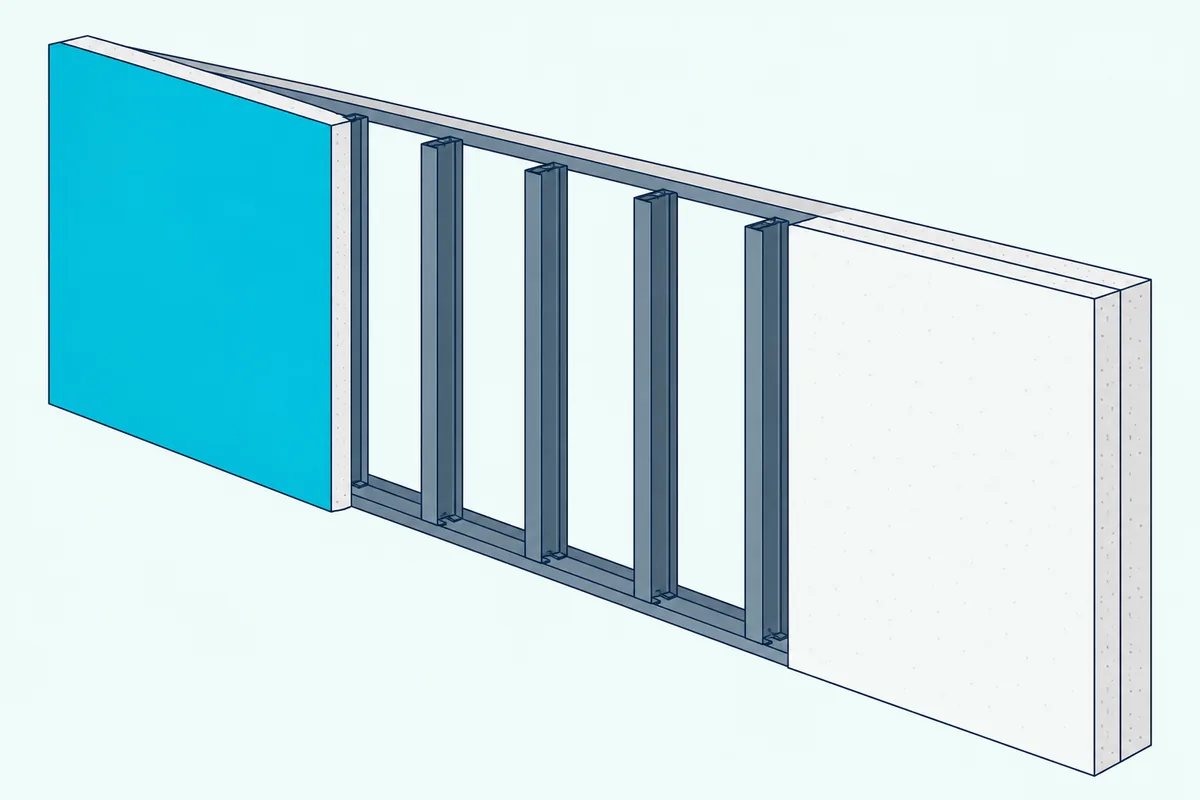
In the Coat of Silence test, the coating took one drywall face from 2.25 to 2.43 pounds per square foot, an 8 percent gain. By that same mass law, 8 percent more weight is worth well under 1 dB, so the paint was never going to act like a second layer of drywall.
Paint can’t plug the other routes either. NRC Canada lists holes, fissures and flanking paths around a wall as ways sound travels between rooms, and ASTM’s E413 rating standard warns that a wall built in a real building can rate lower than the same wall in a lab.
So the steps to soundproof a shared wall start with mass and airtightness, not with the finish coat.
Where Does Soundproof Paint Actually Work?
That mass math doesn’t make every coating useless, though, and three jobs suit one. The first is the high-pitched weak spot of a drywall wall, where Coat of Silence made its biggest gains.
The bare test wall dropped from 49.6 dB at 1,600 Hz to 38.1 dB at 2,500 Hz, right where NRC Canada’s coincidence formula puts the weak spot of 5/8-inch drywall, at about 2,450 Hz. Its digest says energy losses inside a material make that dip shallower, which fits a rubbery coating acting as a damper rather than as mass.
The second job is thin metal, where “sound deadening” coatings are a real category. ASTM E756 measures damping materials on a vibrating metal beam, for controlling vibration and the sound a structure radiates at resonance (ASTM).
If a drumming roof is the problem, Burton Acoustix’s metal roof guide covers the layers that matter more than a coating.
The third job is porous concrete block, where sealing pays off. In a 1995 NRC Canada paper, Warnock found that sound passes through the pores of porous block and that gains of 5 to 10 STC points after sealing are not uncommon (Warnock, 1995).
Blocks that resist airflow showed no gain from sealing in his data, and he recommends plaster or coats of block sealer when a block’s porosity is unknown.
Can Paint Make a Room Less Echoey?
Echo inside a room is a separate problem from noise through a wall, and paint doesn’t fix it either. NRC Canada draws the line: sound-absorbing materials are generally porous and let sound pass into them, while good sound-blocking materials are usually non-porous reflectors.
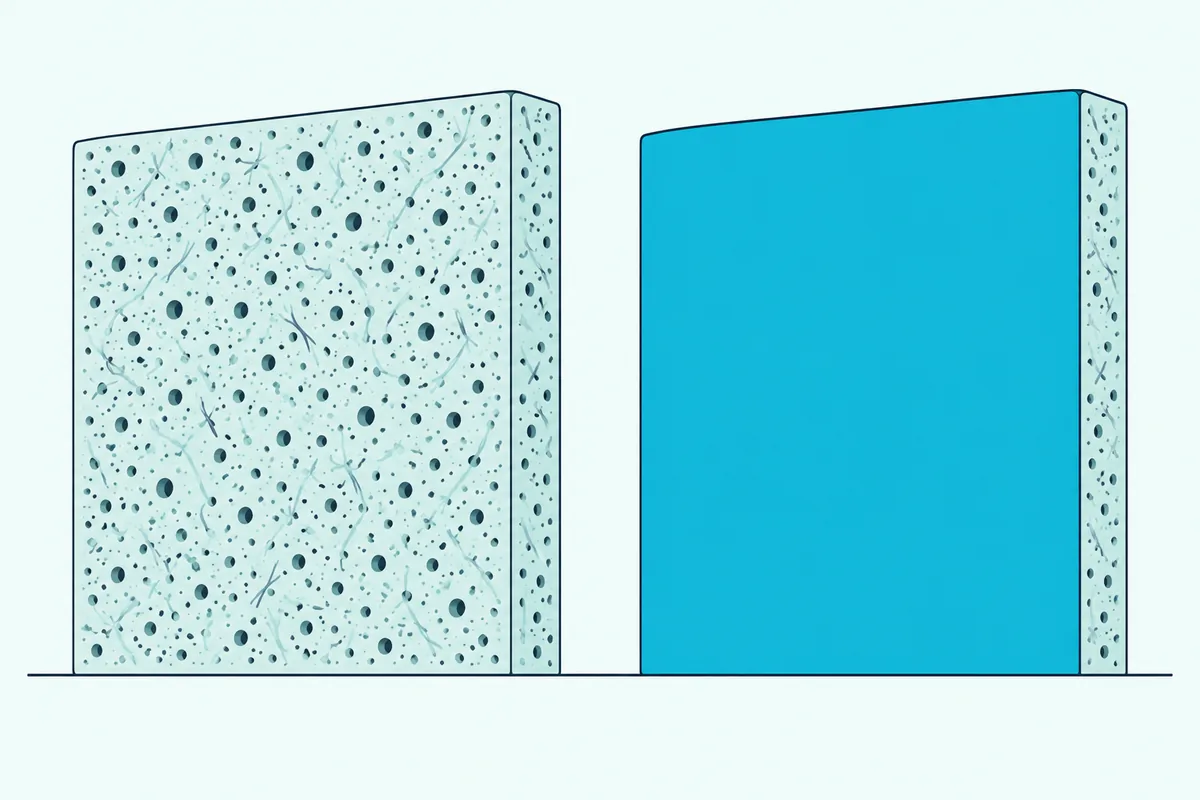
A 2026 University of Rzeszow lab study, published in Advances in Science and Technology Research Journal, found that paint layers smoothed polystyrene foam samples, partially closed their open pores and slightly lowered their peak sound absorption.
Even acoustic paint made for treated rooms works by getting out of the way. Acoustical Surfaces sells SonoKote as an acoustically transparent paint that lets sound pass to the absorbent material behind it, and our guide to painting acoustic panels shows what ordinary paint does to them.
What Works Better Than Soundproof Paint?
Those three niches aside, a shared wall needs changes to its mass, its gaps and the link between its faces. NRC Canada sums up good sound control as resilient supports, sound-absorbing material and leak-free barriers.
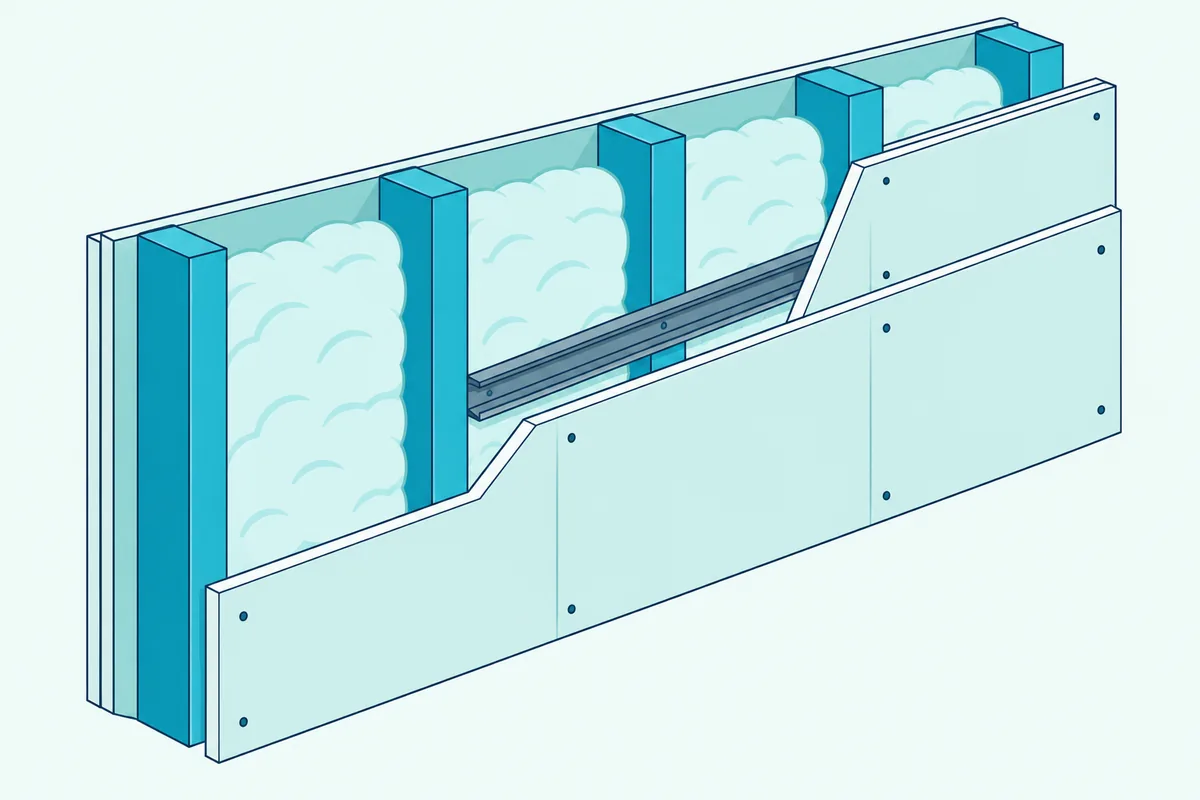
Its digest on transmission loss puts numbers on a wall like the paint test’s, with steel studs and one layer of drywall per side. That wall rates STC 39 empty, 45 with sound-absorbing insulation in the cavity and 56 with two layers per side plus insulation.
Ordinary wood studs behave differently, because drywall attached straight to both sides lets sound cross through the studs. NRC Canada rates that common wall at about STC 33 and says insulation adds only about 3 points there.
That’s why the upgrades worth paying for decouple the faces with resilient channels or staggered studs, add board, or damp two layers together with a compound such as Green Glue between two layers of drywall. On a renter’s budget, sealing the gaps comes first, and this cheap-fix checklist puts those small jobs in order.
Soundproof wallpaper is a separate question, but it’s another thin layer facing the same mass law. By that law, a 6 mm felt wallpaper adds under 1 dB of blocking to 5/8-inch drywall, as our answer to does soundproof wallpaper work works out.
The Bottom Line
Soundproof paint does what a thick coat can: in the lab test its seller posts, it added 2 or 3 STC points, mostly at high pitches, to a bare steel-stud wall.
Use a damping coating on ringing sheet metal and a sealer on porous block, and put the real money into insulation, extra drywall, decoupling and sealed gaps when a neighbor is the problem.
Frequently Asked Questions
Is there a paint that blocks sound?
Not the way a wall upgrade does. The best before-and-after result found for this guide is Coat of Silence’s: 28 mils on a bare steel-stud wall moved it from STC 39 to 41 with one side coated and 42 with both, tested to ASTM E90. A second layer of 5/8-inch drywall roughly doubles a face’s weight, which NRC Canada’s mass law ties to about 6 dB for a single layer.
Does soundproof paint work on a ceiling?
The same mass math applies overhead, so a coat adds little to how well a ceiling blocks voices or TV sound. Footsteps are a separate problem: labs rate impact noise with a standardized tapping machine and a separate number, the impact insulation class (IIC), and the paint test in this guide measured airborne sound only.
Does sound-deadening paint work on cars?
Car sprays such as Design Engineering’s Boom Mat Spray-On are sold to deaden vibration and road noise in door panels, fender wells and other body panels. Damping materials like these are measured on a vibrating metal beam under ASTM E756, which reports a loss factor rather than an STC rating, so a car coating’s numbers tell you nothing about a wall.
What is the cheapest way to reduce noise through walls?
Start with leaks. NRC Canada notes that holes, fissures and similar defects give sound a path between rooms, so seal gaps such as those around outlets and doors before buying any coating. After that, insulation in an open cavity or another layer of drywall adds the mass and absorption that paint can’t.